
Brand management isn’t just about a logo or a catchy tagline; it’s about keeping the story of the brand straight, day in and day out. It’s the messy, ongoing work of making sure customers see, hear, and feel the same thing every time they interact with a company. Done well, it builds trust, recognition, and even loyalty that sticks through ups and downs. It touches everything from pricing and marketing campaigns to employee behavior and customer experience. In today’s noisy, multi-channel world, understanding what brand management is isn’t optional; it’s what keeps a brand from drifting, losing relevance, or confusing the very people it hopes to reach.
Table of Contents
Introduction:
What Is Brand Management and Why Does It Matter Today
Brand management is one of those things people think they understand, until they actually have to do it.
On paper, it sounds clean. In reality, it’s messy, ongoing, and easy to get wrong. It’s not the logo. It’s not the font. Those are artifacts. Brand management is what holds everything together when the company grows, hires faster than expected, launches new products, or hits a rough patch.
Most customers don’t consciously analyze brands. They absorb them. A tone here, a delay there, a confusing message, a surprisingly good support interaction. Over time, those moments stack up and turn into a belief. That belief decides whether someone trusts the brand, recommends it, or quietly moves on.
What’s changed is the environment brands operate in. Nothing lives in isolation anymore. A brand shows up on social media, on a website, inside a product, in emails, and in sales conversations. Often all at once. The cracks show faster now. Inconsistency doesn’t just confuse people; it makes them uneasy.
Strong brand management creates steadiness. Not perfection. Steadiness.
It shapes how credible the brand feels.
How much value people assign to what’s being sold.
And how forgiving they are when mistakes happen.
Brands that manage this well don’t constantly explain themselves. They don’t chase every trend either. They feel familiar. Safe, even. And that’s what keeps people coming back.
This piece breaks down what brand management really means, how it works in practice, and why it matters long after the first wave of attention fades.
What Is Brand Management? (Definition & Meaning)
Brand management is the discipline of making sure a brand means something specific and continues to mean that same thing over time.
It’s not about control in a rigid sense. It’s about direction. Setting guardrails so that as more people touch the brand, employees, partners, agencies, and customers, the story doesn’t drift.
At its core, brand management is about alignment. When what a company says lines up with what it does, people notice. When it doesn’t, they notice that too. Usually faster.
A few distinctions matter here.
Brand identity is the visible layer. The logos, colors, typography, and visual rules. Important, yes. But identity alone doesn’t create trust. Brand management is what ensures those elements aren’t used randomly or rewritten every time someone new joins the team.
Branding is often treated like an event. A launch. A refresh. A moment. Brand management is what happens after the excitement wears off. It’s the unglamorous work of keeping things consistent when no one is applauding.
Marketing and brand management get lumped together a lot, and that’s where confusion starts. Marketing is about execution: campaigns, reach, promotion. Brand management is about meaning. It asks harder, slower questions. What does this brand stand for? What should it never do? What happens when short-term gains conflict with long-term trust?
When those questions aren’t answered, brands become reactive. They still grow sometimes, but unevenly. When they are answered, the brand starts to feel intentional. Grounded. Harder to shake.
How Brand Management Works (Step-by-Step Process)
In practice, brand management doesn’t unfold in tidy steps. It evolves. Still, certain patterns show up again and again.
It usually starts with clarity. Not slogans; clarity. Who the brand is for. What problem it truly solve? What it refuses to be. Without this, teams improvise. That’s where mixed signals come from.
Once that foundation is set, brand management becomes less about creation and more about decision-making. How teams write. How do they design? How they respond publicly. Even though they say no.
Internally, brand management lives in small, everyday choices. Externally, it shows up as consistency. Same tone. Same level of care. Same point of view, whether someone is seeing an ad or asking for help.
There’s also a split most people don’t talk about enough. Internal brand management shapes culture. External brand management shapes perception. If those two don’t match, customers feel it immediately. A brand can’t sound confident outside and confused inside for long.
Consistency is the quiet hero here. Not repetition for its own sake, but coherence. When everything feels like it came from the same place. When nothing feels accidental.
As companies grow, the work shifts. Early on, it’s about figuring things out. Later, it’s about protecting what already works while still allowing the brand to evolve. That balance is uncomfortable. Too rigid, and the brand feels stale. Too loose, and it loses its shape.
When brand management is done right, it doesn’t draw attention to itself. It just makes everything else work better. When it’s ignored, problems show up slowly; then all at once.
Core Components of Brand Management
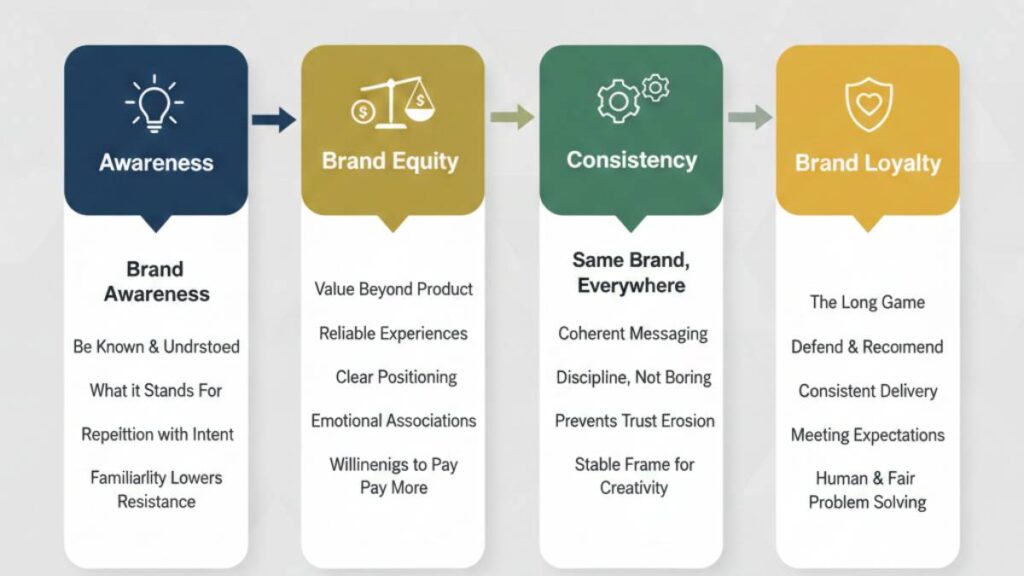
Brand management tends to fall apart when it’s treated as one big, abstract idea. In practice, it’s built on a few core components that work together. Miss one, and the rest wobble.
Brand Awareness
Brand awareness is simply about being known, but not just recognized. Plenty of brands are recognizable and still forgettable. Real awareness means people know what the brand stands for, not just what it sells.
Strong brand management builds awareness through repetition with intent. Same message, same personality, same promise, showing up again and again across different places. Over time, the brand starts to feel familiar. And familiarity lowers resistance. People are more willing to click, try, or trust something they’ve seen consistently.
High-awareness brands didn’t get there by accident. They made deliberate choices about how they show up and stuck to them long enough for those choices to register.
Brand Equity
Brand equity is where things get interesting. It’s the value people assign to a brand beyond the product itself. Two products can do the same job, but one feels worth more. That difference lives in brand equity.
Brand management builds equity slowly, through:
- reliable experiences
- clear positioning
- emotional associations that feel earned, not forced
When people associate a brand with quality, confidence, or even a certain lifestyle, they’re more forgiving. They’re also more willing to pay extra. That pricing power doesn’t come from features alone. It comes from perception reinforced over time.
Brands with strong equity don’t need to explain themselves constantly. The name carries weight on its own.
Brand Consistency
Consistency sounds boring. It isn’t. It’s discipline.
Brand consistency means the brand feels like the same brand wherever someone encounters it. Same tone. Same level of care. Same underlying point of view. Not identical messaging, but coherent messaging.
When consistency slips, trust erodes quietly. A polished website paired with sloppy communication. A bold ad paired with timid follow-through. People may not articulate what feels off, but they feel it.
Brand management exists to prevent that drift. Not to stifle creativity, but to give creativity a stable frame to work within.
Brand Loyalty
Brand loyalty is the long game. Recognition and equity get attention. Loyalty keeps the business alive.
Loyal customers don’t just buy again. They defend the brand. They recommend it without being asked. They stick around when alternatives pop up.
That kind of loyalty isn’t built through clever campaigns. It’s built through consistent delivery. Meeting expectations. Sometimes exceeding them. And handling problems in a way that feels human and fair.
Brand management plays a quiet but critical role here. It ensures the experience matches the promise; every time. When that alignment holds, loyalty follows.
Why Brand Management Is Important for Businesses
Brand management isn’t a “nice to have” once a company gets big. It’s foundational. Especially for growth.
As businesses scale, complexity creeps in. More people. More channels. More decisions are being made without founders in the room. Brand management creates a shared reference point so those decisions don’t pull the brand in different directions.
It’s also a trust engine. Customers don’t just evaluate products; they evaluate risk. A well-managed brand feels safer. More predictable. Easier to commit to. That trust shortens buying cycles and increases repeat behavior.
From a competitive standpoint, brand management is often the real differentiator. Features get copied. Pricing gets matched. But brands that stand for something clear are harder to replace. They occupy mental space that competitors struggle to enter.
The financial impact shows up in subtle but powerful ways:
- stronger retention
- Higher customer lifetime value
- less sensitivity to price changes
During market downturns, this matters even more. Customers pull back, but they don’t pull back evenly. They stick with brands they trust. Brands that feel familiar. Brands that haven’t surprised them in the wrong ways.
In short, brand management turns short-term attention into long-term advantage. It doesn’t guarantee success, but without it, growth is fragile. And fragile growth rarely lasts.

Apply Now: Digital Marketing Course
Benefits of Effective Brand Management
The payoff from brand management is rarely dramatic at first. It creeps in. Then it sticks. That’s why some teams ignore it until something breaks.
The most visible benefit is recognition, but not the shallow kind. This is a recall. The kind where a brand comes to mind without effort. When that happens, the buying journey gets shorter. People don’t stop to compare every option or re-evaluate basics. The brand already feels familiar. Comfortable, even.
Over time, that familiarity turns into longer relationships. Customers stay. They try new things from the same brand. They don’t disappear after one rough patch because they understand what the brand is about. That’s where customer lifetime value grows, not through aggressive tactics, but through consistency.
Pricing works differently, too. Well-managed brands don’t need to explain or justify their price every time. They’re not the cheapest, and they don’t try to be. The value feels baked in. People pay more because the brand feels dependable, intentional, and worth the trade-off.
Trust plays a big role here, even if it’s hard to put on a dashboard. A brand that shows up the same way, again and again, feels credible. The claims sound more believable. New launches get more grace. That trust often spills beyond customers, into partnerships, press, and hiring. People want to associate with brands that seem steady.
Inside the company, the benefits are quieter but just as real. Clear brand management removes friction. Teams waste less time debating tone or direction. Decisions move faster because there’s a shared understanding of what fits and what doesn’t. Fewer rewrites. Fewer mixed signals.
And then there’s risk. Strong brand management reduces it. Outdated logos don’t keep resurfacing. Messages don’t contradict each other. The brand doesn’t slowly drift into something unrecognizable. In crowded markets, that protection matters more than most realize, until it’s gone.
Brand Management Strategy: How to Build and Manage a Strong Brand
A solid brand strategy isn’t about looking good. It’s about choosing and then sticking with those choices.
Everything starts with foundations: mission, vision, values, positioning. These aren’t filler statements. They’re decision tools. They help answer tough questions: what to say no to, where not to play, how to respond when pressure hits. Without them, brand management becomes reactive. Loud voices win. Trends take over.
Audience clarity is another pressure point. Broad appeal sounds nice, but it weakens brands fast. The strongest brands know exactly who they’re for. And, just as important, who they’re not trying to impress. That focus sharpens everything else.
Then comes the brand promise. This is the expectation being set, whether it’s written down or not. Every interaction either reinforces that promise or quietly erodes it. There’s no neutral ground here.
Voice and messaging give the brand its personality. Not cleverness for its own sake; consistency. The same tone when things are going well and when they aren’t. The same point of view across formats and moments. Emotion works when it’s earned. When it’s forced, people notice. Quickly.
Guidelines are where strategy becomes practical. They spell out how the brand behaves visually and verbally. What’s allowed. What’s off-limits. Good guidelines don’t kill creativity. They prevent confusion. Governance matters too. Without clear ownership and approvals, brands fracture as they grow.
As the brand scales, structure becomes unavoidable. Assets multiply. Teams expand. Without centralized access and clear control, things slip. Old versions get reused. Messages drift. Even strong brands can unravel this way.
A smart brand strategy leaves room to evolve. Markets change. Audiences shift. But the core stays intact. Five years in, the brand should feel familiar; not frozen, not lost.
Brand Management vs Marketing: Key Differences Explained
Brand management and marketing get lumped together all the time. That’s understandable. They’re connected. But they solve different problems.
Marketing focuses on action. Campaigns, channels, launches, performance. It’s about getting attention and driving results now. Brand management is slower and broader. It’s about meaning, perception, and direction over time.
Think of it this way: brand management decides what the brand stands for. Marketing decides how to express that in the market. When those roles blur, things get messy. Campaigns feel disconnected. Messages change tone too often. Short-term wins start to chip away at long-term trust.
The focus differs, too. Marketing looks outward: at audiences, competitors, and timing. Brand management looks both outward and inward. It cares about how the brand is experienced externally and how it’s understood internally. A brand that says one thing publicly and behaves differently internally doesn’t hold up for long.
In early-stage companies, marketing often leads out of necessity. Visibility matters. Growth matters. Over time, brand management steps in to protect what’s working. It brings structure and coherence to the noise.
The healthiest organizations don’t pit the two against each other. They connect them. Brand management sets the direction. Marketing builds momentum in that direction. One without the other falls short.
When they work together properly, the brand stops feeling like a series of disconnected campaigns. It starts to feel like a presence. Something people recognize, remember, and trust, without having to think too hard about why.
Real-Life Brand Management Examples
Strong brand management is easiest to understand when looking at brands that have stayed recognizable for decades, even as markets shifted around them.
Coca-Cola is a classic case. The product hasn’t changed much, but the brand has been carefully managed to stay emotionally relevant. The messaging consistently ties back to shared moments, familiarity, and optimism. Campaigns change. The feeling doesn’t. That’s brand management doing its job; protecting the core while letting the expression evolve.
Nike approaches it differently. The brand isn’t about shoes. It’s about identity, effort, and self-belief. Everything, from athlete partnerships to product launches, reinforces that idea. The brand voice is confident, sometimes confrontational, but always aligned. Nike doesn’t chase everyone. It speaks clearly to people who see sport as part of who they are.
Apple’s brand management is built on restraint. Fewer messages. Fewer words. A tight focus on design, simplicity, and premium experience. That consistency allows Apple to charge more without constantly explaining why. The brand has trained its audience to expect a certain level of quality and polish, and it rarely breaks that expectation.
Disney shows how emotional consistency works at scale. Across movies, parks, merchandise, and digital experiences, the brand promise remains intact: magic, storytelling, and family connection. Different audiences, same emotional core. That doesn’t happen without serious brand governance behind the scenes.
For multi-brand companies like Procter & Gamble, brand management looks different again. Each brand has its own identity, tone, and audience, but they’re managed within a broader portfolio strategy. The challenge isn’t consistency across brands; it’s clarity within each one.
Ford offers a simpler contrast. The corporate brand sets trust and legacy, while individual vehicle lines carry their own positioning. Brand management here is about balance, not uniformity.
Role and Responsibilities of a Brand Manager
A brand manager’s job isn’t limited to logos or campaigns. It’s about stewardship.
At a practical level, brand managers oversee both tangible and intangible elements. Tangible things are easier to spot: visual identity, messaging frameworks, guidelines. The intangible side is where the real work happens. Perception. Emotion. Expectation. What people feel when they interact with the brand.
Brand managers spend a lot of time asking uncomfortable questions. Does this align with who we say we are? Does this reinforce the brand promise or dilute it? Are short-term gains undermining long-term trust?
They also act as translators. Strategy has to make sense to designers, marketers, product teams, and leadership. When brand intent gets lost in execution, it’s usually because this translation failed.
Measurement is part of the role, but it’s not always straightforward. Brand performance shows up in sentiment, consistency, preference, and resilience; not just immediate revenue. Brand managers look for patterns over time, not spikes.
The skill set is broad. Strategic thinking. Judgment. Communication. The ability to say no without blocking progress. And the patience to protect something that doesn’t always show immediate returns.
Good brand managers don’t chase attention. They protect meaning.
Brand Assets That Require Ongoing Brand Management
Brands live through their assets, and those assets age faster than most teams expect.
Visual identity assets come first: logos, colors, typography. These need active oversight, not just initial design. Without management, outdated versions creep back in. Slight variations multiply. The brand slowly loses coherence.
Brand guidelines are another critical asset. Not as a static document, but as a living reference. When guidelines are ignored or unclear, teams start improvising. That’s when inconsistency sets in.
Images, videos, and design assets need the same care. Visuals carry tone just as much as words do. Mismatched styles or low-quality assets can quietly undermine a brand’s credibility.
Social media adds another layer. Profiles, bios, highlights, pinned content; all of these shape perception. Without ongoing brand management, these spaces drift quickly, especially as teams change.
Websites and digital touchpoints may be the most sensitive assets of all. They’re often the first real interaction someone has with a brand. Messaging, visuals, UX; everything here needs to feel aligned. A disconnect at this stage is hard to recover from.
Brand assets don’t manage themselves. Left alone, they fragment. Managed well, they reinforce each other, and the brand grows stronger without having to shout louder.
Brand Management in the Digital and AI Era
Brand management today happens in public, whether a company wants it to or not. Every channel, every comment, every half-finished update becomes part of the brand story. There’s no single “brand moment” anymore. There are hundreds of small ones, scattered across platforms, formats, and contexts.
Managing a brand across this kind of landscape is less about control and more about coherence. The website can’t sound like a different company from social. Ads can’t promise what the product experience doesn’t deliver. Marketplaces, support responses, even error messages; all of it counts.
As brands expand into more channels, the risk isn’t invisibility. It’s a distortion. The brand starts to blur at the edges. Messages get simplified too much. Tone shifts depending on who’s posting. Over time, the brand loses its shape.
Governance matters more than ever here. Not heavy-handed oversight, but clear guardrails. Who can speak for the brand? What’s acceptable improvisation? What crosses the line? Without shared answers, well-meaning teams pull the brand in different directions.
User-generated content adds another layer. Customers, creators, and communities now help shape brand perception. That can be powerful, but it can also dilute meaning if the brand doesn’t actively reinforce its core. Strong brands participate in these spaces without chasing every trend. They show up as themselves, even when the format changes.
In short, modern brand management isn’t about being everywhere. It’s about being recognizable wherever you show up.
Common Brand Management Challenges
Most brand management problems don’t start with bad ideas. They start with small compromises.
Inconsistent messaging across teams is one of the biggest issues. Sales says one thing. Marketing says another. The product tells a slightly different story again. None of it is wrong on its own, but together it creates confusion.
Asset misuse is another quiet problem. Old logos, outdated visuals, and off-brand presentations are floating around long after they should’ve been retired. It signals disorganization, even when the business itself is solid.
Scaling makes everything harder. What worked for a small, tight-knit team breaks once the brand goes global. Cultural differences, local adaptations, and speed pressures test consistency constantly. Without a clear brand center, local execution starts rewriting the brand instead of expressing it.
Rapid growth brings its own risks. When demand spikes, brands often cut corners to keep up. Messaging becomes rushed. Experience becomes uneven. Trust erodes faster than expected.
And then there’s the creative tension. Too much control, and the brand feels stiff. Too little, and it becomes unrecognizable. Finding that balance is ongoing work, not a one-time fix.
Best Practices for Effective Brand Management
Strong brand management starts inside the organization. If teams don’t understand or believe in the brand, customers won’t either. Internal buy-in isn’t about slogans on walls. It’s about clarity. People should know what the brand stands for and how that affects their decisions.
Centralizing brand assets and guidelines helps more than most teams realize. When everyone knows where to find the right materials, consistency becomes easier by default. Confusion usually fills the gaps left by missing structure.
Brand strategy shouldn’t be set once and forgotten. Markets shift. Audiences evolve. Reviewing and refreshing the strategy keeps the brand relevant without losing its identity. The key is adjustment, not reinvention.
Measuring brand health matters, even when it feels abstract. Pay attention to sentiment, consistency, preference, and trust; not just short-term performance. Patterns tell more than spikes.
Finally, leave room for evolution. The best-managed brands aren’t frozen in time. They change carefully. Thoughtfully. With intent. Consistency doesn’t mean repetition. It means continuity.
When brand management is done well, it fades into the background. The brand just feels right. Familiar. Trustworthy. And that’s usually the point.
Conclusion:
Brand management isn’t a to-do list you tick once and forget. It’s a mindset. A way of treating everything your brand touches as a chance to reinforce what it stands for. Companies that get this right? They’re not just visually consistent. They’re trusted. They feel dependable. And that makes people remember them.
It shows in tiny, everyday ways. A customer instinctively grabs your product off the shelf. A team knows what to say without overthinking. Partners trust that you’ll deliver. These small wins pile up. Over time, they create a brand that outperforms competitors; not because of flashy marketing, but because the brand feels coherent and real.
Good brand management does two things at once: it protects the brand, and it helps it grow. It gives the brand room to evolve while keeping its core intact. Every ad, post, email, and customer interaction becomes part of a consistent experience. It might feel subtle, but that subtlety is what makes a brand last.
FAQs: About Brand Management
What exactly is brand management?
It’s not about slapping a logo on everything or picking a color because it “looks nice.” Brand management is about how your business is seen, felt, and remembered. It’s the ongoing work of making sure your messages, customer experiences, and visuals all line up. People should recognize the brand, know what it stands for, and feel like they can trust it, even if they’ve only seen it a handful of times.
Why bother with brand management?
Without it, a brand drifts. Messages get muddled. Customers get confused. Loyalty fades. Competitors slip in under the radar. But with strong brand management, people know what your brand means: its tone, values, and promise. Decisions become easier for them, and the brand earns a subtle kind of authority in the market. It’s not flashy, but it works.
What’s the real goal?
Recognition is nice, but the real goal is to be remembered for the right reasons. A well-managed brand feels consistent, trustworthy, and relevant. That’s what nudges people to come back, explore new products, and stick around even if something goes slightly off. Over time, that familiarity turns into emotional attachment, and yes, sometimes people will pay a bit more just because the brand feels “right.”
How is it different from branding?
Branding is the setup: defining identity, designing logos, crafting messages. Brand management is the follow-through. It’s the day-to-day work of keeping all of that coherent and believable. Without management, branding fades quickly or becomes messy. The promises in your visuals and messages have to actually match reality; otherwise, people notice, and trust erodes.
Can small businesses pull this off?
Absolutely. Even a corner café or a small online shop can manage a brand. It doesn’t require huge budgets. It’s more about showing up consistently: signage, social posts, customer interactions, and packaging. When people see the same tone, same feel, same promise over time, it builds credibility. And credibility sticks.