
How to Use AI in Performance Marketing Campaigns is no longer a theoretical question. It’s a practical one that shows up the moment campaigns start to scale and manual optimisation hits its limits. This guide breaks down how AI fits into real performance marketing workflows, from targeting and creative decisions to bidding, budgeting, and conversion optimisation.
It covers where AI genuinely adds leverage, where it needs guardrails, and how experienced marketers use it to reduce waste without losing strategic control. Rather than chasing trends, the focus stays on outcomes: clearer decisions, faster learning cycles, and stronger ROI. If the goal is to use AI with intent, not blindly, this guide lays out what actually matters and how to apply it step by step.
Table of Contents
Introduction
Performance marketing is simple to explain but tricky to pull off. It’s not about just running ads and hoping for clicks. Every campaign has to deliver something measurable: sales, leads, app installs, sign-ups, whatever the goal. One wasted click, one misdirected dollar, and it all adds up.
Things change fast in this space. Audiences get picky. Platforms tweak rules constantly. Yesterday’s “trick” can flop tomorrow. That’s why marketers need tools that help spot patterns and optimize campaigns without having to sit staring at endless dashboards.
Some things that actually make a difference:
- Figure out where campaigns are leaking money, fast.
- Reach the people who actually care, not just anyone scrolling by.
- Test, tweak, repeat; but quickly, because speed matters.
This guide isn’t a magic fix. It’s more like a map to the spots where effort actually counts. It’ll cover strategy, targeting, optimization, and measurement; all the areas that move the needle in a real campaign.
Understanding AI in Digital Marketing
AI in marketing gets hyped a lot. People talk like it’s magic. The truth? It’s mostly about making sense of data and automating repetitive stuff so humans can focus on the decisions that really matter. Nothing perfect, nothing flawless; just smarter tools.
Here’s a clearer picture:
Machine Learning: Looks at what worked before and guesses what might work next. Not foolproof, but better than winging it.
Predictive Analytics: Uses past data to estimate outcomes; who’s likely to convert, how much to spend, and when engagement might spike.
Natural Language Processing (NLP): Helps understand messaging and sentiment. Can highlight if your copy actually lands with an audience or falls flat.
Why bother with it? Traditional marketing tools are mostly reactive. You run a campaign, see what happened, then adjust. AI gives a bit of foresight. It surfaces trends before they become expensive mistakes.
Some tangible wins marketers see:
- Faster insights; no more digging through endless spreadsheets.
- Smarter targeting; fewer wasted impressions.
- Budgets stretch further because campaigns adjust in real time.
- Campaigns gradually get better over time, learning from past outcomes.
Bottom line: AI doesn’t replace marketing skills. It’s a helper that takes the grunt work off your plate and highlights the things that actually matter.
Core Areas Where AI Impacts Performance Marketing
AI can touch almost everything in a campaign, but some areas really make a difference. Knowing where to focus can be the difference between just okay campaigns and campaigns that actually perform.
Ad Targeting and Audience Segmentation:
Forget simple splits by age or location. AI spots behavior patterns; who’s likely to click, who might convert, who will just bounce. Tiny changes here can have big results.
Customer Insights and Behavioral Analysis:
Ever notice some people respond to ads differently? AI can dig into behavior; what people engage with, when, and how often; and uncover patterns that aren’t obvious.
Predictive Analytics for Campaign Forecasting:
Instead of waiting to see how a campaign performs, AI can estimate results ahead of time. Helps plan budgets, timing, and which channels to prioritize.
Real-Time Bidding and Ad Spend Optimization:
Especially in competitive channels, timing matters. AI adjusts bids faster than humans could, cutting wasted spend and improving placement.
Automated Personalization and Dynamic Creatives:
Serving the right ad to the right person at the right time is hard manually. AI can swap messaging, images, or offers depending on the audience. Small, subtle tweaks, but they can really move the needle.
The key idea: AI doesn’t replace thinking. It lets campaigns act faster, more precisely, and with fewer mistakes. It frees up marketers to focus on strategy and creative decisions rather than the tedious stuff.
How to Use AI in Performance Marketing Campaigns
1. AI for Campaign Strategy
Campaign strategy isn’t just picking a channel and throwing money at it. The tricky part is figuring out where effort actually pays off. Some channels will surprise you, performing way better than expected; others flop even if they seem obvious.
AI can help highlight patterns. Maybe a segment that wasn’t obvious converts better. Maybe a certain time of day is actually better than peak hours. It won’t make decisions for you, but it nudges you in the right direction.
A few practical points:
Check which channels are underperforming early, before they eat your budget.
Look for audience segments that consistently convert, and focus there.
Use it to guide budget allocation, but don’t blindly follow it. Human sense still matters.
It’s like having an assistant who notices things you might miss, but you’re still the one steering the ship.
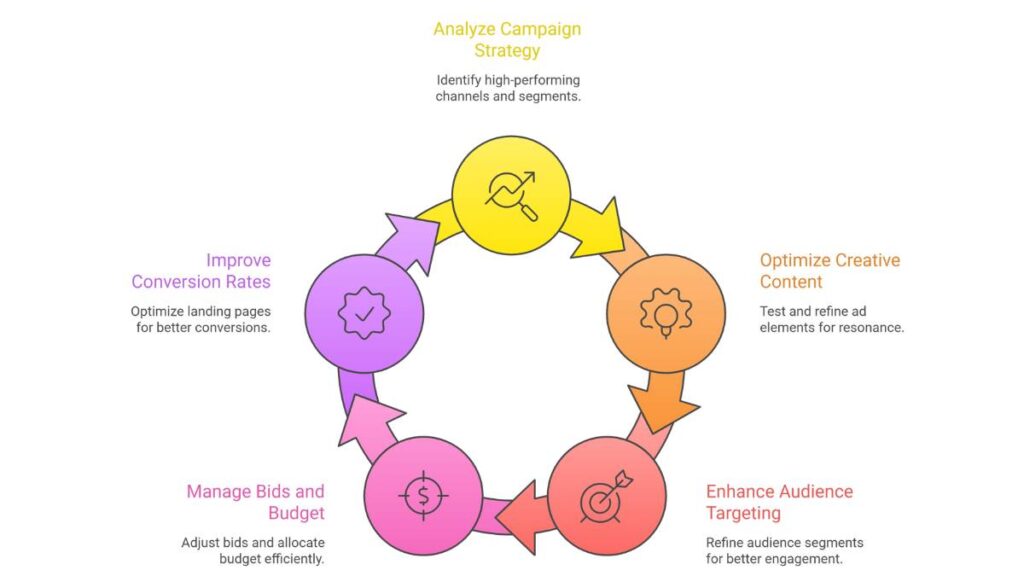
2. AI in Creative Optimization
Ads get stale fast. Even if something works, eventually people stop noticing. AI can spot which headlines, images, or copy variations actually resonate. It’s not perfect, but it speeds up the testing process a lot.
Some ways it helps:
- Try multiple ad versions quickly, without manually juggling dozens of files.
- Notice subtle trends in which messages click with different audiences.
- Identify combinations of visuals and text that tend to convert.
The key here: AI suggests possibilities. Humans decide tone, voice, and story. The best results come when both are in play.
3. AI for Audience Targeting
Finding the right audience is hard. Broad targeting wastes money. Too narrow, and you miss opportunities. AI can dig into behavior and engagement signals that aren’t obvious at first glance.
Ways it improves targeting:
- Create lookalike audiences based on your top customers.
- Adjust segments as behavior changes; automatically, not manually.
- Retarget users who are likely to convert instead of everyone who clicks.
The subtle difference is huge. Small shifts in targeting can boost conversions without spending more.
4. AI in Bid Management & Budget Allocation
Bidding and budgeting are where a lot of campaigns leak money. AI can adjust bids, suggest reallocations, and identify underperforming campaigns. But don’t assume it’s perfect. Context matters.
Practical uses:
- Adjust bids in real time for high-value impressions.
- Forecast where the budget is needed most.
- Pull back on campaigns that aren’t delivering.
It’s the heavy-lifting part you don’t have to watch every second. But it still needs a human check; numbers alone don’t tell the whole story.
5. AI in Conversion Rate Optimization (CRO)
Even the best ad can flop if the landing page is confusing or slow. AI can help flag friction points and suggest what might work better.
How to use it:
- Spot which pages or forms convert better.
- Run multiple page variations quickly to see what sticks.
- Personalize content for different audience segments.
It’s not about blindly following suggestions. Think of it as guidance; small insights that make testing smarter, faster, and less guesswork-heavy.
AI Tools & Platforms for Performance Marketing
Tools can be tricky. There are a million options, and most of them promise the world. Honestly, a lot of marketers end up buying things they never really use. The real question is: does it actually make your life easier, or just look nice on a demo?
Some platforms help manage campaigns, adjusting bids, and moving budgets around. It’s handy. Saves time. But they won’t know your audience as you do, won’t get the context. They give suggestions. Humans decide whether to follow them or ignore them.
Then there are tools for analyzing performance. They pull together data from different campaigns, sometimes spotting patterns you wouldn’t notice otherwise. Again, helpful, but numbers alone don’t tell the story. Trends need context, and context comes from experience.
Creatives are another area. Ads fatigue fast. Testing a handful of variations manually is a headache. Tools make that easier. But at the end of the day, the final say on tone, style, and messaging? Humans decide that. AI might highlight possibilities, but it doesn’t have taste.
The key is picking tools that actually solve problems. If it doesn’t improve your workflow or campaign results, it’s just clutter. Integration matters too. If it doesn’t play well with what you already use, it’s more pain than it’s worth.

Apply Now: AI-Powered Performance Marketing Course
Measuring Success: KPIs for AI-Driven Performance Marketing
Numbers are messy. It’s easy to look at clicks or impressions and feel like you’re winning. But those don’t always mean much. The real question is: is this driving the result you care about? Sales, leads, signups; whatever the goal is.
Conversion rate is obvious. But that alone doesn’t tell the whole story. Return on ad spend matters more. You want to know if the money you’re spending is actually bringing in revenue. And cost per acquisition keeps you honest; it shows if you’re overspending for results that don’t scale.
AI can help spot patterns faster, flag anomalies, and make dashboards easier to read. But don’t let it tell you the whole story. One spike in a day? Could be noise. One drop? Maybe just a quirk. Look at trends. Compared to past campaigns. And always think about the context.
The real skill comes from interpreting numbers, not just collecting them. AI can crunch the data, but humans figure out what it actually means and what to do next.
Challenges & Best Practices in Using AI for Marketing
AI isn’t magic. It’s good at spotting patterns and automating repetitive stuff, sure, but there are pitfalls. Over-reliance is one. Just because the system suggests a move doesn’t mean it’s right. Human judgment is still the final filter.
Data quality is another hidden trap. Garbage in, garbage out. If your tracking is off, if segments are missing, if the data’s incomplete, the AI will spit out “insights” that are misleading. That’s why the human eye matters.
Balance is critical. Let AI do the heavy lifting: reporting, bid adjustments, testing variations; but strategy, context, and judgment? That’s human territory. Audiences shift, campaigns evolve, and without oversight, automation can waste money instead of saving it.
A practical approach is to start small. Test a piece of the campaign, see what the AI highlights, and compare it to what humans notice. Adjust gradually. Think of AI as a partner, not a replacement. It’s there to help you spot things faster, reduce guesswork, and make repetitive tasks easier. But it doesn’t replace thinking. Not ever.
Future of AI in Performance Marketing
The future isn’t about doing more with AI. It’s about needing to guess less.
Right now, most teams use automation to clean up busywork. Helpful, sure. But that’s surface-level. The real shift is quieter and more strategic.
A few things are already becoming obvious:
Creative will move faster, not smarter by default
More variations. More formats. More tests are running at once.
That doesn’t mean better ideas magically appear. It means teams learn sooner what isn’t working and move on without overthinking it.
Forecasting will matter more than reporting
Looking back at what happened is table stakes.
The edge comes from spotting what’s likely to break before it actually does: rising CPAs, shrinking audiences, creative fatigue creeping in. Those early signals are where decisions start to change.
Acquisition will be judged by what happens later
First conversions won’t be the finish line.
Retention, repeat behaviour, and actual revenue; those signals will shape who gets targeted and how aggressively. Some “cheap” users won’t look so attractive anymore.
Channels will stop being treated like silos
Paid ads won’t live in their own bubble forever.
What happens on site, in email, or inside a product will increasingly influence how campaigns are structured upstream. Slowly. Imperfectly. But it’s happening.
The teams that do well won’t be the ones chasing every new capability. They’ll be the ones who know when to trust automation, and when to pull it back.
Conclusion:
AI doesn’t fix a weak strategy. It tends to shine a light on it instead. When things are clear, it sharpens focus. Decisions stop feeling like educated guesses. Teams react less and stay steadier when pressure hits. But when direction is fuzzy, the same systems can move everything in the wrong direction, faster than expected.
The fundamentals still do the heavy lifting. Clear goals matter more than any layer of sophistication. Data quality shapes outcomes long before optimisation begins. And human judgment has to come before scale, not after. When those pieces are missing, speed becomes a liability rather than an advantage.
That speed is the real difference. Patterns surface sooner. Trends become visible earlier. Mistakes, though, also stack up quickly. That’s why restraint matters just as much as ambition. The strongest results usually come from starting small; one campaign, one lever, one question worth answering. Test it properly, learn what it’s telling you, then expand with intention.
AI on its own isn’t the edge. The edge comes from knowing what to ask of it, where to trust it, and where to step in and say, not yet.
FAQs: About AI in Performance Marketing Campaigns
1. What is AI in performance marketing campaigns?
It’s the use of data-driven systems to guide decisions around targeting, bidding, creative rotation, and measurement, especially where manual optimisation starts to break down.
2. How can AI improve ad targeting and audience segmentation?
By spotting patterns humans usually miss. Behavioural signals, timing shifts, intent changes. That leads to audiences that feel less generic and more responsive.
3. Which AI tools are best for campaign optimization?
Usually, the ones already built into the platforms being used. The real difference comes from setup, constraints, and interpretation, not from chasing new tools.
4. Can AI help reduce marketing spend?
Indirectly, yes. It cuts waste more often than it cuts budgets. Fewer bad bids. Fewer dead audiences. Fewer creatives running past their prime.
5. How does AI enhance conversion rate optimization (CRO)?
It helps prioritise what’s worth testing and personalising; instead of guessing where friction might be.
6. Is AI effective for small businesses or only large enterprises?
Smaller teams often benefit sooner. Automation fills gaps where time and resources are limited.
7. How do I integrate AI with existing marketing platforms?
Start with native features and reliable data connections. Complexity should come later, not first.
8. Are there risks of relying too much on AI in marketing?
Absolutely. Poor data, unclear goals, and blind trust can scale problems quickly. Oversight isn’t optional.
9. How do I measure the success of AI-driven campaigns?
Compare against meaningful baselines. Look for consistency, efficiency, and downstream impact; not just short-term spikes.
10. What are the future trends of AI in performance marketing?
More prediction, less reaction. More personalization that actually feels relevant. And more focus on long-term value instead of quick wins.