
How to Write a Strong Product Value Proposition isn’t about coming up with a catchy line and calling it a day. It’s about being clear on who your customer is, what problem they actually have, and how your product makes their life easier, or better. A strong product value proposition spells out the main benefit, highlights what makes your product different, and avoids vague phrases like “best” or “powerful.” It’s specific, to the point, and shows real-world value. When done right, it grabs attention, makes people understand why they should care, and nudges them toward action. Clarity and relevance beat cleverness every time.
Table of Contents
Introduction:
What Is a Product Value Proposition & Why It Drives Conversions
A product value proposition is basically what convinces someone to pay attention, or better yet, buy. It’s not just a tagline; it’s the reason a product exists in someone’s life. A good one tells people, without a lot of fluff, who it’s for, what problem it solves, and why it’s worth their time.
Why does it matter so much? Well, for one, it makes conversion rates better. People don’t like guessing what a product does; they like a clear answer. Also, a strong proposition helps check if the product actually fits the market. If the messaging makes sense to real people, chances are the product does too. And, honestly, it can save money. Marketing spend goes down when people instantly understand why the product matters.
It’s a lot more than words on a page. Think of it like the spine of your messaging: everything else, emails, ads, landing pages, leans on it.
What Is a Product Value Proposition?
Here’s the deal: a product value proposition (PVP) is a short statement about the value a product delivers, plain and simple. It’s not a list of features. It’s not a clever tagline. It’s about results.
Simple one-liner: A PVP tells a specific audience what benefit they get and why this product is better than the alternatives.
Value vs features: Features are what a product does. Value is what it means to the user. People don’t buy software; they buy more free time. They don’t buy a blender; they buy smoothies that save them from making a mess every morning.
Also, don’t confuse this with similar things:
USP: Shows what makes you different. Not always the same as value.
Positioning statement: Mostly for internal clarity.
Brand promise: About perception over time, not immediate benefit.
Marketing slogan: Nice to say, but rarely a full PVP.
Mix these up, and suddenly the message gets muddy. And muddy messages? People ignore them.
Why Most Product Value Propositions Fail
Even smart folks get tripped up. Here’s where things usually go sideways:
Too feature-heavy, benefit-light: A list of features doesn’t tell someone why they should care. It’s like showing the engine of a car to someone who just wants to get somewhere.
Vague buzzwords: “Easy,” “powerful,” “best”; all sound fine, but they don’t prove anything.
No clear audience: Saying “for everyone” usually ends up meaning “for no one.”
No measurable or emotional outcome: If someone can’t picture how their life changes, they skim and move on.
Company-focused copy: Talking about the brand or product instead of the user’s problem is a fast way to lose attention.
Basically, the message has to land where it matters; in the customer’s head, not the company’s ego.
Core Elements of a Strong Product Value Proposition
A solid value proposition isn’t random. There are a few pieces that have to fit together:
- Target customer segment: Be specific. “Small business owners” is okay. “Freelance candle makers selling online” is much better.
- Core problem or pain point: Functional problems are obvious, but emotional struggles matter too; stress, uncertainty, wasted time.
- Primary benefit or outcome: What actually changes for the user? Saved time, better results, fewer headaches.
- Key differentiator: Why this product, not the other guy’s? Could be speed, price, simplicity, experience; anything that matters.
Here’s how it breaks down naturally:
- Who it’s for: Nail down the audience. Specific beats broad every time.
- What problem does it solve: Don’t just hint; state it in real terms.
- Why it’s better than alternatives: Shows a clear angle that competitors don’t have.
- What outcome the user gets: People care about results more than the tool itself.
When all four are in place, the value proposition clicks. People get it quickly. And that’s when your messaging starts working; everywhere.
How to Write a Strong Product Value Proposition (Step-by-Step)
Writing a value proposition isn’t complicated, but it does need a bit of thought. Most people mess it up by either being too vague or too focused on features. The goal here is simple: make someone read it and immediately get why your product matters.
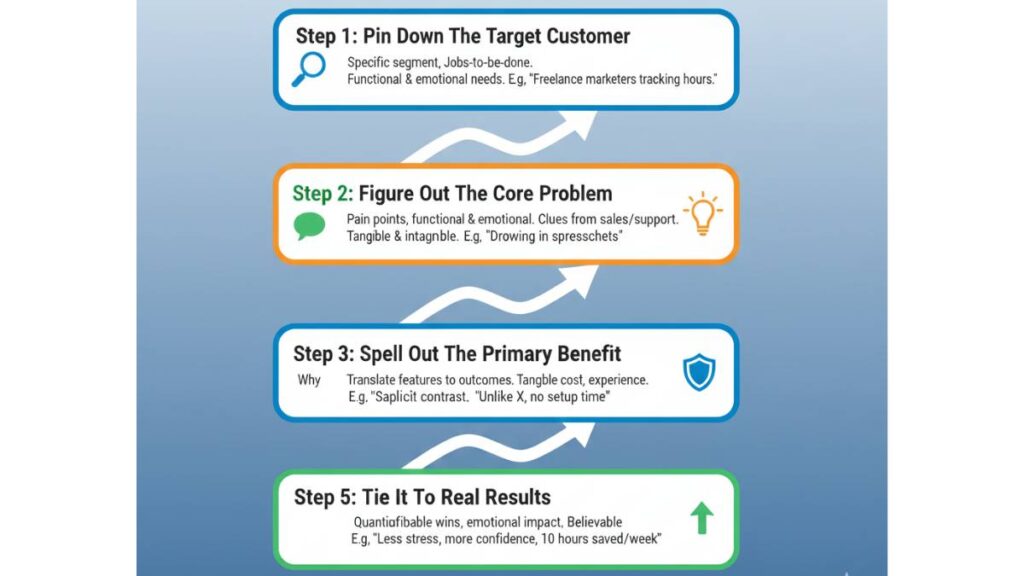
Step 1: Pin down the target customer
You can’t start without knowing who you’re talking to. Sounds obvious, right? But so many PVPs just say “for professionals” or “for businesses,” and that’s it. That’s too broad.
- Be specific. If it’s small business owners, great, but which ones? Freelance designers? Local bakeries? Pick a slice that makes sense.
- Jobs-to-be-done are helpful. What is this person trying to get done, really? Could be functional, like finishing a report faster. Or emotional, like not feeling stressed every Monday morning.
- Examples:
- Too vague: “For busy professionals.”
- Much better: “For freelance marketers juggling multiple clients who need to track hours without drowning in spreadsheets.”
Getting this right makes everything else easier: messaging, features, benefits.
Step 2: Figure out the core problem
Next, get really clear on the pain point. Don’t just list what your product does. Focus on what’s broken for the customer.
- Think functional and emotional. Functional could be slow reports, confusing dashboards, and clunky tools. Emotional might be stress, frustration, or feeling out of control. Both matter.
- Look for clues everywhere: sales calls, support tickets, customer reviews. Sometimes the complaint they’re repeating is your PVP gold.
- Keep it real. If a customer reads it and thinks, “Yes! That’s exactly my problem,” you’re on the right track.
Step 3: Spell out the primary benefit
Now that you know the pain, show the payoff. How does life get easier? How does this product change things?
- Translate features into outcomes. Not “this tool automates reports,” but “save hours every week by generating reports in seconds.”
- Mix tangible and intangible benefits. Tangible could be time or money saved. Intangible could be confidence, peace of mind, or freedom from stress. Both matter.
- Example:
- Weak: “Fast and reliable software.”
- Strong: “Generate reports in seconds and know your numbers are always accurate.”
Outcomes are what stick. Features are just the background.
Step 4: Show the differentiator
Why should someone pick this product and not the other options?
- Focus on what really matters. Could be speed, cost, accuracy, simplicity, or a better overall experience.
- Be explicit. Don’t just say “better than competitors”; show it. “Unlike X, our product doesn’t require hours of setup.”
- Make it matter to the customer. If it doesn’t solve a problem or give a real benefit, it’s fluff.
This is where most PVPs fail. Differentiation is what turns curiosity into interest.
Step 5: Tie it to real results
Finally, show what success looks like. People want to know: if I use this, what actually changes?
- Numbers are persuasive: hours saved, revenue gained, errors reduced. Concrete wins attention.
- Don’t forget the emotional side: less stress, more confidence, feeling in control. Often, this is what people remember more than numbers.
- Make it believable. If it’s abstract, people won’t care. If they can picture themselves benefiting, that’s the magic.
Do all five steps, and the value proposition isn’t just text; it’s a promise people understand and actually care about. Not a slogan, not a tagline. A real, human-centered reason to pay attention.

Product Value Proposition Formulas That Actually Work
Sometimes staring at a blank page feels impossible. Formulas aren’t magic, but they’re a shortcut. They help make sure the basics are covered: who, what, why, and how.
- Classic formula:
“For [target customer] who [problem], our product [solution] that [primary benefit], unlike [alternative].”
It sounds stiff when written down, but it works. Forces you to be clear about who it’s for, what’s broken, and why your product actually fixes it better than anyone else. - One-line formula:
Short, snappy, gets to the point. Great for ads, social posts, or anywhere space is tight. - Headline + subheadline:
Headline grabs attention, subheadline explains the audience, problem, and what sets the product apart. Landing pages and homepages love this approach.
Don’t get hung up on following it perfectly. Think of it as scaffolding. The words don’t have to be exact. The point is clarity.
Examples of Strong Product Value Propositions (With Breakdown)
Seeing examples makes it stick. Theory is nice, but real examples show how to structure it without making it sound like a pitch.
- SaaS example:
“For marketing teams juggling multiple campaigns, our platform automates reporting so you save hours each week, unlike other tools that require manual setup.”
Breakdown:
- Who: marketing teams
- Problem: too many campaigns, reporting takes forever
- Benefit: save hours, automate work
- Differentiator: no manual setup
- E-commerce example:
“For busy parents who want healthy meals fast, our meal kits deliver pre-portioned ingredients and easy recipes in 20 minutes, unlike grocery shopping that takes hours.”
Breakdown:
- Who: busy parents
- Problem: no time for meal prep
- Benefit: quick, healthy meals
- Differentiator: convenience
- B2B service example:
“For small businesses struggling with cash flow, our accounting service gives real-time insights and automated alerts, unlike traditional accounting that updates monthly.”
Breakdown:
- Who: small businesses
- Problem: cash flow uncertainty
- Benefit: real-time insights
- Differentiator: speed and automation
Quick contrast:
- Weak: “Our software is fast and reliable.” – vague, meaningless.
- Strong: “Save 80% of reporting time with our automated platform built for marketing teams.” – clear audience, clear problem, clear benefit.
Bottom line: Specific beats vague. Outcomes beat features. And if it’s believable, it sticks.
How to Test and Validate Your Product Value Proposition
Even a well-written PVP isn’t done until you see how real people respond. Testing is your reality check.
A/B testing headlines: Tiny changes can make a huge difference. Swap words, reorder sentences, test different angles.
Check landing page results: Clicks, sign-ups, purchases; whatever matters. If people ignore it, something isn’t landing.
Talk to customers: Ask the simple questions. “Does this solve your problem?” “Would you pay for this?” Straight answers beat assumptions every time.
Look for consistency: Ads, landing pages, emails, product pages; they all need to tell the same story. Mixed messages confuse people and dilute the impact.
Remember: It’s not just about data. It’s about whether the proposition makes sense, resonates, and actually convinces someone to act. If it does that, it’s working.
Where to Use Your Product Value Proposition for Maximum Impact
A value proposition doesn’t do much sitting in a doc somewhere. Placement is everything. If people don’t see it at the right time, it doesn’t matter how good it is.
Homepage hero section: This is prime real estate. People land and decide within seconds if they care. Make the PVP front and center. Don’t hide it behind paragraphs.
Landing pages: Every landing page should have its own tailored proposition. The visitor got there for a reason; speak directly to that.
Product pages: Remind people why this product matters. Features are fine, but outcomes are what stick.
Ads and emails: Even a single strong line can make someone click. Short, punchy, and clear wins.
Sales decks and pitches: Start with the problem and benefit before diving into details or numbers. Sets the stage and makes the audience lean in.
Placement isn’t just about visibility. It’s about context. Right message, right place, right time. That’s what actually drives action.
Optimizing Your Product Value Proposition for Maximum Clarity
A strong PVP isn’t about fancy words. It’s about being understood immediately. Clarity, consistency, and a little structure go a long way.
Keep definitions clear: Don’t assume your audience knows your lingo. Make it digestible.
Break it down: Bullets, short sentences, little diagrams; whatever helps people scan and understand quickly.
Consistency matters: Ads, emails, landing pages, product pages; all should tell the same story. Mixed messages confuse.
Show contrasts: Say what you do versus what you don’t do. Or versus competitors. Makes it tangible.
Placement of key phrases: Drop naturally in headings or sentences. Don’t stuff. Words like “strong product value proposition,” “value proposition examples,” or “value proposition framework” can fit in naturally.
Link thoughtfully: If someone wants more detail, make it easy to find without breaking the flow.
It’s not about sounding perfect. It’s about making the promise obvious, believable, and impossible to miss.
FAQs: About Writing a Product Value Proposition
1. What makes a product value proposition strong?
Clarity, specificity, real benefit, audience focus, and a differentiator that actually matters. And it helps if people can picture themselves getting that benefit.
2. How long should a value proposition be?
Short enough to get it at a glance, long enough to cover problem, solution, and benefit. One sentence can work. Sometimes a headline + subheadline is better.
3. Can a product have multiple value propositions?
Sure, but only for clearly different audiences or use cases. Don’t mix multiple promises for the same person; it gets fuzzy fast.
4. How often should it be updated?
When your product, audience, or market shifts. Not just because it feels old; update it when it improves clarity or relevance.
5. Is a value proposition the same as a tagline?
Nope. A tagline is catchy, sometimes clever, often vague. A value proposition explains clearly why someone should care, what problem you solve, and why you’re different.