
Getting Facebook ads to actually work isn’t just about throwing money at them. How to do audience research for Facebook advertising is really about figuring out who’s most likely to care, and then testing it. Start with the basics: demographics, interests, and behaviors. Layer in custom audiences, like website visitors or past customers, and maybe try lookalikes if there’s enough data. The tools can help, sure, but nothing beats watching results and tweaking as you go. Sometimes, the audience you think will click the most barely reacts, and a smaller, unexpected segment performs way better. Keep testing, keep adjusting, and use what the numbers tell you; nothing replaces that.
Table of Contents
What Is Audience Research for Facebook Advertising?
Audience research for Facebook advertising is, at its core, about understanding who you’re really talking to before spending money trying to sell to them. Not who you think should buy. Not who looks good on paper. The people who actually notice, care, click, and convert.
It’s the work done before ads ever go live. Looking at patterns. Asking why certain people respond, and others don’t. Figuring out what stage of awareness the audience is in and what they’re paying attention to on the platform.
Most people confuse audience research with targeting. Targeting is the outcome. Research is the thinking behind it.
Facebook’s system works on signals. It watches what people pause on, what they ignore, what they engage with, and what they act on. When audience research is weak, those signals are noisy and slow. When research is solid, Facebook learns faster. Delivery improves. Costs stabilize. Performance becomes predictable.
The biggest difference between guessing audiences and using real research shows up over time. Guessing might work for a few days. Sometimes, even a few weeks. But it breaks the moment the market shifts or costs rise. Data-driven audience research holds up because it’s based on behavior, not assumptions.
Good audience research doesn’t feel clever. It feels obvious after the fact. That’s usually how you know it’s right.
Why Audience Research Is Critical for Facebook Ads Success
When audience research is off, Facebook ads become expensive very quickly.
CPMs creep up. Clicks feel empty. Leads don’t qualify. Sales slow down. At that point, many advertisers start tweaking creatives, changing copy, or blaming the platform. But the real issue usually sits upstream. The wrong people are seeing the ads.
Facebook rewards relevance. If the audience doesn’t naturally respond to what’s being shown, the system has to work harder to find engagement. That effort costs money. The result is higher CPMs and weaker returns.
Audience research also decides how sharp the messaging can be. When the audience is clearly understood, ads can be specific. Specificity drives response. When the audience is vague, ads stay generic. Generic ads blend into the feed and get skipped.
This is where Facebook advertising differs from intent-driven platforms. People aren’t searching for solutions. They’re scrolling. Audience research has to account for mindset, not just need. What feels interruptive? What feels relevant enough to stop scrolling? What problem is already sitting in the back of their mind?
Strong audience research aligns three things at once: who sees the ad, what the ad says, and what action is being asked for. When those pieces line up, performance improves almost quietly. Fewer spikes. Fewer crashes. More consistency.
That consistency is what most advertisers are actually chasing.
Types of Facebook Audiences You Can Research
Facebook offers multiple audience types, but they’re often treated as interchangeable. They’re not. Each one reveals something different, and each plays a specific role in research.
Core Audiences on Facebook
Core audiences are built using demographics, interests, and behaviors. This is usually the starting point, especially when there’s limited data.
Demographics help narrow the field. Age, location, education, job roles, life stages. Useful, but rarely enough on their own.
Interests are where most people spend their time. Pages followed, topics engaged with, content consumed. The mistake here is choosing interests that describe identity rather than intent. Liking a topic doesn’t always mean someone wants to buy around it.
Behavior targeting adds another layer. Purchase activity, device usage, travel habits, and other actions. These tend to signal readiness, not just curiosity. When used carefully, they bring structure to what would otherwise be broad guessing.
Core audience research is about testing assumptions. Seeing which segments lean in and which stay cold. It’s exploratory by nature, and it works best when kept simple.
Custom Audiences for Facebook Advertising
Custom audiences are where assumptions start getting challenged.
These audiences are built from real interactions: website visits, engagement, and customer lists. They show what people actually do, not what sounds logical.
Website visitors reveal friction points. Who looks but doesn’t act. Who comes back? Who converts quickly. Those patterns matter more than interests ever will.
Customer lists expose trends across real buyers. Geography, age ranges, buying cycles, and repeat behavior. This kind of data reshapes how future audiences are defined.
Engagement audiences highlight which messages attract attention and which ones fall flat. Not all engagement is equal, but it’s a signal worth studying.
Custom audiences keep research grounded. They reduce guesswork and force decisions to be based on evidence.
Lookalike Audiences and Research Signals
Lookalike audiences are built from patterns. Facebook studies a source audience and looks for similar behavior across the platform.
The strength of a lookalike depends almost entirely on the quality of the source. Broad or messy sources produce broad results. Clean, intentional sources create precision.
Lookalikes often outperform interest-based audiences once enough data exists, especially for scaling. They adapt faster and don’t rely on static assumptions.
But the real value isn’t just performance. It’s insight. Studying what works in the source audience informs future targeting, creative direction, and offer positioning.
When used properly, lookalikes stop being a shortcut and start becoming a feedback loop.
Together, core audiences, custom audiences, and lookalikes give a full picture. One shows potential. One shows reality. One shows scale. The best audience research connects all three instead of leaning on just one.
How to Do Audience Research for Facebook Advertising: Step-by-Step
Audience research isn’t some fancy trick. It’s basically understanding who actually cares about what’s being offered before throwing money at ads. The difference between a campaign that runs okay and one that really hits often comes down to this step. Most mistakes happen when this gets skipped or rushed.
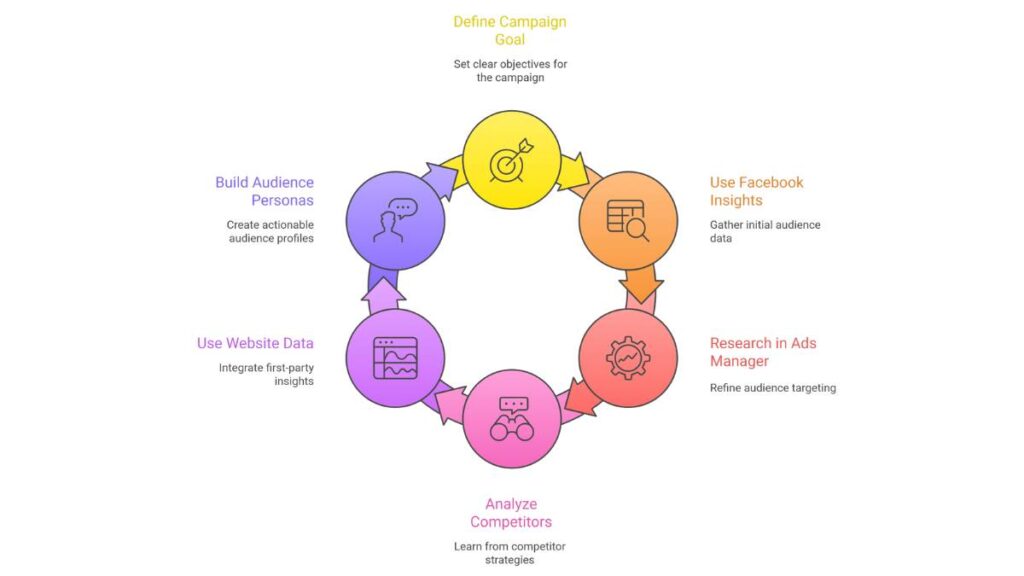
1. Define Your Campaign Goal Before Audience Research
It might sound obvious, but this gets overlooked a lot. Different campaign goals need different kinds of audiences.
Lead generation isn’t about broad appeal. It’s about finding the people who are willing to hand over info. You want signals that suggest trust and interest, not just casual curiosity.
Ecommerce campaigns? Here, the focus is on buyers. Someone might scroll past an ad a dozen times, but that doesn’t mean they’ll click “buy.” Patterns of past purchases and engagement matter more.
Brand awareness is different again. The goal isn’t conversion right away. It’s visibility, recognition, maybe engagement. Audience research here is about attention, habits, and content consumption.
The key point: skip this, and everything else becomes messy. You’ll be guessing, and guessing costs money.
2. Use Facebook Audience Insights
This is one of the best starting points, even if it feels a bit dry at first.
Start broad. Look at age ranges, location, and gender. It’s tempting to jump straight into interests, but filtering basics first avoids wasted spend.
Layer in interests and behaviors slowly. Watch for patterns that show actual engagement, not just general curiosity. Some interests look promising on paper but don’t convert.
Look for high-intent signals: frequent interaction, page follows, and content engagement. These hint at who’s ready to act.
Don’t overload. It’s easy to throw in a dozen interests, thinking it will tighten the audience. Often, it just muddies the signal.
Audience Insights isn’t about finding “the perfect targeting” immediately. It’s about understanding tendencies. Who interacts more? Who clicks? Who converts? These little clues matter.
3. Research Interests and Behaviors Inside Ads Manager
Once Insights gives a sense of direction, Ads Manager lets you put it into practice.
Test single interests first. Too many at once can make it hard to tell what’s working.
Narrow versus broad targeting is tricky. Too narrow, and costs spike. Too broad, and the ad wastes impressions. Somewhere in between is usually best.
Layer interests with intention, not randomness. Each added layer should refine the audience meaningfully.
Exclusions are often ignored. People who have already converted or who engage but never buy should be filtered out. It saves budget and keeps signals clean.
This is where the numbers start talking. Engagement, clicks, and even skips tell you more than assumptions ever will.
4. Analyze Competitor Audiences on Facebook
It’s okay to peek at competitors; not to copy them blindly, but to learn.
Facebook Ad Library shows active campaigns. It doesn’t reveal everything, but you can see messaging, creative angles, and sometimes who they’re aiming at.
Look for gaps. Maybe competitors ignore certain segments or interest combinations. These gaps can be opportunities.
Reverse-engineering doesn’t need to be exact. Context matters. What works for them might not work the same for your audience, but it gives clues.
Think of it as inspiration and market sense, not a cheat code.
5. Use Website & Data Sources for Audience Research
Some of the best insights come from first-party data.
- Meta Pixel shows how visitors interact with the site. Who lingers? Who converts? Who bounces immediately?
- GA4 audience insights can complement this. Demographics, flows, and high-interest pages are all helpful.
- CRM data and surveys add context. Numbers tell one side of the story; understanding “why” rounds it out.
- Heatmaps and session recordings reveal friction points and areas of interest that aren’t obvious from analytics alone.
Mixing these sources with Facebook data turns vague guesses into informed decisions.
6. Build Audience Personas for Facebook Advertising
All the research finally comes together in personas. Not made-up characters, but distilled insights from actual behavior.
- Map pain points, triggers, motivations, and patterns of action.
- Translate these into targeting inputs: demographics, behaviors, interests, and engagement.
- Use personas to guide creative and messaging. Ads that feel like they’re speaking to a real person perform better.
- Personas also make testing cleaner. You know which segment you’re evaluating, so the results are actionable.
Good personas make the difference between campaigns that feel random and campaigns that actually connect. They turn research into something tangible, something that informs every decision.

Apply Now: AI-Powered Performance Marketing Course
Advanced Audience Research Strategies for Facebook Ads
Once the basics are set, it’s time to think a bit deeper. The campaigns that really perform don’t just throw money at audiences; they structure them, test them, and understand how people behave across different segments.
1. Broad Targeting vs Interest Targeting
There’s a lot of debate about this. Honestly, it depends on context.
Broad targeting can be surprisingly effective. Sometimes letting Facebook figure out the right people works better than trying to micromanage every interest. The catch is that the creative has to be strong and budget enough to give the algorithm room to learn.
Interest targeting gives control. You can layer in behaviors, hobbies, and demographics. The danger is overdoing it; too narrow an audience and costs spike fast.
The sweet spot is often a mix. Start broad, collect some signals, then refine with interests and behaviors that actually matter.
2. Audience Research for Scaling Facebook Ads
Scaling is tricky. Throwing more budget at the same audience doesn’t always work.
Start with high-performing segments. Not every audience scales equally; some burn out quickly.
Refresh research regularly. Interests and behaviors shift. Audiences get fatigued. What worked last quarter might flop today.
Expand slowly. Add lookalike audiences or test adjacent interests gradually. Jumping too fast can ruin your return on ad spend.
3. Audience Research for Creative Testing
Research isn’t just for targeting; it shapes creativity too.
Match your ads to the audience segment. High-intent groups respond differently from cold audiences. What works for one might flop for the other.
Use audience patterns to guide hooks. Even small tweaks, like wording that hits a pain point, can make a big difference.
Pay attention to emotional vs logical triggers. Some audiences respond better to urgency, others to storytelling. Knowing which is which saves money and time.
Tools for Facebook Advertising Audience Research
Tools make life easier, but don’t let them replace thinking. They help gather signals, but interpretation is where the real skill lies.
1. Native Facebook & Meta Tools
Meta Audience Insights – Great for spotting patterns. Shows demographics, behaviors, and interests at a glance. Not perfect, but useful for spotting high-potential segments.
Facebook Ads Manager audience breakdowns – Let’s you see who’s actually engaging in campaigns. CTR, frequency, and conversions tell stories that raw data can’t.
Facebook Ad Library – Useful for spying on competitors’ active campaigns. Can give clues on messaging and formats, but not exact targeting.
2. Third-Party Audience Research Tools
Sometimes Facebook isn’t enough. A few tools can round out the picture:
SparkToro – Shows websites, social accounts, and content your audience follows. Helps validate interest patterns.
Google Trends – Good for spotting rising topics or seasonal interests.
Survey tools – Asking real customers or leads about habits, needs, and preferences gives insights that analytics alone can’t capture.
Mixing these tools with first-party data gives a fuller picture. One shows what people do; the other hints at why they do it.
Common Audience Research Mistakes in Facebook Advertising
Even seasoned marketers stumble on these. Catching them early saves a lot of headaches.
Over-targeting and audience size issues – Making audiences too narrow can drive up costs and reduce reach. Sometimes simpler is better.
Relying only on interests – Interests don’t always equal intent. Layer with behaviors, engagement, or demographics to get more accurate targeting.
Ignoring exclusions – People who already converted, or past engagers who never buy, should be excluded. Otherwise, the budget gets wasted.
Not updating research over time – Audiences evolve. Trends shift. Past winners can become underperformers. Checking back regularly keeps campaigns fresh.
Audience research isn’t a one-off task. It’s ongoing, messy sometimes, and requires attention. But done right, it turns targeting from guesswork into something predictable, and that makes all the difference.
How to Validate and Test Your Facebook Ad Audiences
Doing the research is one thing, but seeing how it actually performs? That’s where the real work starts. Audiences don’t always behave as you expect, and sometimes a segment that looks perfect on paper just tanks in the wild.
Start by testing small groups. Don’t throw all your audiences into a campaign at once. Keep things organized. A/B testing works best when each group gets the same creative and offer. That way, it’s clear which segment is actually responding.
Metrics tell you a story, but don’t get obsessed with just one. CTR is helpful;it shows if your ad grabs attention, but conversions and ROAS are what really matter. Sometimes an audience clicks a lot but never converts. That’s a red flag.
Also, be ready to pivot. Audiences fatigue. If performance drops even with fresh creatives, it’s usually time to try a slightly different segment or tweak the targeting. Testing isn’t a one-off. It’s messy, ongoing, and absolutely necessary if you want reliable results.
Facebook Audience Research Best Practices
Facebook’s landscape keeps shifting. People’s habits change, rules around privacy tighten, and what worked a few months ago might not work today. Treat audience research like a living thing.
First-party data is your anchor. It tells you who actually engages and buys. Don’t ignore it.
Privacy matters. With tracking changes, focus on behaviors and signals that are safe and consented.
AI can help, but don’t blindly follow it. Algorithms can point to patterns, but human judgment is still crucial. Look at the numbers, think about your audience, and make calls that make sense.
Stay flexible. Facebook tweaks how ads are delivered all the time. A winning audience today can underperform tomorrow, so keep checking and adjusting.
The bottom line: audiences evolve. The ones that worked last quarter might not be the right fit now. Regular check-ins save wasted spend.
Final Checklist: How to Do Audience Research for Facebook Advertising
Here’s a practical way to keep the research process on track without overcomplicating it:
Audience Research Steps
- Nail down your campaign goal first. Don’t guess.
- Break audiences into clear segments by behavior, interest, and demographics.
- Pull in insights from competitors and your own first-party data.
- Build personas based on actual patterns, not assumptions.
Tools Checklist
- Meta Audience Insights for demographics and engagement trends.
- Ads Manager audience breakdowns to see real campaign performance.
- Ad Library to get ideas from competitors’ active campaigns.
- Optional: SparkToro, Google Trends, surveys; helps get context beyond Facebook.
Testing and Optimization
- A/B test every segment methodically.
- Track CTR, CPA, ROAS, and engagement; not just clicks.
- Watch for audience fatigue and saturation.
- Adjust and iterate based on what actually works, not just what looks right on paper.
Following this approach doesn’t make campaigns perfect overnight. But it turns research into something practical and repeatable, and over time, that’s what separates ads that bleed money from ones that consistently perform.
FAQs: Audience Research for Facebook Advertising
1. How do you find the right audience for Facebook ads?
It’s not as simple as picking a few demographics and hoping for clicks. Often, it’s a mix of signals: behaviors, engagement history, and interests. Start with the obvious: people who’ve visited your site, bought before, or interacted with your content. Those patterns are gold. Competitor ads can give clues, too, but don’t rely on them blindly. Watch how real people react, and be ready for surprises; sometimes the audience you least expect performs best.
2. What’s a good audience size for Facebook advertising?
Depends on what you’re doing. Small audiences can get expensive fast. Big ones can be too broad and waste money. For warm audiences, tens of thousands usually work. For cold audiences, you need more room for the algorithm to figure things out. Don’t fixate on exact numbers; watch results and adjust. It’s more of an art than a science.
3. Are interests still useful for Facebook ads?
They are, but they’re just a starting point. Liking something doesn’t mean someone will act. Interests need context; layer in behaviors, engagement, or demographic signals to make targeting meaningful. Think of them like clues, not the whole story.
4. How often should audience research be updated?
More often than most people do. Habits shift, algorithms change, competitors move. Check your segments every few weeks. Refresh or test new ones when performance dips. Even small tweaks, like adding or excluding certain groups, can make campaigns feel alive again.
At the end of the day, audience research isn’t a one-off chore. It’s a living process. Test, tweak, watch, repeat. That’s how campaigns stay relevant, cost-effective, and actually deliver.
5. Can I target multiple audiences in one campaign?
Sure, but it’s a bit tricky. Tossing too many audiences together can make it hard to tell which ones are actually performing. Better to split them into smaller groups and run separate tests. It’s not glamorous, but it makes the results clearer and saves money in the long run.
6. Should Lookalike Audiences or interest-based targeting come first?
It depends on what data you have. If there’s solid first-party data, like past buyers, Lookalikes usually get you further, faster. Interests can still work, especially for new audiences, but they need more trial and error. Often, the best approach is a mix: start broad, test, then layer in interests that actually matter.
7. How can I tell if an audience is getting tired?
Performance will give it away. CTR drops, frequency climbs, costs creep up; these are all signs people are seeing your ads too often. Sometimes, a small tweak to the creative or message is enough to refresh things. Other times, it’s better to shift to a slightly different audience.
8. Can I just trust Facebook’s audience suggestions?
Not entirely. Those suggestions can point you in the right direction, sure, but they don’t know your product or your market as you do. Think of them as hints, not gospel. Always test and see how real people respond.
9. Is it useful to mix first-party and third-party data?
Absolutely, but don’t overcomplicate it. First-party data shows who’s already engaging with your brand. Third-party tools can fill in gaps, like trends or interests you might not spot internally. Combined, they give a clearer picture, but don’t drown in too many tools. Keep it simple, actionable, and practical.