

Scaling a D2C brand today isn’t easy. Costs are creeping up, attention spans are shorter, and every platform feels crowded. A Practical Guide to Scaling D2C Brands Through Performance Marketing tries to cut through all that noise. It’s not about vague theories; it shows how to actually use performance marketing to get measurable growth. The guide covers everything from understanding what performance marketing really is for D2C to picking the right channels, tracking the numbers that actually matter, and avoiding the common mistakes that trip brands up. There are examples too, showing how real brands managed to scale without burning cash. Step by step, it lays out a path that’s practical, grounded, and usable for any brand trying to grow.
Table of Contents
Introduction:
Why Performance Marketing Became the Growth Engine for D2C Brands
Scaling a D2C brand used to feel simpler. Launch a product, run some ads, push discounts, repeat. That playbook doesn’t hold up anymore.
Customer acquisition costs keep creeping up. Feeds are crowded. Attention spans are thin. Even solid products struggle to break through unless the numbers make sense behind the scenes. And that’s the real shift. Growth today isn’t about being loud. It’s about being efficient.
When people talk about “scaling” a D2C brand, they often mean revenue. But revenue alone is a weak signal. Real scaling shows up as profitable growth, predictable demand, and customers who don’t disappear after the first purchase. Without those, growth becomes expensive very quickly.
This is where performance marketing starts to matter. Not as a buzzword, but as a discipline.
It forces uncomfortable clarity. You see what actually drives sales. You see where money leaks. You learn fast whether something works or not. There’s less room for guesswork and fewer places to hide behind surface-level metrics.
This guide breaks down how performance marketing fits into D2C growth in a practical way. Not theory. Not hype. Just the systems, channels, and decisions that help brands grow without losing control of costs.
What Performance Marketing Really Means for D2C Brands
What is Performance Marketing?
Performance marketing isn’t complicated, but it is strict.
You don’t pay for visibility. You pay for action.
That action could be a click, a lead, a purchase, or a sign-up. The point is simple: spend money only when something measurable happens. For D2C brands, this model fits naturally because the journey from ad to checkout is short and traceable.
There’s a clear line between effort and outcome.
That’s very different from traditional digital marketing, where success often gets measured in reach, impressions, or engagement. Those metrics have their place, but they don’t tell you if the business is healthier.
D2C brands lean toward performance marketing because it answers hard questions:
- What did this sale cost?
- Which campaign actually made money?
- Are customers coming back?
When margins are tight, those answers matter more than anything else.
Why Performance Marketing Fits D2C Scaling So Well
Performance marketing works for D2C because it mirrors how these businesses operate: fast, data-aware, and outcome-driven.
A few reasons it clicks:
- You see the full picture
From the first click to the second or third purchase, the journey is visible. That changes how decisions get made. - Budgets stay flexible
Spending can be adjusted quickly. Campaigns don’t need to “run their course” if they’re clearly underperforming. - Learning happens faster
D2C brands don’t have the luxury of slow feedback. Performance marketing shortens the gap between launch and insight.
It’s not about chasing growth at all costs. It’s about understanding growth well enough to scale it safely.
How Performance Marketing Helps D2C Brands Scale Without Bleeding Cash
1. Revenue Over Noise
One of the biggest mindset shifts performance marketing brings is focus. It pulls attention away from metrics that look impressive but don’t move the business forward.
Impressions don’t pay salaries. Reach doesn’t fix unit economics.
Performance marketing keeps the spotlight on numbers that actually matter:
- Revenue generated
- Cost per acquisition
- Return on ad spend
- Lifetime value
When those numbers guide decisions, growth becomes grounded. Less emotional. Less reactive.
2. Customer Acquisition Gets Smarter, Not Just Bigger
Scaling often gets confused with spending more. In practice, the opposite usually works better.
Performance marketing helps lower acquisition costs over time by:
- Refining targeting based on real buyer behavior
- Using retargeting to convert warm audiences
- Refreshing creatives before they burn out
Instead of pushing harder, brands learn to aim better. The result is more conversions from the same spend, sometimes even less.
3. Faster Validation, Fewer Costly Mistakes
D2C brands don’t need long debates to know if something will sell. They need signals.
Performance campaigns provide those signals quickly. New products can be tested with controlled budgets. Messaging can be validated against real responses. Demand shows up in data, not opinions.
Strong ideas get scaled. Weak ones get dropped early. That alone saves a significant amount of money over time.
Core Performance Marketing Channels That Actually Drive D2C Scale
Most D2C brands don’t scale on a single channel. Growth usually comes from a combination, each playing a different role.
1. Google Ads for D2C Brands
Google captures intent that already exists. Someone searching for a product is already close to buying. That’s valuable traffic.
For D2C brands, this often includes:
- Search campaigns targeting high-intent keywords
- Shopping ads that surface products directly
- Scalable formats designed to maximize conversions
When managed well, Google Ads bring consistency. Fewer surprises. Cleaner attribution.
2. Meta Ads for D2C Scaling
Meta platforms work differently. They create demand rather than capture it.
People aren’t searching. They’re scrolling. Which means creative matters more than almost anything else.
Effective D2C brands focus on:
- Ads that feel native, not polished
- Clear hooks that communicate value fast
- Letting campaigns optimize toward purchases, not engagement
Meta becomes powerful once the fundamentals are right. Without that, it burns budgets fast.
3. Retargeting That Feels Helpful, Not Pushy
Most visitors won’t buy on their first visit. That’s normal.
Retargeting exists to handle that reality. It brings brands back in front of:
- Product viewers
- Cart abandoners
- Past customers
When done well, it feels like a reminder, not a nudge. Dynamic ads and simple sequencing often outperform complex setups.
4. Affiliate and Influencer Campaigns Built on Performance
Influencer marketing gets dismissed too easily. Mostly because it’s often run without accountability.
When structured around outcomes, it becomes a reliable channel:
- Commission-based payouts
- Clear tracking
- Long-term creator partnerships
It’s a reach with responsibility. And for many D2C brands, it scales quietly but consistently.
5. Email and Lifecycle Marketing That Protects Margins
Acquisition brings customers in. Retention keeps the business healthy.
Email and lifecycle campaigns handle:
- Cart recovery
- Post-purchase follow-ups
- Repeat purchase nudges
This is where margins improve. When customers come back, every acquisition campaign becomes more profitable. Scaling stops feeling fragile.
Performance marketing doesn’t work because it’s clever. It works because it’s honest. The numbers don’t flatter. They inform. And for D2C brands trying to scale without losing control, that honesty is the advantage.
How to Scale D2C Brands Using Performance Marketing: Step-by-Step Framework
Scaling a D2C brand with performance marketing looks simple from the outside. Spend more, sell more. In reality, that thinking is exactly what breaks most brands once they cross a certain spend level. The problem usually isn’t effort. Its structure. Or the lack of it.
Real scale doesn’t come from aggressive budgets. It comes from control. From knowing what can be pushed, what needs time, and what will quietly bleed money if ignored.
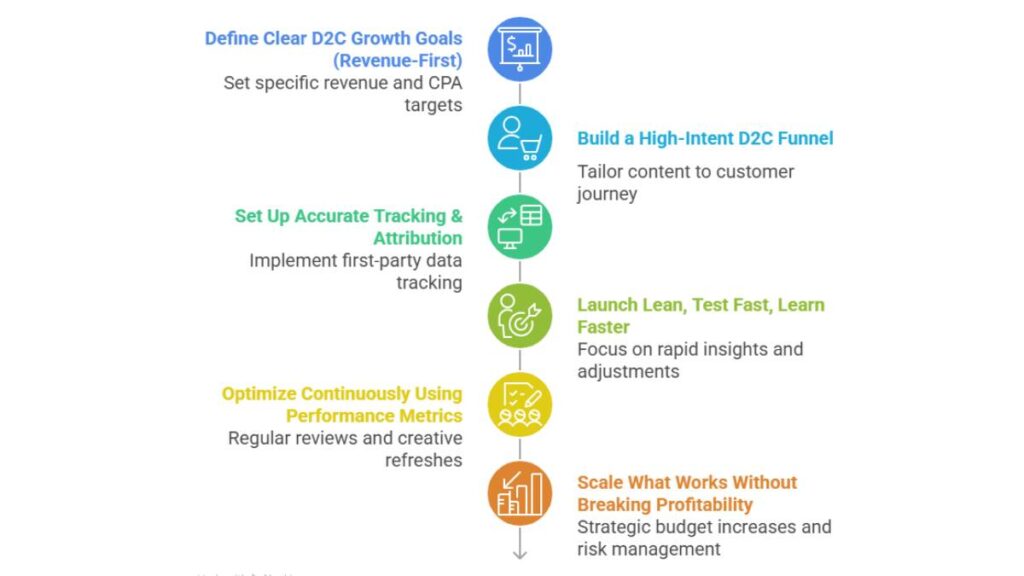
Step 1: Define Clear D2C Growth Goals (Revenue-First)
Most brands say they want growth. Few are specific about what kind. Revenue without margin isn’t growth. A scale that doesn’t improve repeat buying isn’t a real scale either.
Strong performance-led D2C brands start by locking numbers, not hopes. How much revenue needs to come in each month? What CPA keeps the business healthy? How ROAS changes once shipping, discounts, and returns are accounted for. These numbers aren’t motivational posters. They’re guardrails.
Channel-level clarity matters here. A blended ROAS can look comforting while one channel quietly eats into profit. When each channel has its own role and target, decisions get simpler. Sometimes uncomfortable. But clearer.
Step 2: Build a High-Intent D2C Funnel
Not every click means interest. And not every interested user is ready to buy. Treating them all the same is one of the fastest ways to exhaust budgets.
A workable D2C funnel respects timing. Cold audiences usually need context. Why this problem matters. Why this product exists. Warm audiences need proof. Reassurance. A reason to trust. High-intent users don’t want education anymore. They want clarity and an easy path to checkout.
The mistake is pushing discounts too early or storytelling too late. When ad formats, messages, and landing pages match where the customer actually is, performance stabilizes. Fewer spikes. Fewer crashes.
Step 3: Set Up Accurate Tracking & Attribution
Scaling without reliable data feels fine… until it doesn’t. Early on, brands can get away with rough tracking. At scale, that luck runs out.
Revenue needs to be visible. Not estimates. Not assumptions. When attribution is weak, teams argue more and optimize less. Decisions start getting based on instinct alone. That’s expensive.
First-party data becomes important at this stage for one simple reason. It’s consistent. It tells a cleaner story over time. And when the data improves, the questions get better. Why does this campaign hold at a higher spend? Why that one collapses the moment budgets rise.
Step 4: Launch Lean, Test Fast, Learn Faster
There’s a myth that scaling requires big budgets from day one. It doesn’t. It requires fast learning.
Early campaigns should feel almost uncomfortable in how small and focused they are. One idea at a time. One audience. One clear angle. The goal isn’t to prove that something might work. It’s to find out why it works.
Losers should be cut quickly. Not optimized endlessly. Winners deserve attention, not just budget. What hook pulled people in? What objection got removed? Those insights compound. Spend just amplifies them.
Step 5: Optimize Continuously Using Performance Metrics
Performance marketing doesn’t reward neglect. It rewards rhythm.
Daily checks keep waste in control. Weekly reviews reveal fatigue, creative decay, or audience saturation. Monthly analysis shows deeper shifts: AOV moving, repeat rates improving, or margins quietly tightening.
Creative fatigue sneaks up faster than most teams expect. Ads don’t die suddenly. They fade. A small dip here, a slightly higher CPA there. Left unchecked, the account slowly drifts. Regular creative refreshes aren’t a “nice to have.” They’re maintenance.
Metrics matter, but context matters more. A higher CPA can be acceptable if customer quality improves. Blindly chasing cheaper conversions often leads to worse customers long-term.
Step 6: Scale What Works Without Breaking Profitability
This is where restraint separates mature brands from impulsive ones.
Scaling isn’t just increasing budgets. It’s knowing how much pressure the system can handle. Vertical scaling works when foundations are strong. Horizontal scaling keeps risk spread out. Most brands need both.
Budgets should rise in steps, not jumps. Structures that work should be duplicated before experiments multiply. Marginal returns deserve more attention than blended averages.
If performance collapses the moment spend increases, that’s feedback. Not failure. Pull back. Fix what’s weak. Then push again.
When done right, performance marketing stops feeling chaotic. It becomes steady. Predictable. Almost boring. And for D2C brands trying to grow profitably, that’s exactly what success looks like.

Apply now: Performance Marketing Course
Performance Marketing Metrics Every D2C Brand Must Track to Scale
At some point, every growing D2C brand realizes this: dashboards don’t grow businesses. Decisions do. And decisions are only as good as the metrics behind them.
The problem isn’t a lack of data. It’s noise. Too many numbers get tracked, too few get understood.
1. Core Metrics That Actually Matter
Cost Per Acquisition sits at the center of performance marketing for D2C. Not the platform-reported version, but the real one that accounts for discounts, shipping, and returns. If CPA drifts upward without a plan to offset it, scale becomes fragile very quickly.
ROAS matters, but only in context. A high ROAS on low volume doesn’t move the business forward. A slightly lower ROAS at higher spend might be far more valuable if margins and repeat rates hold.
Conversion rate often reveals more than targeting ever will. When traffic is steady but conversions dip, the issue usually lives on the page, not in the ad account. Small changes here compound fast.
Average Order Value deserves regular attention. Upsells, bundles, and pricing communication often unlock scale without increasing acquisition costs. It’s one of the cleanest levers available.
Customer Lifetime Value is where mature D2C brands separate themselves. Scaling becomes easier when repeat purchases improve. Higher LTV gives room to bid more aggressively, test faster, and stay competitive in crowded categories.
2. Metrics to Avoid Obsessing Over
Impressions look impressive. They rarely pay the bills. Reach without revenue is just noise.
CTR can be misleading. High clicks don’t always mean high intent. Sometimes they signal curiosity, not buying behavior.
Any metric that isn’t tied back to revenue or customer quality should be treated cautiously. If it can’t influence a decision, it doesn’t deserve daily attention.
Common Mistakes That Stop D2C Brands from Scaling with Performance Marketing
Most D2C brands don’t fail at performance marketing. They stall. And the reasons are usually predictable.
Scaling too early is a big one. When spending increases before funnels are stable, weak points get amplified. CPAs rise, teams panic, and confidence drops. Data should lead scale, not ambition alone.
Creative testing often gets treated as optional. It isn’t. Brands that rely on one or two “winning” ads eventually hit a wall. Audiences change. Attention shifts. What worked last quarter won’t carry the next one.
Poor tracking creates false confidence. Numbers look fine until revenue doesn’t match expectations. At that point, diagnosing the problem becomes guesswork.
Over-reliance on a single channel is another quiet risk. When performance depends on one platform, volatility becomes dangerous. Diversification isn’t about chasing trends. It’s about stability.
Finally, treating performance marketing like a short-term hack kills long-term potential. Discounts, urgency, and aggressive tactics can spike revenue, but they rarely build durable growth. Without retention and brand trust, scale becomes expensive very quickly.
Examples: D2C Brands That Scaled Using Performance Marketing
Across categories, certain patterns repeat.
D2C skincare brands, for instance, tend to scale well when education leads the funnel. Performance campaigns focus less on hard selling and more on problem-solution storytelling early on. Retargeting then does the heavy lifting, converting educated users with proof, reviews, and clear product benefits. The combination of Meta-driven discovery and high-intent search traffic creates a steady acquisition engine.
SaaS-like D2C brands, especially in wellness or subscription categories, lean heavily into retargeting and lifecycle optimization. The first purchase is treated as a relationship start, not a finish line. Performance marketing here focuses on improving LTV through repeat usage, cross-sells, and timely re-engagement. Scale comes not just from acquiring more users, but from extracting more value per customer over time.
The common thread across successful D2C performance marketing campaigns is restraint. Budgets grow, but only after systems prove they can handle pressure. Creative is tested continuously. Data is respected, but not blindly followed. And growth is treated as something to be engineered, not chased.
That’s usually what separates brands that scale sustainably from those that burn bright and fade fast.
When Should D2C Brands Partner with a Performance Marketing Agency?
There’s a point in a D2C brand’s journey where internal hustle stops being enough. Not because the team isn’t capable, but because scale introduces complexity. More channels. More creatives. More data. More decisions, faster.
That’s usually when cracks start to show.
High ad spends with inconsistent ROAS are a common signal. So is the feeling that performance is being “managed,” not actively improved. Campaigns run, reports get shared, but growth feels flat. Another sign is when founders or senior marketers are still deep in dashboards instead of focusing on product, supply chain, or expansion.
Limited in-house expertise doesn’t mean a weak team. It often means the business has outgrown its current setup. Performance marketing at scale demands strategy, creative direction, analytics depth, and execution speed; all at once.
The right performance marketing agency brings structure to that chaos. Not just buying media, but helping define where growth should come from next. Better funnel design. Cleaner attribution. Stronger creative systems. Agencies that understand D2C don’t chase short-term spikes. They focus on scalable wins and margin protection.
The real value isn’t delegation. It’s leverage.
Future of Performance Marketing for D2C Brands
Performance marketing for D2C is changing, but not in the way headlines suggest. The fundamentals still matter. What’s evolving is how brands execute them.
Bidding and optimization are becoming more dynamic, which puts pressure on inputs. Strategy and creative quality now matter more than constant manual tweaks. Brands that rely on average ads struggle. Those who invest in sharp messaging and clear positioning get rewarded.
First-party data is no longer optional. As platforms share less, brands that understand their customers deeply gain a serious edge. Not just for acquisition, but for retention and repeat growth.
Omnichannel performance marketing is also becoming the norm. Customers don’t move in straight lines anymore. They see a video, search later, return through an email, and convert after a reminder. Treating channels in isolation misses the bigger picture.
Video-first content and creator-led ads continue to grow, especially for D2C brands that need trust quickly. Polished isn’t the goal. Clear, believable, and relevant wins more often.
The brands that adapt best won’t be the ones chasing every new tactic. They’ll be the ones doubling down on fundamentals, just executed better.
Conclusion:
Performance marketing isn’t magic. It doesn’t fix weak products or broken funnels. What it does offer is clarity. Fast feedback. Real numbers that tell the truth, even when it’s uncomfortable.
Sustainable scaling comes from systems, not spikes. From knowing when to push and when to pause. From treating performance marketing as a long-term growth engine, not a quick revenue lever.
For D2C brands willing to stay disciplined, performance marketing becomes a superpower. It connects data with creativity. Strategy with execution. Growth with accountability.
The brands that win aren’t the ones spending the most. They’re the ones learning the fastest and scaling with intent, not impulse.
FAQs: How to Scale D2C Brands Using Performance Marketing
1. How long does it take to scale a D2C brand with performance marketing?
There’s no fixed timeline, and anyone promising one is guessing. Most D2C brands start seeing meaningful patterns within a few weeks, but real scaling usually takes a few months of disciplined testing and refinement. The early phase is about learning what works. Scale comes later, once the numbers stop swinging wildly and start behaving.
2. Which performance marketing channel works best for D2C brands?
The “best” channel depends on intent. Search tends to work well when demand already exists. Social platforms are strong for discovery and education. Retention channels quietly improve profitability over time. Brands that scale well don’t look for one winning channel. They build a mix where each channel plays a clear role.
3. How much budget is needed to scale a D2C brand?
There’s no universal number. What matters more than budget size is efficiency. Some brands struggle with large spends because their fundamentals are weak. Others grow steadily on modest budgets because their funnels and retention are solid. Scaling starts when the unit economics make sense, not when the budget crosses a threshold.
4. Is performance marketing better than brand marketing for D2C?
It’s not a competition. Performance marketing drives measurable action. Brand marketing builds trust and memory. In practice, the two work best together. Performance marketing often leads in the early stages because it provides fast feedback. Over time, brand strength makes performance more efficient.
5. Can small D2C startups scale using performance marketing?
Yes, and many do. Smaller brands often move faster because they test quickly and adapt without layers of approval. The key is restraint. Scaling too hard, too early can hurt. But using performance marketing to learn, refine, and grow step by step works well even at a small scale.
6. What is the minimum ad budget required to start scaling a D2C brand with performance marketing?
Scaling doesn’t begin with big spends. It begins with consistency. A steady budget that allows testing over time is far more useful than sporadic bursts. The goal early on isn’t volume. It’s clarity. Once the data is in place, budgets can grow with confidence.
7. Should D2C brands focus on performance marketing before brand marketing?
In most cases, yes. Performance marketing helps validate demand, pricing, and messaging. It shows what resonates. Brand marketing becomes far more effective when those insights are already clear. Starting with performance doesn’t mean ignoring brand. It means building it with evidence, not assumptions.
8. How long does it take to see results from performance marketing for D2C brands?
Early signals often show up quickly. Real results take longer. Clicks and traffic appear first. Conversions follow. Stable performance comes after iteration. Brands that expect instant profitability usually get disappointed. Brands that treat the first phase as learning tend to scale better.
9. Can performance marketing help D2C brands improve repeat purchases?
Absolutely. Acquisition gets attention, but retention is where profits grow. Performance-driven lifecycle campaigns, remarketing, and post-purchase messaging all play a role in increasing repeat rates. Higher repeat purchases make scaling easier and more forgiving.
10. Is performance marketing sustainable for long-term D2C growth?
It is, when treated as a system. Short-term tactics burn out fast. Long-term performance marketing focuses on clean data, strong creative, and improving customer value over time. Done right, it doesn’t just drive growth. It supports it.