

Behavioural marketing isn’t about who people are on paper; it’s about what they actually do. This blog walks through the whole picture: how to watch actions, pick up signals, and respond in ways that actually make sense to customers. From dynamic website content to email follow-ups, retargeting, and product recommendations, it looks at strategies that turn small clues, like a scroll or a repeat visit, into meaningful engagement. There’s also a close look at segmentation, ethical data use, and real examples from ecommerce, SaaS, and more. The point is simple: paying attention to behaviour makes marketing feel relevant, timely, and, most importantly, human, not robotic.
Table of Contents
Introduction:
What Is Behavioural Marketing?
Behavioural marketing is basically about paying attention to what people actually do, not just who they are. It’s noticing the tiny patterns in how visitors move through a website, which pages they linger on, which emails they click, or don’t. And then, instead of blasting everyone the same message, the marketing responds to those actions.
It’s a bit like walking into a store. Some customers know exactly what they want; others wander around, pick up a few things, think, then leave. Behavioural marketing tries to catch those signals and respond appropriately, nudging someone toward a choice without feeling pushy.
Why Behavioural Marketing Matters in Modern Digital Marketing
Honestly, most people ignore ads these days. There’s just too much noise; emails, social media, pop-ups, banners… You name it. Generic campaigns aren’t just inefficient; they can actually annoy people.
Behavioural marketing helps cut through that clutter by making interactions feel… relevant. A well-timed follow-up, a product suggestion that actually fits what the person was browsing, or an email that reminds them of something they were thinking about; it all feels helpful instead of spammy.
A few things it does really well:
- Shows up at the right moment instead of just more often
- Matches messaging to actual intent, not guesses
- Builds a sense of trust because it feels like the brand “gets it.”
When done right, it turns one-off visitors into repeat buyers, or at least into people who don’t immediately bounce.
Behavioural Marketing vs Traditional Marketing
Traditional marketing usually works from the outside in. Pick a broad audience, craft a single message, push it out, and hope for engagement.
Behavioural marketing flips that around. Start with the person. Start with what they actually do. That’s what guides the message.
Think of it this way:
- Traditional: “Here’s our message. Let’s find people to show it to.”
- Behavioural: “Here’s what this person just did. How do we respond?”
It’s more precise. Less waste. And, honestly, it feels smarter.
How Behavioural Marketing Improves Personalization and Customer Experience
People don’t really care if their name appears in the subject line. What they notice is if the brand actually makes life easier or saves them time.
Behavioural marketing makes personalization more than just a gimmick. Examples include:
- Showing returning visitors content that fits their previous interests
- Sending follow-up emails that reference what was already browsed
- Tweaking offers depending on where someone is in the buying journey
The result? A smoother experience. One that doesn’t feel robotic. One that actually helps people move forward.
Behavioural Marketing: Meaning and Definition
Behavioural Marketing Definition
Behavioural marketing is the practice of using real actions, what people actually do online, to guide messaging. It’s about segmenting and targeting audiences based on behaviour rather than just demographics.
It’s not about assumptions or what “might” work. It’s about what’s actually happening.
What Is Behaviour-Based Targeting?
This is the heart of behavioural marketing: acting on signals.
Signals might include:
- Pages visited
- Products viewed or added to a cart
- Content downloaded
- Emails opened or ignored
Each action tells a story about interest, intent, or timing. Understanding those stories allows for messaging that actually lands instead of being ignored.
How Behavioural Marketing Uses Customer Data and Digital Body Language
Every click, every pause, every scroll is a small clue. And when they’re put together, they show where someone is in their journey.
For instance:
- Spending a lot of time on a pricing page? Likely close to making a decision.
- Coming back to the same product page a few times? They’re comparing or hesitating.
- Skimming a blog post? Probably early-stage research.
Brands that notice these signals can respond with a nudge that feels helpful instead of intrusive.
Behavioural Marketing in B2B vs B2C Marketing
The principles are similar, but execution differs.
- B2C: Often product-focused; cart abandonment, product views, browsing patterns, impulse triggers.
- B2B: Usually longer journeys, multiple stakeholders, content-driven engagement. Demo requests, webinar attendance, or visiting a case study page can indicate readiness in a way that’s subtle but measurable.
Either way, behaviour tells more than demographics ever could. It’s the difference between guessing and actually knowing.
How Behavioural Marketing Works
How Behavioural Marketing Collects Customer Behaviour Data
It starts with observation. Not in a creepy way, but through noticing what visitors do online. Most brands track:
- Website interactions
- Email engagement
- Search behaviour
- Past purchases
The idea isn’t to collect everything under the sun. It’s to see patterns that actually indicate interest, hesitation, or intent.
Types of Behavioural Data Used in Marketing
Not all signals are equally important, and not all brands use them the same way. Key types include:
Website Behaviour Data
- Pages visited
- Scroll depth
- Time spent on a page
- Bounce or exit points
These can reveal curiosity, confusion, or clear intent.
Search Behaviour and Intent Signals
Searches tell a story. Someone searching “best organic mattresses” is in a completely different mindset than someone typing “affordable mattresses near me.” The wording matters.
Email Engagement Behaviour
Opening, clicking, or ignoring an email altogether gives clear feedback. Future campaigns can be adjusted based on these small but telling actions.
Purchase and Transaction Behaviour
Frequency of purchase, total spend, and repeat orders reveal loyalty, satisfaction, or churn risk. This is crucial for retention strategies.
First-Party Data vs Third-Party Data
First-party data, what brands gather directly, is gold. It’s accurate, specific, and context-rich. Third-party data can fill gaps, but lacks the nuance, and with rising privacy concerns, brands relying solely on external data often fall short.
Behavioural Marketing Triggers and Automation
Once patterns are mapped, triggers turn insight into action. A visit to a pricing page, abandoning a checkout, or completing a quiz can automatically start a targeted response.
The trick is timing. Too early, and it feels pushy. Too late, and the opportunity is lost. When done well, it’s just smart marketing that doesn’t feel like marketing at all.
Behavioural Marketing Segmentation
What Is Behavioural Segmentation?
Behavioural segmentation is where behavioural marketing really starts to pull its weight. Instead of grouping people by who they are on paper, it groups them by what they actually do. And that difference matters more than most teams realize.
It’s about looking at actions over time. Patterns. Repeated signals. Someone who visits once and disappears is very different from someone who comes back three times, reads a comparison page, and then checks pricing. Treating them the same rarely works.
Behavioural segmentation in marketing focuses on:
- How users interact with your brand
- How often do they engage
- Where they stall, speed up, or drop off
It’s practical, grounded, and far closer to reality than static profiles.
Why Behavioural Segmentation Improves Conversion Rates
Conversions improve when messaging matches mindset. Behavioural segmentation helps do exactly that.
When segments are built around behaviour:
- Early-stage visitors aren’t pushed into hard sells
- High-intent users don’t get stuck with generic education
- Returning customers aren’t treated like strangers
It reduces friction. People feel understood, even if they can’t quite put their finger on why. That sense of relevance tends to move things forward.
Types of Behavioural Marketing Segmentation
There’s no single way to segment behaviour. Strong strategies combine several types, depending on goals and audience maturity.
Purchase Behaviour Segmentation
This looks at how people buy, or don’t.
- First-time buyers
- Repeat customers
- High-value purchasers
- Cart abandoners
Each group has different needs. Someone who buys frequently doesn’t need the same messaging as someone who hesitated and left halfway through checkout.
Customer Loyalty and Retention Segmentation
Loyalty shows up in behaviour long before someone joins a rewards program.
- Repeat visits
- Consistent engagement
- Willingness to explore new offerings
These users are often overlooked, yet they’re usually the easiest to grow. Behavioural segmentation helps spot them early and treat them accordingly.
Buyer Intent Segmentation
Not all interest is equal. Some behaviours quietly signal readiness.
- Viewing pricing or comparison pages
- Revisiting the same product multiple times
- Engaging with decision-stage content
Intent-based segments help prioritize who needs attention now versus who still needs time.
Engagement-Based Segmentation
Engagement isn’t just about clicks. Its depth.
- Time spent
- Pages viewed per session
- Frequency of return visits
Highly engaged users are telling you something. Ignoring that signal is a missed opportunity.
Customer Journey Stage Segmentation
Behaviour often maps cleanly to journey stages:
- Awareness: browsing, reading, exploring
- Consideration: comparing, returning, evaluating
- Decision: pricing, demos, checkout actions
Segmenting by journey stage keeps messaging aligned with where people actually are, not where the brand wants them to be.
Occasion-Based and Usage-Based Segmentation
Some behaviours are tied to timing or context.
- Seasonal buying patterns
- Event-driven actions
- Changes in usage frequency
These segments are especially useful for businesses with cyclical demand or repeat usage models.
Behavioural Segmentation vs Demographic Segmentation
Demographics still have a place. They provide context. But on their own, they’re blunt instruments.
Two people of the same age, location, and job title can behave very differently. Behaviour reveals urgency, interest, and hesitation; things demographics simply can’t show.
Behavioural vs Demographic Targeting
- Demographic targeting answers who
- Behavioural targeting answers why and when
The second tends to be far more actionable.
When to Use Behavioural Data Over Demographics
Behavioural data is especially useful when:
- Purchase cycles vary widely
- Audiences are diverse within the same demographic group
- Timing matters more than identity
In practice, the strongest segmentation strategies don’t choose one or the other. They start with behaviour and use demographics as supporting context, not the foundation.
Behavioural segmentation works because it reflects reality. People change, intentions shift, and behaviour shows it first.
Types of Behavioural Marketing Strategies
Behavioural marketing strategies work best when they feel quiet and intentional, not loud or intrusive. The goal isn’t to react to every click, but to respond to meaningful behaviour in a way that actually helps the customer move forward.
Dynamic Website Content Personalization
Dynamic website content changes based on how someone interacts with your site. Not who they claim to be. What they do.
That could mean:
- Showing different homepage messaging to new vs returning visitors
- Highlighting products or content based on pages already viewed
- Adjusting CTAs depending on how deep someone scrolls or how often they return
Done well, it feels subtle. Almost invisible. The site simply feels more relevant, less generic.
Behaviour-based website personalization works because it reduces cognitive load. Visitors don’t have to hunt for what matters. It’s already there.
Beyond experience, adaptive content often improves engagement and usability. People stay longer. They click with more intention. That usually shows up in performance, even if no one explicitly notices why.
Behavioural Email Marketing
Behavioural email marketing is less about schedules and more about timing. Messages are triggered by actions, not calendars.
Common examples include:
- Following up after a download
- Nudging after repeated page visits
- Re-engaging users who’ve gone quiet
Abandoned cart emails are the most familiar use case. They work because they respond to a clear signal: interest without completion. The best ones don’t pressure. They remind, reassure, and sometimes clarify.
Behaviour-triggered email campaigns tend to outperform batch sends because they arrive when context still exists. The user remembers why the email matters.
Personalized email automation based on behaviour also helps avoid over-emailing. Not everyone needs the same message at the same time. Behaviour tells you who does.
Retargeting and Remarketing in Behavioural Marketing
Retargeting is often misunderstood as “showing ads again.” In reality, effective behavioural retargeting is about relevance and restraint.
Website retargeting focuses on on-site actions. Search retargeting reacts to intent expressed elsewhere. Both can work, but only when the message matches the behaviour that triggered it.
Examples:
- Product-specific ads after viewing a category
- Educational content after researching a problem
- Reminder-style messaging after pricing page visits
Social media retargeting using behavioural data works best when the creative feels native, not repetitive. Seeing the same ad ten times rarely helps.
Across platforms, strong retargeting adapts. Messaging changes as behaviour changes. That’s the difference between remarketing that converts and remarketing that annoys.
Product Recommendations and Cross-Selling
Behaviour-based product recommendations rely on patterns, not assumptions. What someone viewed, compared, skipped, or bought before tells a clearer story than broad categories ever could.
Effective recommendations:
- Reflect actual browsing behaviour
- Adjust as interests change
- Avoid pushing irrelevant add-ons
Cross-selling and upselling work best when they feel logical. A next step, not a sales trick. Behavioural insights help identify what the next step should be.
When recommendations align with real intent, they’re perceived as helpful guidance rather than persuasion.
Behavioural CTAs and Conversion Optimization
Calls-to-action don’t need to be static. Behavioural CTAs adjust based on how users interact with a page.
Examples include:
- Scroll-based CTAs for long-form content
- Time-based prompts after sustained engagement
- Exit-intent CTAs when hesitation is detected
The key is moderation. Behavioural CRO works when CTAs respond to genuine signals, not when they interrupt every pause.
Well-timed CTAs feel like natural suggestions. Poorly timed ones feel like pop-ups. Behaviour helps tell the difference.
How to Implement Behavioural Marketing Step by Step
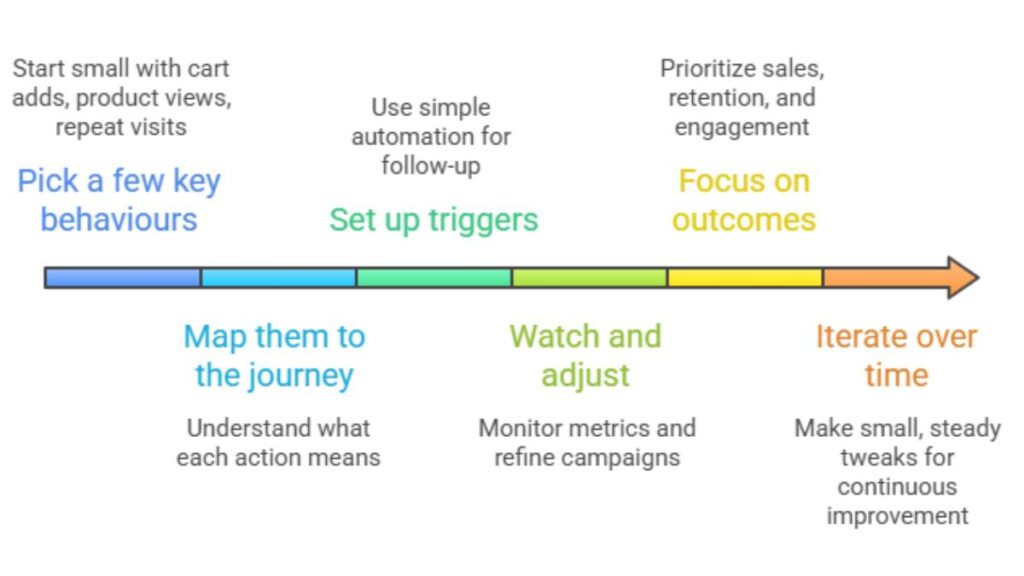
Here’s a way to make it work without overcomplicating things:
- Pick a few key behaviours. Don’t try to track everything. Cart adds, product views, repeat visits; start small.
- Map them to the journey. What does each action mean? Curious, comparing, ready to buy? Knowing this shapes your follow-up.
- Set up triggers. Automation is good, but don’t over-engineer flows. Simple triggers often work better.
- Watch and adjust. Opens, clicks, conversions; look at them. Adjust timing, copy, and triggers based on what’s actually happening.
- Focus on outcomes. It’s tempting to celebrate clicks, but real value comes from sales, retention, or engagement.
- Iterate over time. Behaviour changes, trends shift. Small, steady tweaks outperform huge overhauls.
At the end of the day, it’s less about data and more about people. If campaigns feel alive and respond to how people behave, they work. If they feel mechanical… well, people tune out.
Behavioural Marketing Tools and Platforms
Behavioural marketing doesn’t require a complicated stack, but it does require consistency. Data needs to be collected cleanly, interpreted thoughtfully, and acted on with restraint.
Most teams rely on a mix of:
- Marketing automation platforms to trigger campaigns
- CRM systems to connect behaviour with lifecycle stages
- Personalisation platforms to adapt on-site experiences
- Analytics tools to understand patterns over time
What matters more than the tool itself is how it’s used. Behavioural data loses value when teams chase every metric without context.
The strongest setups focus on a small set of meaningful behaviours and build from there. Fewer signals. Clearer actions.

Apply Now: Advanced Digital Marketing Course
Behavioural Marketing Examples
Behavioural Marketing Examples in ECommerce
Amazon’s behavioural marketing strategy is often cited because it’s deeply embedded. Product recommendations adjust in real time. Browsing history shapes what appears next. Even homepage layouts shift based on past behaviour.
REI approaches behaviour differently. Product recommendations often reflect usage patterns, seasonal interest, and browsing depth. It feels considered, not aggressive.
In both cases, behaviour drives relevance. Not guesswork.
Behavioural Marketing Examples in SaaS and B2B
In SaaS, behavioural retargeting often focuses on feature exploration. If someone engages with a specific capability, follow-up messaging reinforces that interest instead of restarting the conversation.
Behaviour-based lead nurturing in B2B relies heavily on content interaction:
- What’s downloaded
- What’s revisited
- What’s ignored
These signals help shape follow-ups that feel informed, not scripted.
Behavioural Marketing Examples in Travel and Finance
Trivago’s behavioural remarketing ads often respond to search behaviour and comparison activity. Messaging shifts based on destination interest and timing.
NerdWallet uses behaviour-based retargeting to surface relevant financial products after research behaviour. Not immediately. At the right moment.
In both industries, timing and trust matter. Behavioural marketing works because it listens before it speaks.
Benefits of Behavioural Marketing
Behavioural marketing earns its place because it fixes real problems marketers deal with every day. Wasted spend. Irrelevant messaging. Journeys that don’t quite line up with how people actually behave.
When behaviour drives decisions, things get clearer.
Benefits of Behavioural Marketing for Businesses
At a business level, the biggest win is focus. Instead of trying to speak to everyone at once, attention shifts to people showing signals that matter.
That usually means:
- Fewer campaigns are built on assumptions
- More clarity around who’s ready, who’s not, and who needs time
- Better use of the budget, because effort follows intent
It’s not magic. It’s just paying attention.
How Behavioural Marketing Improves Customer Experience
Most bad experiences come from misalignment. The message is wrong for the moment. Or it shows up too late. Or too early.
Behaviour-based marketing reduces that gap.
- Someone browsing gets guidance, not pressure
- Someone comparing options sees reassurance
- Someone returning isn’t treated like a stranger
The experience feels calmer. More considered. Less salesy.
Behavioural Marketing Benefits for Conversion Rate Optimization
Conversion issues are rarely about one big mistake. They’re about friction piling up.
Behavioural data helps spot those small problems:
- Where people hesitate
- Where attention drops
- Where interest fades
Fixing those points often lifts performance without changing the entire funnel.
How Behavioural Marketing Increases Customer Retention and Loyalty
Retention improves when customers feel understood over time. Not just during the first interaction.
Behavioural signals help maintain continuity. Past actions still matter. Preferences don’t reset. And that consistency builds familiarity, which is often the quiet driver behind loyalty.
Behavioural Marketing Statistics and ROI
Numbers matter, but context matters more. Behavioural marketing tends to perform well because it aligns with how decisions actually happen: gradually, unevenly, and across touchpoints.
Behavioural Marketing ROI Statistics
Across industries, behaviour-driven campaigns usually show:
- Higher engagement rates
- Better conversion efficiency
- Lower waste in targeting
Not because they’re aggressive. Because they’re selective.
Personalization and Behavioural Marketing Performance Data
When behaviour informs personalization, engagement feels earned rather than forced.
People respond when content reflects what they’ve already shown interest in. They disengage when it doesn’t. That pattern shows up again and again in performance data.
How Behavioural Marketing Drives Sales Growth and Revenue
Revenue growth often comes from accumulation:
- Slightly better conversion rates
- Slightly higher order values
- Slightly stronger retention
Behavioural marketing improves each of these by staying aligned with intent, not by pushing harder.
Why Behavioural Marketing Outperforms Generic Campaigns
Generic campaigns treat everyone the same. Behavioural marketing accepts that they aren’t.
Different behaviours signal different needs. When marketing adapts to that reality, performance improves naturally. Less noise. More relevance.
Multi-Channel Behavioural Marketing Strategy
People don’t experience brands in channels. They experience them in moments. A search here. An email later. A return visit days after that.
A behavioural strategy has to connect those dots.
What Is Multi-Channel Behavioural Marketing?
Multi-channel behavioural marketing uses signals from one interaction to inform the next, regardless of where it happens.
The goal isn’t omnipresence. It’s continuity.
Behavioural Marketing Across Website, Email, Social Media, and Ads
When channels share behavioural context:
- Website activity shapes follow-up messaging
- Email engagement adjusts future communication
- Ads reflect recent interest, not old assumptions
Each channel plays a role, without repeating the same message everywhere.
Behavioural Marketing Attribution Models
Behavioural data also brings clarity to attribution. It shows how actions build over time instead of crediting a single moment.
This helps teams understand influence, not just outcomes.
Creating a Cohesive Multi-Touch Behavioural Marketing Campaign
Cohesion comes from restraint as much as coordination.
- Not every behaviour needs a response
- Not every signal deserves a campaign
- Timing matters more than frequency
When behaviour guides decisions thoughtfully, the experience feels connected. Almost intuitive. That’s usually when it’s working.
Behavioural Marketing Best Practices
Behavioural marketing isn’t magic. It works, sure, but it’s easy to trip up. Too many messages, misreading the signals, or sending the same email again and again; people notice. A few practical things tend to make campaigns actually land:
- Keep it focused. Not every click, scroll, or page visit is worth tracking. Pick the behaviours that actually tell you something. Cart adds, repeat visits, maybe a certain download; those are gold.
- Segment smartly. Overdoing it makes life messy. Some groups are meaningful, some aren’t. A few strong segments usually beat twenty weak ones.
- Timing is everything. A follow-up email right after someone abandons a cart; perfect. Two weeks later, maybe too late. Timing can make all the difference.
- Make it human. Behavioural data can make messages feel robotic if overdone. Subtlety works better than “Hey, we see you clicked five times.”
A word on privacy: people notice if their data is mishandled. Being upfront, giving them options, and respecting consent isn’t just about laws. It’s about trust. And trust pays off in repeat customers.
Behavioural Marketing vs Personalization vs Predictive Marketing
These terms get tossed around like they’re all the same. They’re not. Let’s break it down:
- Behavioural marketing looks at what people actually do. Clicks, page visits, downloads; real actions.
- Personalization is tailoring content to someone. Behavioural signals help, but sometimes it’s location, past purchases, or preferences.
- Predictive marketing is guessing the next move. Not perfect, but it can guide what’s likely to work next.
So here’s the simple take: behavioural marketing tells you what’s happening now, personalization makes it feel relevant, and predictive gives a hint about what might come next. Mix them, but carefully; overthinking it kills momentum.
Future of Behavioural Marketing
Things are shifting pretty fast. Behavioural marketing isn’t just “nice to have” anymore; it’s becoming how people expect brands to show up. A few things are worth noting:
- First-party data is everything. Cookies are fading out, regulations are tightening… and yet, knowing what someone actually does, clicks, scrolls, buys, is more useful than any demographic guess. The trick is to collect it carefully, respect privacy, and then actually use it.
- Predictive behaviour is creeping in. Patterns give hints. Like, maybe someone is about to churn, or maybe they’re ready to buy again. It’s not perfect, of course. Numbers alone don’t tell the whole story. Timing, context, and judgment matter.
- Cross-device behaviour matters more than ever. People jump from phone to laptop to tablet constantly. If messaging isn’t connected across devices, it feels…weird. Disjointed. Mapping behaviour across platforms takes effort, but it pays off.
- Expect to experiment. What works today may flop tomorrow. Behavioural marketing demands testing, tweaking, and sometimes letting go of campaigns that looked perfect on paper.
The bottom line? Treat behavioural signals like clues, not commands. Interpret them. Use them with context. The brands that do it well feel alive, not like they’re shouting into a void.
Conclusion:
At the end of the day, behavioural marketing isn’t optional. It’s table stakes for growth and retention.
- Actions beat assumptions. Demographics tell you who someone might be. Behaviour tells you what they’re actually doing. That’s where relevance comes in.
- Engagement improves. Messages that reflect real behaviour get noticed; and, more importantly, acted on.
- Retention gets easier. Early signals of disengagement let brands step in before it’s too late. A quick nudge, the right offer, or even a timely reminder can make all the difference.
It’s about relationships, not just transactions. When done right, behavioural marketing feels like a conversation rather than a broadcast. And that’s exactly what keeps customers coming back, quietly but consistently.
FAQs: Behavioural Marketing
1. What is behavioural marketing?
It’s basically marketing that looks at what people do: clicks, page visits, purchases, rather than just who they are. The goal is simple: make messages fit real behaviour.
2. How does it work?
Brands track signals, actions taken online, and then trigger messaging based on those actions. Timing and context matter a lot.
3. What data is used?
Page visits, clicks, scroll depth, searches, purchases, email opens, and maybe location. Mostly first-party now, because privacy is tighter.
4. Behavioural vs demographic marketing; what’s the difference?
Demographics guess. Behaviour shows reality. Behavioural insights are usually more accurate, though they require careful handling.
5. Is it the same as personalization?
Not exactly. Personalization is the effect; what the user sees. Behavioural marketing tells the system how to personalize.
6. Tools commonly used?
Marketing automation, CRM platforms, analytics tools, and personalization software. They help collect and act on behavioural signals.
7. Can small businesses use it?
Absolutely. Even with a small budget, tracking basic website behaviour, sending triggered emails, and running simple retargeting campaigns works. Start small, test, and build gradually.