

This blog takes a grounded look at the AIDA marketing model, not as a theory pulled from a textbook, but as a way people actually move toward decisions. It walks through each stage: attention, interest, desire, action, and shows how they show up across ads, content, e-commerce, and service businesses. There’s room for reality here. Buyers hesitate. They loop back. They change their minds. The guide covers where AIDA still helps bring clarity, where it can feel limiting, and how marketers adapt it without forcing neat funnels onto messy behavior. No hype. Just a practical framework, explained with context, examples, and a clear focus on how real audiences respond before they ever click “buy.”
Table of Contents
Introduction:
What Is the AIDA Marketing Model?
The AIDA marketing model explains something marketers deal with every day, whether they call it AIDA or not: how people move from not caring at all to actually doing something.
At its simplest, AIDA breaks that journey into four stages: Attention, Interest, Desire, and Action. Nothing fancy. Just a way to understand what’s happening in someone’s head before they buy, sign up, click, or enquire.
And yes, it’s an old model. Very old. But that doesn’t make it irrelevant. In fact, it’s stuck around because it maps closely to how people still behave. New platforms, new formats, new tech, but the mental steps are surprisingly familiar.
People don’t wake up wanting to buy your product.
They notice something.
Then they decide if it’s worth their time.
Then they feel a pull toward it.
Then, maybe, they act.
That’s AIDA.
What has changed is the path between those steps. It’s no longer a neat, straight line. Someone might see a reel, ignore it, read a review three days later, ask a friend, then finally click on a search result. AIDA still applies, just spread across more moments, more channels, and more voices than before.
Seen this way, AIDA isn’t a funnel you force people through. It’s a lens. A way to sanity-check marketing:
- Does this actually grab attention, or just exist?
- Does it give people a reason to care?
- Does it create want, not just awareness?
- And is the next step obvious?
When marketing underperforms, it’s usually because one of these breaks. Not all of them. Just one.
What Does AIDA Stand For in Marketing?
AIDA stands for Attention, Interest, Desire, and Action. Each stage reflects a shift in mindset. Miss one, and the whole thing feels off, like asking for a sale before trust, or dumping features before relevance.
Here’s how the stages really work in practice.
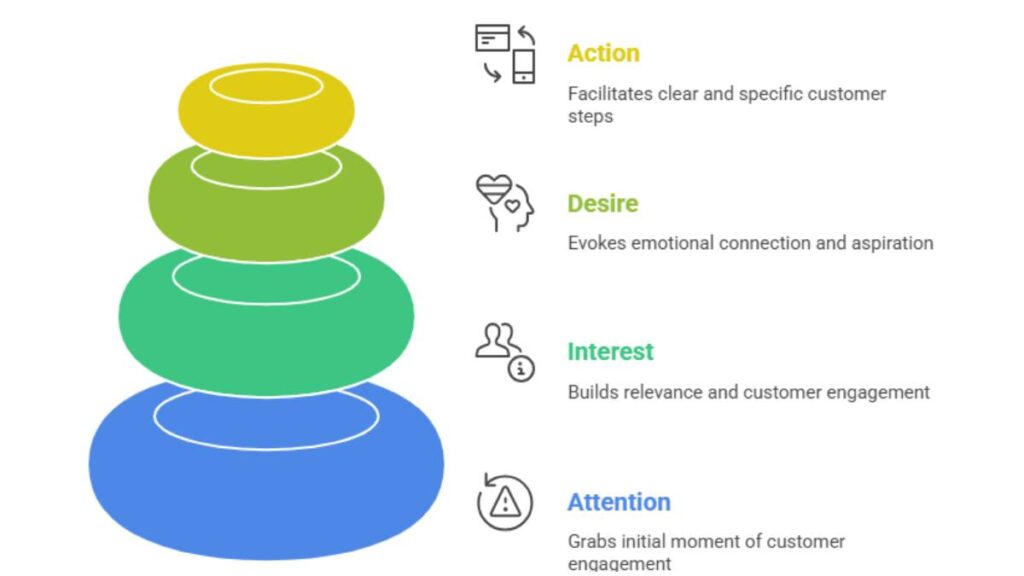
Attention (or Awareness) in the AIDA Model
Attention is the hardest part, and it’s often underestimated.
Most marketing doesn’t fail because the offer is bad. It fails because nobody really noticed it. Or they noticed it in passing and moved on.
Attention means breaking through whatever someone is already focused on. That might happen through:
- A sharp opening line
- A visual that feels different from everything else around it
- A clear problem that hits close to home
- Or simply saying something specific instead of vague
This stage isn’t about explaining. It’s about interrupting. Even briefly.
A quick note on attention vs awareness:
Awareness is knowing a brand exists. Attention is actively noticing a message right now. A brand can have awareness for years and still struggle to get attention in a feed.
Interest in the AIDA Marketing Funnel
Attention buys a moment. Interest decides whether that moment continues.
This is where people subconsciously ask, “Is this worth my time?”
Interest is built when the message starts to feel relevant. Not clever. Not loud. Relevant.
That usually means:
- Talking about outcomes, not just features
- Addressing a real problem instead of a generic one
- Giving enough detail to feel useful, not overwhelming
- Backing claims with proof, examples, or context
Interest doesn’t need hype. It needs clarity. If someone keeps reading, watching, or scrolling, this stage is working
Desire Stage of the AIDA Marketing Model
Desire is where logic quietly hands things over to emotion.
At this point, people aren’t just evaluating. They’re imagining. They start picturing themselves using the product, getting the result, solving the issue that’s been bothering them.
Desire grows when marketing:
- Shows transformation, not just information
- Uses stories, scenarios, or social proof that feel real
- Makes the benefit feel personal, not theoretical
- Aligns with how the audience wants to see themselves
This is the shift from “That makes sense” to “That feels right.”
Good marketing doesn’t push here. It nudges.
Action Stage in AIDA Marketing
Action is where momentum either continues or dies.
By now, the heavy lifting should already be done. The mistake many brands make is treating action as the start, not the finish.
Action works best when:
- The next step is clear and specific
- There’s no unnecessary friction or confusion
- The ask matches the level of commitment built so far
Sometimes action is a purchase. Often it’s smaller: a sign-up, a download, a call. That’s fine. The goal is movement, not pressure.
When AIDA is applied well, action doesn’t feel forced. It feels like the natural next thing to do.
How the AIDA Marketing Model Works (Step-by-Step)
The AIDA model is deceptively simple. Four letters, four stages: Attention, Interest, Desire, Action. Sounds neat, right? But in reality, people rarely move through it in a straight line. They get distracted, skip steps, maybe see an ad, forget it, then notice a review a few days later and finally act. That’s how human brains work; messy, a little random.
Still, the model works as a guide. Think of it like a map rather than a rulebook. It helps figure out where marketing might be falling flat.
Attention: This is the make-or-break moment. Something has to make a person pause, even for a second. Could be a headline, an unusual image, or even a slightly cheeky question. Without attention, nothing else matters.
Interest: Now that they’ve noticed, they need a reason to stick around. This is where relevance comes in. Quick examples, features, or hints at value. Overloading someone here is dangerous; they’ll scroll right past.
Desire: Interest isn’t enough. People have to want it. Desire is about showing how the product or service actually makes life better. Stories, social proof, or real customer results work best here. Emotions start to take the lead.
Action: Finally, the step that counts. Make it obvious what to do next. Click, call, sign up, whatever it is. If there’s any friction, people drop off. Keep it simple.
The stages aren’t rigid. People might skip or loop back. That’s fine. The important part is having a clear structure so messaging doesn’t just float around aimlessly.
AIDA Marketing Model Explained with Real-World Examples
Theory is one thing, but seeing AIDA applied is where it clicks. Let’s break it down with examples from different industries.
Digital Product / SaaS
Attention: A social ad that asks, “Still stuck in spreadsheets?” Short. Snappy. Gets eyes on it.
Interest: A 30-second demo shows how the dashboard saves time. Not too much, just enough to make someone think, “Hmm… that could actually help.”
Desire: Small case studies or testimonials. Real results. Nothing overhyped. People see themselves achieving similar results.
Action: “Start Free Trial” button. Clear, no extra clicks. Maybe throw in a limited-time incentive to nudge urgency, but subtly.
E-commerce Brand
Attention: Instagram post of a backpack mid-air. Looks a bit unusual, catches the eye.
Interest: Carousel highlights durability, tech-friendly pockets, and customer reviews sprinkled in. Enough info to hold interest.
Desire: Lifestyle shots. Someone commuting, traveling, or working remotely. Suddenly, it’s not just a backpack; it’s part of a life people want.
Action: Shop Now button. One click. Maybe a tiny first-time discount. Simple, no confusion.
Service-Based Business
Attention: Local salon posts flyers: “Award-winning stylist now in town.” Bold enough to grab attention.
Interest: Offer a free consultation via email or social posts. Reviews of other clients make it credible.
Desire: Invite-only launch event. People feel special, like they’re missing out if they don’t go. Social proof builds that want.
Action: Multiple booking options: call, online, social message. Easy to act on.
Notice a pattern? Every stage answers a question: Did it grab attention? Is it relevant? Does it make people want it? And can they act without friction? That’s the point; stages overlap, repeat, or even happen out of order. Doesn’t matter. Structure matters more than perfection.

Apply Now: AI-Powered Performance Marketing Course
How to Use the AIDA Marketing Model in Marketing Strategy
AIDA isn’t just for ads. It’s a mindset for thinking about marketing at every level. Step into the customer’s shoes and ask: “Would this make sense to me right now?”
Using AIDA for Digital Marketing
Digital channels are perfect because they let marketers hit all four stages in one campaign.
- Attention: Ads, social posts, and email subject lines that stop a scroll.
- Interest: Explainer videos, blog snippets, mini-guides; show why it matters.
- Desire: Testimonials, mini case studies, influencer mentions. People need proof that it works.
- Action: Clear CTA. Click, sign up, buy. Friction kills momentum.
It’s tempting to overthink this. Don’t. The goal is nudging people gently along, not forcing them down a funnel.
Using AIDA for Content Marketing
Content fits nicely into AIDA if done right:
- Blog posts: Grab attention with the headline, keep interest with useful info, build desire with examples or stories, and finish with actionable tips.
- Video / Reels: Quick hook, show benefits, add a short story, end with a clear CTA.
- Social posts: Short bursts for attention, threads for interest, testimonials or mini case studies for desire, CTA at the end.
The trick: don’t oversell. If the first three steps land, people act on their own.
Using AIDA for Sales and Copywriting
Copywriting essentially grew from AIDA. Here’s how it maps:
- Headline: Grab attention. Bold, sometimes cheeky, sometimes curious.
- Body copy: Build interest. Relevant, credible, digestible.
- Stories/examples: Build desire. Show benefits. Make it feel tangible.
- CTA: Obvious, easy next step. Friction-free.
Good copy doesn’t read like a script. It reads like someone actually thought about the customer, step by step. That’s the subtle power of AIDA; guiding without shoving, logical without being stiff.
AIDA Marketing Model Funnel vs Modern Marketing Funnels
Alright, so here’s the thing. AIDA is simple. Four steps: attention, interest, desire, action. But today? People don’t move in neat lines. They jump around. Check Instagram, then a review site, and back to the website. Funnels feel too neat, too rigid sometimes.
AIDA vs RACE: RACE is more like the modern roadmap: Reach, Act, Convert, Engage. AIDA can sit inside that. Think of it as the early part of the journey, the “first conversation” if you will. RACE keeps the relationship going.
AIDA vs modern funnels: Most modern funnels add loyalty, advocacy, repeat purchase stuff. AIDA doesn’t naturally cover retention, but that doesn’t make it useless. It’s still your guide for the early stages: catching attention, sparking interest, nudging desire.
Omnichannel campaigns: Even if people see your brand across five platforms, AIDA can still anchor your messaging. Attention on a social post, interest in a blog, desire for a testimonial, action via a quick CTA in an email. Stages can overlap. People don’t mind that; it’s the real world.
Bottom line: AIDA is old school, but still handy. Just don’t treat it like a straight line from top to bottom.
Extensions and Variations of the AIDA Marketing Model
Because life isn’t neat, marketers have tweaked AIDA over the years.
AIDAR: The extra “R” stands for retention. Makes sense, right? You get someone to buy, then you want them to stick around. Repeat purchases, referrals, loyalty; this adds a bit of reality to the model.
AIDCAS: Adds confidence before action and satisfaction after. Perfect for high-stakes stuff: cars, software, big-ticket services. People want reassurance before committing. And satisfaction keeps them coming back.
REAN: Reach, Engage, Activate, Nurture. More digital-minded, more cyclical than linear. Useful if campaigns are long-term and layered across channels.
Basically, these variations recognize that buyers aren’t robots. They pause, scroll away, compare options, and come back. AIDA is still the backbone, but the modern tweaks make it fit the messy way people actually buy.
Benefits of the AIDA Marketing Model
Despite being ancient in marketing terms, it still has punch.
Keeps messaging clear: You know what each stage is for. No random “throw everything at the wall” approach.
Shows where customers drop off: If people are seeing the ad but not signing up, maybe the desire stage isn’t strong enough. Easy to diagnose.
Works across industries: SaaS, retail, services… AIDA applies. Doesn’t matter if you sell a backpack or an online course.
Makes content purposeful: Each blog, post, or email has a reason. Not just noise.
Customer-first thinking: It forces the team to think about what people actually need at each step, not just the product features.
AIDA isn’t magic. But it’s a compass. Helps keep campaigns on track. And, honestly, it keeps marketing from wandering into chaos, especially when multiple teams and channels are involved.
Limitations and Criticisms of the AIDA Marketing Model
Okay, let’s not sugarcoat it. AIDA is useful, but it has its blind spots. People talk about it like it’s a magic formula, but life and marketing rarely work that neatly.
Too rigid sometimes: The model assumes a straight path: attention, interest, desire, action. In reality? Buyers zigzag. They might see an ad, check a review site, go back to the website, then sleep on it. AIDA doesn’t capture that loop.
Misses the messy bits: Emotional and social factors, peer influence, urgency, and even timing, aren’t in the original four stages. That can leave gaps if campaigns rely on AIDA alone.
Post-purchase is ignored: Classic AIDA doesn’t think about keeping customers happy, repeat purchases, or loyalty. That’s why variations like AIDAR exist.
Not perfect for complex sales: High-ticket items, B2B deals, multi-decision processes; they move slowly and involve more people. AIDA works, but it can oversimplify these scenarios.
Risk of formulaic content: If every ad or email is forced into the same four-step script, it can feel… robotic. Audiences notice. Humans notice.
Bottom line: AIDA is a great guide, but it’s not the whole story. Think of it as a compass, not a GPS.
Is the AIDA Marketing Model Still Relevant in 2026?
People love to ask, “Isn’t AIDA old news?” And yeah, it is old. But that doesn’t mean it’s useless. It’s a framework, and frameworks don’t die; they evolve.
Digital channels change the game: Today, attention might come from a TikTok clip, interest from a YouTube tutorial, desire through an Instagram story, and action via a one-click ad. Same four stages, just a different path.
Social proof is king: Modern buyers trust what other people say. Reviews, influencers, communities, all of these now feed directly into the desire stage. Makes the model feel more alive, actually.
Data can guide adjustments: You can see where people drop off, which stage they get stuck on, and what they interact with. AIDA gives the skeleton, analytics fills in the meat.
It’s not just for one-off campaigns: Emails, content sequences, retargeting; they all can map back to attention, interest, desire, action. AIDA just gives a structure to what might otherwise feel scattered.
So yes, it’s still relevant, but only if treated flexibly. Stick to the old “linear funnel” idea, and it feels outdated. Adapt it, and it still works like a charm.
Best Practices for Applying the AIDA Marketing Model
If AIDA is going to work in real life, a few practical things matter.
Treat each stage seriously: Don’t lump attention and desire together. Each stage needs something that works for that moment. Miss one, and the rest leaks.
Match content to stage: Bold ads or short videos grab attention. Blog posts or tutorials hold interest. Testimonials or stories build desire. And the CTA? Keep it obvious, simple, no hoops.
Test, then tweak: Nothing works the first time. Look at metrics, see where people drop off, adjust. The framework guides, but results tell the story.
Think retention: Even if sticking to classic AIDA, post-purchase touchpoints are crucial. Follow-ups, loyalty perks, email sequences; they plug the gap AIDA doesn’t cover.
Don’t go robotic: Creativity and human tone matter. Humor, empathy, curiosity; these make each stage feel real, not formulaic.
Keep the customer front and center: Every step should answer, “Does this help the person or just sell something?” If it leans too hard on pushing the product, it fails.
AIDA is simple, but simplicity can be powerful if treated like a map, not a rulebook. Follow it too rigidly, and it fails. Treat it like a guide, add nuance, and it becomes a real tool for guiding people naturally toward action.
Conclusion:
Alright, wrapping this up. AIDA is simple, maybe too simple at first glance, but that’s its charm. It gives a sense of direction without locking anyone into a straight line. People don’t move neatly from attention to action, so don’t treat it like a checklist.
A few things to keep in mind when using it:
- Flexibility matters: The four stages aren’t a ladder. People jump around, pause, or even skip a step entirely. Campaigns need to reflect that, or they’ll feel artificial.
- Make it relevant: Each stage has to mean something to the audience. Don’t just shove features at them; solve problems, answer questions, or spark a tiny curiosity. That’s what actually moves people.
- Keep an eye on results: AIDA gives structure, but you still need to watch metrics. Where are people dropping off? Which stage is weak? That’s where real tweaks happen.
- Spread it across channels: Ads, emails, blogs, social posts; all of these can hit different stages. Just make sure it flows naturally. Forced messaging stands out for the wrong reasons.
- Add retention where it makes sense: AIDA doesn’t cover post-purchase engagement. For long-term success, loop in loyalty, follow-ups, or community touchpoints.
Think of AIDA like a rough map. It shows the route, but the terrain isn’t flat. You still need to navigate, adapt, and improvise. That’s where the real skill lies.
FAQs: AIDA Marketing Model
What is the AIDA marketing model?
At its core, AIDA is just a way to think through how people move from not caring to doing something. First, something catches their eye. Then they pause and pay attention. If it lands, that interest turns into a want. And if nothing blocks them, confusion, doubt, or friction, they act. Attention, Interest, Desire, Action. Simple sequence. Not magic.
Can you give a real example?
Picture a small online store selling handmade notebooks. Someone scrolls past an ad with a bold visual. That’s attention. They tap through, watch a short clip showing how the notebook is made, and maybe flip through a few pages. Interest builds. Then they see a couple of honest reviews or a short note about why the paper feels different. Now it feels personal. That’s desire. A clear “Add to cart” button sits right there. No drama. Action follows, or it doesn’t. That’s real life.
Is AIDA still used today?
Yes, though not always by name. Marketers may not say “we’re doing AIDA,” but the thinking is still there. People don’t jump straight to buying. They warm up. The channels changed; social feeds, inboxes, short videos, but the mental steps haven’t disappeared. If anything, attention is harder now, so the early stages matter more.
How does it work in digital marketing?
Most digital work already fits into AIDA, whether planned or not. A scroll-stopping post earns attention. A useful article or explainer keeps interest alive. Testimonials, examples, or relatable outcomes spark desire. Then comes the ask: sign up, book a call, buy, download. The mistake is rushing people. Skip interest or desire, and action feels forced.
What are the four stages again?
Attention: Get noticed. That’s it.
Interest: Give people a reason to stay.
Desire: Make it feel relevant, even personal.
Action: Remove friction and let them move.