

Keyword match types in Google Ads are one of those things everyone glances over, but honestly, they make or break campaigns. Broad, phrase, and exact match aren’t just labels; they dictate who sees your ads, how much you spend, and whether clicks actually matter. This guide walks through each type, when to tighten the reins, when to let Google roam, and how to mix them without burning money. There’s advice on using negatives, tracking conversions, and spotting mistakes before they drain the budget. Treat match types like dials, not switches; small tweaks over time usually beat big changes done blindly. By getting this right, campaigns can actually grow instead of just spinning their wheels.
Table of Contents
Introduction:
What Are Keyword Match Types in Google Ads?
Keyword match types sit quietly in the background of every Google Ads campaign, but they influence almost everything: who sees your ads, how much you pay, and whether clicks turn into real results.
At a basic level, keyword match types tell Google how closely a user’s search needs to resemble your chosen keyword before your ad is allowed to show. Tight rules mean more control. Loose rules mean more reach. Most accounts struggle not because of bad ads or weak landing pages, but because match types are misunderstood or ignored.
This matters because Google doesn’t just match words anymore. It interprets intent. A user typing a query may never use the exact words you bid on, yet still be looking for exactly what you sell. At the same time, Google can confidently match your ad to searches that look relevant on the surface but are completely wrong for your business.
That tension, between advertiser intent and user intent, is where keyword match types do their work.
Google Ads currently offers three keyword match types:
- Broad match
- Phrase match
- Exact match
Each one gives Google a different level of freedom in deciding when your ad should appear. Knowing how and when to use each is what separates controlled growth from wasted spend.
What Are Keyword Match Types?
Keyword match types define how flexible Google can be when matching your keywords to actual search queries. They don’t decide what you bid on; that’s your keyword list. They decide how loosely those keywords are interpreted.
Think of keywords as signals, not triggers. Match types adjust the strength of that signal.
Depending on the match type you choose:
- Your ad may show for searches that use the same words
- Or searches with the same meaning
- Or searches that are only loosely related to the idea behind your keyword
This is why advertisers sometimes see search terms in their reports that look nothing like the original keyword. That isn’t a mistake; it’s how the system works.
It’s also important to separate the two ideas:
- Keyword targeting: what you tell Google you want to target
- Search term matching: what users actually type and what Google decides qualifies
Match types sit between the two. They act as the filter that determines how wide or narrow that gap becomes.
Why Keyword Match Types Are Important for Google Ads Performance
Keyword match types directly affect performance, often more than bids or ad copy.
Used well, they help:
- Increase ad relevance
- Improve Quality Score
- Control cost per click
- Attract higher-intent traffic
Used poorly, they quietly drain the budget.
Broad targeting without guardrails can flood a campaign with irrelevant clicks. Overly tight targeting can starve a campaign of volume, even when strong demand exists. Match types are what allow you to balance reach and precision instead of guessing.
They also play a major role in scaling. Campaigns that perform well at small volume often break when expanded because match types weren’t adjusted alongside budget increases. On the flip side, campaigns that start too wide struggle to generate clean data early on.
In short, match types help you decide:
- How much control do you want
- How much risk are you willing to take
- How efficiently your budget is spent
That decision impacts CTR, conversion rates, and long-term account stability.
How Keyword Match Types Work in Google Ads
Google Ads no longer matches keywords based on words alone. The system looks at meaning, context, and likelihood of intent.
When deciding whether to show your ad, Google evaluates:
- The user’s query and implied intent
- Synonyms and close variations
- Word order and phrasing
- Historical performance signals
- Context around the search
This is why exact match is no longer truly “exact” and broad match doesn’t require any of your actual keyword terms to appear.
Over time, Google has moved away from literal matching and toward intent-based matching. Close variants, plural forms, reordered phrasing, and implied meaning are all part of the process now. Match types don’t turn this behavior on or off; they influence how far Google is allowed to go with it.
Broad match gives Google the widest interpretation window. Phrase match narrows it by anchoring meaning. An exact match limits it further by requiring strong intent alignment.
Understanding this evolution is critical. Match types are not static rules. They’re dynamic controls layered on top of Google’s interpretation engine. When advertisers treat them as rigid syntax instead of flexible intent signals, performance usually suffers.
Types of Keyword Match Types in Google Ads (Detailed Breakdown)
This is where keyword match types start to feel less theoretical and more practical. Each match type gives Google a different level of freedom when deciding which searches your ads can appear for. More freedom usually means more volume. Less freedom usually means more control.
None of these match types is “good” or “bad” on its own. They’re tools. What matters is how and when you use them.
Broad Match Keywords in Google Ads
What Is Broad Match?
Broad match is the most flexible keyword match type in Google Ads. It allows your ads to show for searches that are related to your keyword, even if the search doesn’t include the exact words you bid on.
Google looks at:
- The overall meaning of the query
- Related concepts and synonyms
- Context around the search
If the system believes the search intent aligns with what you offer, your ad can appear.
This makes broad match powerful, but also risky if it isn’t managed properly.
Broad Match Keyword Examples
Let’s say your keyword is interior paint.
With broad match, your ad could appear for searches like:
- “wall paint colors”
- “home painting supplies”
- “Sherwin-Williams paint”
- “paint for the living room”
Notice how some searches don’t include your keyword at all. That’s intentional. Broad match isn’t about words; it’s about intent.
Pros and Cons of Broad Match Keywords
Advantages
- Maximum reach and visibility
- Strong keyword discovery potential
- Helps uncover new converting search terms
- Scales quickly when campaigns are working
Disadvantages
- Higher risk of irrelevant traffic
- Requires close monitoring
- Can waste budget without proper exclusions
Broad match tends to generate more clicks, but not all of them are equal. Without guardrails, it’s easy to pay for attention that doesn’t convert.
When to Use Broad Match Keywords
Broad match works best when:
- You have enough budget to absorb testing
- Conversion tracking is reliable
- You’re actively reviewing search terms
- The business benefits from broader demand capture (ecommerce is a good example)
For local services or niche B2B offers, broad match needs much tighter control. For ecommerce brands with wide catalogs, it can unlock volume that other match types simply can’t.
Broad Match + Smart Bidding Strategy
Broad match performs best when bidding is tied to conversions, not clicks. Google recommends pairing broad match with conversion-based bidding because it filters traffic in real time based on likelihood to convert.
Instead of bidding aggressively on everything, the system adjusts bids depending on how valuable a search appears. That combination, broad reach with conversion-focused bidding, is what makes broad match viable at scale.
Phrase Match Keywords in Google Ads
What Is Phrase Match?
Phrase match sits between broad and exact match. It allows your ad to show when a search includes the meaning of your keyword, even if the wording isn’t identical.
The intent has to line up. That’s the key difference.
Phrase match still gives Google some flexibility, but it narrows the field compared to broad match.
Phrase Match Keyword Examples
Using the keyword interior paint, phrase match may trigger ads for:
- “Buy interior paint.”
- “best paint for interiors”
- “paint for interior walls”
But it likely won’t show for:
- “exterior paint ideas”
- “paint color inspiration”
- “home decor trends”
Those searches drift too far from the original meaning.
Pros and Cons of Phrase Match Keywords
Advantages
- Better control than broad match
- Still captures variations and related phrasing
- Usually, higher relevance and intent
- More predictable traffic quality
Disadvantages
- Less reach than broad match
- Still needs negative keywords
- Can miss some long-tail opportunities
Phrase match is often the most comfortable starting point. It gives you room to learn without opening the floodgates.
When to Use Phrase Match Keywords
Phrase match works well when:
- You want a balance between scale and control
- Campaigns are new and still gathering data
- Budgets aren’t large enough for aggressive expansion
- Intent matters more than raw volume
For many advertisers, phrase match forms the backbone of their keyword strategy.
Exact Match Keywords in Google Ads
What is an exact match?
An exact match is the most restrictive keyword match type. Your ads will only show when the search closely matches the meaning of your keyword.
This no longer means identical wording, but the intent needs to be very clear and very close.
Exact match prioritizes precision over reach.
Exact Match Keyword Examples
For the keyword interior paint, an exact match could trigger ads for:
- “interior paint”
- “paint for interior”
- “room paint”
But it would not show for broader or exploratory searches like:
- “home paint ideas”
- “best paint brands”
- “paint colors for house”
Pros and Cons of Exact Match Keywords
Advantages
- Highest intent traffic
- Strong relevance and CTR
- Easier performance analysis
- Less wasted spend
Disadvantages
- Lower search volume
- Limited scalability
- Often higher CPCs
An exact match gives you control. Sometimes that control is exactly what you need. Other times, it becomes a bottleneck.
When to Use Exact Match Keywords
An exact match is ideal when:
- Budgets are tight
- You’re targeting high-intent searches
- You want predictable performance
- You’re protecting top-performing keywords
Many successful campaigns start with an exact match, then expand outward once consistent results are in place.
Each match type plays a different role. Broad match helps you explore. Phrase match helps you balance. An exact match helps you protect and refine. The strongest Google Ads accounts don’t choose one; they use all three with intention.

Apply Now: AI-Powered Performance Marketing Course
Which Keyword Match Type Is Best for Google Ads?
No Single “Best” Type
Here’s the deal: there’s no single match type that’s “best” for every situation. It really depends on what the campaign is trying to achieve, how much budget is in play, and how much control is needed over which searches trigger the ads. It’s not one of those things you set and forget. It’s more like steering a boat; you adjust as the currents change.
Broad Match with Smart Bidding
Broad match with Smart Bidding gets a lot of attention for a reason. When there’s enough conversion data in the account, this combination can surface searches you might never have thought of targeting. Then Smart Bidding steps in to make sure clicks are worth the money. Usually, this leads to more conversions without sending the budget through the roof.
Exact Match
Exact match is the opposite: direct and no-nonsense. For keywords that consistently drive results, exact match keeps every click relevant. This is especially useful when budgets are tight; no extra clicks sneaking in from unrelated searches.
Phrase Match
Phrase match sits somewhere in between. It gives more reach than an exact match but still keeps things reasonably tight. For campaigns just getting started or trying to find footing, this middle ground can save headaches.
Real-World Insights
Looking at real campaigns, broad match with Smart Bidding often bumps up conversions with minimal change to cost per acquisition. Exact match tends to give the highest click-through rates and the most qualified leads, though the traffic volume is smaller. Phrase match fills the space nicely; steady results without going too wide.
Key Takeaway
At the end of the day, the “best” match type is really the one that fits the goals, budget, and tracking setup. And most successful campaigns? They mix and match rather than sticking to one type alone.
How to Choose the Right Keyword Match Types
Consider Your Business Type
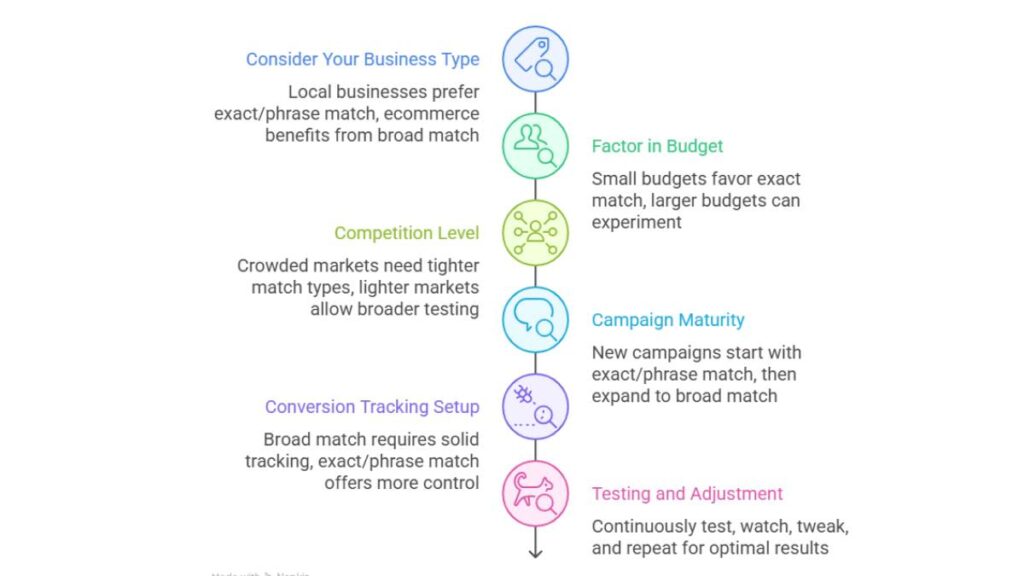
Choosing keyword match types isn’t guesswork; it’s a balancing act that depends on a few things. First, the type of business matters. Local service businesses often do better with exact or phrase match. It keeps leads relevant and avoids getting calls or clicks from people looking for something else. Ecommerce or broader businesses, though, can benefit from broad match because it helps uncover potential buyers who might not be searching for exactly what’s listed.
Factor in Budget
Budget is another factor. Small budgets usually benefit from an exact match. It focuses on high-intent traffic and avoids wasting money on loosely related clicks. Bigger budgets can experiment with phrase or broad match to see what grows reach without hurting ROI too much.
Competition Level
Competition also plays a role. In crowded markets, tighter match types help avoid paying for clicks that won’t convert. When competition is lighter, there’s more room to test broader keywords and see what sticks.
Campaign Maturity
Campaign maturity makes a difference as well. New campaigns often start with exact or phrase match, so performance data is reliable. Once you have a feel for what’s working, broad match can be added to expand reach and uncover more converting searches.
Conversion Tracking Setup
Finally, conversion tracking, or the lack of it, shapes decisions. Broad match works best when paired with solid tracking and Smart Bidding. Without good tracking, an exact or phrase match gives more control over spend and reduces surprises.
Testing and Adjustment
Ultimately, match types aren’t a set-it-and-forget-it thing. Think of it like testing, watching, tweaking, and repeating. Patterns emerge over time, showing which keywords and match types actually drive results. The campaigns that perform best evolve with the data, rather than relying on a fixed plan.
How to Set Keyword Match Types in Google Ads
Getting keyword match types right is simple in theory, but it’s easy to slip up if you’re not careful. Broad match is basically the default; type your keyword, and Google will run with it. So if you put in running shoes, your ad might pop up for searches like “best shoes for jogging” or “athletic footwear deals.” It casts a wide net, which is great if you’re looking for scale, but it can also grab some irrelevant traffic.
Phrase match is a bit tighter. Put quotes around the keyword “running shoes,” and your ad will only appear when that exact phrase shows up in a search. Extra words can appear before or after, but the order matters. It’s a good middle ground if you want some control without going too strict.
An exact match is the sharpest tool. You used to need brackets like [running shoes], but now Google also looks at meaning, close variants, plurals, and similar intents. Every click is usually very relevant, which is great if you want high-quality traffic and your budget is limited.
Changing match types later is pretty straightforward, too. You can tweak them individually in Google Ads, or if you’ve got a big account, Google Ads Editor lets you do bulk changes in minutes. Super handy for when you need to switch hundreds of keywords without messing anything up.
The main point: make sure your match types are set thoughtfully from the start, and revisit them regularly. As campaigns run, adjusting keywords can help you save money, reach more relevant traffic, and get more conversions.
Best Practices for Managing Keyword Match Types
Managing keyword match types isn’t just a one-off task. Negative keywords are huge here. Without a negative broad phrase or exact match, even well-chosen keywords can trigger ads for irrelevant searches, burning budget fast.
Check your search terms regularly. Some queries might surprise you; maybe a broad term is actually converting really well, or maybe some unexpected searches are draining money. Promoting good ones to exact match and adding the useless ones as negatives keeps things tight and efficient.
High-performing keywords deserve some extra attention. A phrase or broad term that converts consistently? Move it to an exact match. That way, you capture the traffic that really matters, without leaving conversions to chance.
The bigger picture: managing match types is active work. It’s not set-and-forget. Regularly pruning negatives, reviewing search terms, and upgrading winning keywords can mean the difference between a campaign that sputters and one that really grows.
Advanced Keyword Match Type Strategies
Once the basics are working, there are ways to step up your game. Broad match can be used strategically to discover new, high-intent search terms. Think of it like casting a net to see what shows up. The data you gather can then inform better targeting decisions down the road.
Mixing match types in a single campaign works well, too. Layer broad match for discovery, phrase match for steady volume, and exact match for the high-intent clicks. It covers multiple levels of intent without wasting money on overlap.
Bidding higher on exact match keywords is another trick. If a term has proven to convert reliably, increasing your bid slightly can squeeze more value out of those high-intent searches. It’s about focusing the budget where it counts, instead of spreading it thin.
These advanced strategies require attention and testing. Nothing works perfectly out of the box. But when done right, layering match types, using broad match to discover, and prioritizing exact match for key conversions, campaigns can get smarter, spend more efficiently, and deliver better results over time.
ChatGPT can make mistakes. Check the important in
Common Keyword Match Type Mistakes to Avoid
Even the most seasoned advertisers trip over the same things when managing keyword match types. Some mistakes are subtle but can quietly drain the budget if ignored.
A classic one is leaning too heavily on broad match without using negatives. Broad match can bring in a flood of clicks, sure, but a lot of them might be completely irrelevant. Suddenly, your ad is showing for searches that have nothing to do with your business; money down the drain.
Then there’s jumping straight to an exact match too early. Exact match is precise, but it’s also restrictive. If a campaign starts here, it can miss out on new keywords or opportunities that might actually convert. It’s tempting to play it “safe,” but that can backfire.
Ignoring search term reports is another trap. These reports literally show what people typed before clicking your ad. Overlooking them means missing chances to weed out junk queries, spot winning searches, or adjust match types for better performance.
Other small but sneaky mistakes include misusing phrase match or stacking match types without a plan. Overlaps or conflicts between keywords can cannibalize traffic or confuse performance data.
The bottom line: keep checking, adjusting, and cleaning up as you go. Match types aren’t a set-it-and-forget-it deal. Paying attention prevents wasted spend and keeps campaigns on track.
Conclusion:
Keyword match types aren’t just a box to tick; they can really make or break your campaigns. They control how far your ads reach, how precise they are, and ultimately, how much value you get from every click. Understanding them well gives control over who sees your ads and when.
It’s never enough to just pick broad, phrase, or exact and leave it alone. The campaigns that perform best treat match types as something to constantly tweak. Look at the data, see what’s working, pull back on what isn’t, and adjust for new patterns.
Over time, match types become a tool for scaling. Broad match can uncover new opportunities, phrase match balances control with reach, and exact match hones in on high-intent clicks. Using them together thoughtfully is where campaigns really take off.
At the end of the day, mastering keyword match types isn’t a one-time thing. It’s an ongoing practice. Keep an eye on the numbers, stay flexible, and let the results guide your choices. When done right, it gives structure, efficiency, and room to grow all at once.
FAQs:
1. What are keyword match types in Google Ads?
Think of keyword match types like traffic lights for your ads. They tell Google when to show your ad based on what someone types. Broad, phrase, and exact all behave differently. Some catch a lot of potential clicks, some keep things tight. It’s less about rules, more about what works for your campaign at the moment.
2. Why do keyword match types matter?
Pick the wrong type, and suddenly your budget is disappearing on clicks that don’t mean anything. Get it right, and your ads land in front of people who actually care. It’s about staying relevant, keeping CTR up, and making sure your spend is not going down a rabbit hole of useless traffic.
3. What’s broad match in Google Ads?
Broad match is kind of like fishing with a big net. You’ll catch a lot, some of it gold, some of it… not so much. Google might show your ad for searches that are loosely related, even if they’re not exact. Works best if there’s tracking in place or Smart Bidding, so the spend goes toward clicks that matter.
4. What’s a phrase match in Google Ads?
Phrase match is somewhere in the middle. Your ad pops up if the search has your phrase, but extra words are fine. It gives decent control without being too restrictive. A good choice if you want steady traffic but don’t want your ads showing up for totally random searches.
5. What’s an exact match in Google Ads?
An exact match is very focused. The search has to match your keyword closely, or a close variant. Clicks are usually super relevant, which is perfect if budgets are tight or conversions really matter. You don’t get huge volume, but what you get is usually worth it.
6. How do I pick the right match type?
It depends. Local services or small campaigns often start with exact or phrase; keeps waste down. Bigger budgets or ecommerce campaigns can try broad match to see what new terms perform. Also, keep an eye on tracking. Broad match without proper tracking can eat your budget quietly.
7. Can I mix-match types in one campaign?
Yes, layering is smart. Broad finds new searches, phrase keeps traffic steady, and exact locks in the hot leads. Just keep an eye on overlaps; without monitoring, it can get messy fast, and you might end up paying twice for the same clicks.
8. Why use negative keywords?
Negatives are basically shields. They stop ads from showing for searches that don’t matter. Especially useful with broad match, because otherwise random clicks creep in. Keep them updated; search behavior changes, and your negatives need to keep up.
9. How often should I check match types?
Frequently. Weekly if you’re running big campaigns, monthly for smaller ones. Check search terms, conversions, and clicks. Adjust match types, promote the winners, and block the junk. It’s a living thing, not a one-and-done setup.
10. Common mistakes with match types?
Over-relying on broad without negatives, jumping straight into exact, ignoring search term reports, or layering types without thinking. These quietly kill ROI. Watching, pruning, adjusting; that’s where campaigns actually improve.