
This blog takes a close look at ROAS in digital marketing and why it matters more than most people give it credit for. It doesn’t just explain the math, though that’s covered too, but digs into how ROAS actually tells the story behind your ad spend. From Google and Facebook to Amazon and mobile campaigns, the blog shows how returns can vary by channel, why context is key, and what mistakes to watch out for. There are real-world examples, practical ways to improve ROAS, and a breakdown of tools to keep it measurable. If advertising dollars are on the line, understanding ROAS isn’t optional; it’s how decisions stop being guesswork and start making sense.
Table of Contents
Introduction
What Is ROAS in Digital Marketing?
ROAS: Return on Ad Spend is one of those metrics that sounds technical but is actually very practical. It simply looks at how much revenue comes back for the money put into ads. Spend ₹1, make ₹4. That’s a 4:1 ROAS.
In digital marketing, ROAS is used to answer a very real question teams face every day: Is this campaign worth continuing? It doesn’t care about impressions or how “engaging” an ad looked. It cares about outcomes. Revenue versus spend. That’s why ROAS shows up in almost every performance discussion, especially when paid media budgets are on the line.
What makes ROAS useful is its directness. No guessing. No interpretation gymnastics. Either the ads are paying for themselves, or they aren’t.
Why ROAS Matters for Marketers and Advertisers
Budgets are limited. Time is limited. Attention is limited. ROAS helps decide where each of those should go.
When ROAS is tracked properly, patterns start to show up fast. Certain campaigns quietly outperform everything else. Others burn money without delivering much back. ROAS brings that clarity. It forces prioritization.
Some practical reasons ROAS matters so much:
- It shows which campaigns deserve more budget, and which don’t
- It helps compare platforms without relying on surface-level metrics
- It brings finance and marketing onto the same page
- It makes performance conversations simpler and more grounded
ROAS also acts as a reality check. A campaign can look great on paper: high clicks, strong engagement, but still fail to justify its cost. ROAS cuts through that noise.
Who Should Care About ROAS?
ROAS isn’t just a “paid ads” metric. It matters to anyone who touches growth or revenue decisions.
That includes:
- Digital marketers managing campaigns day to day
- Ecommerce brands investing heavily in ads
- PPC teams optimizing across multiple platforms
- Founders and growth leads watching cash flow
If money is being spent on digital advertising, ROAS deserves attention. Even when it’s not perfect, it usually tells an honest story.
ROAS Definition and Core Concept
ROAS Explained: Revenue Versus Ad Spend
At its core, ROAS is a comparison. Nothing more.
How much money came in because of ads, versus how much money went out to run them?
That’s why ROAS is so widely used. It mirrors how people naturally think about advertising. Spend this. Get that back. Is the gap wide enough to make it worthwhile?
A strong ROAS usually signals that targeting is right, messaging is landing, and the offer makes sense. A weak ROAS often points to friction somewhere: pricing, audience mismatch, creative fatigue, or tracking issues.
It’s not a perfect metric. But it’s an honest one.
ROAS as a KPI in Digital Marketing Metrics
ROAS sits in a different category than metrics like CPC or CTR. Those measure efficiency or engagement. ROAS measures impact.
That’s why teams lean on it when decisions matter. Scaling budgets. Cutting spending. Choosing between channels.
A few important distinctions:
- CPC tells how expensive traffic is
- CPA shows the cost of a conversion
- ROAS shows what those conversions are actually worth
Used alone, ROAS can be misleading. Used alongside other metrics, it becomes powerful. It helps connect marketing activity to business outcomes instead of vanity numbers.
How ROAS Fits Into the Digital Marketing Funnel
ROAS tends to shine at the bottom of the funnel, where purchases and revenue are clear. That’s where it’s most reliable.
But it still plays a role across the funnel:
- Top of funnel: ROAS may look weak, but these campaigns often support future conversions
- Mid-funnel: Retargeting and consideration campaigns start showing clearer returns
- Bottom of funnel: ROAS becomes a strong signal for optimization and scaling
Context matters here. Judging a brand-awareness campaign by ROAS alone usually leads to bad decisions. Understanding where a campaign sits in the funnel changes how ROAS should be read.
When used with that context, ROAS stops being just a number and starts becoming a decision-making tool.
How to Calculate ROAS
On paper, ROAS is easy. In real campaigns, it rarely stays that way for long. The math is simple. The judgment around it is not.
ROAS Formula for Digital Marketing
At its most basic level, ROAS comes down to this:
Revenue from ads ÷ ad spend
That’s it.
Spend ₹25,000. Generate ₹1,00,000. ROAS is 4.
The mistake many teams make is thinking the formula is the work. It isn’t. The work is deciding what counts as revenue from ads and what counts as ad spend. Those choices quietly shape the final number.
ROAS Expression: Ratios vs Percentages
ROAS shows up in two forms, and both are fine.
- As a ratio: 3:1, 4:1, 6:1
- As a percentage: 300%, 400%, 600%
They mean the same thing. A 4:1 ROAS and a 400% ROAS are identical. Most marketers prefer ratios because they’re easier to think about during day-to-day decisions. Percentages tend to live in reports.
The real issue isn’t the format. It’s switching between them mid-analysis and confusing everyone in the room.
Step-by-Step ROAS Calculation Walkthrough
In a clean setup, ROAS is calculated like this:
- Total ad spend for a campaign
- Total revenue attributed to that campaign
- Revenue divided by spend
But campaigns aren’t clean. There are overlapping audiences, multiple touchpoints, and timing gaps between clicks and purchases. That’s why ROAS is usually more useful when broken down.
Common ways teams look at it:
- Campaign-level ROAS to judge big-picture performance
- Audience or ad-level ROAS to spot winners and losers
- Channel-level ROAS to guide budget shifts
ROAS becomes clearer when it’s compared, not viewed in isolation.
Advanced Considerations When Calculating ROAS
This is where ROAS quietly gets inflated.
Many calculations include only platform spend and topline revenue. That’s understandable, especially early on. But it also hides costs that show up later.
Often excluded:
- Creative production or refresh costs
- Management or execution fees
- Heavy discounts used to push conversions
- Returns, refunds, or cancellations
Leaving these out doesn’t make ROAS useless. It just makes it optimistic. For testing, that’s fine. For scaling decisions, it’s risky.
ROAS by Channel: PPC, Social, Display, and Mobile
ROAS doesn’t behave the same everywhere.
Search campaigns usually deliver steady ROAS because intent is already there. Social campaigns swing more; strong peaks, soft dips. Display and mobile campaigns often look weak on paper but support conversions later on.
Comparing ROAS across channels only works when the role of each channel is clear. Otherwise, solid campaigns get cut for the wrong reasons.
Blended ROAS vs Channel-Specific ROAS
Blended ROAS looks at all ad spend and all revenue together. One number. Big picture.
Channel-specific ROAS zooms in. It shows where returns are strong and where they’re leaking.
Blended ROAS keeps overall performance honest. Channel ROAS helps with optimization. Relying on only one usually leads to overcorrections.
ROAS vs Related Metrics
ROAS is useful, but it’s not a silver bullet. Most problems start when it’s treated like one.
ROAS vs ROI
ROAS and ROI get mixed up constantly, and the difference matters.
ROAS looks only at advertising.
ROI looks at the entire business equation.
A campaign can show a healthy ROAS and still hurt profitability if margins are thin or overhead is high. ROAS answers whether ads are efficient. ROI answers whether the business is.
They solve different problems. Confusing them leads to false confidence.
ROAS vs ACOS (Advertising Cost of Sales)
ACOS flips ROAS on its head.
Instead of asking how much revenue came back, ACOS asks how much was spent to generate that revenue. High ROAS equals low ACOS. Low ROAS equals high ACOS.
In ecommerce, ACOS often feels more intuitive because it aligns closely with margin discussions. ROAS, on the other hand, is easier when planning budgets and scaling spend.
Same insight. Different lens.
ROAS vs CPA, CPC, and CPL
CPC, CPA, and CPL are cost metrics. They tell how expensive actions are.
ROAS tells whether those actions are worth anything.
A campaign can have a low CPA and still underperform if the conversions don’t generate real revenue. Another campaign might look expensive on the surface, but deliver strong ROAS because the customers it brings in actually spend.
That’s why ROAS works best as a decision metric. The others help explain why it looks the way it does.
What Is a Good ROAS? Benchmarks and Industry Standards
This is usually the first question that comes up once ROAS is on the table. And the honest answer is slightly annoying: it depends.
There isn’t a single “good” ROAS that works for every business. What looks healthy for one brand can quietly hurt another.
Common ROAS Benchmarks in Digital Marketing
That said, some rough benchmarks help set expectations.
- Ecommerce brands often aim for something around 3:1 to 5:1
- Service-based businesses may need a higher ROAS to cover operational costs
- High-margin products can survive with lower ROAS
- Low-margin products usually can’t
Benchmarks are a reference point, not a rulebook. Chasing an industry average without looking at margins is how campaigns get scaled too fast, or cut too early.
How Profit Margins Affect Your Target ROAS
ROAS only tells part of the story. Margins fill in the rest.
If a product has strong margins, a 2.5 ROAS might still make sense. If margins are thin, even a 5 ROAS might not be enough once fulfillment, refunds, and overhead kick in.
That’s why ROAS targets should come from business math, not gut feeling. Revenue is good. Profitable revenue is better.
Industry Examples of “Good” vs “Bad” ROAS
A “good” ROAS usually means the campaign can scale without stress. A “bad” ROAS creates pressure: tight cash flow, constant optimization, little room for error.
What’s often overlooked is stability. A consistent 3.8 ROAS over time can be more valuable than a campaign that jumps between 2 and 7 every few weeks. Predictability matters.

Apply Now: AI-Powered Performance Marketing Course
Setting Realistic ROAS Goals
Strong ROAS goals tend to be:
- Grounded in margins
- Flexible across funnel stages
- Reviewed regularly, not locked forever
The best ROAS targets evolve. As data improves, as creatives change, as audiences shift. Static goals usually fall behind reality.
ROAS in Different Digital Marketing Channels
ROAS doesn’t behave the same everywhere. Treating all channels the same is one of the fastest ways to misread performance.
Google Ads ROAS Best Practices
Search campaigns often show clearer ROAS because intent is already there. People are actively looking.
ROAS tends to improve when:
- Keywords are tightly controlled
- Search terms are reviewed regularly
- Landing pages match intent closely
Search ROAS is usually steady. Not flashy. But dependable.
Facebook / Meta Ads ROAS Optimization
Social ads are a different animal.
ROAS here is more volatile. It rises and falls with creative fatigue, audience overlap, and seasonality. Some days look amazing. Others… not so much.
Social ROAS improves when:
- Creatives are refreshed consistently
- Audiences aren’t over-targeted
- Expectations are aligned with the funnel stage
Judging social ads purely on short-term ROAS often leads to pulling the plug too soon.
Amazon and Marketplace Advertising ROAS
Marketplace ads sit very close to the point of purchase. That usually leads to strong ROAS, on paper.
But competition is intense. Small changes in bids or visibility can swing returns quickly. ROAS here needs to be watched closely, especially during high-traffic periods.
Mobile App Advertising and ROAS
ROAS for app campaigns takes patience.
Installs don’t always convert right away. Revenue can come days or weeks later. Early ROAS numbers often look weak before improving over time.
Short windows tell part of the story. Longer windows tell the real one.
How to Improve ROAS
Improving ROAS isn’t about chasing hacks. It’s usually about fixing small, boring things that compound over time.
Targeting and Audience Segmentation
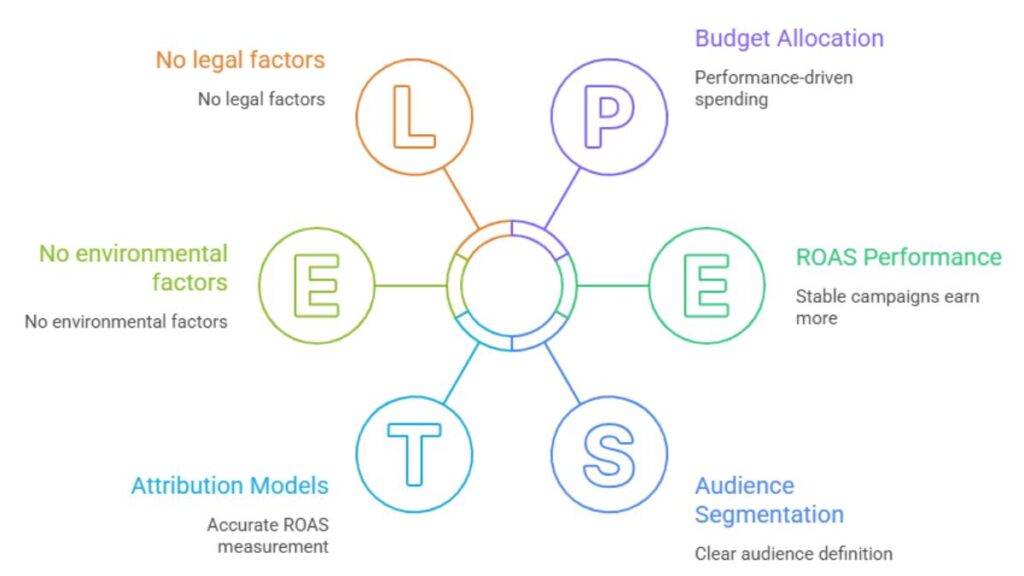
Broad targeting can work, but only when messaging is sharp.
ROAS improves when:
- Audiences are clearly defined
- Messaging matches intent or awareness level
- Retargeting is handled carefully, not aggressively
Over-segmentation can hurt just as much as under-segmentation. Balance matters.
Keyword and Creative Optimization
Keywords bring people in. Creatives decide whether they convert.
Small changes here often drive outsized ROAS gains:
- Clear value propositions
- Strong alignment between ad and landing page
- Removing anything that creates friction
ROAS rarely improves because of one big change. It improves because ten small things stop working against each other.
A/B Testing Ad Variations
Testing doesn’t need to be complicated.
Change one thing. Let it run. Observe. Move on.
Testing too many variables at once muddies the signal. Simple tests, run consistently, usually win over time.
Budget Allocation Based on ROAS Performance
Budgets should follow performance, not promises.
Campaigns with stable ROAS earn more room to run. Campaigns that struggle need constraints, not blind faith. Shifting spend slowly is usually safer than dramatic swings.
Attribution Models and Accurate ROAS Measurement
ROAS is only as good as the attribution behind it.
When attribution is unclear:
- Strong campaigns look weak
- Weak campaigns get credit they didn’t earn
Perfect attribution doesn’t exist. Reasonable attribution is enough. The goal is consistency, not perfection.
Tools and Dashboards for Tracking ROAS
ROAS should be easy to see and hard to ignore.
Clear reporting keeps decisions grounded. Overly complex dashboards tend to slow teams down. If ROAS can’t be explained quickly, it usually isn’t being used properly.
At its best, ROAS becomes a shared reference point. Not a vanity number. Not a scare tactic. Just a clear signal guiding smarter decisions.
Common ROAS Mistakes and How to Avoid Them
ROAS seems simple on the surface; just a ratio of revenue to ad spend, but it’s easy to get tripped up. A lot of campaigns falter not because the numbers are wrong, but because they’re misread or misused.
Ignoring Hidden Campaign Costs
One of the most common pitfalls is forgetting the costs that don’t show up in the ad platform. Think creative production, copywriting, or agency fees. Sometimes, even shipping promotions or discounts get left out.
On paper, the ROAS looks great. In reality, the campaign barely breaks even, or worse. It’s tempting to only look at the platform spend, but a little honesty here can save a lot of wasted budget later.
Misinterpreting ROAS Without Context
ROAS without context can be misleading. A low number might look terrible, but if the campaign is introducing people to the brand, it could pay off later in the funnel. On the flip side, a high ROAS might just reflect a tiny, saturated audience.
Always ask: where in the funnel is this campaign? What’s the conversion window? Context changes everything.
Relying Solely on Short-Term ROAS Signals
Watching ROAS day-to-day can be addictive. But short-term swings are normal, especially for products with longer purchase cycles. Making quick decisions based on daily numbers often leads to overreacting and unnecessary changes.
Patience is underrated. Trends over weeks or months are usually far more telling than yesterday’s ROAS.
Over-Optimization vs Strategic Patience
Another mistake is trying to tweak everything at once. Ads, audiences, bids, copy; it’s tempting to optimize endlessly. But too many changes can destabilize performance.
Sometimes it’s smarter to let campaigns run, track them carefully, and make gradual adjustments. Small, consistent improvements often beat frantic tinkering.
Case Studies and Real-World Examples
Theory is one thing. Seeing ROAS play out in real campaigns brings it to life.
Example: Amazon Ads Campaign ROAS Success Story
Two brands ran similar Amazon Ads campaigns. Daily monitoring highlighted which products weren’t performing. Simple tweaks; adjusting bids, swapping copy; pushed ROAS from around 2.5:1 to a steady 4:1.
The lesson? Sometimes, small, targeted adjustments make a big difference. Consistency matters more than flashy changes.
Example: Multi-Channel ROAS Calculation
A mid-sized ecommerce company ran campaigns across search, social, and display. At first glance, social seemed weak. But tracking revenue across channels revealed that social ads were actually feeding search conversions.
Blended ROAS gave the bigger picture and helped the team allocate budgets more wisely. A single-channel view can be deceiving.
Lessons from High ROAS Campaigns
A few things stand out from campaigns with consistently strong ROAS:
- Audience definition is critical; right people, right message
- Small creative tweaks can improve results more than major overhauls
- Monitoring regularly prevents wasted spend
- Attribution matters; knowing which channel drove revenue is key
High ROAS is rarely the result of one factor. It’s usually many small things working together over time.
Tools and Platforms to Track ROAS
Accurate tracking is where ROAS goes from a number to a decision-making tool.
Analytics Platforms
Analytics platforms help pull together ad spend and revenue. They provide the overview needed to make sense of campaigns, especially when multiple touchpoints are involved.
Paid Ads Dashboards
Platforms like Google, Meta, and Amazon provide dashboards that show ROAS almost in real-time. They’re useful for quick checks, spotting trends, and identifying underperforming campaigns before they cost too much.
Integrations and Reporting Tools
Many brands run ads across multiple platforms. Without integration, it’s easy to misread ROAS. Reporting tools consolidate data, giving a clearer picture of total spend and revenue.
The goal is simple: make ROAS visible, understandable, and actionable. If it’s hard to interpret, it won’t guide decisions effectively. Done right, ROAS isn’t just a number; it becomes a signal for smarter marketing choices.
Future of ROAS in Automated Marketing
ROAS has always been a handy metric, but the way it’s being used is shifting. These days, campaigns run with automated bidding and smarter tracking, sometimes even predicting outcomes before they happen. Sounds fancy, but it doesn’t mean the number tells the whole story. It just gives marketers more signals if those signals are read carefully.
The tricky bit is thinking automation does the thinking for you. It doesn’t. Algorithms can shuffle budgets, adjust bids, or pick audiences, but they don’t understand context. That’s where ROAS comes in as a guide, not a rule. It’s useful to see what worked yesterday, but even more valuable when it helps plan tomorrow.
Then there’s predictive analytics. They can account for things like how often a customer comes back or what their lifetime value might be. That shifts ROAS from a simple ratio into something more nuanced. But here’s the reality: the number only matters if someone looks at it, asks the right questions, and makes decisions. Tools get smarter, sure, but human judgment is still the anchor.
Conclusion
At the end of the day, ROAS isn’t a number you glance at once and forget. It’s the simplest way to see if your advertising spend is actually pulling in money. Across platforms and campaigns, the exact number will differ, but the story is the same: are the ads making more than they cost?
It’s also the kind of metric that tells you where to dig deeper. Maybe your audience isn’t right, maybe the creative isn’t landing, maybe budgets are spread thin. ROAS puts those signals on the table. Track it over time, interpret it in context, and it becomes far more than a number; it becomes a tool for real decisions.
The best way to think about it? Watch it, compare it, don’t obsess over tiny swings, but also don’t ignore patterns. Let ROAS guide budgets, campaign priorities, and conversations about what’s working. Done right, it’s like a compass; you can’t rely on it blindly, but it points you in the right direction.
FAQ:
1. What is ROAS, and how is it different from ROI?
ROAS looks specifically at revenue from advertising spend. ROI is broader; it’s everything, all costs and profits considered. ROAS says if the marketing is efficient. ROI says if the business is profitable. They’re related, but not the same.
2. What is considered a good ROAS?
That depends on the business. A rough benchmark for ecommerce is around 3:1 or 4:1, but margins matter a lot. High-margin products can survive lower ROAS; low-margin products need more to make it worthwhile.
Can ROAS be negative?
Yes. If you spend more on ads than you make in revenue, ROAS drops below 1. Basically, the campaign is losing money.
How often should I calculate ROAS?
It depends on the campaign. Fast-moving campaigns can be checked daily, slower ones weekly or monthly. The key is to have some rhythm and compare consistently.
Does ROAS include all campaign costs?
Not always. Basic ROAS usually looks at ad spend only. For a truer picture, you have to include creative costs, management fees, and other campaign expenses. Otherwise, it can look better than it really is.