

This blog looks at the holistic marketing concept the way it actually shows up inside businesses, not the way it’s usually explained in slides. It connects the dots between messaging, internal teams, customer experience, data, and responsibility, and shows why treating these as separate pieces causes problems down the line. There’s a clear walk-through of the core principles, how they overlap in practice, where alignment usually breaks, and why that matters more than most teams expect. The focus stays practical. Less theory, more reality. It also touches on implementation, common resistance, and where things are headed with AI, personalization, and sustainability. The thread running through it all is simple: coherence builds trust, and trust is hard to fake.
Table of Contents
Introduction to Holistic Marketing Concept
Marketing doesn’t break neatly into boxes in the real world. It never really did, but now the gaps are impossible to ignore. A customer might see an ad in the morning, visit a website at lunch, speak to support a week later, and form an opinion based on all of it combined. Not separately. Together.
That’s the context in which the holistic marketing concept exists. It isn’t a framework invented to sound smart. It’s a response to how people actually experience brands. Everything counts. The message, the follow-through, the tone, the culture behind the scenes. When those things don’t line up, people feel it, even if they can’t quite explain why.
Holistic marketing starts from a simple idea: marketing doesn’t live in campaigns. It lives in the business.
What Is the Holistic Marketing Concept?
The holistic marketing concept looks at marketing as a connected system rather than a collection of tactics. It assumes that every function, branding, communication, internal culture, customer relationships, performance tracking, and social responsibility, shapes how a brand is perceived.
Not in theory. In practice.
A company can run brilliant ads and still lose trust if service falls apart. It can talk about values and still feel hollow if employees don’t buy into them. Holistic marketing exists to close those gaps. It forces alignment between what a brand promises and what it actually delivers.
This approach matters because customers don’t separate experiences the way organizations do. They don’t care which team owns which channel. They only notice whether things feel consistent, credible, and worth their time.
Holistic marketing doesn’t aim for perfection. It aims for coherence.
Evolution of Holistic Marketing in Marketing Theory
Older marketing models were built around control. Control of messaging, control of channels, control of timing. That made sense when attention was limited, and feedback loops were slow.
As markets became crowded and communication turned two-way, those models started showing strain. Customers began comparing experiences instantly. Internal misalignment became visible. Brand promises were tested in public.
Over time, marketing thinking shifted. The focus moved away from isolated wins and toward long-term relationships. Internal culture stopped being an HR issue and started becoming a brand issue. Ethics and responsibility stopped being optional and became part of trust.
Holistic marketing didn’t replace traditional ideas overnight. It grew out of them. It emerged as marketers tried to make sense of complexity instead of simplifying it away.
Holistic Marketing vs Traditional Marketing
Traditional marketing tends to work in pieces. A campaign here. A channel there. Results measured in isolation. That structure can still deliver outcomes, especially in the short term.
Holistic marketing works across connections. It asks whether each effort supports the others. Whether the brand feels the same in different moments. Whether internal decisions quietly undermine external messaging.
The difference shows up over time. Traditional marketing often optimizes performance. Holistic marketing protects trust. And trust, once lost, is expensive to rebuild.
Core Definition & Key Principles of Holistic Marketing Concept
Holistic marketing is built on a few core principles, but they’re not meant to be treated as separate layers. They overlap. They influence each other. In real organizations, they often blur together. That’s normal.
What matters is not ticking boxes. What matters is whether the system holds.
Integrated Marketing
Integrated marketing is less about being everywhere and more about making sense wherever the brand shows up.
When integration is weak, messaging starts to drift. One channel sounds bold. Another sounds cautious. A third feels like it belongs to a different company altogether. Customers pick up on that quickly.
Strong integration creates familiarity. The brand feels recognizable even when the format changes. Over time, that familiarity turns into confidence. People know what to expect, and that lowers resistance.
Integration isn’t flashy. It’s disciplined.
Internal Marketing
Internal marketing is where most alignment efforts quietly fail or succeed.
Employees don’t need slogans. They need clarity. What the brand stands for. Why are certain promises being made? How their role fits into the larger picture.
When internal marketing is ignored, inconsistencies appear in small ways first. Confused responses. Uneven service. Mixed priorities. Eventually, those cracks widen.
When it’s done well, employees reinforce the brand without trying to. Not because they’re trained to, but because the direction makes sense.
Relationship Marketing
Relationship marketing slows things down, and that’s the point.
It values continuity over volume. It assumes that trust is built through repeated, reliable experiences rather than clever persuasion. This changes how communication is handled and how success is defined.
Instead of chasing constant acquisition, relationship marketing focuses on keeping promises. Solving problems properly. Staying relevant without being intrusive.
It’s not soft marketing. It’s patient marketing.
Socially Responsible & Societal Marketing
Brands don’t just operate in markets. They operate in societies.
Every decision sends a signal, intentional or not. About values. About priorities. About how much responsibility the business is willing to take for its impact.
Holistic marketing treats social responsibility as part of strategy, not a side initiative. Not because it’s fashionable, but because credibility depends on it. People are quick to sense when values are performative.
Consistency matters here, too. What a brand supports publicly should reflect how it operates privately.
Performance Marketing within Holistic Strategy
Holistic marketing is not opposed to measurement. It simply asks better questions.
Performance isn’t limited to immediate outcomes. It includes retention, satisfaction, reputation, and long-term growth. Data is used to understand patterns, not just optimize clicks.
When performance marketing sits inside a holistic strategy, metrics become signals rather than scorecards. They help identify where alignment is breaking down and where the system needs adjustment.
That’s where holistic marketing shows its real strength. Not in theory, but in how it adapts over time.
Detailed Components of Holistic Marketing
This is usually the part where things get uncomfortable. Not because the ideas are complex, but because they force a closer look at how marketing actually operates day to day. On paper, most brands claim to be “aligned.” In practice, alignment is fragile. It breaks easily. Sometimes quietly.
Holistic marketing isn’t built from neat components that sit side by side. It’s built from moving parts that constantly affect each other. Change one, and something else shifts. Ignore one, and the system compensates, usually in the wrong way.
Internal Marketing Component Explained
Internal marketing is rarely treated as marketing. That’s the mistake.
When teams don’t share the same understanding of what the brand is trying to achieve, they fill in the gaps themselves. Not out of negligence, but necessity. Decisions still have to be made. Emails still go out. Customers still ask questions.
Over time, those individual interpretations start to show. Slightly different tones. Different priorities. One team pushing growth at all costs, another trying to protect quality. None of it looks dramatic on its own. Together, it creates friction that customers can feel.
Internal marketing is about reducing that guesswork. Making the direction clear enough that people can act without constantly checking if they’re “on brand.” When that clarity exists, alignment happens naturally. When it doesn’t, no external campaign can fix the inconsistency.
Integrated Marketing Communication (IMC) in Holistic Strategies
Integrated marketing communication sounds technical, but the idea is simple. The brand should feel like the same brand wherever someone encounters it.
That doesn’t mean repeating the same lines everywhere. It means avoiding contradiction. The confidence shown in ads shouldn’t disappear in onboarding emails. The promises made on the website shouldn’t quietly change in sales conversations.
When IMC is weak, customers pause. They reread. They hesitate. Sometimes they leave without knowing exactly why. That hesitation is costly, even if it never shows up in reports.
Holistic marketing uses IMC to smooth those edges. Not to impress, but to reassure.
Relationship Marketing as a Major Component
Relationship marketing shifts attention away from quick wins. That alone makes it unpopular in some rooms.
This component assumes that customers remember patterns, not just moments. They remember how problems were handled. Whether communication felt honest. Whether the brand showed up consistently or only when it wanted something.
Strong relationship marketing doesn’t try to be everywhere. It tries to be dependable. It prioritizes follow-through over frequency. Over time, that reliability turns into preference, and preference turns into loyalty.
It’s slower. And it lasts longer.
Social & Societal Marketing Component
Every brand operates within a larger context, whether it acknowledges it or not. Social and societal marketing simply makes that reality explicit.
This component asks uncomfortable questions. What does the brand support in practice, not just in messaging? Where are compromises being made? Who is affected by them?
Customers are rarely fooled by surface-level gestures. They notice patterns. They compare words with actions. When those don’t match, trust erodes quietly.
Holistic marketing treats responsibility as part of long-term credibility. Not a campaign angle. Not a trend. Just part of doing business in public.
Performance Component & Analytics
Performance is where theory meets consequence.
In a holistic setup, performance isn’t reduced to a single number or channel. It’s read across the system. Engagement without retention raises questions. Growth without satisfaction creates risk. Strong short-term results alongside weakening trust signal future problems.
Analytics help surface these tensions. Not to point fingers, but to understand where alignment is breaking down.
Used this way, performance data becomes less about proving success and more about guiding decisions. Which is usually what teams need most.
That’s the real value of these components when they work together. Not control. Clarity.

Apply Now: Advanced Digital Marketing Course
Importance of Holistic Marketing Concept
Holistic marketing matters because brands don’t get evaluated the way teams structure themselves. Customers don’t pause to separate “marketing,” “sales,” and “service” in their heads. They react to the sum of it all. And that reaction sticks.
When things aren’t aligned, the brand feels harder to deal with. Slightly unreliable. When things are aligned, the experience feels smoother, even if nothing flashy is happening. That smoothness is often what people remember.
Building a Unified Brand Experience
A unified brand experience doesn’t mean everything looks the same. It means nothing feels out of place.
Someone moves from an ad to a website. From a website to a conversation. From a conversation to support. Each step sets an expectation. When the next step breaks it, trust drops a notch. Not dramatically. Just enough to matter.
Consistency across touchpoints creates a sense of control. It tells people the brand knows what it’s doing. Over time, that feeling influences behavior more than clever messaging ever could.
Improved Customer Engagement and Loyalty
Engagement improves when interactions feel connected, not random.
Holistic marketing helps because it reduces repetition and confusion. Customers aren’t asked the same questions again. Messages don’t contradict previous ones. Follow-ups feel relevant instead of automated.
Loyalty grows slowly. It comes from a pattern of decent experiences that add up. When marketing, service, and communication pull in the same direction, that pattern becomes easier to maintain.
Efficient Use of Resources & Cross-Team Collaboration
Misalignment is expensive. It just doesn’t always show up on a budget line.
Teams redo work. Campaigns get revised late. Decisions stall because priorities aren’t clear. None of this feels dramatic day to day, but it drains momentum.
Holistic marketing brings clarity around direction. When teams understand the bigger picture, collaboration improves naturally. Less back-and-forth. Fewer corrections. Better use of effort.
Competitive Advantage through Holistic Strategy
Most competitors can copy tactics. They can’t easily copy alignment.
A holistic strategy creates an advantage by making the brand feel dependable. Customers know what they’re getting. Partners know how the brand operates. Internally, decisions take less negotiation.
That reliability becomes a differentiator, even if it’s never advertised as one.
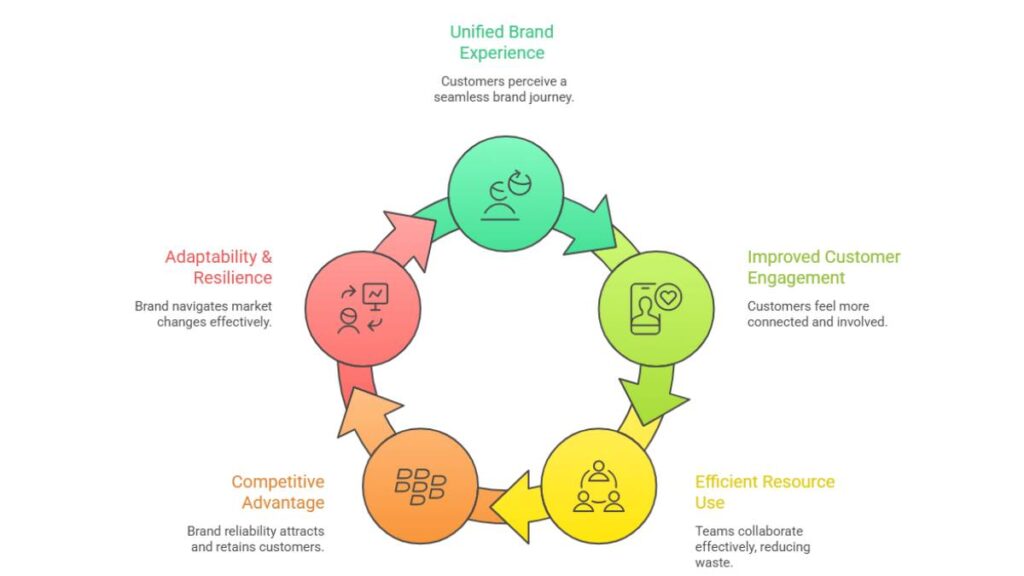
Adaptability & Resilience in Dynamic Markets
Change is constant. Channels evolve. Expectations shift. Pressure builds.
Holistic marketing helps brands adapt without losing themselves. When values and direction are clear, new tactics don’t feel risky. They feel like extensions.
That resilience doesn’t make headlines, but it keeps brands steady when others overcorrect.
How to Implement the Holistic Marketing Concept
Implementation is where theory meets resistance. Not because people disagree with the idea, but because it surfaces gaps that were easy to ignore before.
The goal isn’t to fix everything at once. It’s time to start connecting dots that already exist.
Step-by-Step Framework for Implementation
Begin with observation. How decisions are made. Where communication breaks down. Which teams are working with partial context?
Next comes clarity. What the brand stands for. What it prioritizes. What trade-offs it’s willing to accept?
Only after that does execution make sense. Messaging, processes, and measurement align more easily when the direction is understood. Monitoring happens continuously, not as a final step.
Holistic marketing evolves. It’s adjusted, not “rolled out.”
Building Internal Alignment Around Holistic Goals
Alignment doesn’t come from presentations. It comes from shared understanding.
Teams need to know why certain choices are made and how their work fits into the whole. When context is missing, people default to what feels urgent, not what’s aligned.
Regular communication across teams matters here. Not formal updates. Real conversations. Alignment improves when people feel informed rather than instructed.
Using Data & Analytics to Support Holistic Decisions
Data should inform, not overwhelm.
In a holistic setup, metrics are used to spot connections. A drop in engagement might link back to internal delays. A rise in churn might reflect mismatched expectations.
The focus stays on learning. Numbers guide questions, not conclusions. Decisions improve when data is treated as a signal rather than a verdict.
Real-World Examples and Case Studies
Brands that do holistic marketing well tend to feel steady. Not perfect. Steady.
Their messaging matches their behavior. Their values show up consistently. Growth feels earned rather than forced.
Different industries, different tactics. Same underlying pattern.
Challenges in Adopting the Holistic Marketing Concept
Holistic marketing isn’t difficult because it’s complex. It’s difficult because it requires coordination, patience, and honesty.
The challenges usually come from inside, not outside.
Organizational Siloes & Resistance to Change
Siloes exist for practical reasons. They help teams move fast and specialize. The problem starts when those siloes stop talking.
Holistic marketing doesn’t demand dismantling the structure. It demands better connections. Shared goals. Clear handoffs. Fewer assumptions.
Resistance often fades when people see how alignment makes their work easier, not harder.
Measurement Difficulties Across Integrated Channels
Integrated efforts are harder to measure cleanly. Credit gets blurry. Attribution becomes less satisfying.
This requires a mindset shift. From ownership of numbers to ownership of outcomes. Progress comes from tracking what matters most, even if it isn’t perfectly precise.
Clarity beats perfection here.
Balancing Ethical, Social, and Business Objectives
Trade-offs are unavoidable. Speed versus care. Growth versus responsibility. Short-term results versus long-term trust.
Holistic marketing doesn’t remove these tensions. It forces them into the open.
When values are clear, decisions become more consistent, even when they’re uncomfortable. That consistency is what keeps the system intact when pressure builds.
Future Trends in Holistic Marketing
Holistic marketing isn’t some static theory. It evolves, sometimes in ways that are obvious, sometimes quietly. Customers notice, competitors notice; if your approach isn’t keeping up, you get left behind.
Role of AI & Automation in Holistic Marketing
Automation isn’t magic. It’s just a tool to handle repetitive stuff so people can focus on the bigger picture. That’s the real value. Campaigns don’t have to break down because someone missed a step. Feedback loops get tighter. Teams can react faster.
But here’s the thing: too much reliance, and messaging starts to feel robotic. The trick is letting automation do the grunt work while humans still guide the story.
Personalization at Scale
Personalization has moved past just adding a first name. Today it’s about context. Where is the customer in their journey? What have they done before? What do they care about now?
You can’t just throw in a name and call it personalized. That feels cheap. Doing it right? That requires all teams, marketing, service, and product, to be on the same page. Otherwise, you end up looking inconsistent. And trust me, customers notice that.
Sustainability & Social Impact Driving Marketing Strategy
Social responsibility isn’t a side note anymore. People check whether a brand walks the talk. Sustainability, ethical sourcing, and inclusivity; these aren’t marketing props. They’re part of the story people judge you on.
Holistic marketing makes space for these concerns. If your actions and messaging align, it builds quiet trust. If they don’t… well, that trust disappears faster than most brands realize.
Conclusion
Recap: What Holistic Marketing Concept Is and Why It Matters
At its simplest, holistic marketing is about seeing the bigger picture. Customers don’t interact with marketing in neat chunks. They experience the brand as a whole: products, messaging, support, values, everything.
When these things aren’t aligned, cracks appear. Holistic marketing tries to fix that. It’s not flashy. It’s just coherent.
Key Takeaways for Marketers & Business Owners
- Alignment matters internally as much as externally. Without it, campaigns falter.
- Relationships last longer than quick wins. Focus there.
- Consistency builds trust, even when tactics change.
- Teams working in silos waste energy. Coordination improves efficiency.
- Holistic thinking makes adapting to change easier.
It isn’t easy. But when done right, it shows up everywhere; in loyalty, in clarity, in long-term resilience.
FAQs:
What is the holistic marketing concept?
It’s an approach where marketing isn’t treated as separate channels or functions. Everything, employees, messaging, customer experience, social responsibility, and performance tracking, is viewed as part of a single, interconnected system.
How is holistic marketing different from integrated marketing?
Integrated marketing focuses mostly on keeping messaging consistent across channels. Holistic marketing goes wider. It includes culture, ethics, relationships, performance, and internal alignment; all of it working together.
Why is internal marketing part of holistic marketing?
Because employees are part of the brand experience, whether they’re in marketing or not. Internal marketing makes sure everyone understands the brand promise and acts in ways that reinforce it.
What are examples of holistic marketing in business?
Brands that nail holistic marketing make sure their actions match their messaging. Loyalty programs, consistent omnichannel experiences, sustainable practices, and ethical initiatives; all linked to the brand’s core purpose. Customers feel the coherence, not just see it advertised.