
Marketing only works when there’s restraint. Without it, everything starts sounding the same. This blog looks at STP in Marketing as a way to bring that restraint back. Not as a framework to memorize, but as a way of thinking. It moves from understanding how markets actually break apart, to choosing which groups are worth real effort, to shaping a position people can remember without trying too hard. The sections build on each other slowly. Segmentation sets the base. Targeting forces tough calls. Positioning ties it together. Along the way, it calls out common mistakes, real-world patterns, and why focus usually beats ambition. The theme running through it all is simple: clearer choices lead to calmer, better marketing.
Table of Contents
Introduction to STP in Marketing
Marketing can be… messy. A lot of people try to reach everyone and end up reaching nobody. That’s where STP comes in. Segmentation, Targeting, Positioning. Yeah, it sounds like textbook stuff, but it’s really just a way to stop flailing around.
Segmentation is figuring out who might care. Targeting is picking the people worth actually chasing. Positioning is making sure that when you do reach them, you say something that sticks. Simple in theory. Harder in practice.
Most companies try to be all things to all people. It rarely works. Messages get diluted. Campaigns flop. Budgets get eaten up. STP forces focus. It makes messaging sharper, your audience clearer, and your brand something people remember instead of ignore.
It’s not fancy. It’s just practical. And if done right, it changes everything from the way campaigns are designed to the way products are tweaked.
Why STP Matters
Some businesses treat STP like optional reading. It’s not. Skipping it is basically throwing darts blindfolded. Marketing without focus almost never pays off.
Here’s why:
- Stop wasting money – If the campaign is for everyone, it’s for no one.
- Avoid brand confusion – Clarity matters more than clever slogans. If a brand is everything to everyone, it’s nothing to anyone.
- Make messages actually resonate – When you know what a group cares about, marketing can hit home instead of bouncing off.
The benefits aren’t abstract. Better engagement, smarter spending, stronger positioning. All that happens when the framework actually guides decisions instead of just being a nice chart in a presentation.
In short: focus beats fluff every time.
Understanding Segmentation
Segmentation is where most people get lazy. They either do the obvious stuff or skip it entirely. But this step makes or breaks the whole STP thing. Treat your market like one big blob, and marketing will fail. Break it into meaningful chunks, and suddenly, targeting and messaging start to make sense.
The “Chunks”
- Demographics – Age, gender, income, and education. Simple, but useful. Luxury watches don’t sell the same way to 20-year-olds and 50-year-olds.
- Psychographics – Lifestyle, values, personality. One of the more subtle ones. Two people can have the same income but completely different motivations.
- Behavioral – Habits, loyalty, usage. Who buys often? Who compares brands? Who’s price-sensitive? Very practical.
- Geographic – Location matters more than people admit. Climate, culture, urban vs rural; all of it can influence demand.
- Benefits sought – People don’t buy products; they buy solutions. Some toothpaste buyers want whitening. Others want cavity protection. Messaging changes depending on that.
- Life stage – Marriage, kids, retirement. Different moments, different priorities. Don’t ignore it.
Figuring Out the Segments
Data helps, but numbers aren’t the whole story. Watch behavior, not just what people say. Purchases, clicks, engagement; patterns reveal more than surveys alone. Segmentation done right isn’t about a spreadsheet; it’s about understanding people enough to know who’s worth the effort.
Once you’ve got that, targeting is obvious. And positioning? That’s where you start to look like you actually get the customer, instead of just selling to “everyone.”
Market Targeting: Choosing the Right Customer Segments
Segmentation is nice and all, but targeting… well, that’s where things actually start to matter. It’s where you stop looking at the whole market like it’s one big blob and start thinking: okay, which groups are actually worth bothering with? Not every segment you identify is worth the trouble. And trying to chase all of them usually ends up with wasted money and confusing messages.
Targeting is about picking the groups that actually make sense to chase. The ones that are likely to buy, stick around, and maybe even tell a friend. It’s a bit like fishing; you don’t cast the net over the entire ocean. You look for the schools of fish that are biting.
When picking segments, a few things usually come up:
- Size matters. If the group is tiny, sure, it might be profitable, but is it worth the effort? Sometimes, yes. Sometimes, no.
- Profitability. Not all customers are created equal. Some cost more to reach than they’re worth.
- Accessibility. Can you actually reach them? No point crafting perfect messaging if it never lands.
- Uniqueness. Does this segment have needs your product solves better than anything else out there?
A couple of examples make this less abstract:
- Plant-based milk: You’ve got the health-conscious crowd and the lactose-intolerant crowd. Same product, but the reasons people buy are different, so messaging changes.
- McDonald’s: They target families, teens, young adults, and busy professionals. Same brand, different angles for each segment.
The point is, targeting isn’t about being mean or excluding people. It’s about focus. The more you try to reach everyone, the less anyone hears you. Pick the segments that actually matter, and your marketing will feel sharper; more real, more relevant.
Product Positioning: Standing Out in the Market
Positioning is the bit where targeting meets reality. If targeting is the “who,” positioning is the “why us?” It’s how your product is perceived in the minds of your chosen audience. Done well, people don’t have to think twice; they know what you are, what you offer, and why it matters.
Positioning always ties back to the audience. Say the wrong thing to the wrong segment and your message falls flat. That’s why it matters to keep your segments in mind while crafting it.
Different ways to position a product include:
- Against competitors: “We’re faster, cheaper, whatever.” Straightforward, but only works if the audience cares.
- Around the customer: Solve their problem, not just highlight features. People respond to relevance.
- On price: Low-cost, premium, value for money; it depends on what your audience is sensitive to.
- On benefits: Focus on the real advantage. “Lasts longer,” “saves time,” “makes life easier.”
- On attributes: Sometimes one feature matters more than anything else. Could be design, quality, or even history.
- Prestige/aspirational: Some products sell identity or status more than anything else.
A simple positioning map can help; plot yourself against competitors on the things customers care about. Often, it shows gaps. Places where no one is talking, opportunities to claim a space.
Positioning isn’t static. Markets move, trends shift, competitors poke holes. But if you get it right, your audience immediately gets it. Even in a noisy market, your brand cuts through. That’s the real payoff.
How to Build an STP Marketing Strategy, Step by Step
Step 1: Figure Out Who’s Even in the Room
This sounds obvious. It rarely is. The market isn’t “anyone who might like this.” It’s who could buy, who won’t, and who might; on a good day, with the right push. Until that line is drawn, everything else is guesswork pretending to be strategy. Too many plans fall apart right here.
Step 2: Slice the Market, But Don’t Overthink It
Segmentation isn’t about being clever. It’s about being useful.
Age, location, income; fine. But look deeper. Habits. Triggers. Frustrations. If two groups would react the same way to the same message, they’re not really different. Keep slicing until the differences actually change how marketing behaves.
Step 3: Make the Segments Feel Real
If a segment feels vague, it is vague.
What do they care about? What do they ignore? How long do they hesitate before acting? This isn’t about personas for slides. It’s about clarity. When teams “sort of” understand the audience, the output always shows it.
Step 4: Choose. Then Let the Rest Go
This is where most teams hesitate.
Some segments look big but cost a fortune to win. Others are smaller, quieter, and far more responsive. Trying to serve all of them sounds safe. It isn’t. Focus feels risky at first. It usually pays back.
Step 5: Decide What You Want to Mean
Positioning is a choice, not a slogan.
What should this group remember about you? Why should choosing you feel obvious? If the answer sounds generic, it won’t stick. Being clear beats being clever almost every time.
Step 6: Check If Everything Lines Up
Product. Price. Where it’s sold. How it’s promoted.
If one piece feels off, customers notice. Even if they can’t explain it. Consistency isn’t boring; it builds trust. And trust converts better than hype.
Step 7: Revisit Before Results Drop
Markets move. People change. Competitors adjust.
STP isn’t a one-and-done exercise. The brands that stay sharp revisit assumptions early, not after performance slips. Do that regularly, and marketing stops feeling chaotic. It starts to feel intentional.

Enroll Now: Product Marketing Course Online
STP in Digital Marketing
Digital marketing makes STP feel both more complicated and more useful. Complicated because audiences scatter across platforms, channels, and apps. Useful because there’s more data than ever to actually understand them.
Social media? It’s tempting to spray ads everywhere. But if you don’t really know your segments, you’re just wasting money. Target the right people, craft messages that resonate, and you’ll see results. If you miss the mark, clicks might spike, but nothing else happens.
Email works the same way. Personalization isn’t just putting a first name in the subject line; it’s knowing what that person wants at this moment. Otherwise, your email is just another message ignored.
Even search marketing leans on STP. People search differently depending on where they are in the journey. Some are just browsing, some are ready to buy. If you lump them together, your messaging feels off, and conversions suffer.
The advantage of digital is that you can test, see what works, and adjust fast. But here’s the trap: obsessing over every data point without actually thinking about the audience. Tools are only useful if you know who’s on the other side. Signals matter, but understanding matters more.
In the end, STP in digital marketing is the same principle as offline: pick your audience carefully, focus on the ones that matter, position yourself clearly. The difference is that online, you can see patterns quickly and adjust, so your marketing can actually feel relevant instead of noise.
Real-World Examples of STP in Marketing
Talking about STP in theory is one thing, but seeing it play out is another. The brands that nail this don’t make it obvious; they just make it work.
Take Apple. Not everyone is their customer, and that’s deliberate. They’re targeting people who care about design, status, and simplicity. Every product, ad, and even the store layout, reinforces that sense of premium lifestyle. People don’t just buy the iPhone; they buy the idea behind it. That’s positioning done right.
Then there’s McDonald’s. On the surface, it’s just burgers and fries. But the segmentation is sharp. Families get Happy Meals and kid-friendly experiences. Teens and young adults get snacks, promotions, and things that fit social sharing. Busy professionals? Convenience and speed. The same brand, different messages depending on the audience.
Coca-Cola plays another kind of game. Some campaigns hit health-conscious folks. Others tap into nostalgia or fun. They’ve got multiple segments, and they tailor experiences accordingly. The messaging changes, but the brand stays coherent.
Even a company like Godrej shows that you can target multiple audiences across product lines without losing your identity. Different segments, different products, same brand. The key is clarity; knowing who you’re talking to and why.
STP is not a theoretical exercise. It’s the difference between your marketing landing and just floating in the noise.
Benefits of Implementing STP in Marketing
Skipping STP? Sure, some brands try it. But the reality is, it often means wasted money, confused messaging, and missed opportunities. When you actually put in the work, the benefits are pretty straightforward:
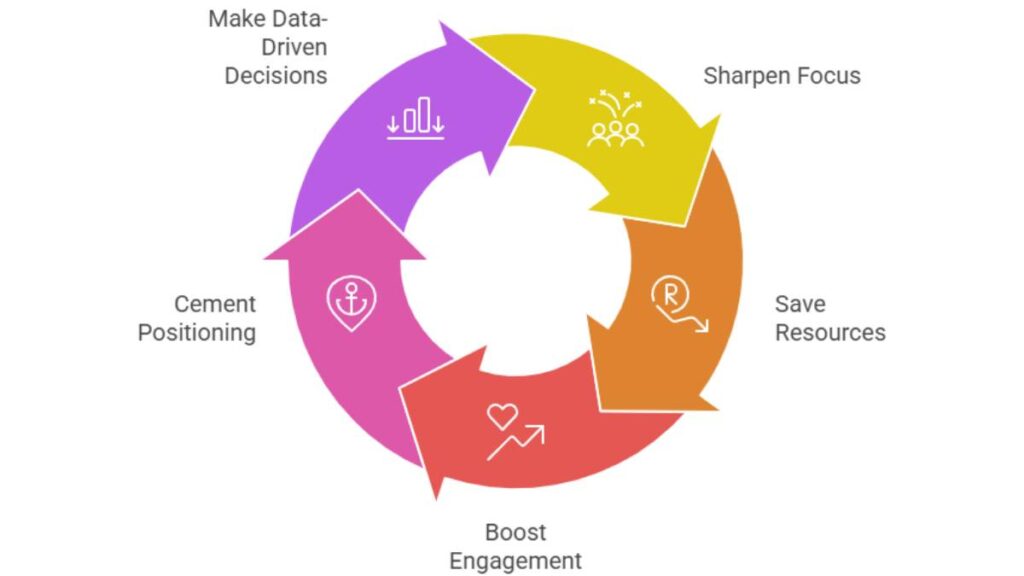
It sharpens your focus. You stop guessing and start speaking in a way that resonates. People notice when you understand them.
It saves resources. Marketing isn’t cheap. Targeted campaigns reach the right people instead of everyone. Fewer wasted impressions, better ROI.
It boosts engagement. When messaging is relevant, people respond. Click, like, share, or buy; it works. Irrelevant messaging? Crickets.
It cements your positioning. A brand that’s clear in the mind of its audience sticks. It’s not just another option on the shelf; it becomes the go-to for the segment you’ve defined.
And it makes decisions more data-driven. STP encourages observation, patterns, and insight over hunches. That doesn’t mean you become robotic; it means you know what actually works instead of hoping.
The big picture is simple: clarity and focus beat randomness almost every time.
Common Mistakes in STP Marketing to Avoid
Even experienced marketers slip up. STP is simple in theory, messy in practice. Some things to watch for:
Trying to reach everyone. Big mistake. If you’re speaking to everyone, you’re really speaking to no one. Focus matters.
Ignoring segment profitability or accessibility. Some groups look interesting but cost too much to reach, or they just won’t convert. Chasing them anyway wastes time and money.
Overcomplicating segmentation. Too many tiny, precise segments can be paralyzing. Keep it meaningful.
Confusing positioning. If the audience can’t tell why you’re different, you’re lost in the noise. Better to be clear than clever.
STP isn’t some secret sauce. It works when you’re disciplined, honest, and pragmatic. Miss these basics, and the strategy falls flat. Nail them, and your marketing suddenly makes sense.
Conclusion
Segmentation, targeting, and positioning often get treated like theory. Slides. Frameworks. Something to “align on” and move past. That’s where things usually go wrong.
STP is not an academic exercise. It’s a discipline. It forces choices. Sometimes uncomfortable ones.
Segmentation is about seeing the market as it really is, not as a single crowd. Targeting is the hard part; deciding who not to go after. Positioning is the long game. It’s what people remember when they’re not looking at ads.
When these three work together, marketing gets quieter. Cleaner. Fewer campaigns chasing everyone. More focus on the right few.
What changes in practice:
- Messaging stops trying to explain everything
- Budgets stretch further because effort is concentrated
- Teams argue less about tactics and more about customers
The biggest benefit isn’t efficiency alone. It’s confidence. Decisions feel grounded. Brands sound consistent. Customers feel understood, not sold to.
STP doesn’t get “done” once. Markets shift. Expectations move. What worked last year might already be slipping. Strong marketers revisit assumptions, adjust segments, and sharpen positioning before performance drops; not after.
That’s the difference between reacting and leading.
FAQs: on STP in Marketing
What is the real difference between segmentation, targeting, and positioning?
Segmentation is observation. Targeting is selection. Positioning is perception. Each builds on the previous one. Skip a step, and the whole structure weakens.
How should segmentation criteria be chosen?
Not by what looks neat in a spreadsheet. Criteria should reflect how people actually think, choose, and buy. If a variable doesn’t change behavior, it probably doesn’t belong in the segmentation.
Does STP make sense for small businesses?
Especially for them. When resources are limited, focus becomes a survival skill. Clear targeting prevents wasted effort and helps smaller brands win on relevance instead of volume.
How does STP show up in digital campaigns?
In who sees what. In which messages get repeated. In which offers feel obvious to the customer instead of intrusive. Good digital marketing usually looks simple on the surface. That simplicity comes from solid STP underneath.
Is STP more strategy or execution?
Both. It starts as a strategy, but it only proves its value in execution. If segmentation doesn’t influence content, targeting doesn’t affect media choices, and positioning doesn’t shape messaging, it’s just theory.
STP isn’t about complexity or jargon. It’s about making fewer, better decisions. And then sticking to them long enough for the market to notice.