
If you ask ten people what a Brand Manager does, you’ll probably get ten different answers.
Some will say branding is all about logos and colors. Others will tell you it’s social media campaigns. A few might say it’s storytelling, advertising, or even psychology. And honestly, they’re all partly right.
Brand management sits at the intersection of strategy, creativity, data, business, and consumer behavior. That’s why transitioning into a Brand Manager role feels exciting and intimidating at the same time.
This article is designed to remove that confusion.
We’ll go deep into the skills to become a Brand Manager, not in a generic checklist way, but in a practical, real-world sense. Whether you’re a student, a digital marketer, a performance marketer, or someone from sales or consulting looking to pivot, this guide will give you clarity, direction, and a roadmap.
Table of Contents
What Does a Brand Manager Actually Do?
Before talking about skills, we need to align on the role.
A Brand Manager is responsible for shaping, maintaining, and growing a brand’s perception in the minds of consumers, while also driving business outcomes.
In most organizations, a Brand Manager works on:
- Brand positioning and messaging
- Campaign planning and execution
- Market and consumer research
- Coordination with agencies, designers, and internal teams
- Tracking brand health metrics and performance
- Ensuring consistency across touchpoints
At companies like Nike, brand managers obsess over emotional resonance and cultural relevance. At a House of Brands company like Hindustan Unilever, they manage portfolios of products with razor-sharp consumer insights. At startups, they often wear five hats at once.
So the skills to become a Brand Manager go far beyond creativity.
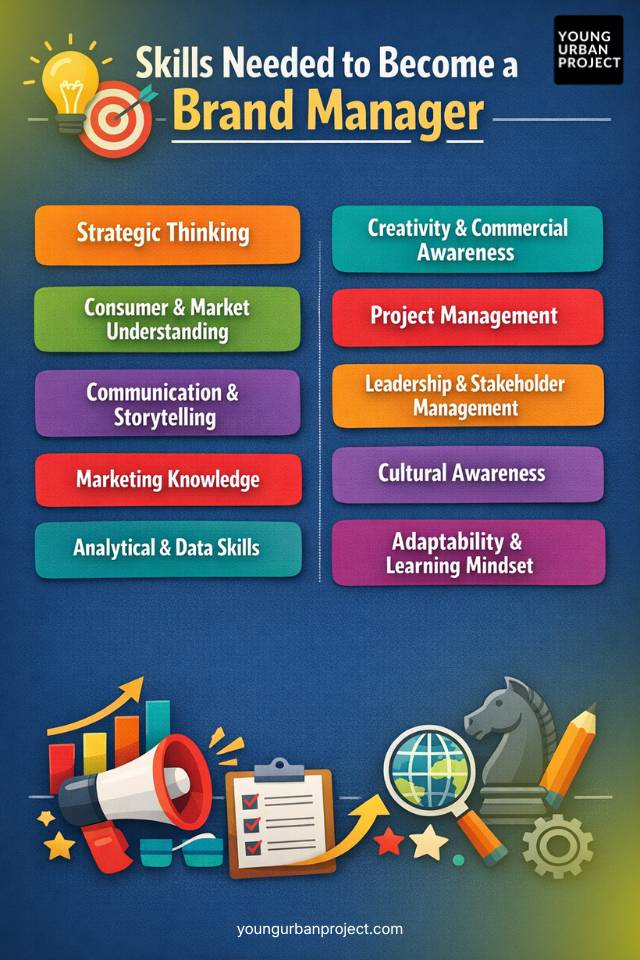
1. Strategic Thinking and Brand Strategy Skills
This is the foundation.
If you want to become a Brand Manager, you must learn how to think in terms of long-term brand value, not just short-term campaigns.
What strategic brand thinking looks like in real life
- Choosing who the brand is for and who it is not
- Deciding which benefits to highlight and which to ignore
- Aligning brand goals with business goals
- Balancing consistency with evolution
Brand Managers constantly answer questions like:
- Why should someone choose us over competitors?
- What problem do we truly solve?
- How should the brand feel five years from now?
Core strategic concepts you must master
- Brand positioning frameworks
- Value propositions
- Brand architecture (house of brands vs branded house)
- Competitive mapping
- Differentiation and relevance
A great example is Apple. Its brand managers don’t sell features. They sell simplicity, creativity, and status. That clarity comes from deep strategic thinking.
Actionable advice:
Practice writing brand positioning statements for real brands. Pick a category and try to define one clear positioning. This skill compounds fast.
2. Deep Consumer and Market Understanding
Brand management is impossible without empathy.
One of the most underrated skills to become a Brand Manager is the ability to understand consumers at a human level, not just as data points.
What this skill involves
- Reading between the lines of consumer behavior
- Understanding motivations, fears, and aspirations
- Translating insights into brand decisions
- Using both qualitative and quantitative research
Brand Managers regularly work with:
- Consumer interviews
- Focus groups
- Social listening tools
- Market research reports
- Survey data
For instance, Dove built its Real Beauty campaign based on deep insights into women’s self-perception, not surface-level trends.
How to build this skill
- Talk to real customers whenever possible
- Learn basic consumer psychology
- Analyze reviews, comments, and forums
- Read ethnographic and cultural studies
Pro tip:
Don’t chase trends blindly. Great Brand Managers understand why trends exist.

3. Communication and Storytelling Skills
Brand Managers are professional communicators.
You’ll spend a huge part of your job articulating ideas, aligning stakeholders, and telling stories that resonate internally and externally.
Key communication scenarios
- Writing creative briefs
- Presenting strategies to leadership
- Aligning agencies and internal teams
- Defining brand tone of voice
- Storytelling through campaigns
Strong storytelling is why brands like Airbnb feel human and relatable, even at scale.
What good brand storytelling requires
- Clarity of message
- Emotional intelligence
- Consistency across channels
- Simplicity over jargon
Actionable exercise:
Try rewriting boring product descriptions into compelling brand stories. This builds narrative thinking.
4. Marketing Fundamentals and Integrated Marketing Knowledge
You don’t need to be a specialist in every channel, but you must understand how all marketing pieces work together.
This is a non-negotiable part of the skills to become a Brand Manager.
Areas you should be comfortable with
- Digital marketing basics
- Content marketing and social media
- Influencer and community marketing
- ATL, BTL, and TTL campaigns
- PR and earned media
- Performance marketing fundamentals
Brand Managers at companies like Coca-Cola orchestrate integrated campaigns where TV, digital, outdoor, and social all reinforce the same brand idea.
Why this matters
If you don’t understand channels, you can’t:
- Evaluate agency ideas
- Allocate budgets smartly
- Judge campaign effectiveness
Practical tip:
Follow live campaigns and break them down channel by channel. Ask why each channel exists in the mix.
5. Analytical and Data Interpretation Skills
Brand Managers are often perceived as “creative types,” but the best ones are deeply analytical.
You don’t need to be a data scientist, but you must be comfortable with numbers and insights.
Common metrics Brand Managers track
- Brand awareness and recall
- Consideration and preference
- Market share
- Campaign performance metrics
- Consumer sentiment
- Sales and revenue impact
At organizations like Procter & Gamble, brand decisions are heavily backed by data.
How data helps Brand Managers
- Validate creative decisions
- Identify brand health issues early
- Measure long-term brand equity
- Optimize future campaigns
Actionable step:
Learn basic Excel, dashboards, and how to read research reports. Interpretation matters more than complex math.
6. Creativity with Commercial Awareness
Creativity without business sense is risky. Business sense without creativity is boring.
One of the most critical skills to become a Brand Manager is balancing creative ideas with commercial realities.
What this balance looks like
- Generating bold ideas within budget constraints
- Aligning creativity with brand objectives
- Understanding ROI, margins, and pricing
- Knowing when to push boundaries and when to play safe
Brands like Zomato excel at this balance. Their creative tone is fun, but always aligned with business growth and app usage.
Mindset shift:
Great brand ideas aren’t just beautiful. They sell, retain, and build loyalty.
7. Project Management and Execution Skills
A Brand Manager’s job doesn’t end at ideas.
Execution is everything.
What execution involves
- Managing timelines
- Coordinating cross-functional teams
- Working with agencies and vendors
- Budget management
- Handling approvals and feedback loops
Even the best strategy fails without disciplined execution.
Tools and skills that help
- Basic project management frameworks
- Clear documentation
- Stakeholder communication
- Risk anticipation
Real-world truth:
Many Brand Managers spend more time managing people and processes than brainstorming ideas.
8. Leadership and Stakeholder Management
You may not always have direct authority, but you must influence.
Brand Managers sit at the center of multiple teams:
- Sales
- Product
- Finance
- Agencies
- Senior leadership
What strong stakeholder management looks like
- Aligning conflicting priorities
- Defending brand decisions with logic
- Negotiating timelines and budgets
- Building trust over time
At large organizations like Tata Motors, brand managers align engineering, sales, and marketing under one brand vision.
Skill builder:
Learn how to present ideas persuasively, not aggressively.
9. Cultural Awareness and Trend Sensitivity
Brands live in culture, not spreadsheets.
Modern Brand Managers must understand:
- Social trends
- Pop culture
- Memes and internet language
- Cultural sensitivities
- Global vs local nuances
Misreading culture can damage a brand instantly. Reading it well can create massive loyalty.
Brands like Netflix stay relevant by being deeply tuned into culture and conversations.
Habit to develop:
Observe how people talk, joke, complain, and celebrate online.
10. Adaptability and Learning Mindset
Brand management is evolving fast.
AI, automation, creator economies, and new platforms are reshaping how brands operate. A key skill to become a Brand Manager today is adaptability.
What this means in practice
- Being open to new tools
- Learning AI-driven insights
- Experimenting with formats
- Accepting that brands are no longer fully controlled
Modern Brand Managers collaborate with creators, communities, and even algorithms.
Long-term mindset:
The best Brand Managers never stop learning.
How to Build These Skills (A Practical Roadmap)
Here’s a simple, realistic approach:
Step 1: Learn the fundamentals
- Brand strategy
- Marketing basics
- Consumer behavior
Step 2: Get hands-on exposure
- Internships
- Marketing roles
- Freelance brand projects
- Side projects and audits
Step 3: Build a brand mindset
- Analyze brands daily
- Question messaging
- Understand positioning shifts
Step 4: Document your thinking
- Create mock brand strategies
- Write case studies
- Share insights online
Hiring managers don’t just look for degrees. They look for how you think about brands.
Common Mistakes Aspiring Brand Managers Make
- Focusing only on aesthetics
- Ignoring business fundamentals
- Avoiding data
- Copying trends without context
- Underestimating execution challenges
Avoiding these mistakes alone puts you ahead of most candidates.
Are You Ready for a Brand Manager Role?
Brand management is not glamorous all the time. It involves ambiguity, pressure, and constant decision-making. But if you love understanding people, shaping narratives, and building long-term value, it’s one of the most rewarding roles in marketing.
The skills to become a Brand Manager are learnable, stackable, and deeply valuable across industries.
Start small. Think big. Stay curious.
Brands don’t build themselves. People do.
Brand Management Skills – Frequently Asked Questions (FAQs)
What are the most important skills to become a Brand Manager?
The most important skills to become a Brand Manager include strategic thinking, consumer understanding, communication and storytelling, marketing fundamentals, analytical skills, creativity with business awareness, project management, and stakeholder management. Together, these skills help Brand Managers build strong brand identities while driving business growth.
Do I need an MBA to become a Brand Manager?
No, an MBA is not mandatory to become a Brand Manager. While an MBA can help with strategic and business exposure, many successful Brand Managers come from backgrounds like digital marketing, content, performance marketing, sales, or communications. Practical experience, strong brand thinking, and demonstrated skills matter more than formal degrees.
How can a digital marketer transition into a Brand Manager role?
A digital marketer can transition into a Brand Manager role by expanding beyond execution and developing skills in brand strategy, consumer insights, integrated marketing, and storytelling. Young Urban Project’s Brand Management Course can help you learn these skills. Working closely with brand teams, contributing to positioning discussions, and building case studies around brand-led campaigns can significantly improve transition chances.
Is Brand Manager a creative or analytical role?
Brand management is both creative and analytical. While creativity is essential for storytelling and campaigns, Brand Managers also rely heavily on data, market research, and performance metrics to make informed decisions. The role requires balancing creative ideas with business and analytical thinking.
Are Brand Manager roles only available in large companies?
No, Brand Manager roles exist in startups, D2C brands, mid-sized companies, and large enterprises. In startups, Brand Managers often have broader responsibilities, while in large organizations, the role may be more specialized and structured.
Is Brand Management a good long-term career?
Yes, brand management is a strong long-term career option. The skills to become a Brand Manager are transferable across industries and roles, including leadership, strategy, marketing, and consulting. With experience, Brand Managers can grow into senior leadership roles like Head of Brand or Chief Marketing Officer (CMO).