

AI in advertising has moved from buzzword territory into everyday execution. Campaigns aren’t run only on fixed rules and manual adjustments anymore. Instead, systems analyze behavior, spot patterns, and adjust delivery, bids, and messaging while ads are live. Sometimes subtly. Sometimes in ways that change performance overnight.
The impact shows up in practical places. Search campaigns lean into users who are more likely to convert, not just those who click. Social platforms expand beyond tightly defined audiences when signals suggest stronger potential elsewhere. Ecommerce ads shift product recommendations based on browsing habits that happened minutes ago. It’s less about guessing, more about responding.
Creative is evolving too. One headline doesn’t carry the whole campaign. Variations rotate, combinations get tested, and engagement data quietly decides what gets shown more often. Not every experiment wins; that’s normal, but the learning compounds over time.
Efficiency is the obvious benefit, but relevance is the bigger story. Ads feel less random when targeting improves. Budgets stretch further when waste drops. Still, none of this runs well on autopilot alone. Clear goals, clean data, and steady oversight make the difference between smart automation and expensive confusion.
The direction is clear, though. Advertising is becoming more adaptive, more responsive, and more data-shaped than ever. The role of marketers isn’t shrinking; it’s shifting toward strategy, creative judgment, and making sure the machines are pointed at the right problems in the first place.
Table of Contents
Introduction
AI in advertising didn’t arrive with a big announcement. It crept in through bidding tools, targeting options, recommendation engines, and small features at first. Now it’s quietly running most serious digital campaigns, whether teams realize it or not.
Advertising has become a real-time decision environment. Users scroll fast, platforms shift constantly, and attention comes in short bursts. Manual campaign management just can’t react quickly enough anymore. That’s where AI earns its place, not as a flashy add-on, but as the engine underneath the dashboard.
A few noticeable shifts have happened because of this:
- Media buying has moved from manual controls to algorithm-guided decisions
- Targeting now leans more on behavior and predicted intent than basic demographics
- Creative isn’t always one fixed version; it adapts depending on who’s seeing it
- Optimization happens during the campaign, not just in post-campaign reports
Traditional digital ads were built around planning, launching, and then analyzing later. AI-powered systems work differently. They adjust while campaigns are live. Budgets move. Audiences update. Bids change. Quietly, constantly.
What Is AI in Advertising?
AI in Advertising Definition
AI in advertising refers to the use of machine-driven models that analyze data, make predictions, and automate campaign decisions across targeting, bidding, creative delivery, and performance optimization.
The key distinction isn’t just automation; it’s adaptation.
Older automation followed rules set in advance. If X happens, do Y. AI systems look at patterns in data, learn from outcomes, and improve future decisions based on what actually works. That learning loop is what makes modern ad platforms feel less like tools and more like systems that “steer” campaigns.
In practice, AI is involved in decisions like:
- Which users are most likely to convert
- How much to bid for a specific impression
- Which creative version to show
- Where the budget should increase or pull back
Most of this happens in the background. No dramatic switches being flipped. Just models constantly recalculating probabilities.
Core AI Technologies Used in Advertising
Several AI technologies power these decisions. Each one handles a different layer of the process.
Machine learning in advertising
Machine learning models process past and real-time campaign data to predict outcomes; clicks, conversions, engagement quality, and even lifetime value in some cases. The more data they see, the sharper those predictions get.
Natural language processing (NLP) in ads
NLP helps systems interpret text-based signals. Search queries, page content, product descriptions, and even user-generated content can be analyzed to understand intent and context. That’s a big deal for matching ads to what people are actually thinking about, not just who they are.
Predictive analytics for ad performance
Predictive models estimate what’s likely to happen next. Which audiences are heating up? Which placements might drop off? Where returns could improve with more budget. This allows adjustments before performance dips become obvious in reports.
Computer vision in digital advertising
Computer vision allows AI to interpret images and video. It’s used for brand safety, contextual alignment, and understanding visual content in environments where text signals are limited. Especially important as video and visual platforms dominate more ad spend.
These technologies don’t operate separately. They layer together, feeding signals into shared models that guide campaign decisions in real time.
How AI in Advertising Works
AI in advertising runs as a loop. Data comes in, predictions are made, decisions are executed, and results feed back into the system. Then it repeats. Over and over.
AI Data Collection and Audience Analysis
Everything starts with signals. Lots of them.
- First-party data vs third-party data in AI advertising
First-party data has become the backbone: site visits, purchase history, app activity, and CRM records. It’s accurate and tied to real customer relationships. Third-party data still exists, but it’s less reliable and harder to use at scale than it once was.
- Behavioral targeting using AI
AI focuses heavily on behavior: what users browse, how long they engage, what they compare, and when they return. These patterns often predict intent better than static demographic labels.
- Real-time audience segmentation
Segments aren’t fixed lists anymore. AI updates audience groupings dynamically. Someone researching today can move into a high-intent segment within hours. Someone who converted yesterday drops out just as quickly.
AI Algorithms for Ad Targeting
Once patterns are clear, AI models estimate probabilities.
- Predictive audience targeting
Each user is assigned a likelihood score for specific actions. Campaigns then prioritize impressions where the probability of conversion is higher.
- Lookalike modeling using AI
Instead of copying surface traits, AI identifies deeper behavioral similarities between existing customers and new prospects. That’s how scale happens without losing relevance.
- Intent-based targeting with AI systems
Search activity, content consumption, and on-site behavior combine to signal when someone is actively considering a solution. Ads aligned to these intent windows tend to perform better, often with less wasted spend.
AI-Powered Ad Placement and Bidding
This is where financial decisions get automated.
- Programmatic advertising with AI
AI evaluates individual impressions across exchanges in milliseconds. It considers user value, context, device, time of day, and competition before placing a bid.
- Automated bidding strategies
Bids aren’t fixed. They rise or fall depending on the predicted conversion value. Some impressions are worth paying more for. Others aren’t worth chasing.
- Real-time bidding (RTB) optimization
During live auctions, AI balances cost against expected return, constantly recalibrating as performance data flows in.
AI for Ad Performance Optimization
Once campaigns are running, AI keeps tuning.
- AI-driven A/B testing
Different creatives, formats, and messages are tested simultaneously. Spend shifts toward winners automatically, often before a human would even flag a difference.
- Budget allocation using AI
Budgets move between audiences, placements, and even channels based on where results are trending up or slipping.
- Performance forecasting models
AI estimates where performance is heading based on early signals, helping prevent overspending in areas that are starting to decline.
All of this creates a system that’s less about setting campaigns and more about guiding them. Humans still define strategy, positioning, and creative direction. But AI handles the constant micro-decisions that used to overwhelm teams. Quiet work. Relentless. And increasingly necessary.
Key Benefits of AI in Advertising
The real advantage of AI in advertising isn’t some futuristic magic trick. It’s consistency. Small improvements, made constantly, across thousands of decisions most teams never even see. Over time, those marginal gains turn into noticeable performance lifts. Not overnight. Gradually. Then all at once.
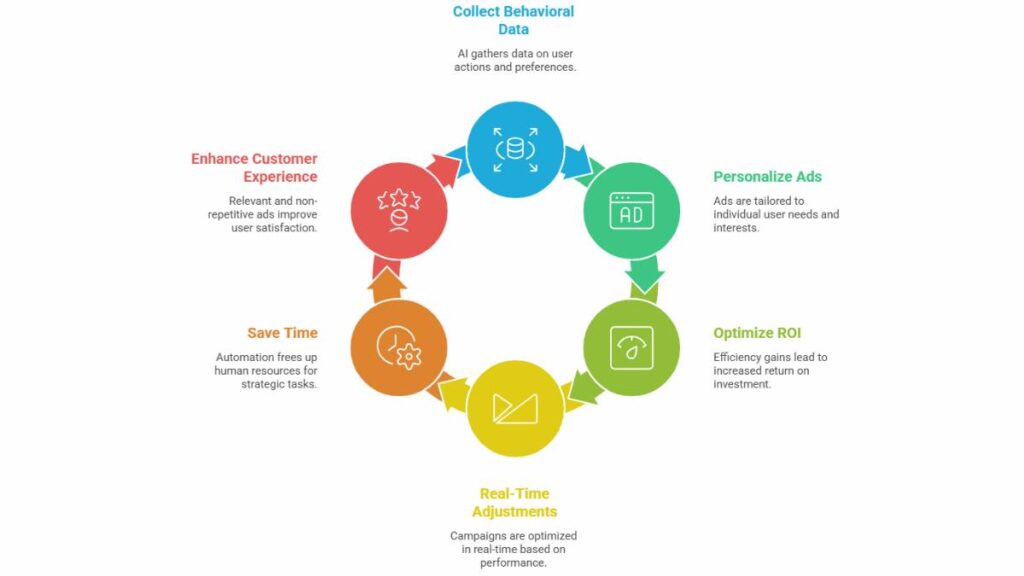
Improved Ad Targeting and Personalization
Targeting used to mean choosing an age range, a few interests, maybe a location, and hoping the message landed somewhere close to the mark. That approach still exists, but it’s no longer the core driver. AI looks at behavior patterns instead; what people actually do, not just who they are supposed to be.
When systems pick up signals like repeat product views, comparison browsing, or content consumption trends, ads can be aligned with those signals. The result feels more timely. Less guesswork. Not perfect, of course, but noticeably sharper than static audience buckets.
Personalization also moves beyond just inserting a first name into a message. Creative can shift based on context; different product angles, different offers, different imagery, depending on what matters most to a specific segment. One campaign can quietly contain dozens of variations. Most users never realize that what they’re seeing is slightly different from what the next person sees. That’s kind of the point.
Increased Advertising ROI
Efficiency gains tend to show up early when AI is used well. Not because costs magically drop, but because waste gets trimmed around the edges.
Impressions that historically lead nowhere get deprioritized. Users who repeatedly engage get more attention. Placements that quietly drain budget without driving action start receiving less spend. It’s a constant rebalancing act. No dramatic switches, just steady corrections based on performance signals.
Conversion rate improvements also come from pattern recognition. Certain combinations, device type, time of day, and audience behavior often convert better together. AI leans into those combinations automatically, scaling what works while easing back on what doesn’t. Over time, that tends to raise the average return per dollar spent.
Real-Time Campaign Optimization
One of the biggest shifts is timing. Optimization used to happen in reporting cycles. Now it happens during delivery.
If a creative starts to fatigue, delivery shifts. If a new audience pocket starts responding well, the budget follows. If costs rise in one area without performance to justify it, the system reallocates. These changes don’t wait for meetings or end-of-week reviews. They happen in the background, all day, every day.
Budget pacing is another quiet win. Campaigns avoid burning through spend too quickly early on, which leaves room to capitalize on late-stage performance trends. That smoother pacing often leads to more stable results across the full flight.
Time-Saving Through Advertising Automation
There’s also a human benefit here that doesn’t get enough attention. Teams spend less time making tiny manual adjustments that rarely move the needle on their own.
Bid tweaks, micro-segmentation, placement exclusions; those used to eat hours. AI handles much of that automatically. That frees up time for bigger decisions: creative direction, offer strategy, landing page experience, cross-channel planning. The work shifts from constant maintenance to higher-level thinking. A healthier place to be, frankly.
Better Customer Experience with AI Ads
This part is easy to overlook, but it matters. When ads are more relevant, they’re less irritating. Still ads, yes, but not completely disconnected from what someone cares about at that moment.
AI also helps manage repetition. If someone has clearly seen the same message too many times, systems can rotate creative or reduce exposure. That helps limit fatigue, which protects both performance and brand perception. Nobody enjoys being followed around the internet by the same banner for two weeks straight.
Top Use Cases of AI in Advertising
AI shows up across the advertising ecosystem in different ways. Some applications are highly visible. Others are buried deep in bidding systems and delivery algorithms.
AI in Programmatic Advertising
Programmatic media buying is one of the clearest examples of AI in action. Every ad impression is evaluated in milliseconds. There’s no human who can look at that volume of opportunities and make smart decisions one by one.
AI models assess signals tied to the user, the context, historical performance, and predicted outcomes before placing a bid. It’s a probability game at scale. Some impressions are worth more. Some aren’t worth chasing. The system makes those calls continuously.
Demand-side platforms lean heavily on these models. They decide not only whether to bid, but how aggressively, based on expected return. That’s where a lot of efficiency gains come from.
AI for Ad Creative Optimization
Creative used to be locked once a campaign launched. Now it’s fluid.
Multiple versions of headlines, descriptions, visuals, and calls to action can run at the same time. Over days and weeks, delivery shifts toward combinations that generate stronger engagement or conversions. Underperforming variations fade out naturally.
Dynamic creative optimization goes a step further. Ads are assembled in real time from different components. Someone interested in price might see a discount-led message. Someone browsing premium products might see quality-focused copy instead. Same campaign structure, different emphasis depending on the viewer.
AI in Social Media Advertising
Social platforms produce massive engagement data: likes, shares, comments, watch time, and profile visits. AI systems digest those signals to refine delivery.
As campaigns run, models learn which users are more likely to take meaningful actions, not just scroll past. Targeting evolves. Delivery tightens. Audiences that looked promising at the start may get less budget later, while unexpected high-performing pockets get more.
Video-heavy platforms rely even more on this feedback loop. Watch time, completion rates, and replays signal interest. AI pushes ads toward viewers who tend to stay engaged longer or interact after watching.
AI in Search Advertising
Search intent is direct. When someone types a query, there’s usually a clear need behind it.
AI-driven bidding systems evaluate not just the keyword, but the context of the search; device, location, time, past behavior, and likelihood of conversion. Bids adjust in real time for each auction. Two people searching the same phrase might trigger very different bid levels based on their predicted value.
Smart bidding strategies also learn from conversion data over time, improving how budgets are distributed across queries and audiences.
AI in Video Advertising
Video generates rich behavioral data. Who watched, how long, what they did next. AI models use this information to refine both targeting and delivery.
Viewers who tend to watch longer or engage after seeing an ad get prioritized. Creative variations can also be rotated based on engagement patterns, keeping messaging fresh and aligned with what holds attention.
AI Chatbots and Conversational Advertising
Advertising is starting to feel more interactive in some environments. Chat-based experiences can answer questions, surface product suggestions, and guide users toward next steps.
AI allows these interactions to adapt in real time. Responses shift depending on what the user asks or clicks. That creates a more guided journey rather than a single static ad leading to a landing page.
AI in Retail Media and Ecommerce Advertising
Ecommerce platforms are heavily shaped by predictive systems. Sponsored products and shopping ads often rely on models that estimate purchase likelihood based on browsing history, cart activity, and past purchases.
Bids adjust depending on product performance, margins, and demand trends. Inventory signals can also factor in, ensuring promotions align with what’s actually available and likely to sell.
Enroll Now: AI Marketing Course
AI Tools for Advertising (Platforms and Software)
Most AI in advertising isn’t found in standalone products. It’s built directly into the platforms marketers already use.
AI Advertising Platforms
Major ad ecosystems rely on machine learning at their core. Automated bidding, audience expansion, and delivery optimization all depend on models that learn from performance data.
Retail advertising platforms use shopping behavior to refine which products get shown to which users. Social platforms use engagement patterns. Search platforms use intent signals. Different data sources, same underlying principle: prediction driving delivery.
AI Tools for Ad Creative Generation
Creative development is also becoming more adaptive. Systems can help generate and test multiple variations of ad text quickly, allowing performance data to guide which angles resonate most.
Visual assets can be resized, reformatted, or adjusted for different placements with less manual production work. That flexibility makes it easier to tailor creative across formats without rebuilding everything from scratch.
AI Analytics and Optimization Tools
On the measurement side, AI helps surface patterns that might be buried in large datasets. Sudden performance shifts, emerging high-value segments, or underperforming placements can be flagged earlier.
Predictive models also estimate future performance based on early campaign signals. That allows for mid-flight adjustments before trends fully play out, reducing the lag between insight and action.
All of these tools share a common thread: they reduce manual guesswork and replace it with data-informed adjustments happening continuously. Not loud. Not flashy. Just steady improvement over time.
AI in Advertising vs Traditional Digital Advertising
People often assume the difference is just automation. It’s not. The real shift is how decisions get made ; and how often.
Manual vs AI-Driven Campaign Management
Traditional campaign management is very hands-on. Someone sets bids, checks results, tweaks budgets, reviews search terms, adjusts again next week. A steady rhythm. Sometimes effective, sometimes slow.
AI-driven campaigns behave more like living systems.
- Bids change based on conversion likelihood, not fixed rules
- Budgets slide toward stronger segments without waiting for a weekly review
- Weak signals get filtered out early, before they drain too much spend
- Tiny behavior patterns ; time of day, device combinations, repeat interactions ; quietly influence delivery
Instead of constant micromanagement, the work shifts toward steering. Setting guardrails. Deciding where the business actually wants growth, not just cheaper clicks.
Traditional Targeting vs AI Audience Targeting
Traditional targeting works with clear boxes: age groups, cities, interest categories. Useful, but broad. Sometimes too broad.
AI targeting leans on patterns instead of labels.
Rather than just asking who someone is, the system looks at what they’re doing and how that behavior compares to past converters. Small signals start to matter ; depth of site visits, repeat searches, engagement timing.
That leads to:
- Audiences that update as behavior changes
- Lookalikes that improve over time instead of staying static
- Delivery that leans toward intent, not just demographics
It’s rarely perfect, but it’s usually more efficient than relying on surface-level traits alone.
Static Ads vs Dynamic AI-Personalized Ads
Traditional ads are built, approved, launched. Maybe refreshed next quarter.
AI-supported creative works more like a toolkit than a finished piece. Multiple headlines. Different descriptions. Visual variations. The system tests combinations and quietly favors the ones driving results for each segment.
One group might respond to price. Another to convenience. Another to trust signals. Same offer, different emphasis. That flexibility is hard to manage manually at scale.
Static ads broadcast a single message. Dynamic setups adjust the message depending on who’s on the other side of the screen. Subtle difference. Big impact over time.
Challenges and Risks of AI in Advertising
All that efficiency comes with trade-offs. Some technical, some ethical, some just practical headaches that show up once campaigns get large.
Data Privacy and AI Advertising
AI models rely heavily on data signals, and data rules are getting stricter every year. That tension isn’t going away.
A few things are becoming clear across the industry:
- Third-party data is less dependable than it used to be
- First-party data is moving to the center of media strategy
- Transparency around data use now affects brand trust, not just compliance checklists
Strong data practices are no longer a background concern. They shape how far AI-driven strategies can actually go.
AI Bias in Ad Targeting
AI systems learn from historical performance. If past data is skewed, the outcomes can be skewed too.
Sometimes that means certain groups see fewer ads. Sometimes it means optimization keeps chasing the “easiest” conversions and ignores valuable but less obvious segments.
Performance metrics alone don’t always reveal this. Delivery patterns matter. Audience breakdowns matter. Responsible use of AI includes checking who is being reached ; and who quietly isn’t.
Transparency and Explainability in AI Ads
AI platforms don’t always explain their decisions clearly. Results go up or down, budgets shift, segments expand or shrink ; and the reasoning isn’t always visible.
That can be uncomfortable for teams used to full control.
The practical approach is balance. Use automation, but don’t disengage. Watch trends. Question sudden changes. Treat platform recommendations as guidance, not commands carved in stone.
Ad Fraud Detection Using AI
One of the stronger use cases for AI sits on the defensive side: fraud detection.
Machine learning systems are good at spotting patterns like:
- Unnatural click behavior
- Traffic spikes that don’t match real user activity
- Repeated low-quality interactions
They can scan volumes of data no human team could realistically review. Still, fraud never disappears completely. Ongoing monitoring and layered protections remain part of the job.
The Future of AI in Advertising
What’s happening now is more of a foundation than a final state. The tools are getting smarter, but the bigger changes are in how advertising itself is structured.
Generative AI in Advertising
Creative production is gradually becoming more iterative.
Instead of building a small set of polished assets and hoping they resonate, teams can test more variations early. Different angles, different hooks, different formats. Some quick, some rough around the edges. The stronger directions get scaled, the weaker ones fade out.
This doesn’t replace creative thinking. If anything, it puts more pressure on having clear ideas and strong positioning. Volume helps, but direction still matters.
AI Agents and Autonomous Media Buying
We’re starting to see systems that don’t just optimize within a campaign, but shift strategy across channels.
Budgets move based on performance trends. Scaling happens faster when signals look strong. Pullbacks happen earlier when efficiency drops. Less waiting for end-of-month reviews.
Human involvement shifts upward ; setting business goals, defining acceptable cost ranges, deciding which products or regions deserve priority. The day-to-day adjustments become more automated, but oversight stays essential.
Voice Search and AI Advertising
As voice interfaces grow, advertising won’t always look like ads.
Recommendations may come through spoken responses. Product discovery might happen through questions instead of scrolling feeds. That changes tone and format ; less visual persuasion, more contextual relevance.
Brands that focus only on flashy creative may struggle here. Being genuinely useful in the moment becomes more important than grabbing attention.
Predictive and Intent-Based Advertising
One of the most important developments is predictive modeling.
AI systems are getting better at spotting early intent signals ; subtle behaviors that suggest someone is moving toward a decision. Not just reacting to past clicks, but anticipating what might happen next.
That allows campaigns to:
- Show up earlier in the buying journey
- Use softer, more helpful messaging instead of aggressive retargeting
- Guide users forward instead of chasing them around
Done well, it feels less like surveillance and more like relevance. Still advertising, of course. Just better timed, and a bit more thoughtful.
The real advantage won’t come from handing everything to machines. It’ll come from combining smart automation with sharp human judgment ; knowing when to lean on the system, and when to step in and steer.
How to Start Using AI in Advertising
Getting started with AI in advertising is less about technology and more about readiness. The brands that see results usually aren’t the ones chasing every new feature. They’re the ones with clean data, clear goals, and the patience to let systems learn before pulling the plug too early.
Step 1: Prepare Your Advertising Data
- Fix broken or duplicate conversion tracking
- Separate high-quality leads from low-intent form fills
- Organize CRM and customer lists into meaningful segments
- Prioritize first-party data that’s accurate and permission-based
- Standardize campaign naming so reports stay usable
Step 2: Choose the Right AI Advertising Tools
- Start with platforms already driving measurable results
- Match automation features to business goals, not trends
- Introduce one major change at a time
- Make sure reporting across channels can be compared easily
- Focus investment where scale makes manual work inefficient
Step 3: Start with AI Bidding and Targeting
- Shift bidding toward conversions or revenue, not traffic
- Allow audience expansion beyond narrow manual filters
- Feed systems strong, consistent conversion signals
- Avoid frequent budget resets during learning periods
- Evaluate performance over weeks, not days
Step 4: Test AI Creative Optimization
- Provide multiple messaging angles tied to real buyer concerns
- Use varied visuals that reflect different use cases
- Keep creative inputs structured, not random
- Let performance data decide which themes grow
- Refresh creative before fatigue drags performance down
Step 5: Measure and Refine AI Campaign Performance
- Track revenue quality alongside volume
- Review trends across longer timeframes
- Identify segments delivering incremental growth
- Shift budget toward stable, efficient performers
- Adjust strategy based on business goals, not just platform prompts
Conclusion:
AI in advertising is gradually changing how campaigns operate. Instead of relying on fixed settings and periodic manual updates, advertisers now work with systems that learn from behavior and adjust as performance data comes in. The shift isn’t loud, but it’s steady ; and it adds up.
The advantages show up in smarter targeting, faster optimization, and more efficient use of budgets. Campaigns can improve while they run, not just after reports are reviewed. Creative evolves based on engagement, and audience models surface pockets of opportunity that might otherwise go unnoticed.
Still, automation alone doesn’t drive results. Clear strategy, reliable data, thoughtful messaging, and human oversight remain essential. AI handles speed and scale; marketers provide direction, context, and judgment. That balance ; practical, measured, and intentional ; is what will shape the next chapter of digital advertising.
FAQs: About AI in Advertising
1. What is AI in advertising?
AI in advertising refers to the use of data-driven systems that analyze behavior patterns and automatically adjust how ads are targeted, delivered, and optimized. Instead of relying only on manual rules, campaigns respond to real-time performance signals, helping advertisers reach more relevant audiences and improve efficiency across the customer journey.
2. How is AI used in digital advertising?
AI is used to power automated bidding, predictive audience targeting, dynamic creative selection, and performance forecasting. It processes large volumes of behavioral data to determine who is most likely to convert, what message resonates best, and when ads should be shown, allowing campaigns to adapt continuously rather than staying static.
3. What are the benefits of AI in advertising?
AI helps improve targeting precision, reduce wasted ad spend, and optimize campaigns while they are live. It can uncover patterns that manual analysis often misses and respond faster to changes in user behavior. Over time, this leads to stronger return on investment and more relevant experiences for potential customers.
4. Is AI replacing human advertisers?
AI is not replacing advertisers, but it is reshaping their responsibilities. Automated systems handle repetitive optimizations and large-scale data analysis, while humans focus on strategy, creative direction, and aligning campaigns with business priorities. The strongest results usually come from collaboration between human judgment and machine-driven efficiency.
5. What are the risks of AI in advertising?
AI in advertising brings challenges such as data privacy concerns, algorithmic bias, and limited transparency into how certain decisions are made. Overreliance on automation without proper oversight can also lead to misaligned optimization. Careful monitoring, ethical data practices, and clear objectives help manage these risks effectively.