
BTL marketing isn’t the loud, flashy stuff you see on TV or billboards. It’s quieter, more personal, and often way more effective. The idea is to reach the people who actually care about what you’re offering, not just toss your message into the void. That might mean a timely email, a small event, a free sample, or even a local promotion that hits the right spot at the right time. It’s measurable, flexible, and surprisingly cost-effective. This blog goes over what makes BTL marketing tick, compares it with ATL and TTL, explores the tactics that work, and explains why it drives real engagement and ROI.
Table of Contents
Introduction
When most folks hear “marketing,” the first things that pop into their heads are TV ads, huge billboards, or maybe a catchy radio jingle. That’s the classic Above-the-Line stuff; big, flashy, and expensive. But not every brand has a multi-million-dollar budget, and honestly, those big campaigns don’t always translate to sales. That’s where Below-the-Line (BTL) marketing comes in.
BTL is quieter. More targeted. It’s about connecting with the people who actually care about what you’re selling. Could be a personalized email that lands just at the right moment, a sample of your product at a local store, or a small, well-thought-out event. The thing is, these tactics aren’t trying to impress everyone; they’re trying to move the people who matter.
Some things about BTL that make it different:
- Personal touch matters. It’s not a shout into the void. You’re reaching people directly, and if done right, they notice.
- You can see what’s working. Unlike a billboard, where you hope someone notices, BTL lets you track results. Opens, clicks, visits, sign-ups; it’s all measurable.
- It builds loyalty. People stick with brands that treat them as individuals. Even small gestures count.
- Flexible budgets. You don’t need a blockbuster budget to make an impact. Start small, scale smart.
The bottom line? BTL isn’t flashy, but it works. Often, better than anything above the line. And for businesses trying to stretch every marketing dollar, it’s a game-changer.
History and Evolution of BTL Marketing
Funny story about the term itself: “Below-the-Line” comes straight from old accounting practices. Back in the 1950s, big companies like Procter & Gamble literally drew a line on their budget sheets. Everything above it, TV, radio, print ads, was for mass audiences. Everything below it, small, targeted campaigns, was “secondary.” That secondary stuff? Turns out, it became critical.
Over time, BTL has changed a lot:
- From general targeting to precision. Back then, it was flyers in a neighborhood or coupons in the mail. Now, thanks to data, you can reach people based on interests, purchase behavior, and even timing. No guesswork.
- Mixing digital with real life. BTL used to be offline only. Now, email, social media, and SMS; these all blend with offline tactics for a bigger impact.
- Experiences sell. Pop-ups, workshops, product demos; these aren’t gimmicks. There are ways to get people to feel your brand, remember it, and hopefully talk about it later.
Here’s the takeaway: it’s not about how many people see your campaign. It’s about how the right people experience it. That’s why BTL works. It’s targeted, personal, and can be done on almost any budget if you think about it the right way.
BTL Marketing vs ATL and TTL Marketing
Most people assume marketing is all about reach; get as many eyes as possible. But in reality, blasting your message everywhere often wastes time and money. That’s where understanding ATL, BTL, and TTL comes in.
- Above-the-Line (ATL) is your big, broad stuff. TV, radio, billboards. It’s loud, expensive, and great for making your brand known. But the catch? You don’t really know who’s paying attention, or if they’re going to do anything.
- Below-the-Line (BTL) is the opposite. Small, precise, targeted. You’re not speaking to everyone; you’re speaking to the people who might actually buy. Could be a sample at a store, a personal email, or a small local event. The goal isn’t just visibility; it’s action.
- Through-the-Line (TTL) mixes the two. Run a big ad to get attention, then follow up with a direct campaign to convert the interested folks. It’s tricky to get right because the timing and messaging need to align, but when it works, it covers the whole funnel.
Some practical ways to think about it:
- ATL = make people notice, hope they act.
- BTL = make people act, know exactly who you’re reaching.
- TTL = do both, coordinate it.
A lot of brands rely on BTL to actually drive results. ATL might get the crowd into the theater, but BTL sells the tickets. And honestly, for most businesses, especially smaller ones, this precision often beats throwing money at mass campaigns that may or may not stick.
Key Characteristics of BTL Marketing
BTL is more than a set of tactics. It’s a philosophy about how you connect with your audience. Done right, it turns interest into action; fast. But certain things need to be in place.
1. Targeted Audience
Not everyone is your customer. BTL is about honing in on the folks who care. Could be past buyers, certain demographics, or even behaviors. The more precise you are, the better your return. Wasted impressions cost money and attention.
2. Direct Communication
Emails, texts, even a quick chat at an event; these are chances to connect personally. A small nudge, sent at the right moment, can make more difference than a billboard ever will.
3. Personalized Messaging
It doesn’t take much to stand out: using a person’s name, referencing a recent interest, or offering something relevant. It makes people feel like you actually see them. That feeling sticks.
4. Interactive Experiences
Demos, workshops, pop-ups, sampling; whatever gets people involved. Interaction builds trust faster than passive advertising. And trust often leads to action. People remember experiences more than ads.
5. Strong Calls-to-Action (CTAs)
Every campaign needs a clear next step. Sign up, visit the store, claim the offer; no guessing. If it’s vague, momentum dies.
BTL isn’t easy. It takes effort, planning, and attention to detail. But done right, it’s hands-down one of the most effective ways to convert interest into real customers. Think of it as working smarter, not just louder.
Popular BTL Marketing Methods and Examples
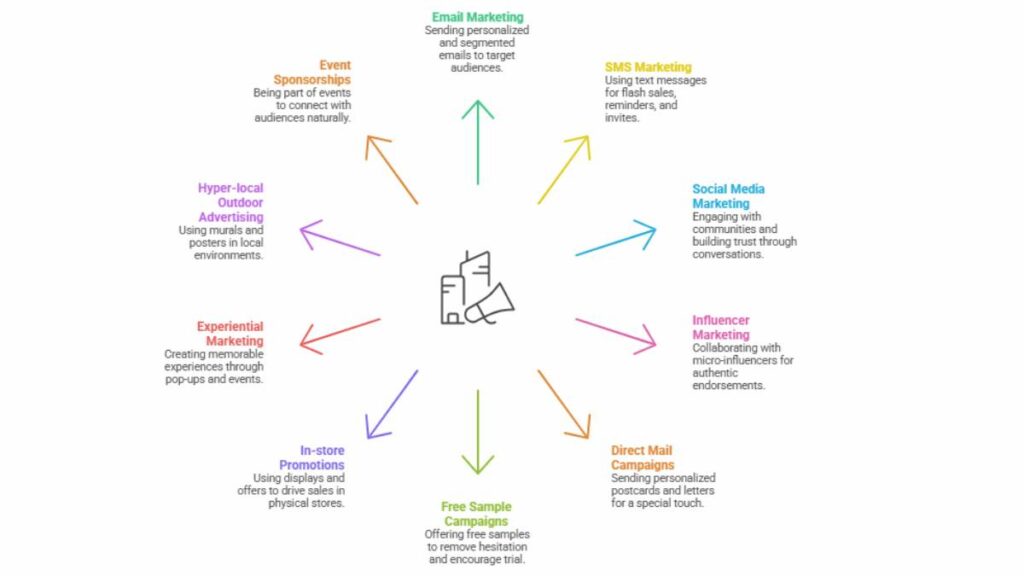
Email Marketing
Email isn’t dead; far from it. But here’s the thing: most brands get it wrong. Sending generic blasts? Forget it. People delete those before finishing their coffee. The secret is relevance. Segmenting your audience, sending the right message to the right people, timing it when it matters… that’s what works. A welcome series, a small product update, or a discount that actually feels personal can do more than dozens of broad campaigns. And yeah, automation helps, but it doesn’t replace thinking about the person on the other side.
SMS Marketing
Text messages hit fast. Really fast. People read them almost immediately. That immediacy is a weapon if used right. Flash sale? Perfect. Appointment reminder? Golden. Special invite? Works every time. But if you’re annoying, irrelevant, or vague, it’s gone, and people won’t forgive it. Short, useful, timely. That’s all it needs to be. And somehow, brands keep overcomplicating it. Simple works.
Social Media Marketing
Social media in BTL is not about flooding feeds with content. It’s tiny, sharp moves. One live Q&A can build far more trust than twenty posts that don’t hit the mark. Community matters, conversations matter. Answer comments, slide into DMs when appropriate, share behind-the-scenes stuff that feels human. People don’t just want content; they want connection. And that’s where the real value hides.
Influencer Marketing
Big-name influencers? Sometimes overrated. Micro-influencers, niche creators; they punch above their weight. Their audience trusts them because they’re relatable. A short story about using your product, a quick demo, a casual mention; it lands differently than a polished ad. Authenticity matters. People sniff out fake endorsements instantly.
Direct Mail Campaigns
Direct mail has a weird charm. In a world of screens, a real piece of mail can feel… special. Postcards, letters, small catalogs; they get noticed, especially if they’re targeted and personal. Throwing generic stuff in the mailbox? Waste of money. But something that speaks to the person, even with a tiny personal touch, can linger in the mind longer than any email.
Free Sample Campaigns
People love trying before buying. Free samples remove the hesitation, let the product speak for itself. But don’t just hand them out randomly. It’s about precision; giving them to people who might actually care. Pair it with a next step, a coupon, or a link; otherwise, curiosity fizzles out. Done right, samples are like magic for conversion.
In-store Promotions
In-store promotions are low-tech but effective. A well-placed display, a little gift, or a seasonal offer can tip a casual shopper into a sale. Timing and placement are everything. Near the checkout, high-traffic areas make it impossible to ignore. Add urgency, scarcity, or a small perk, and suddenly people are grabbing what they might have passed by. Clear, eye-level in-store displays with simple messaging and strong visuals help spotlight key products and quietly guide shoppers’ decisions right at the moment of purchase.
Experiential Marketing
Experiential marketing is where BTL shines. It’s about creating a memory, not just pushing a message. Pop-ups, workshops, interactive events; let people touch, taste, test. The ones who experience it remember it. They tell their friends. It sticks. Ads rarely do that. This is human, tangible, and yes, sometimes messy; but that’s the point.
Hyper-local Outdoor Advertising
Local ads don’t have to be huge. A mural on a neighborhood wall, a small poster at a bus stop, even something cheeky near a local café; those things work. People notice when it’s part of their environment. Context matters: make it relatable, nod to the area, add a little humor. Suddenly it’s not an ad. It’s part of the neighborhood.
Event Sponsorships
Sponsoring an event is not just slapping a logo on a banner. It’s showing up, being part of something people care about. Hand out samples, chat with attendees, offer deals that actually make sense. Sports events, book fairs, community meetups; find where your audience actually hangs out. The more natural the presence, the more people remember you.
BTL isn’t about flashy campaigns or mass reach. It’s precision, timing, relevance, and most of all, human connection. Do it well, and the results aren’t just sales, they’re relationships. Relationships that last longer than any billboard ever could.

Enroll Now: Advanced Digital Marketing Course
Benefits of BTL Marketing
BTL marketing isn’t flashy. It doesn’t make the kind of headlines that ATL campaigns do. But here’s the thing: it works in ways those big campaigns often can’t. It’s about precision. Hitting the people who actually matter instead of shouting into the void.
ROI is often higher than what most expect. When you spend smartly on a campaign targeted to the right people, you often get better results than a massive campaign that reaches everyone but connects with almost nobody. Small, focused actions; a well-timed email, a demo at the right event; these can stick with a customer much longer than a TV ad ever could.
There’s also the flexibility side of it. You can test things, tweak messages, and pivot mid-campaign if something isn’t working. Measurability is another huge bonus. Unlike big ATL campaigns, where tracking impact can be messy, BTL gives clear signs: engagement, conversions, and foot traffic. And the cost factor; it’s not cheap in time, but financially it’s often far more forgiving than buying mass media.
It’s targeted. It’s measurable. And when done right, it punches way above its weight.
Challenges and Limitations of BTL Marketing
Now, it’s not perfect. Nothing ever is. One big issue is that BTL takes effort. It’s not like you can just set something up and forget it. Personalization, follow-ups, on-the-ground events; all that stuff eats time.
Reach can be a problem, too. If your goal is to make your brand a household name overnight, BTL alone won’t cut it. It’s precise, but narrow. It shines when combined with broader strategies.
Expertise is critical. Miss your audience, get the timing wrong, or send the wrong message, and it can flop hard. Scaling is another headache. What works in one city or one demographic might not translate somewhere else. You have to adapt constantly; a local nuance here, a cultural detail there; otherwise, your efforts can feel flat.
So yes, BTL can be incredibly effective, but it’s demanding. The companies that pull it off well tend to be the ones that pay attention to the small details and aren’t afraid to get a little messy in execution.
Five Steps to Successful BTL Marketing Campaigns
Getting BTL right doesn’t have to be complicated, but it does need structure. Here’s a framework that actually makes sense in the real world.
Step 1: Define clear goals and KPIs
Before spending anything, figure out what success looks like. Is it sales? Leads? Engagement? Make it measurable. Otherwise, you’re flying blind.
Step 2: Know your audience
BTL is all about precision. Who are you trying to reach? Where do they hang out? What makes them tick? Getting this wrong is expensive.
Step 3: Check your resources
Be honest with yourself, your team, your budget, and your time. Don’t promise a huge experiential campaign if there’s no one to run it. Start small, scale smart.
Step 4: Pick your tactics carefully
Email, SMS, events, sampling… choose what fits your audience and goals. Sometimes less really is more. Don’t overcomplicate it.
Step 5: Layer with ATL if it makes sense
BTL can shine alone, but pairing it with a bigger campaign can amplify results. The trick is integration; make sure the two don’t contradict each other, and that the message stays coherent.
Follow these steps, and BTL stops being random and starts being strategic. It becomes something measurable, repeatable, and yes, capable of delivering both quick wins and long-term relationships.
Measuring and Optimizing BTL Marketing Campaigns
BTL marketing is nice because you can actually see what’s happening. Not just “brand impressions” floating in the ether, but real responses. People clicked, people showed up, people bought. That’s the kind of clarity that makes it worth doing. But the tricky part is, you have to pay attention. A number alone doesn’t tell the story.
Engagement is the first thing to check. Are your emails getting opened? Are SMS messages read? Do people come to the events or respond to your outreach? If not, figure out why: timing, message, or even the wrong audience. Conversions tell another story. People might engage but never take the step to buy or sign up. That gap is where insights hide. ROI is obvious; a campaign that costs more than it returns isn’t sustainable, simple as that. And don’t forget retention. BTL works best when it builds relationships, not just a one-off interaction.
Optimization here is almost like tinkering. Small changes matter; tweak the copy, change the CTA, move the timing a bit. Test, watch, adjust. Sometimes it’s frustrating because nothing is perfect on the first try. But the beauty of BTL is that it lets you pivot midstream. You learn fast if you’re paying attention.
Conclusion:
BTL marketing isn’t flashy, and it doesn’t get the big headlines like ATL campaigns. But quietly, it works. Really works. It connects with people personally. It’s measurable. It’s cost-conscious. And it’s flexible. That combination makes it a serious tool for any business that cares about results, not just reach.
Mixing BTL with ATL is like using both hands; one spreads awareness, the other seals the deal. Alone, they work, but together, the effect is stronger.
For businesses that need results without burning cash on broad campaigns, BTL is the smarter play. It’s not about going viral overnight. It’s about thoughtful, deliberate engagement that drives action and builds real relationships.
FAQs:
1. Is BTL Marketing suitable for small businesses?
Yes. Small budgets, tight resources; BTL lets you focus every dollar where it counts. You reach the right people instead of spraying and praying. It’s practical.
2. How does BTL Marketing differ from digital marketing?
Digital is a channel. BTL is about approach. You can do BTL digitally; emails, SMS, targeted ads, but BTL also includes in-person stuff, direct mail, samples, and events. The key is focus, not the medium.
3. What’s the ROI of a typical BTL campaign?
It depends. But because it’s targeted, personalized, and measurable, BTL usually outperforms broad ATL campaigns on ROI. Every touch is intentional, and that’s where the value comes in.
4. Can BTL Marketing work internationally?
Sure, but it’s trickier. Local context matters; culture, timing, even what feels “personal” changes across regions. You can do it, but copy-paste campaigns rarely work. Adaptation is key.