
2026 has changed how product marketing feels. It’s not tidy, not predictable, and the old rules don’t stick. This blog looks at how AI is transforming product marketing, showing what actually moves the needle. Brands aren’t just throwing ads around; they’re watching patterns, nudging campaigns, and adjusting on the fly. From spotting trends early to tailoring messages so they don’t feel generic, the work is hands-on, thoughtful, and a little improvisational. AI helps, sure, but judgment and timing still matter more than any tool. The post also touches on what’s coming next: new tech, higher expectations, and the tricky balance of being personal without crossing a line.
Table of Contents
Introduction
2026 is… different. Not in a “big flashy change” kind of way, but in the quiet, creeping way that suddenly makes old methods feel useless. Customers don’t want generic messages anymore. They want relevance. Timing. Sometimes, that tiny nudge is what makes them notice a product without even realizing it.
Marketing used to be simpler, in theory. You picked an audience, made some ads, and hoped it worked. These days, it’s messy. People change their minds mid-click. Trends flip overnight. Campaigns that looked perfect a week ago suddenly underperform. The trick now is noticing those signals and reacting fast.
It’s not about following a template. It’s about paying attention, adjusting on the fly, and sometimes… yeah, improvising a little. The brands that get that right aren’t just surviving; they’re actually getting ahead.
The Evolution of Product Marketing
Product marketing didn’t always feel this complicated. A few years back, it was all broad strokes: segment audiences, send messages, track the numbers, rinse, repeat. Sometimes it worked. Sometimes it didn’t.
The old problems never went away:
- Messages that felt generic, because targeting wasn’t precise.
- Feedback is coming too late to do much about it.
- Metrics that looked good on paper: clicks, opens, but didn’t match reality.
Between 2020 and 2025, small changes started making a difference. More tracking, more testing, more noticing patterns that weren’t obvious before. One small tweak could change how a campaign performed. It wasn’t perfect. Nothing ever is. But it worked better than before.
Fast forward to 2026, and the difference is clear. Product marketing is no longer just about messaging. It’s about anticipating behavior, reacting in real-time, sometimes even reading between the lines. Brands that figure this out early… they gain a huge edge. The others? Well, they’re trying to catch up, and catching up is never easy.
Digital Marketing Today: A Quick Snapshot
Marketing today feels… alive. Not in a flashy way, but in a way that actually responds. It’s less broadcasting, more listening. And adjusting.
A few things stand out:
- Automation that actually helps: Tasks that used to eat up hours; segmenting, following up, reporting; now happen quietly. That frees people to actually think. Strategy, adjustments, the stuff dashboards can’t show.
- Content that doesn’t feel forced: Recommendations, emails, campaigns; they shift with behavior, sometimes subtly. It feels… natural. Not canned.
- Metrics that actually mean something: It’s not just clicks. It’s patterns, conversions, and real engagement. And marketers can pivot quickly when things go sideways.
- Conversational touchpoints: Brands interact in ways that feel human. Quick replies, nudges, clarifications. No robotic tone.
- Proof in outcomes: Those who get this see real results. Higher engagement. Better retention. Marketing that actually makes sense in terms of spend vs. return.
At the end of the day, product marketing is still messy. It’s reactive. It’s learning. And that’s exactly why it works.
How AI Is Transforming Product Marketing
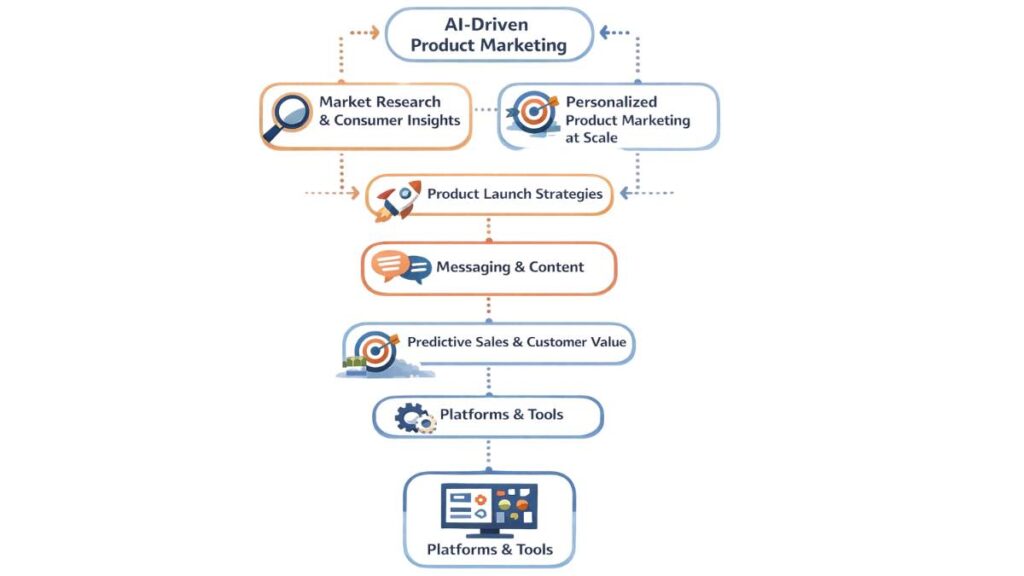
Marketing isn’t a straight line anymore. Launching a product, creating campaigns, figuring out what sticks; it’s a little messy. The brands that get it right don’t just follow rules. They watch patterns, adjust mid-course, and yes, sometimes guess a bit.
Market Research & Consumer Insights
One thing that’s really changed is knowing your audience before anyone else does. Not perfectly, but enough to make smarter moves.
- Predictive analytics? Think of it as spotting trends early. Sometimes, you notice buying behavior shifting before the competition does.
- Real-time tracking shows small behaviors, such as clicks, searches, and browsing, that hint at what customers might do next.
- Competitor moves are easier to see too. Not just big launches, but small adjustments that tell you what’s working.
- Forecasting demand feels a bit like looking at the weather; you won’t get it right every time, but you’ll miss fewer surprises.
It’s not about having a crystal ball. It’s more like connecting dots quickly, before they disappear.
Personalized Product Marketing at Scale
Generic messaging? People tune it out. Full stop. Now it’s about small touches that make someone feel understood.
- Campaigns can change subtly depending on who’s seeing them. A tweak here, a different suggestion there. It matters.
- Recommendations that adjust dynamically; that’s not just convenience. It shows the brand noticed and paid attention.
- Segmentation goes beyond age and location. Past behavior, patterns in engagement, and even the timing of activity all play a part.
- Even small brands are seeing conversions tick up when messages feel thoughtful rather than forced.
The lesson here: it doesn’t have to be huge, just right. Small adjustments often beat big, generic campaigns.
Product Launch Strategies
Launching a product used to feel like rolling the dice. Now, it’s still a little dicey, but you at least see the numbers on the table.
- Timing matters. The same product at the wrong time, or on the wrong channel, tanks fast.
- Content is tuned. Headlines, offers, visuals; they all respond to small hints about what resonates.
- Adjustments happen while the campaign is running, not after it’s over. Spot something off, fix it. Quick.
- Measuring results isn’t guesswork. You can see what nudged adoption and what didn’t.
Flexibility is the new rule. Sticking to a rigid plan is what trips brands up.
Messaging & Content
Messaging is tricky. Even great products can flop if the story feels off.
- Copy tweaks matter; sometimes tiny wording changes can swing engagement.
- A/B testing isn’t guessing anymore. It’s about noticing patterns and responding.
- Sentiment matters. Numbers tell part of the story, but how people feel is often the bigger part.
- Brands that iterate messaging over time see steady improvements. Slow and steady wins, often.
Small changes can feel invisible, but they’re the ones that stick.
Predictive Sales & Customer Value
Marketing doesn’t stop at getting someone to buy. Keeping the right customers is just as important.
- Lead scoring helps focus energy where it counts. Not all prospects are equal.
- Predicting which customers are high-value means better retention, better offers, better ROI.
- Retention strategies are tailored, not one-size-fits-all. A little attention goes a long way.
- Anticipating behavior rather than reacting keeps campaigns ahead of the curve.
It’s about working smarter. Not harder. And about noticing who actually matters.
Platforms & Tools
Platforms are no longer just tools; they’re like an extra set of hands. They don’t replace judgment, but they do handle the repetitive stuff so marketers can focus on thinking.
- Some platforms handle automation, personalization, and analytics all in one. Not perfect, but makes life easier.
- Choosing the right one is key. The fanciest platform doesn’t always help; what matters is what actually moves your campaigns forward.
- It’s less about what’s shiny, more about what works day-to-day.
Product marketing is messy, yes. But done well, it’s more informed, more reactive, and way more connected to what customers actually want. And sometimes, that little bit of intuition makes all the difference.
Measuring the Impact of AI on Product Marketing
Looking at marketing numbers isn’t new, but how you read them has changed. It’s not enough to see clicks or opens and call it a win. What matters is whether people actually do something.
- KPIs that count: Things like repeat visits, signups, purchases; stuff that shows real interest. Not just vanity metrics.
- ROI in practice: Money matters. Tracking what really works saves wasted spend. Sometimes the simplest insight, like noticing one segment responds better, can change the whole plan.
- Watching patterns early: Campaigns don’t behave linearly. Some spikes, some drops. If you catch it early and adjust, it’s better than waiting for a report.
The key is attention. Keep watching. Don’t assume numbers tell the whole story. Adjust. Test. Repeat. That’s how impact gets measured.

Enroll Now: Product Marketing Course
Future Trends: AI in Product Marketing Beyond
Things aren’t slowing down. Marketing is still shifting, and the pace is only going to pick up.
- New tech keeps coming: Some of it won’t matter, but a few things will change how customers interact with products entirely.
- Expectations rise: Customers want faster, smarter, more relevant experiences. They won’t tolerate generic messaging for long.
- Beyond screens: Marketing won’t just be on social or email. Think AR, VR, smart devices, products, and messaging blending with real life.
- Ethics matter: Personalization is useful, but people notice when it feels invasive. Being thoughtful, not creepy, will matter a lot.
Basically, the landscape keeps moving. Brands that notice and adapt early will have the edge. The rest will be playing catch-up.
Conclusion
Product marketing in 2026 isn’t neat. It’s messy, but that’s the point. Those who succeed are watching, noticing patterns, adjusting mid-flight. Flexibility beats perfection.
A few practical takeaways:
- Pay attention to what really moves customers. Not vanity metrics.
- Adjust fast when something isn’t working. Don’t wait for perfect data.
- Make messaging personal, but subtle. Overdoing it backfires.
- Retention is just as important as acquisition. High-value customers deserve care.
At the end of the day, tools help, data helps, but nothing replaces careful observation and judgment. It’s messy, yes, but done right, it works.
FAQs: How AI Is Transforming Product Marketing
1. What is AI product marketing, and why is it important?
It’s basically about using patterns and signals to guide marketing moves. Not perfect, not magical. But it helps make smarter decisions. By 2026, people expect brands to feel “in tune” without being pushy. That’s where this comes in: spotting trends, nudging campaigns, catching opportunities early.
2. How does AI improve personalization in product marketing campaigns?
Personalization isn’t just putting someone’s name in an email. That’s old-school. It’s more about noticing what someone actually cares about. For example:
1. Showing products or offers that actually make sense to them.
2. Adjusting messages based on small patterns: clicks, visits, previous interactions.
3. Segmenting audiences in ways that feel natural, not cookie-cutter.
Even little adjustments, like timing a suggestion at the right moment, can move the needle.
3. Which AI tools are most effective for product marketing today?
There’s no single answer. Some tools are better at analyzing behavior, some at automation, some at predicting trends. The important thing is picking tools that actually let teams act. Fancy features are useless if they slow things down.
4. Can AI predict consumer trends for new product launches?
Kind of. It’s like looking at patterns in past behavior and competitor moves to make an educated guess. Not perfect; never perfect; but it gives hints. Think of it like a weather forecast: useful, but not foolproof.
5. How do companies measure ROI for AI-driven product marketing?
Clicks and impressions only tell part of the story. What matters is:
1. Are people actually doing something, buying, signing up, coming back?
2. Is engagement meaningful, not just flashy?
3. Are campaigns nudging the right group in the right way?
When you track that alongside costs, you get a better sense of what’s actually working.
6. Will AI replace human marketers in product marketing?
Nope. Not really. AI handles repetitive stuff and spots patterns. That’s helpful. But humans still make the judgment calls. Decide what’s creative, what resonates, what feels right. The real winners are the marketers who use AI as a tool, not a crutch.
7. What are the future trends of AI in product marketing?
Expect more channels: AR, VR, connected devices. People will want faster, smarter, smoother experiences. Personalization will grow, but so will scrutiny. Too much automation without thought feels creepy. Brands that balance insights with human judgment will come out ahead.