

A strong brand storytelling strategy isn’t really about clever taglines or one big campaign moment. It’s the longer thread a brand builds over time; the way it explains what it stands for, who it’s here for, and why that matters in day-to-day life. This piece looks at how stories give context to products and help people feel understood instead of simply targeted.
Inside, the focus stays on the building blocks that make storytelling actually work: clear purpose, honest reflection of customer challenges, and moments of real progress that feel believable. It also calls out where brands tend to slip, usually when they talk too much about themselves and lose sight of the people they’re trying to reach.
There’s practical guidance, too, on shaping story-driven content so it flows naturally and feels easy to follow. Nothing overly theatrical. Just grounded, human communication that sounds like it comes from a real point of view; the kind that sticks because it feels familiar.
Table of Contents
Introduction
What Is a Brand Storytelling Strategy?
A brand storytelling strategy is basically the long game behind how a brand talks about itself and its place in the world. Not just a campaign theme. Not a clever tagline. More like an ongoing narrative that shows up everywhere: website, social posts, sales pages, customer emails, and even how support teams talk to people.
At a simple level, it answers a few quiet but important questions:
Why does this brand exist? Who is it really for? What changes for someone after they choose it?
Lots of companies are clear on what they sell. Fewer are clear on what they mean. That’s the gap storytelling fills. It turns information into context. And context is what helps people care.
Most strong brand storytelling strategies are built around three steady anchors:
- Purpose – the reason the brand exists beyond just hitting revenue targets
- Values – the beliefs that guide decisions, behavior, and priorities
- Customer reality – the everyday struggles, goals, frustrations, and hopes people carry
When those pieces show up consistently, in a natural, believable way, the brand starts to feel familiar. Recognizable. Not just another option in a crowded feed.
Here’s the part that often gets missed: features are easy to copy. Pricing can always be adjusted. But a story rooted in perspective and identity is harder to replicate. That’s where storytelling moves from “nice marketing extra” to real strategic advantage.
Done right, a brand storytelling strategy tends to:
- Make communication more memorable because it carries emotion, not just claims
- Build trust through repetition of the same core narrative across channels
- Help customers see themselves in a better situation, not just using a product
- Support decisions without constant pressure or hard selling
People rarely remember a list of benefits. They remember moments. Situations. A sense of “this feels like it gets me.” Storytelling is about creating that feeling deliberately and consistently, until the brand stands for something clear in the audience’s mind.
Less performance. More resonance. That’s usually the shift.
Why Brand Storytelling Strategy Is Critical
Marketing is everywhere now. Constant. Scroll, swipe, skip, repeat. The volume keeps rising, but attention hasn’t. If anything, patience is thinner than ever.
That’s why a clear brand storytelling strategy carries more weight today than it did a few years ago. It gives people a reason to pause, not just another message to ignore.
Brand Storytelling and Buyer Psychology
People like to believe decisions are rational. In practice, emotion usually gets there first, and logic follows behind to justify it. Stories naturally tap into that emotional layer.
They work because they:
- Create an emotional context, which helps messages stick
- Let people see themselves in the situation, which builds relatability
- Turn abstract benefits into something more concrete and human
A list of features asks the brain to compare. A story invites the brain to imagine. And once someone starts picturing a better outcome, less stress, more confidence, smoother days, the message lands differently.
There’s also a quieter effect at play. Story-led content tends to hold attention longer. People read on because there’s a flow. A beginning, a challenge, some kind of shift. That extra time spent with a brand, even in small moments, builds familiarity. Not dramatic. Just steady.
So while storytelling often gets framed as a creative choice, it lines up closely with how people actually process information and make decisions. That’s a big reason it continues to work, even as platforms and formats keep changing.
Brand Storytelling in the Digital Age
The old idea of a neat customer journey doesn’t really hold anymore. People jump between platforms all day. A social post in the morning. A review in the afternoon. A late-night visit to the website. Bits and pieces, scattered.
If the brand sounds different in each place, trust weakens. Slowly, but noticeably.
A brand storytelling strategy helps keep the narrative steady across all those touchpoints. The format might change; short video, long article, quick email, but the core story stays recognizable. Same beliefs. Same perspective. Same sense of who the brand is for.
In practical terms, that often looks like:
- A website that clearly expresses what the brand stands for, not just what it sells
- Social content that feels like a continuation of the same voice, not a separate persona
- Customer stories that focus on real-life change, not just metrics
- Messaging that sounds grounded and human, not overly polished or inflated
Audience expectations have shifted, too. Big claims without substance are easier to spot. People lean toward brands that show they understand everyday challenges and speak in a tone that feels natural, not engineered.
Hard selling hasn’t disappeared. But it’s storytelling that builds long-term preference.
Brands that tend to stand out right now usually do a few things consistently:
- They show a clear understanding of their audience’s real-world situations
- They communicate values through stories and actions, not just slogans
- They stay consistent, so familiarity builds instead of resetting every campaign
In a crowded digital space, meaning travels further than volume. A thoughtful brand storytelling strategy helps a brand become known not just for its products or services, but for the story it keeps telling, and the role it plays in people’s lives.
Core Components of a High-Impact Brand Storytelling Strategy
When a brand storytelling strategy really works, it doesn’t feel like “marketing.” It just feels consistent. Familiar. Like every piece of communication comes from the same place, even when the format changes. That kind of clarity doesn’t happen by accident; it comes from getting a few foundational pieces right.
Here’s what usually sits underneath strong brand storytelling.
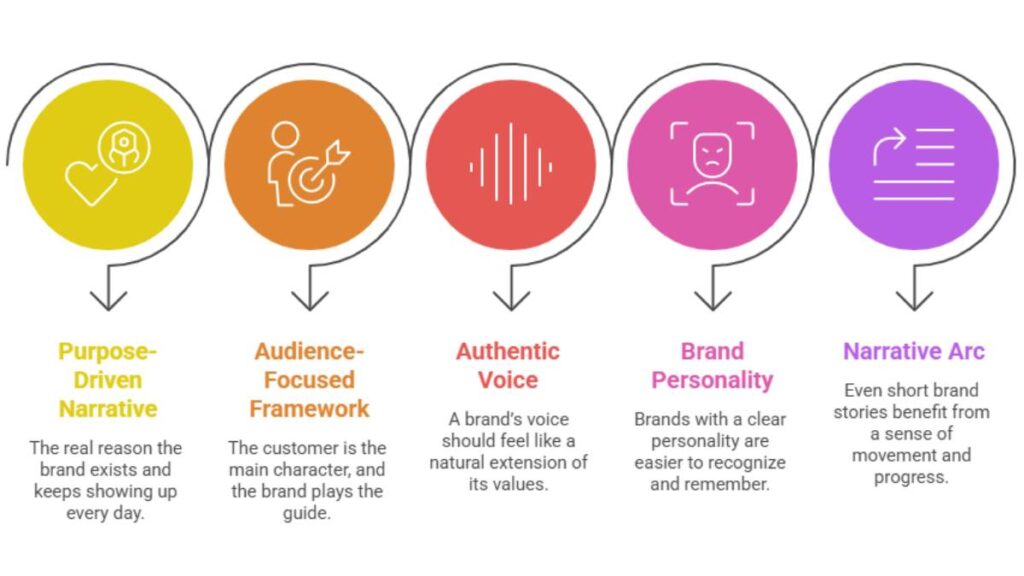
Purpose-Driven Brand Narrative
At the center of any effective brand storytelling strategy is purpose. Not the polished mission line crafted for a presentation. The real reason the brand exists and keeps showing up every day.
A purpose-driven narrative answers questions like:
- What problem does this brand actually care about solving?
- What kind of change does it want for its customers?
- Why does that change matter beyond the transaction?
When the purpose is clear, storytelling becomes easier to guide. Decisions about campaigns, partnerships, and content start to align naturally. There’s a filter in place. Some ideas fit, others don’t; and that’s a good thing.
Purpose also gives stories emotional depth. Customers connect more with brands that stand for something specific, even if it’s simple, than with brands that try to be everything to everyone. A mission-led narrative quietly signals, “This is what we believe.” Over time, that builds trust.
Without purpose, storytelling drifts into safe territory: quality, service, innovation. Fine words. Forgettable stories.
Audience-Focused Story Framework
A lot of brands still position themselves as the hero. That usually backfires. In a strong brand storytelling strategy, the customer is the main character. The brand plays the guide.
A simple structure works well here:
Problem → Guide (brand) → Transformation
- The customer is facing a challenge, frustration, or a goal that feels just out of reach
- The brand steps in with clarity, support, or a solution
- The customer experiences a meaningful shift; something improves, internally or externally
This framework keeps storytelling grounded in real experiences instead of brand self-praise. It also makes messaging more relatable because the focus stays on the customer’s world.
To do this well, brands need to understand more than demographics. They need insight into:
- Daily frustrations that seem small but add up
- Goals that feel exciting and slightly intimidating
- Doubts people rarely say out loud
When stories reflect those emotional layers, audiences feel understood. And feeling understood is often what builds loyalty, not just satisfaction.
Brand Values and Authentic Voice
Values shape behavior. In a brand storytelling strategy, they should also shape stories.
It’s easy to list values. Harder to show them. That’s where storytelling carries the load. Values come through in:
- The kinds of customer stories that get highlighted
- The issues or communities the brand chooses to support
- How the brand responds when something goes wrong
Stories make values visible. Otherwise, they stay abstract.
Voice is tied closely to this. A brand’s voice should feel like a natural extension of its values and the people it’s speaking to. Not overly styled. Not chasing trends.
For example:
- A brand focused on empowerment may sound encouraging and optimistic
- One built on expertise may sound clear, steady, and confident
- A community-driven brand might lean warmer and more conversational
Consistency matters more than cleverness here. When the tone shifts too often, the brand starts to feel unclear. A steady voice builds familiarity, and familiarity builds trust.
Character and Brand Personality
Brands with a clear personality are easier to recognize and remember. Not because they’re loud, but because they’re consistent.
A defined brand personality might answer:
- Is the brand more reassuring or more energizing?
- More playful or more serious?
- More of a trusted guide or a bold challenger?
These traits influence everything: word choice, visuals, and even how the brand handles criticism. Personality acts like a set of guardrails. It helps teams decide what feels on-brand and what doesn’t.
Over time, storytelling patterns reinforce this character:
- The way customer wins are framed
- The perspective the brand takes on industry trends
- The emotional tone behind campaigns: hopeful, determined, calm, ambitious
When these signals stay consistent, people start to recognize the brand’s “personality” without needing to see the logo first. That kind of recognition is hard to manufacture quickly. It’s built story by story.
Narrative Arc & Emotional Journey
Even short brand stories benefit from a sense of movement. A clear narrative arc keeps content from feeling flat or purely informational.
Most effective stories follow a familiar flow:
- A challenge or tension
- An effort to work through it
- A resolution or improvement
That structure mirrors real life, which is probably why it resonates so well. There’s progress. A before and after.
The emotional side of that journey matters just as much as the practical side. Good brand storytelling often highlights shifts like:
- Confusion turning into clarity
- Doubt turning into confidence
- Frustration turning into relief
- Feeling stuck turning into forward movement
Those emotional transitions are what people connect with. They see a version of their own situation reflected back, even if the details differ.
When a brand storytelling strategy consistently uses these arcs, in case studies, campaigns, social content, and brand messaging, the brand becomes associated with progress. Not just products or services, but positive change people can actually feel.

Enroll Now: Advanced Digital Marketing Course
Strategic Steps to Build Your Brand Storytelling Framework
Building a brand storytelling strategy sounds creative, and it is, but the process behind it is pretty grounded. Less “lightbulb moment,” more careful observation over time. Patterns, repeated questions, and the tone people use when they describe their problems. That’s where the real material sits.
A framework just gives all of that a shape.
Research and Audience Insight
Most brands think they know their audience. Sometimes they do. Often, they know the demographic version: age, job title, location, but not the day-to-day emotional reality.
That emotional layer is where strong storytelling starts.
Good insight usually comes from places that aren’t polished:
- Sales calls where prospects hesitate before explaining a concern
- Customer support messages are written when someone is frustrated or confused
- Reviews where people describe what was going on in their lives when they found the brand
- Community comments where people speak more casually and honestly
Look for repeated themes. Not just “save time” or “grow revenue,” but things like feeling behind, wanting clarity, needing reassurance before making a decision. Those are story signals.
When audience research includes emotional context, fears, motivations, quiet ambitions, stories stop sounding like marketing and start sounding familiar.
Define Brand Story Pillars
Without a few steady themes, brand storytelling drifts. One month it’s inspirational, the next it’s purely promotional, and after that it’s trying to be trendy. Audiences feel that inconsistency, even if they can’t explain it.
Brand story pillars help prevent that.
These pillars are recurring narrative themes that reflect what the brand stands for and what customers care about. Often, they include ideas like:
- Purpose – why the brand exists beyond selling
- Progress – the kind of change customers are working toward
- Support – how the brand helps during uncertain or challenging moments
- Belonging – the shared mindset or community around the brand
Not every piece of content has to cover all pillars. That would feel forced. But over time, these themes should show up often enough that people start associating them naturally with the brand.
If a story idea doesn’t connect back to at least one pillar, it’s usually a sign it may be noise rather than narrative.
Storytelling Formats for Maximum Reach
A brand story isn’t a single “About Us” page. It’s a thread that runs through many formats, each showing a different angle.
Some formats naturally lend themselves to storytelling:
- Long-form articles that explore challenges, decisions, and turning points
- Video where tone, pacing, and expression add emotional depth
- Customer stories that focus on real situations instead of just results
- Short-form social posts that capture moments, reflections, or small wins
- Interactive experiences that help people see where they stand and what they might need next
Not every brand needs every format. What matters is choosing the ones the audience already uses, then carrying the same core narrative through each space. Familiar themes, different expressions.
Integrating Search Terms Without Breaking the Story
There’s always a practical side to content. Certain topics need to be addressed clearly because people are actively looking for them. The challenge is keeping that clarity without flattening the story.
It helps to:
- Use important phrases where they make sense in headings and explanations
- Introduce key ideas through real situations rather than definitions alone
- Let related terms appear as part of useful context, not as isolated inserts
For example, discussing brand narrative examples works better when tied to an actual scenario that a reader can picture. Same with storytelling for customer loyalty; it lands stronger when connected to emotions, trust, and long-term relationships, not just tactics.
When the story leads, and the terminology follows, the content feels natural instead of engineered.
Clear Structure That Supports the Narrative
Even the most engaging story benefits from clear organization. Readers skim, jump around, and come back later. Structure helps them do that without losing the thread.
Breaking content into defined sections, using descriptive headings, and including focused Q&A-style explanations make it easier for people to find what matters to them. It doesn’t make the story less human. It just makes it easier to move through.
And in a crowded content environment, ease matters more than people admit.
Measuring Your Brand Storytelling Strategy
Storytelling doesn’t always produce loud, instant spikes. Its impact is often quieter at first, then cumulative. Familiarity builds. Trust builds. Eventually, decisions get easier for the audience.
Still, there are clear ways to see whether the narrative is doing its job.
Brand Awareness and Engagement Metrics
When people connect with story-driven content, their behavior shifts in small but meaningful ways.
Look for signs like:
- Spending more time on pages that explore real situations or journeys
- Scrolling further through in-depth pieces instead of dropping off early
- Returning to read more from the same brand over time
These patterns suggest the content is holding attention because it feels relevant, not because it’s aggressively pushing a message.
Conversion Signals from Narrative Content
Not every story is meant to trigger an immediate action. Many are there to reduce uncertainty first. To help people feel understood before they ever click a button.
That said, storytelling often influences conversions indirectly:
- Prospects referencing specific articles or stories during inquiries
- Higher response to calls to action that feel like the next step in a journey rather than a hard sell
- Leads arriving with a clearer understanding of what the brand stands for
When fewer basic questions need answering, it’s usually because the story has already done part of the work.
Customer Sentiment and Shareability
One of the strongest indicators of effective storytelling is how people talk about the brand when the brand isn’t in the room.
Signals worth paying attention to:
- Comments where readers say, “This feels exactly like my situation.”
- Social shares where people add their own perspective or experience
- Customers describing the brand using similar language and themes to those the brand uses itself
At that point, the story is no longer just published. It’s circulating. Being repeated, adapted, and made personal. That’s when storytelling moves from messaging to meaning.
Examples of Successful Brand Storytelling in Practice
Across industries, strong brand storytelling tends to follow a few recognizable patterns. Different products, different audiences; similar narrative shapes.
Customer Transformation Narratives
These stories focus on the person, not the product.
They usually explore:
- What life or work felt like before change happened
- The tension, frustration, or limitation that pushed someone to look for help
- The shift that followed and what feels different now
The brand appears as a guide or enabler, not the hero. That positioning makes the story easier for others to step into mentally. It feels achievable, not staged.
Brand Mission-Driven Campaigns
Some of the most memorable brand stories connect to a belief bigger than the offering itself.
These narratives often:
- Highlight a shared challenge or overlooked issue in the audience’s world
- Show how the brand’s actions line up with a clear set of values
- Invite people to feel part of something broader than a transaction
When the mission shows up consistently, not just in slogans but in decisions and initiatives, the story carries more weight. People sense when it’s real.
User-Generated Stories That Expand the Narrative
Eventually, the strongest brand stories aren’t written by the brand at all.
Customers begin sharing their own experiences:
- How they use the product or service in everyday life
- What changed for them, in their own words
- Why do they recommend it to others in situations that feel similar
These stories add texture and credibility that no brand voice can fully replicate. When they’re acknowledged and woven into the broader narrative, the brand story starts to feel lived-in. Ongoing. Less like a campaign, more like a shared experience that keeps evolving.
Common Brand Storytelling Mistakes (and How to Avoid Them)
Brand storytelling gets talked about like it’s simple. Just share your “why,” be authentic, and build a connection. Sounds nice. In reality, plenty of brands drift into patterns that slowly drain the life out of their stories.
It rarely looks like a big mistake in the moment. More like small shifts that pile up.
Selling instead of telling
A story pulls people in with a real situation, something recognizable. Then, halfway through, it pivots into a pitch. Features show up. Claims get louder. The emotional thread quietly snaps.
Stories work when persuasion is indirect. Show the tension. Show what changed. Let people draw conclusions. When every paragraph leans toward “buy this,” readers lean back instead.
Inconsistent brand voice
Some brands sound thoughtful on their website, stiff in email, and overly slang-heavy on social. Each version may have good intentions, but together they don’t feel like the same voice.
Consistency doesn’t mean using identical wording everywhere. It means the brand’s worldview stays steady. The way it talks about challenges. The way it frames progress. That through-line is what builds familiarity, and familiarity builds trust.
Ignoring real audience insight
It’s easy for internal teams to fall in love with clever angles and creative narratives. The trouble is, customers are usually thinking about very practical things. Time, risk, trade-offs, and pressure from their boss. Real stuff.
Stories hit harder when they reflect actual frustrations, not imagined drama. Specific situations beat abstract inspiration almost every time. Without that grounding, storytelling can sound smooth but strangely hollow.
Over-polishing until the story feels flat
Structure helps, sure. Clear sections, tight messaging, optimized flow. But taken too far, it squeezes out the human side. The rough edges disappear, and with them, the sense that a real perspective sits behind the words.
When everything reads perfectly balanced, it often feels distant. A bit of natural rhythm, even a slightly uneven one, keeps the story feeling alive.
Structuring Brand Storytelling Content for Discoverability and Depth
Strong storytelling isn’t just about the narrative itself. It’s also about how people move through it. Most readers don’t go line by line. They skim first, pause where something clicks, then decide whether to stay.
Structure can either support that behavior or fight it.
Clear, Scannable Structure
Even story-driven content benefits from visual breathing room. Dense blocks of text feel like work, especially to someone discovering a brand for the first time.
Clear headings help people orient themselves quickly. Shorter paragraphs reduce friction. Lists can clarify grouped ideas without overexplaining. Small recap moments help readers who jump around still leave with something useful.
None of this makes the writing shallow. It simply respects attention. And when content feels easier to move through, people tend to go deeper than expected.
Conclusion: The Future of Brand Storytelling
Brand storytelling has moved from “nice to have” to something closer to a baseline expectation. Markets are crowded. Attention is split. People don’t just compare products anymore; they look for signals about who a brand is and whether it understands their world.
Information is easy to find. Meaning takes more work.
That’s where storytelling earns its place. A clear narrative helps a brand be known for something beyond features or price. A point of view. A consistent way of framing problems and progress.
Looking ahead, the brands that stand out will likely be the ones that hold a steady perspective, tell stories rooted in real customer experience, and stay consistent across channels without sounding mechanical. Tools and platforms will keep shifting. The human need for stories that make sense of things probably won’t.
FAQs: That Reflect Real Questions
1. What makes a brand storytelling strategy effective?
An effective strategy connects the brand’s purpose with real customer experiences in a way that feels consistent and believable. It focuses less on pushing messages and more on building meaning over time. When stories reflect genuine situations and are repeated with a steady voice, they become recognizable and easier to trust.
2. How is brand storytelling different from content marketing?
Content marketing is about formats and channels, blogs, videos, emails, and social posts. Brand storytelling is the narrative layer that ties all of it together. It shapes the perspective behind the content, the emotional tone, and the bigger message that makes separate pieces feel connected instead of random.
3. Can small businesses use a brand storytelling strategy effectively?
Small businesses often have more relatable stories because their journeys are closer to the surface. Customer wins, early struggles, and community ties feel tangible, not manufactured. With a clear narrative and consistent voice, smaller brands can build strong emotional connections without needing massive reach or production budgets.
4. What platforms should you use for brand storytelling?
The right platforms depend on where the audience already pays attention. Websites, email, social media, and video often work together, each showing a different side of the same narrative. The format may shift, but the core story and perspective should remain steady across every touchpoint.
5. How often should a brand update its storytelling strategy?
A storytelling strategy should evolve when the audience, market, or brand direction changes in a meaningful way. Reviewing it once a year is usually enough to keep it relevant. The core narrative should stay stable, while examples, language, and emphasis adjust to current realities.