

Content can get messy fast if there’s no real focus, even with tons of posts and updates. That’s where content pillars come in. So, what is a content pillar? Simply put, it’s a core topic a brand sticks with over time, the kind of theme that everything else connects back to blogs, social posts, videos, and campaigns. Pillars give structure, help readers follow the story, and quietly build authority. This guide walks through how to define them, common mistakes, and ways to measure success. By the end, it’s clear: strong content pillars aren’t just planning tools, they’re the backbone that keeps everything organized and meaningful.
Table of Contents
Introduction
A lot of brands are producing more content than ever. More blogs, more reels, more emails. Still, something feels off. The messaging jumps around. One week it’s trends, the next it’s random tips, then a hard sales push out of nowhere. From the outside, it looks busy. From the audience side, it feels messy.
That usually comes down to one missing piece: content pillars.
So, what is a content pillar? It’s a core topic a brand chooses to consistently talk about. Not just once. Not when it’s convenient. Ongoing. These pillars shape the direction of everything else: blog posts, social updates, videos, and even campaigns.
Without pillars, content decisions tend to be reactive. Whatever idea sounds good that day gets published. With pillars in place, there’s a filter. A bit of discipline. Not every idea makes the cut, and that’s a good thing.
Strong pillars do a few quiet but important jobs:
- They make the brand’s focus obvious
- They connect individual pieces of content into a bigger story
- They help audiences know what to expect
And when people know what to expect, they’re more likely to stick around.
This guide breaks down what content pillars really are, how they work in practice, and why they matter more than most teams realize.
What Is a Content Pillar
What Is a Content Pillar? Explanation
A content pillar is a broad theme that represents a key area of expertise or interest for a brand. It’s not a single article. It’s more like a content category that keeps showing up over time.
Picture it this way: if all content were sorted into folders, pillars would be the main folders. Everything else, articles, videos, posts, gets saved inside one of them.
This is where some confusion happens. People mix up pillars with individual pieces of content.
- A blog post answers one specific question
- A social post shares one idea, moment, or update
- A content pillar sits above both. It’s the recurring topic those pieces belong to
Then there are related terms that get thrown around.
- Pillars = the big themes
- Topic clusters = groups of related content connected to a pillar
- Sub-topics = the individual, focused pieces inside those clusters
For example, if “Social Media Marketing” is a pillar, sub-topics might include:
- How to write better captions
- Best posting times
- Community-building tactics
Each piece covers one angle, but together they build depth around that main theme. Over time, that consistency adds up. The brand becomes associated with that subject, not just one random article that did well once.
Real Examples of Content Pillars
It helps to see how this looks outside of theory.
Example: Blog Content Pillars
A software company might organize content into pillars like:
- Product Tutorials
- Industry Insights
- Customer Case Studies
- Strategy & Best Practices
Every new article has to fit into one of these. If it doesn’t, it’s probably off-track. This keeps the blog focused and prevents it from drifting into topics that don’t support the business.
Example: Brand Content Pillars
A skincare brand could define pillars such as:
- Skin Education
- Ingredient Awareness
- Routines & How-Tos
- Customer Stories
This structure keeps the brand from only talking about products. It balances education, trust-building, and proof. Over time, the audience sees the brand as helpful, not just promotional.
Example: Social Media Content Pillars
On social, pillars often show up as repeatable content types:
- Educational tips
- Behind-the-scenes moments
- User or client features
- Offers and announcements
This creates rhythm. Followers start recognizing the pattern, which makes the feed feel familiar instead of random. And familiar content tends to perform better than constant unpredictability.
Across industries and platforms, the principle stays the same: a small number of clear themes guiding a large amount of content.
The Importance of Content Pillars in Digital Marketing
Content pillars might sound like an internal planning tool, but their effects show up everywhere: in performance, perception, and long-term growth.
Why Content Pillars Are Important for SEO
When content consistently centers around a few core topics, depth builds naturally. Instead of one-off mentions, there’s ongoing coverage from different angles.
That structure helps by:
- Clarifying the main subjects the site focuses on
- Creating logical connections between related pieces of content
- Building stronger authority in specific areas over time
Search engines don’t just look at individual pages in isolation. They look at overall topic coverage. Pillars make that coverage clearer and more intentional.
Why Content Pillars Matter for Audience Engagement
From a reader’s perspective, pillars create a smoother experience.
When themes are consistent:
- It’s easier to find more content on the same subject
- The brand feels more specialized and reliable
- The overall message feels cohesive instead of scattered
Someone might read one article, then notice several more on related topics. That encourages deeper exploration. More time spent. More trust built. It’s not flashy, but it’s effective.
Consistency also sets expectations. Audiences know what kind of value they’ll get from the brand, which makes them more likely to return.
Why Content Pillars Help in Ranking and AI Overviews
Search is becoming better at understanding topics, not just matching individual phrases. Brands that cover a subject thoroughly and in an organized way tend to stand out.
Content pillars support this by:
- Showing long-term focus on specific subject areas
- Covering multiple angles instead of repeating surface-level advice
- Structuring content so that relationships between topics are clear
They also strengthen credibility signals. Consistent, in-depth content demonstrates real knowledge and experience. Not through claims, but through volume and quality of coverage.
In the bigger picture, content pillars help shape how a brand is understood; not just as a publisher of content, but as a go-to source in its space.
Types of Content Pillars
Content pillars aren’t one-size-fits-all. How they work really depends on what kind of brand you’re running, who the audience is, and what you want them to take away. Some are practical, some are more about building reputation, and some are a mix of both.
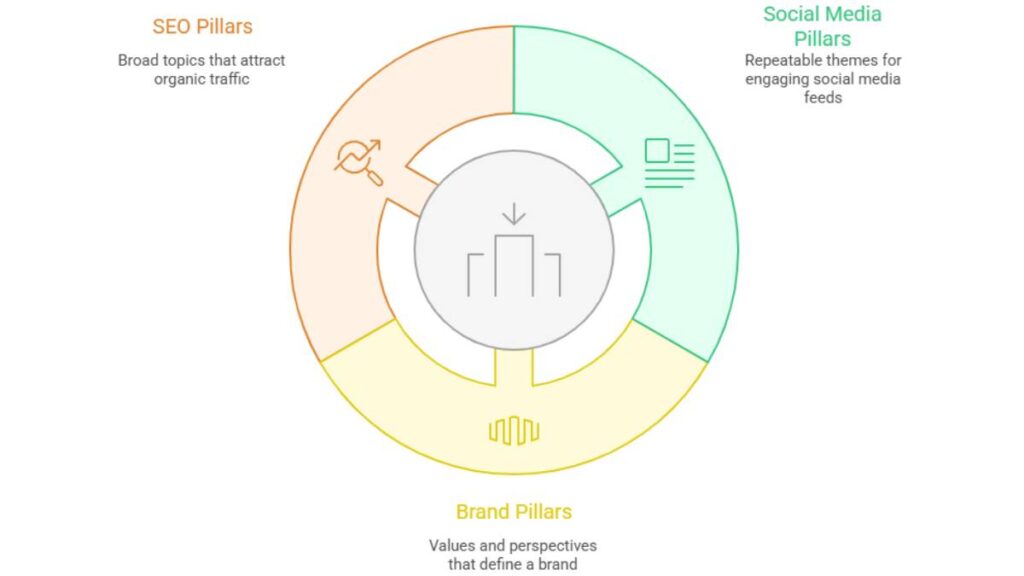
SEO Content Pillars
These are probably what most people picture when they hear “content pillar.” They’re broad topics that act like a hub; everything else connects back to them in some way.
A few things to keep in mind:
- They need to be specific enough to give the brand focus, but broad enough to support lots of content.
- Smaller, related posts should naturally link back to the pillar. That’s how the topic builds weight over time.
- Consistency matters more than perfection. Even a few posts per month, all under the same pillar, can start to define your expertise.
For instance, a marketing brand might have a pillar called “Email Marketing.” Under it, there could be posts on subject lines, segmentation, automation strategies; all different angles but part of the same theme. Over time, that one pillar becomes a recognizable area of authority.
Social Media Content Pillars
Social media pillars are a little different. They’re more about types of content than one big topic. Think of them as repeatable themes that give the feed some rhythm. Without them, social media can feel like a jumble of posts thrown together.
Common examples:
- Tips and educational posts; short, helpful, shareable stuff
- Fun or engagement posts; polls, quizzes, little challenges
- Behind-the-scenes: glimpses of the team, office, or process
- Promotions: product launches, offers, announcements
The key is variety that still feels like it belongs together. Followers start recognizing the patterns, and it gives the feed a sense of consistency without getting boring.
Brand / Thought Leadership Pillars
These are less about “how-to” and more about showing what the brand stands for. They’re about values, big ideas, and perspectives that separate the brand from the rest.
A few things to note:
- They can overlap with SEO or social pillars, but the goal is more long-term influence than immediate clicks.
- They help build authority in the eyes of the audience. Not by shouting it, but by showing consistent insight over time.
- This content often inspires, educates, or challenges the audience; it’s not just a product push.
For example, a sustainability brand could use pillars like “Ethical Manufacturing” or “Innovations in Green Tech.” It sends a clear signal: this is what the brand cares about, and it’s worth paying attention to.
Mixing these three types, practical hubs, social themes, and thought leadership, usually works best. Each piece of content should link back to a pillar, even loosely. That’s how a brand feels coherent, intentional, and alive, without it feeling like it was overly planned or robotic.
How Content Pillars Help With Keyword Strategy
Content pillars and keywords go hand in hand, but it’s not as rigid as some guides make it sound. Think of a pillar as a big topic you care about, and the smaller pieces of content, blogs, posts, guides, as ways to explore it from different angles. It’s a bit like looking at a city from a drone versus walking the streets. The big view shows the structure, and the streets fill in the details.
A few practical points:
- Pick themes that actually matter to your audience, not just trendy keywords.
- Make sure each pillar can support several smaller pieces; don’t stretch one too thin.
- Depth beats breadth. Better to cover a topic well than skim many.
Long-tail keywords fit naturally here. For example, under a “Social Media Marketing” pillar, you could cover things like “best posting times for Instagram” or “writing captions that get clicks.” These are small angles, but they all feed back to the main theme.
Internal linking is key. Even a few well-placed links from cluster posts back to the main pillar page make the whole thing feel connected; for readers and, well, anyone trying to make sense of it all.

Enroll Now: Advanced Digital Marketing Course
How to Create and Define Effective Content Pillars
Building pillars isn’t magic. It’s planning and paying attention to what matters. Randomly picking topics rarely works.
Step 1: Understand Your Audience
Before doing anything else, know who the content is for. What keeps them up at night? What do they search for? What will actually make them stick around? If the pillar doesn’t answer a need, it’s just filler.
- Map out pain points and frequent questions
- Check where your audience hangs out online
- Pick pillars that genuinely match their interests
Step 2: Align Pillars With Business Goals
Every pillar should serve a purpose. Random topics might be fun, but if they don’t help the brand in the long run, they’re not worth the effort.
- Make sure the pillar fits your mission or core message
- Connect it to bigger marketing goals, like awareness, engagement, or leads
- Think about whether the topic can sustain multiple posts over time
Step 3: Spot the Gaps
Even obvious topics deserve a reality check. Look at what competitors have done and see where they fall short. That’s where the brand can stand out.
- Find questions that aren’t fully answered elsewhere
- Aim to add value, not just repeat what’s already out there
- Let gaps guide which subtopics to create under each pillar
Step 4: Plan Pillars and Clusters
Once the pillars are chosen, sketch out the supporting content. It doesn’t have to be fancy. Even a simple list works.
- Most brands do well with 3–5 pillars
- Each pillar should have a few cluster topics: blogs, videos, posts, that connect back to it
- Make sure the connection is clear, so readers can see the bigger picture
Step 5: Build and Link
When creating content, think of the pillar as the hub and the supporting pieces as spokes.
- Pillar pages show the big picture
- Cluster content supports it without repeating it
- Link naturally between pieces so readers can explore more without getting lost
Even small efforts in linking make the content feel alive and organized. Over time, this becomes the backbone of the brand’s content.
Best Practices for Content Pillars
A pillar isn’t done once it’s published. It needs some attention, or it starts to look stale. A little care goes a long way.
Keep Them Focused But Flexible
Too many pillars, and things get messy. Too few, and coverage is shallow. The goal is a handful that can support multiple pieces without overlapping too much.
Refresh Regularly
Even evergreen content needs occasional updates. Stats change. New insights pop up. Adding fresh links or small updates keeps pillars relevant.
Watch the Performance
Look at what’s actually working. Some pillars will naturally attract more attention; others might need a nudge. Adjust content, add clusters, or retire what no longer fits.
It’s not about perfect planning. Small tweaks over time make a big difference. A well-tended set of pillars eventually becomes a brand’s backbone: solid, consistent, and actually useful for the audience.
Common Mistakes to Avoid
Even with a solid plan, content pillars can go sideways if a few things slip through the cracks. They’re not dramatic errors, just small oversights, but over time, they add up.
- Skipping research: Picking topics without really understanding the audience or checking what’s already out there? That rarely ends well. If the pillar doesn’t answer a real need, it just sits there, unnoticed.
- Too many unrelated pillars: Ten pillars that barely connect? That just confuses everyone. Better to focus on a handful that actually matter and can be supported with smaller pieces of content.
- Ignoring internal links: If cluster posts aren’t pointing back to the main pillar, the effort is wasted. Those links are what give the pillar some weight and make it easy for readers to explore.
- Neglecting performance data: Publishing and walking away doesn’t cut it. Keeping an eye on what works and what doesn’t is the only way to improve over time.
Little mistakes like these don’t blow up overnight, but they quietly make the whole strategy harder to manage.
Measuring Success of Your Content Pillars
Creating pillars is one thing. Knowing if they’re actually doing their job is another. Without some measurement, it’s just guessing.
Here are some ways to check if a pillar is working:
- Traffic and engagement: Are people showing up? Are they clicking into the cluster content?
- Depth of content consumption: Are readers exploring multiple subtopics? Spending enough time to actually get value?
- Conversions and goals: Depending on the brand, this could be newsletter signups, inquiries, or purchases.
It doesn’t have to be complicated. Even tracking a few key indicators will tell which pillars are pulling their weight. The important part is noticing trends over time rather than obsessing over single-day results. Pillars are not set-it-and-forget-it; they grow, evolve, and sometimes need a little pruning.
Conclusion:
Content pillars aren’t just a trendy term or a checkbox on a content strategy list. They’re a practical way to keep things organized, meaningful, and actually useful for people.
Some things to remember:
- Pillars give a clear structure. They make it easier for both readers and teams to see how everything fits together.
- Supporting content adds depth without cluttering the main idea. Think of it as layering, not overstuffing.
- Updating pillars and paying attention to performance keep them alive, relevant, and valuable.
At the end of the day, a strong set of pillars becomes the backbone of a content strategy. It gives the brand shape, guides the audience, and makes all content feel connected. Brands that invest time in building and maintaining pillars don’t just create content; they create something that lasts.
FAQs:
1. How many content pillars should a brand have?
Honestly, it depends. Usually, three to five is a sweet spot. Any less and you’re leaving holes. Too many, and it gets messy fast; no one can keep track. Stick to a few solid ones, make them count, and let supporting content fill in the gaps.
2. Can a single blog post act as a content pillar?
Not really. A post is too narrow. A pillar is bigger; it’s a hub that ties multiple pieces together. Think of the post as a piece of the puzzle, not the puzzle itself.
3. What’s the difference between a content pillar and a cluster page?
Picture a tree. Pillars are the trunk, broad and solid. Clusters are the branches; smaller, specific, but always pointing back to the trunk. Without the trunk, the branches float. Without the branches, the trunk feels empty.
4. How do content pillars help keep content organized?
They give everything a place. Without them, content feels scattered. With them, readers can follow a thread, and teams can see what belongs where. It’s like tidying up a messy desk; suddenly, it’s obvious what matters.
5. How are pillars different from topic clusters?
Pillars = big picture. Clusters = details. Clusters cover side topics, answer questions, and go deeper. Pillars hold it all together. They need each other.
6. Are content pillars just for websites, or can social media use them too?
They work on both. Websites? Long-form hubs with cluster links. Social? Content buckets: themes that repeat, like tips, entertainment, promos, stories. Different formats, same principle: keep it organized, keep it consistent.
7. How long should a pillar page be?
Length isn’t the main thing; depth is. A pillar should cover a topic enough for someone to really understand it, and link to supporting pieces. Could be 1,500 words, could be 3,000. Doesn’t matter.
8. How often should pillar pages be updated?
Regularly, but don’t overthink it. Check for old stats, new trends, or missing angles. Even small updates matter. Stale pillars don’t help anyone.
9. Do content pillars build trust and authority?
They do. Thorough, consistent, well-organized pillars signal that the brand knows its stuff. Readers notice, slowly but surely.
10. Can content pillars change over time?
Absolutely. Audiences shift, priorities shift, questions change. Pillars aren’t static; they should evolve along with the brand and the audience.