
Personal brand management isn’t some glossy concept reserved for influencers or executives with PR teams. It’s the everyday work of making sure a professional reputation actually matches the work being done now, not five years ago. This guide looks at how that alignment happens in practice, from clarifying positioning and tightening up messaging to keeping profiles, conversations, and visible work moving in the same direction. It also gets into the less comfortable parts: reputation gaps, mixed signals, and the slow drift that happens when no one’s paying attention. Managed well, personal brand management turns experience into a clear story; one that helps the right opportunities connect a little more naturally.
Table of Contents
Introduction
What Is Personal Brand Management?
Personal brand management is the ongoing work of shaping how others experience someone professionally, and making sure that experience lines up with reality. Skills, values, strengths, reputation. All of it. It’s less about hype and more about clarity.
Every professional already has a personal brand. Colleagues describe it. Clients talk about it. Recruiters sense it in minutes. The question isn’t whether a brand exists; it’s whether it’s being guided or just… happening.
At a practical level, personal brand management involves:
- Deciding what you want to be known for
- Making sure your profiles and conversations reflect that
- Reinforcing the same themes over time, not changing direction every month
It’s not a one-time exercise. Careers shift. Interests evolve. Industries move. Brand management is the adjustment process that keeps professional identity aligned with where someone is actually headed.
Personal Branding vs. Personal Brand Management
These two often get lumped together, but they play different roles.
Personal branding is the creation phase. Defining strengths. Clarifying positioning. Choosing how to present expertise to the world.
Personal brand management is what happens after that. Maintaining consistency. Updating the story as experience grows. Making sure the outside perception doesn’t drift too far from the truth.
Branding builds the house. Management keeps it from falling apart and renovates when needed.
Why Personal Brand Management Matters Today
Professional visibility doesn’t start with a handshake anymore. It usually starts with a search, a profile scan, or a quick scroll. First impressions happen quietly, before any conversation.
Strong personal brand management helps with:
- Standing out in crowded industries
- Building trust faster with new audiences
- Attracting opportunities instead of constantly chasing them
- Making career transitions smoother because the narrative already makes sense
When brand management is neglected, confusion creeps in. Mixed messages. Outdated achievements front and center. A profile that says one thing while recent work says another. None of this looks dramatic, but it quietly slows momentum.
How Personal Brand Management Works in the Digital Era
Today, a personal brand lives across an ecosystem, not a single platform. A headline on LinkedIn, a conference bio, a guest article, even comments left on industry posts; all of it connects.
People often move through these touchpoints in seconds:
- See a name mentioned somewhere
- Check a profile
- Skim recent activity
- Look for proof of expertise
That journey shapes perception fast. Which means personal brand management now includes:
- Keeping messaging aligned across platforms
- Being intentional about what gets shared publicly
- Periodically checking what shows up when your name is searched
Not obsessive monitoring. Just awareness. A little maintenance goes a long way.
The Role of Perception, Reputation, and Digital Footprint
Personal brand management is really about managing signals.
Perception forms from those signals in real time, how someone comes across in writing, speaking, or online presence.
Reputation builds from repeated perceptions over time. Patterns matter more than one-off moments.
Digital footprint is the record of those patterns; posts, features, comments, profiles, all sitting there for others to interpret.
Complete control isn’t possible. But influence is. Every update, project highlight, or thoughtful comment nudges perception in a direction. Enough nudges, and a clear professional identity starts to stick.
Core Concepts of Personal Brand Management
Before tactics and checklists, a few foundational ideas need to be clear. Without these, personal brand management turns into a random activity that feels busy but doesn’t move much.
Personal Brand Equity Explained
Personal brand equity is the professional value attached to someone’s name. It’s the reason a person gets recommended in rooms they’re not in. The reason a message gets opened a little faster.
This kind of equity builds quietly. No single post or achievement creates it. Instead, it grows from consistent proof over time.
Strong personal brand equity usually includes:
- Reputation – What people reliably say about someone’s work and professionalism
- Differentiation – A clear sense of how this person is not just another version of everyone else
- Visibility – Being seen often enough in the right contexts, not everywhere all the time
- Credibility – Evidence. Results. Experience that supports the claims
When these pieces line up, opportunities tend to feel less random. There’s a reason behind them.
The Psychology Behind Personal Branding
Personal brand management sits right between identity and perception. How someone sees themselves isn’t always how others see them. That gap is where a lot of brand confusion lives.
Two perspectives matter:
- Internal perspective – Strengths, motivations, values, long-term goals
- External perspective – Feedback, referrals, what people actually come to you for
Sometimes they match. Often they don’t, at least not perfectly. For example, someone may think of themselves as a big-picture strategist, while peers mainly see reliability and execution. Both are useful, but the brand message needs to bridge that gap intentionally.
Self-presentation also shapes perception more than many expect. Small details influence professional impressions:
- How ideas are explained
- The tone used in public posts
- Visual consistency across platforms
- The topics someone repeatedly speaks about
None of these needs to feel forced. But leaving them entirely to chance usually leads to a scattered brand.
Key Personal Brand Management Terms You Must Know
A few core terms help make personal brand management more concrete.
Brand Identity
The overall professional character, skills, values, personality, and focus areas. This is the foundation everything else rests on.
Brand Narrative
The connecting story that explains how past experiences led to current expertise and where things are heading next. A good narrative makes a career path feel intentional, even if it has a few turns.
Brand Messaging
The actual words used to describe work and impact. Headlines, bios, introductions. Clear messaging reduces the mental effort others need to understand what someone does.
Brand Consistency
Alignment across platforms and interactions. Similar themes. Similar positioning. Not robotic repetition, just a steady through-line.
Brand Visibility
How often does the right audience encounter someone’s ideas, work, or name? Visibility isn’t about constant posting. It’s about showing up where it counts, regularly enough to stay top of mind.
Together, these concepts form the backbone of personal brand management. Once they’re clear, the tactical decisions, what to share, where to show up, and how to describe work, become much easier to make and a lot less random.
How to Manage Your Personal Brand (Step-by-Step)
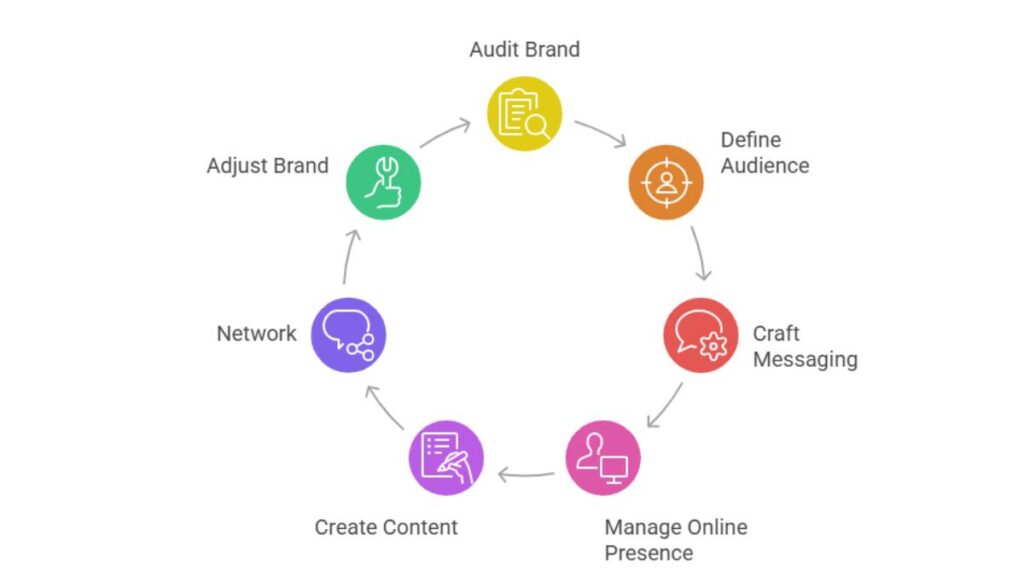
Personal brand management isn’t a one-day exercise. It’s closer to routine maintenance. Small adjustments, done regularly, keep things running smoothly. Ignore it for too long, and the brand starts drifting; not dramatically, just enough to cause confusion.
There’s a natural order to this work. Skipping ahead usually leads to surface-level polish without real clarity underneath.
1. Self-Discovery & Brand Definition
This is the part people rush, and it shows. Without clear direction, the brand ends up sounding like a copy of everyone else in the same industry.
Start with a few grounded questions:
- What kind of work consistently brings strong results?
- Which problems feel interesting enough to solve repeatedly?
- What values actually show up in decisions, not just the ones that sound good on paper?
Patterns tend to appear when looking at past roles and projects. Certain strengths keep surfacing. Certain types of challenges feel energizing instead of draining. That’s where the real positioning lives.
Then there’s differentiation. Not in a flashy way. Just honest specifics.
- Maybe it’s the ability to simplify messy situations
- Or connecting technical teams with non-technical stakeholders
- Or building a structure where there was none before
When strengths and preferences overlap, a personal brand statement starts to take shape. Short. Clear. Focused on value and audience, not job titles.
2. Personal Brand Audit & Reputation Assessment
Most professionals are walking around with an outdated public version of themselves. Old headlines. Early-career achievements are taking up prime space. Meanwhile, the real expertise has moved on.
A brand audit helps bring things back in sync.
Start with visibility:
- Search your name and review what actually appears
- Check LinkedIn, personal sites, speaker bios, anywhere your professional story lives
- Look at recent activity; does it reflect the current direction or an old phase?
Then look at reputation signals:
- Recommendations and testimonials: what themes show up?
- Endorsements, project highlights, published work
- Feedback received repeatedly in reviews or client conversations
Now compare that to where you want to go. That’s the gap.
Sometimes the issue is under-communication; strong skills, not enough proof. Other times, it’s misalignment; being known for something you’re trying to move away from. Both are fixable, once visible.
3. Target Audience & Positioning
Trying to appeal to everyone is usually a sign that positioning hasn’t been nailed down yet.
Personal brand management works better with a clear audience in mind:
- Hiring managers in a specific field
- Clients in a certain industry or growth stage
- Peers and collaborators in a niche community
Each group looks for different signals. A startup founder hiring a consultant cares about speed and adaptability. A corporate hiring manager might focus more on process and stakeholder management. Positioning should reflect those expectations.
Defining a niche often feels uncomfortable at first. It sounds limiting. In practice, it makes the brand sharper and easier to remember.
Good positioning connects three things:
- What’s done exceptionally well
- What kind of work is actually desired
- What the audience actively needs help with
When those line up, the brand feels natural. No exaggeration required.
4. Strategic Brand Messaging & Narrative Construction
Messaging is where positioning becomes tangible. This is the language people repeat when they describe someone to others.
Strong messaging usually has a few traits:
- Plain language over industry jargon
- Focus on outcomes, not just responsibilities
- Consistency across bios, profiles, and introductions
Then there’s the narrative; the thread that ties everything together. Careers aren’t always linear, and that’s fine. What matters is helping others understand the logic behind the journey.
A simple structure works well:
- The types of problems that kept showing up
- The approach developed to handle them
- The results that followed
That story helps people see expertise as earned and relevant, not random.
5. Online Personal Brand Management
Online presence is often the first filter people use. Details carry more weight than expected.
Key areas to review and refine:
- LinkedIn headlines and summaries that clearly state focus and value
- Experience sections written around impact, not just tasks
- Bios and “About” pages that match the same positioning
Consistency matters more than cleverness. If one platform says “strategy leader” and another says “operations specialist,” confusion creeps in.
Visual consistency plays a role, too. Professional photos, similar tone of voice, aligned messaging. Nothing overproduced. Just coherent.
6. Content Strategy for Personal Brand Management
Content keeps a personal brand visible and credible between major milestones.
The most effective content usually comes from lived professional experience:
- Observations about industry changes
- Lessons from recent projects
- Common mistakes seen in the field
- Practical tips others can apply
It doesn’t have to be constant. In fact, steady and sustainable beats intense bursts followed by silence.
A loose rhythm helps:
- A few thoughtful posts a month
- Occasional deeper pieces like articles or talks
- Engagement with others’ ideas to stay part of the conversation
Over time, this builds a body of work that reinforces expertise without needing to say “expert” out loud.
7. Networking & Relationship Management
Personal brand management is reinforced through relationships. People remember how interactions feel just as much as what profiles say.
Strong networking often looks like:
- Sharing useful insights without expecting immediate returns
- Following up after meaningful conversations
- Staying lightly in touch with peers and collaborators
Strategic connections matter too:
- People are ahead in the field
- Peers in complementary specialties
- Organizers, editors, and community builders
Both online and offline touchpoints count. A thoughtful comment, a quick message of congratulations, a shared resource. Small gestures build familiarity. Familiarity builds trust.
8. Feedback, Monitoring & Brand Adjustment
A personal brand isn’t static, and trying to freeze it usually backfires. Careers evolve. Interests shift. New strengths develop.
Ongoing brand management includes noticing patterns:
- What kind of work inquiries are coming in
- Which topics spark the most engagement or discussion
- Feedback that shows up repeatedly from different people
When patterns change, the brand should adjust too.
That might mean:
- Updating messaging to highlight new focus areas
- Reworking profiles to reflect a shift in direction
- Letting the older positioning fade out gradually
These don’t have to be dramatic reinventions. Usually, small refinements are enough. Over time, those adjustments keep the personal brand aligned with reality, which is what makes it believable in the first place.
Enroll Now: Advanced Digital Marketing Course
Tools & Techniques for Effective Personal Brand Management
Personal brand management sounds abstract until there’s a system behind it. Not complicated. Just a few practical ways to keep an eye on how things look from the outside.
Digital Tools for Brand Monitoring & Analytics
Most people don’t realize how their professional presence actually appears until they go looking for it. That’s where basic monitoring comes in.
A few habits go a long way:
- Checking search results for your name every so often
- Reviewing social and professional profiles as if seeing them for the first time
- Noticing which posts, talks, or articles people react to most
Engagement data can be surprisingly revealing. Not in a numbers-for-ego sense, but directionally.
- Are people responding more to practical advice or big-picture ideas?
- Do certain topics bring in connection requests or inquiries?
- Are peers engaging, or mostly people outside the target audience?
A simple “profile health check” helps too:
- Is the headline still accurate?
- Do summaries reflect current focus?
- Are the featured projects recent enough to represent where things stand now?
Small corrections prevent the brand from quietly drifting out of date.
Automation & Systems in Personal Brand Management
As careers get busier, consistency gets harder. That’s where simple systems help.
Scheduling content in advance, keeping a running list of ideas, or setting reminders to review profiles quarterly; none of this is flashy, but it keeps brand management from becoming reactive.
Automation can support:
- Regular content sharing without last-minute scrambling
- Tracking where your name or work is being mentioned
- Organizing speaking, writing, or project highlights in one place
Still, systems should support judgment, not replace it. Tone, boundaries, and professional values need a human filter. Always.
Visual Identity & Multimedia Branding
Visuals shape perception fast. Before someone reads a word, they’ve already formed an impression.
A few basics matter more than people expect:
- A current, professional photo that fits your industry
- Consistent visual style across personal websites, slide decks, or portfolios
- Clean, readable formatting in any public-facing material
Multimedia also strengthens personal brand management. Talks, panel clips, short videos, and well-designed presentations; these formats often communicate credibility faster than text alone.
They show how someone thinks and communicates, not just what they claim to know.
Best Practices for Long-Term Personal Brand Management
Short bursts of effort can boost visibility. Long-term consistency builds reputation. That’s the real game.
Maintaining Brand Consistency Across Touchpoints
Consistency doesn’t mean sounding scripted. It means reinforcing the same core identity over time.
That shows up as:
- Similar positioning across bios, profiles, and introductions
- A recognizable tone; whether thoughtful, direct, analytical, or conversational
- Visual alignment in photos, design choices, and presentation materials
When someone moves from a profile to a talk to an article, the experience should feel connected. Not identical. Just familiar in a reassuring way.
Ethical Personal Brand Management
There’s a line between positioning and exaggeration. Crossing it usually creates problems later.
Sustainable personal brand management sticks to:
- Clear, honest descriptions of roles and contributions
- Giving proper credit in collaborative work
- Resisting the urge to present every project as a massive success story
People talk. Industries are smaller than they look. Credibility travels just as fast as reputation damage.
Authenticity may feel slower, but it compounds over time.
Adapting to Trends Without Compromising Identity
Platforms change. Formats evolve. New expectations show up in professional spaces.
Adapting is necessary, but chasing every trend can make a brand feel scattered.
A steadier approach works better:
- Notice where your audience is paying attention
- Experiment with new formats that still fit your strengths
- Keep core positioning stable even as delivery methods shift
Relevance should enhance identity, not blur it.
Challenges in Personal Brand Management (And Solutions)
Even well-managed personal brands run into friction. Careers aren’t linear, and reputations aren’t built in perfect conditions.
Common Pitfalls to Avoid
Some issues appear again and again.
Inconsistent messaging
Different platforms highlight different strengths. This makes it harder for others to know what you actually want to be known for.
Neglecting online presence
Letting profiles sit untouched for years sends the wrong signal, even if real-world experience has grown.
Ignoring feedback patterns
If multiple people describe the same strength or niche, that’s data. Overlooking it can mean missing a natural positioning advantage.
Most of these problems build slowly. No big red flags, just gradual misalignment.
How to Recover & Rebuild a Damaged Brand
Sometimes the challenge is bigger: a public misstep, a difficult role, or a project that didn’t go well.
Rebuilding usually involves:
- Addressing issues directly when appropriate, not pretending they didn’t happen
- Demonstrating change through consistent professional behavior
- Shifting attention toward positive contributions and current strengths
Trust doesn’t return overnight. It rebuilds through repeated proof.
Re-Positioning Your Personal Narrative
Career shifts can make an old personal brand feel outdated. Moving into leadership, switching industries, and starting independent work all of these require narrative updates.
Re-positioning works best when it:
- Highlights transferable skills from past roles
- Connects previous experience logically to the new direction
- Updates public messaging to reflect future focus, not just past history
The goal isn’t to erase earlier chapters. It’s to show how they lead naturally into what’s next. When that connection is clear, others follow along much more easily.
Case Studies & Examples of Personal Brand Management
Theory sounds nice on paper. But patterns show up more clearly in real careers, messy timelines and all. Personal brand management doesn’t look identical across industries, yet the underlying mechanics stay surprisingly consistent.
Professional Brand Turnarounds
Most brand turnarounds don’t begin with a bold public declaration. They start quieter. A moment of friction. A realization that the market keeps describing someone in a way that no longer fits.
Typical situations look like this:
- A capable operator who wants to be seen as a strategic thinker, not just “the one who gets things done.”
- A professional who outgrew an old job title, but the label stuck anyway
- Someone known for one early niche that no longer reflects the real scope of their expertise
The shift usually follows a steady, deliberate path:
- Get clear on the new positioning first. If the direction is fuzzy, the perception will be too.
- Adjust the high-visibility touchpoints; headline, bio, intro, featured work, so they tell the updated story.
- Share work, insights, and conversations that reinforce the new direction. Repetition matters more than a single announcement.
Perception rarely changes because of one post or profile update. It changes because the evidence keeps showing up. Again and again.
Successful Personal Brand Management Across Careers
Different career paths call for different emphasis, but strong personal brand management always connects three things: expertise, visibility, and trust. Miss one, and the brand feels incomplete.
Corporate Professionals
Inside structured organizations, brand management often plays out in subtler ways. It’s less about visibility to everyone, more about visibility to the right people.
Effective patterns include:
- Becoming associated with a specific strength or domain, rather than just a role
- Contributing insights in meetings, internal forums, or industry spaces where peers and leaders pay attention
- Making sure public profiles reflect leadership qualities and impact, not just task lists
This isn’t about self-promotion for ego. It’s about reducing confusion. Decision-makers can only connect opportunities to people they clearly understand.
Freelancers & Entrepreneurs
For independent professionals, personal brand management directly influences opportunity flow. The brand quietly filters who reaches out, and who doesn’t.
Common threads show up:
- Clear positioning around a defined problem, audience, or outcome
- Consistent sharing of ideas and perspectives that show depth, not just availability
- Visible proof in the form of results, client feedback, or real work
When the brand is vague, inquiries are vague. When the brand is sharp, opportunities tend to be a better fit. Not perfect, but noticeably better.
Before–After Brand Comparison Patterns
Brand evolution often reveals itself in contrasts.
Before
- Broad labels like “consultant,” “marketing professional,” and “creative thinker.”
- Profiles that feel slightly different from one platform to another
- Experience listed, but impact left to interpretation
After
- Specific positioning tied to a specialty, audience, or outcome
- Messaging that feels aligned wherever someone looks
- Stories and examples that show results, not just responsibilities
The change isn’t about being louder. It’s about being clearer. Clarity does most of the heavy lifting.
Conclusion:
There was a time when personal brand management was occasional. Update a profile during a job search. Polish a bio before a big opportunity. Then leave it alone for a while.
That rhythm doesn’t really work anymore.
Growing Role of Search & Digital Discovery
Professional discovery now often happens quietly, in the background.
People look up names. They scan profiles. They skim recent activity. Impressions form quickly, based on things like:
- The roles and experiences that are most visible
- How clearly the expertise is explained
- Whether messaging feels consistent across platforms
In many cases, an opinion is forming before any direct conversation happens. That shifts brand management from a one-time task to an ongoing professional responsibility.
Why Continuous Brand Management Matters
Careers don’t stand still. Responsibilities expand. Interests shift. New strengths develop.
Without active management, public perception tends to freeze at an earlier version. Sometimes years earlier.
Ongoing brand management helps:
- Keep positioning aligned with current goals
- Highlight new directions and capabilities as they develop
- Prevent outdated information from shaping present-day opportunities
Small, regular adjustments usually beat dramatic overhauls. Less stress, fewer surprises.
Final Checklist: Personal Brand Management Framework
A simple mental checklist keeps things on track:
- Clarity – Is the positioning specific and easy to grasp, even for someone outside the field?
- Consistency – Do profiles, bios, and introductions tell roughly the same story?
- Credibility – Are claims backed by examples, outcomes, or visible work?
- Visibility – Is expertise showing up in places where the right audience actually spends time?
- Relevance – Does the brand reflect where the career is heading, not only where it started?
When these elements stay aligned, a personal brand becomes more than a profile. It turns into a long-term asset, one that quietly compounds as experience grows.
FAQs: Personal Brand Management
1. What’s the difference between personal branding and personal brand management?
Personal branding is the initial work of defining how someone wants to be known: strengths, focus areas, reputation, that sort of thing. Personal brand management is what happens after that. It’s the ongoing effort to keep that image accurate, relevant, and consistent as roles change, experience grows, and professional goals shift over time.
2. How often should someone update their personal brand?
There’s no perfect schedule, but waiting years usually creates problems. A quick review every few months keeps things aligned with current work and direction. Bigger updates tend to make sense after role changes, major projects, or skill growth. The goal is simple: make sure public perception doesn’t lag behind real progress.
3. Can personal brand management improve career prospects?
Yes, mostly because clarity makes decisions easier for other people. When strengths, focus areas, and results are easy to understand, opportunities tend to come faster and with less friction. It won’t replace strong performance, obviously, but it does make sure good work is visible, understood, and associated with the right kind of expertise.
4. What tools help with personal branding analytics?
Most useful signals are fairly straightforward: profile views, engagement with shared insights, inbound conversations, and how often expertise leads to real opportunities. Looking at search results and how others describe someone also reveals a lot. The point isn’t obsessing over numbers, just checking whether positioning is actually landing the way it should.
5. Is personal brand management only for influencers?
Not even close. Influencers may rely on visibility for income, but professionals in any field are still being evaluated based on what people can see and learn about them. Recruiters, clients, and peers form impressions quickly. Managing a personal brand simply makes sure those impressions reflect real strengths and current professional direction.