
Brand positioning strategy is basically the thread running through this entire guide, even when it’s not spelled out every second. It looks at positioning in real business terms, not theory-heavy slides, but the kind of decisions that affect how a brand grows, prices, and keeps customers coming back. That part often gets underestimated, by the way.
The guide breaks down what positioning actually is, how it’s different from branding (they get mixed up a lot), and why it lives in people’s heads more than in brand books. From there, it covers the building blocks that make a position strong and defensible, then walks through the main ways brands carve out space in crowded markets. Quality, price, innovation, service, lifestyle; different paths, same goal: be remembered for something clear.
There’s also a practical side woven in. A step-by-step way to develop positioning without overcomplicating it. Real brand examples, guidance on turning strategy into messaging, and ways to check if the market actually sees the brand the way it intends to. Because that gap shows up more often than teams expect.
Overall, the aim stays pretty grounded. Shape a position that makes sense to customers, holds up in the real world, and doesn’t fall apart the moment competition gets louder. Clear, credible, and built to last; not just nice words on a slide.
Table of Contents
What Is Brand Positioning Strategy?
A brand positioning strategy is the deliberate choice of how a brand wants to be seen and remembered by the people it’s trying to reach. Not internally. Not in a slide deck. Out there, in the messy real world, where customers compare, scroll, skim, and decide fast.
At its simplest, positioning answers one big question:
Why pick this brand instead of the others?
It defines the specific space a brand aims to occupy in the market. That space might be built around quality, affordability, innovation, reliability, lifestyle, or even a point of view. The key is that it’s focused. Not everything is for everyone. Just something clear and meaningful for the right audience.
Brand Positioning vs Brand Identity vs Branding
These terms get tossed around like they mean the same thing. They don’t.
- Brand positioning is the strategic choice about what the brand stands for in the customer’s mind
- Brand identity is how that positioning is expressed: visuals, voice, design, personality
- Branding is the ongoing execution of that identity across all touchpoints
Positioning is the foundation. Identity and branding are the visible layers built on top. When companies jump straight to logos and taglines without clear positioning… things start looking nice but saying very little.
What a Brand Positioning Strategy Statement Includes
Behind the scenes, many brands document their thinking in a brand positioning statement. It’s not meant for customers. It’s a clarity tool for teams.
It usually covers:
- Who the target audience really is
- Which category does the brand compete in
- The main benefit customers get
- The key difference versus alternatives
- The reason to believe the brand can deliver
If any of those feel fuzzy, the positioning probably is too.
Why Positioning Is About Perception in the Customer’s Mind
Here’s the part that trips people up: positioning isn’t what a company claims. It’s what customers believe.
A brand can call itself premium, innovative, or customer-first all day. But if the experience doesn’t back that up, the market quietly disagrees. And the market usually wins that argument.
Strong positioning lives in perception. It shows up in how easily customers can describe the brand, what they expect from it, and when it comes to mind. In crowded markets, that mental shortcut, that quick “this is the one that…”, is incredibly powerful.
Why Brand Positioning Strategy Is Important for Business Growth
When positioning is unclear, marketing starts to feel scattered. Messages change every few months. Campaigns don’t quite connect. Teams describe the brand in completely different ways. It’s subtle at first… then it becomes expensive.
Clear positioning brings focus. And focus tends to compound over time.
How Strong Brand Positioning Increases Brand Recall
People don’t remember everything about a brand. They remember the main thing.
That “main thing” is usually the result of consistent positioning. Over time, the brand becomes associated with a specific benefit, feeling, or role. The association sticks because it’s repeated, reinforced, and easy to understand.
When a need comes up, the brand that owns a clear idea in the customer’s mind is simply easier to recall. No mental gymnastics required.
Impact of Positioning on Customer Loyalty and Trust
Positioning sets a promise. The experience either keeps it or breaks it.
When customers consistently get what they expect, in quality, tone, service, or outcome, trust builds quietly. Loyalty follows. Not because of flashy campaigns, but because the brand feels dependable. Predictable in a good way.
Weak positioning creates mismatched expectations. And when expectations and experiences don’t line up, trust erodes faster than most teams realize.
Role of Positioning in Competitive Markets
In crowded categories, products and services start to look alike. Features overlap. Pricing models converge. Marketing language becomes suspiciously similar.
Positioning is what creates separation beyond the spec sheet. It shifts the focus from just “what it does” to “what it represents” and “who it’s really for.” That layer of meaning is much harder for competitors to copy.
Instead of competing feature by feature, well-positioned brands compete on identity and relevance. That’s a tougher battlefield, but a more defensible one.
How Positioning Affects Pricing Power and Profitability
Pricing rarely works in isolation. It makes more sense when seen through the lens of positioning.
- Premium positioning supports higher prices because expectations are set accordingly
- Value positioning supports scale and accessibility
- Specialist positioning can justify niche, expertise-driven pricing
When positioning is clear, pricing feels logical. When it’s not, higher prices feel random and get questioned more often.
Why Weak Brand Positioning Leads to Brand Confusion
Brands without strong positioning tend to drift. They try to appeal to too many segments, borrow language from competitors, and change direction frequently.
The result is a brand that feels vague. Hard to describe. Easy to overlook.
And in fast decision environments, unclear brands don’t get the benefit of the doubt. They just get skipped.
Core Elements of an Effective Brand Positioning Strategy
Strong positioning usually rests on a few essential pieces. Leave one out, and the whole thing starts to wobble.
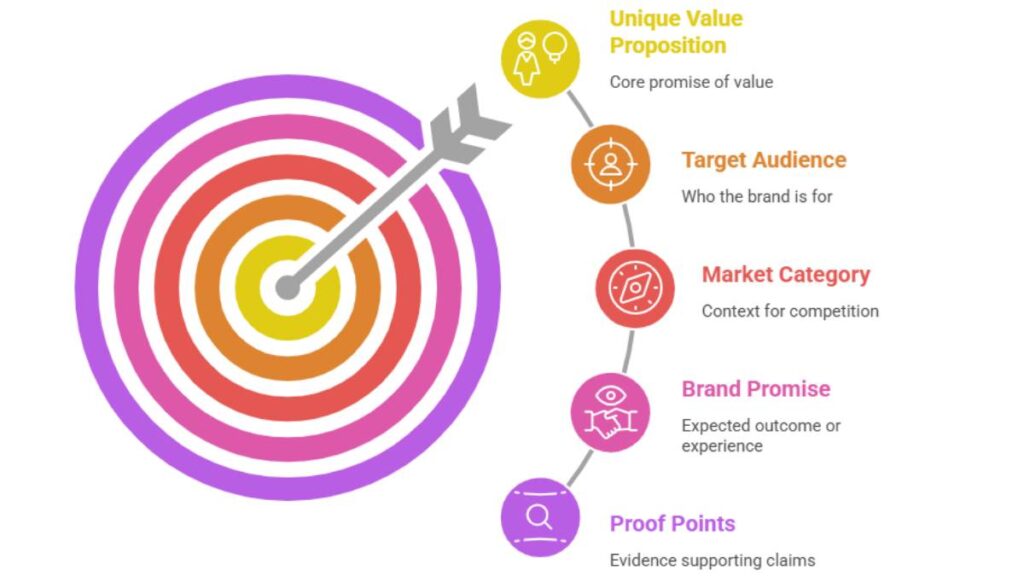
Target Audience Definition in Brand Positioning
Good positioning starts with a clear sense of who the brand is really for. Not “everyone who might buy this.” That’s where positioning goes to die.
Clarity comes from understanding:
- The audience’s real problems and goals
- How do they make decisions
- What they value beyond just price
- What frustrates them about existing options
The sharper the audience definition, the sharper the positioning can be. Broad targets tend to produce bland messages.
Market Category and Competitive Frame of Reference
Customers need context before they can appreciate differences. That context comes from the category a brand chooses to compete in.
This is the frame of reference. It tells customers what kind of solution this is, and what other options it sits next to.
Choosing the right category shapes:
- Who the brand is compared against
- What expectations do customers bring
- What counts as “different” in the first place
Sometimes, reframing the category itself is part of the positioning strategy. Subtle, but powerful.
Unique Value Proposition (UVP) in Brand Positioning
At the center of positioning sits the unique value proposition. It’s the core promise of value the brand delivers in a way that stands apart.
A strong UVP is:
- Clear and specific
- Relevant to the target audience
- Grounded in something the brand can actually deliver
If the same sentence could describe several competitors, it’s not unique yet. Needs more work.
Brand Promise and Key Differentiators
The brand promise is the consistent outcome or experience that customers can expect. Differentiators explain why the brand can keep that promise.
Differentiators might include:
- A distinct approach or process
- Specialized expertise
- Unique features or service models
- Reputation, heritage, or credibility
They add weight to the positioning. Without them, the promise can sound like generic marketing language.
Emotional vs Functional Brand Benefits
Strong positioning blends practical and emotional value.
- Functional benefits explain what the brand does better: faster, easier, more reliable
- Emotional benefits explain how customers feel as a result: confident, secure, in control, inspired
Functional benefits often get a brand considered. Emotional benefits often tip the final decision. Not always obvious, but consistently true.
Proof Points That Support Brand Positioning Claims
Positioning needs evidence. Otherwise, it reads like a slogan.
Proof points make the claims believable. These might be:
- Results and performance data
- Testimonials or case studies
- Credentials, certifications, or partnerships
- Demonstrated expertise over time
They don’t need to be flashy. Just credible enough that the positioning feels earned, not invented.
Types of Brand Positioning Strategies
There isn’t one magic positioning formula. Different markets reward different strengths, and what works in one category can fall flat in another. The bigger issue usually isn’t which strategy a brand chooses; it’s trying to stand for too many things at once. That’s when messaging turns into mush.
Strong brands tend to anchor themselves in one main positioning idea. Maybe a second one supports it quietly. But there’s always a clear center of gravity.
Here’s how that typically plays out.
Quality-Based Positioning
This is the “we do it better” lane, but it only works when there’s real substance behind it.
Quality positioning leans on things like better materials, tighter processes, stronger performance, or craftsmanship that competitors don’t bother with. Sometimes the difference is visible. Sometimes it’s under the hood. Either way, customers are meant to feel the upgrade.
Price usually runs higher here. That’s not a side effect, it’s part of the signal. Premium cost helps frame the brand as serious, not mass-market.
The catch? Expectations rise fast. If quality slips even slightly, people notice. And they talk.
Price-Based Positioning
Some brands win by being cheaper. Others win by being smarter and more valuable. Those aren’t the same thing, even though they get mixed up.
Budget positioning is about the lowest cost, no frills. Value positioning says, “You get a lot for what you pay.” Different story, different audience.
This strategy attracts practical buyers; people comparing numbers, not chasing image. Though truthfully, the feeling of getting a deal is emotional, too. Just a quieter kind.
Margins tend to be thinner in this space, so the business model behind the scenes has to be tight. Efficiency isn’t optional.
Customer Service Positioning
In certain industries, products look nearly identical on paper. That’s when service becomes the differentiator.
Brands in this space focus on being easy to reach, quick to respond, fair with policies, and generally helpful when something goes wrong. It’s less about flashy marketing, more about a reputation built over time.
This works especially well where purchases feel risky or complex. People want reassurance that a real human will step in if needed.
The hard part? Consistency. One bad experience can undo a lot of goodwill.
Convenience-Based Positioning
Convenience positioning makes one big promise: less hassle.
That could mean faster delivery, simpler setup, fewer steps, better availability; anything that reduces friction. Often it’s not about huge innovations, just removing the small annoyances everyone else has decided to live with.
Customers get used to that ease quickly. Then competitors start to feel… slow, clunky, outdated. Convenience reshapes expectations more than brands realize.
Innovation and Technology Positioning
Some brands build their identity around being ahead. New features, smarter systems, constant upgrades.
This appeals to people who like being early adopters, or at least don’t want to feel behind. Progress becomes part of the brand’s personality.
The pressure, of course, is staying ahead. Once the tech feels standard, the positioning loses punch. Innovation can’t be a one-time story.
Competitor-Based Positioning
Here, the brand defines itself in contrast to a known player. It’s the “we’re not them” approach.
This might mean calling out common frustrations, pointing out gaps in the market leader’s offer, or presenting a more modern, flexible alternative. Challenger brands use this a lot.
It works best when customers already feel some irritation with the dominant option. Without that tension, comparisons feel forced.
Differentiation Positioning
This strategy focuses on distinctiveness, plain and simple.
Maybe the brand serves a narrow niche. Maybe it has a unique feature set. Maybe the personality is different enough to stand out in a sea of sameness. The goal is not for everyone.
Niche brands often do well here. Smaller audience, stronger fit. Less shouting, more resonance.
Problem–Solution Positioning
Some brands center everything around a specific pain point. They name the problem clearly and present themselves as the fix.
This works especially well when the issue feels urgent or frustrating. Customers aren’t casually browsing; they want relief. The brand that understands the struggle usually gets attention first.
Clarity matters here. Vague problems don’t convert.
User-Centric Positioning
Instead of focusing on features, this strategy focuses on who the brand is for.
It might target a specific profession, lifestyle group, or type of customer with shared needs. Over time, the brand becomes “the one for people like us.”
That sense of recognition builds loyalty. People stick with brands that feel like they were designed with them in mind, not the general public.

Enroll Now: Advanced Digital Marketing Course
Emotional Positioning
Not every buying decision is rational, even when we pretend it is.
Emotional positioning connects the brand to feelings: confidence, freedom, security, nostalgia, and status. Functional benefits still exist, but they’re not the headline. The brand sells how life feels with it in the picture.
When done well, this creates a strong attachment. Harder for competitors to copy a feeling than a feature.
Value-Based Positioning
Here, the brand stands for principles beyond the product itself.
That could include sustainability, ethical sourcing, social responsibility, and transparency. Customers choosing these brands often want purchases to reflect personal beliefs.
Still, purpose alone isn’t enough. If the product disappoints, values won’t save it for long.
Lifestyle Positioning
Lifestyle brands attach themselves to a certain way of living.
Think interests, habits, aspirations, aesthetics. The brand becomes part of a broader identity story. Customers buy in because it fits how they see themselves, or how they want to be seen.
It’s less about the item, more about the world around it.
Cultural or Community Positioning
Some brands align with cultural movements, communities, or shared identities.
When it’s genuine and consistent, this builds deep loyalty. When it’s surface-level or opportunistic, audiences notice, and the backlash can be swift.
This positioning asks for long-term commitment, not one-off campaigns.
Most successful brands don’t invent a brand-new positioning category. They choose a clear direction, commit to it, and reinforce it over time; through product decisions, messaging, service, everything. That steady consistency is what really earns a spot in people’s minds. Not clever slogans. Not trends. Just clarity, repeated.
How to Create a Brand Positioning Strategy (Step-by-Step Process)
Building a brand positioning strategy isn’t a creative exercise alone. It’s part analysis, part decision-making, part restraint. The hardest bit? Choosing what the brand will not try to be.
Here’s a grounded way to approach it.
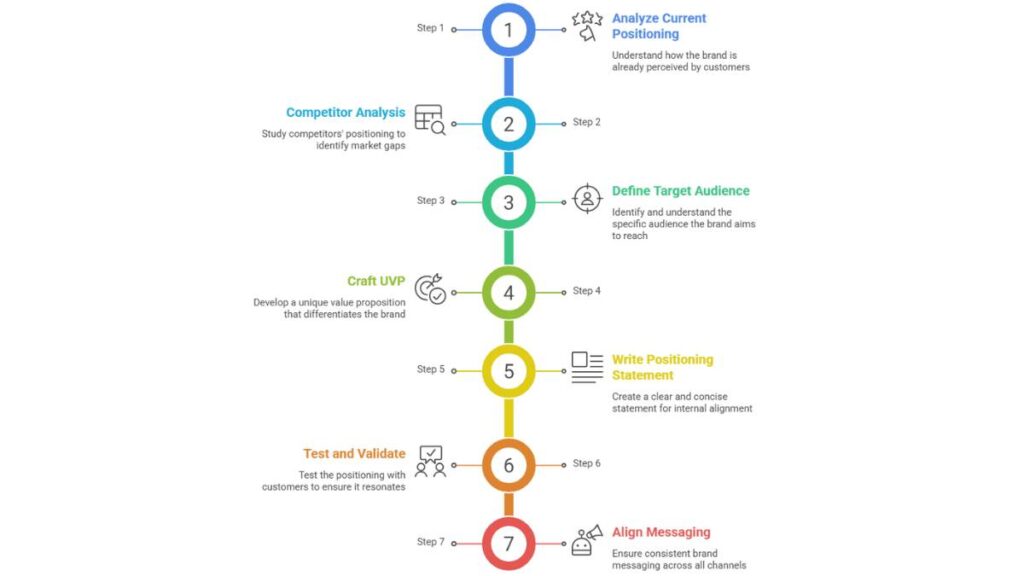
Step 1 – Analyze Your Current Brand Positioning
Before changing anything, get a clear picture of how the brand is already perceived. Not internally; externally. Those two versions rarely match perfectly.
Look at:
- Customer reviews and testimonials
- Sales team feedback from real conversations
- Common objections or hesitations
- Social media comments and questions
Patterns show up. Certain words repeat. Certain expectations come up again and again. That’s your starting point, whether it’s accurate or not.
Step 2 – Conduct Competitor Positioning Analysis
Customers don’t evaluate brands in isolation. They compare, often subconsciously.
Study competitors by asking:
- What do they clearly want to be known for?
- Are they competing on price, expertise, innovation, or service?
- How do they describe their customers?
- What emotional tone do they use: bold, safe, friendly, or premium?
A simple perceptual map helps here. Plot brands on two axes that matter in your market. You’ll usually find clusters where everyone sounds the same… and maybe one or two open spaces that feel underclaimed.
Those gaps can be opportunities if the brand can credibly own them.
Step 3 – Define Your Target Audience and Market Segment
Trying to appeal to everyone weakens positioning fast. Strong positioning feels like it’s meant for someone specific.
Go beyond surface-level demographics. Consider:
- What pressures does your audience deal with daily
- What risks do they worry about when choosing a provider
- What outcomes matter more than features
- What frustrates them about existing options
Psychographics; motivations, fears, ambitions; shape positioning more than age or job title ever could.
Step 4 – Craft Your Unique Value Proposition (UVP)
This is where clarity often turns into vagueness. Phrases like “high quality” and “great service” creep in. They sound safe. They’re also forgettable.
A useful test:
If a competitor could say the exact same thing without sounding strange, it’s not a real differentiator.
Strong value propositions usually focus on:
- A specific strength that the brand can consistently deliver
- A type of outcome customers care deeply about
- A point of emphasis, competitors don’t lean into
Specific beats impressive. Clear beats clever.
Step 5 – Write a Clear Brand Positioning Statement
This statement isn’t for advertising. It’s for alignment. It should make internal decisions easier, not harder.
A practical structure looks like this:
For [target audience]
Who [has this need or challenge]
Our brand is a [category or type of solution]
That [primary benefit or differentiator]
Because [reason to believe]
It doesn’t have to sound elegant. It needs to be unmistakable. If two team members explain it differently, it’s not sharp enough yet.
Step 6 – Test and Validate Your Brand Positioning
Before rolling out new messaging everywhere, test the direction in small ways.
- Try different value angles in marketing copy
- Ask customers which descriptions feel most accurate
- Use interviews to understand emotional reactions, not just logical agreement
Sometimes a positioning that sounds strong in a meeting room feels flat to customers. Better to find that out early.
Step 7 – Align Brand Messaging Across Channels
Once positioning is defined, consistency becomes the real work.
It should influence:
- Website headlines and service pages
- Sales presentations and proposals
- Social media voice and themes
- Customer support tone
- Even hiring and onboarding language
Positioning is a promise. Every touchpoint either reinforces it or quietly undermines it. People notice the disconnects, even if they can’t explain why.
Brand Positioning Strategy Examples from Top Brands
Well-positioned brands feel clear, almost obvious. That clarity usually comes from years of repeating the same core idea, not constant reinvention.
McDonald’s Brand Positioning Strategy
McDonald’s stands for convenience, affordability, and consistency.
It’s not trying to be artisanal or premium. The positioning is built around predictability: quick meals, familiar taste, and easy locations. For families on the go or travelers needing something reliable, that promise matters more than culinary innovation.
The brand wins by being dependable at scale.
Tesla’s Brand Positioning Strategy
Tesla’s positioning blends innovation, sustainability, and high-end technology.
It doesn’t present itself as just another car brand. The narrative leans heavily into the future: software-driven vehicles, cutting-edge performance, and a shift away from traditional fuel. The cars feel like products from a tech ecosystem, not just transportation.
That future-focused identity justifies both the price and the loyalty.
Coca-Cola’s Brand Positioning Strategy
Coca-Cola is anchored in emotion, happiness, and shared experiences.
Very little of its communication focuses on the drink itself. Instead, the brand consistently shows moments of connection; celebrations, friendships, small joys. The product becomes a symbol of togetherness.
Owning that emotional space makes it hard for competitors to copy without feeling forced.
How to Communicate Your Brand Positioning Effectively
A positioning strategy only works if it shows up consistently in how the brand speaks, looks, and behaves.
Start with messaging themes. Decide:
- What ideas should always be reinforced
- What claims don’t fit the positioning, even if they sound appealing
From there, shape the brand’s tone of voice. A brand positioned as premium might sound calm and assured. A brand focused on accessibility may sound more direct and friendly. Tone signals positioning before customers fully process the words.
Visual identity matters too. Colors, typography, and imagery should feel aligned with the same personality. When visuals and messaging send mixed signals, trust weakens a little.
Content plays a long game. Articles, videos, social posts; they should consistently reflect the same perspective and priorities. Over time, repetition builds recognition.
And then there’s consistency across touchpoints:
- Website
- Ads
- Emails
- Sales calls
- Customer service interactions
Positioning isn’t a slogan. It’s an experience pattern. When customers keep encountering the same underlying promise in different situations, the brand earns a clear place in their minds.
How to Measure the Success of Your Brand Positioning Strategy
Brand positioning lives in people’s minds, which makes it feel intangible. But its effects show up in very real numbers and behaviors. The trick is looking at the right signals, not just surface metrics.
Brand awareness metrics are a starting point. If positioning is clear and distinctive, more people should recognize the brand in its category. This includes:
- Unaided brand recall (who comes to mind first)
- Aided awareness (recognition when shown the name)
- Search demand for the brand specifically
Awareness alone isn’t enough, though. Plenty of well-known brands are known for the wrong things.
Brand perception surveys dig deeper. These help answer questions like:
- What three words do customers associate with the brand?
- What does the brand do better than others?
- When would someone choose this brand over a competitor?
When customer language starts to match the intended positioning, that’s a strong sign that things are clicking.
Net Promoter Score (NPS) can also reflect positioning strength. A brand that stands for something meaningful tends to earn stronger advocacy. Not just satisfaction; real willingness to recommend.
Then there’s customer loyalty and retention. Clear positioning attracts the right customers. And the right customers tend to stay longer, buy more, and churn less. If acquisition looks healthy but retention is weak, positioning may be attracting the wrong audience.
Finally, watch the share of voice and brand sentiment. Are people talking about the brand in ways that align with its intended identity? Are conversations positive, neutral, or drifting negative in areas tied to the brand promise?
Positioning success is rarely one big spike. It’s a gradual pattern of alignment between what the brand says and what customers repeat.
How to Improve Your Brand Positioning Strategy Over Time
Markets shift. Customer expectations evolve. Competitors change direction. A positioning strategy that worked five years ago can start to feel dated; sometimes subtly, sometimes all at once.
Improvement doesn’t always mean a dramatic repositioning. Often, it’s about sharpening or updating the edges.
Use Perceptual Mapping to Identify Market Gaps
Perceptual mapping helps visualize how customers see brands relative to each other. When plotted on meaningful dimensions, like premium vs affordable, or traditional vs innovative, gaps sometimes appear.
Those gaps don’t automatically mean opportunity. The brand still needs the capabilities to deliver on that space. But they can reveal:
- Overcrowded positioning of territories
- White space that competitors haven’t clearly claimed
- Areas where the brand is drifting too close to others
It’s a reality check. Helpful, occasionally uncomfortable.
Build and Maintain a Strong Brand Personality
Positioning defines what the brand stands for. Personality shapes how it expresses that.
Over time, personality can blur if different teams create content in isolation. One campaign feels playful, another overly corporate, another overly aggressive. The result? Mixed signals.
Refining personality means clarifying:
- How the brand sounds in writing and speech
- How bold or conservative its tone should be
- What kind of humor, if any, fits
- What topics or attitudes feel off-brand
Consistency here strengthens the overall positioning without changing its core.
Ensure Brand Consistency Across All Channels
Customers experience brands in fragments; a social post here, a sales email there, a support interaction later. If each touchpoint presents a slightly different identity, positioning weakens.
Regular reviews of key channels help spot drift:
- Website messaging vs ad copy
- Marketing promises vs sales conversations
- Brand voice vs customer service tone
Small inconsistencies add up. Tightening them reinforces the same mental picture over time.
Stay Focused on Evolving Customer Needs
Sometimes positioning weakens not because the brand changed, but because customers did.
New priorities emerge. New frustrations show up. Language shifts. A benefit that once felt compelling might now feel expected, not differentiating.
Staying close to customers through ongoing feedback, interviews, and behavior patterns helps brands adjust their emphasis. Not abandoning their core, just making sure it still connects to real, current needs.
5 Brand Positioning Statement Templates
Positioning statements aren’t meant to be catchy. They’re meant to be clear enough that internal teams make aligned decisions. These templates help structure thinking without forcing the brand into vague language.
Template for Startups
For [specific target audience]
Who struggle with [key problem or unmet need]
Our brand is a [category or type of solution]
That helps them [primary outcome or benefit]
Unlike [main alternative or competitor]
We [key differentiator or unique approach]
Template for B2B Brands
For [industry, role, or business type]
Who needs to [critical business objective]
Our brand provides [type of product or service]
That delivers [measurable or strategic benefit]
Because we [capability, expertise, or proof point competitors lack]
Template for Premium Brands
For [discerning or quality-focused audience]
Who value [specific high-end expectation]
Our brand is a [premium category descriptor]
That offers [superior experience or performance benefit]
Through [craftsmanship, innovation, exclusivity, or other premium driver]
Template for Value Brands
For [price-conscious or practical audience]
Who wants [essential benefit without unnecessary extras]
Our brand is a [accessible or value-focused category]
That provides [reliable core benefit]
At [clear cost or efficiency advantage]
Template for Purpose-Driven Brands
For [values-driven audience or community]
Who cares about [cause, belief, or social issue]
Our brand is a [category]
That helps them [primary functional benefit]
While also [clear social, environmental, or cultural commitment]
These templates are starting points. The real strength comes from the choices behind the words; what the brand is willing to emphasize consistently, and what it’s willing to leave out.
How Brand Positioning Strategy Actually Plays Out Across Industries
Brand positioning always comes back to the same basic idea: owning a clear space in the customer’s mind. Simple in theory. In practice… it bends depending on the industry, the risk involved in buying, and how people make decisions there.
Brand Positioning Strategy in Professional Services
Professional services are a different beast. People aren’t just buying an outcome; they’re buying judgment, experience, and a working relationship. That shifts what positioning needs to lean on.
A few things tend to matter more here:
- Specialization – Firms that try to do everything for everyone often fade into the background. Clear focus on a niche industry or a specific problem is easier to trust.
- Proof of expertise – Case work, credentials, visible thought leadership. Not flashy claims, just steady evidence that the team knows its ground.
- A defined way of working – Clients feel more comfortable when there’s a method behind the service, not just “we’ll figure it out.”
- Working style – Some firms position themselves as deeply collaborative partners. Others are sharp, strategic outsiders who challenge assumptions. Both can work, but it needs to be clear.
And honestly, phrases like “client-centric” or “results-driven” don’t move the needle much anymore. They’re everywhere. What cuts through is clarity about who the firm is built for, and who might be better served elsewhere.
Brand Positioning in Technology Companies
Tech companies often default to saying they’re “innovative.” Which, at this point, is almost background noise. Innovation is expected. It’s not a position on its own.
More effective tech positioning usually narrows the promise:
- Making complex things feel simple – Especially in crowded SaaS categories where tools get bloated fast.
- Performance under pressure – Speed, uptime, scalability. Enterprise buyers care about what happens on a bad day, not just a demo.
- A clear break from legacy systems – Framing the product as a real step forward, not just a nicer interface.
- Easy integration – Fitting into existing tools without drama. Quietly powerful positioning, but very persuasive.
The strongest tech brands tie features back to outcomes people care about in their day-to-day work. Less about what the tool does. More about what it helps teams avoid: wasted time, manual work, bad data, messy decisions.
Brand Positioning in Consumer Goods
Consumer goods move faster. Decisions are often emotional, sometimes habitual, and made with limited attention. Positioning has to land almost instantly.
Common angles show up again and again:
- Dependable quality – Especially in products connected to health, home, or family routines.
- Smart value – Not just cheap, but a sensible, no-regret choice.
- Lifestyle fit – Products that quietly signal identity. Fitness-focused, eco-conscious, design-forward, and so on.
- Ethical or sustainable stance – This keeps growing, particularly with younger buyers who read labels and brand stories more closely.
Here, positioning isn’t just in the words. It lives in packaging, design, colors, and even the weight of the product in hand. A lot gets communicated before a single sentence is read.
Common Brand Positioning Mistakes That Trip Brands Up
Most positioning mistakes don’t come from laziness. They come from trying to play it safe. Ironically, that’s what makes a brand easy to ignore.
Trying to appeal to everyone
It feels safer to stay broad. But broad positioning rarely sticks. When a message tries to speak to everyone, it usually resonates deeply with no one. Strong positioning naturally pulls some people in tighter than others. That’s not a flaw; that’s the point.
Leaning too hard on competitor language
It’s tempting to mirror the market leader’s tone or claims. The result is a category full of brands saying nearly the same thing. When customers can’t tell brands apart, price becomes the deciding factor. That’s a tough place to compete.
Using generic differentiators
“High quality.” “Innovative.” “Great service.” All positive. All vague. Without context or proof, they blur together. Specific strengths, even narrower ones, are easier to believe and remember.
Inconsistent signals over time
One campaign pushes premium positioning. The next focuses on discounts. Then another highlights speed above all else. Each message may make sense on its own, but together they create a fuzzy brand image.
Positioning that outpaces reality
This one hurts long-term. If a brand promises simplicity but feels complicated, or claims premium but delivers average, trust erodes quickly. Positioning sets expectations. The actual experience either reinforces it… or quietly undermines it.
Conclusion:
Strong positioning usually isn’t loud or dramatic. It’s steady. Repeated. Reinforced in small ways, over and over.
Brands that manage to hold a clear place in the market tend to do a few things well:
- They make a deliberate call on what they want to be known for
- They repeat that idea consistently, even when the team gets tired of hearing it internally
- They evolve the way they express the brand, but don’t keep changing the core promise
- They stay close to customer shifts and adjust emphasis when needed, without overreacting
There’s always pressure to chase trends or respond to every competitor’s move. Sometimes that’s necessary, sure. But constant repositioning can make a brand feel unstable.
Over time, positioning works a bit like compound interest. Small, consistent signals build familiarity. Familiarity builds trust. And trust, more than clever taglines or flashy campaigns, is what gives a brand a solid, defensible place in the market.
FAQs: About Brand Positioning Strategy
1. What’s a brand positioning strategy?
It’s basically the spot your brand takes in people’s heads. Simple as that. Not a tagline, not a logo. It’s about being known for something, and being clear who it’s actually for. When done right, people get it without having to read a long paragraph. If they have to think too hard… well, that’s usually a sign it’s off.
2. What makes positioning strong?
First, know your people. Not vaguely; really, who they are. Then figure out your turf; what space do you own? Your value proposition has to fix a real problem, not sound nice on paper. Throw in some emotion. Practical benefits, too. And proof; something believable. Put that together and suddenly your positioning isn’t just words. It sticks.
3. Positioning vs branding; what’s the deal?
Positioning is the thinking behind it: what the brand stands for, who it’s for, and why it matters. Branding is how that shows up: logo, voice, messaging, campaigns. One’s the plan, the other’s the visible stuff. Mix them up and, yeah, people get confused, messaging feels messy.
4. Why does it matter?
Without it, a brand just… blends in. Marketing becomes noisy. Customers get confused. Price wars sneak in. A clear position makes marketing easier. It pulls the right people in. Makes your value obvious. Even allows for slightly higher pricing if people get why you’re different.
5. Brand positioning statement; what is it?
It’s an internal guide. Tells the team who the brand serves, the space it’s in, the key benefit, and why people should believe it. Customers don’t see it directly, but everything they experience comes from it: messaging, campaigns, product tweaks. It’s the hidden engine.
6. Can positioning change?
Sure. Markets shift, people change, brands grow. But… don’t start from scratch. Build on what people already believe. Big, sudden changes can confuse or even upset loyal customers. Slow, careful shifts work better.
7. How to know if it’s working
Listen to how people talk about the brand. Can they describe it the way you intended? Awareness goes up, associations get sharper, and preference improves. Loyalty tends to follow. If people “get it” without repeated explanation, that’s the sweet spot.