
Long advertising copy has a reputation for being “too much,” yet it keeps working for one simple reason: serious buyers want real answers. This piece looks at why longer-form ads still persuade in a world full of short attention spans. It walks through how detailed messaging builds trust, handles objections, and guides readers step by step instead of rushing them. There’s discussion around structure, psychology, platform differences, and what separates helpful depth from drawn-out fluff. Real brand examples show how strong long advertising copy feels informative rather than salesy. The takeaway is practical: when clarity leads, and every section earns its place, length stops feeling long and starts feeling useful.
Table of Contents
Introduction
Long advertising copy tends to get a bad rap. Too wordy. Too slow. Supposedly, nobody reads anymore. Yet when money, trust, or personal outcomes are on the line, people absolutely read, just more carefully. Quick slogans might grab attention, but they rarely close thoughtful buyers on their own.
That’s where long copy proves its value. It gives space to explain things properly. Not hype, not noise; actual clarity. It walks through what the offer is, who it’s for, what makes it different, and why it’s worth considering. When readers feel informed instead of rushed, resistance drops. Decisions get easier.
There’s another shift happening, too. People search with specific questions now. They compare, evaluate, and double-check. Content that goes deeper tends to match that mindset better than surface-level messaging. Long advertising copy, when structured well, lines up naturally with how real buyers think things through.
What Is Long Advertising Copy?
Long advertising copy is persuasive writing that takes its time. Instead of squeezing everything into a headline and two lines of text, it builds a full case for the offer. It explains, reassures, and guides the reader toward a decision, step by step.
It’s not just about length. It’s about coverage.
Strong long copy usually does a few things well:
- Explains the offer in plain terms
- Connects features to real-life outcomes
- Anticipates common objections
- Provides proof or credibility signals
- Leads naturally to a clear next step
Long Ad Copy vs. Short Ad Copy
Both formats work. The difference is how much convincing needs to happen.
Short ad copy is great when:
- The product is low-cost or familiar
- The brand already has trust
- The goal is a quick click or impulse action
It grabs attention, creates curiosity, and moves fast. Details often come later.
Long advertising copy, on the other hand, is better when:
- The offer is new, complex, or higher priced
- Buyers have doubts or need reassurance
- The decision carries some risk
In those situations, people don’t want clever lines. They want answers. Long copy provides the room to give them.
Why Long Advertising Copy Works for Complex and High-Value Offers
The bigger the decision, the slower the process. That’s just how people operate. Before committing, buyers start asking practical questions; sometimes consciously, sometimes not.
- Is this really worth it?
- How is it different from other options?
- What if it doesn’t work for someone like me?
- Can this brand actually deliver?
Long advertising copy works because it doesn’t ignore those questions. It brings them into the open and deals with them directly. Instead of pushing for a fast yes, it builds a steady case. That approach feels more respectful, and often more convincing.
There’s also a perception factor. Detailed explanations suggest the company understands the problem and has nothing to hide. Thin copy can feel like it’s skipping over something. Depth signals confidence.
The Psychology Behind Long Copy Ads
Buying decisions rarely happen in a straight line. People move from curiosity to interest, then hesitation, then comparison. Sometimes they circle back. Long copy works because it mirrors that internal process instead of fighting it.
It gives readers time to think while still guiding the direction of those thoughts.
How Long Does Copy Build Trust and Reduce Objections
Trust isn’t built through bold claims alone. It grows through explanation and transparency.
When copy openly addresses concerns, cost, effort, results, and limitations, it feels more honest. Readers don’t feel like they’re being sold to; they feel like they’re being informed. That small shift changes how the message is received.
Objections are easier to handle when they’re answered before turning into silent deal-breakers. Long copy creates space to say, “Here’s what you might be wondering,” and then respond clearly. That reduces friction in the decision process.
The Role of Storytelling in Persuasive Advertising Copy
Stories help people picture outcomes. Not dramatic, movie-style stories; just grounded scenarios. A common struggle. A turning point. A practical result.
When readers can see their own situation reflected in the message, the offer feels more relevant. Benefits stop sounding theoretical and start feeling possible. Long copy gives room for these small narrative moments that make the message stick.
Emotional vs. Logical Triggers in Long Ad Copy
Most decisions start emotionally and get justified logically.
Emotional drivers often include:
- Frustration with an ongoing problem
- Desire for improvement or relief
- Fear of making the wrong choice
- Hope for a better outcome
These create urgency and interest.
Logical drivers step in after:
- Clear explanations of how the product works
- Comparisons or differentiators
- Data, proof, or demonstrations
- Guarantees or risk-reduction elements
Long advertising copy handles both sides. It connects emotionally first, then supports that feeling with facts and reasoning. That balance makes the final decision feel smart, not impulsive.
Why People Skip Boring Copy but Engage With Relevant Long Copy
Length isn’t what makes copy boring. Irrelevance does.
People scroll past short, flashy ads every day. At the same time, they’ll spend ten minutes reading about a topic that directly affects them. When long advertising copy speaks to a real problem, uses clear language, and avoids filler, readers stay with it.
Useful content doesn’t feel long. It feels worth the time.
Long Advertising Copy Examples That Convert
Looking at real ads makes the theory click. Long copy isn’t about piling on words; it’s about guiding someone from mild interest to real conviction. Here are three strong examples that show how different brands use depth to move people closer to a decision.
Example 1: Mitsubishi SUV Long-Form Print Ad
Automotive brands have used long copy for decades, especially when introducing new models or features buyers weren’t familiar with yet. One Mitsubishi SUV print ad did this well by combining technical reassurance with everyday practicality.
Instead of shouting about horsepower and specs right away, the copy opened with a relatable scenario: families wanting freedom to explore without worrying about terrain, safety, or reliability. Only after that emotional entry point did it move into the engineering.
What worked
- Benefit-first framing
It talked about confidence in rough weather and long drives before mentioning drivetrain systems or suspension. - Technical details in plain language
Features were explained in terms of what they meant for the driver. Not “advanced torque distribution,” but “better grip on slippery roads.” - Objection handling is built into the flow
Concerns about fuel economy, maintenance, and everyday comfort were addressed naturally, not dumped into a FAQ-style block. - A calm, confident tone
No hard sell. The copy assumed the reader was making a serious purchase and respected that mindset.
Key takeaway
For higher-priced products, long copy works best when it connects lifestyle outcomes to technical credibility. Lead with the life the buyer wants. Then show the machine that makes it possible.
Example 2: Atoms Shoes Product Page Copy
Atoms, the footwear brand known for half sizes and detailed fit options, uses long-form product copy on its site to reduce uncertainty, which is huge when people can’t try something on in person.
Instead of a short description and a price tag, their copy walks through comfort, materials, design choices, and real-life use cases in a steady, conversational rhythm.
What worked
- Clear problem awareness
The copy acknowledges common frustrations: shoes that feel great in-store but hurt later, sizing that never feels quite right, materials that look good but don’t breathe.
- Education without feeling like a lecture
It explains why certain fabrics were chosen and how the design supports daily wear, but in everyday language.
- Specific, tangible benefits
Not “premium comfort,” but details about stretch, airflow, and how the shoe adapts over long hours.
- Social proof woven in, not bolted on
Testimonials and customer feedback appear in context, reinforcing points already made rather than interrupting the story.
Key takeaway
When customers can’t physically experience the product yet, long copy becomes the experience. It needs to replace touch and trial with clarity and reassurance.
Example 3: Volkswagen “Think Small” Era Long Copy Ads
Volkswagen’s classic print ads are often remembered for their headlines and minimalist design, but the body copy did a lot of the real persuasion. Understated, detailed, and quietly confident, the long copy helped reframe how people saw a small car in a market obsessed with size.
The text didn’t try to overpower the reader. It explained design decisions, reliability, and practicality in a tone that felt almost conversational, like a knowledgeable friend who had done the research already.
What worked
- Honesty as a selling tool
Instead of pretending the car was big and flashy, the copy leaned into its size and explained why that was actually an advantage.
- Logical persuasion layered over subtle humor
Small, dry observations made the copy enjoyable to read, which kept people engaged longer than a straight list of features would have.
- Strong positioning through detail
The car was framed as smart, efficient, and thoughtfully engineered; a rational choice in a sea of excess.
- Confidence without hype
The brand trusted the reader to connect the dots, which made the message feel more credible.
Key takeaway
Long copy doesn’t have to feel heavy. When the tone is human, and the points are genuinely interesting, readers stay. Especially when the message challenges an existing belief and takes time to back it up.
Patterns Across All Three Examples
Even though these brands and products are very different, the structure behind their long copy has a lot in common:
- They start with the customer’s world, not the product
- They translate features into lived outcomes
- They address doubts before the reader has to ask
- They build credibility through specifics, not hype
- They let the decision feel considered, not rushed
That’s the real power of long advertising copy. It doesn’t just push for attention. It earns trust, step by step, until saying yes feels like the logical next move.
Common Pitfalls to Avoid in Long Advertising Copy
Long copy gives room to persuade. It also gives room to wander off track. A lot of underperforming long ads don’t fail because they’re long; they fail because they’re unfocused.
Here’s where things usually go wrong.
Writing Too Much Without a Clear Point
Length should come from depth, not repetition. If the same idea shows up in five slightly different ways, readers feel it. Attention drops.
Strong long advertising copy keeps moving the argument forward:
- Introduce the problem
- Deepen the stakes
- Present the solution
- Prove it works
- Make the next step feel natural
If a section doesn’t add clarity, reassurance, or momentum, it’s probably filler.
Ignoring Readability and Scanning Patterns
Even people who read long copy rarely read every word in order. They skim first, then slow down where something grabs them.
Dense paragraphs, no subheads, and walls of text make the message feel like work. And once it feels like work, people leave.
Better approach:
- Short to medium paragraphs
- Clear subheadings that signal what’s coming
- Occasional bullet points where lists make sense
- Natural pauses in the flow
Long copy should feel easy to move through, not heavy.
Mixing Multiple Conflicting CTAs
One of the fastest ways to weaken long advertising copy is to ask readers to do too many different things.
“Buy now.”
“Book a call.”
“Download this.”
“Follow us.”
When everything is important, nothing feels important. Long copy works best when it leads toward one primary action, with maybe one closely related secondary step. Anything else creates hesitation at the exact moment you want clarity.
Losing the Customer’s Perspective
It’s easy to drift into brand talk: history, values, internal processes, and forget the reader’s real concern: “What does this do for me?”
Every section of long copy should quietly answer that question. If a paragraph is mostly about the company and not about the customer’s outcome, it probably needs reframing.
Features matter, but only when tied back to:
- Time saved
- Risk reduced
- Results improved
- Stress removed
- Opportunities gained
Keyword Stuffing vs. Natural Language
Forcing the same phrases over and over makes copy sound stiff and unnatural. Readers notice, even if they can’t explain why.
Strong long advertising copy uses varied, natural language that still stays clearly on topic. The goal is clarity and relevance, not mechanical repetition. When the writing sounds human and focused, it builds more trust than any over-optimized sentence ever could.
How Long Copy Fit Into Multi-Channel Marketing
Long advertising copy isn’t limited to old-school sales pages. It shows up across channels, just adapted to how people behave on each platform.
Website Landing Pages
This is where long copy has the most space to do its job.
Landing pages often carry the full weight of the decision. Visitors are comparing options, checking credibility, and looking for reassurance. Long-form copy can guide them from top to bottom:
- Clear problem definition
- Detailed solution explanation
- Benefits in real-world terms
- Proof and credibility
- Risk reducers (guarantees, policies, support)
- A focused call-to-action
Here, depth is an advantage. The page becomes the salesperson.
Facebook & Instagram Long-Form Ads
Social platforms aren’t just for short captions anymore. Longer ad copy works well when:
- The offer needs an explanation
- The audience is highly targeted
- The problem is specific and relatable
These ads often open with a strong hook that calls out a pain point or scenario, then expand into:
- A relatable struggle
- A shift or insight
- The solution and how it helps
The key is pacing. Break up the text, keep the tone natural, and make it feel like a story unfolding, not a pitch dumped into the feed.
LinkedIn B2B Long Copy Ads
B2B decisions usually involve more risk, more money, and more stakeholders. That naturally calls for more explanation.
Long copy on LinkedIn works well for:
- Explaining complex services
- Outlining clear business outcomes
- Addressing common objections from decision-makers
Here, substance matters. Specific use cases, measurable outcomes, and clear differentiation carry more weight than clever lines. The tone can stay conversational, but the substance needs to feel solid.
PPC & Google Search Long Ad Descriptions
Even in search ads with tighter character limits, the long-copy mindset still applies, just compressed.
Instead of vague claims, strong ad descriptions:
- Highlight a specific benefit
- Call out a clear audience or use case
- Reduce risk with proof or reassurance
Then the landing page continues the longer conversation. The ad starts with a promise; the long copy fulfills it.
Technical SEO Tips for Long Advertising Copy
Long advertising copy performs best when its structure is as clear as its message. Organization helps both readers and search engines understand what the page is really about.
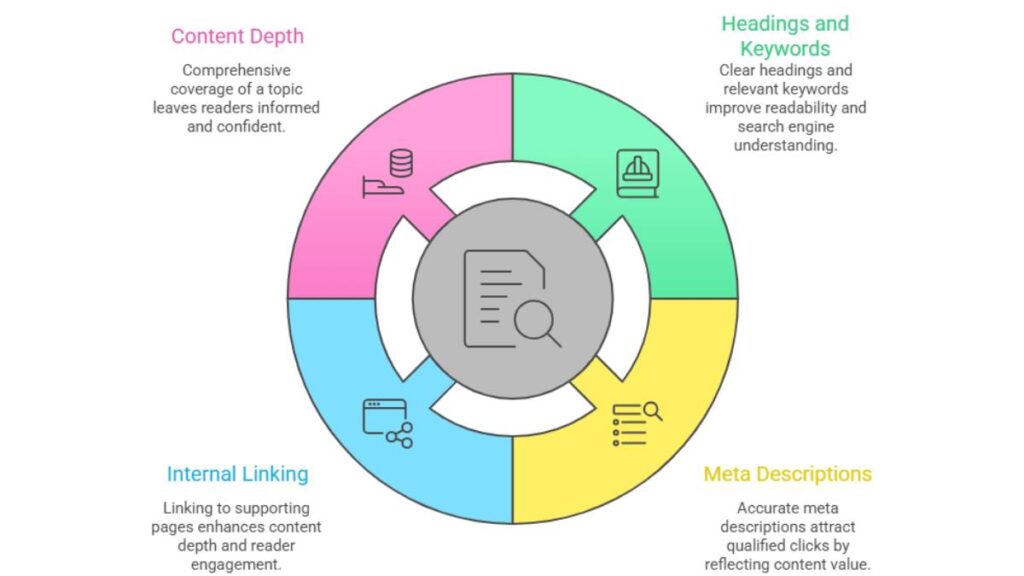
Proper Use of Headings (H1–H3) & Keyword Placement
Headings aren’t just visual breaks. They signal the flow of ideas.
A strong structure usually looks like:
- One clear main headline that sets the topic
- Section headings that break the message into logical stages
- Subheadings that answer specific questions or objections
When headings are descriptive and aligned with what readers are actually looking for, the page becomes easier to scan and easier to understand.
Meta Descriptions and Structured Data Support
While readers don’t see the technical setup behind the scenes, it still plays a role in how content appears in search results.
Clear page summaries and structured formatting help ensure the main message of the long copy is represented accurately. When the page description reflects real value instead of generic phrases, it attracts more qualified clicks.
Internal Linking Strategy
Long advertising copy rarely exists in isolation. Supporting pages; case studies, detailed feature explanations, FAQs, or blog articles, can strengthen the overall message.
Linking naturally to:
- Deeper explanations
- Proof points
- Related solutions
…helps readers explore at their own pace. It also shows that the topic is covered thoroughly, not just at the surface level.
Content Depth and Topic Coverage
Surface-level copy struggles to compete when readers are looking for real answers. Strong long-form advertising content tends to cover:
- The problem in detail
- Different angles of the solution
- Comparisons or alternatives
- Practical outcomes and scenarios
Depth doesn’t mean rambling. It means leaving fewer unanswered questions. When readers finish the page feeling informed and confident, the copy has done its job, both as persuasion and as a useful resource.

Enroll Now: Advanced Digital Marketing Course
Measuring the Success of Your Long Advertising Copy
Long advertising copy can feel persuasive and still underperform. That happens more often than most teams admit. The words sound good in a review meeting… then the numbers tell a different story.
Performance is what keeps opinions honest.
Primary KPIs to Watch
A few metrics usually reveal whether the copy is doing real work or just taking up space:
- Click-through rate (CTR) – Shows whether the promise and positioning are strong enough to earn curiosity in the first place.
- Conversion rate – Tells you if the full message actually convinced people once they landed and read.
- Engagement signals – Time on page, scroll depth, and interaction patterns hint at whether readers stayed with the story or bailed halfway through.
A common pattern: high clicks, low conversions. That usually means the opening made a bold promise… but the body didn’t fully support it. The opposite can happen too; modest traffic, strong conversions. That often points to well-aligned messaging attracting the right people.
Ways to Evaluate What’s Working
Improving long copy is rarely about rewriting everything. It’s more like tightening bolts.
Look for:
- Sections where readers consistently stop scrolling
- CTAs that get ignored
- Parts of the page people skim past quickly
Those drop-off points often signal confusion, weak transitions, or benefits that weren’t clear enough. Small edits in those areas can lift performance more than a full rewrite.
Testing Long Copy Against Short Copy
There’s always a debate around length. The cleanest answer comes from testing.
Keep the same offer, same audience, same design. Change only the depth of the message.
What tends to happen:
- Short copy drives quicker, lighter clicks
- Long copy filters out casual interest but converts more serious buyers
Neither is “better” in every situation. The right choice depends on how much thinking the purchase requires. Higher-consideration offers usually benefit from deeper explanation. Lower-risk ones often don’t need the extra runway.
Looking Beyond Immediate Conversions
Not every result shows up instantly. Longer pages often support longer decision cycles.
Visitors might:
- Read most of the page
- Leave
- Come back later through another channel
When that happens consistently, it’s a sign the copy is building trust, even if the final action happens later. That influence is harder to measure, but it’s real, especially for complex or high-ticket offers.
Long Advertising Copy Checklist
Before publishing, it helps to pause and run a quick quality check. Long copy has more moving parts, which means more places where things can quietly go off track.
Audience Alignment
- Is it obvious who this is for within the first few lines?
- Do the examples and situations match real customer experiences?
- Does the tone fit the reader’s level of awareness and expertise?
Structure & Flow
- Does the message move logically from problem → solution → proof → action?
- Are subheadings doing real work, or just filling space?
- Are paragraphs short enough to keep momentum?
Messaging Quality
- Are benefits explained in terms of outcomes, not just features?
- Are objections addressed directly instead of being glossed over?
- Is anything repeated without adding new value?
Call to Action
- Is there one main action you want readers to take?
- Does the CTA feel like a natural next step, not a sudden push?
- Does it appear at logical moments throughout the page?
Clarity and Focus
- Does the page stay centered on one core offer?
- Are key terms explained in simple language?
- Does anything feel like filler or unnecessary hype?
Running through a checklist like this usually catches small leaks: unclear phrasing, buried benefits, or sections that wander. Fixing those often makes the whole piece feel tighter without cutting much length.
Conclusion:
Long advertising copy sticks around because buying decisions haven’t gotten simpler. If anything, they’ve become more careful. People compare more. Question more. Take their time.
Short messages can spark interest, sure. But when trust, money, or results are involved, readers look for substance. They want to understand what they’re getting into. They want reassurance that someone has thought this through.
That’s where long copy earns its place. Done well, it doesn’t feel like a sales pitch stretched out. It feels like a clear, structured explanation that removes doubts one by one. By the time readers reach the end, the decision doesn’t feel pressured; it feels reasonable.
And that’s the real goal. Not just attention, but confidence.
FAQs:
1. What is long advertising copy?
Long advertising copy is the slower, more thorough kind of persuasion. Instead of chasing a quick click, it explains the offer in full, answers the questions people are already thinking, and builds trust over a few minutes of reading. It works best when the decision actually matters, and people want to feel sure.
2. How long should long advertising copy be?
There’s no fixed rule, despite what some templates suggest. Many long copy pieces fall between 700 and 2,000 words, sometimes more for detailed offers. The real measure is whether doubts have been handled. If the message drags or repeats, it’s too long. If key questions linger, it’s still too short.
3. When does long advertising copy work better than short copy?
Long copy usually wins when buyers feel risk. Higher prices, unfamiliar services, or professional solutions all raise more questions. A short slogan can’t carry that weight. People want clarity, proof, and reassurance. In those cases, extra explanation doesn’t feel like “more copy”; it feels like needed information.
4. Is long advertising copy good for SEO?
Detailed pages tend to perform well in search because they cover a topic from several angles, not just one keyword. That naturally brings in related phrases and context. When the structure is easy to follow, readers stay longer and explore more, which supports stronger visibility over time.
5. What makes long advertising copy convert?
Strong long copy builds a case instead of making noise. It opens with a problem that feels familiar, then walks toward a solution that seems practical and believable. Add proof, reduce risk, and make the next step obvious. When everything connects logically, the decision feels comfortable rather than forced.
6. How do you structure long advertising copy?
A clear flow helps. Start with a headline that promises something meaningful, follow with a relatable problem, then introduce the solution. After that, explain benefits, show evidence, handle common objections, and guide readers toward action. It mirrors how people naturally think through a purchase, step by step.
7. Does long ad copy work on social media?
Surprisingly, yes. Not for every audience, but when the message hits a real pain point, people will stop scrolling. The trick is readability: short paragraphs, simple language, and a strong opening line. If it feels relevant, length alone doesn’t scare readers away.
8. How is long advertising copy different from a sales page?
Long advertising copy often acts as a bridge. It warms people up, builds interest, and gets them ready for a deeper commitment. A sales page usually takes over from there and focuses fully on closing the sale. One starts the persuasion process; the other finishes it.
9. Can long advertising copy be used in Google Ads?
Search ads themselves are short by design, but the pages they lead to don’t have that limit. That’s where long advertising copy does its job. The ad earns the click. The landing page explains everything properly and handles the heavier persuasion that can’t fit in a headline.
10. What are the key elements of effective long copy ads?
Clear audience focus, strong benefits, emotional connection, and believable proof usually sit at the center. Add a logical structure and a clear call to action. When those pieces line up, the message feels steady and convincing instead of salesy or exaggerated.
11. How do you keep long advertising copy engaging?
Reading comfort matters. Break up text with short paragraphs, useful subheadings, and the occasional bullet list. Use plain language and relatable examples. When the copy feels easy to move through, readers don’t notice the word count; they just keep following the message.
12. Should long advertising copy include keywords?
Yes, but naturally. When the topic is covered properly, relevant phrases tend to show up without being forced. Overloading the page with repeated terms makes the writing stiff and harder to read. Clarity and usefulness usually do more for visibility than obvious keyword repetition.
13. What mistakes should be avoided in long advertising copy?
One big issue is adding volume without substance. Repeating points, listing features without outcomes, or wandering off-topic can lose readers. Weak headlines and vague calls to action also hurt performance. Strong long copy stays focused on the reader’s concerns and keeps moving with purpose.
14. How do you test long advertising copy performance?
Testing often means comparing versions and watching how people behave. Try different openings, benefit sections, or calls to action, then look at conversion rates and engagement depth. Improvements usually come from refining key sections, not rewriting everything from scratch each time.
15. Why does long advertising copy perform well in Google AI Overviews?
Thorough pages tend to answer questions clearly and cover related points in one place. That structure makes it easier for search systems to understand the topic and pull useful summaries. Readers benefit too, since the depth builds confidence and reduces the need to keep searching elsewhere.