

Most brands think they know how they’re perceived. Then a campaign flops, or sales stall, and suddenly the gap becomes obvious. That’s where brand perception analysis actually matters. Not as a report, but as a reality check. This blog walks through practical ways to uncover what customers really think, why it shapes growth more than expected, and how to act on it without overcomplicating the process.
Table of Contents
Introduction:
A strong product helps. A clever campaign helps. But neither guarantees growth.
What really moves the needle is how people feel about a brand. Not what the brand says about itself; that part is easy. It’s what customers believe, repeat, and remember that shapes outcomes.
Brand perception is that invisible layer sitting between your marketing efforts and your results. It can quietly elevate a company to “premium” status… or just as quietly push it into the discount corner. No announcement. No warning. Just a slow shift in how people talk about you.
At its simplest, brand perception is the overall impression your brand leaves in people’s minds. Every touchpoint feeds into it: ads, pricing, customer service interactions, website experience, word-of-mouth, even silence when something goes wrong. And here’s the uncomfortable part: internal perception rarely matches external reality. Teams often believe they’re seen as innovative or customer-first. The market may disagree.
That’s why brand perception analysis matters. It forces alignment between assumption and truth. Instead of operating on gut feel or vanity metrics, you get clarity. Where trust is strong. Where friction exists. Where positioning is landing, or missing.
This guide breaks down how brand perception analysis works, why it directly affects business performance, and how to approach it in a practical way. Not theory. Real-world application.
What Is Brand Perception Analysis?
What Is Brand Perception?
Brand perception isn’t your logo. It isn’t your tagline. It isn’t even your positioning statement.
It’s the mental shortcut people use when they hear your name.
That shortcut is built from two types of signals:
- Rational cues: price, product performance, reliability, customer support.
- Emotional cues: trust, aspiration, belonging, familiarity.
Both matter. Sometimes the emotional layer outweighs everything else. A technically superior product won’t win if it feels cold or untrustworthy. On the other hand, brands with average features sometimes dominate because they feel relatable and credible.
Perception forms gradually. Repeated exposure. Conversations. Reviews. Marketing messages. Even headlines. And once formed, it sticks longer than expected.
It helps to separate a few related ideas:
- Brand identity – what the company intends to project.
- Brand perception (or image) – what customers actually interpret and internalize.
- Brand equity – the commercial value created when perception is consistently positive.
Confusing identity with perception is common. One lives inside the company. The other lives in the market.
What Is Brand Perception Analysis?
Brand perception analysis is the structured process of understanding how your brand is truly viewed. Not how you hope it’s viewed.
It asks uncomfortable but necessary questions:
- Are customers seeing the brand as premium, or overpriced?
- Is it trusted or tolerated?
- Is it differentiated or interchangeable?
Companies conduct brand perception research to reduce uncertainty. Product teams use it to refine positioning. Marketing teams use it to sharpen messaging. Leadership uses it to evaluate long-term brand strength.
Done well, brand perception analysis becomes less about reporting and more about direction. It guides positioning shifts, messaging decisions, and even pricing strategy. It highlights where the brand promise is aligned with reality, and where it isn’t.
There’s a big difference between assuming the brand is well-loved and having evidence that it actually is. That gap is where perception analysis earns its value.
Why Brand Perception Analysis Is Important for Business Growth
Perception isn’t a “soft” marketing concept. It shows up in numbers; quietly, but consistently.
Importance of Brand Perception in Marketing
Purchasing decisions rarely come down to features alone. Most buyers choose the option that feels safer, smarter, or more aligned with their values. That feeling? It’s perception doing the heavy lifting.
A few areas where it plays out:
- Buying behavior – Trust reduces hesitation. Doubt increases comparison.
- Customer loyalty – People return to brands they feel confident about, even when alternatives exist.
- Pricing power – Strong perception supports premium positioning. Weak perception forces discounts.
- Credibility – Campaigns perform better when the brand behind them is already trusted.
Perception either compounds your marketing efforts or quietly undermines them.
Strategic Importance of Brand Perception Analysis
From a strategic standpoint, perception analysis provides clarity.
It reveals:
- Whether your differentiation is actually recognized.
- Whether competitors are being associated with qualities you intended to own.
- Whether small reputational issues are growing beneath the surface.
It’s also critical during high-pressure moments. When a brand faces criticism or market shifts, knowing existing perception helps shape the response. Overreacting can damage trust. Underreacting can do the same.
Understanding perception gives context.
Impact on Business Performance
Eventually, perception translates into measurable impact:
- Revenue growth – Brands seen positively tend to convert more consistently.
- Customer lifetime value – Trust extends relationships.
- Customer acquisition cost – Strong perception lowers friction in acquisition.
- Conversion rates – Confidence shortens decision cycles.
None of this happens overnight. Perception builds slowly. But once established, it becomes one of the strongest competitive advantages a company can have.
Brand perception analysis simply makes that invisible asset visible and manageable.
And in competitive markets, manageability matters.
How to Conduct Brand Perception Analysis (Step-by-Step)
On paper, brand perception analysis sounds neat and structured. In reality, it’s a bit messier. People don’t think in clean data points. They think in impressions, shortcuts, and emotions. So the job here isn’t to chase perfect data. It’s to get close enough to the truth that better decisions become obvious.
The biggest mistake? Jumping straight into tools without deciding what actually matters.
Step 1: Define Brand Perception Metrics
Before sending a survey or scanning social media, pause for a second. What does “good perception” even mean for this brand?
For some companies, it’s trust. For others, it’s innovation. For premium brands, it might be exclusivity. If the definition isn’t clear internally, the measurement will be scattered.
A few core angles usually matter:
- Sentiment: Are conversations leaning positive, negative, or somewhere in the middle?
- Trust and credibility: Do people believe the brand delivers on its promises?
- Share of voice vs. share of sentiment; Lots of attention doesn’t help if most of it is criticism.
- Associations: What words come up repeatedly when people describe the brand?
The point isn’t to track everything. It’s to track what actually signals movement. Otherwise, teams end up with dashboards full of numbers and no clarity.
And that’s where perception analysis quietly fails; too much noise, not enough meaning.
Step 2: Conduct Brand Perception Surveys
Surveys still work. Not because they’re exciting, but because they force clarity. You ask. People answer. Patterns show up.
That said, badly designed surveys are worse than none at all. Long forms, leading questions, overly clever wording; all of that skews results.
Keep it simple.
Ask things like:
- “What three words describe this brand?”
- “How does this brand compare to alternatives?”
- “How trustworthy does this brand feel?”
Short. Direct. No corporate language.
Also, mix formats. Rating scales help quantify perception, but open-ended questions reveal tone. Sometimes a single sentence from a customer explains more than a full spreadsheet.
One thing worth noting: awareness and perception aren’t the same. Someone might recognize your brand instantly, and still feel neutral about it. Or worse. So design surveys that separate familiarity from feeling.
Step 3: Social Listening and Brand Sentiment Analysis
If surveys are structured insight, social listening is raw insight.
People are honest online in ways they rarely are in formal research. Especially in reviews and forums. That’s where perception often shows itself without filters.
Instead of obsessing over every mention, look for patterns:
- Are complaints repeating?
- Is praise focused on one specific strength?
- Has the one shifted recently?
Frequency matters, yes. But tone matters more. A small spike in frustration around customer service can be an early warning sign. A sudden wave of positive commentary after a campaign might mean the message finally clicked.
Reviews are particularly revealing. Read enough of them in a row, and themes become obvious. Maybe customers love the product quality, but feel onboarding is confusing. That gap; that’s perception at work.
Step 4: Brand Focus Groups and Community Research
Numbers tell you what. Conversations tell you why.
Focus groups, community discussions, and even browsing niche forums; these uncover the emotional layer. And that’s usually where the interesting stuff sits.
A few practical points:
- Let people talk without steering them too much.
- Notice hesitation. Notice the emphasis.
- Pay attention to contradictions.
Sometimes customers admire a brand but don’t feel connected to it. Sometimes they like the product but feel the company is distant. These nuances rarely show up in structured surveys.
Communities like Reddit or niche industry forums can be surprisingly revealing. People speak freely there. Not always politely. But honestly.
And honesty is useful.
Step 5: Brand Analytics and Data Integration
Here’s where perception analysis moves from insight to impact.
Perception alone doesn’t drive growth. Behavior does. The real value shows up when you connect perception signals to business outcomes.
For example:
- Does higher trust correlate with repeat purchases?
- Do spikes in negative sentiment align with churn?
- When brand favorability improves, do conversions rise?
Linking survey insights or sentiment trends with CRM and performance data changes the conversation internally. It shifts perception from “soft marketing metric” to “business indicator.”
Also, track movement over time. One snapshot won’t tell much. Trends will.
At its core, brand perception analysis isn’t about finding a single score and celebrating it. It’s about building a layered view: surveys, sentiment, conversations, behavior; and then spotting where perception supports growth… and where it quietly blocks it.
Once that picture becomes clear, strategy decisions stop feeling abstract. They start feeling obvious.
Measuring Your Brand’s Uniqueness and Competitive Position
Most brands believe they’re different. Very few can prove it.
Liking a brand is easy. Standing out is harder. In crowded categories especially, everything starts to blur; similar promises, similar visuals, similar claims about “quality” or “innovation.” When that happens, perception alone doesn’t create leverage. It creates noise.
Competitive brand perception analysis forces a more honest look. Not just “How are we seen?” but “How are we seen compared to everyone else?”
A few ways to get clarity:
- Competitor sentiment comparison
Don’t just track your own mentions. Line them up next to competitors. Where are they consistently praised? Where are they criticized? Patterns show up quickly. If customers describe three competitors as “affordable,” but only one as “reliable,” that difference matters. - Perceptual mapping
Plot key attributes on a simple grid: price vs quality, innovation vs trust, and premium vs accessible. It doesn’t need to be fancy. What matters is where customers place you, not where you’d like to sit. Sometimes the gap between those two is… uncomfortable. - Brand positioning matrix
Overlay customer priorities with competitor strengths. Where is the unmet demand? Where are others overpromising? Often, the opportunity isn’t in being louder; it’s in being clearer.
And then there’s the awareness trap.
Recognition is not respect. A brand can have high awareness and weak preference. Measuring awareness without perception is like counting how many people walked past a store without checking whether they walked in.
True differentiation lives at the intersection of familiarity, trust, and emotional pull. If those don’t align, uniqueness is just a claim.
Key Components of Brand Perception
Brand perception isn’t built in one campaign. It’s built in fragments. Small impressions stacked over time.
Miss one piece and the whole thing tilts slightly off balance.
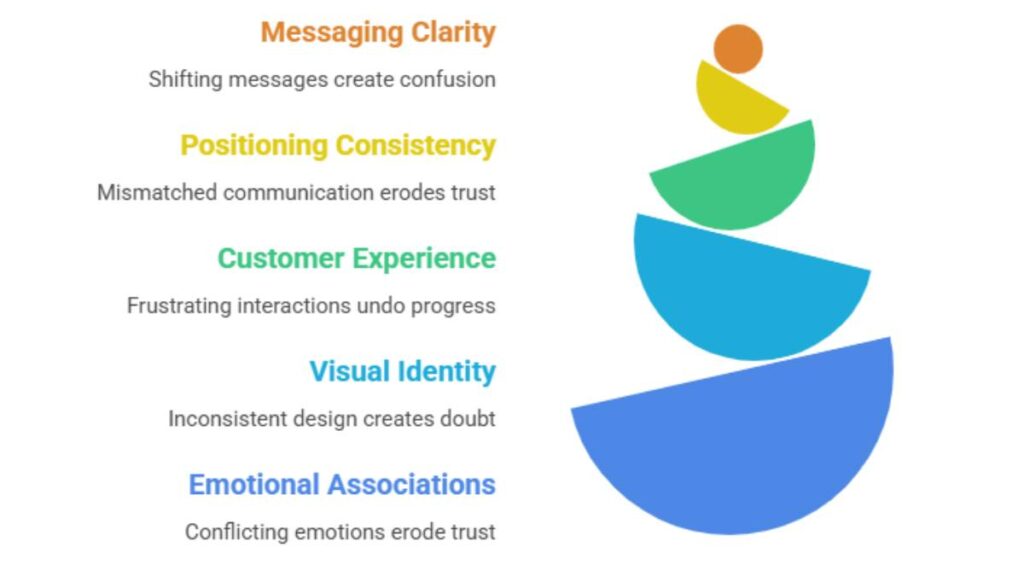
Here’s what tends to shape perception most:
Brand messaging clarity
If messaging shifts every quarter, customers feel it. Confusion rarely creates confidence. The strongest brands repeat themselves, not because they lack ideas, but because consistency compounds.
Brand positioning consistency
Positioning is not the tagline on a slide deck. It’s how salespeople speak. How does support respond? How the website explains value. When those don’t match, customers notice the gap.
Customer experience perception
This one overrides almost everything. A smooth buying process builds credibility quietly. A single frustrating interaction can undo months of brand building. Service moments stick longer than ad impressions.
Visual identity and recall
Design signals seriousness. Or chaos. Clean, cohesive visuals create subconscious trust. Inconsistent design creates doubt, even if the product is strong.
Emotional associations
Logic explains a purchase. Emotion justifies it. Trust, pride, aspiration, relief; those feelings are what customers remember later when they’re deciding again.
When these elements move in the same direction, perception strengthens. When they pull against each other, friction builds. It doesn’t explode immediately. It just… erodes slowly.
Strategies to Improve Brand Perception
Improving brand perception isn’t about a dramatic rebrand every two years. It’s steady work. Often unglamorous. Usually cross-functional.
Here’s what tends to move the needle.
Define Your Brand Clearly
Start internally. Mission, values, differentiation; not as posters on a wall, but as operational guidelines. If teams interpret the brand differently, the market will receive mixed signals. Alignment inside almost always shows up outside.
Clarity reduces noise.
Focus on Customer Experience
Marketing sets expectations. Experience confirms or contradicts them.
Map the customer journey honestly. Where are delays happening? Where does communication drop? Fixing friction in onboarding or support often shifts perception faster than launching a new campaign.
Experience builds credibility quietly.
Stay Consistent Across Channels
A brand that sounds premium on social media but transactional in email creates cognitive dissonance. Tone, visuals, and messaging don’t need to be identical everywhere, but they should feel related. Like parts of the same conversation.
Consistency builds familiarity. Familiarity builds trust.
Tell a Compelling Brand Story
Not a dramatic origin myth. Just a clear narrative.
Why does this brand exist? What problem does it care about solving? What does it stand against?
Stories give customers something to attach meaning to. Without that, brands become interchangeable.
Build Relationships and Community
Perception is influenced heavily by other people. Reviews, referrals, conversations in communities; these shape belief faster than advertising ever could.
Encourage advocacy. Respond publicly. Show up consistently. When customers defend a brand on their own, perception shifts in a way no campaign can replicate.
Be Authentic and Transparent
Over-polished messaging often triggers skepticism. Especially now.
If sustainability is part of the brand, show the proof. If mistakes happen, acknowledge them. Controlled vulnerability builds more trust than flawless positioning.
Audiences are quick to detect exaggeration. They’re slower to doubt honesty.
Improving brand perception is rarely dramatic. It’s incremental. It’s the alignment between what’s promised and what’s delivered. Over time, those small consistencies compound.
And when perception strengthens, everything else gets easier: pricing, loyalty, referrals, even resilience during a crisis.
Perception doesn’t shout. It settles in quietly. Then it shapes growth from underneath.
Key Brand Perception Metrics
When digging into perception, it helps to focus on a few metrics that actually mean something rather than a long laundry list that just fills up dashboards. The useful ones tend to show not just awareness, but how people are thinking and acting.
Net Promoter Score (NPS)
It’s simple: ask how likely someone is to recommend you. But watch the why behind it. A high score with lukewarm language can tell a very different story than a high score with enthusiastic comments.
Brand sentiment score
This gauges tone; are the conversations around your brand mostly positive? Negative? Or somewhere in the middle? Tracking this over time shows if perception is improving or quietly slipping.
Brand equity score
This goes past recognition. It looks at perceived value and relevance. People might know your name, but do they think you’re worth paying extra for? Do they talk about you as a leader, or just another option?
Customer satisfaction (CSAT)
Ask about key touchpoints: purchase, support, and onboarding. CSAT shows whether the experience lived up to expectations. If it doesn’t, perception can sour quickly.
Brand recall and associations
Awareness is one thing. The words people link to your brand: quality, trust, value, innovation; those are real clues into perception. One quick test is open-ended recall: if people can’t name something positive quickly, that’s worth noticing.
The trick isn’t collecting a bunch of numbers. It’s connecting them. High recall with poor sentiment? That’s a problem. Good CSAT but low equity? That suggests experience is fine, but positioning or messaging isn’t landing.
Brand Perception Analysis Tools
Truth is, no single tool solves perception. It lives in bits and pieces: surveys, mentions, reviews, behavior. But certain tools make those pieces easier to collect and interpret. Here are a few that actually get used in real-world work:
Survey Tools – SurveyMonkey, Typeform, Google Forms
These help you capture structured feedback. Typeform, for example, feels a bit more conversational and can get you better response rates than wall-of-text forms. Make sure you include open-ended questions; those free-text answers often reveal feelings that numbers don’t.
Social Listening – Brandwatch, Sprout Social, Hootsuite Insights
These track mentions across blogs, forums, and social platforms. Sprout Social is solid for mid-sized teams; Brandwatch digs deeper into sentiment trends. The key isn’t just volume, it’s tone changes and recurring themes.
Review Monitoring – Trustpilot, Yelp, Google Business Profile
Star ratings tell one part of the story, but reading the language in reviews is where insight lives. Frequent complaints about “communication delays,” for example, tell you something very specific about perception.
Brand Analytics Dashboards – Tableau, Looker, Power BI
These aren’t perception-specific, but they help connect perception data with business data, like sales, churn, and engagement. Once you can see patterns over time, the “so what” becomes clearer.
Community & Feedback Channels – Reddit, Quora, niche forums
Not a tool in the traditional sense, but these places are where people talk freely. Patterns you see there often show up later in broader sentiment data.
Here’s the thing: tools don’t tell the story by themselves. They give you fragments. It’s the context; what you compare them to, how you look for trends, that turns metrics into insight.

Enroll Now: Brand Management course
Case Studies on Changing Brand Perception
Perception shifts. It doesn’t happen all at once, usually. But with consistent actions, messaging, experience, and emphasis, even longstanding perceptions can change. A few examples that illustrate this:
Snickers: Reframing Brand Messaging
Before that “You’re Not You When You’re Hungry” campaign, Snickers was just another candy bar. After it? People started associating it with humor and relatability. It’s not that it suddenly tasted better, but the way the brand talked connected with experiences people actually had. That made conversations more positive and more memorable.
Zoom: From Business Tool to Everyday Platform
This one is a bit unusual. A tool that was mostly used in corporate America became something nearly everyone used: school, family calls, and community meetups. The shift in perception from “work-only” to “essential” came because it was actually used in all those scenarios. The brand didn’t have to pretend; the usage itself drove perception.
Burberry: Luxury Brand Repositioning
Burberry used to be seen as a bit old-fashioned. By modernizing visuals, leaning into digital experiences, and targeting different audiences while keeping classic elements, it started being talked about as more contemporary. Perception shifted among younger audiences while still holding appeal with long-time loyalists.
Coursera: Recommendation & Authority Perception
It’s one thing to be an online learning platform. It’s another to be seen as credible and authoritative. Coursera leaned into partnerships with well-known universities in its messaging, which reinforced trust and made its courses feel more credible, not just another online class.
Spotify: Pricing Perception Management
Freemium models always walk a line between free value and paid premium. Spotify managed this balance by framing the paid tier in terms of what you get, not just what you lose. That subtle shift in messaging, an emphasis on added value rather than restriction, helped reinforce positive perception around subscription adoption.
These cases share something important. None of them involved a dramatic overnight overhaul. What did happen was consistent communication of a clear message, alignment with customer expectations, and reinforcement of the perception the brand wanted to own. You don’t always have to reinvent the wheel. Often, you just have to steer it in a direction that matches what your audience already values.
Brand Refresh and Brand Perception Management
Not every brand problem calls for a dramatic rebrand. Sometimes the fundamentals are solid. The product works. Customers trust you. But the edges feel… dated. Or slightly off. That’s usually a signal for a refresh, not a reinvention.
A brand refresh is about alignment. Making sure how the brand looks and sounds today actually reflects what it has become. Over time, businesses evolve. Audiences change. Competitors sharpen their positioning. If the brand expression stays frozen, perception slowly drifts.
And perception drift is subtle. Until it’s not.
What a Brand Refresh Is
A brand refresh is an adjustment without identity loss.
- Updated visuals that feel current, not trendy.
- Refined messaging that clarifies value instead of complicating it.
- A tighter tone of voice that reflects maturity or growth.
A rebrand, on the other hand, is structural.
- New positioning at the core.
- Possibly a new name.
- A meaningful shift in the target audience or market space.
Confusing the two can be expensive. Refresh when the perception is fuzzy. Rebrand when the foundation itself is wrong.
When a Refresh Makes Sense
Certain patterns tend to show up:
- The brand looks older than the business actually is.
- New audiences don’t “get it” as quickly as they should.
- Sales teams explain the value differently every time.
- Customers describe the brand in ways that don’t match internal intentions.
None of these screams a crisis. But collectively, they signal misalignment. And misalignment compounds.
Managing a Refresh in Larger Organizations
This is where things often get messy. Not because the strategy is wrong, but because execution fractures internally.
A few realities:
- Stakeholder alignment matters more than logo design. If leadership isn’t unified on the why, the rollout will feel cosmetic.
- Internal education is non-negotiable. Employees shape perception daily. If they’re unclear on the refreshed messaging, customers will be too.
- Rollout should feel intentional, not abrupt. Customers don’t need a dramatic announcement unless something truly major changed. Consistency across channels does more work than hype.
- Measure the shift. Baseline perception before changes. Then track sentiment, brand associations, and engagement. If perception doesn’t move, something didn’t land.
A refresh is not a campaign. It’s a recalibration. And it only works if the external signal matches the internal reality.
Brand Messaging and Brand Positioning in Perception Analysis
Messaging and perception are tightly linked. In fact, most perception problems trace back to unclear positioning or inconsistent messaging. Not product failure. Not pricing. Clarity.
When a brand says five different things in five different places, customers build their own interpretation. And once that interpretation forms, it sticks.
Brand Messaging Strategy
Strong messaging usually rests on a few non-negotiables:
- Clear pillars. Two to four core ideas that define what the brand stands for. Not ten. Not abstract philosophy. Concrete value.
- A deliberate tone. Tone communicates emotion faster than content. Friendly, bold, authoritative, and reverent; each creates a different perception.
- A sharp value proposition. Not “we help businesses grow.” That’s vague. Instead, who exactly, what specific problem, and why this approach works better.
When these elements are tight, perception stabilizes. When they’re loose, perception drifts.
Positioning and Perception Alignment
Positioning lives at the strategic level. Messaging expresses it.
A simple positioning framework still works:
- Target audience
- Primary benefit
- Clear differentiation
The real question, though, is whether the market perceives the brand the way leadership intends. That gap is often uncomfortable. Customers may see a brand as affordable when it wants to be premium. Or as a niche when it aims to be mainstream.
Testing matters here.
- Short perception surveys.
- Message testing with real customers.
- Early feedback loops before major launches.
It’s easier to adjust language before scale than to correct perception after it solidifies.
Messaging isn’t decoration. It’s how positioning becomes real in the customer’s mind.
Conclusion:
Brand perception analysis isn’t a box to check. It’s an ongoing discipline. Markets move. Expectations rise. Competitors reposition. If a brand stops paying attention, perception fills in the gaps on its own.
And perception, once formed, drives behavior.
A few truths tend to hold:
- Positive perception reduces price resistance.
- Clear positioning increases conversion confidence.
- Trust lowers acquisition costs over time.
- Misalignment quietly erodes loyalty long before revenue drops.
The real advantage comes from consistency. Measuring perception regularly. Listening without defensiveness. Adjusting messaging, experience, or positioning when needed; not reactively, but deliberately.
Brands that treat perception as strategic infrastructure, not surface-level marketing, tend to compound value. Slowly. Steadily.
At the end of the day, customers don’t buy branding frameworks. They buy what they believe about a brand. And belief is built, protected, and refined through disciplined brand perception analysis.
FAQ: Brand Perception Analysis
1. What is brand perception analysis, and why is it important?
Think of it as really tuning in to how people see your brand, not just whether they know it exists. It’s about trust, feelings, and associations that quietly shape choices. When handled right, it helps messaging line up with reality, builds loyalty, and even nudges pricing power a bit.
2. How does brand perception differ from brand awareness?
Awareness is the easy part; you know the brand exists. Perception digs deeper: how people feel, what they think, and whether they trust it. A brand can be famous and still disliked or misunderstood. Perception drives real loyalty and emotional connection; awareness alone doesn’t cut it.
3. What are the key metrics for measuring brand perception?
There isn’t a single magic number. NPS, customer satisfaction, sentiment scores, brand equity, recall, and associations all play a role. The key is spotting patterns, connecting the dots to behavior, and seeing the bigger picture. Individual metrics alone rarely tell the full story.
4. How can social listening help in brand perception analysis?
It lets you see what people are actually saying, unfiltered. Complaints, praise, and even jokes reveal emotions and associations. The tricky bit is noticing subtle shifts in tone; these small changes can warn you of bigger perception problems before they snowball.
5. What are the best tools for conducting brand perception research?
No single tool covers it all. Surveys give structured feedback, social listening tracks mentions and sentiment, review platforms surface recurring issues, and dashboards connect perception to behavior. Using several together paints a more honest picture of how your brand is actually seen.
6. How do brand perception surveys work, and what questions should I ask?
Mix open-ended with scaled questions. Ask people to describe the brand in their own words, rate trust or quality, or compare with competitors. Open answers reveal emotions and associations; scaled questions show sentiment. The goal is understanding both feeling and thinking, not just ticking boxes.
7. What role do customer reviews and testimonials play in brand perception?
Reviews are pure insight; they show what people really experience. Patterns in reviews reveal trends that surveys might miss. They help refine messaging, products, or services so the brand image stays credible and believable.
8. How can focus groups improve my understanding of brand perception?
They dig into the “why.” You see subtle associations, emotions, and misunderstandings that surveys often miss. Listening to real discussions helps refine messaging, test positioning, and catch gaps before rolling changes out widely.
9. What is the impact of brand perception on customer loyalty?
It’s huge. Perception often decides if customers stick around or advocate. Positive perception builds trust and emotional connection. Misaligned perception can quietly erode loyalty, even if the product is solid. Often, feelings outweigh features when it comes to repeat business.
10. How can brand perception influence pricing and product positioning?
Strong perception gives room for premium pricing and differentiation. People buy into value, reliability, or innovation. Weak perception forces price competition, and even good products can seem ordinary. Often, perceived worth matters more than the product itself.
11. What steps should I take to improve a negative brand perception?
Start by finding the gaps: messaging, trust, experience, or associations. Align teams, fix pain points, and communicate consistently. It’s slow work. Small, deliberate tweaks over time reshape perception without feeling forced or fake.
12. How often should I conduct brand perception analysis?
Not just when things go wrong. Quarterly or every six months is sensible. Big campaigns, product launches, or market shifts are also good reasons. Keeping a steady eye prevents nasty surprises and keeps the brand aligned with expectations.
13. What is the difference between brand perception analysis and brand analytics?
Perception analysis asks, “How do people see us?”; emotions, trust, and associations. Analytics answers “what happened? ”sales, traffic, conversions. One explains why, the other what. Together, they reveal the bigger picture.
14. How can a brand refresh change consumer perception?
It signals relevance. Small tweaks in visuals, messaging, or tone can shift outdated or inconsistent perception. Done carefully, it strengthens trust, clarifies positioning, and nudges audiences to see the brand in a better light, without touching the core identity.
15. Can social media monitoring alone accurately measure brand perception?
Not really. Online chatter is only a slice of reality. Offline experiences, reviews, and direct feedback also shape perception. Social listening is useful, but only together with surveys, focus groups, and other methods do you get a full picture.
16. What are the common mistakes companies make in brand perception research?
Focusing on surface metrics, confusing awareness with perception, asking leading questions, or ignoring qualitative insights. Another trap is acting without context. Research works only when it’s connected, holistic, and grounded in real audience experience.
17. How do I measure brand uniqueness and differentiation?
Look at your attributes, messaging, and emotional associations versus competitors. Perceptual maps and positioning matrices show where the brand really stands out. The goal is making sure audiences notice your difference, not assuming it exists.
18. Can brand perception analysis help in crisis management?
Absolutely. Knowing perception highlights risks to trust or loyalty before they blow up. It guides messaging, prioritizes channels, and anticipates reactions. Brands aware of perception can respond smarter and sometimes even turn bad situations into credibility wins.
19. How do case studies of brands like Snickers or Spotify illustrate perception changes?
They show perception isn’t fixed. Snickers leaned into humor; Spotify reframed value. Both made small, consistent tweaks. Gradual, audience-informed adjustments reshape perception over time. It’s about steering, not flipping, perception overnight.
20. What is the strategic role of brand messaging and positioning in perception analysis?
Messaging and positioning make strategy real for audiences. They bridge intent and perception. Clear, consistent messaging reinforces position; misalignment causes confusion. Studying perception shows gaps, informs refinements, and helps protect reputation while building long-term equity.