
Table of Contents
Introduction
Most companies don’t think about reputation until something goes wrong. This guide takes a different angle. It walks through what a real reputation management strategy looks like when it’s built into daily operations, not just activated during a crisis. From reviews and social conversations to internal response policies and crisis planning, the article breaks down how perception actually forms, and how it quietly affects sales, hiring, and long-term growth. It’s practical, sometimes blunt, and focused on execution. Because reputation isn’t a marketing accessory. It’s infrastructure. And when it’s managed intentionally, it becomes a competitive advantage instead of a recurring risk.
What is a reputation management strategy?
Strip away the jargon, and it’s this: a reputation management strategy is a structured way to make sure the market sees your business the way it actually deserves to be seen.
Not the polished version from a pitch deck. Not the defensive version after a bad review. The real one.
Reputation lives in conversations you’re not part of. In the review sections. In hiring forums. In group chats between customers, comparing options. A strategy simply means you’re not leaving those conversations to chance.
It’s the discipline of:
- Knowing how you’re perceived
- Deciding how you should be perceived
- Building systems that close that gap
And yes, it’s ongoing. Reputation doesn’t sit still. Markets shift. Expectations evolve. One ignored complaint can quietly snowball. So this isn’t a “campaign.” It’s infrastructure.
Why reputation management matters for businesses
The buying journey has changed. People don’t start with your website anymore. They start with search results, reviews, social feeds, and third-party opinions.
Trust is pre-qualified before a sales conversation even begins.
A few realities businesses are facing right now:
- Customers screenshot everything.
- Negative experiences travel faster than marketing campaigns.
- Job candidates research culture as deeply as investors research numbers.
Reputation is now a front-door filter. If perception is weak, prospects simply don’t walk in.
What’s interesting is that many companies don’t realize they have a reputation issue because revenue hasn’t dropped yet. But revenue lag is real. Perception shifts first. Sales feel it later.
By the time numbers dip, the damage has usually been compounding for months.
How a strong reputation management strategy impacts trust, visibility, and revenue
Let’s break this down without overcomplicating it.
Trust
When customers consistently see thoughtful responses to feedback, transparent communication, and accountability during problems, something subtle happens. Resistance lowers. Skepticism softens. Buying feels safer.
Trust doesn’t eliminate mistakes. It cushions them.
Visibility
Brands with stronger reputations naturally earn more engagement. More reviews. More shares. Better placement across search and social platforms. Positive sentiment has momentum.
Reputation quietly boosts discoverability.
Revenue
Higher ratings correlate with higher conversions. That’s not theory; it shows up in data across industries. Sales teams also close faster when the brand carries credibility before the call even begins.
Over time, the financial gap between a well-managed brand reputation and a neglected one becomes very real.
Reputation might be intangible, but its commercial impact isn’t.
Understanding Reputation Management
Definition of business reputation management
Business reputation management is the structured effort to monitor, influence, and strengthen public perception across every meaningful touchpoint.
That includes:
- Online reviews
- Social media conversations
- Media coverage
- Customer support interactions
- Employee sentiment
- Leadership visibility
It’s part of communications. Part operations. Part customer experience.
And here’s the part that’s often overlooked: reputation reflects operational truth. If internal systems are messy, no amount of messaging will fully compensate.
Reputation strategy works best when it’s aligned with how the business actually behaves.
Difference between reputation management and public relations
This gets blurred all the time.
Public relations focuses on external storytelling; press coverage, announcements, and leadership interviews. It shapes narratives.
Reputation management is broader. It asks:
- Are customers happy?
- Are complaints being addressed consistently?
- Does employee feedback align with brand claims?
- What shows up when someone searches the company name?
PR amplifies messages. Reputation management aligns perception with reality.
You can have strong PR and a weak reputation if service delivery is inconsistent. The reverse is also true; strong operations with poor communication can leave a reputation under-leveraged.
They overlap. But they’re not interchangeable.
Key objectives of a reputation management strategy
A solid strategy typically aims to achieve several outcomes, and they’re practical, not theoretical.
Maintaining a professional image
Consistency builds confidence. When tone, responses, and public communication feel steady across channels, credibility strengthens.
Inconsistent messaging; defensive one day, silent the next; creates doubt.
And doubt spreads quickly.
Boosting brand visibility online
Positive reviews and active engagement increase surface area. More content. More mentions. More digital presence.
Visibility rooted in credibility tends to outperform visibility driven by aggressive promotion.
Building trust and credibility
Trust forms in small moments:
- A respectful reply to criticism
- A transparent update during service disruption
- A clear acknowledgment of a mistake
These moments seem minor in isolation. Together, they compound.
Managing customer perceptions
Perception often forms before experience.
Prospects scan ratings, skim comments, and form assumptions in seconds. A structured strategy ensures those touchpoints reflect the best and most accurate version of the business.
Handling misinformation and rumors
False narratives can take shape surprisingly fast. Especially in competitive industries.
Monitoring mentions and responding early prevents speculation from hardening into belief. Silence, in many cases, is interpreted as confirmation.
Attracting top talent and thought leadership
Reputation doesn’t just influence buyers. It influences candidates.
High-performing professionals evaluate culture, leadership tone, and public perception before accepting offers. A strong reputation signals stability and credibility.
It also strengthens executive positioning within the industry, which, over time, compounds authority.
Why Every Business Needs a Reputation Management Strategy
There’s a misconception that only large brands need formal reputation management. That’s rarely true.
Importance for small, medium, and large businesses
Small businesses often depend heavily on local reviews. A few unresolved negative experiences can materially impact monthly revenue.
Mid-sized companies face growth visibility. As attention increases, so does scrutiny.
Large enterprises operate under constant observation. One poorly handled issue can dominate headlines.
The scale changes the complexity. The necessity doesn’t change.
Role in marketing, customer retention, and sales growth
Marketing generates awareness. Reputation determines conversion.
When perception is strong:
- Sales objections decrease
- Customer retention improves
- Referral volume increases
Reputation acts as a silent closer. It reduces friction before conversations even start.
It also lowers acquisition costs over time because trust shortens decision cycles.
Long-term benefits of a proactive reputation management plan
Reactive management feels chaotic. Proactive management feels steady.
Businesses with structured systems tend to experience:
- Higher average ratings
- Faster issue resolution
- Fewer escalated crises
- Stronger brand equity over time
And internally, teams operate with more clarity. There’s a framework. There’s ownership. There’s less scrambling when something goes wrong.
Reputation stability becomes an asset. Not just a defensive shield.
Top Elements of an Effective Reputation Management Strategy
Reputation management isn’t one tactic. It’s layered.
Online Review Management
Reviews are often the first serious evaluation point.
Effective review management includes:
- Actively requesting feedback from satisfied customers
- Responding promptly and professionally to all reviews
- Identifying recurring themes in complaints
- Closing operational gaps is causing negative feedback
Ignoring reviews doesn’t make them disappear. It signals indifference.
Key platforms businesses commonly prioritize:
- Google Business Profile
- Yelp
- Trustpilot
Where customers evaluate you publicly, strategy must follow.
Social Listening and Qualitative Research
Not every opinion appears in a review section.
Customers discuss experiences on social platforms, community forums, and industry spaces. Monitoring these conversations reveals early sentiment shifts.
Social listening allows teams to:
- Track brand mentions
- Understand emotional tone
- Compare perception against competitors
Numbers show patterns. Conversations reveal nuance.
Customer Experience Management
Reputation reflects experience. If customer journeys are fragmented, reputation will eventually mirror that fragmentation.
Improving customer experience means:
- Building feedback loops
- Acting on recurring complaints
- Aligning service standards across teams
When operational quality improves, reputation improves, often without additional promotion.
Crisis Communication Planning
At some point, every business faces pressure. Negative publicity. Service disruption. Public criticism.
Preparation makes the difference.
Strong crisis planning includes:
- Defined response protocols
- Clear spokesperson guidelines
- Internal escalation processes
- Transparent communication standards
Delays create speculation, and speculation escalates quickly.
Prepared brands respond with clarity. Unprepared brands react emotionally.
And markets can tell the difference.
Step-by-Step Reputation Management Strategy
A reputation management strategy only works if it moves from theory to execution. Frameworks look good in documents. What matters is how they operate when a real customer leaves a real complaint at 11:47 PM on a Friday.
The most effective strategies follow three clear phases: build, maintain, and recover.
Not because it sounds neat. Because reputation behaves in cycles.
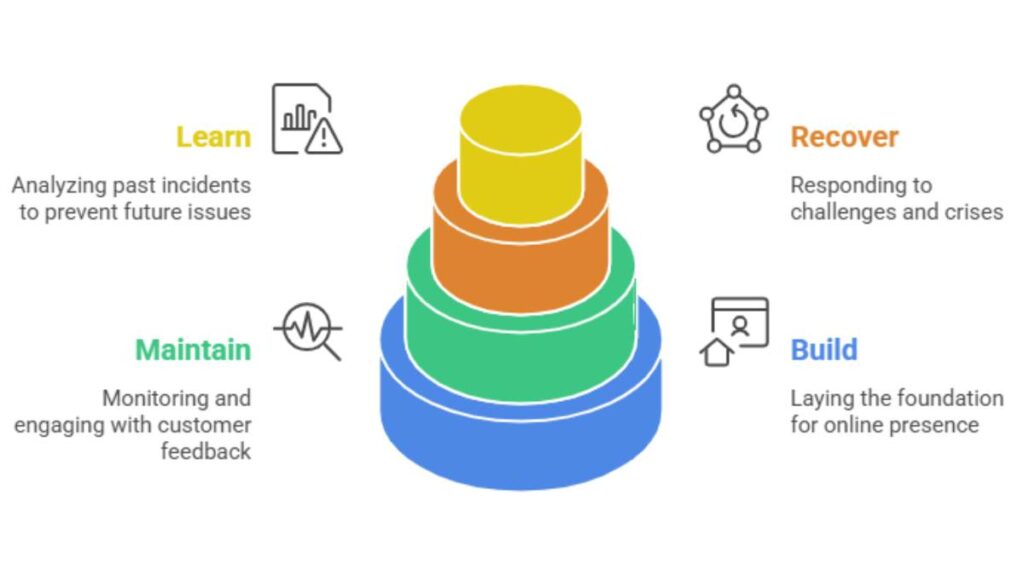
Phase 1 – Build: Laying the Foundation
This is where most companies rush. They want monitoring dashboards before Clarity. That’s backwards.
Start with direction.
Define your reputation goals and KPIs
Be specific. “Improve reputation” isn’t a strategy.
Instead, define measurable targets:
- Increase average review rating from 3.9 to 4.5 within 12 months
- Reduce negative review response time to under 24 hours
- Improve customer sentiment score quarter over quarter
- Raise employee satisfaction metrics tied to employer brand
Reputation goals should align with business goals. If retention is a priority, focus on post-purchase sentiment. If hiring is critical, monitor employer perception closely.
Identify key online channels and review platforms
Not every platform deserves equal energy. Focus on where perception is formed.
For most businesses, that includes:
- Google Business Profile
- Yelp
- Trustpilot
- Relevant social media platforms based on your audience
The mistake many brands make? Spreading themselves thin. Choose platforms that materially impact buying decisions.
Audit existing brand reputation and mentions
Before improving perception, understand the current reality.
Look at:
- Average ratings across platforms
- Recurring themes in negative reviews
- Common praise points
- Brand mentions in social conversations
- Media coverage tone
Patterns matter more than isolated comments. If multiple customers mention slow response times, that’s operational feedback disguised as reputation feedback.
Don’t defend it. Diagnose it.
Set internal policies for brand communication
Reputation management fails when response standards are unclear.
Define:
- Who responds to reviews
- Acceptable tone guidelines
- Escalation paths for sensitive issues
- Approval workflows for public statements
Consistency builds credibility. A sarcastic reply to one reviewer and a formal reply to another send mixed signals.
Structure prevents emotional responses, and emotion is often what escalates small issues into larger ones.
Phase 2 – Maintain: Monitor and Engage
Once the foundation is set, the real work begins. Reputation maintenance isn’t dramatic. It’s steady.
Almost boring. And that’s a good sign.
Choose the right online reputation management tools
Tools should centralize monitoring, streamline responses, and surface trends.
Common platforms businesses rely on include:
- Sprout Social
- Qualtrics
- Yext
- Podium
But tools are only as strong as the process behind them. Software doesn’t create accountability. Teams do.
Monitor brand mentions and social conversations
Set up consistent tracking of:
- Direct brand mentions
- Product-specific conversations
- Leadership mentions
- Industry comparisons
It’s not about obsessing over every comment. It’s about spotting shifts early.
If sentiment starts dipping, even slightly, investigate before it snowballs.
Engage with customer feedback promptly
Speed signals care.
Even a simple acknowledgment, “Thank you for the feedback, we’re looking into this,” reduces frustration.
When responding to negative reviews:
- Stay calm
- Avoid defensiveness
- Offer resolution offline when appropriate
- Never blame the customer publicly
And when reviews are positive? Don’t ignore them. Gratitude strengthens loyalty.
Track sentiment trends and performance metrics
Reputation isn’t measured by one viral incident. It’s measured by patterns.
Monitor:
- Average rating movement
- Sentiment score changes
- Review volume growth
- Engagement rates
- NPS shifts
The goal isn’t perfection. It’s a steady improvement.
If sentiment trends upward over time, the system is working.
Phase 3 – Recover: Respond to Challenges
At some point, something will go wrong. Product failure. Service breakdown. Public criticism. It happens.
The difference between damage and recovery lies in structure.
Develop a structured response framework
Before a crisis hits, define:
- Crisis severity levels
- Internal notification chains
- Approved spokespersons
- Public response timelines
In the middle of a reputational issue, clarity matters more than speed, but both matter.
Confusion internally often leads to contradictory public statements. That’s when trust erodes fastest.
Address negative reviews professionally
Not every negative review is fair. Some are exaggerated. A few may be completely inaccurate.
Still, public responses should remain measured.
A strong format often includes:
- Acknowledgment
- Empathy
- Clarification (if needed)
- Invitation to resolve offline
Public arguments rarely end well. Even when the business is technically correct.
Remember, the audience isn’t just the reviewer. It’s everyone else reading.
Use crisis communication protocols
For larger issues, public complaints, media scrutiny, and operational failures, transparency becomes essential.
Silence creates speculation. Overreaction creates panic.
Effective crisis responses:
- Acknowledge the issue quickly
- Share known facts
- Avoid shifting blame
- Communicate corrective actions
- Provide updates as progress unfolds
Trust is often rebuilt through honesty, not perfection.
Learn from past incidents to prevent future issues
Post-crisis analysis is where growth happens.
Ask:
- What caused the issue?
- Were early warning signs missed?
- Did response time meet internal standards?
- How did customers react to communication?
Then adjust systems accordingly.
Reputation management isn’t about avoiding every mistake. It’s about building resilience.
When handled well, even difficult moments can strengthen credibility.
Because in the end, customers don’t expect flawlessness. They expect accountability.
Measuring the Success of Your Reputation Management Strategy
This is where things usually get fuzzy.
Most teams say they “care about reputation,” but when asked how they measure it, the answers get vague. A few screenshots of five-star reviews. Maybe a quarterly NPS slide. That’s not a system. That’s surface-level comfort.
Reputation needs to be tracked the same way revenue or retention is tracked; consistently, and with context.
Key metrics that actually matter
Start simple. Then go deeper.
Sentiment trends
Not just positive vs. negative. Look at tone shifts over time. Are complaints becoming sharper? More emotional? More frequent around a certain product or service line? That’s early warning data.
Average review rating and distribution
A 4.3 average can hide problems. If there’s a steady stream of one-star reviews mixed with five-star praise, something is inconsistent operationally. Reputation often exposes internal variability.
Review velocity
Are you generating fresh reviews consistently? Stagnant profiles look neglected. Momentum signals relevance.
Social engagement quality
Comments matter more than likes. Are people asking genuine questions? Tagging others? Or just reacting passively?
NPS or referral intent
Recommendation intent remains one of the clearest signals of trust. But don’t obsess over the number. Obsess over why it moves.
And here’s the part that’s often ignored: measure response time. If negative feedback sits unanswered for days, perception erodes quietly.
Tools and dashboards are useful, but only if interpreted well
Dashboards are helpful. They consolidate noise into patterns. But tools don’t make decisions; people do.
The mistake some teams make is watching metrics without tying them back to action. If sentiment drops 8% this quarter, what changed? A pricing shift? Slower support? New leadership communication style?
Numbers are signals. They demand interpretation.
Using insights to refine the strategy
Reputation metrics should trigger operational adjustments.
For example:
- If multiple reviews mention “slow response,” that’s not a marketing issue. That’s service capacity.
- If praise consistently highlights one product feature, lean into it. That’s positioning clarity from the market itself.
- If employer reviews start declining, internal culture needs attention before it becomes a public narrative.
Reputation data is often brutally honest. It shows where brand promise and brand experience don’t fully align.
Used properly, it becomes a feedback engine, not just a scorecard.

Enroll Now: Brand Management course
Emerging Trends in Reputation Management
Reputation management is shifting from reactive to predictive. That’s the real evolution.
Markets move fast. Conversations move faster.
A few trends worth paying attention to:
Integrated listening across CX and social
More companies are connecting customer feedback systems with social monitoring. That way, a complaint on social media doesn’t live in isolation; it connects to service logs, purchase history, and internal teams.
It sounds operational. It is. And it’s powerful.
Because reputation problems usually start as experience problems.
Predictive risk awareness
Patterns reveal pressure before it explodes.
If negative sentiment slowly rises around delivery times, that’s a signal. Address it early, and it stays manageable. Ignore it, and suddenly it becomes a public narrative.
Reputation risk rarely appears out of nowhere. It builds quietly.
Real-time response expectations
Customers expect acknowledgment quickly now. Not necessarily full resolution; just acknowledgment.
Silence feels like neglect. Even a short, professional reply changes perception.
Speed communicates care.
Cross-platform consistency
Conversations don’t live on one platform anymore. A complaint might start on social media, appear in reviews, and then show up in forums.
Reputation strategy needs visibility across channels. Otherwise, teams respond in fragments, and messaging becomes inconsistent.
Consistency, even under pressure, builds authority.
Top Reputation Management Tools and Software
Technology helps. It doesn’t replace judgment, but it helps.
Several platforms support monitoring, analytics, and engagement workflows, including:
- Sprout Social
- Qualtrics
- Yext
- Podium
Each serves a different purpose: social monitoring, experience analytics, digital presence management, and review collection.
The real question isn’t which tool is “best.” It’s whether the tool fits your internal process.
What to look for in reputation management software
Not flashy dashboards. Functional capability.
Look for:
- Centralized monitoring across review and social platforms
- Sentiment analysis with historical trend comparison
- Response management workflows with clear ownership
- Reporting that connects to business KPIs
- Integration with customer support or CRM systems
If a tool can’t connect insight to action, it becomes noise.
And one more thing: software won’t fix a weak culture. If teams don’t believe in responding respectfully, no system will force authenticity.
Reputation management works when process, people, and technology align.
When they don’t… cracks show quickly.
FAQs: Reputation Management Strategy
1. What is a reputation management strategy, and why does it really matter?
It’s less of a document and more of a discipline. A reputation management strategy is how a business intentionally shapes the way it’s talked about; online, offline, in meetings it’s not part of. Perception influences decisions long before price or features do. Customers lean in or back away based on what they’ve heard. So do partners. So do potential hires.
Without a plan, small issues sit unresolved. A delayed reply here, a defensive comment there. Nothing dramatic. Until it is. That’s usually how credibility erodes; quietly, then all at once.
2. What actually belongs in a solid reputation management plan?
Monitoring is the obvious piece. Reviews, mentions, sentiment trends. But that’s just the surface.
The real work sits behind it: clear response guidelines, internal ownership (someone has to be accountable), and operational feedback loops. If customers keep complaining about delivery delays, no amount of clever messaging will protect the brand. The plan must connect marketing, operations, and leadership. Otherwise, it’s cosmetic.
Consistency matters too. Tone. Timing. Follow‑through. Reputation rewards steady behavior more than occasional grand gestures.
3. How often should a business revisit its strategy?
Quarterly reviews are practical. But reputation doesn’t move on a quarterly schedule.
A product launch, pricing shift, leadership change, or a spike in complaints should trigger an immediate review. The smartest teams treat reputation as a live system. If sentiment shifts, they respond. Waiting for a calendar reminder is usually too slow.
4. Are tools necessary, or overrated?
They help. No question. Monitoring platforms surface trends faster than manual tracking ever could. They pull reviews into one dashboard, flag unusual spikes, and track sentiment over time. Useful.
But tools don’t make judgment calls. They don’t write thoughtful responses. They don’t decide when to escalate internally. Technology supports structure. It doesn’t replace it.
Some businesses overinvest in software and underinvest in process. That imbalance shows.
5. How does a company recover from a damaged online reputation?
First, resist the urge to defend too quickly.
Acknowledge. Clarify facts calmly. Offer resolution; often offline, where real conversations happen. Most people aren’t looking for perfection; they’re looking for accountability. Silence feels dismissive. Over‑spin feels dishonest.
Recovery also requires internal correction. If the same issue keeps appearing, customers will notice faster than leadership does. Fix the root cause. Then communicate what’s changed. That’s when trust starts rebuilding.
6. Does reputation truly impact revenue, or is that overstated?
It impacts revenue more than most teams admit.
A strong reputation reduces hesitation. Prospects convert faster because they feel safe. Referrals increase because people don’t second‑guess recommendations. On the flip side, unresolved complaints quietly reduce conversions. Sales teams feel it first. They call it “harder leads.”
Reputation compounds, positively or negatively.
7. Where does social media fit into all of this?
Social media is both a radar and an amplifier.
It reveals early dissatisfaction before it becomes formal complaints. It also magnifies mistakes if ignored. A short, thoughtful response in the comments can prevent days of speculation.
The mistake many brands make? Treating social channels as broadcast platforms instead of conversation spaces. Reputation grows in dialogue, not announcements.
8. What’s the real impact of online reviews on brand image and search visibility?
Reviews shape first impressions before a website is ever opened.
Prospects scan ratings. They read one or two detailed comments. If responses from the brand are respectful and specific, confidence rises. If reviews sit unanswered, doubt creeps in.
Search engines also reward activity and relevance. A consistently managed review profile often ranks better than a neglected one. Visibility and credibility are connected more than they appear.
9. Proactive vs. reactive reputation management; what’s the difference in practice?
Proactive work happens before headlines. Encouraging reviews. Monitoring sentiment. Preparing crisis frameworks.
Reactive work happens after something breaks. Both are necessary. But brands that rely only on reaction are always slightly behind the narrative. And catching up is expensive.
Preparation reduces panic. Panic damages trust.
10. How should success be measured?
Look at patterns, not isolated numbers.
Sentiment trends over months. Review volume and quality. Response time. Recurring complaints. Employee advocacy. NPS scores.
Metrics alone don’t tell the full story, though. Context matters. A temporary dip during rapid expansion may signal operational strain, not brand failure. Interpretation requires nuance.
11. What mistakes show up again and again?
Defensive responses. Inconsistent tone. Ignoring negative feedback while amplifying praise.
Another common misstep: treating reputation as purely a marketing responsibility. Most complaints originate from operational friction. If operations aren’t part of the strategy, the cycle repeats.
Small issues rarely stay small when dismissed.
12. Can reputation really influence talent acquisition?
Absolutely. High‑performing candidates research before applying. They read reviews. They look at leadership presence. They scan social conversations.
A company’s public narrative signals stability and culture. When that narrative feels transparent and steady, hiring becomes easier. When it feels chaotic, recruitment costs rise; financially and reputationally.
13. How should fake reviews or misinformation be handled?
Verify first. Document everything. Respond calmly, focusing on facts rather than emotion. Escalating publicly often gives misinformation more oxygen than it deserves.
Behind the scenes, establish reporting processes and platform escalation paths. Quiet diligence usually works better than public confrontation.
14. Where does crisis communication intersect with reputation management?
Crisis communication is the pressure test.
It defines who speaks, how quickly statements are released, and how consistent messaging remains across channels. When crisis planning is integrated into reputation strategy, responses feel composed rather than reactive.
Handled well, even difficult moments can reinforce credibility. Mishandled, they undo years of goodwill.
15. Do small businesses need formal reputation systems?
Yes, perhaps more than large corporations.
A handful of negative reviews can shift perception dramatically for a local business. Simple routines; weekly monitoring, clear response templates, consistent follow‑ups; create stability.
It doesn’t require complex software. It requires discipline.
16. How does reputation support thought leadership?
Authority isn’t claimed. It’s granted.
When a business consistently delivers value, responds transparently, and maintains credibility, industry peers take notice. Invitations follow. Partnerships form. Visibility increases.
Thought leadership grows from reputation, not the other way around.
17. How critical is customer feedback in shaping strategy?
It’s the most reliable diagnostic tool available.
Feedback reveals gaps between expectation and experience. Patterns expose systemic issues. Ignoring it turns strategy into guesswork. Acting on it, visibly, signals maturity and responsiveness.
Customers notice when changes follow their input.
18. What exactly is social listening, beyond the buzzword?
It’s paying attention to conversations that don’t tag the brand directly.
Mentions in forums. Industry threads. Casual complaints. Early praise. These signals often appear before formal reviews. Monitoring them allows for earlier, softer interventions.
Listening early prevents firefighting later.
19. How does competitor analysis strengthen reputation management?
Reputation exists in comparison.
Understanding where competitors are praised or criticized reveals shifting expectations. It highlights gaps to fill and pitfalls to avoid. Without that lens, strategy risks becoming inward‑looking.
Markets don’t evaluate brands in isolation.
20. What technologies are shaping the future of reputation management?
Monitoring platforms are becoming more integrated. Sentiment analysis is faster. Predictive alerts flag unusual spikes in conversation. Workflow tools connect feedback directly to internal teams.
Still, technology only accelerates awareness. Judgment remains human. Tone remains human. Trust remains human.
And in the end, reputation is built through consistent behavior over time. Not clever systems. Not polished statements. Just steady, reliable execution; again and again.