

SEO isn’t what it used to be. Pages aren’t just judged on keywords anymore; structure, content depth, and clarity matter just as much. This guide looks at AI SEO Audit Tools and how they dig deeper than old-school audits. They spot hidden technical glitches, thin content, messy internal links, and authority gaps that a simple crawl would miss. The blog walks through the top tools, shows how to pick one depending on your site, and even gives a step-by-step approach for running audits that actually move the needle. It’s practical, hands-on advice for anyone wanting their site to stand out in Google’s AI-driven search results.
Table of Contents
Introduction
For years, a standard SEO audit meant running a crawl, exporting a spreadsheet, highlighting a few red errors, and calling it a day. That worked; when search results were mostly blue links and ranking meant “position #3.”
That world is gone.
Search today is layered. You’re competing not just for traditional rankings, but for AI Overviews, rich snippets, featured answers, and conversational responses. Pages aren’t judged only by keywords anymore. They’re evaluated by structure, topical depth, clarity, authority signals, and technical precision; all at once.
Manual audits still matter. But they’re no longer enough.
Modern AI SEO audit tools go beyond flagging broken links or missing meta tags. They connect patterns. They detect subtle structural weaknesses. They surface intent mismatches. They prioritize what actually impacts visibility instead of dumping 300 issues into your lap and walking away.
And that’s the shift.
This guide breaks down:
- What AI SEO audit tools actually do
- Why traditional audits fall short in the AI-driven search landscape
- The hidden issues most websites miss
- And how to approach audits strategically, not mechanically
Because ranking in Google’s AI-driven search experience isn’t about ticking boxes. It’s about building technically clean, semantically complete, structurally sound pages that machines can fully understand.
What Are AI SEO Audit Tools?
What Is an AI SEO Audit?
An AI SEO audit is a system-driven evaluation of your website that doesn’t just identify errors; it interprets them.
Traditional audit tools typically scan for:
- Missing title tags
- Broken links
- Duplicate content
- Slow-loading pages
Useful? Absolutely.
But they stop at detection.
AI-powered audits go further. They analyze relationships between pages, detect semantic gaps in content, evaluate search intent alignment, and prioritize issues based on likely ranking impact. Instead of a checklist, you get direction.
At its core, an AI SEO audit combines:
- Technical crawling
- Machine learning pattern recognition
- Search performance data
- Content and entity analysis
The result isn’t just a report. It’s a roadmap.
And that difference matters when you’re trying to earn visibility in AI-generated search results.
How AI SEO Audit Tools Work
Under the hood, these systems do more than crawl HTML.
They simulate how search engines interpret your website. That includes structural analysis, internal linking patterns, schema validation, and contextual keyword coverage. But the more advanced layer is pattern detection.
They look at:
- Ranking drops and correlate them with structural changes
- Content depth versus competitors
- Internal link distribution and authority flow
- Topical coverage across clusters
Instead of saying “you have 42 issues,” they identify which 5 actually move the needle.
Another important shift is predictive guidance. AI-driven audits can detect emerging weaknesses, like thinning topical authority or declining crawl efficiency, before they become ranking losses. That’s the difference between reactive SEO and proactive SEO.
And when you’re competing for AI Overviews, that timing matters. Because those placements often reward comprehensive, well-structured, clearly defined content, not just optimized pages.
Why AI SEO Audits Matter for Google AI Mode (SGE)
Google’s AI-driven search experience favors clarity and completeness.
Pages that perform well tend to share a few traits:
- Structured information
- Strong internal topic relationships
- Clear entity signals
- Clean technical foundations
- Authoritative coverage of subtopics
An AI SEO audit helps identify whether your site actually meets those standards.
For example:
A page may rank #6 organically; decent visibility. But if it lacks structured data, doesn’t define entities clearly, and has shallow supporting content, it may never be selected for an AI Overview citation.
Traditional audits won’t tell you that.
AI-powered audits evaluate semantic relevance, structured markup presence, and topical cohesion. They measure whether your content answers questions completely, not partially.
And increasingly, that’s what determines visibility.
Why Websites Underperform: Hidden SEO Issues AI Tools Detect
Most websites don’t struggle because of one catastrophic mistake. They struggle because of accumulated friction.
A weak internal link structure here. Slightly outdated content there. Slow-loading category pages. Inconsistent schema. Thin supporting articles.
Individually, these issues look minor. Together, they suppress growth.
AI-driven audits are particularly effective at identifying these layered weaknesses.
Technical SEO Issues
Technical problems are still the foundation. If search engines can’t crawl, render, and index your site efficiently, everything else becomes harder.
Common issues AI audits uncover include:
Crawl inefficiencies.
Large sites often waste crawl budget on faceted URLs, parameters, or orphan pages. AI tools map crawl depth patterns and highlight structural bottlenecks.
Indexing inconsistencies.
Pages marked “noindex” accidentally. Canonical conflicts. Duplicate variations are competing internally. These aren’t always obvious in surface-level scans.
Core Web Vitals friction.
Subtle performance issues, especially cumulative layout shift and slow server response times, impact user signals and search visibility. AI systems connect performance metrics with ranking volatility to reveal cause-and-effect relationships.
Mobile usability gaps.
Not just responsive design errors, but mobile content parity issues where important content exists on desktop but not on mobile versions.
These technical weaknesses rarely scream for attention. They quietly erode performance over time.
On-Page SEO Gaps
Content problems are often less visible than technical ones ; but just as damaging.
Thin topical coverage is a major culprit. A page may target a primary keyword effectively but fail to cover related subtopics, entities, or supporting questions. That limits its perceived authority.
AI audits detect:
- Missing semantic keywords
- Incomplete topic clusters
- Weak internal anchor text variation
- Keyword cannibalization between similar pages
Internal linking deserves special attention. Many sites link randomly or excessively to commercial pages while neglecting informational hubs. AI tools analyze authority flow and identify where internal links should be strengthened to improve topical reinforcement.
Another frequent issue is intent mismatch. A page targeting an informational query may lean too promotional. Or a commercial page may lack transactional signals. AI analysis can detect behavioral inconsistencies and suggest structural adjustments.
Off-Page & Authority Issues
Backlink profiles aren’t just about quantity anymore. Context matters.
AI-driven backlink analysis evaluates:
- Anchor text diversity
- Link neighborhood quality
- Topical alignment of referring domains
- Toxic or spam-driven patterns
It also highlights imbalances; for example, a site is heavily linked to its homepage but lacks deep links to supporting content. That weakens topic-level authority.
Broken backlinks and lost links are another hidden drain. AI systems detect declining link velocity and flag opportunities to reclaim authority before rankings dip.
Authority today is layered. It’s not just domain-wide. It’s topic-specific. AI audits help identify where those gaps exist.
Advanced SEO Elements
This is where many modern sites quietly fall short.
Schema markup is often partially implemented; product schema without review markup, article schema without author details, and FAQ schema missing proper structure. AI audits validate structured data integrity and detect inconsistencies.
Entity gaps are another issue. If your content mentions concepts but doesn’t clearly define or connect them, search engines struggle to build context. AI-powered semantic analysis identifies missing entity relationships and incomplete definitions.
Then there’s E-E-A-T signaling. Weak author attribution, thin about pages, outdated content timestamps; these signals influence trust perception more than most teams realize.
Finally, content freshness. AI tools detect declining engagement and outdated sections within otherwise strong pages. Refreshing those areas can restore visibility faster than publishing new content.
Underperformance rarely comes from one glaring flaw.
It comes from quite a misalignment across technical structure, content depth, authority signals, and semantic clarity.
AI SEO audit tools surface those misalignments. More importantly, they prioritize them.
And in an environment where visibility depends on clarity, structure, and completeness, that prioritization becomes the real advantage.
10 Best AI SEO Audit Tools
There’s no single “best” platform. That’s the honest answer.
Some tools go deep into technical diagnostics. Others are built around content intelligence. A few try to do everything, with mixed results. The right choice depends on your site size, your growth stage, and what’s actually holding you back.
Below are ten platforms that consistently deliver when it comes to intelligent site audits, prioritization, and performance insight.
1. Semrush: AI-Powered Site Audit & Technical SEO Tool
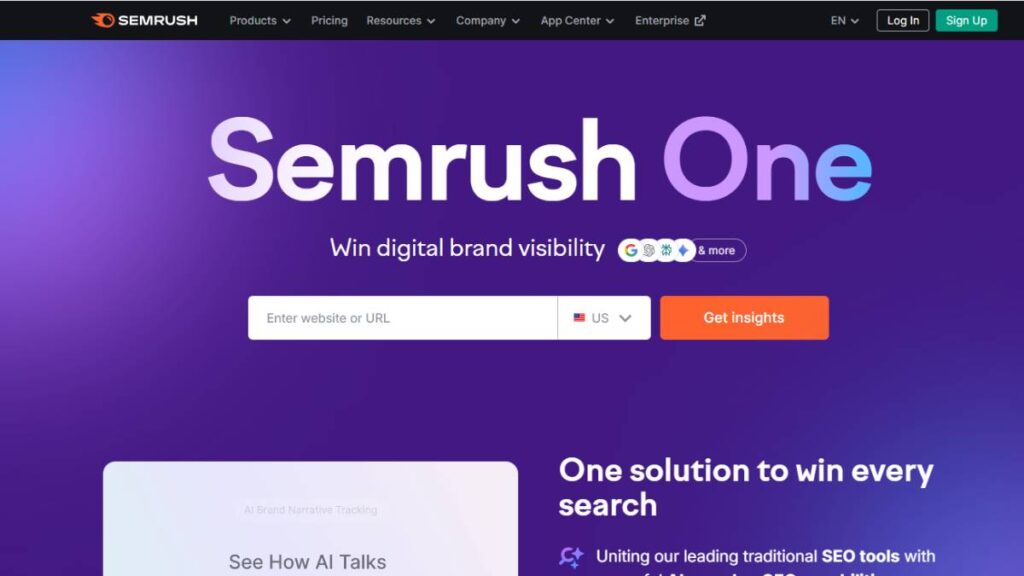
Semrush is one of the most complete auditing environments available. It’s built for teams that want visibility across technical health, backlinks, and content performance in one place.
What stands out is the site health scoring system. Instead of overwhelming you with hundreds of warnings, it translates issues into an overall health percentage, which makes reporting cleaner and prioritization easier.
Key strengths:
- 140+ technical checks covering crawlability, HTTPS, performance, and internal linking
- Automated backlink audits with toxicity scoring
- On-page optimization suggestions tied to ranking competitors
- Ongoing monitoring and scheduled reports
This is often the go-to for agencies and mid-to-large businesses because it balances depth with usability. You don’t need to stitch five different tools together.
2. Ahrefs: AI SEO Audit & Backlink Intelligence
Ahrefs has always been strong in backlink intelligence, but its site audit crawler has matured significantly.
The crawl reports are clean, fast, and highly visual. You can identify orphan pages, redirect chains, thin content, and indexation conflicts without digging through cluttered dashboards.
Where it really excels:
- Deep backlink profile analysis
- Anchor text distribution insights
- Internal linking suggestions based on crawl data
- Competitive gap analysis
If your growth ceiling feels tied to authority rather than just technical structure, Ahrefs becomes particularly valuable. It’s less about surface-level issues and more about strategic visibility.
3. Surfer SEO: AI On-Page SEO Audit Tool
Surfer focuses heavily on content structure and topical coverage.
Instead of just flagging errors, it evaluates how well a page aligns with high-performing results. It analyzes headings, semantic terms, word count ranges, and structural patterns across ranking pages.
Notable capabilities:
- NLP-driven keyword suggestions
- Real-time content scoring
- SERP structure analysis
- Optimization recommendations tied to specific queries
It’s especially effective for content-heavy websites where ranking improvements depend on refining existing pages rather than fixing technical architecture.
4. Screaming Frog: AI-Assisted Technical SEO Crawler
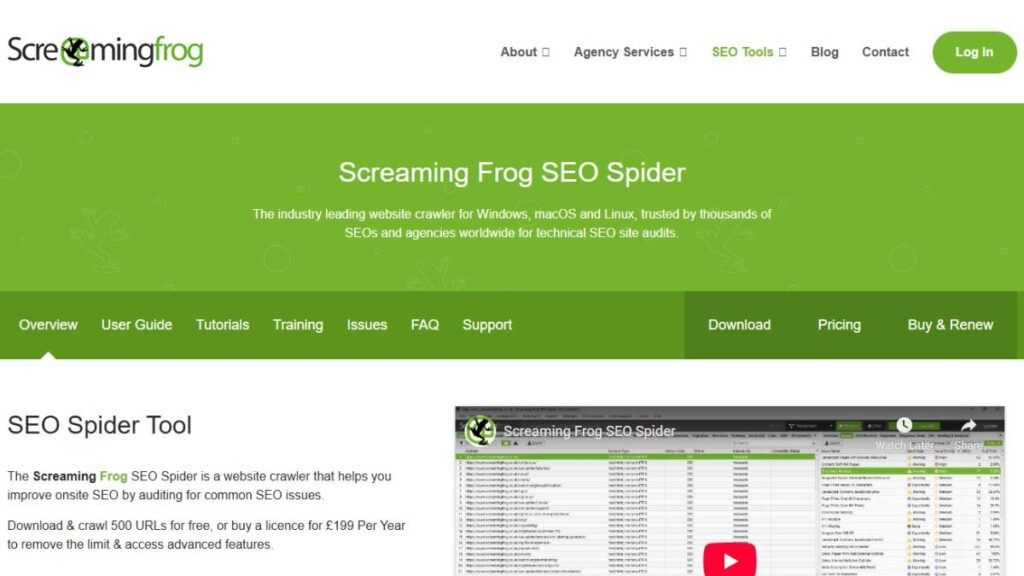
Screaming Frog remains a staple for technical audits. It’s not flashy, and that’s part of its appeal.
This is a precision tool. You crawl the site, extract exactly what you need, and analyze it on your terms.
Core strengths:
- Deep crawl analysis at scale
- Log file analysis for understanding bot behavior
- Structured data validation
- Custom extraction capabilities
For technical professionals who want granular control, this tool still delivers unmatched flexibility. It’s less automated than some platforms, but incredibly powerful in the right hands.
5. Sitebulb: Visual AI SEO Audit Reports
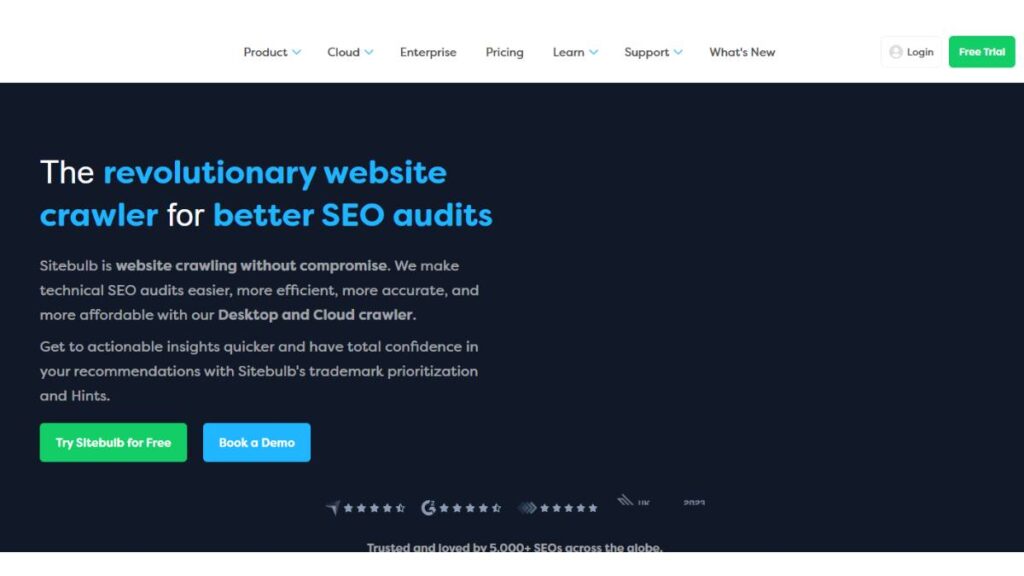
Sitebulb differentiates itself through clarity. The visualizations are sharp, intuitive, and surprisingly useful.
Instead of static spreadsheets, you get visual crawl maps and flow diagrams that reveal structural weaknesses quickly. It’s easier to spot internal linking bottlenecks or thin clusters when you can see them mapped visually.
What it does well:
- Prioritized issue scoring
- Crawl depth visualization
- Internal linking analysis
- User experience–oriented insights
For teams that need to present findings to stakeholders, the visual reporting alone makes it worth considering.
6. Moz: AI SEO Site Audit & Authority Tracking
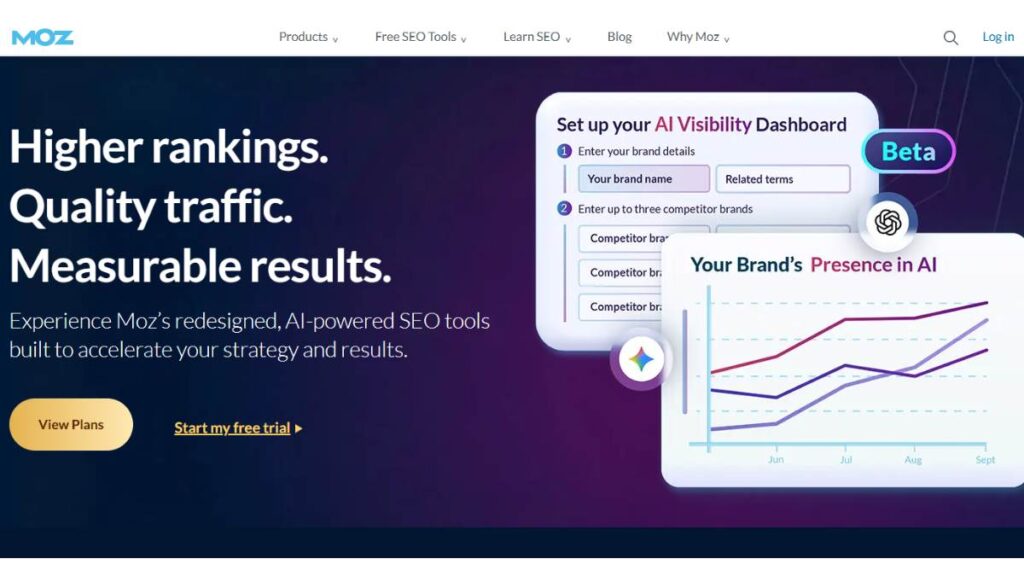
Moz brings a balanced approach. It doesn’t try to overwhelm with complexity. Instead, it focuses on core fundamentals: authority metrics, site health, and ranking tracking.
Highlights include:
- Spam score and link risk evaluation
- On-page grading suggestions
- Domain authority tracking
- Keyword performance monitoring
It’s especially suitable for small to mid-sized businesses that need structured guidance without diving too deep into technical weeds.
7. SE Ranking – Automated AI SEO Audit Platform
SE Ranking is often underrated. It combines auditing, monitoring, and competitor tracking into a streamlined interface that’s surprisingly accessible.
Key features:
- Comprehensive website audit reports
- Page change monitoring
- Competitor performance comparison
- White-label reporting options
For consultants and growing agencies, this tool provides flexibility without enterprise-level pricing.
8. NeuronWriter – AI Semantic SEO Audit Tool
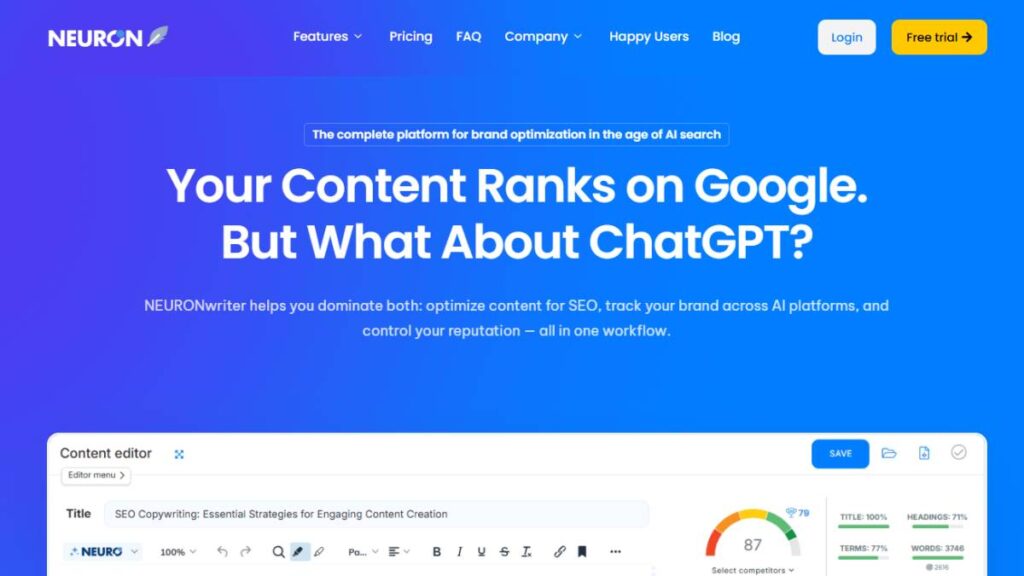
NeuronWriter leans heavily into semantic depth and topical authority. It analyzes how comprehensively a page covers its subject compared to top-ranking competitors.
What makes it useful:
- NLP-based content scoring
- Entity-focused optimization insights
- Topic clustering suggestions
- Competitive content gap analysis
If rankings are stagnating despite solid technical foundations, this kind of semantic audit often reveals what’s missing.
9. Frase – AI Content & SEO Audit Platform
Frase excels at bridging research and execution.
It analyzes search results, extracts recurring themes and questions, and turns that data into structured content briefs. That makes it particularly useful for scaling editorial teams.
Standout capabilities:
- SERP topic analysis
- Automated content brief generation
- Question-based optimization
- Gap analysis against competitors
It’s a strong fit for brands investing heavily in content marketing and needing structured guidance.
10. MarketMuse – AI Content Audit & Topic Authority Tool
MarketMuse takes a strategic, big-picture view of content performance.
Rather than evaluating pages individually, it analyzes your entire content inventory and identifies gaps in topical depth. It’s less about fixing errors and more about building authority.
Key strengths:
- Content inventory auditing
- Topical depth and authority scoring
- Competitive gap analysis
- Predictive content modeling
This platform works best for established sites with large content libraries that need refinement, consolidation, and strategic expansion.
Choosing Among These Tools
A few general observations:
- If technical structure is your biggest issue, look at platforms with strong crawl and indexing diagnostics.
- If content depth is limiting rankings, prioritize semantic analysis and topical mapping.
- If authority and backlinks are the bottleneck, choose tools with deep link intelligence.
- If you need an all-in-one solution for reporting and monitoring, enterprise platforms may justify the investment.
No tool replaces strategic thinking. But the right one can dramatically shorten the distance between identifying a problem and fixing it.
And in a search landscape that’s increasingly competitive and context-driven, that speed matters.
How to Choose the Best AI SEO Audit Tool for Your Website
Choosing a platform isn’t about picking the one with the longest feature list. It’s about identifying what’s actually holding your site back.
Some sites struggle with crawl inefficiencies. Others have solid technical foundations but weak topical authority. Some simply lack visibility into what competitors are doing better.
Start with the diagnosis. Then choose accordingly.
Based on Website Type
Different business models create different structural challenges.
eCommerce SEO
Online stores deal with scale. Hundreds or thousands of product pages. Faceted navigation. Duplicate variations. Filtered URLs.
For eCommerce sites, look for tools that handle:
- Large-scale crawling without breaking
- Duplicate content detection across product variants
- Category-level internal linking analysis
- Structured data validation for products and reviews
If your catalog is expanding constantly, monitoring and automation become critical.
SaaS SEO
SaaS websites often rely on content marketing and landing pages tied to specific use cases or integrations. The technical side may be stable, but content gaps are common.
Prioritize tools that help with:
- Topic cluster mapping
- Landing page optimization
- Competitive keyword gap analysis
- Internal linking distribution across use-case pages
The challenge here isn’t scale; it’s authority depth.
Local SEO
Local businesses need precision. NAP consistency, local schema, location pages, and intent alignment matter more than sheer volume.
You’ll want capabilities like:
- Local keyword tracking
- Structured data validation
- Mobile performance analysis
- Review and reputation signals monitoring
For locals, small technical errors can have an outsized impact.
Enterprise SEO
Enterprise sites are a different animal. Multiple subdomains. International targeting. Development cycles that move slowly.
Enterprise-ready platforms must support:
- Scalable crawling
- Log file analysis
- Automated reporting for stakeholders
- Integration with analytics and performance dashboards
In enterprise environments, clarity and prioritization matter more than raw data volume.
Based on Audit Depth
Not every team needs an all-in-one solution.
Some need technical clarity. Others need content refinement.
Technical-focused audits
If indexing issues, crawl waste, or performance bottlenecks are your biggest concerns, prioritize tools that specialize in:
- Crawl diagnostics
- Redirect and canonical analysis
- Core Web Vitals monitoring
- Server response tracking
Technical clarity often produces quick wins, especially for larger sites.
Content-focused audits
If rankings are plateauing despite strong technical health, the issue may be topical depth or intent mismatch.
In that case, look for:
- Semantic keyword analysis
- Topic gap identification
- Content scoring
- Internal linking optimization
Content refinement is slower but compounds over time.
Backlink-focused audits
When competitors consistently outrank you despite similar content quality, authority imbalance may be the issue.
You’ll need:
- Backlink profile analysis
- Anchor text distribution tracking
- Toxic link identification
- Competitor link gap insights
Authority growth requires strategic link building, not just volume.
All-in-one platforms
For agencies or growing teams, consolidating tools simplifies reporting and workflow. Just make sure depth isn’t sacrificed for convenience.
Based on the budget
Budget shouldn’t dictate strategy, but it does influence tool selection.
Free audit tools
Free versions are useful for:
- Basic site health checks
- Small websites
- Early-stage projects
But expect limited crawl depth and restricted reporting.
Affordable tools for startups
Mid-tier platforms usually offer a strong balance of functionality and cost. Ideal for small teams scaling content or improving structure gradually.
Enterprise-level solutions
These come with advanced reporting, API access, automation, and deeper integrations. They make sense when multiple teams depend on the data.
The key is alignment. Don’t overbuy complexity. Don’t underinvest in clarity.

Enroll Now: Advanced Digital Marketing Course
How to Perform an AI SEO Audit (Step-by-Step Guide)
Running an audit isn’t about clicking “Start Scan” and exporting a PDF.
It’s a structured process. Each step builds on the previous one. Skipping layers leads to shallow conclusions.
Step 1: Run a Technical Audit
Start with the foundation.
Crawl the entire site and evaluate:
- Indexation status
- Redirect chains
- Broken internal links
- Canonical conflicts
- Page speed metrics
Fix critical errors first. If search engines can’t crawl or index efficiently, content improvements won’t deliver their full impact.
Pay special attention to crawl depth. Important pages should not sit five clicks away from the homepage. Authority distribution matters more than most teams realize.
Step 2: Conduct On-Page Analysis
Once technical barriers are cleared, move to page-level optimization.
Review:
- Heading hierarchy
- Title and meta alignment
- Semantic keyword coverage
- Content completeness
- Internal linking context
This isn’t about keyword stuffing. It’s about ensuring each page comprehensively answers its intended query.
Look for thin sections. Missing subtopics. Weak transitions. Often, expanding existing content performs better than publishing something new.
Step 3: Analyze Backlinks
Authority remains a core ranking factor.
Audit your backlink profile for:
- Toxic or spam-heavy domains
- Over-optimized anchor text
- Lost links
- Imbalance between homepage and deep page links
If authority is concentrated only on your homepage, deeper pages will struggle to rank.
Competitor link analysis can also reveal opportunities. Where are they earning links that you’re not? That gap often signals strategic blind spots.
Step 4: Optimize for Google AI Overviews (SGE)
Visibility today requires more than technical health.
Strengthen structured data implementation. Ensure articles clearly define concepts. Build logical internal connections between related pages.
Focus on:
- Clear entity definitions
- FAQ-style structured answers
- Strong author and trust signals
- Conversational query alignment
Pages selected for AI Overviews tend to be structured, complete, and easy to interpret. Clarity beats cleverness.
Step 5: Generate Reports & Monitor Continuously
An audit is not a one-time event.
Set up recurring monitoring for:
- Site health fluctuations
- Performance drops
- New crawl errors
- Ranking volatility
Weekly reviews catch small issues before they become expensive problems.
Ongoing monitoring turns audits from reactive cleanup into proactive growth management.
Key Features to Look for in AI SEO Audit Tools
Not all platforms are built equally. The feature list matters, but more importantly, how those features translate into action.
Here’s what separates robust systems from surface-level scanners.
AI-Based Issue Prioritization
Data without prioritization creates paralysis.
The right tool should not only list problems but rank them by impact. Critical crawl issues should not sit alongside minor alt text warnings with equal weight.
Prioritization saves time. And time compounds into growth.
Automated Site Health Scoring
A clear health score simplifies reporting and benchmarking.
It allows you to:
- Track improvements over time
- Identify sudden drops
- Communicate progress to stakeholders
While the score itself isn’t the goal, it provides directional clarity.
Core Web Vitals Monitoring
Performance metrics are no longer optional.
Look for real-time tracking of:
- Largest Contentful Paint
- Cumulative Layout Shift
- Interaction responsiveness
Subtle speed improvements can influence both visibility and user behavior.
Structured Data Validation
Structured markup plays a significant role in enhanced search features.
A solid audit tool should detect:
- Missing schema
- Incorrect property usage
- Validation errors
- Opportunities for enhancement
Incomplete markup often goes unnoticed without proper validation.
Entity & NLP Analysis
Modern search relies heavily on context and relationships between concepts.
Tools that evaluate semantic coverage help identify:
- Missing related entities
- Incomplete topic exploration
- Thin subtopic treatment
This is especially important for competitive informational queries.
Search Console Integration
Integration with performance data provides critical context.
It allows you to:
- Connect crawl issues with traffic drops
- Identify queries driving impressions
- Analyze indexation anomalies
Without real performance data, audits remain theoretical.
Real-Time Alerts
Websites change constantly. Developers push updates. Plugins conflict. Content gets modified.
Real-time alerts ensure you’re not discovering issues weeks later.
Immediate notifications reduce damage and recovery time.
Exportable Reports
Reporting matters.
Whether you’re presenting to a client, a CMO, or a development team, exportable reports with clear action steps make implementation smoother.
Data alone isn’t persuasive. Structured recommendations are.
Ultimately, the best audit tool is the one that makes decisions easier.
Clarity. Prioritization. Continuous insight.
That combination, not flashy dashboards, drives measurable improvement over time.
Free vs Paid AI SEO Audit Tools
What’s the Difference?
This is where a lot of businesses get stuck.
They run a free audit, see a list of errors, fix a few title tags, maybe compress a couple of images, and assume they’re “optimized.” Meanwhile, competitors are running continuous monitoring, competitive gap analysis, entity mapping, and technical crawls at scale.
Free tools absolutely have their place. But they’re not built for depth or scale.
Free AI SEO Audit Tools
Free tools are great for:
- Small websites
- Quick health checks
- Early-stage startups validating basics
- Spot-checking technical errors
What you typically get:
- Limited crawl depth (often 100–500 URLs)
- Basic issue detection (missing meta tags, broken links, basic speed issues)
- Surface-level reporting
- Restricted exports
- Minimal competitor insights
They help identify obvious problems. But they rarely prioritize issues properly. You might get 30 warnings with no context about which ones actually impact visibility.
And that’s the real limitation; no strategic filtering.
Paid AI SEO Audit Tools
Paid platforms are built for continuous optimization, not one-off scans.
You’ll typically get:
- Full-site crawling (thousands or millions of URLs)
- Advanced technical diagnostics
- Structured data validation
- Entity and semantic analysis
- Backlink monitoring and toxicity detection
- Competitor benchmarking
- Automated reporting
- Search Console integration
- Ongoing change tracking
The biggest difference? Prioritization.
Instead of listing 100 issues, premium platforms surface what’s actually holding performance back; whether that’s crawl depth problems, weak internal link flow, thin topical clusters, or schema gaps.
For eCommerce, SaaS, enterprise, or content-heavy websites, paid tools are usually not optional. They’re infrastructure.
If your site drives revenue, your audit system shouldn’t be running in “basic mode.”
What Makes an AI SEO Audit Tool Different from Traditional SEO Tools?
Traditional audit tools are diagnostic.
Modern AI-powered audit platforms are strategic.
That distinction matters.
Older tools tend to:
- Crawl your site
- Output static reports
- Highlight technical errors
- Leave the interpretation to you
Which means the value depends heavily on the user’s expertise.
AI-driven platforms go further. They analyze patterns. They compare your structure to that of ranking competitors. They evaluate content depth. They assess internal link distribution. They model topical authority. And then they prioritize.
Here’s what separates them:
1. Automation vs Manual Interpretation
Traditional tools say:
“You have 147 issues.”
AI-driven tools say:
“These 5 issues are limiting growth. Fix these first.”
That shift alone changes how teams operate.
2. Predictive Recommendations vs Static Reports
Instead of just reporting problems, modern systems suggest improvements based on ranking patterns, semantic coverage, and competitive gaps.
They identify:
- Missing entities
- Under-optimized topic clusters
- Cannibalization risks
- Weak internal linking paths
- Pages that should be consolidated
It’s less about technical checklists and more about performance modeling.
3. NLP and Entity Optimization
Search has evolved from keyword matching to entity understanding and semantic relationships.
AI-powered audits evaluate:
- Topic depth
- Context relevance
- Keyword co-occurrence
- Content structure quality
- Conversational search readiness
Traditional crawlers simply don’t analyze content at that level.
4. AI-Based Content Clustering
Instead of optimizing pages individually, advanced tools identify:
- Content gaps across clusters
- Missing subtopics
- Overlapping themes
- Opportunities to build topical authority
This is critical for ranking in AI-generated results where depth and structure matter more than isolated keywords.
5. Prioritized Action Plans
This might be the biggest differentiator.
Modern platforms create:
- Severity scoring
- Impact estimates
- Structured workflows
- Team-ready reports
- Ongoing monitoring alerts
You’re not just auditing. You’re building a performance roadmap.
The real advantage isn’t finding problems. It’s knowing what to fix first, and why.
The Future of AI SEO Audit Tools & Ranking in Google AI Mode
Search is no longer ten blue links.
It’s AI Overviews. Summarized answers. Entity-based understanding. Contextual intent interpretation. Structured information extraction.
That changes how websites need to be audited.
AI-Driven SEO Is Becoming Mandatory
Search engines increasingly evaluate:
- Topical depth
- Entity coverage
- Content structure clarity
- Internal knowledge architecture
- E-E-A-T signals
- Schema implementation
- Page experience metrics
A once-a-year technical crawl simply doesn’t keep up.
Continuous auditing, semantic optimization, and real-time monitoring are becoming baseline requirements, not advanced tactics.
Why Continuous AI Audits Matter
Websites are dynamic:
- New content gets published.
- Pages get updated.
- Internal links shift.
- Backlinks appear (or disappear).
- Core updates roll out.
- Competitors expand their topical coverage.
Without ongoing audits, performance gaps widen quietly.
Modern AI-driven platforms help teams:
- Detect ranking volatility early
- Spot cannibalization quickly
- Identify new keyword clusters
- Monitor entity expansion
- Track health trends over time
It’s proactive instead of reactive.
Ranking in Google AI Mode Requires Structural Clarity
To surface in AI-generated summaries and AI Overviews, websites need:
- Clear topical authority
- Structured data consistency
- Logical internal linking
- Well-defined entities
- Comprehensive, layered content
- Clean technical foundations
AI audit tools help evaluate those structural elements in ways manual reviews often miss.
They analyze the site as a system, not a collection of pages.
Automation + Strategic Oversight = Sustainable Growth
There’s a misconception that automation replaces strategy.
It doesn’t.
Automation identifies patterns faster. It surfaces blind spots. It models gaps. It prioritizes action.
But a human strategy is still required to:
- Align content with brand positioning
- Define topical focus
- Make consolidation decisions
- Build authority intentionally
- Interpret broader market context
The future isn’t fully automated optimization.
It’s intelligent systems supporting smart decision-making.
And the brands that treat AI SEO audit tools as a continuous operating system, rather than a one-time diagnostic, will be the ones consistently showing up in AI-driven search experiences.
That’s the real shift happening right now.
FAQs: About AI SEO Audit Tools
What is the best AI SEO audit tool?
“Best” depends on what kind of mess the site is in. A massive eCommerce store with 80,000 URLs needs something very different from a 40-page SaaS site. Some platforms are heavy on technical crawling. Others are stronger at content structure and topical gaps. The right choice usually becomes obvious once the real bottleneck is identified. Before that, everything looks shiny.
Are AI SEO audit tools accurate?
For technical diagnostics? Generally yes. They’re good at catching crawl errors, broken links, thin pages, and performance slowdowns. Where things get tricky is interpretation. A flagged issue doesn’t automatically mean “drop everything and fix this.” Context matters. Business model matters. Priorities matter. The data is solid; the decisions still require judgment.
Can AI replace manual SEO audits?
Replace? No. Reduce workload? Absolutely. Automation handles scale far better than spreadsheets and manual reviews ever could. But deciding whether to merge pages, rework positioning, or shift topic focus, that’s strategic work. Tools surface patterns. People decide what those patterns mean.
How often should you run an SEO audit?
If the site is active, publishing, updating, building links, and monthly technical reviews are reasonable. But ongoing monitoring is smarter. Issues don’t wait politely. They stack up quietly. By the time traffic drops, the root cause usually started weeks earlier.
Do AI SEO tools improve Google rankings?
They don’t magically push pages up. What they do is expose friction; crawl inefficiencies, weak internal linking, shallow topic coverage, and structural confusion. When those issues are cleaned up properly, rankings tend to respond. The improvement comes from the fixes, not the dashboard.
Can SEO audit data be exported?
Most serious platforms allow exports: CSV, PDF, and shareable dashboards. That matters more than people think. Teams need documentation. Stakeholders want proof of progress. Historical comparisons help justify decisions. Without exports, it’s hard to track real improvement over time.
Is there a limit on audits?
Usually, yes; especially on lower tiers. Free plans tend to cap URL counts or monthly scans. Paid plans expand those limits. Enterprise subscriptions often remove practical restrictions. The real question isn’t the limit itself; it’s how frequently the site changes and how closely those changes need monitoring.
How does AI prioritize SEO issues?
Stronger systems score issues based on impact: crawlability, indexation status, page performance, and internal link flow. Instead of overwhelming users with 200 warnings, they surface what’s likely suppressing visibility first. That filtering is critical. Otherwise, teams waste weeks polishing low-impact details.
Do AI tools help with on-page SEO audits?
Yes, particularly around structure. They evaluate heading logic, semantic coverage, content depth, and internal linking alignment. It’s less about stuffing keywords and more about whether the page truly covers its topic in a complete, coherent way. That distinction makes a difference.
Are AI SEO audit tools worth it for small businesses?
For small businesses competing against stronger domains, structured insights can shorten the learning curve. Even modest technical improvements or content adjustments can unlock noticeable growth. But tools don’t execute changes. Consistency does. Without follow-through, even the best platform becomes an expensive decoration.
How do AI SEO audit tools help improve Core Web Vitals?
They break performance into specifics: what’s delaying load time, what’s causing layout shifts, what scripts are slowing interactivity. Instead of vague “your site is slow” warnings, they isolate the components. Fixing those improves user experience and strengthens technical signals that influence visibility.
Can AI SEO audit tools detect duplicate content automatically?
Yes, and not just obvious copy-paste duplication. Modern systems recognize near-duplicates; pages targeting the same intent with slightly different wording. That’s especially common on large sites. Cleaning it up reduces internal competition and clarifies topical focus.
Do AI SEO audit tools support structured data and schema validation?
Most advanced platforms check for missing or broken schema and highlight enhancement opportunities. Structured data helps search engines understand context. When markup is inconsistent or incomplete, visibility in enhanced results can suffer. Clean implementation matters more now than it used to.
How do AI SEO tools identify keyword gaps and content opportunities?
They compare site coverage against high-performing competitors and look for missing subtopics, related entities, and thematic depth. The output isn’t just a keyword list. It’s more of a coverage map showing where authority is thin. Filling those gaps builds stronger long-term positioning.
Are AI SEO audit tools useful for local SEO optimization?
Yes, particularly for multi-location businesses. They evaluate landing page structure, geographic keyword alignment, and schema consistency. Small inconsistencies across locations can limit local visibility. At scale, those small issues add up faster than expected.
Can AI SEO audit tools analyze competitor websites?
Premium platforms can crawl competitor domains and reveal structural differences, backlink strength, internal linking depth, and content breadth. Seeing how competitors organize topic clusters often reveals opportunities that internal audits alone might miss.
How often should you run an AI-powered SEO audit?
For active sites, monthly technical scans are a safe baseline. Continuous monitoring is better. Algorithm shifts, indexing changes, and crawl errors don’t send invitations. Catching issues early prevents larger performance drops later.
Do AI SEO audit tools integrate with Google Search Console?
Many do, which helps connect technical diagnostics with real search data: impressions, clicks, and indexing coverage. That integration provides clarity. It shows whether structural fixes are influencing actual performance rather than just improving audit scores.
Can AI SEO audit tools help optimize content for Google AI Overviews?
They support structural clarity, entity coverage, and conversational alignment; elements that influence summarized search results. Pages that define topics clearly, connect related concepts logically, and maintain a clean structure are more likely to surface in AI-driven summaries.
Are AI SEO audit tools suitable for eCommerce websites?
For large catalogs, they’re almost essential. Product variations, duplicate descriptions, thin category pages, crawl inefficiencies; these issues multiply quickly. Audit systems highlight structural weaknesses and indexing waste that often suppress visibility. Cleaning those up at scale can produce meaningful gains over time