

Brand Asset Management used to sound like something only big enterprises worried about. A shared drive, a few folders, maybe a brand PDF; that felt “good enough.” Not anymore. As teams expand, agencies come in, content multiplies, and campaigns roll out across five platforms at once, small inconsistencies start stacking up. An old logo here. A slightly off-tone headline there. Nothing dramatic. Just messy.
This guide walks through what Brand Asset Management actually looks like in practice; the systems behind it, how it differs from basic file storage, how to organize assets properly, and why governance matters more than most teams realize. It’s less about theory and more about keeping your brand from slowly drifting off course.
Table of Contents
Introduction:
Brand asset management is the structured process of organizing, controlling, distributing, and maintaining a company’s brand assets, including logos, design systems, marketing materials, and brand guidelines, to ensure consistency, compliance, and long-term brand value across every channel.
That’s the simple definition. The real reason it matters? Brand consistency has never been harder.
Most businesses don’t struggle with creativity. They struggle with control. Files are scattered across shared drives. Old logos resurface in sales decks. Agencies use outdated color codes. A regional team tweaks messaging “just slightly,”; and suddenly the brand looks different in five places at once.
At the same time, digital media has exploded. Brands now publish across websites, apps, social platforms, marketplaces, paid ads, email campaigns, partner portals, and internal channels. Every platform demands content. Every team needs access. And every asset must reflect the same brand identity.
Without a system, things fall apart quietly. Not dramatically. Quietly.
Brand asset management systems solve this by creating structure around your brand. They centralize assets, define permissions, attach usage rights, track versions, and ensure the correct files are always being used. Instead of chasing brand consistency, you build it into your operations.
In this guide, we’ll break down what brand asset management really means, what qualifies as a brand asset, how management systems work, and why structured brand control is becoming non-negotiable for modern businesses.
What Is Brand Asset Management?
Brand Asset Management Definition
Brand asset management is the strategic process of organizing and governing all brand-related assets to ensure consistent, compliant, and efficient usage across marketing, sales, and communication channels.
In practical marketing terms, it means having complete visibility and control over everything that represents your brand, visually and verbally. It’s not just about storing files. It’s about protecting brand identity.
When done properly, brand asset management ensures:
- The right logo is used every time
- Approved messaging stays consistent
- Design systems remain intact
- Teams don’t reinvent or misuse brand materials
It acts as the operational backbone of brand consistency. Without it, even strong brands slowly drift into fragmentation.
Why Brand Asset Management Matters in Modern Marketing
Marketing today isn’t centralized in one office. It’s distributed. Regional teams create localized campaigns. Agencies produce creative assets. Freelancers design landing pages. Internal departments build presentations. Social teams publish daily content.
Now multiply that across countries.
Brand asset management matters because:
- Brand consistency across digital channels directly impacts trust and recognition.
- Multi-channel publishing increases the risk of visual and messaging inconsistencies.
- Remote and hybrid teams need structured access to approved brand assets.
- Scaling companies cannot rely on manual file sharing forever.
When brand control becomes reactive instead of proactive, small inconsistencies compound. Fonts shift. Tone softens in one region and sharpens in another. Visual hierarchy gets diluted.
Brand asset management brings governance to creativity. It protects the integrity of the brand while still enabling teams to move fast.
What Are Brand Assets?
Brand Assets Meaning
Brand assets are the identifiable elements that represent a company’s identity, values, and positioning in the market. They are the building blocks of brand recognition.
Some brand assets are tangible. Others are deeply intangible.
Tangible assets include visual and physical elements that customers can see or interact with. Intangible assets include emotional associations, brand voice, and reputation. Both are critical. Both require management.
A strong brand isn’t built on a logo alone. It’s built on a system of assets working together cohesively.
Types of Brand Assets
Brand assets typically include:
- Logos and brand marks
- Brand guidelines and style guides
- Typography systems and fonts
- Color palettes and visual frameworks
- Marketing collateral (brochures, presentations, ads)
- Social media creatives and templates
- Video content and multimedia assets
- Product packaging designs
- Brand voice documentation and messaging frameworks
- Trademarks and intellectual property
Each of these elements plays a role in shaping perception. When they are aligned, the brand feels unified. When they are inconsistent, the brand feels unstable.
Even something as small as using an outdated shade of blue can dilute recognition over time.
Tangible vs Intangible Brand Assets Explained
Tangible brand assets are easier to identify. They are files, designs, physical materials, templates, packaging, and visual components. These are typically stored, versioned, and distributed through systems.
Intangible brand assets are more nuanced. They include brand personality, tone of voice, emotional positioning, reputation, and customer perception. These cannot be stored in folders, but they can absolutely be governed.
A brand’s equity lives in the intangible layer. Its consistency lives in the tangible layer.
Effective brand asset management connects the two. It ensures that visual materials reinforce brand personality, that messaging reflects positioning, and that every asset, whether digital or physical, strengthens recognition instead of weakening it.
When companies overlook this connection, they end up with polished visuals but an inconsistent identity. Or strong messaging trapped inside scattered files.
True brand asset management bridges strategy and execution.
What Is a Brand Asset Management System?
Brand Asset Management Software Explained
Most teams don’t wake up one day and decide they need a brand asset management system. It usually happens after a few small issues pile up. The wrong logo goes out in a campaign. An old product visual gets reused. A regional team tweaks something “just for local relevance,” and now the brand looks slightly different in five markets.
That’s when the conversation starts.
A brand asset management system is essentially a structured environment where all brand-related assets live, and more importantly, where they’re controlled. Not just stored. Controlled. It brings logos, templates, campaign visuals, messaging documents, and guidelines into one governed space.
Unlike a basic shared drive, this isn’t just about uploading files into folders and hoping people pick the right one. A proper system creates rules around how assets are added, updated, accessed, and retired. It builds discipline into everyday marketing work.
Most modern platforms are cloud-based, which matters more than it sounds. Teams today are scattered; different cities, different agencies, freelancers dialing in from who knows where. Emailing attachments around simply doesn’t hold up anymore. A centralized system reduces that chaos.
For larger organizations, it becomes even more important. Multiple product lines. Regional adaptations. Campaign layers are running simultaneously. Without structure, brand identity slowly drifts. Not dramatically. Just subtly enough to weaken recognition over time.
Brand asset management software exists to stop that drift.
Key Features of Brand Asset Management Systems
The core of any solid brand asset management system is a centralized digital asset library. One place. One source of truth. No guessing which folder holds the final version. No digging through last year’s presentations.
But storage alone isn’t the real value.
Brand guidelines management makes a big difference. Instead of static PDFs buried in email threads, guidelines are embedded into the system itself. When someone downloads a logo, they can see usage rules alongside it. When a template is accessed, it’s already pre-aligned with typography and color standards. That subtle integration saves endless back-and-forth.
Version control is another quiet hero. Brands evolve. Logos get refined. Messaging sharpens. Without structured versioning, old assets never really disappear; they linger. Good systems archive outdated materials automatically and make it clear which version is current. That alone prevents a surprising number of mistakes.
Role-based access control adds a layer of maturity. Not everyone needs editing rights. Some teams only need view or download access. Brand managers may approve uploads before they go live. This isn’t about restricting creativity; it’s about protecting consistency.
Metadata tagging and taxonomy might sound technical, but they’re practical. Assets are tagged by campaign, region, product, format, or usage type. Instead of remembering exact file names, teams search by context. It’s faster. It’s cleaner.
More advanced systems now include AI-powered search and auto-tagging. Images can be identified based on visual elements. Keywords are suggested automatically. It reduces manual work and, frankly, reduces human error.
Rights management is another feature many overlook until it’s too late. Licensing terms, expiration dates, and usage restrictions; these details are attached directly to assets. That’s not just helpful. It protects the business legally.
And then there’s analytics. Seeing which assets are reused, which ones sit untouched, and which campaigns drive the most downloads gives brand teams real insight into what’s actually working. Creative decisions stop being guesswork.
How Brand Asset Management Works
In practice, brand asset management works through structure and discipline.
Assets are uploaded into the system and categorized based on predefined standards. This step matters more than most realize. A messy setup at the beginning leads to long-term confusion. A clean taxonomy makes everything easier later.
Each asset gets metadata: descriptive tags that clarify where it belongs, how it can be used, and who owns it. Campaign names, regions, product lines, licensing notes. It turns a simple file into a managed brand resource.
Approval workflows are built into the system. Before a new logo variation or campaign visual becomes widely accessible, it goes through review. That prevents inconsistencies from spreading quietly.
Once approved, distribution becomes straightforward. Teams, agencies, and partners access the same centralized platform. No emailing zip files. No “final_v3_revised” confusion. Just controlled access to approved materials.
Over time, asset lifecycle management keeps everything current. Expired visuals are archived. Updated versions replace older ones. The system evolves as the brand evolves. That ongoing maintenance is what keeps brand identity intact year after year.
Digital Asset Management (DAM) vs Brand Asset Management (BAM)
What Is Digital Asset Management (DAM)?
Digital asset management, or DAM, focuses on organizing and storing digital files. Images, videos, documents, creative files; all structured so they can be searched, retrieved, and shared efficiently.
At its core, a DAM system answers a simple operational question: where is this file, and who can access it?
For teams dealing with thousands, sometimes millions, of assets, DAM is incredibly useful. It brings order to digital clutter. It reduces duplication. It improves speed.
But DAM, by itself, doesn’t always enforce brand discipline. It manages files well. It doesn’t automatically protect brand integrity.
Key Differences Between DAM and BAM
The distinction between DAM and BAM comes down to intent.
DAM is primarily about file management and operational efficiency. BAM adds a layer of brand governance on top of that foundation.
A DAM system ensures assets are organized. A BAM system ensures assets are aligned with brand standards.
With BAM, brand guidelines aren’t separate documents sitting somewhere else. They’re connected directly to assets and workflows. Approvals aren’t just about file quality; they’re about brand compliance.
Creative management also differs. DAM supports creative teams in storing and distributing files. BAM supports brand leaders in maintaining strategic consistency across campaigns and regions.
Workflow depth tends to be stronger in BAM environments. Brand reviews, permission hierarchies, and compliance tracking; these are built in intentionally.
Branding compliance is really the dividing line. DAM helps teams move faster. BAM ensures they move in the right direction.
When to Use DAM vs BAM
For smaller businesses with centralized marketing teams, a traditional DAM system may be enough. If the brand ecosystem is simple and oversight is tight, full-scale brand governance might not yet be necessary.
As organizations grow, complexity increases. More campaigns. More contributors. More markets. That’s when cracks begin to show.
Enterprise marketing teams usually need more than storage. They need control. Agencies managing multiple clients often need strong brand governance layers to prevent cross-contamination and inconsistency. Global brands, especially those operating across regions with localized adaptations, benefit significantly from BAM systems.
In many cases, companies start with DAM and transition toward BAM as brand maturity increases. It’s rarely an overnight shift. It happens gradually; often after a few painful lessons about inconsistency.
Brand asset management isn’t about adding another system for the sake of it. It’s about recognizing that brand identity is an asset worth protecting with the same rigor as financial data or intellectual property. Once that realization clicks, the move toward structured governance feels less like an upgrade and more like a necessity.
How a DAM Powers Your Brand Asset Management Strategy
A strong brand asset management strategy rarely stands alone. In most organizations, it’s built on top of a solid digital asset management foundation. The DAM handles the heavy lifting of storage and organization. The brand layer adds governance, context, and control.
When the two work together properly, brand execution becomes sharper. Less friction. Fewer mistakes.
One Centralized Source of Truth
A centralized repository sounds simple, almost obvious. But in practice, it’s transformative.
Without a single source of truth, assets multiply. Teams download files, tweak them, save local copies, and circulate “updated” versions that aren’t actually approved. Over time, five versions of the same logo exist in five different folders. Nobody is fully confident which one is correct.
A DAM-powered brand system fixes that by creating one definitive home for assets. Approved logos live in one location. Campaign visuals are grouped by initiative. Templates are clearly labeled and structured.
Duplicate files start to disappear. Outdated materials are archived. Instead of asking, “Does anyone have the latest version?” teams simply go to the system.
That shift, from asking people to trusting a system, is where operational maturity begins.
AI-Powered Brand Asset Search
As asset libraries grow, search becomes more important than storage.
Manual tagging works, but it’s never perfect. People forget to label things. Naming conventions slip. Over time, search becomes unreliable.
AI-powered search adds intelligence to the system. Assets can be identified by visual elements, keywords, campaign context, or even thematic relevance. A search for “holiday social banner” doesn’t require remembering exact file names. The system surfaces relevant content based on patterns and metadata.
Auto-tagging reduces manual effort and improves consistency across uploads. That consistency matters when you’re managing thousands of assets across regions and teams.
More importantly, intelligent search protects brand consistency indirectly. When the right assets are easy to find, teams are less likely to create workarounds or build something from scratch that doesn’t align with brand standards.
Brand Information Attached to Every Asset
An image without context is risky. A logo without usage rules is an invitation for misuse.
Strong brand asset management attaches critical information directly to each asset. Licensing terms are visible. Usage rights are clear. Expiration dates are documented. Campaign associations are labeled.
This removes ambiguity.
If a stock image is only licensed for a certain region, that information travels with the file. If a campaign visual is tied to a specific product launch, that context remains attached. It reduces compliance risk and prevents accidental misuse.
Over time, this level of detail builds confidence. Teams know they’re using assets correctly. Legal and brand teams spend less time policing usage. The system itself enforces discipline.
Benefits of Brand Asset Management for Businesses
Brand asset management isn’t just about organization. It delivers tangible business impact. Often quietly, but consistently.
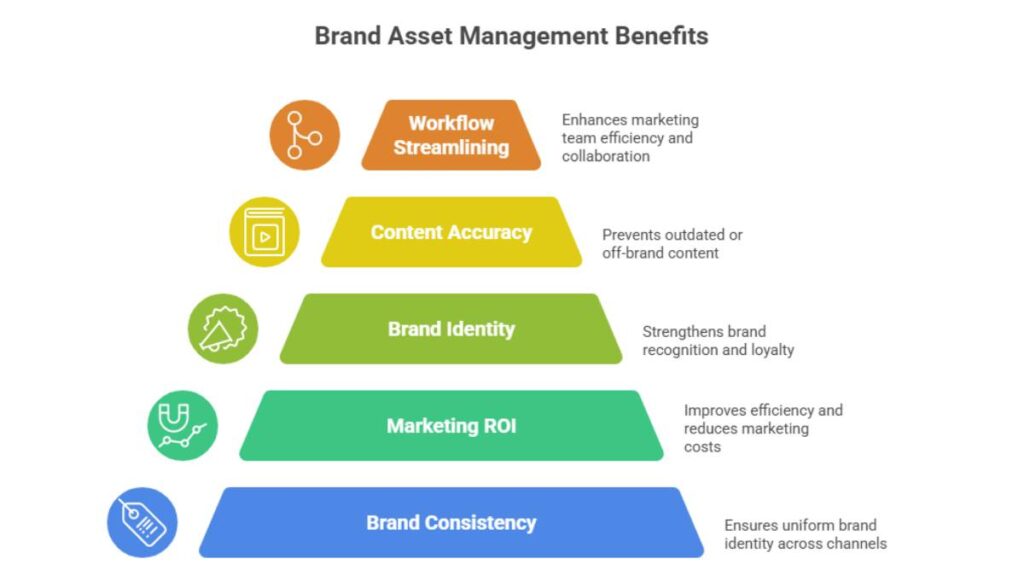
Maintain Brand Consistency Across Channels
Consistency is what turns recognition into trust.
When visuals, tone, and messaging align across websites, social platforms, advertising, packaging, and presentations, customers feel that alignment, even if they can’t articulate it. The brand appears stable, intentional, and credible.
Without structured asset management, inconsistency creeps in. A slightly altered logo here. A different shade of brand color there. Messaging that feels off-brand in certain campaigns.
For multi-location businesses or global brands, this risk multiplies. Local teams adapt materials for regional markets. Agencies interpret guidelines in their own way. Over time, the brand begins to fragment.
Brand asset management provides guardrails. It ensures that while creativity flourishes, the core identity remains intact.
Improve Marketing ROI
Marketing budgets rarely shrink because assets are well managed. But they often leak when assets are not.
When teams can easily locate and reuse existing materials, they reduce redundant design work. Campaign elements are repurposed intelligently. Templates speed up production cycles.
Faster campaign execution means quicker time to market. Reduced duplication means fewer unnecessary creative hours. Higher asset reuse rates stretch the value of every piece of content produced.
Over time, those efficiencies compound. What seems like an operational improvement becomes a financial advantage.
Strengthen Brand Identity and Recognition
Strong brands are consistent brands.
When customers encounter the same visual language repeatedly, the same typography, color structure, and tone of voice, recognition strengthens. Familiarity builds trust. Trust builds loyalty.
Brand asset management ensures that identity isn’t diluted through careless execution. It reinforces visual unity across campaigns, product lines, and channels.
That unity matters more than many realize. Recognition isn’t built on one brilliant campaign. It’s built on repetition and cohesion over time.
Avoid Outdated or Off-Brand Content
Outdated content doesn’t always look dramatically wrong. Sometimes it’s subtle. An old product image. A discontinued tagline. A retired logo variation.
These small inconsistencies chip away at credibility.
Version control and structured archiving prevent outdated materials from resurfacing. When assets expire, they’re flagged or removed. When branding updates occur, new versions replace old ones systematically.
The result is cleaner execution and fewer embarrassing corrections.
Streamline Marketing Workflows
Marketing moves fast. Approval bottlenecks slow momentum. Miscommunication wastes time.
Brand asset management introduces structure into creative workflows. Approvals happen within defined processes. Stakeholders know where to review assets. Teams know where to access final versions.
Creative collaboration becomes smoother because expectations are clearer. Agencies understand brand standards upfront. Regional teams pull from pre-approved templates instead of improvising.
Speed improves, not because teams rush, but because confusion is reduced.
How Brand Asset Management Systems Help Manage Large Media Libraries
As brands grow, asset libraries grow with them. Hundreds of images turn into thousands. Campaign archives expand year after year. Without structure, large media libraries become overwhelming.
Organizing Thousands of Digital Assets
Folders alone don’t scale well. Nested directories become complex. Naming conventions break down.
Brand asset management systems rely on taxonomy and metadata to organize assets at scale. Instead of depending purely on folder structures, assets are categorized by multiple attributes: campaign, region, product line, format, and usage type.
This multi-layered organization makes large libraries manageable. An image doesn’t live in just one folder; it lives within a structured system of tags and classifications.
Smart tagging strategies make retrieval efficient. When someone searches for a product launch banner from a specific region and year, they find it quickly. That precision matters in high-volume environments.
Scaling Brand Management Globally
Global brands face additional challenges. Different languages. Regional adaptations. Local regulations.
Brand asset management systems support multi-language asset versions within the same structured framework. Teams can access localized materials without compromising core brand elements.
Regional brand compliance becomes easier to monitor. Instead of relying on manual oversight, systems track usage and approvals centrally. Leadership maintains visibility across markets.
As brands expand into new territories, this scalability becomes essential. Growth without structure leads to fragmentation. Growth supported by strong asset management maintains cohesion.
At scale, brand discipline isn’t about control for its own sake. It’s about protecting the long-term value of the brand while enabling teams around the world to move confidently and consistently.
How to Organize Brand Assets Effectively
Brand asset management only works if the structure behind it makes sense. Too many teams jump straight into uploading files without thinking through how people will actually search, filter, and reuse those assets six months from now.
Organization isn’t about neat folders. It’s about making the right asset easy to find at the exact moment it’s needed.
Step 1: Identify and Audit All Brand Assets
Before organizing anything, take inventory.
A proper brand asset audit usually uncovers:
- Multiple versions of the same logo
- Old campaign visuals are still floating around
- Outdated product screenshots
- Brand guidelines no one has opened in years
- Social templates saved on individual desktops
Start by asking: What counts as a brand asset in this organization? Logos are obvious. But what about pitch decks? Email signatures? Product UI screenshots? Sales one-pagers?
Create a checklist that includes:
- Core visual identity (logos, fonts, colors)
- Campaign creative
- Product visuals
- Brand messaging and tone documents
- Templates (presentations, social, email)
- Legal and trademark assets
Then remove what shouldn’t be used anymore. Archive expired campaigns. Delete duplicates. Flag assets that need updating.
This part is tedious. It’s also where most of the clarity comes from.
Step 2: Create a Brand Asset Organization Structure
Once everything is accounted for, build a structure that reflects how teams actually work.
Folder Hierarchy
Folders still matter, but they shouldn’t carry the full weight of organization.
Common top-level categories:
- Brand Identity
- Campaigns
- Product Marketing
- Social Media
- Sales & Enablement
- Events
- Regional Assets
Under each, organize by year, campaign name, or product line; whichever aligns with how your marketing team thinks.
Keep it logical. If someone needs a file in 10 seconds before a deadline, they shouldn’t have to guess.
Naming Conventions
File names are underrated. They quietly determine whether assets are reusable or lost forever.
Strong naming conventions usually include:
- Brand or product name
- Asset type
- Channel
- Version number
- Date (if relevant)
For example:
ProductX_Launch_Social_Instagram_V2_2026.jpg
It looks long, but it prevents chaos later.
Metadata Standards
Folders help. Metadata does the heavy lifting.
Define tagging standards early:
- Campaign name
- Region
- Language
- Product line
- Asset type
- Usage rights
- Status (approved, draft, archived)
Consistency matters more than complexity. A simple, disciplined tagging system beats a sophisticated one no one follows.
Step 3: Implement Brand Governance Policies
An organization without governance falls apart quickly.
Brand governance answers questions like:
- Who can upload assets?
- Who approves new creative?
- Who can edit brand guidelines?
- What happens when a campaign ends?
Set clear rules around:
- Role-based access control
- Approval workflows
- Version management
- Asset expiration and archiving
Without governance, people revert to old habits: downloading files to desktops, sharing via email, duplicating assets “just in case.”
Structure needs accountability behind it.
Step 4: Ensure Ongoing Brand Asset Maintenance
Brand asset management isn’t a one-time cleanup project. It’s an ongoing discipline.
Build in:
- Quarterly asset audits
- Regular version reviews
- Expiration tracking for licensed content
- Updates when brand elements evolve
Marketing moves fast. Products change. Messaging shifts. New channels emerge.
The structure must adapt without collapsing.
Small, consistent maintenance beats massive reorganization every two years. Always.

Enroll Now: Brand Management course
Real-World Examples of Strong Brand Assets
Strong brands don’t rely on volume. They rely on clarity and consistency. The following companies show how disciplined brand asset management translates into recognizable, scalable identity.
Mailchimp
One glance at a bright yellow background and playful illustrations, and most marketers know exactly who it is.
Mailchimp has built a consistent yellow brand identity that shows up across web, ads, social, and product. Their visual system isn’t complicated, but it’s tightly controlled.
Key strengths:
- Distinct primary color usage
- Consistent illustration style
- Recognizable, conversational brand voice
That consistency doesn’t happen by accident. It requires clear asset guidelines and disciplined distribution.
Amazon
Amazon is a masterclass in subtle brand asset reinforcement.
The arrow in the logo, stretching from A to Z, is simple. But it appears everywhere: packaging, delivery vans, digital interfaces.
Brand asset strengths include:
- Logo usage consistency
- Packaging alignment across regions
- Repeated visual cues reinforcing brand promise
Even at a global scale, the identity stays remarkably stable.
Microsoft
Microsoft demonstrates structured brand architecture.
Its Fluent design system ensures:
- Unified product visuals
- Consistent iconography
- Clear typography standards
With multiple product lines and sub-brands, structure becomes essential. Without organized brand asset management, visual fragmentation would be inevitable.
Apple
Apple is known for minimalism, and that minimalism requires precision.
Strong brand asset traits:
- Clean product photography
- Strict visual hierarchy
- Controlled typography and spacing
Everything feels deliberate. That level of polish only works when asset governance is tight.
Coca-Cola
Few brands own a color the way Coca-Cola owns red.
From packaging to outdoor advertising, the red tone remains remarkably consistent worldwide.
Brand asset strengths:
- Iconic color identity
- Consistent script typography
- Repeated bottle silhouette
Over decades, these assets have been protected and managed carefully, not reinvented every few years.
These examples highlight a key truth: strong brand assets aren’t flashy. They’re controlled, repeatable, and instantly recognizable.
Why Brand Asset Management Is Critical for Digital-First Brands
Marketing today is fragmented. Brands publish across websites, marketplaces, social platforms, streaming services, email campaigns, and partner portals; often simultaneously.
That scale introduces risk.
Without structured brand asset management:
- Visual inconsistencies multiply
- Old messaging resurfaces
- Regional teams improvise
- Agencies reinterpret guidelines
Digital-first brands feel this pressure more intensely because content velocity is higher than ever.
AI-Generated Content and Brand Control
Content production has accelerated dramatically. More creative variations, more formats, more distribution channels.
Speed is helpful. But without guardrails, brand drift happens quietly.
A structured brand asset management system ensures that:
- Approved logos and visual elements are always used
- Messaging frameworks remain intact
- Templates guide creative execution
- Expired assets are automatically removed
It creates boundaries without slowing creativity.
Multi-Platform Publishing
Each platform has its own specifications, aspect ratios, and audience behavior. Brands often create dozens of variations of a single campaign.
Without central control:
- Teams redesign assets unnecessarily
- Outdated visuals get reused
- Brand tone shifts between channels
With organized brand assets, adaptation becomes faster and safer.
Remote Teams and Global Marketing
Modern marketing teams are rarely centralized. Designers, marketers, and agencies operate across time zones and markets.
A strong brand asset management framework provides:
- A single, reliable source of truth
- Region-specific assets without losing core identity
- Clear usage rights and compliance visibility
- Controlled access based on role or geography
In distributed environments, structure isn’t bureaucracy. It’s stability.
Digital-first brands face more complexity. More content. More channels. More collaboration. More compliance.
Brand asset management becomes the quiet system holding it all together, ensuring that as a brand scales, it doesn’t slowly lose itself in the process.
How to Choose the Best Brand Asset Management Software
Choosing brand asset management software looks like a tech decision on paper. In reality, it’s operational. Cultural, even. The wrong platform turns into another polished dashboard that nobody opens after month three. The right one? It quietly fixes things in the background. Fewer Slack messages asking for the “latest logo.” Fewer last-minute approval scrambles before launch. That kind of improvement.
Before reviewing vendors or booking demos, step back. What’s actually broken?
Is the issue brand inconsistency across regions?
Are approvals painfully slow?
Are designers rebuilding assets that already exist?
Is Legal worried about expired licenses?
Usually, it’s a mix. But ranking those problems matters. Otherwise, the evaluation becomes feature shopping instead of problem solving.
What to Look For (Beyond the Sales Pitch)
Scalability
This isn’t just about storage limits. It’s about structural durability.
Think ahead a bit:
- How many users will need access in two years?
- Will new product lines double the asset library?
- Are regional teams going to localize campaigns?
Plenty of systems look clean with 2,000 files. Things change at 40,000. Search slows. Folder logic breaks. Metadata becomes messy. Scalability is really about whether the system still feels usable when complexity rises.
Integration With Daily Tools
Brand assets don’t live in isolation. They flow into CMS platforms, email tools, ad managers, design software, and sales decks. If the system doesn’t integrate well, people work around it. And once workarounds start, governance slips.
Look for:
- Native integrations with core platforms
- Flexible APIs
- Easy embedding or asset linking
- Compatibility with creative workflows
If accessing assets feels like extra effort, adoption drops. Not dramatically. Just slowly.
AI Capabilities (But Be Practical)
AI features sound impressive in demos. The real question is whether they solve real friction.
Helpful capabilities include:
- Smart visual search (not just keyword search)
- Auto-tagging based on objects or context
- Duplicate detection
- Expiration alerts for licensed content
Automation won’t replace governance. It supports it. When search works well, people stop saving files to their desktops “just in case.” Small behavioral shifts make a big difference over time.
Security and Compliance
Brand assets aren’t just creative files. They include licensed photography, trademarks, partner logos, and embargoed campaign materials.
Evaluate:
- Role-based access controls
- Granular permissions
- Audit trails
- Rights management tracking
- Data security certifications
For global brands, regional compliance matters more than most teams expect. Especially when imagery or trademarks carry legal exposure.
Questions Worth Asking (The Practical Ones)
When speaking with vendors, surface the everyday realities.
- How long does implementation actually take?
- What does onboarding look like for non-technical teams?
- Can brand guidelines live inside the system, not as a separate PDF?
- Can assets auto-archive after expiration?
- How painful is file migration?
- What reporting exists for asset usage?
- How customizable is metadata?
- What support is included after launch?
Also, involve the actual users. Designers. Brand managers. Content teams. Executive approval matters, but usability determines survival. If daily users don’t trust the interface, the system becomes shelfware.
Brand asset management software should reduce friction. If it introduces new layers of complexity, something’s off.
Conclusion:
There was a time when brand asset management felt like a “nice to have.” A well-labeled shared drive. Maybe a structured Dropbox folder and some naming conventions. That worked, until growth happened.
Today, brands move fast. Campaign cycles shrink. Content volume multiplies. Teams expand across regions and time zones. Under those conditions, informal systems collapse quietly.
At its core, brand asset management is a discipline. Organizing and protecting the visual and strategic elements that define a brand. Logos. Messaging frameworks. Campaign visuals. Templates. Tone of voice. All of it.
Consistency doesn’t happen accidentally. It’s engineered.
When visuals and messaging align across channels, recognition builds slowly but powerfully. Customers begin to recognize the brand without effort. That familiarity compounds over time. It’s subtle. But it drives equity.
Without structure, the opposite unfolds:
- Inconsistent visuals dilute recognition
- Outdated messaging resurfaces
- Teams recreate assets that already exist
- Compliance risks increase
- Internal frustration grows
None of it feels catastrophic at first. Just inefficient. Then scale magnifies the cracks.
A strong brand asset management system supports growth without chaos. It allows global teams to adapt campaigns locally without breaking core identity. It gives leadership visibility. It reduces duplicated work. It builds confidence that the brand is being represented correctly, everywhere.
Looking ahead, automation will continue improving. Search will get smarter. Tagging more accurate. Rights management is more proactive. But technology alone doesn’t solve brand fragmentation. The foundation is clarity. If the brand strategy itself is undefined, no system can fix that.
The brands that outperform and go beyond won’t necessarily be the loudest. They’ll be the most consistent. The most disciplined. The easiest to recognize in a crowded feed.
A practical starting point?
Audit existing assets. Understand what exists, where it lives, who controls it, and what’s outdated. Clean first. Then the structure. Then govern. Then invest in the right system.
Brand asset management isn’t operational housekeeping. It’s brand protection. And increasingly, it’s a competitive edge hiding in plain sight.
FAQs: Brand Asset Management
What Is Brand Asset Management?
Brand asset management is the practice of keeping a brand’s core elements: logos, color systems, templates, and messaging organized and controlled. It’s less about storage and more about discipline. Without it, brands drift. Slightly at first. Then noticeably.
What Is the Difference Between Brand Asset Management and Digital Asset Management?
Digital asset management focuses on storing and retrieving files. Brand asset management adds governance, approvals, usage rules, version control, brand standards.
DAM helps find files.
BAM ensures the right files are used correctly.
It’s a subtle difference. Operationally, it’s huge.
Why Is Brand Asset Management Important?
Brands rarely break overnight. They fragment slowly. A slightly outdated logo here. A messaging tweak there. Over time, inconsistency becomes visible externally.
Brand asset management prevents that quiet erosion.
What Are Examples of Brand Assets?
Logos, typography, color palettes, packaging designs, product photography, campaign visuals. Also, messaging frameworks, taglines, and tone-of-voice documents.
Some assets are visible instantly. Others shape perception behind the scenes.
What Does a Brand Asset Management System Do?
It centralizes approved materials and adds structure. Version tracking. Permissions. Usage rules. Teams know where to go and what’s current. Less guessing. Fewer mistakes.
How Does Brand Asset Management Improve Brand Consistency?
When everyone pulls from a single controlled source, variation drops naturally. No more debates about “which file is correct.” Over time, that operational clarity strengthens brand recognition.
Is Brand Asset Management Only for Large Enterprises?
Large enterprises feel the pressure first. But growing companies encounter the same issues once multiple teams or partners get involved. Informal sharing works; until it doesn’t.
What Features Should a Brand Asset Management System Include?
At minimum:
Centralized storage
Strong search
Metadata tagging
Version control
Role-based permissions
Approval workflows
As libraries grow, rights management and reporting become essential.
How Is Brand Asset Management Different From a CMS?
A CMS manages website pages and published content. Brand asset management controls the foundational brand elements used across channels. They complement each other. They’re not interchangeable.
Can Brand Asset Management Software Integrate With Marketing Tools?
It should. Integration with design platforms, CMS systems, email tools, and ad platforms reduces friction. If assets aren’t accessible within daily workflows, teams revert to manual workarounds.
What Is the Role of AI in Brand Asset Management?
AI improves search, tagging, duplicate detection, and license tracking. As asset libraries expand, manual organization alone doesn’t scale. Automation keeps systems usable without increasing overhead.
What Is Brand Governance in Brand Asset Management?
Brand governance is the rule framework behind asset usage. Permissions. Approvals. Version tracking. It ensures assets align with brand standards before publication.
Storage without governance isn’t protection.
How Does Brand Asset Management Help With Compliance and Licensing?
Many assets carry usage restrictions. Attaching licensing data directly to files reduces misuse risk. Especially across global campaigns where regulations differ.
What Are the Challenges of Managing Brand Assets Without a System?
Assets scatter across drives and inboxes. Teams duplicate work. Outdated visuals resurface. Approvals get lost. It feels manageable early on. Then scale amplifies the inefficiency.
How Much Does Brand Asset Management Software Cost?
Costs vary widely depending on scale and feature depth. The better question: does the system reduce wasted time, protect brand equity, and support growth? Price alone rarely tells the full story.
Can Agencies Use Brand Asset Management Systems for Multiple Clients?
Yes. Structured systems allow separate client libraries with controlled permissions. It protects brand boundaries while enabling collaboration.
How Does Brand Asset Management Improve Marketing ROI?
It reduces duplicated design work, speeds up campaign launches, and improves asset reuse. Consistency strengthens recognition. Recognition supports long-term revenue. The return compounds rather than spikes.
What Is the Difference Between Brand Asset Management and Brand Management?
Brand management defines strategy and positioning. Brand asset management ensures execution stays aligned with that strategy. One sets direction. The other maintains operational control.
How Do You Measure the Success of a Brand Asset Management Strategy?
Look at asset reuse rates, approval turnaround time, adoption levels, and compliance incidents. Also assess something less tangible but important: does the brand feel unified across channels? If yes, the system is working.