
Ecommerce email marketing gets reduced to “send a few campaigns every week.” That’s usually the problem.
When it’s treated like a set of random promotions, it behaves like one, unpredictable, inconsistent, and heavily dependent on discounts. But when it’s built like a revenue system, things change. Subtly at first. Then materially.
This guide looks at email the way operators actually use it. Not as a design exercise. Not as a content calendar filler. As infrastructure.
It starts with the basics most brands rush through: how data is collected and organized. Because without clean data, automation is just noise. Behavioral triggers matter, but only if they’re tied to real intent, browsing specific products, repeat purchase windows, and engagement patterns. Otherwise, it’s just automation for the sake of saying there’s automation.
Campaigns are part of it, yes. But the real leverage often sits inside the flows. Cart recovery that addresses hesitation instead of repeating the same reminder. Post-purchase sequences that educate and reduce refunds. Replenishment emails that land when the product is actually about to run out, not two weeks too early. Small timing shifts can lift revenue more than another blanket sale.
List growth gets attention, too. Not the “add a pop-up and hope” version. The strategic version. Why would someone actually give an email? What promise is being made? And whether that promise shows up in the first few sends. That early experience shapes everything.
There’s also the less glamorous side of deliverability, frequency control, and engagement decay. Not exciting topics. But ignore them, and performance slowly erodes. Most brands don’t notice until revenue dips.
Email, done right, supports retention in a way paid ads simply can’t. It increases lifetime value quietly. It reduces reliance on constant acquisition. It gives brands some control back.
None of this is complicated in theory. But it does require intention. When ecommerce email marketing is built deliberately with clear triggers, thoughtful sequencing, and disciplined measurement, it becomes one of the steadier growth channels in the mix.
Not flashy. Just dependable. And in ecommerce, dependability is powerful.
Table of Contents
Introduction:
What Is Ecommerce Email Marketing?
Ecommerce email marketing is the use of email to turn online store visitors into buyers, and buyers into repeat customers. It’s not just sending offers. It’s a structured system of promotional campaigns, automated flows, and behavioral triggers designed to generate revenue consistently.
What makes it different from general email marketing? Intent.
A typical newsletter might focus on updates, thought leadership, or brand storytelling. Ecommerce email marketing is tied directly to transactions. Someone views a product. Leaves a cart. Buys once but doesn’t return. Each of those moments creates an opportunity, and email steps in.
Done properly, it becomes one of the most predictable revenue channels an online store has.
How Ecommerce Email Marketing Works
At a glance, it looks simple. You collect emails. You send campaigns. Sales happen.
In reality, there’s more going on underneath.
- Customer data collection
Every click, product view, and purchase feeds into a profile. Over time, patterns emerge: what categories someone prefers, how often they buy, and whether they respond to discounts or not. That data quietly powers everything. - Behavioral triggers
If someone adds a product to their cart and disappears, a cart reminder can automatically go out. If they browse the same product three times? That’s the intent. If they haven’t purchased in 90 days? That’s a re-engagement opportunity. Email responds to behavior, not guesswork. - Automation workflows
Instead of manually sending emails every day, structured flows handle the journey: welcome sequences, post-purchase follow-ups, and replenishment reminders. Once set up well, they run in the background, and they work. - Revenue attribution
One of the biggest advantages: clarity. You can see exactly how much revenue came from a specific campaign or automation. That level of visibility is rare in marketing. And powerful.
When ecommerce email marketing is weak, it feels like random promotions.
When it’s strong, it feels almost invisible; just timely, relevant nudges that make buying easier.
Types of Ecommerce Email Marketing Campaigns
Not all ecommerce emails are created equal. Each type plays a different role in the revenue engine.
Promotional emails
Flash sales, seasonal offers, and new product launches. These drive spikes in revenue. They create urgency. They move inventory.
Transactional emails
Order confirmations. Shipping updates. Delivery notifications.
Often ignored strategically, which is a mistake. These emails get opened more than almost anything else. A subtle cross-sell or product suggestion here can outperform a broadcast campaign.
Lifecycle emails
Welcome series. First-purchase follow-ups. Education sequences.
These guide customers through the stages of their relationship with the brand. Not pushy. Just structured.
Behavioral trigger emails
Cart abandonment. Browse abandonment. Back-in-stock alerts.
These are usually among the highest converting emails in ecommerce. Why? Because they respond to existing intent.
Retention and re-engagement emails
Win-back campaigns. Loyalty perks. VIP exclusives.
These protect lifetime value, which is where real profitability lives.
Together, these campaigns create coverage across the entire customer journey. From first click to fifth purchase.
Why Ecommerce Email Marketing Drives Online Store Revenue
There’s a reason experienced ecommerce operators obsess over their email list.
It’s not trendy. It’s not flashy. But it works; quietly, consistently, profitably.
Ecommerce Email Marketing ROI Statistics
Across industries, email marketing is frequently cited as one of the highest ROI digital channels. In ecommerce specifically, it’s common to see 20–40% of total store revenue influenced or directly driven by email when systems are mature.
That doesn’t happen overnight.
Paid ads require a constant budget. Once spending stops, traffic stops. Email works differently. Once someone joins your list, you’re not paying every time you want to reach them. That changes the economics entirely.
And automation compounds. A well-built cart recovery flow might generate revenue every single day. No manual work. No additional ad spend.
It’s not magic. It’s leverage.
How Email Marketing Increases Ecommerce Sales Conversion Rates
Email often converts better than colder acquisition channels for one simple reason: the audience already knows the brand.
A few key drivers behind that:
Personalization
Showing products based on past purchases or browsing behavior feels relevant. Relevance increases clicks. Clicks increase revenue.
Cart abandonment recovery
Most ecommerce stores lose a large percentage of carts. That’s normal. A structured cart sequence can recover a meaningful chunk of that lost revenue. Sometimes, without even offering a discount.
Repeat purchase stimulation
The first sale is expensive to acquire. The second sale is cheaper. Email nurtures that second and third purchase, through replenishment reminders, product education, or simple “you might also like” suggestions.
Conversion improves because the relationship already exists.
And relationships convert better than interruptions.
First-Party Data Advantage in Ecommerce Email Marketing
There’s growing unpredictability in digital advertising: platform changes, algorithm shifts, rising costs.
Email offers something different: ownership.
Your list is an asset. It’s built from first-party data; information customers willingly share. That means:
- Direct communication.
- More stable performance.
- Less dependency on external platforms.
It also enables deeper segmentation. Instead of blasting the same message to everyone, you can target high-value customers differently from first-time buyers. Subtle shifts in messaging. Better alignment with intent.
That level of control matters more now than it did a few years ago.
Building Customer Loyalty Through Email Marketing
Revenue gets attention. Retention builds businesses.
Email keeps the brand present in a customer’s world, without being intrusive when done right. A thoughtful post-purchase email explaining how to use a product. Early access to a new collection. A loyalty reward that actually feels exclusive.
Small touches add up.
Customers who feel understood don’t just buy again. They stay longer. They spend more time. They refer others. And that’s where margins improve.
Ecommerce email marketing isn’t just about sending offers. It’s about building a communication system that strengthens over time; data feeding personalization, personalization driving relevance, relevance driving revenue.
Not loud. Not complicated. Just structured and intentional.
How to Build a Winning Ecommerce Email Marketing Strategy
A lot of ecommerce brands send emails. Far fewer have a strategy.
There’s a difference between “sending campaigns” and building a revenue system. The second one takes structure. It takes clarity. And it takes a bit of patience in the beginning, because most of the heavy lifting happens before the first automated dollar comes in.
Let’s break it down properly.
Step 1 – Define Clear Ecommerce Email Marketing Goals
Before touching segmentation or automation, define what email is actually supposed to do for the business.
If the only goal is “send more emails,” performance will stay scattered.
Revenue goals should be specific. Not vague growth targets. Is email expected to contribute 20% of total revenue? 30%? Is the goal to increase the repeat purchase rate within 60 days? Improve average order value? Drive seasonal campaign spikes?
Customer retention goals matter just as much as revenue. A store with high churn can’t rely on acquisition forever. Email should reduce that churn. It should increase lifetime value. It should shorten the time between the first and second purchase.
When these numbers are clear, LTV, AOV, and repeat purchase rate, the strategy becomes focused. Without them, email turns reactive.
Step 2 – Understand and Segment Your Ecommerce Audience
Sending the same email to everyone is the fastest way to lower engagement.
Segmentation is where email starts feeling intelligent instead of noisy.
Demographic segmentation is the starting layer: location, gender, and maybe age brackets. But that’s surface-level.
Behavioral segmentation is where things get interesting. Who clicked in the last 30 days? Who viewed a product category multiple times? Who abandoned a cart but didn’t purchase?
Purchase history segmentation often produces immediate gains. First-time buyers need different messaging than repeat buyers. High spenders shouldn’t receive the same discount strategy as bargain-driven shoppers.
Engagement-based segmentation protects deliverability. Subscribers who haven’t opened in 90 days shouldn’t receive the same frequency as active readers.
Then there’s RFM segmentation: recency, frequency, monetary value. It sounds analytical, but it’s practical. Someone who purchased recently, buys often, and spends more deserves a different experience than someone who bought once a year ago.
Segmentation doesn’t complicate email marketing. It simplifies messaging. It makes it relevant.
Step 3 – Choose the Best Ecommerce Email Marketing Software
The right platform doesn’t make strategy, but the wrong one can slow it down.
Automation capabilities are non-negotiable. If flows can’t be built flexibly, revenue potential stays limited.
Deep ecommerce integrations are essential. Product catalogs, purchase tracking, and customer behavior data; these need to sync properly. Without that, personalization becomes shallow.
Personalization features matter, but not in a flashy way. The platform should allow dynamic product blocks, conditional content, and behavior-based triggers without friction.
Deliverability tools are often overlooked. Authentication support, list management controls, and reputation monitoring; these protect long-term performance.
Analytics dashboards should go beyond opens and clicks. Revenue per campaign, revenue per subscriber, automation contribution. If email is meant to drive sales, the reporting should reflect that.
The platform should support growth. Not just today’s needs, but next year’s complexity.
Step 4 – Build and Grow Your Ecommerce Email List
No list, no revenue. It’s that simple.
But list growth shouldn’t feel desperate.
High-converting signup forms work because they’re clear and well-timed. A generic “subscribe to our newsletter” rarely converts well anymore. Value needs to be obvious.
Exit-intent popups, when done respectfully, can capture otherwise lost visitors. The key is relevance. A discount works in some industries. In others, exclusive access or early launch notifications perform better.
Lead magnets can work well beyond discounts; style guides, buying guides, tutorials, and early access drops. It depends on the brand positioning.
Incentive strategies must align with margins. Offering 20% off as a default signup incentive trains customers to wait for discounts.
And compliance isn’t optional. Clear opt-in, transparent communication, and respecting unsubscribe requests protect both reputation and performance.
List growth is ongoing. It’s not a one-time setup.
Step 5 – Create High-Converting Ecommerce Email Campaigns
This is where many brands overthink or underthink.
Subject lines don’t need to be clever. They need to be clear. Curiosity works. Urgency works. Personalization often works. But clarity almost always wins.
Email copy for ecommerce should feel focused. One primary goal per campaign. One main message. Too many competing CTAs dilute action.
Product recommendation blocks should feel curated, not random. Showing related products based on browsing or purchase history increases relevance significantly.
Mobile-first design is critical. Most ecommerce emails are opened on mobile devices. If buttons are too small or layouts feel cramped, engagement drops quickly.
And calls to action should be direct. “Shop the collection.” “Complete your purchase.” “See what’s back.” Simple works.
Great ecommerce emails don’t feel loud. They feel timely.
Step 6 – Implement Smart Email Automation for Ecommerce
Automation is where email shifts from effort to engine.
Trigger-based automation responds to behavior in real time. Cart abandonment flows. Browse abandonment sequences. Post-purchase follow-ups. These aren’t optional anymore; they’re foundational.
Customer journey mapping helps identify where email fits across the lifecycle. Awareness. Consideration. Purchase. Retention. Re-engagement. Each stage deserves structured communication.
Lifecycle marketing flows build continuity. A welcome series shouldn’t be a single email. A post-purchase experience shouldn’t stop at confirmation.
Automation works best when it feels intentional, not overwhelming.
Step 7 – Optimize Ecommerce Emails for Mobile Commerce
Mobile optimization isn’t a design preference; it’s a requirement.
Responsive design ensures emails render properly across screen sizes. Load speed matters more than most brands realize. Heavy images slow performance.
Buttons should be thumb-friendly. Spacing should allow easy scrolling. Copy should be scannable.
If an email is frustrating to navigate on mobile, conversion suffers. Quietly.
Step 8 – A/B Testing Ecommerce Email Campaigns
Testing shouldn’t be random. It should be structured.
Subject line testing can reveal tone preferences: urgency versus curiosity, discount versus benefit-driven messaging.
CTA testing sometimes produces surprising shifts in clicks. Small wording changes matter.
Timing optimization varies by audience. Some brands see higher engagement mid-week. Others perform better on weekends.
Personalization testing, dynamic product blocks versus static featured products, can uncover where revenue lifts exist.
Testing compounds over time. One improvement may seem small. Multiple improvements stack.
Step 9 – Monitor Ecommerce Email Marketing KPIs
Open rates are directional, not definitive. Click-through rates show engagement depth. Conversion rates show intent translating into action.
Revenue per email is often the most practical performance metric. It ties effort directly to outcome.
Unsubscribe rates help measure content fatigue. Deliverability rate protects long-term viability.
The key is not tracking everything obsessively. It’s tracking what influences revenue and retention.
Step 10 – Maintain a Clean and Engaged Email List
A large list means nothing if half the subscribers never engage.
List cleaning protects the sender’s reputation. Removing or suppressing inactive subscribers improves overall engagement metrics.
Re-engagement campaigns can recover some dormant users, but not all. And that’s fine.
Sunset policies define when it’s time to stop sending to non-engaged subscribers. It can feel counterintuitive to remove contacts. In reality, it strengthens performance.
Quality over quantity always wins in email marketing.
The 7 Essential Ecommerce Email Automation Flows That Drive Revenue
Automation flows are the backbone of ecommerce email marketing. Without them, campaigns become manual and inconsistent. With them, revenue becomes steadier.
These seven flows cover most of the lifecycle.
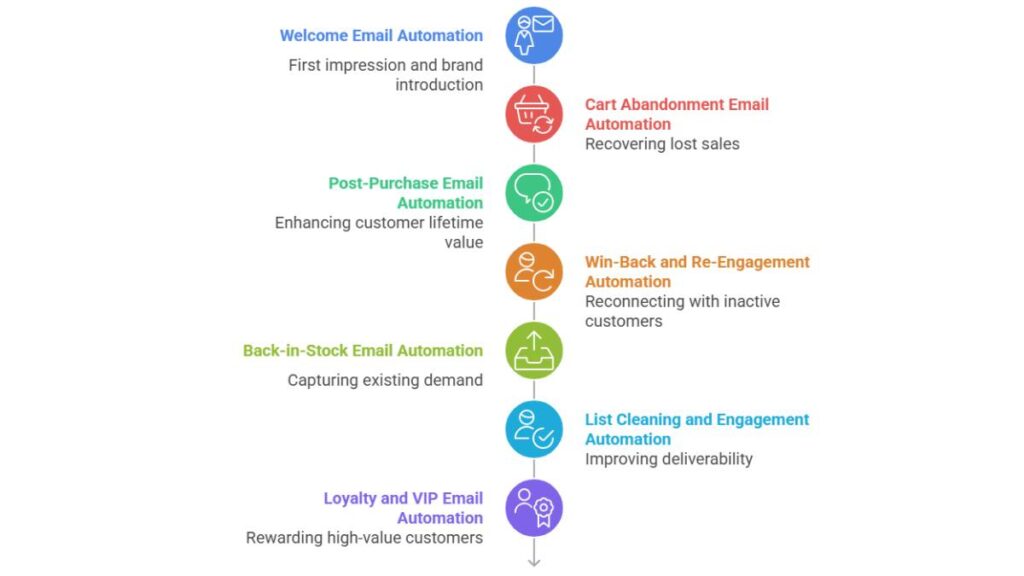
1. Welcome Email Automation for Ecommerce
The welcome sequence sets expectations.
It’s not just a thank-you email. It’s the first impression of the brand in someone’s inbox. That moment carries weight.
A strong welcome sequence introduces brand values, highlights bestsellers, and guides new subscribers toward their first purchase. If a discount was offered at signup, it should be positioned clearly, not buried.
Engagement-driven onboarding works well here. Encourage browsing. Highlight social proof. Build familiarity before pushing urgency too hard.
The welcome flow often drives some of the highest revenue per subscriber. It deserves attention.
2. Cart Abandonment Email Automation
Cart abandonment is normal. It’s not failure.
Timing matters here. The first reminder should go out relatively soon after abandonment. The tone should feel helpful, not accusatory.
Incentive strategies depend on brand positioning. Some stores avoid immediate discounts and focus on reminders. Others introduce a small incentive in the second or third email.
A multi-email sequence performs better than a single reminder. The first nudges. The second reinforces urgency. The third may introduce scarcity or a limited-time incentive.
When structured properly, this flow consistently recovers meaningful revenue.
3. Post-Purchase Email Automation
Post-purchase emails are often underutilized.
Order confirmations should reassure and inform. But they can also introduce related products subtly.
Cross-sell and upsell emails work best when aligned with the original purchase. Suggesting complementary items feels natural. Suggesting unrelated products feels forced.
Review request emails serve two purposes: collecting feedback and reinforcing engagement. Timing is important. Ask after the customer has had time to use the product.
A thoughtful post-purchase sequence increases lifetime value without aggressive selling.
4. Win-Back and Re-Engagement Automation
Not every customer will stay active.
Identifying inactive customers, whether 60, 90, or 120 days since last purchase, creates an opportunity to reconnect.
Incentive strategies here can vary. Some brands offer exclusive discounts. Others highlight new arrivals or improvements.
Personalization makes these campaigns stronger. Referencing past purchases or categories browsed increases relevance.
Not every subscriber will return. The goal is to recover those who still have interest but need a nudge.
5. Back-in-Stock Email Automation
Back-in-stock emails capture existing demand.
When a product sells out, interest doesn’t disappear. It waits.
Notifying subscribers the moment inventory returns creates urgency. These emails often convert well because intent already existed.
Scarcity messaging should be honest. If stock is limited, say so. Authentic urgency converts better than manufactured pressure.
6. List Cleaning and Engagement Automation
Inactive subscribers impact deliverability.
An engagement automation can identify subscribers who haven’t opened or clicked within a defined period. A re-engagement sequence can attempt recovery with refreshed messaging or a compelling offer.
If no response follows, suppressing those contacts protects overall performance.
It’s not about shrinking the list. It’s about strengthening it.
7. Loyalty and VIP Email Automation
High-value customers deserve differentiated treatment.
Exclusive access campaigns. Early product drops. Special tier-based rewards. These emails reinforce appreciation.
Tier-based segmentation allows brands to reward frequent buyers without offering blanket discounts to everyone.
Referral program emails can extend loyalty into acquisition.
Loyalty automation strengthens the long-term revenue base; quietly, but powerfully.
Ecommerce email marketing becomes truly effective when these flows and strategic foundations work together. Not scattered campaigns. Not random discounts. A connected system that moves customers forward; one email at a time.

Enroll Now: Advanced Digital Marketing Course
6 Proven Ecommerce Email Marketing Strategies for Growth
Email can quietly become the highest revenue channel in an ecommerce business, or it can turn into background noise. The difference usually comes down to execution. Not fancy tactics. Just disciplined, thoughtful strategy applied consistently.
Here are six approaches that actually move the needle.
1. Create High-Converting Ecommerce Signup Forms
Most stores treat signup forms like an afterthought. A tiny box in the footer. Maybe a generic “Join our newsletter.”
That doesn’t build a serious list.
High-performing ecommerce brands treat list growth like customer acquisition, because that’s exactly what it is.
A few practical shifts:
- Make the value clear. Not “Sign up for updates.” Try: early access, exclusive drops, private discounts, restock alerts.
- Keep the form simple. Email first. Everything else later.
- Use exit-intent popups carefully. They work, but only when the offer feels relevant.
- Match the incentive to the margin. A 10% discount might convert well, but on low-margin products, it hurts more than it helps.
And one more thing. Don’t chase volume at the expense of intent. A smaller list of buyers will outperform a massive list of coupon hunters every time.
2. Personalize Product Recommendations Using Customer Data
Generic product blasts don’t convert like they used to. Customers expect relevance now. Quietly, without saying it out loud.
Good personalization doesn’t have to be complicated. Start with:
- Recently viewed products
- Related items based on past purchases
- Category affinity (what someone browses most)
- Average order value tiers
A customer who consistently buys premium items shouldn’t receive the same promotion as someone who only purchases during clearance events. That mismatch erodes brand positioning over time.
The key isn’t hyper-complex AI logic. It’s thoughtful segmentation and respecting buying behavior.
3. Use Dynamic Content in Ecommerce Emails
Dynamic blocks allow different subscribers to see different content inside the same campaign. It sounds technical. It isn’t.
Examples:
- Show men’s products to male shoppers and women’s to female shoppers.
- Feature winter gear for colder regions, summer collections elsewhere.
- Display loyalty points balance for repeat customers.
Done well, dynamic content reduces campaign volume while increasing relevance. Instead of sending five separate emails, one intelligently structured email can adapt itself.
Less noise. More impact.
4. Integrate Email Marketing with SMS and Retargeting Ads
Email rarely works alone anymore. The highest-performing ecommerce brands coordinate channels.
For example:
- Abandoned cart email goes out after 1 hour.
- SMS reminder follows at 24 hours (for opt-in users).
- Retargeting ads reinforce product visibility for 3–5 days.
The message doesn’t need to be identical across channels. In fact, it shouldn’t be. Email can educate. SMS can nudge. Ads can remind visually.
The magic happens in consistency. Customers don’t think in channels; they just experience the brand.
5. Leverage Behavioral Triggers to Increase Repeat Purchases
Triggered emails outperform bulk campaigns almost every time. Why? Timing.
Some high-impact behavioral triggers:
- Browse abandonment
- Product replenishment reminders
- Price drop alerts
- Back-in-stock notifications
- Post-purchase cross-sell flows
Replenishment reminders, especially for consumables, are quietly powerful. Sending the reminder too early feels pushy. Too late, and the competitor gets the sale.
Watching purchase intervals and adjusting timing accordingly; that’s where real revenue lives.
6. Optimize Send Time and Frequency for Maximum Revenue
There’s no universal “best time to send.” That advice floats around constantly. It rarely holds up.
Frequency depends on:
- Purchase cycle length
- Product type
- Customer engagement level
- Brand positioning
Luxury brands can’t email daily. Flash-sale brands often need to.
A practical approach:
- Increase frequency for highly engaged subscribers.
- Reduce frequency for low-engagement segments.
- Monitor unsubscribe and spam complaint trends closely.
If unsubscribes spike after every promotional push, that’s a signal. Not necessarily to email less, but to email better.
Benefits of Email Marketing for Ecommerce Brands
Email marketing isn’t exciting. It doesn’t go viral. It doesn’t generate buzz.
But it compounds. And compounding wins.
Boosted Brand Loyalty and Customer Retention
Consistent email communication builds familiarity. Familiarity builds trust.
When customers repeatedly see helpful product recommendations, thoughtful post-purchase follow-ups, and relevant promotions, the brand stops feeling transactional.
Retention isn’t about constant discounts. It’s about staying relevant between purchases.
Cost-Effective Customer Acquisition Channel
Paid ads fluctuate. Costs rise. Algorithms change without warning.
Email doesn’t behave like that.
Once a subscriber is acquired, the marginal cost of sending to them is minimal. That doesn’t mean email is “free”; strategy and execution still matter, but the economics are stable and predictable.
Over time, email reduces dependence on paid acquisition. That stability matters.
Detailed Audience Targeting and Personalization
Email allows deep segmentation:
- Purchase frequency
- Category preference
- Lifetime value
- Engagement level
- Geographic region
Few channels provide this level of precision with owned data. And because the audience is owned, not rented, the relationship feels more direct.
That ownership is a strategic advantage, especially in a privacy-focused landscape.
Measurable ROI and Attribution Tracking
Revenue from email is trackable. Clicks, conversions, order value; it’s all visible.
More importantly, email can influence revenue even when it’s not the final click. Post-purchase education, product education sequences, and replenishment reminders all contribute to lifetime value.
When measured properly, email often accounts for 20–40% of total ecommerce revenue in mature stores. Sometimes more.
Increased Sales Conversion Rates
Subscribers convert at higher rates than cold traffic. That’s not surprising; they’ve already expressed interest.
What matters is nurturing that interest:
- Sending relevant campaigns
- Using triggered automations
- Maintaining list hygiene
A disengaged list drags down performance. An engaged list amplifies it.
Recover Lost Revenue from Abandoned Carts
Cart abandonment is inevitable. Recovery isn’t.
Well-structured cart recovery flows can reclaim 10–20% of otherwise lost revenue. Sometimes higher for high-consideration products.
And here’s the nuance: incentives aren’t always required. A reminder is often enough. Discounts should be strategic, not automatic.
Ecommerce Email Marketing Benchmarks and KPIs
Metrics matter, but context matters more. Benchmarks are directional, not definitive.
Here’s what to watch.
Average Ecommerce Email Open Rates
Open rates vary widely by industry, but many ecommerce brands fall between 20–40%.
Transactional emails are usually much higher. Promotional campaigns fluctuate more.
Open rates are useful, but they’re not the goal. Revenue is.
Click-Through Rate (CTR) Benchmarks
CTR often ranges between 1–5% for ecommerce campaigns.
Low click-through rates typically signal one of three issues:
- Weak subject line alignment with content
- Irrelevant product selection
- Overloaded design with too many options
Sometimes simplifying the layout increases clicks more than rewriting the copy.
Conversion Rate Benchmarks
Conversion rates depend heavily on product price and buying cycle. Lower-ticket items convert more quickly. High-ticket products require more nurturing.
Instead of obsessing over industry averages, compare:
- Campaign-to-campaign performance
- Segment performance
- Automation vs bulk campaign performance
That internal comparison reveals more than generic benchmarks ever will.
Revenue Per Subscriber Metrics
Revenue per subscriber (RPS) is one of the most telling metrics.
It answers a simple question: how much is each email address worth over time?
Increasing RPS doesn’t require aggressive discounting. It often comes from:
- Better segmentation
- Smarter cross-sells
- Improved post-purchase flows
Small lifts here compound significantly.
Deliverability Benchmarks
Deliverability isn’t just about avoiding spam folders. It’s about maintaining sender reputation.
Watch:
- Bounce rates
- Spam complaint rates
- Engagement trends
If engagement drops steadily over time, inbox placement may already be declining.
Proactive list cleaning and re-engagement campaigns help protect long-term performance.
How to Calculate Ecommerce Email Marketing ROI
At its simplest:
ROI = (Revenue generated from email – Email costs) ÷ Email costs
But real evaluation should also consider:
- Customer lifetime value is influenced by email
- Repeat purchase rate
- Reduced paid acquisition dependency
Email rarely shows its full value in a single campaign. Its impact builds quietly, across months, sometimes years.
And that’s the part many brands underestimate.
Done properly, ecommerce email marketing isn’t just another channel. It becomes the backbone of predictable revenue; steady, measurable, and remarkably resilient when everything else feels volatile.
Best Ecommerce Email Marketing Software and Tools
Choosing the right email platform for ecommerce isn’t about picking the most popular name. It’s about finding the system that fits your store’s size, complexity, and growth stage.
An ecommerce brand doesn’t just need a newsletter tool. It needs a revenue engine; something that connects customer behavior, product data, and automation in one place.
You’ll typically see platforms like Klaviyo, Mailchimp, Omnisend, ActiveCampaign, and HubSpot dominating the ecommerce space. They all work, but they don’t all work the same way.
The real difference comes down to depth.
Features to Look for in Ecommerce Email Platforms
At a minimum, your platform should offer:
- Native ecommerce integration (products, order history, customer data sync)
- Advanced segmentation capabilities
- Visual automation builder
- Revenue attribution tracking
- Deliverability monitoring
- Strong reporting dashboards
If your tool can’t tell you how much revenue a specific automation flow generated, that’s a problem. Ecommerce email isn’t about opens and clicks; it’s about dollars.
You also want flexible template systems. Ecommerce emails rely heavily on dynamic product blocks, recommendation widgets, and personalized sections. Static newsletters won’t cut it.
Automation and AI Capabilities
Modern ecommerce email software should allow:
- Behavioral triggers (viewed product, added to cart, purchased, inactive)
- Predictive segmentation (likely to buy, likely to churn)
- Send-time optimization
- Dynamic product recommendations
The more your system can use real customer behavior instead of guesswork, the better your performance becomes. Automation is no longer optional. It’s foundational.
That said, complexity doesn’t always equal results. Some stores perform incredibly well with simple, clean automation flows executed consistently.
Integration with Ecommerce Platforms
Your email platform must integrate seamlessly with platforms like Shopify, WooCommerce, BigCommerce, or Magento.
Without deep integration, you lose:
- Real-time cart data
- Purchase tracking
- Inventory updates
- Customer behavior signals
And without those, automation becomes guesswork.
Scalability for Growing Online Stores
What works at 1,000 subscribers won’t necessarily work at 100,000.
As your list grows, you’ll need:
- Advanced segmentation logic
- Multiple automation branches
- A/B testing at scale
- Strong deliverability infrastructure
- Dedicated IP options (eventually)
Switching platforms mid-growth is painful. So choose something that can scale with you, even if you don’t use every advanced feature on day one.
A good ecommerce email platform should feel like infrastructure, not just a tool you log into occasionally.
Ecommerce Email Marketing vs SMS Marketing: Key Differences
This isn’t an either/or debate. It’s about understanding the strengths of each channel.
Email and SMS play very different roles in ecommerce marketing.
Email is depth.
SMS is immediacy.
When to Use Email vs SMS
Use Email When:
- You’re telling a story
- You’re showcasing multiple products
- You’re educating customers
- You’re sending long-form content
- You’re building brand loyalty
Email gives you space. Design. Rich content. Segmentation flexibility. It’s ideal for lifecycle marketing and retention strategies.
Use SMS When:
- There’s urgency (flash sale, limited drop)
- You need instant visibility
- You’re sending short reminders
- Cart abandonment needs fast follow-up
SMS open rates are typically higher, but it’s a more intimate channel. Overuse it, and customers will opt out quickly.
Email is forgiving. SMS is not.
Combining Email and SMS for Omnichannel Ecommerce Marketing
The smartest ecommerce brands don’t choose one; they orchestrate both.
For example:
- Cart abandonment email goes out at 1 hour
- SMS reminder goes out at 4–6 hours if no purchase
- Final email with incentive within 24 hours
Or:
- New product launch teaser via email
- Drop alert via SMS
Email builds anticipation. SMS triggers action.
When synced properly, the two channels reinforce each other rather than compete.
The key is coordination. Messaging must feel connected, not repetitive. Customers should feel guided, not chased.
How to Improve Ecommerce Email Deliverability
You can write the best email campaign in the world. If it lands in spam, it doesn’t matter.
Deliverability is the invisible foundation of ecommerce email marketing. Most brands only think about it when performance drops. That’s usually too late.
Avoiding Spam Filters
Spam filters evaluate behavior, engagement, and reputation.
To stay out of trouble:
- Avoid aggressive subject lines (“100% FREE!!!”)
- Don’t overload emails with spam-trigger words
- Maintain balanced text-to-image ratios
- Send consistently (not in random bursts)
- Remove inactive subscribers regularly
Engagement matters more than almost anything else. If subscribers consistently open, click, and purchase, inbox providers view you as valuable.
If they ignore you repeatedly, your placement suffers.
Domain Authentication (SPF, DKIM, DMARC)
This is non-negotiable.
You need proper authentication protocols set up:
- SPF (Sender Policy Framework)
- DKIM (DomainKeys Identified Mail)
- DMARC (Domain-based Message Authentication, Reporting & Conformance)
These prove to inbox providers that your emails are legitimate and authorized.
If you’re unsure whether these are configured correctly, check immediately. Many ecommerce brands skip this step and unknowingly damage deliverability from day one.
Maintaining Sender Reputation
Your sender reputation is influenced by:
- Bounce rates
- Spam complaints
- Unsubscribe rates
- Engagement levels
- Sending volume consistency
Sudden spikes in sending volume can trigger filtering. Gradual scaling is safer.
Also, avoid purchased lists at all costs. They destroy reputation faster than almost anything else.
Warm up new domains slowly. Monitor complaint rates. Keep list hygiene tight.
Engagement-Based List Management
This is where experienced ecommerce marketers separate themselves.
Not every subscriber deserves the same sending frequency.
Segment based on engagement:
- Highly engaged – frequent campaigns
- Moderately engaged – normal frequency
- Inactive – re-engagement flow
- No engagement after attempts – sunset policy
Sunsetting inactive subscribers may feel counterintuitive. But sending to unengaged contacts damages long-term performance.
Healthy lists outperform large lists.
Deliverability isn’t a technical afterthought. It’s a strategic discipline. Protect it, and your revenue engine stays stable. Ignore it, and everything downstream starts to weaken.
And in ecommerce, small deliverability losses compound into significant revenue gaps over time.
Conclusion:
Every few years, someone declares email “dead.”
Then the revenue reports come in.
And email quietly sits there, driving 20, 30, sometimes 40 percent of total store revenue without demanding daily creative burnout or unpredictable ad budgets.
Here’s the uncomfortable truth most brands eventually learn: paid acquisition gets attention, but email builds the business.
Social algorithms shift. CPMs climb. Targeting options shrink. Email, on the other hand, is owned. Permission-based. Built on first-party data you collected yourself. That changes the economics completely.
But let’s be honest; email only becomes the highest-ROI channel when it’s treated like infrastructure, not a newsletter.
The brands seeing real returns are doing a few things differently:
- Automation runs in the background at all times
- Segmentation is based on behavior, not just demographics
- Product recommendations aren’t random; they’re contextual
- Lists are cleaned regularly
- Reporting focuses on revenue, not vanity metrics
Automation, especially, is where the shift happens. Welcome flows, cart recovery, post-purchase cross-sells, win-back campaigns; these aren’t “nice to have.” They’re revenue systems. Once built properly, they compound.
Personalization adds another layer. Not the superficial kind (“Hey {First Name}”). The real kind. Browsing behavior. Purchase timing. Category affinity. Engagement levels. When emails reflect what customers actually care about, conversions feel almost frictionless.
Looking ahead and beyond, predictive segmentation and smarter send-time optimization are becoming normal. Not experimental. Brands that lean into data and respect subscriber attention will continue to outperform.
And that’s the core idea.
Email isn’t exciting. It’s effective.
It doesn’t rely on trends. It runs on relationships.
And for ecommerce brands focused on sustainable profit rather than short-term spikes, it remains the most stable growth lever available.
FAQs: About Ecommerce Email Marketing
What are common mistakes in ecommerce email marketing?
Most mistakes come down to over-sending and under-segmenting. Brands blast promotions to everyone, ignore behavioral data, and let inactive subscribers pile up for months. Weak automation is another issue. If welcome flows and cart recovery aren’t optimized, revenue leaks quietly in the background.
How often should ecommerce brands send marketing emails?
Frequency depends on engagement and buying cycle, not a fixed rule. Weekly works for many stores, but highly engaged subscribers can handle more. Inactive segments should receive less. Watch unsubscribe spikes and click patterns closely. When relevance drops, frequency becomes the problem.
What are the most important ecommerce email KPIs?
Revenue per email and overall conversion rate matter most because they tie directly to profit. Click-through rate helps evaluate content performance. Open rate is useful directionally, but not definitive anymore. Long term, customer lifetime value tells the real story.
How can I prevent ecommerce emails from going to spam?
Strong authentication setup is essential, but engagement matters just as much. Sending consistently, removing inactive subscribers, and avoiding sudden volume spikes protect deliverability. Spam filters increasingly reward relevance. When subscribers interact regularly, inbox placement improves naturally.
What is the difference between ecommerce email marketing and traditional email marketing?
Ecommerce email marketing is deeply tied to purchasing behavior. It uses automation, transactional messaging, and revenue attribution. Traditional email marketing often focuses on newsletters or brand updates. Ecommerce campaigns revolve around lifecycle stages and measurable sales outcomes.
How can A/B testing improve ecommerce email revenue?
Small improvements add up. Testing subject lines can lift open rates. Testing product blocks or call-to-action placement can improve conversions. Over time, incremental gains across automated flows create meaningful revenue increases. Assumptions are expensive. Testing reduces guesswork.
Is ecommerce email marketing still effective?
Yes, particularly because first-party data has become more valuable. As ad platforms face tracking limitations and rising costs, owned channels provide stability. Email continues delivering predictable revenue when supported by smart segmentation and automation.
How much revenue can ecommerce email marketing generate?
For many ecommerce brands, email contributes between 20% and 40% of total revenue once automation is mature. Cart recovery and post-purchase sequences often become top performers. Revenue per subscriber varies by industry, but consistent engagement drives steady growth.
What is the best frequency for ecommerce email campaigns?
There isn’t a universal answer. Weekly campaigns are common, but engagement-based sending performs better long-term. Promotional bursts can work during launches or sales events, though constant discounts reduce impact. Monitoring subscriber behavior usually reveals the right rhythm.
What is the difference between transactional and promotional ecommerce emails?
Transactional emails confirm actions such as purchases or shipping updates. They typically achieve higher open rates because customers expect them. Promotional emails focus on offers or product discovery. Transactional messages can include subtle cross-sell elements without distracting from their primary purpose.
How long should an ecommerce marketing email be?
Length should match the objective. Product-focused campaigns often benefit from concise, visual-heavy layouts. Story-driven launches may require more context. The key is clarity. If the value is obvious and the next step is easy to take, length becomes secondary.
What are the best subject lines for ecommerce email marketing?
Clear, relevant subject lines outperform clever but vague ones. Personalization can help when meaningful, not forced. Urgency works when genuine. Testing emojis versus plain text is worthwhile because audience preferences vary. Over time, data reveals patterns specific to each brand.
How do I grow my ecommerce email list faster?
High-visibility signup forms and well-timed popups drive growth. Discounts attract quick signups, though value-based incentives often produce better long-term subscribers. Promoting offers through social channels and paid traffic can accelerate list building while strengthening first-party data assets.
How does personalization improve ecommerce email performance?
Personalization increases relevance, which increases clicks. Dynamic product recommendations based on browsing and purchase history typically outperform generic campaigns. Behavioral segmentation ensures customers receive content aligned with their interests. Over time, that consistency builds stronger repeat purchasing behavior.
What metrics matter most in ecommerce email marketing?
Revenue-focused metrics deserve priority. Revenue per email, overall conversion rate, and lifetime value show real business impact. Click-through rate helps measure engagement quality. Monitoring unsubscribe and spam complaints protects long-term channel health.
Can small ecommerce businesses succeed with email marketing?
Absolutely. Even basic automation, welcome sequences, and cart recovery can generate meaningful revenue. Smaller lists often see stronger engagement when nurtured properly. Email scales efficiently, allowing small brands to compete without relying entirely on paid ads.
How does ecommerce email marketing support customer retention?
Retention grows through consistent, relevant communication after purchase. Post-purchase education, cross-sell recommendations, and loyalty offers encourage repeat buying. Win-back campaigns re-engage dormant customers before they disappear entirely. Done thoughtfully, email strengthens long-term customer relationships.