

Social media content has quietly turned into a volume game. Not in an obvious way at first, but over time, the expectations changed. More posts, more variations, faster turnaround. Most teams don’t struggle with ideas. The real friction comes from turning those ideas into actual posts consistently, especially across platforms that all expect slightly different formats. This is exactly where an AI social media post generator becomes useful. Not as a replacement for thinking, but as a way to remove the slowest part: getting started. This blog breaks down how these tools actually work, where they help most, which platforms stand out, and how to use them without losing the human side that makes content worth reading.
Table of Contents
Introduction:
Social media content used to be slower. A few posts per week were enough. Brands had time to think, write, design, review, and publish. That reality doesn’t exist anymore.
Today, visibility depends on consistency. Not occasional bursts of activity, but steady presence. Daily posts. Sometimes multiple posts per day. Across platforms that all behave differently.
That shift has changed how content gets created.
What used to be a creative task is now also an operational one.
The growing demand for faster content creation
The pressure comes from everywhere: algorithms, competition, and audience expectations.
Most brands are now publishing across several platforms at once:
- Instagram for reach and brand visibility
- LinkedIn for authority and professional positioning
- X (Twitter) for real-time conversations
- Facebook for community and retention
- Short-form video platforms for discovery
Each platform needs its own format, tone, and timing. A single campaign can easily turn into 20–30 individual pieces of content when adapted properly.
That creates three real challenges.
First, frequency.
Posting consistently is no longer optional. Inconsistent brands slowly disappear from feeds, replaced by those showing up regularly.
Second, speed.
Trends move quickly. A content idea has a short window where it’s relevant. If creation takes too long, the opportunity passes.
Third, creative fatigue.
Even experienced marketers run out of fresh ways to say the same thing. New angles, new hooks, new variations; it adds up.
This is where automation began to move from “nice to have” to necessary.
Not to replace creativity. But to support the scale, modern social media demands.
What is an AI social media post generator?
An AI social media post generator is a system designed to create written content for social platforms automatically based on a simple input.
That input could be:
- A topic
- A product description
- A campaign idea
- A blog post
- Or even just a short prompt
From there, it produces ready-to-publish content such as:
- Captions
- Full posts
- Content variations
- Hashtag suggestions
- Sometimes even visuals
The key difference is speed and flexibility. What used to take 20–30 minutes to draft can now be generated in seconds and refined quickly.
But the real value isn’t just speed. It’s momentum.
Instead of staring at a blank screen, there’s something to work with immediately. A starting point. A draft that can be shaped, adjusted, and aligned with brand voice.
This removes one of the biggest bottlenecks in social media: getting started.
It’s also important to distinguish this from traditional scheduling tools.
Scheduling tools help with publishing. They organize when content goes live.
Post generators help with creation. They produce the content itself, and in some cases can even convert written posts into text to speech narration for reels, shorts, or video captions.
Many modern platforms combine both, but the core function of a post generator is simple: turn ideas into publishable content faster.
Why AI social media content generation is becoming essential
The scale of content required today makes manual-only workflows difficult to sustain long-term.
Several shifts have accelerated this change.
Content volume has increased dramatically
A single brand might need:
- Daily posts
- Multiple platform variations
- Campaign-specific content
- Evergreen content
- Reactive, trend-based posts
This isn’t occasional work anymore. It’s continuous.
Short-form and real-time content dominate attention
Audiences expect fresh, relevant content constantly. Especially on platforms driven by discovery algorithms.
Delays reduce reach. Speed increases visibility.
Efficiency has become a competitive advantage
Brands that can create faster can:
- Test more ideas
- Learn what works sooner
- Adapt messaging quickly
- Stay visible consistently
Meanwhile, slower workflows limit experimentation.
Consistency builds familiarity and trust
Audiences don’t remember brands that post occasionally. They remember those who show up regularly with useful, relevant, or interesting content.
Consistency compounds over time.
That’s ultimately why content generation systems have become part of modern marketing workflows. Not because creativity disappeared, but because scale increased.
The role shifted from writing everything from scratch to directing, refining, and optimizing content efficiently.
How an AI Social Media Post Generator Works
At a surface level, it feels simple. You enter an idea, and a post appears.
But behind that simplicity is a structured process designed to turn basic inputs into coherent, platform-ready content.
Understanding this process helps in getting better results and using it more effectively.
The technology behind AI content generation
Social media post generators rely on language models trained on large amounts of written content.
Their purpose is to understand patterns in language, including:
- Sentence structure
- Tone variations
- Context and meaning
- How ideas are expressed naturally
Instead of copying existing content, they learn patterns: how captions are structured, how hooks work, how engagement is encouraged.
This allows them to generate original text that feels familiar and readable.
Several underlying components make this possible:
Natural language processing (NLP)
This enables the system to interpret input prompts and understand intent. For example, recognizing whether a prompt is promotional, educational, or conversational.
Pattern recognition from training data
The system learns how different types of posts are typically written: short captions, longer posts, question-based engagement content, and more.
Predictive text generation
Based on the prompt, it predicts the most logical and natural sequence of words that follow.
This is why prompt clarity matters. The more specific the input, the more aligned the output tends to be.
It’s not guessing randomly. It’s generating based on learned patterns.
The post generation process is explained step-by-step
While the experience feels instant, there’s a clear sequence behind it.
Step 1: Input prompt or topic selection
This is the foundation. The prompt provides direction.
Examples of inputs include:
- “Instagram post promoting a digital marketing course.”
- “LinkedIn post about productivity tips for founders.”
- “Caption for product launch announcement”
The prompt defines intent, tone, and objective.
Step 2: Content generation and structuring
Based on the prompt, the system generates structured content. This may include:
- A hook to capture attention
- Supporting information or messaging
- A conclusion or call-to-action
The structure often mirrors patterns known to perform well on social platforms.
Step 3: Tone and style alignment
Content can be adjusted to match different tones, such as:
- Professional
- Casual
- Educational
- Promotional
- Conversational
This ensures content fits the platform and audience expectations.
Step 4: Refinement and editing
This is where human input remains important.
Minor adjustments improve:
- Brand alignment
- Clarity
- Specificity
- Authenticity
The generated content becomes a draft that can be quickly refined rather than built from scratch.
Step 5: Publishing or scheduling
Once finalized, content can be published immediately or scheduled as part of a broader content calendar.
This completes the workflow from idea to published post.
Types of content AI can generate
The range of content that can be created is broader than many expect.
It’s not limited to captions alone.
Social media captions
Short, platform-specific captions designed for engagement and readability.
Full social media posts
Longer, structured posts are often used on platforms like LinkedIn and Facebook.
These may include:
- Hooks
- Value-driven insights
- Structured messaging
Hashtags and emojis
Relevant hashtag suggestions based on topic and platform.
Emojis are used strategically to improve readability and tone.
Content variations
Multiple versions of the same idea with different angles.
This is especially useful for testing which version performs best.
Visual content support
Some systems can generate accompanying visuals or suggest design concepts that align with the post.
This helps ensure consistency between text and visuals. Understanding how these systems work changes how they’re used. The goal isn’t to automate creativity entirely. It’s to remove friction from the creation process, so more time can be spent refining ideas, improving messaging, and focusing on strategy instead of repetitive drafting.
Key Benefits of Using an AI Social Media Post Generator
Most teams don’t struggle with ideas. They struggle with execution. There’s always something to say: product updates, insights, lessons, launches, opinions. The real bottleneck is turning those thoughts into actual posts, consistently, without draining time and energy.
This is where post generators quietly change the workflow, not by replacing thinking, but by removing friction.
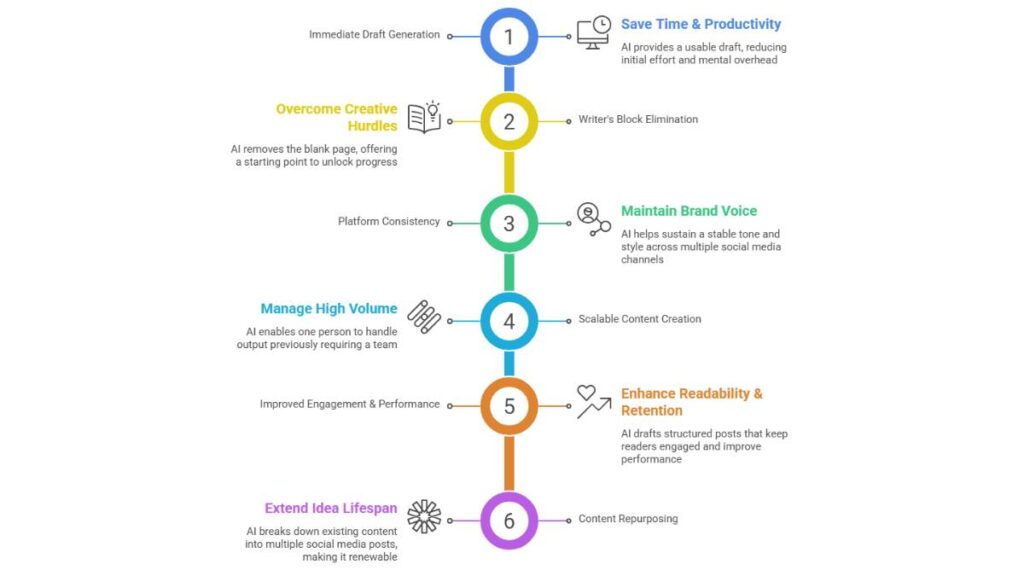
Save time and increase productivity
Content creation has a hidden cost. It’s not just writing. It’s switching contexts, staring at drafts, rewriting the same sentence five times, adjusting tone, then second-guessing everything.
That mental overhead adds up fast.
Even experienced marketers feel it. Especially when managing multiple platforms.
Post generators reduce that initial effort. Instead of starting from zero, there’s a usable draft almost immediately. Something concrete to react to.
That changes the dynamic.
Editing is easier than inventing. Always has been.
This shift allows teams to:
- Spend more time refining ideas instead of forcing them
- Produce content faster without lowering standards
- Keep momentum without creative fatigue setting in
The time savings compound over weeks and months. What used to feel heavy becomes routine.
Eliminate writer’s block completely
Writer’s block rarely means there’s nothing to say. It usually means there’s too much pressure to say it perfectly.
That pressure slows everything down. The blank page becomes the problem.
Post generators remove that blank page. There’s always a starting point. Maybe not perfect, maybe not final, but enough to unlock progress.
And once momentum starts, clarity follows.
This is especially useful when:
- Posting frequently
- Managing multiple content themes
- Or simply having an off day creatively
Some drafts will need heavier editing. Others might be usable almost immediately. It varies. But the important part is this: content keeps moving.
No stalls. No long gaps.
Consistency becomes easier to sustain.
Maintain consistency across platforms
Consistency is one of those things everyone talks about, but few sustain long-term. Not because people don’t care. Because it’s exhausting to maintain manually.
Social media doesn’t reward occasional effort. It rewards steady presence.
Post generators help maintain that rhythm. Content gets created even on busy days. Even when attention is elsewhere.
That stability matters.
Over time, consistent posting builds familiarity. Audiences begin to recognize tone, style, and perspective. Trust builds gradually.
Not from one viral post. From repeated exposure.
There’s also another layer: voice consistency.
When content is generated from structured prompts and refined properly, tone becomes more stable. Less fluctuation. Less randomness.
That stability strengthens brand identity.
Scale content creation efficiently
Scaling content used to mean hiring more writers. More people, more coordination, more complexity.
Now scaling looks different.
One person can manage output that previously required a small team. Not because effort disappeared, but because the most repetitive part, drafting variations, became faster.
This becomes critical when managing:
- Multiple clients
- Multiple product lines
- Multiple platforms
Each requires its own content stream.
Without scalable workflows, quality drops or consistency breaks. Sometimes both.
Post generators help absorb that volume without overwhelming teams.
They also make experimentation easier. Testing different hooks, angles, or formats doesn’t feel like extra work anymore.
That flexibility leads to better performance over time. Because content evolves faster.
Improve engagement and performance
Engagement often comes down to structure. How the post begins. How it flows. How easy it is to read.
Small things matter more than expected.
Post generators are surprisingly effective at producing structured drafts. They follow patterns that keep readers moving through the content.
This improves readability immediately.
From there, human refinement adds depth. Specific examples. Sharper positioning. Stronger clarity.
Together, this combination tends to perform better than rushed manual drafts.
Not because it’s automated. Because it’s intentional.
Better structure leads to better retention. Better retention leads to better engagement.
Repurpose existing content easily
Most brands are sitting on valuable content already. Blog posts. Internal insights. Customer conversations. Product thinking.
The challenge isn’t creating ideas. It’s converting those ideas into social formats.
Repurposing manually takes effort. Each piece needs rewriting, shortening, and restructuring.
Post generators simplify this step.
Long-form content can be broken down into multiple posts. Different angles. Different formats. Different tones.
This extends the lifespan of existing ideas.
Instead of using content once, it becomes a source of ongoing material.
That efficiency changes everything. Content stops being scarce.
It becomes renewable.
Core Features to Look for in an AI Social Media Post Generator
Not every post generator delivers real value. Some produce content that feels generic. Others lack flexibility.
The difference usually comes down to features and how well those features support actual workflows, not just surface-level generation.
AI caption and post generation
This is the foundation. The ability to turn rough ideas into structured posts quickly.
But quality matters here.
Good generators produce content that feels natural. Not stiff. Not overly formal. Just readable and usable.
They should be capable of generating:
- Short captions when brevity matters
- Longer posts when depth is needed
- Structured messaging with clear flow
The output shouldn’t feel finished immediately. It should feel usable. There’s a difference.
Usable drafts accelerate creation. Finished drafts often feel rigid.
Flexibility is what makes the difference long-term.
Platform-specific optimization
Each platform has its own rhythm. Its own expectations.
LinkedIn readers tolerate longer posts. Instagram audiences prefer tighter, more visually friendly captions. X rewards conciseness.
Trying to use identical posts everywhere rarely works well.
Post generators should adapt tone and structure depending on the platform.
This reduces manual rewriting.
More importantly, it makes content feel native to each environment. That improves how audiences respond.
Content that fits the platform always performs better than content that feels imported.
Hashtag and emoji generation
Hashtags still play a role in discoverability. Emojis still influence readability.
But both need restraint.
Too many hashtags look desperate. Too many emojis look forced.
Good generators suggest balanced usage. Relevant tags, not random ones. Emojis are used to enhance clarity, not decorate unnecessarily.
These small details improve presentation.
And presentation influences perception more than most realize.
Visual and image generation capabilities
Social media is visual first. Text supports visuals, not the other way around.
Having visual alignment matters.
Some generators support image creation or at least visual suggestions tied to the post. This reduces the disconnect between caption and design.
When text and visuals reinforce each other, content feels intentional. Stronger. More cohesive.
Without alignment, even good captions lose impact.
Visual context completes the message.
Content customization options
No brand wants interchangeable content. Voice matters. Tone matters. Perspective matters.
Customization allows adjustment of:
- Tone: formal, conversational, sharp, educational
- Length: concise or expanded
- Style: direct, storytelling, instructional
This ensures content reflects brand identity instead of generic templates.
The goal isn’t automation for its own sake. It’s controlled with efficiency.
Customization keeps that balance intact.
Content repurposing capabilities
Repurposing is often overlooked, but it’s one of the most valuable capabilities.
A single blog post can produce:
- Multiple LinkedIn posts
- Several Instagram captions
- Short-form variations
This multiplies output without multiplying effort.
Repurposing ensures ideas reach audiences in different formats. Not everyone consumes content the same way.
This flexibility increases reach without increasing workload significantly.
Scheduling and publishing integration
Creation is only half the workflow. Publishing matters equally.
Scheduling integration allows content to be prepared ahead of time. Planned. Organized.
This prevents last-minute scrambling.
Consistency improves naturally when content is scheduled in advance. Posting becomes predictable instead of reactive.
That stability strengthens overall content presence.
Multi-language support
For brands reaching diverse audiences, language flexibility matters.
Being able to generate posts in different languages allows messaging to remain relevant across regions.
Localization feels more authentic than direct translation. It respects audience context.
This becomes increasingly important as brands grow beyond single-region audiences.
It ensures content connects properly; not just linguistically, but culturally.
The real value of post generators isn’t just speed. It’s sustainability. They make consistent, high-quality content creation possible without exhausting creative energy. Over time, that consistency becomes a serious competitive advantage.
Best AI Social Media Post Generators
There’s no shortage of social media tools claiming to simplify content creation. But in practice, most fall into one of three categories: content generators, scheduling platforms, or hybrid systems that try to combine both.
The right choice depends less on features and more on how content actually gets created and managed day-to-day. Some tools are better for fast caption creation. Others are stronger at managing multiple accounts or supporting team workflows.
Below are platforms that consistently stand out; not because they promise the most, but because they solve real bottlenecks.
1. All In One SEO (AIOSEO)
Originally built for website optimization, AIOSEO has expanded into content generation, including social media captions. It’s especially useful for teams already managing website content alongside social distribution.
Its biggest strength is alignment. Social posts can stay consistent with website messaging, product positioning, and content themes.
Key features
- Caption generation aligned with website content
- Content suggestions based on existing articles or pages
- Metadata and social preview optimization
- Easy integration with website publishing workflows
Best use cases
- Brands managing blogs and social media together
- Content teams focused on repurposing website content
- Businesses prioritizing consistency between web and social messaging
Pros
- Strong alignment between website and social content
- Efficient repurposing of existing content
- Useful for long-term content ecosystems
Cons
- Less focused on advanced social-specific workflows
- Limited depth compared to dedicated social media platforms
2. ChatGPT
ChatGPT has become one of the most widely used platforms for social media content creation. Its flexibility is the main advantage. It can generate captions, full posts, variations, and even complete content calendars with the right input.
It doesn’t impose rigid workflows. That freedom makes it especially useful for marketers who want control over tone, structure, and messaging.
Strengths for content generation
- Highly adaptable to different writing styles
- Generates multiple content variations quickly
- Handles both short captions and long-form posts
- Effective for brainstorming and ideation
Best prompt strategies
Results improve significantly when prompts include:
- Target audience
- Platform
- Tone (educational, conversational, authoritative, etc.)
- Content objective (engagement, awareness, conversion)
The clearer the input, the stronger the output.
3. SocialBee
SocialBee focuses heavily on workflow organization. It’s not just about generating posts, but managing content categories, scheduling patterns, and long-term consistency.
This makes it particularly useful for teams running structured content strategies.
Automation and scheduling capabilities
- Category-based content scheduling
- Automated posting queues
- Content recycling for evergreen posts
- Multi-platform publishing
This structure reduces the need to constantly plan content manually.
Best suited for
- Agencies managing multiple clients
- Businesses with defined content themes
- Teams prioritizing structured scheduling
4. Buffer
Buffer has always been known for simplicity. Its interface is clean, its workflow is straightforward, and it doesn’t overwhelm users with unnecessary complexity.
Its post generation capabilities integrate naturally with its scheduling system.
AI assistant and scheduling integration
- Caption generation is built into the publishing workflow
- Simple post scheduling across platforms
- Clear content calendar visibility
- Easy editing and refinement before publishing
This balance between creation and scheduling makes it practical for small teams.
Best suited for
- Small businesses
- Solo creators
- Teams prioritizing ease of use over complexity
5. Predis.ai
Predis.ai stands out because it combines text generation with visual content creation. This makes it particularly effective for platforms where visuals drive performance, like Instagram.
Instead of treating captions and visuals separately, it connects both parts of the post.
AI caption and image generation capabilities
- Caption generation tailored to visual formats
- Automatic image generation aligned with content
- Hashtag recommendations based on post topic
- Creative variations for testing different angles
This makes it useful for teams prioritizing visual-first platforms.
Best suited for
- Instagram-focused brands
- Visual content creators
- Businesses prioritizing design and presentation
6. HubSpot
HubSpot’s strength lies in integration. Social media content connects directly with broader marketing workflows, including email, CRM, and customer journeys.
This creates alignment between social content and the overall marketing strategy.
AI features for social media marketers
- Caption generation within campaign workflows
- Content scheduling across multiple platforms
- Performance tracking tied to broader marketing goals
- Centralized marketing management
This makes it particularly useful for businesses managing full marketing funnels.
Best suited for
- Marketing teams managing integrated campaigns
- Businesses focused on customer lifecycle marketing
- Organizations needing centralized control
7. Hootsuite
Hootsuite is one of the most established social media management platforms. Its strength lies in managing scale.
It’s built for teams handling large volumes of content across multiple accounts.
AI writing and publishing features
- Caption generation within scheduling workflows
- Bulk scheduling capabilities
- Multi-account management
- Detailed content calendar visibility
It helps reduce operational complexity when managing high content volume.
Best suited for
- Agencies
- Enterprise teams
- Brands managing multiple social accounts
8. Flick
Flick focuses heavily on caption quality and hashtag optimization. It’s particularly useful for creators and brands that rely on organic reach.
Its strength is precision rather than scale.
Hashtag and caption generation strengths
- Relevant hashtag recommendations
- Caption generation tailored to audience tone
- Content idea suggestions
- Optimization for discoverability
It helps improve content visibility without relying purely on paid promotion.
Best suited for
- Creators building organic reach
- Instagram-focused brands
- Personal brands and influencers
9. SocialPilot
SocialPilot offers a strong balance between affordability and functionality. It supports both content creation and scheduling without becoming overly complex.
This makes it accessible while still capable.
AI post generation and scheduling features
- Caption generation for multiple platforms
- Bulk scheduling capabilities
- Multi-account management
- Content calendar organization
It supports steady, scalable posting without requiring heavy operational overhead.
Best suited for
- Growing businesses
- Agencies with moderate client volume
- Teams needing balance between cost and capability
Choosing the Right Tool Depends on Workflow, Not Just Features
Some teams need faster caption generation. Others need structured scheduling. Others need scalability across multiple clients.
There isn’t a universal “best” platform. The right choice depends on how content gets created and managed.
The most effective approach is choosing tools that remove friction from existing workflows, not tools that force entirely new ones.
When content creation becomes easier to sustain, consistency improves naturally. And consistency is what drives long-term growth.

Enroll Now: Advanced Digital Marketing Course
How to Use an AI Social Media Post Generator
Using an AI social media post generator isn’t complicated. The mechanics are simple. What makes the difference is how clearly the input is defined and how carefully the output is refined.
The process works best when treated as a starting point, not a final destination.
Step 1: Choose your platform and content goal
Every platform behaves differently. A LinkedIn post doesn’t follow the same rhythm as an Instagram caption. Twitter/X rewards brevity. Instagram rewards emotion and relatability. LinkedIn rewards clarity and insight.
Before generating anything, decide:
- Where the post will be published
- What the post is supposed to achieve
- Who it’s meant to reach
Common goals include:
- Driving engagement
- Educating the audience
- Promoting a product or service
- Building authority
- Starting conversations
Without a clear objective, even well-written content can fall flat.
Step 2: Enter a clear and specific prompt
This is where most people get average results. Vague input produces vague output. Specific input produces sharper, more usable content.
Strong prompts usually include:
- Topic or idea
- Target audience
- Platform
- Tone (educational, bold, conversational, direct, etc.)
- Desired outcome
For example, instead of:
Write a post about email marketing
A more effective input would look like:
Write a LinkedIn post explaining why most email campaigns fail, targeting startup founders, with a confident and educational tone.
That level of clarity gives direction. And direction improves quality.
Step 3: Generate multiple post variations
One version is rarely enough. The real advantage comes from generating options.
Different variations help reveal:
- Different hooks
- Different framing angles
- Different emotional tones
Sometimes the second version works better than the first. Sometimes the fourth version has the strongest opening line. It’s unpredictable. But having options makes it easier to choose what actually feels right.
Step 4: Customize and refine the output
This step matters more than people expect.
Raw output often gets the structure right, but small refinements make it sound natural and aligned with the brand voice.
Look for opportunities to:
- Adjust phrasing to match your tone
- Remove anything generic or unnecessary
- Add specificity where needed
- Improve the opening hook
- Make the ending stronger or more actionable
Even small edits can dramatically improve how the post feels.
Step 5: Add visuals, hashtags, and finishing touches
Content rarely exists in isolation. Supporting elements improve visibility and engagement.
Enhancements may include:
- Relevant hashtags to improve discoverability
- Platform-appropriate emojis (when appropriate)
- Images, carousels, or short videos
- Formatting adjustments for readability
Formatting is often overlooked. Short paragraphs. Clean spacing. Easy scanning. These small details increase retention.
Step 6: Publish immediately or schedule for later
Once the post is ready, it can either be published instantly or scheduled as part of a broader content calendar.
Scheduling offers important advantages:
- Maintains consistent posting frequency
- Reduces last-minute pressure
- Helps balance different types of content
Consistency builds familiarity. Familiarity builds trust. And trust drives long-term growth.
Types of Social Media Posts You Can Create with AI
One of the biggest advantages is flexibility. Content doesn’t need to follow a single format. Different post types serve different purposes, and the strongest strategies use a mix.
Here are the most effective categories.
Promotional posts
These posts focus on products, services, or offers. But effective promotional content doesn’t feel aggressive. It feels useful and relevant.
Strong promotional posts often:
- Focus on outcomes, not just features
- Address a specific problem
- Highlight a clear benefit
Direct selling works best when it feels aligned with the audience’s needs.
Educational posts
Educational content builds authority. It positions the brand as a source of insight, not just promotion.
Examples include:
- Tips and frameworks
- Industry observations
- Step-by-step breakdowns
- Lessons learned from experience
This type of content builds long-term credibility.
Story-driven posts
Stories create emotional connection. They make content feel human and relatable.
This can include:
- Lessons from failures
- Behind-the-scenes insights
- Contrarian observations
- Unexpected realizations
Story-based posts tend to hold attention longer.
Engagement-focused posts
These posts invite interaction. They encourage comments, opinions, and participation.
Common formats include:
- Questions
- Poll-style prompts
- Opinion-based statements
- “Agree or disagree” posts
Engagement signals increase visibility organically.
Product launch posts
Launching something new requires clarity and excitement.
Effective product launch posts typically include:
- What’s new
- Why it matters
- Who it’s for
- What problem does it solves
Clarity removes friction. People engage faster when they immediately understand the value.
Personal brand posts
These posts focus on perspective. Not just information, but interpretation.
They often include:
- Opinions about industry trends
- Lessons learned
- Observations about common mistakes
- Insights gained over time
This builds authority beyond products or services.
Carousel captions
Carousels require captions that support the visual narrative.
Strong carousel captions usually:
- Reinforce the main idea
- Add additional context
- Encourage users to swipe
- End with a call to action
They work as an extension of the visual content.
Video captions and short-form descriptions
Video content moves fast. Captions provide context and increase retention.
Effective captions often:
- Reinforce the key message
- Add clarity
- Include keywords naturally
- Encourage interaction
This improves overall performance.
Best Practices for Using AI to Generate Social Media Posts
Results vary widely depending on how the system is used. Some approaches produce generic content. Others produce sharp, distinctive posts that feel intentional.
The difference comes down to process.
Write clear, focused prompts
Clarity improves output quality immediately.
Include:
- Target audience
- Platform
- Tone
- Goal
Ambiguity leads to average results. Specificity leads to stronger structure and messaging.
Always review and edit before publishing
Even strong outputs benefit from refinement.
Editing allows you to:
- Improve clarity
- Remove unnecessary phrases
- Strengthen the opening
- Align with brand voice
Publishing without editing often results in content that feels slightly off.
Maintain a consistent brand voice
Consistency matters more than perfection.
Over time, audiences become familiar with tone, phrasing, and perspective. Sudden shifts weaken recognition.
To maintain consistency:
- Use a similar tone across posts
- Avoid sudden stylistic changes
- Refine posts to match your existing voice
Consistency builds identity.
Avoid over-automation
Efficiency is valuable. But over-automation creates distance.
Content performs best when it feels intentional and thoughtful. Not mass-produced.
Balance matters.
Use automation to accelerate creation. But keep human judgment in the loop.
Combine speed with strategic thinking
Speed alone doesn’t create results. Strategy does.
Before generating posts, define:
- Content themes
- Audience priorities
- Messaging direction
This ensures content stays aligned with larger goals.
Test different variations and learn from performance
Some posts perform well. Others don’t. That’s normal.
Testing different angles helps identify what resonates most.
Experiment with:
- Different hooks
- Different tones
- Different content formats
- Different posting times
Patterns emerge over time. Those patterns improve future content decisions.
Used correctly, AI social media post generators don’t replace creative thinking. They remove friction. They accelerate execution. And they make consistency easier to sustain, which is often the hardest part of social media growth.
Common Mistakes to Avoid When Using AI Social Media Generators
AI makes publishing easier. That’s obvious within the first few uses. What’s less obvious is how easy it becomes to lower your own standards without realizing it.
The danger isn’t bad content. It’s average content. The kind that looks fine, reads fine… and disappears without impact.
Most of the mistakes come from treating AI like a replacement instead of a starting point.
Using generic prompts
When the input is vague, the output has nothing solid to work with. It fills the gaps with safe language. Predictable structure. Things that sound correct but don’t carry weight.
Social media rewards specificity. Sharp angles. Clear intent.
Instead of asking for a post about productivity, narrowing it down changes everything. For example, why most productivity advice fails. Or a mistake teams repeat when scaling content. That kind of direction gives the post a backbone.
Without that, it just floats.
Publishing without editing
This one shows up more often than expected. A post gets generated, looks clean, and goes out immediately.
But generated content often carries small tells. Slightly formal phrasing. Extra words where fewer would feel stronger. Sometimes the tone drifts halfway through.
Editing fixes this quickly. Not a full rewrite. Just tightening. Removing anything that feels unnecessary. Making sure the message lands cleanly.
It’s a small step. But it changes how the content is perceived.
Ignoring brand voice
Every brand settles into a voice over time. Some are direct. Some lean conversational. Others keep things minimal and sharp.
Problems start when that voice isn’t maintained. One post sounds corporate. The next sounds casual. Then, overly enthusiastic.
It creates distance. The audience can’t quite “place” the brand anymore.
Consistency builds familiarity. And familiarity makes people pay attention.
Overusing AI-generated content
More content doesn’t always mean better results. In fact, pushing out too much too quickly often reduces impact.
Audiences notice patterns. When posts start to feel repetitive or slightly interchangeable, engagement drops quietly. No obvious signal. Just fewer responses.
It helps to slow down occasionally. Refine the message. Add perspective. The goal isn’t volume. Its relevance.
Not optimizing for platform-specific audiences
Each platform has its own rhythm. Ignoring that makes the content feel out of place.
LinkedIn readers tend to pause for insight. Something practical. Something they can apply.
Instagram leans more emotional. Relatable. Quick to consume.
Twitter/X rewards clarity and bold thinking. No room for padding.
The message can stay the same. The delivery shouldn’t.
That adjustment makes a bigger difference than most people expect.
Who Should Use an AI Social Media Post Generator
Not everyone needs help creating content at scale. But anyone responsible for maintaining consistent visibility benefits from reducing friction in the process.
The value shows up differently depending on the role.
Social media managers
Social media management looks simple from the outside. It rarely is.
There’s constant pressure to keep content moving. Campaigns overlap. Priorities shift. New requests appear without warning.
AI helps reduce the time between idea and execution. It removes the slowest part, starting from nothing.
That alone makes the workload more manageable.
Digital marketers
Marketing involves coordination across multiple channels. Social media supports broader campaigns, not just isolated posts.
When execution becomes faster, marketers can focus more on positioning. Messaging clarity. Timing.
Those strategic decisions have far more impact than the mechanics of writing captions.
AI helps create space for that.
Small business owners
Most small businesses don’t have content teams. Social media still matters, but it competes with everything else.
Product. Operations. Customers.
Content often gets delayed simply because there’s no time to think about it properly.
AI makes consistency possible without adding extra strain. It removes the starting friction, which is usually the biggest barrier.
Content creators and influencers
Creators operate in cycles of momentum. When posting slows down, reach usually follows.
The hardest part isn’t always creativity. It’s maintaining rhythm.
AI helps keep that rhythm intact. Ideas don’t get lost between drafts. Execution happens faster, while the creator still controls the direction.
That balance matters.
Agencies managing multiple clients
Agencies deal with scale. Different industries. Different tones. Different expectations.
Content production becomes a coordination challenge more than a creative one.
AI reduces turnaround time. It makes it easier to produce structured drafts quickly, which can then be refined to match each client’s voice.
This improves both efficiency and consistency.
Startups and founders
Startups move quickly. Attention shifts constantly between product, hiring, growth, and operations.
Social media often becomes inconsistent, not because it isn’t important, but because it competes with everything else.
AI helps maintain presence without requiring constant attention.
Which, at that stage, makes a real difference.
Limitations of AI Social Media Post Generators
AI is powerful. But it isn’t instinctive.
It doesn’t understand context the way humans do. It recognizes patterns, not lived experience.
That distinction matters more than it seems.
Lack of real human experience
AI can structure ideas clearly. It can mirror tone. But it doesn’t know what it feels like to struggle with a campaign that didn’t work. Or adjust messaging after seeing audience reactions.
That depth comes from experience.
Without it, content sometimes feels slightly distant. Technically sound, but missing conviction.
People notice that.
May generate generic content
AI tends to favor safe phrasing. Language that avoids being wrong.
The downside is that safe content rarely stands out.
Strong content usually carries a clear point of view. Something specific. Sometimes, even slightly uncomfortable.
AI can assist with structure. Perspective still needs to come from the human side.
Requires editing and oversight
Generated content should never be treated as final automatically.
Not because it’s unusable, but because refinement makes it stronger. Cleaner. More aligned.
Even small edits improve credibility.
Skipping this step weakens the end result.
Cannot fully replace human creativity
Creativity isn’t just output. It’s judgment. Timing. Emotional awareness.
AI helps accelerate execution. But it doesn’t decide what actually matters to the audience.
That part still depends on human thinking.
And likely always will.
Future of AI in Social Media Content Creation
AI is already part of modern content workflows. But its role is still evolving.
The biggest changes won’t come from replacing humans. They’ll come from reducing friction between ideas and execution.
Making the process smoother.
Fully automated content workflows
Content creation used to involve multiple disconnected steps, like Planning, Drafting, editing, and publishing.
Those steps are starting to blend together.
Workflows feel more continuous now. Less fragmented.
This reduces delays. Content moves faster, without feeling rushed.
AI-generated video and visual content
Visual formats continue to dominate attention. That’s unlikely to change.
AI is making visual creation more accessible. What used to require multiple tools and time can now happen faster.
This doesn’t replace creativity. It removes technical barriers.
Which encourages more experimentation.
Personalized AI content creation
Audiences respond to relevance. Content that feels tailored, not broadcast.
AI is improving at adapting tone and messaging based on audience behavior.
This makes communication feel more direct. Less generalized.
And that improves engagement naturally.
AI-driven performance optimization
One of the most valuable shifts is feedback.
AI can identify patterns across content performance, which messages resonate, which formats work, and which approaches fall flat.
This makes future content more informed.
Less guessing. More clarity.
And clarity, more than anything, improves consistency over time.
Conclusion
Social media didn’t slowly evolve. It accelerated. Quietly at first, then all at once. The expectations changed. Posting occasionally isn’t enough anymore. Brands that disappear for a few weeks often lose momentum, and getting that attention back is harder than most expect.
Consistency has become the real differentiator.
This is exactly where AI social media post generators started becoming useful. Not as some magical replacement for creativity. More like removing the small, repetitive friction that slows everything down. The hardest part of content creation has always been starting. That blank page. That hesitation.
AI reduces that resistance.
Instead of staring at an empty screen, there’s something to react to. Something to shape. And that alone changes the workflow more than most people realize.
What used to take half a day can now be drafted in minutes. Not because the thinking disappears. The thinking simply moves to a different stage. Less time drafting from scratch. More time refining what actually matters.
The message. The clarity. The intent behind the post.
Because here’s the reality. AI can generate words. But it can’t fully replace judgment. It doesn’t know the subtle context behind a brand’s audience. It doesn’t instinctively know what feels authentic versus what feels forced.
That part still requires human direction.
When used properly, AI becomes part of the process. It handles the mechanical work, structure, variations, and first drafts. That frees up space to focus on strategy. Positioning. Tone. Timing.
And that’s where the advantage really shows up.
Not in producing more content just for the sake of volume. But in producing stronger content. More consistently. Without the usual burnout that comes with constant creation.
That shift is small on the surface. But over time, it compounds.
FAQ:
1. Can AI actually be used to generate social media posts?
Yes. And at this point, it’s no longer experimental. It’s part of everyday workflows across marketing teams, agencies, and creators.
AI can generate captions, full posts, headline variations, hashtag sets, and even multiple angles for the same idea. That flexibility makes it easier to maintain a steady publishing rhythm.
But raw output isn’t the final step. The real value comes from shaping and refining what AI produces. Without that layer of judgment, the content tends to feel flat. Usable, but forgettable.
The strongest posts still involve human input.
2. How does an AI social media post generator actually work?
It responds to direction. That’s the simplest way to describe it.
When given context, topic, audience, tone, and goal, it generates content that aligns with those inputs. The clearer the direction, the more useful the result.
Vague prompts usually produce generic posts. Specific prompts produce sharper ones.
This is why experienced marketers get better results. Not because the tool changes. Because the inputs improve.
3. What are the biggest benefits of using AI for social media content?
Speed is the obvious one. But that’s only part of it.
It also reduces mental fatigue. Constantly generating fresh ideas can be draining, especially when posting frequently. AI helps break that cycle by offering starting points quickly.
Other practical benefits include:
1. Faster content drafting
2. Easier brainstorming and idea expansion
3. More consistent posting frequency
4. Ability to test multiple content variations
5. Less creative burnout over time
It makes consistency sustainable. And consistency is what drives growth.
4. Can AI generate images and videos along with posts?
Yes, many tools now handle both text and visuals together.
This matters because social media isn’t text-driven anymore. Visual alignment plays a major role in performance. When the image and message reinforce each other, engagement tends to improve.
That said, generated visuals still benefit from review. Small adjustments often make a big difference.
5. Can AI-generated posts be customized?
They should be. Customization isn’t optional; it’s necessary.
Tone, length, structure, emphasis. All of it can be adjusted. And those adjustments are usually what separate average posts from effective ones.
Even small edits help. Removing unnecessary phrases. Tightening the hook. Making the message more direct.
These details add up.
6. Can AI create posts for different platforms like LinkedIn, Instagram, or Twitter/X?
Yes. And this is where it becomes especially useful.
Each platform behaves differently. LinkedIn rewards thoughtful, insight-driven content. Instagram leans toward emotional connection and visual storytelling. Twitter/X favors clarity and speed.
AI can adapt formatting and tone accordingly. But platform awareness still matters. Knowing what resonates where makes the output far more effective.
7. Can AI generate posts in multiple languages?
Yes, and this has become increasingly important for brands operating across regions.
AI can generate content in different languages quickly. But direct translation doesn’t always capture nuance perfectly. Reviewing for tone and cultural context helps maintain authenticity.
Localization goes beyond literal translation.
8. Is there a limit to how many posts AI can generate?
Technically, no meaningful limit. Large volumes can be generated quickly.
But volume alone doesn’t create results.
Publishing fewer, stronger posts usually outperforms publishing many weak ones. Oversaturation can reduce engagement over time.
Consistency matters more than sheer quantity.
9. Can AI tools schedule posts automatically?
Many of them can. Generation and scheduling often exist inside the same workflow now.
This simplifies planning. Content can be drafted, refined, and scheduled in advance. That removes the pressure of daily manual posting.
It also helps maintain consistency, even during busy periods.
10. How can better results be achieved when using AI post generators?
Clarity makes the biggest difference.
Providing context about audience, intent, and tone leads to better outputs. Without that, the results tend to stay generic.
Editing also plays a major role. Tightening the structure. Making the message more intentional. Removing filler.
AI builds the foundation. Refinement strengthens it.
11. Is it legal to use AI for social media content?
Yes. Using AI for content creation is legal.
However, responsibility still sits with the person publishing the content. Reviewing for originality, accuracy, and compliance with platform guidelines is important.
AI assists the process. It doesn’t replace accountability.
12. Can AI match an existing brand voice?
Yes, especially when given examples to work from.
Providing previous posts, tone guidelines, or writing samples improves alignment significantly. Over time, outputs become more consistent.
Even then, review helps maintain precision.
13. Do AI-generated posts actually perform well?
They can. But performance depends more on the idea itself than the tool used to write it.
Strong positioning. Clear messaging. Relevance to the audience. These factors drive engagement.
AI supports execution. It doesn’t replace strategy.
14. Can beginners use AI social media post generators easily?
Yes. Most tools are designed to be accessible.
Basic prompts produce usable drafts almost immediately. Over time, as familiarity improves, so does output quality.
There’s very little technical barrier.
15. How accurate are AI-generated hashtags and captions?
Generally relevant. But not always perfectly optimized.
Reviewing and adjusting hashtags improves targeting. Small refinements often improve reach.
Accuracy improves with better input and oversight.
16. Can AI repurpose existing content into social media posts?
Yes, and this is one of its most practical uses.
Blogs, videos, and podcasts; all of it can be transformed into social posts. This extends the lifespan of existing content and improves overall content efficiency.
One idea can support multiple formats.
17. How often should AI-generated posts be published?
There’s no universal number.
Posting frequency depends on platform, audience, and content quality. Consistency matters more than intensity.
Steady, reliable posting usually performs better than unpredictable bursts.
18. Can AI generate viral content?
It can help structure content effectively. But virality isn’t purely structural.
Timing. Relevance. Emotional resonance. These elements still determine whether content spreads.
AI supports execution. It doesn’t guarantee virality.
19. Can AI tools manage multiple social media accounts?
Yes. This is especially useful for agencies or brands managing multiple profiles.
It simplifies workflow and helps maintain consistency across accounts.
Operational efficiency improves significantly.
20. What’s the difference between a post generator and a scheduler?
A generator creates content while a scheduler publishes content.
Many modern platforms combine both, allowing content creation and scheduling inside one system. This reduces friction and keeps workflows organized.