
App Store Optimization, or ASO, isn’t just about stuffing keywords and hoping for the best. It’s about making an app actually findable and convincing once someone lands on its page. This blog walks through everything that matters: titles, subtitles, descriptions, visuals, ratings, and reviews, and why each piece quietly nudges users toward hitting “install.” It digs into keyword research, on-metadata and off-metadata strategies, seasonal updates, and how localizing listings can make a real difference. Beyond the technical tweaks, it looks at user behavior, conversion, and retention, showing how steady, thoughtful refinement often beats big flashy changes. In short, ASO is a long game, a mix of visibility, persuasion, and ongoing adjustments.
Table of Contents
Introduction to App Store Optimization
What is App Store Optimization (ASO)?
ASO, short for App Store Optimization, isn’t about cramming in keywords and hoping for luck. It’s more like… lining up your app so people can actually find it, and making the page convincing enough that they hit “install” without thinking twice. Sounds easy on paper, but in reality, it’s a bit messy.
People don’t wander around in the App Store like they scroll social media. They’re usually on a mission, looking for a quick fix, a tool, a game, whatever fits the moment. ASO is the bridge between that search and your app. It makes sure your app shows up for the right queries, and that when someone lands on it, it speaks clearly: “Yep, this is the one.”
In short, it’s two things at once: being visible and being persuasive. Nail both, and installs start to happen almost naturally. Get either one wrong, and users scroll right past without much thought.
Importance of ASO for App Visibility and Downloads
There are millions of apps live right now. Most of them get very little attention. Not because they’re terrible, but because they’re buried. App stores don’t hand out visibility evenly.
A large share of installs starts with a search inside the store. Someone types “budget tracker,” “photo editor,” or “meditation app,” and quickly scans the top results. Rarely does anyone scroll forever. If an app doesn’t surface early for relevant searches, growth becomes an uphill battle.
But showing up is only half the job. Once a user sees the listing, the app still has to compete. The icon, the name, the rating, and the first screenshots; these elements shape a snap judgment in a few seconds. When they work together, installs feel like a natural next step. When they don’t, users hesitate and try another option. No drama, just a quiet skip.
Over time, better visibility leads to more installs, and stronger install performance can lead to even better visibility. That compounding effect is one of the main reasons ASO matters so much in long-term growth.
ASO vs. SEO: Understanding the Differences
ASO and SEO get compared all the time, and sure, they share some DNA. Both deal with search systems and optimization. But the environments they operate in are very different.
Search engines focus on web pages and information. App stores focus on products that people download and use regularly, or delete just as quickly. Because of that, user behavior carries a heavier weight. Installs, engagement, ratings, and retention all influence how an app performs in store rankings.
Intent is different, too. Web searches are often exploratory. App store searches are usually more decisive. When someone searches inside an app store, there’s often a clear goal and a willingness to install if the option looks right. That makes clarity more important than clever wording. Users don’t want to decode a brand message. They want to know what the app does, fast.
How ASO Impacts App Store Rankings and Discoverability
App store algorithms look at both relevance and performance. Metadata like titles and subtitles helps the store understand what the app is about. User actions help determine whether the app deserves continued exposure.
If users frequently tap a listing after seeing it in search results, that’s a positive signal. If they install and stick around, even better. If ratings stay strong and reviews keep coming in, visibility often improves further. It’s not instant, and it’s not perfectly predictable, but the pattern is consistent over time.
Discoverability, then, isn’t just about inserting keywords. It’s about aligning the listing with real user expectations and delivering an experience that matches the promise. When that alignment is strong, rankings tend to move in the right direction.
The Role of ASO in App Marketing
Why Mobile App Discoverability Matters
Smartphones are crowded. Users are selective about what earns a spot on their home screen. That makes discoverability one of the biggest challenges in app marketing, even for well-funded products.
Most users don’t browse categories for long. They search, glance at a few top options, and decide. If an app consistently appears low in results, it simply doesn’t get enough chances to be chosen. Quality alone doesn’t fix that.
There’s also a perception factor. Apps that appear frequently in relevant searches start to feel established. Familiarity builds quietly. Even before reading the full description, users may feel more comfortable choosing something they’ve seen a few times before.
ASO as a Cost-Effective App Marketing Strategy
Paid campaigns can drive traffic quickly, but they come with a meter running in the background. Once spending stops, visibility often drops. ASO works on a slower timeline, but the effects last longer.
A stronger store listing improves conversion from every traffic source. Paid ads, social media, influencer mentions; all of it eventually leads back to the app store page. If that page doesn’t convince users, acquisition costs rise fast. When it’s optimized well, the same traffic produces more installs.
Over time, organic installs driven by improved visibility help balance acquisition costs. ASO doesn’t replace paid marketing, but it makes each dollar work harder and builds a more stable base of growth.
Key Metrics Influenced by ASO
Downloads are the most visible outcome tied to ASO. Higher rankings and clearer messaging typically bring more installs. But focusing only on download volume misses part of the story.
Conversion rate is a big one. This measures how many users install after viewing the listing. Changes to screenshots, icons, or messaging can move this number more than expected. Small lifts here often create meaningful growth over time.
Retention connects in a quieter way. When the listing accurately represents the app, it attracts users who are a better fit. Those users are more likely to stay active and leave positive reviews. That feedback loop supports stronger performance signals inside the store.
Key Components of App Store Optimization
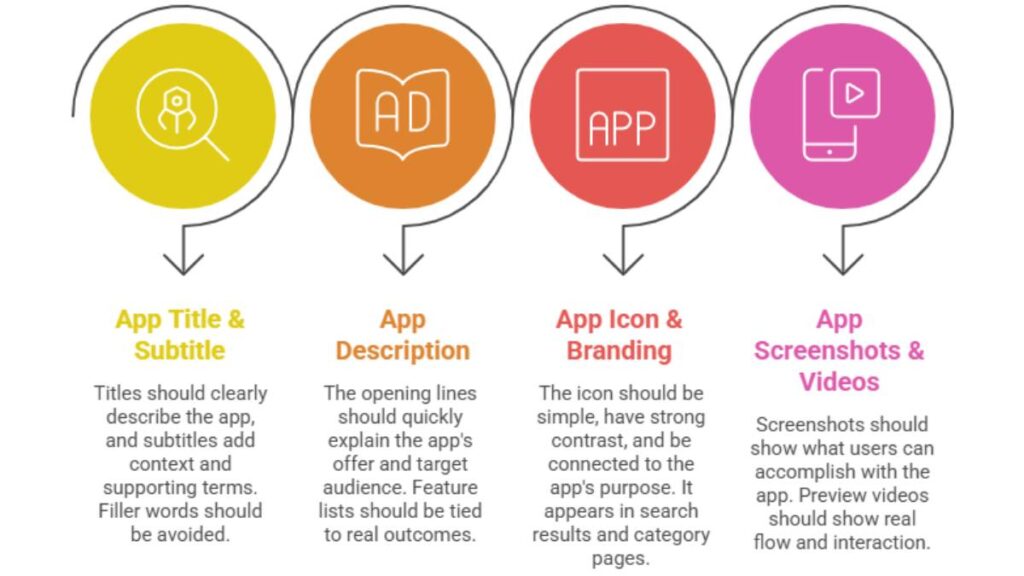
App Title & Subtitle Optimization
The app title does a lot of heavy lifting. It helps with visibility, and it shapes first impressions at the same time. Titles that clearly describe what the app does tend to perform better than ones that rely only on brand names or vague taglines.
Subtitles or short descriptions add context. They’re a chance to reinforce the main value and include supporting terms users might search for. Space is tight, so filler words usually hurt more than help. Clear and direct works best here.
App Description Optimization
Descriptions often get skimmed, not studied. The opening lines carry the most weight. They need to explain quickly what the app offers and who it’s meant for. If that part is unclear, many users won’t read further.
Feature lists are useful, but they work better when tied to real outcomes. Instead of just naming tools or functions, it helps to show how those features make something easier or faster. People care about results more than internal mechanics.
Keyword usage still plays a role, but it has to feel natural. Overloading the description with repetitive phrases makes the listing feel untrustworthy. And once trust drops, install decisions usually follow.
App Icon & Visual Branding
The icon is tiny, but it carries a surprising influence. It appears in search results and category pages, often before a user reads much text. A generic or cluttered icon can quietly reduce tap-through rates.
Simple shapes, strong contrast, and a clear visual identity tend to work well. The icon should feel connected to the app’s purpose without blending into a sea of similar designs. Small visual differences can affect user behavior more than most teams expect.
App Screenshots & Videos
Screenshots do a lot of the explaining. Many users rely on them more than the written description. If screenshots are overly decorative or focused only on interface details, they miss the chance to communicate value.
Strong screenshots show what users can actually accomplish with the app. Short captions help guide attention, but the visuals should tell most of the story. The goal is quick understanding, not visual overload.
Preview videos can reinforce this by showing real flow and interaction. They reduce uncertainty about how the app works. When users feel confident about what to expect, they’re more likely to install and less likely to uninstall right away.
Keyword Research for ASO
Importance of Keyword Research in ASO
Keyword research is where real ASO work begins. Not with design tweaks. Not with guesswork. With an understanding of how people actually search.
Teams often describe their apps one way, while users describe their needs another way entirely. That mismatch is common. An app might be built as a “personal finance management solution,” while users just search “expense tracker” or “budget app.” Subtle difference, big impact.
Good keyword research listens to user language. It looks at patterns in search behavior, not just what sounds impressive in a meeting. The goal is to align the app’s messaging with real-world intent; the words people type when they want to solve something right now.
It also keeps priorities clear. Some keywords bring high traffic but brutal competition. Others are smaller but more focused, often leading to better conversion. Knowing the difference helps avoid chasing visibility that doesn’t turn into installs.
Tools for Finding High-Performing App Keywords
ASO tools help make sense of the search landscape. They show which terms are searched frequently, how competitive they are, and how rankings shift over time. Useful data, but still just input.
These tools are especially helpful for spotting keyword variations that might not be obvious at first glance. Small wording differences can represent very different search volumes. They also help track performance after listing changes, which keeps optimization grounded in results rather than opinions.
Still, numbers alone don’t decide everything. A keyword might look attractive from a traffic perspective, but bring in users who aren’t a good fit. Relevance always wins. Visibility without conversion doesn’t help much.
Long-Tail vs Short-Tail Keywords in App Stores
Short-tail keywords are broad and competitive. Think “fitness,” “photo editor,” “notes.” Huge search volume, but also packed with well-established apps and big budgets. Ranking for these takes time and strong overall performance.
Long-tail keywords are more specific. Phrases like “home workout without equipment” or “daily spending tracker” may draw fewer searches individually, but they usually reflect clearer intent. Users searching these know what they want. That often leads to higher install rates.
A practical strategy uses both. Broad terms build a general presence over time. More specific phrases bring in targeted users who are more likely to stick around. It’s less about choosing one or the other, more about balancing reach with relevance.
Tracking Keyword Rankings Over Time
Keyword rankings don’t stay still. Competitors update their listings. New apps enter the category. User interests shift with trends and seasons. Without tracking, it’s hard to know whether changes are helping or quietly hurting performance.
Monitoring keyword positions over time reveals patterns. A new term added to the title might improve visibility for related searches. Removing another might cause a drop. These shifts rarely happen overnight, but they show up in the data if you watch closely.
ASO works best as a continuous process. Small adjustments, measured over time, tend to outperform big, infrequent overhauls.
On-Metadata ASO Techniques
Optimizing Metadata Fields: Title, Subtitle, Keywords
On-metadata elements are the parts of the app that are fully under direct control. They send strong signals about what the app does and who it’s for.
The app title should make the main function obvious. When users scan search results, they don’t want to decode brand slogans. They want clarity. A title that combines brand with function usually performs better than brand alone.
Subtitles or short descriptions support the title by adding context and covering related phrases. This space is limited, so every word needs to carry weight. Repeating the same idea in different words doesn’t add much. Expanding on value does.
Keyword fields, where available, should focus on variety within the app’s core theme. Repeating the same terms across multiple fields doesn’t provide extra benefit. Covering related ways users describe the same need tends to be more effective.
Localizing Metadata for Multiple Markets
Localization isn’t just translation with better grammar. That approach looks fine on the surface, but it often misses how people in different regions actually search. Even when the language is technically the same, search habits can be surprisingly different. One country might favor short, functional phrases. Another leans toward descriptive, benefit-driven wording. Subtle difference. Big impact.
Metadata that reflects local phrasing tends to feel more natural. More familiar. Users pick up on that quickly, even if they can’t explain why. A listing written with local context in mind feels like it belongs there. A direct translation, on the other hand, can feel slightly off; not wrong, just distant.
Good localization pays attention to:
- Common terms people actually use in that region
- How competitors describe similar apps locally
- Cultural context that shapes how benefits are perceived
Sometimes the change is just a few words swapped out for more locally common ones. Nothing dramatic. But those small shifts can improve both visibility and conversion in ways that add up over time.
Seasonal and Trending Keyword Integration
Search behavior isn’t static. It moves with the calendar, events, and even moods during certain times of the year. Ignoring that rhythm means missing windows of opportunity that come around predictably.
Fitness interest spikes at the start of the year. Travel searches climb before holiday seasons. Study tools get more attention around exam periods. These patterns repeat, and listings that adjust to them can capture extra visibility without changing the core product at all.
The key is alignment, not distraction. Seasonal keywords should connect naturally to what the app already does. If the link feels forced, users sense it right away, and conversion suffers.
When done well, seasonal updates feel timely, not opportunistic. A small tweak in phrasing. A slight shift in emphasis. Just enough to match what users are already thinking about. Then, once the moment passes, the listing settles back into its core positioning. Steady, relevant, and in sync with demand.

Enroll Now: Advanced Digital Marketing Course
Off-Metadata ASO Techniques
App Backlinks and Social Signals
ASO doesn’t live entirely inside the app store. External visibility can influence how often users encounter an app and how familiar it feels when they see it in search results.
Mentions on blogs, websites, and social platforms create additional touchpoints. When users recognize an app name from outside the store, they’re more likely to tap when it appears in search. Familiarity reduces hesitation.
External traffic also brings more visitors to the listing, which can improve performance metrics like conversion and engagement over time.
Leveraging External Content and PR for App Visibility
Reviews, feature articles, and curated app lists introduce products to audiences who may not be actively searching yet. When those users later need an app in that category, the name is already in their mind.
Public relations efforts, partnerships, and influencer coverage can drive spikes in attention. These bursts often lead to increased searches for the app, more installs, and stronger overall performance signals inside the store.
External content acts as a bridge. It connects user awareness outside the store with install decisions inside it.
App Store Feature Placements and Editorial Opportunities
Editorial features inside the app store can dramatically increase visibility. These placements often highlight apps with strong design, clear value, and positive user experiences.
While features can’t be forced, certain practices improve the chances. Keeping the listing polished, maintaining strong ratings, and aligning updates with seasonal themes all help position an app as feature-worthy.
Beyond the immediate surge in downloads, features build credibility. Even after the spotlight fades, the increased user base and improved performance signals often continue supporting stronger discoverability.
Conversion Rate Optimization (CRO) in ASO
Getting people to see an app in the store is one thing. Getting them to actually install it… That’s a different game. Visibility brings traffic. Conversion turns that traffic into real users. And that decision usually happens fast; a few swipes, a quick glance, maybe ten seconds of attention. Sometimes less.
How ASO affects install-to-download conversion rates
Every element on the store page quietly shapes that decision. The app title sets the tone. The icon creates an instant impression; polished or forgettable, trustworthy or sketchy. Then come the screenshots, which carry most of the weight. People scan them to figure out what the app really does, not what the description claims.
When the message is clear, focused, and benefit-driven, installs tend to follow. When the visuals feel cluttered or the value is buried under features, users hesitate. And hesitation usually means they move on to the next app in the list. No drama. Just gone.
Conversion performance also has a ripple effect. Listings that convert well often gain more momentum over time. Strong engagement and steady installs send positive signals back to the store ecosystem. It becomes a cycle; better conversion supports better exposure, which brings in more users to convert again.
A/B testing icons, screenshots, and videos
Creative decisions shouldn’t rely on personal taste alone. What looks “better” in a design review doesn’t always win with real users.
Testing different visual variations helps answer questions that otherwise turn into endless debates:
- Does a simple, bold icon stand out more than a detailed one?
- Do screenshots focused on outcomes perform better than those listing features?
- Is a short preview video more effective than a longer walkthrough?
Often, small changes make a noticeable difference. A clearer headline on the first screenshot. Less text. Better contrast. Nothing flashy, just easier to understand at a glance. That’s usually what moves conversion.
Enhancing app store page engagement to boost rankings
When users scroll through screenshots, expand the description, or watch the preview video, it shows interest. That kind of engagement matters. It suggests the listing matches what people are looking for.
A few practical ways to encourage deeper engagement:
- Put the strongest benefit right at the start of the screenshot sequence
- Keep text overlays short enough to read in a second or two
- Use preview videos to show real in-app flow, not just animated slides
If the page answers questions quickly and clearly, people stay longer. That extra attention, repeated at scale, adds up more than most expect.
Monitoring & Analytics for ASO
ASO without measurement is mostly guesswork. And guesswork gets expensive fast.
Numbers don’t tell the whole story, but they do show direction. Up, down, flat. That alone helps separate what’s working from what just felt like a good idea at the time.
Tracking downloads, installs, and retention rates
Download volume is the obvious metric, but it’s only the surface. Trends over time matter more than single spikes.
Useful patterns to watch:
- Install changes after listing updates
- Conversion rate from store page views to installs
- Early retention in the first few days after download
If installs go up but retention drops, there may be a disconnect. The store page might be promising something the app doesn’t fully deliver yet. That gap creates churn, which eventually drags performance down.
Using analytics to measure ASO performance
Store dashboards and performance reports provide steady feedback, visibility trends, traffic sources, and user behavior on the page. None of these numbers should be viewed alone. Context matters.
Sometimes a title change increases impressions but not installs. That suggests visibility improved, but the message isn’t convincing enough yet. Other times, new screenshots lift conversion in one country but not another. That points toward localization or cultural differences in messaging.
Looking at these patterns side by side helps avoid random tweaks. Adjustments become more deliberate. More grounded.
Adjusting strategy based on data insights
ASO isn’t a one-time setup. It’s ongoing maintenance. Stores evolve, competitors update their listings, and user expectations shift. What worked six months ago can quietly lose impact.
When the data shows something improving performance, it makes sense to build on it. When it shows friction, delays in fixing it usually cost more than expected. Visibility can slip gradually, then suddenly feel hard to recover.
Steady, informed updates tend to outperform big, infrequent overhauls. Less dramatic. More effective.
Common ASO Mistakes to Avoid
A lot of underperforming apps don’t fail because of the product itself. They struggle because the store listing gets in the way. Some issues show up again and again.
Keyword stuffing and over-optimization
Trying to squeeze every possible keyword into titles or descriptions often backfires. The result feels unnatural, hard to read, and less trustworthy.
Users don’t install apps because they spot a string of search terms. They install because the value feels clear and relevant to their need in that moment. If the message sounds forced, confidence drops. Quietly, but noticeably.
Ignoring app reviews and ratings
Ratings and reviews act as public proof. People check them quickly, almost instinctively.
Low ratings with no responses raise red flags. Repeated complaints left unanswered suggest the app isn’t being maintained. On the other hand, thoughtful replies, even to negative feedback, show that someone is paying attention.
Encouraging satisfied users to leave honest reviews can slowly shift the average upward. It doesn’t happen overnight. But over time, stronger ratings support both conversion and overall credibility.
Neglecting visual optimization and localization
Visuals carry more influence than many teams assume. Outdated screenshots, cluttered layouts, or tiny text that’s hard to read on a phone screen quietly hurt conversion.
Localization is another common gap. Direct translations often miss how people in different regions actually search or interpret messaging. Adapting visuals and copy to local expectations can unlock growth that generic, one-size-fits-all listings never reach.
Most ASO progress comes from steady refinement, not big, flashy changes. Avoiding these common mistakes keeps things moving in the right direction; sometimes slowly, yes, but with solid, lasting gains.
Future Trends in App Store Optimization
ASO doesn’t really have a finish line. It shifts as user habits shift, and lately those shifts have been… noticeable. Discovery is getting smarter, yes, but also more human. People search differently now. They skim faster. They expect relevance almost instantly.
Smarter discovery driven by user behavior
App stores are leaning harder on how users behave, not just what they type. Downloads still matter, but what happens after the install is starting to carry more weight.
Apps that hold attention, get opened repeatedly, and keep users around longer tend to build stronger visibility over time. That creates a kind of quality filter. Listings can’t just promise value; the product has to back it up, or performance eventually slips.
So the future of ASO isn’t just about polishing the page. It’s about making sure the messaging on the page reflects what the app genuinely does well. Otherwise, users drop off. And the stores notice.
More natural search behavior
Search queries are sounding more like conversations. Less “budget tracker app,” more “how to manage monthly expenses.” That subtle change matters.
Listings written in stiff, keyword-crammed language start to feel disconnected from how real people describe their problems. On the other hand, descriptions that explain benefits in plain, natural language tend to align better with these evolving search patterns.
It’s less about squeezing in every variation of a phrase and more about clearly explaining who the app helps and what changes for the user after installing. Simple, but not simplistic.
Early performance signals matter more
There’s growing emphasis on early indicators, what users do in the first few days after installing. Do they come back? Do they explore key features? Or do they disappear after one session?
These patterns help platforms gauge whether an app actually delivers on expectations set by the listing. When engagement lines up with the promise, visibility tends to stabilize or improve. When there’s a mismatch, growth can stall, even if downloads look decent on the surface.
ASO strategy is gradually becoming more tied to product experience. The listing and the app can’t feel like two different stories anymore.
Conclusion
App Store Optimization works best when it’s treated as an ongoing process, not a one-time project. Markets change. Competitors update their pages. User expectations move, sometimes quietly.
Strong fundamentals still carry most of the weight. Clear titles. Relevant keywords. Visuals that explain value in seconds. Ratings that build trust. All of these pieces reinforce each other.
Steady refinement usually beats dramatic overhauls. Small updates based on real performance trends tend to compound over time. Visibility improves. Conversion gets stronger. The app earns its position instead of chasing it.
In the long run, the listings that win are the ones that stay aligned with what users actually want, not just what sounds good in a feature list.
FAQs: About App Store Optimization (ASO)
1. What is App Store Optimization (ASO)?
App Store Optimization is the practice of improving how an app appears inside app stores so more people can find it and feel confident installing it. It covers messaging, visuals, keywords, and how users respond after downloading.
2. Why is ASO important for app marketing?
Even great apps struggle if they’re hard to discover. ASO helps connect the app with users already searching for something similar and improves the chances that store visitors turn into actual users.
3. How is ASO different from SEO?
ASO focuses on app stores, where visuals, ratings, and install behavior play a major role. SEO, on the other hand, is centered around websites in traditional search engines. The environments and ranking signals are quite different.
4. What factors most influence app store rankings?
Keyword relevance, conversion rates, download trends, user ratings, and ongoing engagement all play a part. It’s a mix of how well the listing matches searches and how satisfied users seem after installing.
5. How should the right keywords be selected?
Good keywords usually reflect how potential users naturally describe their needs. Relevance to the app’s core function matters more than chasing high-volume terms that don’t really fit.
6. Do icons and screenshots really affect installs?
Absolutely. Visuals form the first impression and often determine whether someone looks deeper or scrolls past. Clean, benefit-focused screenshots tend to perform better than cluttered feature lists.
7. How do ratings and reviews impact performance?
Ratings influence trust almost instantly. Higher ratings and recent positive feedback make people more comfortable installing, while visible responses to reviews show that the app is actively supported.
8. What’s the difference between on-metadata and off-metadata ASO?
On-metadata ASO involves changes made directly to the store listing, like titles and descriptions. Off-metadata ASO includes external influences such as brand awareness, media mentions, and general buzz that drive traffic to the listing.
9. How can ASO results be measured?
Installs, conversion rates, keyword visibility, ratings, and retention trends are all useful indicators. Watching how these shift after updates helps determine what’s actually improving performance.
10. What trends are shaping ASO going forward?
More personalized discovery, stronger focus on user engagement after install, better localization, and listings written in more natural, user-focused language are all becoming more important in how apps gain and maintain visibility.