
B2B influencer marketing isn’t about flashy posts or viral hits; it’s about credibility, trust, and slow, steady influence. This blog walks through what that really means in practice. It covers how B2B influencer marketing differs from B2C, why relationships matter more than reach, and how to work with the right experts without forcing it. You’ll get tips on building campaigns, integrating influence across channels, measuring what actually matters, and avoiding the usual pitfalls. Real-world examples from Flock Freight, Monday.com, Semrush, and Sprout Social show how influence quietly shapes decisions. The goal isn’t instant attention; it’s being a trusted voice when it counts, over time, in the places that matter most.
Table of Contents
Introduction:
Why B2B Influencer Marketing Matters in 2026
B2B buyers have changed. Not overnight, but enough that most old playbooks feel… off.
There’s more scrutiny now. More internal pressure. More “let’s double-check this” before anyone signs anything. And when that happens, brand messaging alone doesn’t carry the same weight it once did. Even good messaging.
What does cut through is the outside perspective. Someone credible saying, in their own words, this makes sense.
That’s the real reason B2B influencer marketing matters right now. It fits the way decisions actually happen. Long timelines. Multiple people are involved. Lots of quiet research before sales ever enter the picture.
Influence fills the gaps marketing can’t. It shows up in the background. In posts, people save. In conversations, they remember later. In names that feel familiar when it’s finally time to decide.
No hype. Just trust building, slowly, the way it usually does in B2B.
What Is B2B Influencer Marketing?
Strip away the buzzwords, and it’s pretty straightforward.
B2B influencer marketing is about working with people who already have credibility with your buyers, and letting that credibility rub off, naturally, over time.
Not scripted promotions. Not flashy endorsements. And definitely not “use my product” posts.
It’s closer to collaboration than advertising.
A Practical Definition
B2B influencer marketing is when brands partner with respected industry voices to shape how potential customers understand a problem, a solution, or a category.
The product isn’t always the focus. Often it’s the thinking behind it.
That’s an important distinction. Influence in B2B tends to work sideways, not head-on.
How B2B Influencers Are Different
B2B influencers don’t win attention by being everywhere. They win it by being selective.
Most have built trust slowly:
- By sharing hard-earned opinions
- By calling out bad ideas when needed
- By staying quiet when they don’t have something useful to add
Their audiences aren’t massive. But they listen. And that matters more.
Who These Influencers Usually Are
In the real world, B2B influencers tend to be:
- Consultants who’ve seen the same problems repeat across companies
- Founders who’ve made decisions buyers are trying to make now
- Practitioners who speak honestly about what worked, and what didn’t
Some have big followings. Many don’t. Often, the most effective ones sit in smaller circles where trust runs deep.
How Influence Shows Up in B2B
Rarely as a single moment.
It shows up in patterns. A familiar name. A point of view that keeps resurfacing. Content that doesn’t feel like marketing, but somehow sticks.
By the time a buying decision is on the table, the influence has already done its work. Quietly.
B2B Influencer Marketing vs B2C Influencer Marketing
This is where a lot of teams go wrong.
They look at B2C influencer marketing and assume B2B is the same thing, just less flashy. It isn’t.
The Real Differences
In B2C, attention is often the win. In B2B, attention is just the entry point.
B2B audiences aren’t browsing. They’re evaluating. They’re thinking about internal buy-in, budget conversations, and risk. They don’t want to be entertained. They want to be confident they won’t regret the decision later.
That changes the rules:
- Depth beats frequency
- Context beats creativity
- Familiarity beats virality
And results don’t show up neatly in a last-click report. They surface in sales conversations and closed-won deals months later.
Why B2B Needs a Slower, Different Approach
B2B influencer marketing works best when it’s relationship-led.
Not a one-off post. Not a quick campaign. Ongoing collaboration where the influencer actually understands the brand and believes in the thinking behind it.
Reach still matters, but relevance matters more. Always has.
Benefits of B2B Influencer Marketing
When done well, B2B influencer marketing doesn’t feel like a tactic. It feels like support. For marketing, sales, and even product teams.
Reaching the Right Rooms
Instead of trying to reach everyone, it helps brands reach the rooms that matter.
Smaller audiences. Higher stakes. People who actually influence decisions, not just clicks.
That kind of reach doesn’t spike overnight. It compounds.
Borrowed Trust (In the Best Way)
Buyers are naturally skeptical of brands talking about themselves. Fair enough.
But when someone they already respect engages with a brand, joins a discussion, contributes to content, and shows up consistently, that skepticism softens. Not disappears. Softens.
That’s progress in B2B.
Better Engagement, Without Forcing It
Influencer-led content tends to spark real responses. Not because it’s optimized. Because it sounds like something worth reacting to.
More thoughtful comments. More saves. Fewer empty likes.
It feels human. Because it is.
Helping Demand Gen Do Its Job
Influence works upstream.
It makes webinars feel less promotional. Reports feel more credible. Sales conversations feel warmer before they even start.
By the time a lead raises their hand, the brand doesn’t feel new. It feels known.
Turning Relationships Into Long-Term Advantage
The strongest programs don’t churn through influencers.
They build with them.
Over time, those relationships become a moat. One competitor can see, but can’t easily copy.
Benefits of B2B Influencer Marketing (Why It Should Be Part of Your Strategy)
B2B influencer marketing doesn’t work because it’s clever. It works because it’s believable.
Most B2B buyers are tired. Tired of inflated claims. Tired of “leading” solutions that look exactly like everyone else’s. When a brand shows up alone, it’s judged harder. When it shows up alongside people who’ve earned respect in the space, the tone shifts.
That shift is the real benefit.
Expands Brand Reach in High-Value B2B Niches
This isn’t about going wider. It’s about going deeper.
B2B influencers tend to operate inside focused circles: specific roles, industries, or problem areas. When a brand enters those circles through a trusted voice, it gains access to rooms that are usually closed to direct marketing.
Not everyone sees it. The right people do.
And in B2B, that’s the point.
Builds Trust and Brand Credibility
Trust is borrowed before it’s earned.
When an expert is willing to associate their name with a brand, comment on its ideas, collaborate on content, and show up more than once, it sends a quiet signal. Not endorsement. Alignment.
That signal matters far more than polished messaging ever could. Especially when buyers are comparing options that all look good on paper.
Boosts Engagement and Content Performance
Influencer-led content tends to feel different. Less forced. Less sales-shaped.
It invites conversation instead of clicks. People respond because they have something to say, not because they were prompted to react.
You’ll notice it in:
- Longer comment threads
- More saves than likes
- Shares with added context
That’s engagement with intent, not noise.
Supports Demand Generation and Pipeline Growth
Influence does its best work before a lead fills out a form.
It helps prospects arrive informed. More confident. Less defensive. By the time sales get involved, the brand doesn’t feel unfamiliar or risky. It feels known.
That shortens conversations. Smooths objections. Sometimes quietly tips a deal in the right direction.
Improves Brand Loyalty and Long-Term Advocacy
The strongest programs don’t rotate influencers in and out.
They build relationships.
Over time, those relationships turn into something more durable; ongoing advocates who understand the brand, the audience, and the space. People who speak with consistency, not obligation.
That kind of loyalty can’t be rushed. And it can’t be copied easily either.
Which is exactly why it’s worth building.
How to Run a B2B Influencer Marketing Campaign
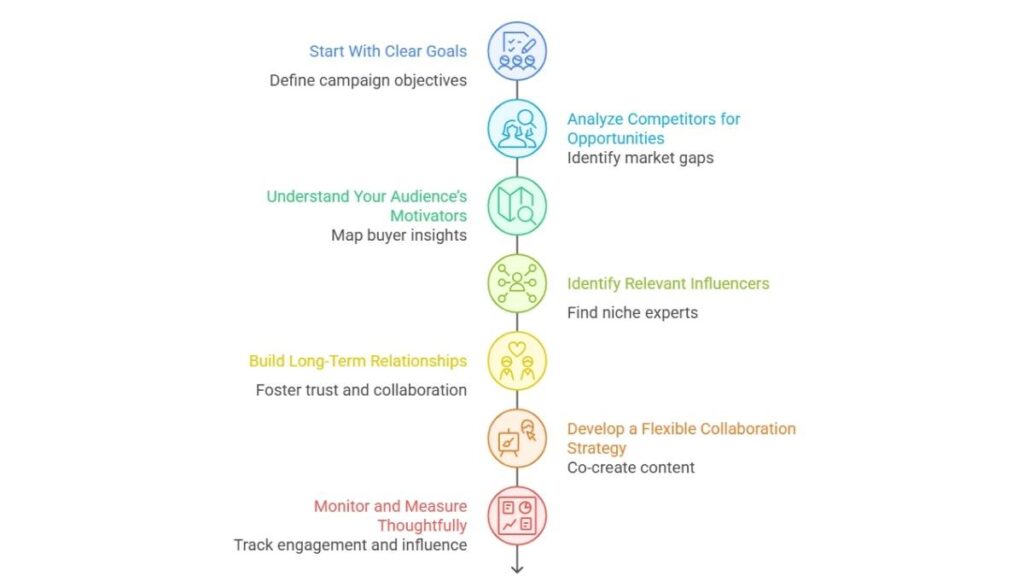
Start With Clear Goals
A B2B influencer campaign starts with clarity. What do you actually want to achieve? Awareness in a niche segment? Thought leadership that sticks? Pipeline influence that may not show up cleanly in reports? Goals set the tone for everything else. Without them, campaigns quickly get messy.
Analyze Competitors for Opportunities
Look at what competitors are doing; not to copy them, but to spot gaps. Who are they working with? Who are they ignoring? Often, the biggest opportunities lie in overlooked niches or underutilized voices rather than chasing the obvious “big names.”
Understand Your Audience’s Motivators
Forget demographics. Dig into motivators. What makes your buyers hesitate? What risks are they avoiding? What validation actually matters? Mapping influencers to these insights ensures alignment feels natural rather than forced.
Identify Relevant Influencers
It’s not about follower counts. It’s about fit. Are they talking about the right problems? Are their opinions trusted, even when they’re critical? Smaller, niche influencers often perform better when credibility matters more than reach.
Build Long-Term Relationships
Influence in B2B doesn’t happen in a single campaign. One-off activations rarely move the needle. Building relationships that last beyond a single post or event is key. Let influencers understand your business, your audience, and your challenges. That’s how trust develops.
Develop a Flexible Collaboration Strategy
Collaboration works best when it’s flexible. Blogs, webinars, podcasts, reports, events; all have a role. The best results come when influencers contribute thinking and perspective, not just amplify messages. Co-creation usually outperforms scripted promotion.
Monitor and Measure Thoughtfully
Measure smartly. Engagement quality matters more than volume. Influence on the pipeline matters more than clicks. Some results will be tangible; others will be subtle, showing up in warmer leads, shorter conversations, or stronger relationships. That’s normal in B2B.
Integrating B2B Influencer Marketing Across Channels
LinkedIn: The Natural Starting Point
LinkedIn is where most B2B conversations already happen. Thoughtful posts, comment threads, newsletters, and collaborations can gradually shape perception. Not by being loud, but by being consistent and credible.
Enhance B2B Content Marketing
Influencers add depth to blogs, reports, and case studies in ways brand-only content often can’t. Their perspectives bring nuance, authority, and sometimes even healthy disagreement, which makes content feel authentic rather than manufactured.
Leverage Webinars and Events
Influencers make events feel worthwhile. Their presence can boost registrations, engagement, and the quality of discussion. It signals to participants that the conversation is credible and valuable, not just another sales pitch.
Extend to Paid Media and ABM Carefully
Paid campaigns or account-based marketing can benefit, but only as an extension. Influencer content should amplify existing work, not introduce the influencer cold. Familiarity first. Amplification second.
The Key Across Channels
Influencer marketing works best when it’s integrated. Reinforce credibility wherever buyers already spend attention. Don’t try to be everywhere. Just be where it counts.

Apply Now: Advanced Digital Marketing Course
Choosing the Right B2B Influencer Marketing Platform
Prioritize Relevance Over Flash
A platform should support how relationships really work. Discovery must prioritize relevance over raw reach. Analytics should help understand influence beyond surface-level engagement. Relationship management should feel practical, not transactional.
Reporting That Reflects Reality
Influence in B2B rarely converts in a straight line. Platforms that pretend to do so create frustration. The right platform helps connect the dots without oversimplifying results.
Platforms for Discovery and Analytics
Some platforms excel at helping teams find credible voices and track conversations over time. These are great for programs starting to scale or needing to map influence patterns across niches.
Platforms for Relationship Management
Other platforms focus on sustaining long-term influencer partnerships. They help teams track interactions, maintain context, and keep relationships active without friction.
Platforms With Data-Driven Insights
Some platforms lean heavily on data, providing structured insights for larger programs. Useful for organizations running multiple campaigns across industries or segments, where scale and reporting are critical.
Choosing Based on Program Maturity
Early-stage programs don’t need complex platforms. Larger, more established programs may benefit from advanced analytics and relationship management tools. The platform won’t fix a weak strategy, but it can make a strong strategy much easier to execute and sustain.
How to Contract B2B Influencers
Getting influencers on board in B2B isn’t like buying a banner ad. These are people with expertise, opinions, and reputations. If a contract feels rigid or overly formal, it kills trust. But if it’s too loose… well, someone usually ends up frustrated. Finding the balance is key.
Compensation Models Aren’t One-Size-Fits-All
Some influencers want a retainer. Makes sense if the work is ongoing. Others are happy with project-based payments, like co-hosting a webinar or contributing to a report. And yes, some prefer performance-based deals if their influence can drive a measurable pipeline.
It’s worth thinking through what kind of impact you expect and matching that to how you pay. Don’t just hand over a check for followers; that rarely works. And don’t nickel-and-dime the expert; credibility comes at a price.
Contracts, Deliverables, and Rights
You want clarity, but don’t micromanage. Spell out what content is expected, deadlines, and reporting; fine. But leave room for the influencer’s own voice. That’s where authenticity comes from.
Ownership and usage rights need to be explicit, too. Can you republish a blog post? Use snippets in ads? What about disclosures, especially in regulated industries? Sorting that out early prevents headaches later.
Measuring ROI
Here’s the thing: ROI in B2B influencer marketing is rarely obvious. Likes and clicks don’t tell the story. Look at engagement quality, influence on pipeline, and assisted conversions. Some things are measurable, others are subtle: a warmer lead, shorter sales cycle, better conversations. That’s normal. Expect it, don’t stress it.
Top B2B Influencer Marketing Agencies
Even seasoned teams sometimes need help. Agencies bring networks, know-how, and structure. But not all agencies are the same; some just throw a bunch of influencers at you and call it a day. That rarely works in B2B.
What Agencies Actually Do
Mostly three things: strategy, sourcing, and measurement. They help identify the right influencers, coordinate campaigns, manage relationships, and track outcomes. Good ones also provide insights on trends, audience behavior, and what’s credible in your niche. Think of them as part of your team, not a vendor. The wrong agency, though? You’ll know. Deadlines slip, messages fall off, and results disappear.
Leading Agencies
- inBeat – Known for connecting brands to niche influencers and managing multi-channel campaigns.
- Leadtail – Excels in mapping social influence and figuring out where audiences actually spend attention.
- OST Marketing – Focuses on long-term programs and amplifying thought leadership.
- Socially Powerful – Bridges content, influencers, and strategy to deliver tangible results.
- Thinkers360 – Combines discovery, analytics, and tracking for thought leaders.
- TOP Agency – Offers end-to-end campaign management with a focus on measurable impact.
Agencies are great, but remember: they amplify what you already do well. If your internal strategy is weak, no agency can fix that.
Building a Scalable B2B Influencer Marketing Strategy
B2B influencer marketing works best when it’s ongoing. A one-off post might create a ripple, but repeated, consistent presence builds real influence.
Start Small, Then Scale
Test before you commit fully. Try different types of content, audiences, and influencer tiers. See what lands. Then scale. The mistake is trying to run a massive program right away. Always-on campaigns work because they build familiarity and credibility slowly. That slow burn is far more valuable than a quick spike.
Tie Influencer Work to Sales
Influencer marketing can’t live in a silo. When sales teams know what influencers are saying, they can lean on that messaging during conversations. The brand feels consistent, credible, and familiar. Without alignment, all that influence sometimes disappears in the pipeline.
Make Repeatable Playbooks
Scalable programs need structure. Document workflows, define touchpoints, and set reporting expectations. Playbooks don’t have to be rigid; they just make it possible to manage multiple relationships without losing consistency. That’s how you turn influencer marketing from a lucky experiment into a dependable channel that actually moves the needle.
B2B Influencer Marketing Examples You Can Learn From
It’s tempting to think influencer marketing is all about flashy posts or viral videos, but in B2B… It’s really not. Most of the time, it’s slower, quieter, and far more strategic. The brands that get it are the ones that treat it like building credibility, not chasing likes.
Take Flock Freight. They’ve leaned on real industry experts to talk about things like logistics efficiency and sustainability. It’s not sexy content, but it works. When a prospect hears the same insight from a trusted voice as the brand, suddenly, Flock Freight feels knowledgeable and reliable. That’s influence in action.
Then there’s Monday.com. They work with SaaS consultants and productivity creators who already have an audience of business managers. The influencers produce tutorials, workflow showcases, and even casual reviews. Prospects get value, not a pitch. That’s subtle, but it builds trust over time.
Semrush does something similar but on a bigger, long-term scale. They invest in recurring webinars and guides with thought leaders in digital marketing. Instead of one-off posts, it’s a slow accumulation of authority. When someone is choosing a marketing tool months down the line, Semrush is already top-of-mind.
Finally, Sprout Social integrates influencers into measurable campaigns; product launches, webinars, and content pushes, but the focus isn’t vanity metrics. They want leads, engagement that matters, and pipeline influence. Influence, yes, but with teeth.
The lesson? B2B influencer marketing is about authority and trust, not fleeting attention. And yes, it takes patience.
5 Ways to Leverage B2B Influencer Marketing Effectively
There’s a trap a lot of brands fall into: thinking influencer marketing is easy. It’s not. In B2B, if you’re not careful, you can waste money and time. A few approaches that actually make a difference:
Start with what you want. Sounds obvious, but so many campaigns start without a clear goal. Awareness, leads, pipeline movement; pin that down first. Otherwise, it’s just noise.
Credibility beats reach. A small, highly trusted expert audience will do more for your brand than a huge following that doesn’t really care about your product.
Focus on relationships, not transactions. One-off campaigns can work, sure. But lasting partnerships with influencers are where the magic happens. Think of them as collaborators, not vendors.
Structure without suffocating. Give influencers some guidance: key points, deadlines, content type, but leave space for their voice. Authenticity matters more than perfect phrasing.
Measure what counts. Likes and shares are nice, but they’re not everything. Look at pipeline influence, conversation depth, and whether the influencer actually made the buyer journey smoother. That’s where the real ROI hides.
It’s a different mindset. Slow, careful, intentional, but way more effective than chasing trends.
Conclusion:
B2B buyers are smarter than ever, and they ignore generic ads. Influence is the new currency. If a trusted voice says your product is worth considering, prospects listen. That’s the reality today.
It’s not a fast win. B2B influencer marketing is slow. It takes persistence, patience, and relationship-building. But done right, it shapes perception, builds trust, and nudges prospects forward in subtle ways no ad can match.
The brands that treat influencers as strategic partners, long-term, integrated into campaigns, tied to real business outcomes, are the ones that win. And in a world where trust is hard to earn, that influence translates directly into pipeline, conversions, and long-term credibility.
B2B influencer marketing isn’t a gimmick. It’s a business strategy. And it’s only going to get more important in the years ahead.
FAQs: About B2B Influencer Marketing
1. What is B2B influencer marketing?
It’s basically getting someone your prospects respect to vouch for your brand. Not in a flashy, Instagram-famous way, but more like lending credibility. These are the folks who know their stuff, and when they talk about a product, people listen. It’s a slow, steady influence rather than a quick hype.
2. How is B2B different from B2C influencer marketing?
B2C is fast and flashy; think likes, shares, trending posts. B2B is slower, more deliberate. Decisions take time, involve committees, budgets, and approvals. Your content has to match that: in-depth, helpful, and credible. You’re aiming to become a trusted voice, not just a catchy headline.
3. Who counts as a B2B influencer?
Not celebrities, not random content creators. People like consultants, analysts, founders, or industry experts. Sometimes they have thousands of followers, sometimes just a few hundred, but if their audience trusts them, that’s enough. Quality beats quantity here, every time.
4. Does it actually work?
Yes, but it’s subtle. You won’t see results in likes or shares. The impact is on real decisions: getting a prospect to take your solution seriously, or nudging them along the sales journey. Done badly, it’s just noise. Done right, it’s quietly powerful.
5. Which platforms are worth using?
LinkedIn is the obvious one, but also webinars, podcasts, blogs, and even gated reports. Basically, wherever your audience actually spends time and absorbs information. It’s not about being everywhere, it’s about being where it counts.
6. How do you find the right influencers?
Look for relevance, credibility, and audience quality. A big following doesn’t matter if they’re not respected. Sometimes a small, niche expert has more pull than a huge name. Check their work, see how people engage with them, and if they genuinely know their field.
7. How much does it cost?
It varies; some are open to collaborations, some want retainers, some want performance-based pay. Don’t just think about the fee alone. Think about the access you get to the right audience, the authority they bring. Cheaper isn’t always better.
8. How do you measure ROI?
Forget vanity metrics. Look at influence on pipeline, lead quality, webinar signups, report downloads; any action that actually drives a decision. If an influencer moves a prospect closer to buying, that’s your ROI.
9. Should B2B influencer marketing be part of an ABM strategy?
Absolutely. It reinforces account-based marketing. When your sales team talks to a target account, and they see a respected voice echoing similar messages, it sticks. Credibility multiplies, plain and simple.
10. Can it scale?
Yes, but carefully. Start small, test, and see what works. Scaling too fast can kill authenticity, and in B2B, authenticity is what makes influence work. Long-term relationships always beat chasing numbers.