

This comprehensive guide explores brand architecture strategy, explaining its definition, models, components, and real-world examples from companies like Apple, Nestlé, and Marriott International. It breaks down branded house, house of brands, hybrid, and endorsed approaches, while offering a step-by-step framework to build a scalable structure that strengthens brand equity and supports long-term growth.
Table of Contents
Introduction
What Is Brand Architecture Strategy?
Brand architecture strategy is the system that decides how all your brands, products, and services fit together. Not just structurally, but strategically. It defines which brand leads, which brands support, and how everything connects in a way customers can actually understand.
This sounds simple on the surface. But in reality, it’s one of those decisions that quietly shapes how a company grows over the next 5, 10, even 20 years.
At its core, brand architecture strategy answers questions like:
- Should every product use the main brand name?
- Should some products have their own identities?
- How closely should sub-brands be connected to the parent brand?
- When launching something new, does it strengthen the main brand or dilute it?
Without clear answers, brands tend to grow in random directions. And customers feel that confusion immediately.
Brand Architecture Strategy Definition in Marketing
In practical marketing terms, brand architecture strategy is the framework used to organize a company’s entire brand ecosystem. It defines how the master brand, sub-brands, and individual products relate to each other.
Think of it less like a branding exercise and more like infrastructure. It’s the underlying structure that supports growth.
A strong brand architecture strategy ensures:
- Every product has a clear place
- Brand relationships make sense
- Customers can easily connect the dots
- New launches don’t weaken the overall brand
When done right, customers don’t have to think too hard. Everything just feels coherent.
What Brand Architecture Strategy Means for Modern Businesses
Brand architecture becomes critical the moment a company expands beyond one core product.
Early on, things are straightforward. One brand. One product. One clear identity.
Then growth happens.
New products launch. New categories open up. Sometimes acquisitions enter the picture. Suddenly, there are multiple brands, overlapping audiences, and positioning decisions that weren’t part of the original plan.
This is where brand architecture strategy shifts from optional to essential.
It helps businesses scale without losing clarity. It prevents situations where customers don’t realize multiple products come from the same company. And just as important, it prevents internal confusion; something that quietly slows down marketing teams more than expected.
A clear structure makes growth smoother. Without it, expansion often creates friction.
Brand Architecture vs Brand Strategy vs Brand Hierarchy
These terms get mixed up constantly. And it’s understandable; they’re closely related. But they serve different roles.
Brand strategy defines how a brand competes in the market. It covers positioning, messaging, personality, and perception.
Brand architecture strategy defines how multiple brands and products are organized and connected.
Brand hierarchy is simply the structural layout, the visible arrangement of those relationships.
A simple way to think about it:
- Brand strategy shapes perception
- Brand architecture strategy shapes structure
- Brand hierarchy visualizes that structure
They work together. But architecture is what keeps everything organized as companies grow.
Simple Explanation of Brand Architecture Strategy with Real-World Context
Every company faces a structural choice at some point.
Some businesses put everything under one brand. Every product strengthens the same name. Over time, that brand becomes incredibly powerful because all equity accumulates in one place.
Other companies create separate brands for different products or audiences. This allows flexibility. Different brands can target different segments without affecting each other.
Neither approach is automatically better. It depends on the company’s goals, positioning, and growth direction.
What matters most is consistency. When architecture evolves randomly, brand strength fragments. When it evolves intentionally, brand strength compounds.
Why Companies Need a Structured Brand Architecture Strategy
Most companies don’t notice the problem early. It builds gradually.
A new product gets launched with its own identity. Then another. Naming conventions start drifting. Some products connect to the main brand, others don’t. Customers begin seeing brands as unrelated, even when they come from the same company.
Internally, marketing teams feel it first.
Campaigns don’t reinforce each other’s messaging overlaps. Resources are spread thin across disconnected identities. Instead of building one strong brand, companies end up managing several weaker ones.
A structured brand architecture strategy prevents this.
It brings clarity to questions like:
- How should new products be branded?
- Which brands should lead?
- How do sub-brands support the master brand?
More importantly, it ensures that growth strengthens the brand instead of weakening it.
Why Brand Architecture Strategy Is Important for Business Growth
Brand architecture rarely feels urgent in the early stages. But as companies grow, its importance becomes obvious. Sometimes painfully obvious.
Growth creates complexity. More products. More audiences. More positioning decisions.
Without structure, that complexity turns into confusion.
With the right brand architecture strategy, growth becomes easier to manage and far more efficient.
Importance of Brand Architecture Strategy for Multi-Product Companies
The moment a company moves beyond one product, brand architecture decisions begin shaping perception.
Every new product introduces questions:
- Should it carry the parent brand name?
- Should it feel independent?
- Should it target the same audience, or a different one?
These decisions affect how customers understand the business.
When the structure is clear, customers build familiarity faster. When the structure is inconsistent, every new product feels disconnected. That slows down trust.
Trust takes time to build. Brand architecture helps accelerate that process.
How Brand Architecture Improves Brand Clarity and Positioning
Clarity is one of the biggest advantages of strong brand architecture, and one of the most overlooked.
Customers shouldn’t have to work hard to understand what a company offers. They shouldn’t wonder whether products are related. Or whether they come from the same brand.
Clear architecture removes that friction.
It helps customers immediately recognize relationships between products. That recognition builds familiarity. Familiarity builds trust.
And trust shortens decision cycles.
Role of Brand Architecture Strategy in Scaling Product Portfolios
Scaling introduces structural pressure.
Without a brand architecture strategy, each new product becomes a standalone decision. Naming, positioning, branding; all decided independently.
This slows teams down. It also creates inconsistency.
With clear architecture, decisions become easier. New products fit into an existing system. Teams know how naming should work. They know how brands should relate.
This consistency compounds over time.
Product launches become smoother. Marketing becomes more efficient. Brand equity builds faster.
How Brand Architecture Strategy Impacts Customer Perception and Trust
Customers don’t analyze brand architecture consciously, but they respond to it instinctively.
When structure is clear, brands feel stronger. More established. More credible.
When structure is unclear, brands feel fragmented. Less cohesive. Less trustworthy.
Even small structural inconsistencies can affect perception.
For example, when naming conventions vary too much, products feel disconnected. Customers hesitate. They treat each product as unfamiliar.
Brand architecture strategy ensures brand equity transfers properly across the portfolio.
That transfer of trust is incredibly valuable.
Benefits of Brand Architecture Strategy for Marketing Efficiency
Marketing efficiency improves significantly when brand architecture is clear.
Instead of building awareness separately for every product, companies build awareness collectively.
Brand equity accumulates.
Campaigns reinforce each other. Messaging becomes consistent. Recognition builds faster.
Without clear architecture, marketing efforts often compete with each other. Teams unknowingly fragment brand strength.
Strong architecture aligns everything.
It makes every marketing effort more effective.
How Brand Architecture Reduces Brand Confusion and Cannibalization
Brand confusion happens quietly.
Two products target similar audiences but aren’t clearly differentiated. Customers struggle to understand the difference. Sales get split instead of growing the overall market share.
This is brand cannibalization. And it’s more common than expected.
Brand architecture strategy helps prevent it by defining clear roles for each brand and product.
Each offering has a purpose. Each brand has boundaries.
This clarity strengthens the entire portfolio.
Impact of Brand Architecture Strategy on Brand Equity and Long-Term Growth
Brand equity grows through consistency.
When customers repeatedly encounter the same brand structure, recognition deepens. Trust builds faster. Decision-making becomes easier.
Over time, this creates momentum.
New products benefit from existing trust. Expansion becomes smoother. Customer acquisition becomes more efficient.
Weak architecture forces brands to rebuild trust repeatedly.
Strong architecture allows trust to scale.
That difference becomes more visible with time.
Key Components of a Successful Brand Architecture Strategy
Brand architecture strategy isn’t built on a single decision. It’s built from multiple components that work together. Each plays a specific role in creating clarity and scalability.
When these components align, brand structure feels natural. When they don’t, confusion shows up quickly.
Let’s break down the most important ones.
Master Brand (Parent Brand Strategy)
The master brand is the center of everything. It carries the core identity, reputation, and equity of the company.
In many cases, it’s the name customers recognize first. And trust most.
A strong master brand makes expansion easier. Customers already have confidence in the brand, so new products don’t start from zero.
They inherit trust.
Definition of Master Brand in Brand Architecture
The master brand is the primary brand that anchors the entire brand ecosystem. It connects products, sub-brands, and services under a shared identity.
It represents the company’s core promise.
Customers associate the master brand with reliability, quality, and consistency; even before evaluating individual products.
Role of Master Brand in Brand Architecture Strategy
The master brand provides structural stability.
It acts as a reference point. Customers use it to make sense of the broader product ecosystem.
When the master brand is strong, it creates momentum. New products gain credibility faster. Marketing becomes more efficient.
But this only works when the relationship between the master brand and sub-brands is clear.
Ambiguity weakens that transfer of trust.
Examples of Strong Master Brands
Some brands concentrate nearly all their equity in the master brand. Their products extend the brand rather than compete independently.
This creates enormous brand strength over time.
Customers don’t just trust individual products. They trust the brand behind them.
That distinction matters.
Sub-Brands and Their Strategic Role
Sub-brands allow companies to expand while maintaining structure.
They introduce flexibility. Products can target different audiences or use cases without losing connection to the parent brand.
This balance is useful, especially as companies grow into new categories.
What Is Sub-Branding in Brand Architecture Strategy
Sub-branding creates distinct identities within the larger brand ecosystem.
These identities remain connected to the parent brand but serve specific purposes.
Sub-brands often help:
- Differentiate product lines
- Target different customer segments
- Expand into adjacent categories
They create room for growth without fragmenting the overall brand.
When to Create Sub-Brands vs Standalone Brands
Sub-brands work best when products still align closely with the parent brand’s identity.
If the connection feels natural, sub-branding strengthens the ecosystem.
Standalone brands make more sense when positioning needs to be completely different. Or when association with the parent brand could limit growth.
This decision should be strategic, not reactive.
Benefits and Risks of Sub-Branding
Sub-brands offer flexibility. They allow expansion while preserving the strength of the master brand.
But too many sub-brands can create complexity.
Structure matters. Each sub-brand should have a clear role. Otherwise, the architecture becomes harder to maintain.
Clarity should always guide expansion.
Brand Hierarchy Structure Explained
Brand hierarchy defines the structural layers within the brand ecosystem.
It organizes relationships. It brings order.
Without hierarchy, brands exist, but their relationships remain unclear.
What Is Brand Hierarchy in Brand Architecture Strategy
Brand hierarchy is the structured arrangement of corporate brand, master brand, sub-brands, and individual products.
It defines how authority and identity flow through the system.
Customers don’t need to see the hierarchy explicitly. But they experience its effects.
A clear hierarchy creates an intuitive understanding.
Levels of Brand Hierarchy
Most brand hierarchies include several levels:
- Corporate brand (company level)
- Master brand (primary identity)
- Sub-brands (category or segment level)
- Product-level brands (individual offerings)
Each level serves a different purpose.
Together, they create a coherent structure.
How Hierarchy Improves Brand Clarity
A clear hierarchy removes ambiguity.
Customers understand how products relate. They recognize connections. Trust builds faster.
Internally, hierarchy helps teams make better branding decisions. Naming becomes more consistent. Expansion becomes more structured.
Hierarchy turns growth into something manageable.
Without it, brand ecosystems drift.
Types of Brand Architecture Strategy
At some point, every growing company runs into the same uncomfortable question. Should everything live under one brand… or should different products stand on their own?
It sounds like a naming decision on the surface. It isn’t. It’s a long-term structural decision that affects trust, marketing efficiency, expansion, and even acquisition strategy.
There’s no universal “correct” model. What works depends on how strong the parent brand already is, how different the audiences are, and how far the company plans to stretch in the future.
Most brand architecture strategies fall into three core models. Nearly every real-world example is some variation of these.
Understanding them properly makes future brand decisions much easier. And prevents expensive clean-ups later.
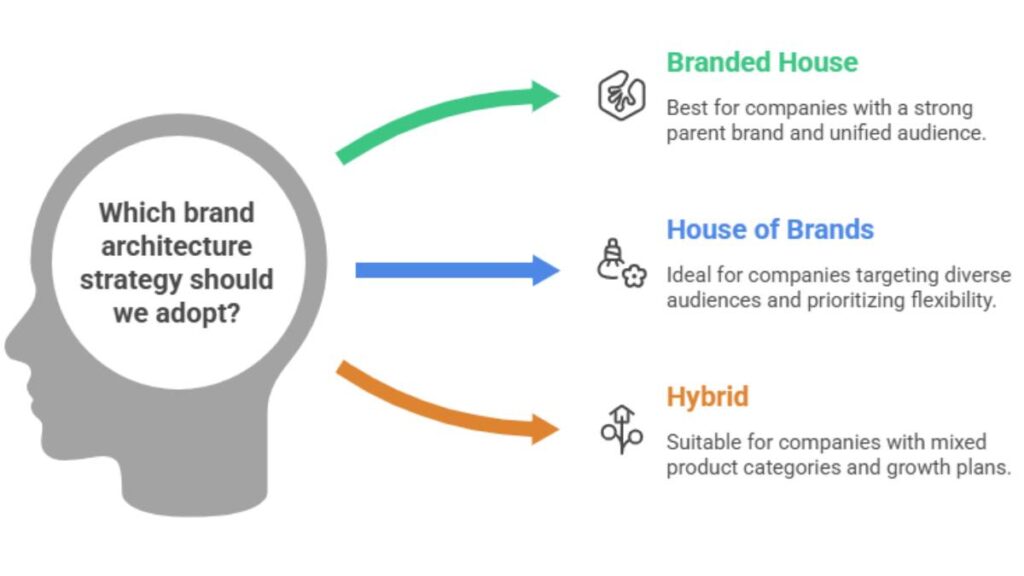
Branded House Strategy (Monolithic Brand Architecture)
This is the most unified approach. Everything revolves around one master brand. No separate identities competing for attention. No fragmented perception.
Customers don’t see multiple brands. They see one brand, expressed in different forms.
The master brand does the heavy lifting.
Branded House Definition and Meaning
In a branded house, the parent brand stays front and center. Product names usually support it, not replace it.
You’ll notice naming patterns like:
- Parent brand + product function
- Parent brand + descriptor
- Parent brand + variation
The master brand always leads. Always visible.
This consistency compounds over time. People begin to trust the brand itself, not just individual products.
Companies like Google, Apple, and FedEx built enormous brand equity this way. Every new product strengthens the parent brand instead of diluting attention.
It’s efficient. And powerful.
Core Characteristics of the Branded House Model
Certain patterns show up repeatedly in strong branded house systems:
- The master brand dominates all communication
- Products support the parent brand, not compete with it
- Messaging remains consistent across offerings
- Marketing builds one central perception over time
Customers don’t need to “learn” new brands constantly. Recognition becomes automatic.
That familiarity reduces friction. Especially in crowded markets.
Advantages and Limitations of the Branded House Strategy
Advantages:
- New products gain trust faster
- Marketing investment compounds instead of fragmenting
- Brand recognition grows stronger over time
- Clear, unified positioning
Limitations:
- One product failure can affect the overall perception
- Less flexibility when targeting very different audiences
- Harder to separate unrelated categories
This model works best when products share a common philosophy or audience.
Technology companies, SaaS platforms, and service businesses tend to benefit most from it.
When Branded House Strategy Makes Strategic Sense
This approach works especially well when:
- The parent brand already has strong credibility
- Products feel naturally connected
- Long-term brand equity is a priority
- The company wants to dominate with one recognizable name
It’s slower at first. But incredibly strong over time.
House of Brands Strategy (Pluralistic Brand Architecture)
House of brands takes the opposite approach. Instead of concentrating equity in one brand, the company builds multiple independent brands.
Each one has its own identity. Its own audience. Its own positioning.
Sometimes, customers don’t even know they share the same parent company.
And that’s intentional.
House of Brands Definition and Strategic Meaning
In this model, the parent company stays mostly invisible. Individual brands operate independently in the market.
Each brand controls:
- Its own voice
- Its own positioning
- Its own customer segment
- Its own marketing strategy
This creates maximum flexibility.
Companies like Procter & Gamble and Unilever built massive portfolios this way. Their brands often compete in completely different segments, even within the same category.
Customers connect with individual brands, not the parent company.
How House of Brands Strategy Works in Practice
Instead of building one dominant brand, equity spreads across multiple specialized brands.
This allows companies to:
- Target completely different audiences
- Experiment with positioning
- Reduce risk to the parent brand
- Acquire and integrate brands easily
It’s structurally more complex. But strategically flexible.
Benefits and Tradeoffs of the House of Brands Model
Benefits:
- Freedom to target different segments independently
- Reduced risk to the overall company reputation
- Easier acquisition integration
- Clear differentiation between offerings
Tradeoffs:
- Higher marketing costs
- Slower equity accumulation per brand
- More operational complexity
- Less cross-brand synergy
This model prioritizes flexibility over efficiency.
It works especially well in consumer goods, where audiences and positioning vary widely.
When House of Brands Strategy Is the Right Choice
This approach makes sense when:
- Products serve very different audiences
- Brand positioning needs separation
- The parent brand adds limited value to certain categories
- Growth includes acquisitions
It gives room to expand without forcing everything into one identity.
Hybrid Brand Architecture Strategy (Balanced Approach)
Hybrid architecture sits somewhere in between. Some brands stay closely tied to the parent. Others operate independently.
This reflects reality for many growing companies.
Growth rarely follows a perfectly clean structure.
Some products benefit from parent brand association. Others perform better standing alone.
Hybrid architecture allows both.
Hybrid Brand Architecture Definition
Hybrid architecture mixes branded house and house of brands elements.
Some products strengthen the master brand. Others maintain distance.
This creates balance; consistency where useful, independence where necessary.
Companies like Marriott International and Microsoft use hybrid structures effectively. Certain offerings reinforce the parent brand strongly. Others operate with more independence to serve different audiences.
It’s flexible. And realistic.
Strategic Advantages of Hybrid Brand Architecture
Hybrid models offer several practical benefits:
- Flexibility without losing brand cohesion
- Ability to serve diverse customer segments
- Better alignment between brand and product positioning
- Easier integration of acquisitions
It allows brand structure to evolve naturally.
Not everything has to follow one rigid rule.
When Hybrid Brand Architecture Works Best
This model makes sense when:
- Companies operate across multiple product categories
- Some offerings benefit from parent brand trust
- Others require distinct positioning
- Growth includes acquisitions or diversification
Most large companies eventually move toward hybrid structures.
It’s often the most sustainable long-term solution.

Enroll Now: Brand Management course
Brand Architecture Strategy Models and Supporting Frameworks
Beyond the three core models, there are more specific frameworks that refine how brands relate to each other.
These aren’t entirely separate systems. They’re more like structural variations; fine-tuning tools.
Most companies end up using combinations of these.
Monolithic Brand Strategy
Monolithic strategy is essentially another form of branded house, but with even stronger emphasis on unity.
Everything reinforces one central brand.
Sub-brands exist. But they never overshadow the parent brand.
The master brand carries the trust.
Strategic Role of Monolithic Brand Architecture
This works best when the company’s reputation is one of its strongest assets.
Customers trust the parent brand first. Products benefit automatically from that trust.
It simplifies perception. And simplifies marketing.
This structure is especially effective when clarity matters more than flexibility.
Endorsed Brand Strategy
Endorsed brand architecture creates a middle ground.
Sub-brands maintain their own identities, but still visibly connect to the parent brand.
The parent brand acts as a credibility signal.
Not overpowering. But present.
How Endorsed Brand Architecture Works
You’ll often see structures like:
- Sub-brand name, endorsed by parent brand
- Sub-brand identity with visible parent association
The sub-brand leads. The parent brand reassures.
Companies like Nestlé use this effectively. Individual products maintain distinct personalities, but the parent brand adds credibility quietly in the background.
It’s subtle. But powerful.
Strategic Benefits of Endorsed Brand Strategy
Endorsed branding allows companies to:
- Maintain differentiation between products
- Transfer trust from the parent brand
- Expand into new segments safely
- Balance independence with credibility
It’s particularly useful when expanding into adjacent categories.
Multi-Brand Strategy
A multi-brand strategy involves managing multiple brands; sometimes even within the same category.
This isn’t accidental. It’s deliberate.
Different brands target different price points, audiences, or positioning angles.
This allows companies to occupy more space in the market.
Strategic Importance of Multi-Brand Architecture
Multi-brand strategy helps companies:
- Reach more customer segments
- Capture greater overall market share
- Reduce dependence on one brand
- Adapt to changing customer preferences
But differentiation becomes critical.
If brands overlap too much, they weaken each other.
Clear positioning prevents internal competition.
Sub-Brand Strategy
Sub-brands allow companies to expand without abandoning the parent brand.
They stay connected, but with slightly more independence.
It’s a controlled extension.
Strategic Role of Sub-Brand Architecture
Sub-brands help companies:
- Enter new categories
- Target niche audiences
- Extend brand relevance
- Maintain parent brand credibility
Customers recognize the connection. Trust transfers naturally.
This makes expansion smoother.
Less resistance. Faster adoption.
Sub-Brand vs Endorsed Brand vs Independent Brand
The differences are subtle, but important.
- Sub-brands: closely tied to the parent brand
- Endorsed brands: independent identity with visible parent endorsement
- Independent brands: no visible parent brand connection
Each serves different strategic goals.
Choosing the right structure depends on growth direction, not preference.
Brand architecture, when done properly, doesn’t just organize brands. It quietly shapes how customers understand the entire business.
How to Develop a Brand Architecture Strategy (Step-by-Step Guide)
Brand architecture strategy rarely becomes a priority early on. At the beginning, most companies just focus on getting products out, acquiring customers, and building traction. Structure comes later. Usually, when things start feeling messy.
New products don’t fit neatly under the main brand. Naming becomes inconsistent. Customers aren’t sure what belongs to what. Internally, teams start improvising.
That’s usually the signal. The structure hasn’t caught up with the business.
Building a proper brand architecture strategy fixes this, but it requires stepping back and making deliberate decisions. Not cosmetic changes. Structural ones.
Here’s how that process actually works.

Step 1: Conduct a Brand Audit and Portfolio Analysis
Before changing anything, it’s necessary to see the full picture. Not the simplified version. The real one.
This means listing every brand, sub-brand, product, and offering currently in use. Everything. Even the ones that seem minor.
Once mapped out, patterns start to appear.
Some common things show up quickly:
- Products with completely different naming styles
- Sub-brands that don’t clearly connect to the master brand
- Multiple products targeting the same audience with similar positioning
- Legacy names that stayed around longer than they should have
It’s surprisingly common to find structural contradictions. One part of the portfolio follows a branded house logic. Another part behaves like a house of brands. Usually not intentionally.
This stage isn’t about fixing yet. Just understanding.
Clarity first. Decisions later.
Step 2: Define Your Business and Brand Growth Strategy
Brand architecture strategy should reflect where the company is going, not just where it is today.
This part often gets overlooked. Teams focus on organizing current products, but ignore future expansion. That’s a mistake. Because architecture decisions tend to last for years.
A few important things to consider:
- Will new products stay close to the core business, or move into new categories?
- Will the same audience be served, or completely different segments?
- Is the company planning to acquire other brands?
- Does the master brand have enough strength to carry future products?
If the business plans to build depth within a focused category, a branded house usually works well.
If expansion involves very different categories or audiences, separation becomes more useful.
Architecture should make future launches easier. Not harder.
Step 3: Understand Your Target Audience and Market Segmentation
Brand structure isn’t just an internal decision. It directly shapes how customers interpret the portfolio.
Customers naturally try to make sense of relationships. They look for signals. Naming, design, brand association; all of it influences perception.
When products serve similar audiences, keeping them under one master brand builds familiarity faster. Trust compounds.
But when audiences differ significantly, say, premium vs budget segments, forcing everything under one brand can create tension. It weakens positioning instead of strengthening it.
Some practical questions help here:
- Do customers benefit from seeing the parent brand association?
- Or would independence strengthen credibility?
- Does the master brand carry positive associations in this category?
Brand architecture works best when it aligns with how customers already think. Not when it tries to force a logic that only exists internally.
Step 4: Analyze Competitor Brand Architecture Strategy
Looking at competitors helps, not because their structure should be copied, but because it reveals category dynamics.
Certain patterns repeat within industries.
Technology companies, for example, often concentrate equity under one master brand. It reinforces trust across products. On the other hand, consumer goods companies frequently operate multiple independent brands. Different audiences, different positioning.
Both approaches make sense within their context.
Pay attention to things like:
- Whether competitors emphasize the parent brand or hide it
- How clearly sub-brands connect to the main brand
- Whether multiple brands target different price tiers or segments
Sometimes gaps appear, too. Opportunities to simplify where others have overcomplicated.
Understanding the landscape makes structural decisions more grounded.
Step 5: Define Brand Roles, Relationships, and Hierarchy
This is where the architecture starts taking shape.
Every brand in the system needs a defined role. Not just a name that exists because it was created at some point, but a strategic purpose.
Typically, the structure includes:
- The master brand (the primary source of equity)
- Sub-brands that extend or support the master brand
- Independent brands, if separation is necessary
- Individual product names
The key is clarity.
Customers should be able to understand relationships without needing explanations. The connection, or separation, should feel obvious.
If teams internally debate how brands relate, customers will definitely feel that confusion.
Hierarchy removes that ambiguity.
Step 6: Choose the Right Brand Architecture Model
At this point, the right model usually becomes clearer.
Most brand architecture strategies fall into one of three directions:
- A branded house, where everything strengthens one master brand
- A house of brands, where individual brands operate independently
- A hybrid structure, combining both where appropriate
The decision depends on reality, not preference.
A strong, trusted master brand can carry new products effectively. But if new products target completely different audiences, forcing association may create friction.
Hybrid structures often emerge naturally as companies grow. Some products benefit from master brand association. Others need distance.
The important thing is intentionality. Structure should reflect strategic logic, not historical accidents.
Step 7: Create Brand Naming and Messaging Structure
Naming is where architecture becomes visible.
Without a clear naming system, even well-designed architecture starts breaking down over time. New products get named inconsistently. Teams improvise. Structure slowly erodes.
Strong naming usually follows predictable logic:
- Clear connection to the master brand when appropriate
- Consistent patterns across product lines
- Logical extensions rather than random naming
Consistency builds recognition. It reduces cognitive effort for customers.
Messaging matters just as much. Tone, positioning, and voice should reinforce brand relationships. If one sub-brand feels completely disconnected in tone, it weakens cohesion.
Structure isn’t just visual. It’s perceptual.
Step 8: Build a Visual and Verbal Brand Identity System
Visual identity quietly reinforces architecture every time customers interact with the brand.
Things like logo structure, typography, and color usage; these signals shape perception faster than words do.
Related brands should feel connected visually. Not identical, but clearly related.
Independent brands, on the other hand, should maintain an appropriate distance.
Some key elements are usually defined here:
- Logo hierarchy and usage rules
- Visual relationships between the master brand and sub-brands
- Typography systems
- Tone of voice and messaging consistency
This isn’t about aesthetics alone. It’s about signaling structure clearly.
When done well, customers intuitively understand brand relationships without needing explanation.
Step 9: Create a Brand Architecture Diagram
This step sounds simple. But it’s incredibly useful.
A brand architecture diagram visually maps the entire structure: master brand, sub-brands, product lines, and independent brands.
Seeing everything laid out removes ambiguity.
It also becomes a reference point internally. Especially useful when launching new products or evaluating structural changes.
Without a diagram, architecture lives in scattered documents and individual interpretations.
With one, structure becomes tangible.
Step 10: Implement and Monitor Your Brand Architecture Strategy
Implementation is where many companies hesitate. Structural changes can feel disruptive.
But clarity always pays off long term.
Implementation may involve:
- Renaming products or aligning naming conventions
- Updating visual identity systems
- Clarifying brand relationships in communication
- Creating internal brand guidelines
Consistency matters more than speed here. Partial alignment creates mixed signals.
Brand architecture also isn’t permanent. It evolves as the business evolves.
It’s worth reviewing periodically, especially during expansion, acquisitions, or major repositioning.
When done properly, brand architecture becomes a foundation. It makes growth smoother. It strengthens recognition. It reduces confusion.
And over time, that clarity compounds.
Brand Architecture Strategy Examples
Brand architecture starts making real sense when looking at companies that have lived with these decisions for years. Not theory. Actual companies dealing with growth, acquisitions, shifting audiences, and product expansion.
A pattern becomes obvious fairly quickly. Some companies protect one central brand at all costs. Others intentionally keep brands separate. Neither approach is universally better. It depends on how customers think, how products differ, and honestly… how the company plans to grow over the next decade, not just the next quarter.
A few examples make this clearer.
Coca‑Cola Brand Architecture Strategy Example
On the surface, Coca‑Cola feels like one brand. Simple. Familiar. Almost permanent.
But underneath, there’s structure. Very intentional structure.
Products like Coca‑Cola Zero Sugar, Diet Coke, and Coca‑Cola Cherry aren’t trying to become independent brands. They stay visibly connected to the parent. Same name. Same visual cues. Same emotional territory.
That connection does most of the heavy lifting.
When a new variation launches, customers don’t need convincing. Trust already exists. Recognition is instant. There’s no introduction phase in the traditional sense.
Marketing effort compounds instead of resetting each time.
The master brand carries the credibility. Sub‑brands simply extend it into new preferences; lower sugar, different flavor, different lifestyle associations.
The important takeaway here is restraint. Coca‑Cola doesn’t create new brands unnecessarily. It stretches the existing one, but carefully. Extensions still feel like Coca‑Cola.
That consistency protects long‑term brand strength.
Marriott International Brand Architecture Strategy Example
Marriott tells a different story. More complex. And honestly, more reflective of how companies evolve over time.
Some of its brands stay closely tied to the parent. Courtyard by Marriott, Fairfield by Marriott; the connection is clear, and that association signals reliability. Customers know roughly what to expect.
But then there are brands like The Ritz‑Carlton or W Hotels.
They stand more independently. Their audiences expect something different. Luxury customers don’t want something that feels standardized or overly corporate. They want distinction. Separation helps create that.
This mix isn’t accidental. It allows Marriott to serve very different travelers without forcing everything into the same identity.
Budget traveler. Business traveler. Luxury traveler. Lifestyle traveler.
Each brand speaks differently, even though the parent company sits behind all of them.
Hybrid architecture gives flexibility. And flexibility becomes more valuable as portfolios grow.
Nestlé Brand Architecture Strategy Example
Nestlé operates in a way most people don’t fully notice.
Many of its product brands, KitKat, Maggi, and Nescafé, exist in customers’ minds as standalone brands. The Nestlé name isn’t always the primary driver of choice.
Customers don’t walk into a store thinking, “Buy Nestlé.” They think, “buy Maggi” or “buy KitKat.”
That separation creates freedom.
Each brand can build its own identity. Its own positioning. Its own emotional associations.
Problems in one brand rarely damage others. That insulation matters, especially in large portfolios.
This approach works best when products serve very different needs or live in different mental categories. Forcing everything under one master brand would create confusion instead of clarity.
Independence, in this case, makes the portfolio stronger, not weaker.
Apple Brand Architecture Strategy Example
Apple represents the opposite extreme. Almost everything reinforces one central identity.
Mac. iPhone. iPad. Apple Watch.
The product names matter, but the Apple brand carries the real weight. Customers aren’t evaluating isolated product brands. They’re evaluating whether it’s an Apple product.
That distinction changes everything.
Trust transfers automatically. New products don’t start from zero. They inherit credibility the moment they appear.
Over time, this creates a compounding effect. Every successful product strengthens the parent brand. And that stronger parent brand makes future launches easier.
But this only works because Apple protects its brand carefully. It doesn’t stretch into areas that would weaken its meaning.
Focus keeps the structure strong.
How to Choose the Right Brand Architecture Strategy
This is where many companies get it wrong. They copy structures from companies they admire, without asking whether the conditions are actually similar.
What works for Apple won’t automatically work for a growing SaaS startup. What works for Nestlé won’t make sense for a focused B2B company.
Brand architecture isn’t something chosen in isolation. It emerges from business reality.
Several factors matter more than most people realize.
Company Size and Growth Stage
Early on, simplicity wins. Almost every time.
Managing multiple brands sounds appealing, but it creates operational overhead very quickly. More positioning work. More messaging work. More marketing investment.
Spreading attention too early slows momentum.
Building one strong master brand first creates a foundation. Structure can expand later, when complexity genuinely requires it.
Trying to architect for a hypothetical future often creates unnecessary friction in the present.
Growth should drive structural complexity, not anticipation alone.
Product Diversity and Audience Separation
This factor quietly drives most architecture decisions.
When products serve the same audience, keeping everything under one brand makes life easier. Customers understand the connection. Marketing reinforces itself.
But when audiences differ significantly, shared branding can create tension.
A premium offering and a budget offering under the same brand can weaken perceived value. Enterprise and consumer audiences expect different signals.
Separate brands prevent those conflicts.
Customers should never feel confused about what a brand represents. Confusion erodes trust faster than most companies expect.
Strength of the Master Brand
This part is often overlooked.
A strong master brand creates options. A weak one creates limitations.
If customers already trust the brand, extending it into new areas feels natural. If the brand lacks recognition or carries narrow associations, extensions feel forced.
In those cases, building new brands can actually accelerate growth.
Brand strength determines architectural flexibility. Not the other way around.
Expansion Through Acquisitions
Acquisitions complicate brand architecture quickly.
Acquired companies often bring their own brand equity. Their own customer relationships. Their own recognition.
Eliminating those brands entirely can destroy value overnight.
Many companies take a hybrid approach here. Some acquired brands remain independent. Others integrate gradually.
There’s no single formula. The goal is to protect existing equity while creating long‑term coherence.
Forced integration rarely works as cleanly as expected.
Internal Clarity and Operational Reality
Brand architecture doesn’t only affect customers. It affects internal teams just as much.
When the structure is unclear, teams improvise. Naming becomes inconsistent. Messaging drifts. New launches feel disconnected from the broader portfolio.
Clear architecture removes decision fatigue.
Teams understand how new products should be positioned. How they should be named. How they should relate to the parent brand.
This clarity becomes more valuable as organizations scale. Without it, brand portfolios slowly become chaotic.
And fixing chaos later is far harder than preventing it early.
Common Brand Architecture Strategy Mistakes to Avoid
Most brand architecture problems don’t appear suddenly. They accumulate slowly, usually from well‑intentioned short‑term decisions.
A new product gets its own brand. Then another. Then another.
Eventually, the portfolio loses cohesion.
A few mistakes appear repeatedly.
Creating Too Many Sub‑Brands Without Clear Justification
This happens more often than expected.
New products feel important. Teams want them to stand out. So they create new brands.
But every new brand requires ongoing investment: positioning, messaging, and awareness building.
Over time, attention becomes fragmented.
Instead of strengthening one brand, companies dilute effort across many weaker ones.
Sometimes, a simple product name under the master brand would have been far more effective.
Restraint protects brand strength.
Lack of Clear Hierarchy
When relationships between brands aren’t obvious, customers notice.
They hesitate. They question whether products are related. They wonder whether trust transfers between them.
This uncertainty weakens perception.
Strong brand architecture removes ambiguity. Relationships feel intentional. Natural.
Customers shouldn’t have to analyze brand structure. It should be immediately clear.
Inconsistent Naming Decisions
Inconsistent naming quietly erodes brand coherence.
One product emphasizes the master brand. Another barely mentions it. A third introduces something completely unrelated.
Over time, the portfolio feels disconnected.
Consistency strengthens memory. Inconsistency weakens it.
Naming decisions shouldn’t be improvised. They should follow defined logic.
Even small inconsistencies compound over time.
Weak Master Brand Positioning
When the master brand lacks a clear meaning, the entire structure becomes unstable.
Sub‑brands lose direction. Messaging becomes fragmented. Customers struggle to understand what the company actually stands for.
Strengthening the master brand often fixes structural issues indirectly.
Architecture alone cannot compensate for weak positioning.
Structure amplifies meaning. It doesn’t create it.
Ignoring Future Growth
Some structures work well with three products. They break at thirty.
This happens when architecture is designed only for current conditions.
Growth introduces complexity. New categories. New audiences. New positioning requirements.
Architecture should allow expansion without constant reinvention.
Planning ahead reduces disruption later.
Not perfectly. Just enough to accommodate realistic growth.
Brand architecture rarely gets attention early. It feels abstract compared to product launches or marketing campaigns.
But over time, its impact becomes obvious.
Clear structure makes everything easier; launches, messaging, positioning, and even internal alignment.
And perhaps most importantly, it allows brand strength to compound instead of fragment.
That compounding effect is subtle at first. Then impossible to ignore.
Brand Architecture Strategy vs Related Branding Concepts
It’s easy to get tangled up in all the branding terms: architecture, hierarchy, portfolio, positioning. They overlap, sure, but each plays a distinct role. Think of it like this: architecture is the skeleton, the frame. Hierarchy, portfolio, positioning; they’re how the muscles, organs, and skin fit onto it.
- Brand Architecture vs Brand Hierarchy
Hierarchy is the levels: corporate, family, and product. Architecture is the map of how those levels relate. Without it, the hierarchy is just a list, not a system. - Brand Architecture vs Brand Portfolio
Portfolio management is about juggling multiple brands for revenue, coverage, and performance. Architecture is about relationships; when to lean on the parent brand, when to let a sub-brand do its own thing. - Brand Architecture vs Brand Positioning
Positioning is what people think and feel about your brand. Architecture makes sure those perceptions don’t clash or confuse the audience. - Brand Architecture vs Brand Strategy
Strategy answers why the brand exists and how it competes. Architecture decides how that strategy scales when new products, services, or acquisitions come into play.
Mix these up, and customers and even your own teams get confused. Clear architecture keeps the rest in check.
Signs Your Business Needs a New Brand Architecture Strategy
Problems usually creep in slowly. You don’t notice until things are tangled. Some early warning signs to watch for:
- Confusing product names
If customers can’t tell what’s related or who’s behind a product, it’s a signal. - Poor brand recognition
Too many disconnected brands dilute awareness. No one remembers who’s who. - Brand cannibalization
Products start eating each other’s market share instead of growing the business. - Difficult scalability
Adding new products feels messy and inconsistent. - Mergers, acquisitions, or expansion
Suddenly, there’s a jumble of old and new brands, and nothing fits neatly.
Spotting these early saves a lot of headaches down the line.
Benefits of a Strong Brand Architecture Strategy
A well-thought-out architecture doesn’t just “look organized.” It changes how the business runs and how customers experience the brand.
- Improved clarity
People instantly understand what belongs together. No guessing. - Better customer understanding
Decisions become easier because the brand story is obvious. - Faster product launches
New products slot in naturally. Teams spend less time debating names or messaging. - Stronger brand equity
Sub-brands reinforce the master brand instead of working against it. - Marketing efficiency
Campaigns carry more punch because messaging leverages existing brand recognition.
At the end of the day, good architecture makes growth smoother and marketing more focused.
Conclusion:
Brand architecture doesn’t get flashy headlines. But the right structure makes everything else easier.
A strong architecture:
- Fits business reality and audience expectations
- Protects and amplifies the master brand
- Let new products, acquisitions, or expansions slot in without chaos
- Reduces internal confusion
- Builds customer trust consistently
Over time, that clarity compounds. Each new launch or campaign reinforces the structure. It may not be exciting, but it’s essential. A solid brand architecture keeps the brand understandable, manageable, and durable.
It’s not about perfection. It’s about building a framework that works in the real world and keeps growing with the business.
FAQs: About Brand Architecture Strategy
1. What are the four main brand architecture strategies?
In the real world, most companies end up in one of four camps: branded house, house of brands, hybrid, or endorsed. A branded house, like Apple, keeps everything tightly linked to one master name. A house of brands, like Procter & Gamble, runs multiple independent brands. Hybrid blends the two. Endorsing gives independence, but with visible parent backing.
2. What is the difference between brand architecture strategy and brand portfolio strategy?
Brand architecture strategy is structural. It answers how brands connect and where they sit in the hierarchy. Brand portfolio strategy is commercial; where to invest, what to grow, what to retire. One builds the framework. The other decides how aggressively to play within it. They’re related, but not interchangeable.
3. When should a company change its brand architecture strategy?
Usually, when the cracks start showing. After acquisitions. When product names overlap, sales teams struggle to explain the differences. When customers hesitate because the brand structure feels muddy. Architecture shouldn’t change every year. But ignoring structural strain quietly compounds confusion.
4. How does brand architecture strategy affect brand equity?
Equity builds through consistency. When each product reinforces the same promise, the master brand grows stronger. When products pull in different directions, equity thins out. A disciplined brand architecture strategy ensures growth feels cumulative. Over time, that reinforcement becomes a serious competitive edge.
5. What is the role of the master brand in brand architecture strategy?
The master brand carries the weight. It sets the tone, the expectation, the standard. In companies like Apple, the master brand does most of the heavy lifting. Sub-brands benefit from that trust. If the master brand lacks clarity, everything underneath feels unstable.
6. What is an endorsed brand in brand architecture strategy?
An endorsed brand has its own identity, but signals support from a parent. Think of Nestlé backing KitKat. The product stands confidently on shelves, yet the endorsement reassures buyers. It’s a practical middle ground; autonomy with credibility attached.
7. How does brand architecture strategy support business scalability?
Growth without structure gets messy fast. A defined brand architecture strategy gives teams guardrails: naming logic, hierarchy rules, and clear roles. New products fit into a system rather than creating new confusion. Scaling becomes intentional. And far less chaotic.
8. What is a brand architecture framework?
A brand architecture framework is essentially a decision blueprint. It clarifies how brands relate and how future launches should be structured. Without it, brand decisions become reactive, often political. With it, there’s consistency. Over time, that consistency pays off.
9. How do startups create an effective brand architecture strategy?
Early-stage companies usually benefit from restraint. One strong master brand. Clear positioning. Limited fragmentation. Launching multiple standalone brands too early spreads recognition thin. As the business grows and segments diversify, the structure can evolve. Early clarity prevents painful clean-up later.
10. How does brand architecture strategy improve marketing efficiency?
When the structure is clear, campaigns reinforce each other. Messaging compounds instead of competing internally. Budgets stretch further because awareness builds on itself. Teams stop debating brand hierarchy every quarter. Efficiency comes from alignment, not from squeezing spend.
11. What is the difference between sub-branding and endorsed branding?
Sub-branding keeps products closely tied to the master brand, often sharing name and identity. Endorsed branding allows more independence but keeps visible parent credibility. Marriott International uses endorsement across its hotel portfolio. Each property stands apart, yet the corporate name reassures guests.
12. How do mergers and acquisitions impact brand architecture strategy?
Mergers force structural decisions quickly. Keep brands separate? Merge them? Introduce endorsement? Companies like Unilever often retain acquisitions within a house of brands structure. The right move depends on equity strength and how much audience overlap exists.
13. What are the risks of a poor brand architecture strategy?
Confusion creeps in first. Then overlap. Then wasted marketing spend. Weak architecture rarely collapses overnight. It erodes gradually, product by product, until the portfolio feels fragmented. Fixing that later can be disruptive and expensive.
14. How often should companies review their brand architecture strategy?
There’s no calendar rule. Reviews usually follow big shifts: acquisitions, repositioning, and expansion into new markets. Even without major disruption, periodic reassessment keeps the structure aligned with strategy. Architecture shouldn’t be static. But it shouldn’t be constantly reinvented either.
15. What is a brand architecture diagram, and why is it important?
A brand architecture diagram makes the invisible visible. It shows hierarchy, relationships, and endorsements all in one view. Once mapped, overlaps and gaps stand out immediately. Leadership alignment becomes easier because everyone is looking at the same structure.
16. What is brand architecture strategy in simple terms?
Put simply, brand architecture strategy is how a company organizes its brands so customers understand them without effort. It defines who leads, who supports, and how products connect. When done right, it feels obvious. When ignored, friction shows up quickly.
17. What are the main types of brand architecture strategy?
The main types are branded house, house of brands, hybrid, and endorsed. Each distributes equity and risk differently. The right choice depends on business goals, category diversity, and how strong the master brand already is.
18. How do you create a brand architecture strategy?
Start with a serious audit. Identify overlaps, gaps, and areas of confusion. Align structure with long-term growth plans. Define brand roles clearly. Choose the right model. Set naming and hierarchy rules. Then document and enforce them. It’s a strategic discipline, not just creative thinking.
19. What is the difference between a branded house and a house of brands?
A branded house centralizes equity under one dominant identity, like Google. A house of brands separates identities, as seen with Procter & Gamble. One compound’s awareness. The other spreads risk. Both can succeed if aligned with strategy.
20. What is an example of a brand architecture strategy?
Coca-Cola largely operates as a branded house, where product variations reinforce the master brand. Nestlé follows a house of brands model across categories. Both approaches reflect deliberate structural choices shaped by scale.
21. Why is brand architecture important for companies?
As companies grow, complexity increases. Brand architecture strategy keeps that complexity manageable. It protects equity, sharpens positioning, and prevents internal competition. Without structure, expansion creates fragmentation. With structure, growth compounds value instead of diluting it.