
A brand development strategy is, at its core, a long-term decision about how a business wants to exist in people’s minds. Not just how it looks, but how it feels. How it’s described when the company isn’t in the room. And more importantly, why does someone choose it over something else that probably does the same thing?
Many businesses assume branding is mostly visual: logo, colors, fonts, maybe a tagline. That’s part of it, sure. But the real work runs deeper. It’s in the positioning choices that narrow the focus. It’s in the tone used on the website, the promises made in sales conversations, the way products are packaged, even the kind of customers the business intentionally attracts, or quietly avoids.
This guide breaks down that process in a structured way, but not as theory. It explains how brands move from being just another option to becoming the obvious choice. That shift doesn’t happen because of louder marketing. It happens because the brand becomes clearer. More specific. Easier to trust.
It also looks at the parts that are often overlooked. The internal alignment. The consistency over time. The small, repeated signals build recognition slowly. Brand strength rarely comes from one big moment. It’s usually the result of hundreds of small, steady decisions that point in the same direction.
The goal here isn’t to create something that simply looks professional. Plenty of brands look professional and still feel forgettable. The goal is to build something that feels intentional. Something people recognize quickly. Something that holds its shape as the business grows, instead of needing to be reinvented every year.
Because in practice, a strong brand doesn’t just support growth. It makes growth easier.
Table of Contents
Introduction
What Is a Brand Development Strategy?
Let’s slow this down for a moment.
When people hear brand development strategy, they often think of visuals. A new logo. A rebrand announcement. Maybe a brand guideline PDF sitting somewhere in a shared drive.
But a brand development strategy isn’t a design project.
It’s the thinking behind how a business wants to be understood in the market, and how it plans to earn that perception over time.
At its simplest, a brand development strategy defines:
- Who the brand is
- Who it serves
- What makes it meaningfully different
- How will it consistently communicate that difference
Notice the word consistently. That’s where most brands break down.
Without a clear strategy, messaging shifts every quarter. Campaigns feel disconnected. Sales teams describe the company one way, marketing describes it another. Customers pick up on that confusion faster than most leaders realize.
A solid brand development strategy acts like a compass. It doesn’t dictate every tactic, but it keeps direction steady.
And that steadiness matters.
Strategic Value in Business Growth and Differentiation
Here’s something that becomes obvious after working with enough businesses: most industries are crowded with lookalikes.
Everyone claims to be:
- Customer-focused
- Innovative
- High-quality
- Results-driven
After a while, those words stop meaning anything.
A real brand development strategy forces sharper decisions. It asks uncomfortable but necessary questions:
- What are we willing to compete on, and what are we not?
- Which audience are we intentionally prioritizing?
- Where can we create clarity instead of noise?
That clarity becomes differentiation.
And differentiation does practical things:
- It reduces the pressure to constantly discount
- It shortens sales conversations because positioning is clearer
- It improves retention because expectations are aligned
- It strengthens referrals because customers can easily explain what makes you distinct
Growth feels less chaotic when the brand is clearly defined.
Internally, something else happens too. Teams align more naturally. Hiring becomes easier because values are defined. Partnerships become more strategic because the brand knows what it stands for.
That’s not fluffy branding talk. That’s operational leverage.
How Brand Development Supports Long-Term Success
Quick wins are tempting. Flashy campaigns. Aggressive promotions. Trend-based marketing pushes.
They can work for a while.
But brand development is about equity. And equity builds slowly.
Over time, a strong brand development strategy helps a business:
- Become recognizable without over-explaining
- Build trust through consistency
- Signal authority in its space
- Attract customers who align, not just customers who buy
Customers don’t just evaluate products. They evaluate confidence. Stability. Credibility.
A clear strategy ensures those signals are intentional, not accidental.
Without it, perception forms anyway, just not necessarily in your favor.
Why a Brand Development Strategy Matters in 2026
The market has changed. Not overnight, but steadily.
Customers research more. Compare more. Question more. They move between platforms quickly and expect coherence everywhere they look.
That’s where brand development strategy becomes critical.
It’s no longer enough to “have a brand.” Businesses need a structured approach to building and managing that brand across digital environments.
Role in Digital Transformation and Modern Search Behavior
Today, discovery often starts online. A search. A comparison article. A review thread. A website visit that lasts less than a minute.
If your brand positioning is unclear, that lack of clarity shows up immediately.
- Headlines feel generic.
- Value propositions feel interchangeable.
- Messaging feels safe, but forgettable.
A defined brand development strategy sharpens all of that.
It ensures that:
- Website messaging reflects a clear position
- Content reinforces expertise in a specific area
- Social presence aligns with core brand voice
- Sales messaging mirrors marketing language
When these pieces align, the brand feels intentional. Cohesive. Established.
When they don’t, the brand feels reactive. And reactive brands struggle to build authority.
Impact on Visibility, Authority, and Conversions
Visibility isn’t just about traffic. It’s about being recognized as relevant.
Authority isn’t built by saying “we’re experts.” It’s built by consistently communicating from a clear position over time.
Conversions improve when customers understand quickly:
- Who this brand is for
- What problem does it solves
- Why is it different from alternatives
A thoughtful brand development strategy supports all three.
It improves visibility by clarifying messaging.
It strengthens authority by reinforcing positioning.
It increases conversions by reducing confusion.
Without a strategy, marketing becomes a series of disconnected efforts. A campaign here. A redesign there. Some content sprinkled in.
With strategy, each action builds on the previous one. Momentum compounds. The brand becomes easier to understand and easier to trust.
At its core, a brand development strategy is about control and clarity. Control over how your business is perceived. Clarity in how it communicates. And discipline in how it grows.
It’s not flashy work. It’s foundational work.
And foundational work is what lasts.
Step-By-Step Brand Development Strategy Framework
This is where brand development strategy stops being theory and starts becoming operational.
A lot of companies understand the branding conceptually. Fewer actually build it step by step. And when steps are skipped, especially research and positioning, the entire structure feels unstable later.
Think of this framework as a disciplined progression. Each step informs the next. If one feels vague, it probably needs more work before moving forward.
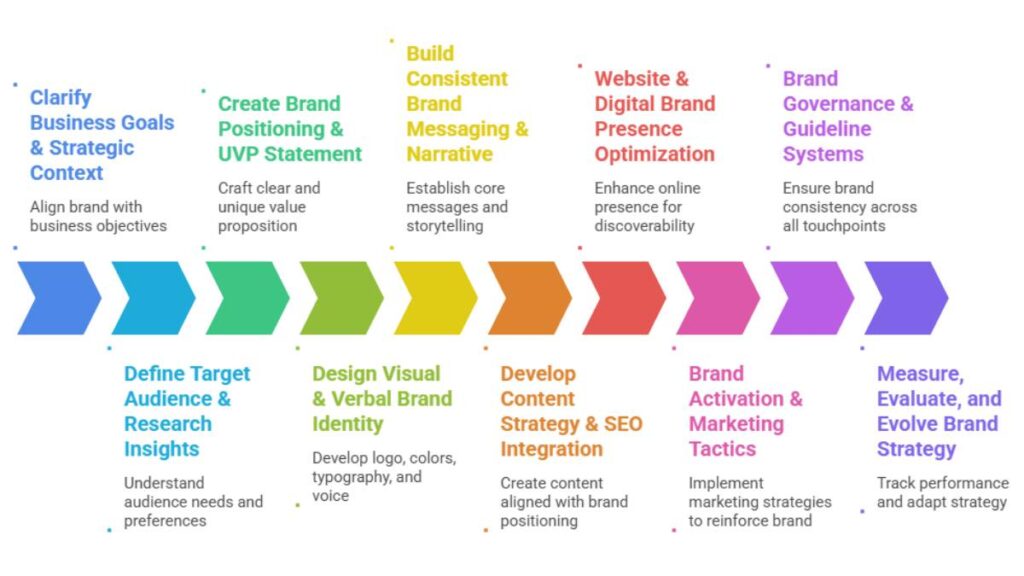
Clarify Business Goals & Strategic Context
Before discussing logos, messaging, or even positioning, the brand development strategy has to connect to business reality.
Brand exists to support growth. So start there.
Ask:
- What are the 3–5 year business goals?
- Are you scaling, repositioning, entering a new market, or defending share?
- What revenue model are you strengthening?
- What does success actually look like in measurable terms?
Brand positioning that ignores business strategy creates friction later. For example, a premium positioning doesn’t align with a volume-based growth model. A niche authority position won’t support a mass-market expansion without adjustments.
Understanding market positioning before branding is equally critical.
Look at:
- Current competitors and how they position themselves
- Gaps in messaging across the category
- Where saturation exists, and where clarity is missing
Brand development strategy is partly about differentiation, but it’s also about strategic fit. The brand must reinforce where the business is going.
Define Target Audience & Research Insights
Many brands claim to serve “everyone.” That’s usually the first red flag.
A strong brand development strategy defines an ideal audience clearly, sometimes uncomfortably clearly.
Start with segmentation:
- Demographics (if relevant)
- Psychographics: values, motivations, fears
- Buying triggers
- Decision-making patterns
- Pain points and objections
Audience segmentation best practices go beyond surface-level descriptions. Instead of “small business owners,” define:
- Revenue stage
- Industry type
- Growth challenges
- Internal resource constraints
Then layer in research.
User research and competitor analysis frameworks help answer:
- Why do customers choose competitors?
- Where are competitors overpromising?
- What language resonates most with buyers?
When audience research is done properly, messaging becomes sharper automatically. You stop guessing tone. You stop overexplaining. You start speaking directly to real concerns.
That clarity fuels every later stage of brand development strategy.
Create Brand Positioning & UVP Statement
Positioning is the backbone of the brand.
Without it, the brand floats.
A strong positioning statement clearly defines:
- Target audience
- Market category
- Primary benefit
- Key differentiator
Not in a poetic way. In a precise way.
For example, instead of saying, “We help businesses grow,” strong positioning would specify:
- What type of businesses
- What stage of growth
- What specific problem
- What makes the approach distinct
Developing a compelling, unique value proposition (UVP) requires discipline. It must be:
- Clear
- Specific
- Defensible
- Relevant to audience pain points
If competitors could copy your value proposition without changing anything, it’s too generic.
Positioning within a competitive market means deliberately choosing your lane. Sometimes that means narrowing the scope. Sometimes it means emphasizing expertise instead of breadth.
Strong brand development strategy prioritizes clarity over cleverness.
Design Visual & Verbal Brand Identity
Now, and only now, does identity come into play.
Designing a brand logo that resonates with user psychology isn’t about trends. It’s about alignment with positioning.
Premium brands signal restraint.
Innovative brands may signal boldness.
Trust-focused brands lean into clarity and stability.
Visual identity includes:
- Logo design
- Color psychology
- Typography hierarchy
- Layout principles
- Imagery style
But visual identity without verbal identity feels hollow.
Developing tone, language style, and voice consistency is just as important.
Ask:
- Is the brand authoritative or conversational?
- Technical or accessible?
- Direct or narrative-driven?
Voice should reflect both audience expectations and brand positioning. And it should remain consistent across website copy, content marketing, social posts, and sales communication.
Consistency builds recognition. Recognition builds trust.
Build Consistent Brand Messaging & Narrative
Brand messaging is where positioning becomes practical.
Start with the messaging hierarchy:
- Core message (top-level positioning)
- Supporting messages (proof points, differentiators)
- Audience-specific variations
Core messaging should remain stable. Supporting messages can adapt slightly depending on context.
Storytelling frameworks help bring structure to narrative. Instead of describing features, effective brand storytelling highlights:
- The problem
- The stakes
- The transformation
- The outcome
Emotion plays a role here. Not manipulation; alignment.
Customers want to see themselves in the story. They want clarity about what changes after working with you.
A disciplined brand development strategy ensures messaging remains cohesive even as campaigns evolve.
Develop Content Strategy & SEO Integration
Content is how brand positioning shows up publicly.
A well-defined content strategy supports brand authority and reinforces positioning over time.
This includes:
- Educational blog content
- Thought leadership articles
- Case studies
- Industry commentary
- Long-form cornerstone content
The key is alignment. Content topics should map directly to brand positioning.
If your brand claims expertise in a specific niche, content should demonstrate that depth consistently. Random topics dilute authority.
Long-form content strategies are particularly effective when structured around core brand themes. Over time, repetition within a focused domain builds credibility.
Content should not feel scattered. It should feel cumulative.
Website & Digital Brand Presence Optimization
Your website is the central brand hub. It’s where positioning, messaging, and identity converge.
Every critical element should reinforce the brand development strategy:
- Homepage headline clarity
- Clear value proposition above the fold
- Defined service pages
- Proof elements (case studies, testimonials)
- Logical navigation structure
SEO-optimized landing pages and structured metadata support discoverability, but clarity matters more than complexity.
Ask yourself:
Can a first-time visitor understand who this is for and why it matters within 10 seconds?
Digital presence extends beyond the website:
- Social media positioning
- Online directories
- Partnership mentions
- Media appearances
Each touchpoint should echo the same positioning. Fragmentation weakens authority.
Brand Activation & Marketing Tactics
Brand activation turns strategy into visible action.
This is where content marketing, social media strategy, and partnerships come into play.
Content marketing should reflect defined messaging pillars. Social media shouldn’t drift into random trends that don’t align with positioning.
Influencer collaborations and strategic partnerships must feel natural, aligned with the audience and values. Forced associations dilute brand strength.
Marketing tactics should always answer:
Does this reinforce our brand positioning? Or distract from it?
Discipline matters here.
Brand Governance & Guideline Systems
Brand consistency doesn’t happen automatically.
Internal brand guidelines create structure. They define:
- Logo usage
- Tone guidelines
- Messaging frameworks
- Visual standards
- Communication principles
Training teams to maintain consistency is just as important as creating guidelines.
Sales teams. Marketing teams. Customer support. Leadership.
If internal understanding is fragmented, external perception will be too.
Brand governance protects long-term equity.
Measure, Evaluate, and Evolve Brand Strategy
Brand development strategy is not static.
Measurement helps determine whether positioning is resonating.
Key brand KPIs may include:
- Brand awareness growth
- Engagement quality
- Lead quality improvements
- Sentiment tracking
- Conversion rates
- Customer retention
Quantitative data matters. So does qualitative feedback.
Are customers describing the brand the way you intended?
Are they using your positioning language organically?
If not, something may need refinement.
Continuous improvement is part of a mature brand strategy. Markets evolve. Audiences shift. Competitive landscapes change.
A strong brand development strategy adapts without losing its core identity.
That balance, stability with evolution, is what separates enduring brands from short-lived ones.

Enroll Now: Brand Management course
Advanced Brand Development Strategy Techniques
Once the foundational pieces of a brand development strategy are in place, things get more nuanced. This is the stage where many businesses either mature into strong, enduring brands… or slowly start drifting. The basics might be documented. The messaging may look clean. But without deeper refinement, brands plateau.
Advanced brand strategy isn’t about adding complexity. It’s about sharpening alignment. It’s about making sure growth doesn’t quietly distort the identity you worked hard to build.
Leveraging AI & Data Insights in Brand Strategy
Modern brand strategy has to be informed by real signals, not assumptions. Markets leave clues everywhere. Customers leave clues in how they describe your service. Competitors leave clues in how they adjust their positioning. Search behavior reveals what people actually care about, not just what they claim to value.
Pay attention to recurring language in customer conversations. Notice what objections repeat themselves. Observe which messages consistently generate strong engagement and which ones fall flat. Over time, patterns emerge. Those patterns should influence refinement, not trigger constant reinvention.
Predictive insights and sentiment analysis can highlight perception gaps; sometimes uncomfortable ones. For example, you may believe your brand is positioned as premium, but audience feedback may describe it as accessible or budget-friendly. That disconnect matters. It signals either a messaging issue or an experience misalignment.
Competitive benchmarking is equally important, though it should never lead to imitation. The goal isn’t to mirror competitors but to identify where the category feels crowded and where clarity is missing. Sometimes the strongest strategic move is simply articulating something more clearly than anyone else.
Still, there’s a balance. A brand that reacts to every data fluctuation becomes unstable. Consistency builds trust. Refinement should feel deliberate, not reactive.
Brand Experience Optimization Across Touchpoints
A brand doesn’t live only in positioning statements or website headlines. It lives in experience. And experience is where strategy is tested.
Consider the entire customer journey. The first visit to your website. The response time after an inquiry. The tone of your emails. The onboarding process. The way your support team handles friction. Each of these interactions reinforces or quietly contradicts your brand promise.
If your brand positions itself as high-touch but delivers automated, impersonal communication, credibility weakens. If you claim simplicity but require customers to navigate complicated processes, trust erodes slowly.
Brand experience optimization requires stepping back and auditing every touchpoint with fresh eyes. Does the sales conversation reflect the same tone as your marketing? Does the product experience feel aligned with your visual identity and messaging? Are expectations set clearly, and then met consistently?
UX and CX alignment isn’t glamorous work, but it’s powerful. When brand values and user experience move in the same direction, customers feel it. The brand becomes cohesive. Predictable in a good way.
A strong brand development strategy treats experience design as an extension of positioning. Weak strategies treat it as an afterthought.
Brand Extension & Growth Strategies
Growth introduces pressure. Expansion opportunities appear. New markets open. Additional product lines seem promising. And this is where discipline becomes critical.
Brand extension can accelerate momentum, but it can also dilute everything. Before expanding into new offerings, it’s worth asking whether the extension strengthens the core positioning or blurs it.
A focused brand often grows more sustainably than a scattered one. When you attempt to serve too many segments under one identity, messaging becomes strained. The brand starts feeling stretched.
Strategic planning for brand extension involves thinking several steps ahead. If the new offering succeeds, will it redefine your core identity? Are you prepared for that shift? If it fails, will it weaken the perception of your main service?
Strong brands expand in ways that feel natural to their audience. The growth feels like a logical evolution, not a random addition.
Restraint is often underrated in brand development strategy. Not every opportunity is aligned.
Common Brand Strategy Mistakes to Avoid
Even experienced teams make predictable mistakes. One of the most common is investing heavily in visual identity before clarifying positioning. Design can enhance strategy, but it cannot compensate for its absence.
Another frequent misstep is trying to appeal to too broad an audience. When messaging attempts to resonate with everyone, it resonates deeply with no one. Clarity requires boundaries.
Some brands change tone or messaging too often, especially when short-term results don’t appear immediately. That inconsistency confuses customers. It also prevents the brand from building cumulative recognition.
Ignoring measurement is another issue. Brand development strategy requires feedback. If you’re not evaluating awareness trends, engagement patterns, or customer sentiment, you lack insight into whether your positioning is landing as intended.
Perhaps the most subtle mistake is treating the brand as a marketing department responsibility alone. Brand influences sales, operations, customer service, and leadership communication. If alignment stops at marketing, the strategy will eventually fracture.
Conclusion:
A brand development strategy is not a campaign plan. It’s a long-term architecture for perception.
When executed thoughtfully, it clarifies who you are, who you serve, and why you matter. It aligns messaging, experience, and growth decisions under one consistent identity.
Implementing a brand development strategy step by step requires discipline. You start with business goals and market context. You define the audience carefully. You develop positioning and a compelling value proposition. You build identity systems that reinforce that positioning. You structure messaging. You align content and digital presence. You activate through marketing. You establish governance. You measure and refine.
It’s straightforward in sequence, but demanding in practice.
A simple checklist helps maintain focus. Is the brand clearly differentiated? Is messaging consistent across touchpoints? Does the customer experience reflect positioning? Are results being tracked thoughtfully? Are refinements strategic rather than reactive?
Strong brands aren’t built in bursts of inspiration. They’re built through clarity and repetition.
Markets will continue to shift. Competitors will continue to emerge. Trends will come and go.
But a brand grounded in strategy, consistent, differentiated, and aligned with real audience needs, remains steady. And steady brands tend to win over time.
FAQs: Brand Development Strategy
1. What’s the difference between brand strategy and brand development?
Brand strategy is the decision layer. It’s where the hard thinking happens: who the brand is meant for, what space it wants to own, and why anyone should care. Brand development is what happens after that. It’s the rollout. The identity, messaging, presence, and consistency that bring the strategy to life in the real world.
2. How long does it take to see results from a brand development strategy?
It rarely feels dramatic at first. Usually, the early signs are internal. Messaging becomes easier to write. Teams stop second-guessing tone. Then customers start responding differently. Recognition improves. Trust builds slowly. Most brands start seeing meaningful external impact somewhere between six months and a year, depending on consistency and market noise.
3. Can small businesses use the same brand strategy steps as enterprises?
Yes. The fundamentals don’t change. A small company still needs clear positioning, audience clarity, and consistent messaging. In fact, smaller businesses often benefit more because strong branding helps them compete against bigger players. When the brand feels focused and relevant, size becomes less of a disadvantage. Clarity can level the field surprisingly well.
4. What are the key elements of a successful brand development strategy?
It starts with knowing exactly who the brand serves and why it exists. From there, positioning defines how it stands apart. Messaging reinforces that difference, and identity makes it recognizable. None of these works in isolation. When they align, the brand feels cohesive. People understand it faster. And more importantly, they remember it later.
5. How is a brand development strategy different from a marketing strategy?
Brand development shapes perception over time. Marketing drives immediate action. Marketing campaigns promote offers, products, or services, but brand strategy defines how those messages feel and what they represent. Without strong branding underneath, marketing may still work, but it won’t build lasting recognition or preference. It becomes temporary instead of cumulative.
6. How much does it cost to create a brand development strategy?
Costs vary widely, but the bigger risk is operating without one. Poor positioning leads to wasted marketing spend, unclear messaging, and slow growth. A strong brand strategy improves efficiency across everything else. It reduces friction. It sharpens communication. The return isn’t always instant, but over time, it compounds in meaningful ways.
7. When should a company update or refine its brand development strategy?
Usually, when the business outgrows its original positioning. This happens more often than expected. New services get added. Target audiences shift. Market conditions evolve. When messaging starts feeling slightly off, or harder to explain, that’s usually a signal. Brand strategy should reflect the current reality of the business, not its earlier version.
8. What role does SEO play in a brand development strategy?
Search behavior reveals what people care about and how they describe their problems. That insight helps refine positioning and messaging. When brand language aligns naturally with audience language, discoverability improves as a side effect. More importantly, relevance improves. People recognize that the brand understands their needs without needing heavy persuasion.
9. How do you measure the success of a brand development strategy?
Brand strength shows up in subtle ways. Customers understand the offering faster. Conversations move forward with less explanation. Recognition increases. Referrals become more frequent. Over time, the brand starts carrying its own weight. Marketing becomes easier because trust already exists before the first interaction even begins.
10. Can startups build an effective brand development strategy with a limited budget?
Yes, because strategy itself doesn’t require a large budget. It requires clarity. Many early-stage companies succeed by being extremely focused on a specific audience and problem. That focus naturally sharpens messaging. Visual polish can improve later. But clarity, once established, creates momentum even when resources are limited.
11. What are common brand development strategy mistakes businesses make?
One common mistake is jumping straight into design without defining positioning. The result looks good, but it doesn’t mean much. Another mistake is inconsistency; changing tone, messaging, or direction too often. Brands grow through repetition. Familiarity builds gradually. Constant shifts reset that progress and make the brand harder to recognize over time.
12. How long does it take to implement a complete brand development strategy?
The initial strategy work might take a few weeks or months, depending on the depth. But brand development itself doesn’t really end. It evolves continuously. Messaging gets refined. Positioning becomes sharper. Market understanding deepens. Strong brands aren’t static. They stay aligned with the business as it grows and changes.
13. What tools and frameworks are best for building a brand development strategy?
Frameworks help organize thinking, but they’re only as useful as the insight behind them. The most important part is understanding the audience, competitors, and the brand’s true strengths. That clarity drives better decisions. Frameworks simply provide structure. They don’t replace the need for thoughtful positioning and honest evaluation.
14. Why is consistency so important in brand development strategy?
Consistency builds familiarity. Familiarity builds trust. When people encounter the same tone, message, and identity repeatedly, recognition becomes automatic. Over time, the brand feels dependable. Inconsistent brands never reach that point. They always feel slightly unfamiliar, even after multiple interactions.
15. Can a brand development strategy improve customer loyalty?
Yes, because loyalty depends on confidence. Customers stay with brands they understand and trust. When expectations are met consistently, that trust deepens. The brand becomes predictable in a good way. That predictability reduces uncertainty, which makes customers more likely to return and recommend it to others.
16. Does brand development strategy affect sales performance?
It does, often more than expected. When positioning is clear, customers understand value faster. Sales conversations become more focused. Less time is spent explaining basics. More time is spent addressing real needs. Strong branding removes friction. It prepares customers before they even speak with the sales team.
17. Is brand development strategy only important for new businesses?
No. Established businesses need it just as much, sometimes more. Over time, messaging drifts. Offerings expand. Market perception changes. Revisiting brand strategy helps restore clarity. It ensures the brand reflects what the business actually is today, not what it used to be.