

Brands get lost in the shuffle fast. Everyone’s claiming “high quality” or “innovative,” and after a while, it all sounds the same. A brand differentiation strategy isn’t about shouting louder. It’s about picking a clear spot to stand in your customers’ minds and sticking to it, even in small everyday choices. This blog walks through how to figure out what actually matters to your audience, how to define a UVP that isn’t just words on a page, and how emotional connection, experience, and even pricing quietly set a brand apart. Plus, it touches on rolling it out across teams and channels, so it actually works.
Table of Contents
Introduction
Look at almost any industry long enough, and the same thing happens. Products start sounding alike. Services promise the same outcomes. Every website claims to be “innovative,” “customer-centric,” and “high quality.” After a while, it all blends together.
A brand differentiation strategy exists to stop that slide into sameness.
In simple terms, it’s the structured effort to define what makes a brand meaningfully different; and to express that difference so clearly that customers can feel it, not just read it. It’s not about being flashy or dramatic for attention. It’s about choosing a distinct place to stand and being consistent about it.
Because here’s the uncomfortable truth: when customers can’t tell the difference between options, they default to price, convenience, or habit. Not exactly a strong foundation for long-term growth.
Why differentiation actually matters
Differentiation isn’t a branding “extra.” It’s what gives all marketing efforts direction. Without it, campaigns might look good but feel disconnected. Messages change every quarter. Offers start chasing competitors. The brand slowly loses shape.
Clear differentiation helps a brand:
- Be recognized faster in crowded spaces
- Give customers a reason to care, not just compare
- Build a preference that goes beyond features
- Defend margins because the brand isn’t seen as interchangeable
- Strengthen loyalty through identity, not just transactions
In markets where switching is easy, emotional and perceptual differences often matter more than small functional ones. People stick with brands that feel aligned with how they see themselves or how they want to feel. That part is often underestimated.
The real goal behind all this
The aim isn’t just to be different for the sake of it. Different can be confusing. Or irrelevant.
The real goal is to earn a clear, favorable position in the customer’s mind. A spot that connects what the brand does well with what a specific audience truly values. When that connection clicks, marketing gets easier. Sales conversations get shorter. Loyalty feels more natural, less forced.
That’s the power of thoughtful differentiation. Quietly strategic, but incredibly practical.
Core Elements of a Brand Differentiation Strategy
Strong differentiation doesn’t come from one clever idea. It’s built from several decisions that line up: market understanding, audience clarity, value definition, positioning, and expression. Miss one, and the rest start to wobble.
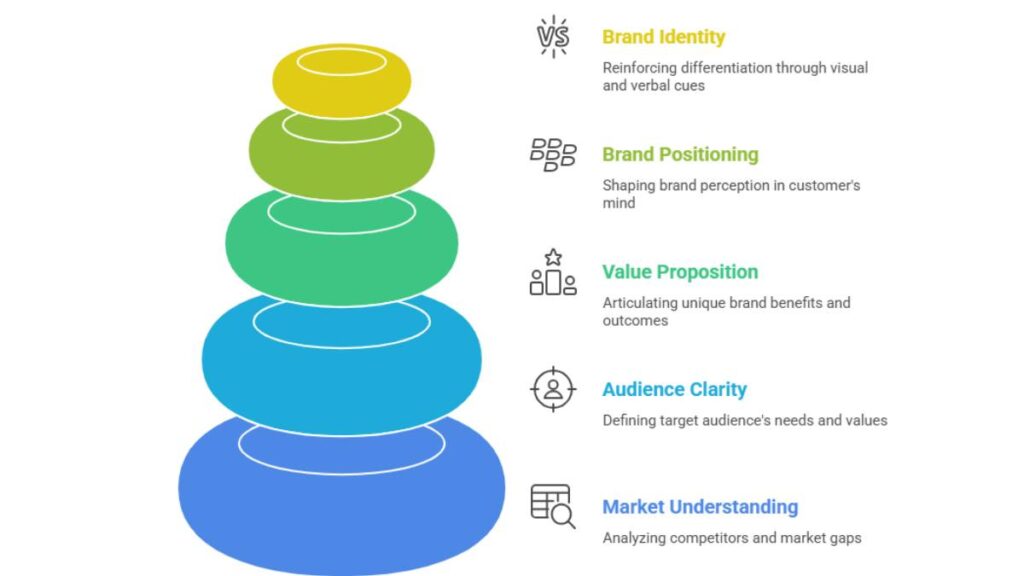
Understanding Your Market and Competitors
Before trying to stand out, it helps to see the full picture of what everyone else is doing. Sounds obvious, yet many brands skip this and rely on assumptions.
A proper look at the market usually reveals patterns:
- Competitors using near-identical language
- Everyone claiming to be the “trusted” or “leading” choice
- Similar feature lists are presented as if they’re unique
That’s where opportunity hides; in the gaps created by repetition.
A few useful angles to explore:
- Where are competitors over-investing in the same messages?
- Which customer needs are mentioned lightly but never deeply addressed?
- Are there audiences being served functionally, but not emotionally?
Frameworks like SWOT or perceptual maps can help organize thinking, but the real value comes from interpretation. The goal isn’t just to list strengths and weaknesses. It’s to spot white space; areas of value, tone, or focus that no one fully owns yet.
That’s often where a brand can step in with credibility.
Identifying Your Target Audience
Trying to be meaningfully different from “everyone” usually results in being vaguely similar to most. Differentiation sharpens when the audience definition sharpens.
A well-defined audience goes beyond age brackets or job titles. It digs into:
- What problems feel urgent versus mildly annoying
- What trade-offs they’re willing (or unwilling) to make
- What emotional outcomes matter: security, status, freedom, simplicity
Sometimes two segments buy the same product for completely different reasons. One might want efficiency. Another wants reassurance. Same category, very different levers for differentiation.
Segmentation can be shaped around:
- Needs and pain points
- Values and attitudes
- Behaviors and decision styles
- Emotional drivers that influence trust and preference
When a brand clearly understands who it’s really for, differentiation stops being abstract. It becomes a set of choices about what to emphasize, what to ignore, and where to take a stand.
Define Unique Value Proposition (UVP)
The unique value proposition is where the strategy becomes concrete. It answers a practical question:
What does this brand do or deliver in a way that truly stands apart?
Strong UVPs tend to share a few traits:
- They focus on outcomes, not internal processes
- They are specific enough to be memorable
- They reflect something the brand can consistently back up
Vague statements like “high quality solutions” don’t differentiate. Almost everyone claims that. A sharper UVP draws a line; this is what makes the offer meaningfully different, and here’s why that difference matters.
It becomes a filter for decisions, not just a line on a website.
Brand Positioning
Differentiation defines the substance. Positioning shapes how that substance lives in the customer’s mind.
Positioning clarifies things like:
- Who the brand is primarily for
- The context or category it wants to be associated with
- The main benefit, belief, or promise it wants to be known for
Two brands can offer similar services but position themselves very differently. One might lean into premium expertise and exclusivity. Another might emphasize approachability and ease. Both are valid, but they attract different expectations and audiences.
Clear positioning prevents mixed signals. It gives marketing, sales, and product teams a shared direction instead of everyone interpreting the brand slightly differently.
Brand Identity and Personality
Visual identity and brand personality often get treated as decoration. In reality, they reinforce differentiation every single day.
Identity includes elements like:
- Logo and visual symbols
- Colors, typography, and layout style
- Imagery choices and overall design feel
These choices signal cues before a single word is read. A bold, high-contrast design communicates something very different from a soft, minimal one.
Personality and voice do similar work through language:
- Formal or conversational
- Playful or serious
- Direct and bold, or calm and reassuring
Over time, consistency in these areas builds familiarity. And familiarity builds mental availability; people recognize the brand faster, recall it more easily, and start associating it with a distinct feeling or tone.
That’s when differentiation moves from strategy documents into real-world perception.
Strategic Pathways for Brand Differentiation
This is the part where strategy leaves the slide deck and meets reality. Differentiation has to show up in ways people can notice without being told what to notice. Not loud for the sake of it. Just… distinct. Consistently.
There isn’t one single lever that makes a brand stand apart. Usually, it’s a mix of choices that, together, create a pattern customers start to recognize. Over time, that pattern becomes the difference.
Emotional Connection
Most buying decisions feel rational on the surface. Underneath, emotion is doing more work than many teams admit.
A brand that makes people feel understood, reassured, and capable; that brand earns a different kind of attention. It’s no longer just an option on a list. It feels like a better fit.
Emotional connection often shows up in small but telling ways:
- Messaging that speaks to real frustrations, not generic “pain points.”
- A tone that sounds aware of the customer’s world, not stuck in brand language
- Moments in the journey where tension is reduced instead of added
When customers feel a brand is on their side, preference builds quietly. Competitors can copy features. They struggle to copy that sense of alignment.
Innovation-Driven Differentiation
Innovation doesn’t have to be dramatic to matter. In fact, the most effective differentiation often comes from practical improvements people notice in everyday use.
A brand stands out when it challenges something the industry has accepted as normal, especially if that “normal” has always been a bit annoying.
This kind of differentiation might involve:
- Removing a step that customers never liked but tolerated
- Simplifying a process that competitors have made complicated
- Offering flexibility where the category usually feels rigid
If the change saves time, reduces confusion, or lowers mental effort, customers feel the benefit quickly. And they remember who made things easier.
Brand Presentation and Storytelling
Before customers fully understand an offer, they react to how it looks and sounds. Visual identity and tone send early signals about who the brand is for.
Some brands differentiate through boldness and edge. Others through clarity and restraint. Neither is automatically better. What matters is that the presentation feels intentional and consistent, not like it’s chasing trends every year.
Storytelling adds depth to that presentation. Not dramatic tales for effect, but grounded stories that:
- Show the brand’s point of view on its category
- Highlight real customer progress or transformation
- Explain why the brand approaches problems the way it does
These stories give the brand a perspective. Over time, that perspective becomes recognizable. Customers begin to associate the brand with a certain mindset, not just a set of products.
Unique Customer Experience
Experience is where many brands accidentally differentiate, for better or worse.
When products look similar, customers remember how interactions felt. Smooth. Frustrating. Clear. Confusing. Those impressions stick longer than feature comparisons.
Experience-driven differentiation often comes from operational choices:
- How easy it is to find straightforward information
- How guided or overwhelming do the first steps feel
- How support conversations are handled when something goes wrong
- How clearly the brand communicates during uncertain moments
When the overall journey feels noticeably easier or more considerate, customers notice. They might not describe it in marketing terms, but they feel the contrast.
Pricing Strategy
Price sends a signal, even when a brand isn’t consciously using it that way.
Higher prices can communicate confidence, quality, or exclusivity. Lower prices can signal accessibility and practicality. Either approach can differentiate, as long as the rest of the brand experience supports the message.
Pricing works as a strategic differentiator when:
- It aligns with how the brand is positioned
- Customers can see why the offer is priced that way
- The approach is sustainable, not built on constant discounts
Competing only on price tends to create long-term pressure. But using pricing deliberately, as part of a broader identity, can reinforce how the brand wants to be seen.
Taken together, these pathways shape how differentiation shows up in daily interactions. Not through one bold claim, but through a steady pattern of decisions, emotional, functional, visual, and experiential, that make the brand feel distinct in ways customers pick up on naturally.

Enroll Now: Advanced Digital Marketing Course
Implementation Framework
This is where the real work begins. Not in the workshop, not in the slide deck. In the messy middle, where ideas meet deadlines and different teams interpret “the strategy” in their own way. That’s usually where differentiation either gets stronger… or slowly watered down.
Research and Insight Gathering
Before rolling anything out, it helps to sense-check the direction against reality. Not just dashboards and trend reports, but actual human behavior and conversations.
A few inputs tend to surface the truth faster than others:
- Customer interviews that reveal hesitation, confusion, or unexpected motivations
- Buying journey data that shows where people drop off or lean in
- Sales and support feedback: the raw, unpolished reasons prospects say yes, no, or “not yet”.
When the same themes keep showing up across sources, that’s usually pointing to something meaningful. Maybe it reinforces the chosen differentiator. Maybe it exposes a gap that was missed earlier. Either way, better to catch it now than after a big campaign goes live.
Develop Messaging and Communication Guidelines
Once the differentiator is clear, the next challenge is making it usable. Strategy language can be inspiring… and completely impractical at the same time.
Teams need guidance they can apply on a random Tuesday, not just at launch.
That usually includes:
- A simple brand narrative that explains what the brand stands for and why it exists in this space
- A few strong proof points that make bold claims believable
- Tone of voice direction: how the brand sounds when things go right, and when things go wrong
- Clear red lines: claims, tones, or tactics that don’t fit the positioning
Without this structure, messaging starts to drift. One campaign sounds premium, another sounds discount-driven. One team talks innovation, another talks convenience. None of it is technically “wrong,” but together it blurs the picture.
Integrated Multi-Channel Rollout
Customers don’t experience brands in tidy stages. They bounce. Social feed to website. Review the site for the sales call. Add to onboarding email. The differentiator has to survive all those jumps.
Consistency doesn’t mean repeating the same headline everywhere. It means the same core idea shows up in different shapes:
- Visual identity that feels familiar without being repetitive
- Messaging that reinforces the same positioning, adapted to the channel
- Experiences that actually deliver on what the brand promises
When a brand claims simplicity but has a clunky sign-up flow, that contradiction sticks. Same with a brand that positions as premium but offers slow, generic support. Those moments quietly undo months of positioning work.
Internal Alignment and Brand Advocacy
Employees influence brand perception more than most campaigns do. A single sales call or support interaction can either reinforce the differentiator… or completely ignore it.
If teams don’t understand what makes the brand different, they default to safe, generic behavior. It’s not intentional. It’s just easier.
Stronger internal alignment often looks like:
- Clear explanations of the brand’s positioning in plain language
- Practical examples of how the positioning should influence decisions
- Encouraging teams to reflect brand values in how they communicate and solve problems
When internal behavior and external messaging line up, differentiation feels real. When they don’t, the brand starts to feel like marketing spin. Customers notice, even if they can’t quite explain why.
Measurement and Optimization
Differentiation isn’t a one-time decision. Markets shift. Competitors copy fast. Customer expectations move quietly in the background. What once felt bold can become standard before anyone realizes.
Tracking the right signals
Some metrics look impressive but say very little about differentiation. Others reveal whether the brand is truly standing apart.
Signals that tend to matter more:
- Unaided brand recall: whether people think of the brand without prompts
- Brand associations: the qualities customers link to the brand first
- Repeat behavior and loyalty; signs of preference, not just curiosity
- Willingness to choose the brand at a similar or higher price
Short-term spikes in traffic or leads can be misleading. Attention doesn’t always equal distinctiveness.
Feedback loops
Ongoing feedback helps spot early warning signs. Or encouraging ones.
Useful sources include:
- Customer surveys with open-ended questions, not just ratings
- Reviews and testimonials, especially the language customers use naturally
- Sales team input on why deals are won, stalled, or lost
When customers start describing the brand using the same themes the strategy is built on, that’s a strong sign that alignment is happening. When descriptions sound generic, the positioning probably isn’t landing clearly yet.
Iterative refinement
Strong differentiation rarely comes from constant reinvention. It’s usually the result of small, steady adjustments.
That might mean:
- Sharpening how benefits are explained
- Adding clearer proof behind bold claims
- Fixing parts of the experience that quietly contradict the positioning
The core idea stays steady. The execution gets tighter over time. Less noise, more clarity.
Common Pitfalls to Avoid
Differentiation doesn’t usually collapse overnight. It fades. Edges soften, language gets safer, and gradually the brand starts sounding like the rest of the category again.
Generic messaging
Words like “innovative,” “high-quality,” or “customer-centric” sound good on paper. The problem is, nearly every competitor uses them too.
A quick gut check helps: if another brand could swap in its logo and use the same line without changing anything, the message isn’t doing much differentiation work.
Chasing differences, customers don’t value
Not every difference matters to buyers. Some feel impressive internally but barely influence real decisions.
Effective differentiation connects with priorities customers already care about: risk reduction, time savings, status, simplicity, growth, and peace of mind. If the difference doesn’t tie back to something meaningful in their world, it won’t carry much weight.
Inconsistency across touchpoints
A bold brand voice in ads but a bland, cautious tone on the website creates friction. Promising ease while delivering a complicated onboarding process erodes trust quickly.
Inconsistency blurs perception. And once the brand feels unclear, the differentiator loses sharpness, no matter how strong the original idea was.
Staying distinct takes ongoing attention. Not dramatic overhauls. Just steady alignment between what the brand says, how it behaves, and what customers actually experience. Over time, that consistency is what sticks.
Conclusion
A brand differentiation strategy isn’t just about looking different on paper or in an ad. It’s about how people actually think about a brand when they’re making decisions, often without even realizing it. That’s where the magic happens.
When differentiation works, conversations start to shift. Customers stop asking, “Which one is cheaper?” and start asking, “Which one feels right?” or “Which one actually understands what I need?” That shift alone can change everything. Price still matters, but it’s no longer the only game in town.
It also brings internal clarity. Teams make quicker decisions, marketing has a sharper point of view, and the brand stops drifting with every trend. Not everything will line up perfectly; that’s normal, but the drift slows, and consistency starts to feel natural.
The brands that stick in people’s minds aren’t the loudest or flashiest. They’re the ones that know exactly what they stand for, refuse to dilute it, and repeat it enough times for customers to notice. Over time, that repetition builds trust. And trust? That’s what leads to preference.
Differentiation isn’t a one-off project. It lives in small, everyday choices: the product features you emphasize, the way support handles issues, how the brand communicates; all the little things that add up.
FAQs:
1. What if competitors copy the differentiator?
They might copy the words, or even a feature or two. Sure. But the real difference, the way the brand actually behaves, delivers, and keeps its promise, that’s much harder to replicate. Copycats usually end up feeling… well, copied. A little hollow.
2. Can a brand have more than one differentiator?
Yes, but not too many. People rarely remember more than one or two things. Trying to lead with five different “uniques” usually dilutes all of them. Better to go deep on a couple of things than spread thin.
3. Does differentiation matter in price-sensitive markets?
Absolutely. Sometimes even more there. When buyers are comparing costs closely, a clear difference in reliability, ease, and support makes them feel safer. That perceived reassurance can outweigh small price differences.
4. How long before differentiation shows results?
Not instantly. Shifts in perception take a bit of time. Early hints show up in sales calls, customer feedback, or the way people talk about the brand. Metrics and market share follow later. Patience matters.
5. What if the brand already feels generic?
Start with honesty. How do customers actually describe the brand today? Once that’s clear, small but deliberate choices in messaging, positioning, and experience slowly reshape perception. It’s not flashy work, but it works.
Got it. Let’s make this feel less “crafted in a lab” and more like something written after years of watching brands get it right… and very wrong.
6. Is differentiation just branding theory, or does it really impact revenue?
It impacts revenue. Quietly, but directly. When a brand feels interchangeable, negotiations get tougher. Discounts creep in. Sales cycles drag. But when buyers see a clear difference, conversations change. There’s less explaining, less convincing. The decision feels safer. That usually shows up in margins first, then growth.
7. What’s the first sign that a brand is losing its differentiation?
Messaging starts sounding cautious. Safe. Generic. You’ll see more buzzwords creeping in and fewer specific claims. Internally, teams begin debating basic questions again: “What do we actually stand for?” That confusion doesn’t happen overnight. It builds slowly.
8. Can differentiation exist in boring industries?
Especially there. “Boring” industries are often full of sameness because nobody thinks it’s worth pushing. That’s usually the opportunity. Clarity, transparency, speed, and even tone of voice; those things stand out more in conservative categories because expectations are low to begin with.
9. How do you avoid confusing customers while trying to stand out?
By being different in a way that makes sense. If the differentiation forces customers to relearn the entire category, that’s friction. But if it simplifies, sharpens, or improves something they already care about, it feels natural. Different shouldn’t mean complicated.
10. Is emotional differentiation really that powerful in B2B?
Yes. Even in B2B. Decisions might be justified with spreadsheets, but they’re rarely made without emotion. Risk, reputation, pressure from leadership; those factors sit in the background of every major purchase. A brand that reduces anxiety or builds confidence has an edge, even if nobody says it out loud.
11. What if internal teams disagree on what makes the brand different?
That’s more common than most companies admit. Marketing says one thing. Sales says another. The product has its own angle. When that happens, customers receive a blurred version of the brand. Alignment conversations can be uncomfortable, but they’re necessary. Otherwise, the market decides your positioning for you.
12. How long does it take for differentiation to stick in the market?
Longer than leadership usually hopes. Perception shifts gradually. First in conversations. Then, in feedback. Then, in measurable behavior. Impatience leads to constant repositioning, which resets the clock every time. Consistency does the heavy lifting.
13. Can strong differentiation limit growth?
Only if it’s too narrow or built around something fragile. Clear positioning might reduce appeal to some segments, yes. But it strengthens appeal to the right ones. Broad and vague often feels safer, yet it rarely builds loyalty.
14. Does premium pricing automatically create differentiation?
No. Premium pricing without a premium experience just creates skepticism. Price can signal positioning, but it has to be supported everywhere else: service, design, communication, and delivery. Otherwise, it feels inflated rather than intentional.
15. What’s one practical step brands can take this quarter to sharpen differentiation?
Audit real customer language. Not survey ratings. Actual words from calls, emails, and reviews. Look for patterns. What do customers appreciate most? Where do they hesitate? There’s usually a clue there about what’s truly valued, and what’s being overlooked.