

Brand Management Strategy is often misunderstood as design work or campaign planning. It’s bigger than that. It’s the ongoing discipline of shaping how a business is perceived, and making sure that perception doesn’t drift over time. This blog walks through the real mechanics behind it: positioning that actually differentiates, messaging that holds steady, visual systems that don’t fragment, and internal alignment that keeps teams moving in the same direction. It also looks at practical examples, common pitfalls, and what tends to break when brand management is neglected. The focus isn’t theory. It’s the steady, structured work that turns a brand from something talked about… into something trusted.
Table of Contents
Introduction
What Is a Brand Management Strategy?
A brand management strategy isn’t a document you create once and forget. It’s more like a discipline. Ongoing. Sometimes tedious. Always necessary.
At its simplest, it’s the structured way a business decides how it will be perceived, and how it will protect that perception over time.
Not just during campaigns. Not just during launches. All the time.
Most companies think they “have a brand” because they have a logo and a color palette. That’s surface-level. A real brand management strategy answers harder questions:
- What space do we own in the customer’s mind?
- What are we willing to stand for, even if it costs us?
- Where do we draw the line?
Without clarity there, everything becomes reactive. Messaging shifts based on trends. Teams interpret the brand differently. Over time, the identity stretches… then blurs.
A proper strategy prevents that drift. It sets guardrails so creativity can happen without chaos.
Why Brand Management Matters for Modern Businesses
The market today is crowded. Loud. Restless.
Customers don’t patiently study brands anymore. They scan. They compare. They move on. Decisions happen faster than most internal teams realize.
That’s why brand management matters more now than it did ten years ago.
Consistency builds memory. Memory builds trust. Trust drives preference.
When brand management is strong, a few things quietly improve:
- Marketing becomes more efficient because the message is already defined.
- Sales conversations become easier because positioning is sharper.
- Customer retention improves because expectations are clear and consistent.
- Pricing pressure reduces slightly at first, then more noticeably.
On the flip side, poor brand management creates friction. Teams argue about tone. Campaigns feel disconnected. Customers sense inconsistency, even if they can’t articulate it.
And here’s the thing: inconsistency rarely shows up as a dramatic failure. It shows up as slow erosion. Lower recall. Softer loyalty. Slightly weaker conversion rates.
Small cracks. Over time, they add up.
Brand Management vs. Marketing: Not the Same Thing
This confusion happens all the time.
Marketing drives attention and demand.
Brand management defines what that demand is anchored to.
Marketing asks:
How do we get people to act?
Brand management asks:
What should they believe about us before they act?
Marketing is campaign-based and often short-term.
Brand management is structural and long-term.
Think of brand management as the foundation of a building. Marketing is everything built on top of it. You can renovate the upper floors as much as you want. If the foundation is shaky, the structure won’t hold.
When brand management is clear, marketing becomes more focused. Creative decisions happen faster. Messaging doesn’t wander. There’s cohesion.
Without it, every campaign starts from scratch.
Understanding Brand Management
What Is a Brand, Really?
A brand is not a logo. Not a font system. Not a clever tagline.
Those are identifiers.
A brand is the collection of associations people carry in their heads about your business.
It’s the shortcut they use when choosing. The expectation they feel before interacting. The emotional tone attached to your name.
And those associations don’t form from advertising alone. They’re shaped by:
- Product experience
- Customer service tone
- Pricing decisions
- Website usability
- Leadership behavior
- Public responses during crises
- Word of mouth
Everything signals something.
Brand management, then, is the ongoing effort to make sure those signals align instead of contradict each other.
It’s less about “looking good.” More about coherence.
Product Brand Management vs. Corporate Brand Management
Not all brands are structured the same way, and this matters strategically.
Product Brand Management focuses on individual offerings. Each product may have its own positioning, target audience, and personality. Common in consumer goods and tech ecosystems.
In these setups, the product often carries the emotional weight. Customers build loyalty to the product first.
Corporate Brand Management focuses on the company itself as the central trust anchor. The organization’s reputation supports everything it offers. This is more common in B2B, services, consulting, and enterprise spaces.
The strategic tension appears when companies try to do both: multiple product brands under a strong corporate umbrella. Alignment becomes more complex. Messaging must differentiate without fragmenting the core identity.
The real question is simple, though rarely asked clearly:
Where does the equity live?
In the product?
Or in the company?
The answer shapes the entire management approach.
Core Elements of Effective Brand Management
Across industries, strong brand management tends to share a few consistent elements:
- Clear positioning – A defined role in the market, not a vague aspiration.
- Consistent messaging – Repeated themes that build memory over time.
- Visual discipline – Design systems that reinforce recognition.
- Experience alignment – Promises matched by actual delivery.
- Internal clarity – Employees who understand what the brand stands for.
- Governance – Guidelines that protect consistency at scale.
Notice what’s not on that list: constant reinvention.
Strong brands don’t change personality every quarter. They evolve carefully. Gradually. With intention.
That restraint is part of the discipline.
The Importance of a Brand Management Strategy
Consistency Across Channels: The Hidden Advantage
Customers don’t interact with brands in neat, predictable funnels anymore.
They might come across a social media post. Then, they could read a review. After that, they might visit the website. Next, they might reach out to customer support. Then, they may vanish for six months. Finally, they might return. Each interaction either reinforces the same story or quietly contradicts it.
A structured brand management strategy ensures:
- The tone feels familiar everywhere.
- Visual identity doesn’t drift between teams.
- Key messages aren’t rewritten every quarter.
- Customer experience reflects what the marketing promised.
Consistency builds mental availability. Familiarity reduces hesitation. When customers recognize you quickly, decision-making speeds up.
Inconsistent brands, on the other hand, create subtle doubt. Something feels off. Not dramatic. Just unclear.
And unclear brands are rarely chosen first.
Internal Efficiency: The Overlooked Benefit
Brand management isn’t just external. It dramatically affects internal operations.
When teams understand the brand’s positioning and voice, decision-making becomes easier.
Design doesn’t argue over every color selection. Content doesn’t change its tone with each new campaign. Sales teams don’t make up value propositions on the spot. Clarity minimizes friction. Without that clarity, meetings stretch longer than they should. Creative reviews turn subjective. Departments pull in slightly different directions.
Brand strategy acts as a shared reference point. It aligns people who may never sit in the same room.
That alignment saves time. And time compounds.
Driving Engagement and Loyalty
Loyalty rarely comes from promotions alone.
It comes from identity alignment.
When customers feel that a brand reflects their values, aspirations, or standards, they return. Not just because of price or convenience, but because it feels familiar. Comfortable.
That’s where consistent brand management pays off.
Consistency fosters recognition.
Recognition nurtures trust.
Trust paves the way for preference.
And when preference is maintained over the years, it ultimately transforms into equity. Brands that manage this well don’t rely solely on constant acquisition. Their existing customers stay longer. Recommend more often. Forgive small mistakes.
That resilience is strategic.
Long-Term Growth and Brand Equity
Short-term growth tactics can spike revenue. Discounts. Aggressive campaigns. Heavy promotions.
But long-term growth depends on brand equity.
Strong brand management supports:
- Premium pricing
- Easier category expansion
- Faster adoption of new products
- Greater resilience during market downturns
- Stronger talent attraction
Equity doesn’t appear overnight. It accumulates through consistency and disciplined decision-making.
And that’s what brand management really is:
Not flashy. Not loud.
Disciplined.
Over time, that discipline becomes one of the company’s most valuable assets, even if it doesn’t always show up clearly on a quarterly report.
Key Components of a Successful Brand Management Strategy
Strong brand management isn’t built on slogans. It’s built on structure. When brands struggle, it’s usually because one of these core components is weak, undefined, or constantly changing.
Let’s break down what actually matters.
Brand Positioning Strategy
Positioning is where everything begins. If this isn’t clear, nothing else will be.
Defining Target Audience and Market Niche
Many brands claim to serve “everyone.” That’s usually the first red flag.
Clear positioning requires sharp audience definition:
- Who specifically is this brand for?
- What problem does it solve better than alternatives?
- What category does it compete in, and which ones does it deliberately avoid?
Strong brands narrow before they expand. They pick a space and own it.
Trying to appeal to everyone often results in sounding like everyone else.
Competitive Analysis for Brand Differentiation
Differentiation isn’t about being louder. It’s about being distinct.
That requires honest competitive analysis:
- What are competitors claiming?
- What emotional territory do they occupy?
- Where is the overlap?
- Where is the white space?
The goal isn’t to copy what works for others. It’s to identify where the brand can stand apart in a way that feels credible.
Positioning that isn’t believable won’t stick.
Positioning Statements That Resonate
A positioning statement isn’t meant for advertising. It’s meant for alignment.
It should clearly articulate:
- Target audience
- Category
- Core benefit
- Primary point of difference
When written well, it becomes a decision filter. If a campaign doesn’t support the positioning, it doesn’t move forward. Simple.
Without this anchor, messaging drifts.
Brand Messaging & Communication Strategy
Once positioning is clear, messaging gives it voice.
Crafting Clear and Consistent Brand Messages
Messaging should translate strategy into language that feels natural and repeatable.
Core messages typically include:
- Value proposition
- Brand promise
- Key differentiators
- Supporting proof points
Repetition matters here. Brands sometimes get bored with their own messaging long before customers even register it.
Consistency builds memory. Constant reinvention weakens it.
Aligning Tone of Voice with Brand Identity
Tone isn’t decoration. It signals personality.
Is the brand authoritative? Approachable? Bold? Reassuring? Playful?
Whatever the choice, it must align with positioning and audience expectations. A luxury brand speaking casually can feel off. A youth-focused brand sounding overly corporate feels disconnected.
Tone guidelines help prevent inconsistency across teams. Especially as content volume grows.
Multichannel Communication Planning
Different platforms require adaptation, not fragmentation.
The voice may adjust slightly between social media, website copy, email, and in-store communication. But the core message and personality should remain intact.
Fragmented messaging confuses audiences. Adapted messaging strengthens relevance without losing identity.
The difference matters.
Visual Identity Management
Visual identity is often what people notice first. It shouldn’t be treated lightly.
Logo, Color Palette, Typography, and Design Assets
A strong visual system goes beyond a logo. It includes:
- Primary and secondary color palettes
- Typography hierarchy
- Photography style
- Iconography
- Layout principles
When these elements work together consistently, recognition builds quickly.
When they’re used inconsistently, even strong brands can look fragmented.
The Role of Visual Consistency in Brand Recognition
Recognition reduces friction. The faster customers recognize a brand, the easier decisions become.
Consistency across:
- Website
- Packaging
- Social content
- Advertising
- Internal materials
…builds familiarity.
Frequent visual changes can disrupt that recognition. Rebrands should be intentional and strategic, not cosmetic updates driven by trend fatigue.
Case Studies: Successful Visual Identity Transformations
When companies redesign thoughtfully, the results can be powerful.
Kia shifted from a conservative automotive identity to a modern, forward-looking visual system. The logo change wasn’t just aesthetic; it aligned with a broader repositioning toward innovation and design credibility.
Apple has maintained remarkable visual discipline for decades. Clean lines, restrained color use, minimalism. The consistency reinforces premium positioning without constant reinvention.
Visual identity works best when it reflects strategy, not when it tries to replace it.
Customer Experience & Brand Loyalty
Brand isn’t what a company says. It’s what customers experience.
Integrating Customer Touchpoints into Brand Strategy
Every touchpoint communicates something:
- Website navigation
- Customer service tone
- Product packaging
- Onboarding emails
- Post-purchase support
If a brand promises simplicity but delivers a complicated experience, trust erodes quickly.
Customer experience must mirror brand positioning. Otherwise, the disconnect becomes obvious.
Creating Emotional Connections with Your Audience
Emotional alignment drives loyalty.
This doesn’t require dramatic storytelling. It requires consistency and reliability.
Brands that consistently meet expectations and occasionally exceed them build deeper relationships. Over time, customers stop comparing alternatives as aggressively.
That’s loyalty.
Tools to Monitor and Improve Customer Experience
Monitoring matters. Brands should track:
- Customer satisfaction scores
- Net promoter scores
- Retention rates
- Complaint patterns
- Reviews and feedback themes
Patterns reveal gaps between promise and delivery.
Ignoring feedback doesn’t protect the brand. It weakens it.
Brand Governance & Compliance
As brands grow, control becomes more complex.
Without governance, inconsistency spreads quickly.
Creating Internal Brand Guidelines and Policies
Comprehensive brand guidelines typically include:
- Positioning summary
- Messaging framework
- Tone of voice rules
- Visual standards
- Usage examples and restrictions
These guidelines should be practical, not theoretical. Teams need clear direction, not vague statements about “being innovative.”
Good governance empowers creativity within defined boundaries.
Preventing Brand Misuse and Inconsistency
In larger organizations, different departments may create materials independently. Without oversight, inconsistencies multiply.
Governance structures might include:
- Approval workflows
- Centralized brand reviews
- Asset libraries
- Training for new employees and partners
The goal isn’t control for control’s sake. It’s coherence.
Assigning Brand Custodians and Accountability
Someone must own the brand.
Not in a territorial way, but in a custodial sense.
Clear accountability ensures:
- Guidelines are updated when needed.
- Violations are corrected.
- Strategic shifts are implemented thoughtfully.
Without ownership, brand management becomes everyone’s responsibility; and therefore, no one’s priority.
Brand Management Tools and Technology
Brand management used to rely heavily on manual processes and static documents. That approach doesn’t scale well anymore.
Technology now plays a significant role in maintaining consistency and insight.
Digital Asset Management (DAM) Platforms
As brands grow, asset libraries expand rapidly.
Logos, photography, templates, presentations, video files; without central organization, teams waste time searching or, worse, recreating assets.
Digital Asset Management systems help:
- Centralize approved assets
- Control versioning
- Reduce duplication
- Maintain brand consistency globally
They’re less about storage and more about control.
Brand Monitoring and Analytics Tools
Brand perception can shift quickly. Monitoring tools help track:
- Online mentions
- Review sentiment
- Social media conversations
- Share of voice
- Brand awareness trends
Data doesn’t replace strategy, but it informs it.
Ignoring brand signals, especially negative ones, can create long-term damage. Early visibility allows a proactive response.
AI-Powered Tools for Brand Consistency and Personalization
Automation now supports consistency at scale.
AI-driven systems can assist with:
- Content personalization
- Messaging adaptation across audiences
- Sentiment analysis
- Visual compliance checks
Used correctly, these tools reinforce brand standards rather than dilute them.
The key is oversight. Technology should support the brand strategy, not dictate it.
How Technology Enhances Brand Strategy Execution
Execution often fails not because the strategy is weak, but because implementation breaks down.
Technology supports:
- Faster collaboration across teams
- Clearer visibility into performance metrics
- Streamlined content workflows
- Real-time feedback loops
But no platform replaces clarity.
A well-defined brand strategy remains the foundation. Technology simply makes consistent execution more achievable, especially at scale.
In the end, tools amplify discipline. They don’t create it.
Developing an Effective Brand Management Strategy: Step-by-Step
A brand management strategy doesn’t come together in a workshop and magically work forever. It’s built deliberately. Pressure-tested. Adjusted. Sometimes simplified.
The steps below aren’t flashy. They’re practical. And when done properly, they create clarity that lasts.
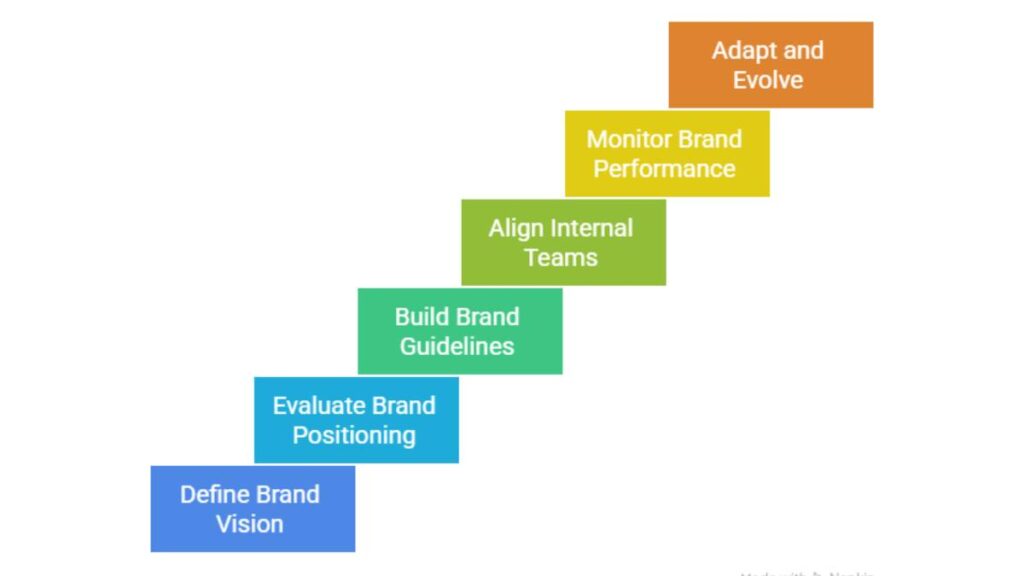
Step 1: Define Your Brand Vision, Mission, and Goals
Before discussing campaigns or creative direction, zoom out.
What is this brand actually trying to become?
- Vision defines the long-term ambition. Where is the brand heading?
- Mission clarifies what it does today and for whom.
- Goals translate both into measurable business outcomes.
This step forces focus. Many organizations skip it because it feels obvious. It rarely is.
A strong vision should guide decisions five years from now. If it only sounds good on a website, it won’t hold up internally.
Goals should connect brand to business impact: market share, retention, expansion, and pricing power. Otherwise, the brand becomes a decorative function instead of a strategic one.
Clarity here prevents confusion later.
Step 2: Evaluate Current Brand Positioning and Market Perception
Before building anything new, assess what already exists.
That means asking uncomfortable questions:
- How is the brand currently perceived?
- Is there a gap between internal belief and external reality?
- Are customers describing the brand the way leadership intends?
- Where is differentiation strong, and where is it weak?
This evaluation can include:
- Customer feedback analysis
- Review and sentiment tracking
- Competitive comparison
- Internal stakeholder interviews
Sometimes the biggest surprise is discovering how inconsistent perception has become across different audiences.
It’s better to see it clearly than to assume alignment.
Step 3: Build Comprehensive Brand Guidelines
Once positioning and messaging are refined, they need structure.
Brand guidelines should include:
- Positioning summary
- Target audience definition
- Core messaging pillars
- Tone of voice guidance
- Visual identity standards
- Usage rules and restrictions
- Real examples of correct and incorrect applications
The mistake many companies make is creating guidelines that are either too vague or too rigid.
Guidelines that are too vague lead to varying interpretations among teams, while overly strict guidelines stifle creativity. Effective guidelines serve as guardrails, allowing freedom without tying hands. And they should be accessible. If teams can’t easily find or understand them, they won’t use them.
Step 4: Align Internal Teams, Stakeholders, and External Partners
Even the best strategy fails if it lives in isolation.
Brand alignment requires internal buy-in. That includes:
- Marketing
- Sales
- Customer service
- Product teams
- HR and recruitment
- External agencies and partners
Everyone who communicates on behalf of the brand influences perception.
Alignment doesn’t mean turning everyone into brand experts. It means ensuring they understand:
- What the brand stands for
- How it should sound
- What it should avoid
- Why consistency matters
This often requires training sessions, workshops, or structured onboarding materials. Not once, but periodically.
Brand clarity fades when new hires enter without context.
Step 5: Monitor Brand Performance Using KPIs and Analytics
Brand performance isn’t measured by aesthetics. It’s measured by impact.
Key metrics might include:
- Brand awareness
- Consideration and preference scores
- Net promoter score (NPS)
- Customer retention rate
- Share of voice
- Sentiment analysis
- Price sensitivity trends
Not all metrics need to be tracked at once. But a brand strategy without measurement becomes subjective.
If awareness isn’t increasing, something may be off in messaging or reach.
If retention is weak, experience may not match positioning.
If sentiment shifts negatively, perception needs attention quickly.
Data doesn’t replace instinct. It sharpens it.
Step 6: Adapt and Evolve Based on Insights
A brand management strategy isn’t static.
Markets shift. Competitors reposition. Customer expectations evolve. Cultural trends change.
The key is evolution, not overreaction.
Brands that pivot too frequently lose identity. Brands that refuse to adapt become irrelevant.
The balance lies in protecting core positioning while adjusting execution.
- Messaging can be refined.
- Visual elements can be modernized.
- Channel strategies can shift.
- Experience standards can improve.
But the central promise, what the brand fundamentally stands for, should remain steady unless there’s a deliberate, strategic rebrand.
Periodic reviews help. Annual strategy evaluations. Quarterly performance check-ins. Not to reinvent, but to recalibrate.
Developing an effective brand management strategy takes discipline. It requires clarity, alignment, measurement, and restraint.
Done well, it creates momentum that compounds over time.
Done casually, it creates noise.
The difference isn’t creativity. It’s commitment.
Examples of Brand Management Success
Looking at strong brands helps cut through theory. Patterns become clearer when you see them in motion. Not perfect brands; just disciplined ones.
Uber: Turning Utility Into a Category Habit
Uber didn’t just grow because it had funding. It grew because it repeated one simple idea relentlessly: transportation, simplified.
Open the app. Tap. Car arrives.
That clarity showed up everywhere: interface design, messaging, onboarding, and expansion into new cities. Even when controversies hit (and there were many), the core utility message never became fuzzy.
That’s the part people miss. Brand management isn’t about never making mistakes. It’s about keeping the central promise steady, even when the company is under pressure.
When a brand becomes a verb, that’s not marketing hype. That’s repetition meeting clarity.
Apple: Restraint as a Strategy
Apple’s discipline is almost boring, and that’s the point.
Minimal design. Controlled launches. Tight messaging. A very specific emotional tone.
They don’t experiment wildly with personality every year. They refine. Subtle shifts. Small evolutions. But the core remains: premium, intuitive, design-first.
Walk into a store. Visit the website. Open the packaging. It all feels like it belongs to the same system.
That level of cohesion doesn’t happen accidentally. It requires saying no, often.
And saying no consistently is part of brand management.
Nike: Emotion With Structure
Nike plays in emotion, but it’s structured emotion.
The brand has stayed anchored to personal achievement and athletic identity for decades. Campaign styles change. Athletes change. Cultural moments shift.
But the underlying belief system? Stable.
What stands out isn’t just the storytelling. It’s the confidence to take a stand; socially, culturally, without diluting the core message.
Brands that try to attach themselves to every trend usually lose themselves. Nike filters everything through its central idea first.
That filter is the strategy.
Kia: Repositioning With Operational Backing
Kia’s visual rebrand got attention. The new logo sparked conversation. But the real shift happened underneath.
Design quality improved. Product perception changed. Messaging aligned with innovation rather than affordability alone.
A rebrand without operational change feels cosmetic. Consumers sense that quickly.
In Kia’s case, the identity shift was supported by product evolution. That alignment made the repositioning believable.
Believability is underrated in brand management.

Enroll Now: Brand Management course
Advanced Brand Management Strategy Trends
Trends come and go. The pressure to “modernize” never stops. But underneath the noise, a few shifts are genuinely reshaping how brands operate.
The challenge is adapting without fragmenting.
Digital Brand Management in a Fast-Moving Environment
Digital channels multiply quickly. New platforms appear. Content volume increases. Internal teams expand.
That creates two risks:
- Inconsistency.
- Speed overtaking strategy.
Brands now need tighter systems to manage assets, approvals, and messaging at scale. The days of a single brand manager reviewing everything manually are over in most organizations.
But speed alone doesn’t build equity. Fast inconsistency is still inconsistency.
The brands handling digital well are the ones that invest in structure first, then accelerate.
Personalization Without Identity Loss
Customers expect relevance now. Generic communication feels invisible.
So brands personalize. Offers change. Messaging adapts. Experiences shift based on behavior.
That’s smart, if done carefully.
The risk is fragmentation. If personalization becomes so extreme that different audiences see entirely different brand personalities, cohesion suffers.
The solution isn’t less personalization. It’s anchored personalization.
Core positioning remains fixed. Tone stays recognizable. Only the framing adjusts.
There’s a difference.
Social Media and Influencer Alignment
Social media forces brands into constant visibility. Every post communicates something. Every collaboration signals values.
Influencer partnerships can amplify reach quickly, but misalignment spreads just as fast.
The key question should always be: Does this partnership reinforce the brand’s positioning, or just chase attention?
Short-term engagement spikes are tempting. Long-term coherence matters more.
Brands that treat social media as a brand extension, not just a distribution channel, manage it better.
Sustainability and Social Responsibility
Consumers increasingly evaluate brands on ethics, not just utility.
Environmental commitments. Supply chain transparency. Community involvement.
But here’s the catch: performative messaging backfires.
If sustainability claims outpace operational reality, credibility drops quickly. Trust once lost is expensive to rebuild.
Brands integrating responsibility effectively usually do two things:
- Embed it operationally.
- Communicate it with clarity, not exaggeration.
Understatement often feels more credible than bold declarations.
Customer Experience as a Differentiator
Customer experience isn’t a support function anymore. It’s the brand strategy.
Response times. Ease of returns. Website clarity. Tone of service interactions.
If a brand promises premium positioning but delivers confusing support, the brand erodes.
Experience has become the proof point.
And increasingly, customers judge brands less on what they say and more on how they behave.
Brand Management Best Practices
There’s no secret formula. But strong brand management does follow certain habits. Repeatedly.
Continuous Evaluation, Not Constant Reinvention
Brands shouldn’t change identity every time metrics fluctuate.
Instead:
- Review perception regularly.
- Monitor key performance indicators.
- Identify patterns before reacting.
Small course corrections prevent dramatic pivots later.
Overreaction is often more damaging than inertia.
Responding to Feedback Without Losing Direction
Customer feedback matters. Market signals matter.
But not every piece of feedback requires repositioning.
Smart brand leaders ask:
- Is this an operational issue?
- A communication issue?
- Or a strategic issue?
Too many companies misdiagnose the problem and change the wrong layer.
Sometimes the product needs fixing, not the brand story.
Protecting Creativity While Enforcing Discipline
Creative teams thrive on exploration. Brand governance demands consistency.
These forces don’t have to clash.
Clear guardrails actually make creativity more effective. When boundaries are defined, teams can push within them instead of questioning fundamentals every time.
The balance isn’t rigid control. It’s structured freedom.
Scaling With Structure
As organizations expand, they often face increasing complexity. More teams, more markets, and more content can lead to a tangled web of inconsistency. To combat this, it’s essential to establish clear ownership, document guidelines, and define approval processes.
While this may not sound glamorous, it’s crucial for success. Strong brands may seem effortless from the outside, but behind the scenes, they require careful management and rigorous discipline.
At its essence, effective brand management isn’t about flashy reinventions or constant experiments. It revolves around clarity, repetition, and alignment, coupled with the patience to allow consistency to build and thrive over time.
Conclusion
Brand management strategy isn’t the exciting part of business. It’s not the campaign that trends for a week or the launch that gets applause on LinkedIn. It’s slower than that. Quieter. And honestly, that’s the point.
When a brand is managed well, most people don’t notice the management. They just feel clarity. They know what the company stands for. They know what to expect. That kind of predictability builds trust; not overnight, but steadily.
Over time, strong brand management starts showing up in subtle ways:
- Teams make faster decisions because the guardrails are clear.
- Marketing stops reinventing the tone every quarter.
- Sales conversations feel sharper, less defensive.
- Customers forgive small mistakes because the relationship already feels solid.
That’s brand equity doing its job.
The companies that win long-term aren’t always the loudest. They’re the most consistent. They protect their positioning. They align internal culture with external messaging. They treat brand like an asset, not a campaign.
And here’s the uncomfortable truth: brand management is never “done.” Markets shift. Customers evolve. Leadership changes. The strategy needs review. Sometimes adjustment. Rarely a full reset.
The real advantage comes from discipline. Showing up the same way, on purpose, for years. That kind of clarity compounds.
FAQs:
What is the difference between brand management and brand strategy?
Brand strategy defines where the brand is going and why it exists in the first place. It covers positioning, audience, differentiation, and the bigger picture. Brand management is the ongoing work of keeping everything aligned with that strategy. One sets direction. The other protects and executes it daily.
How do you measure the success of a brand management strategy?
There isn’t one single metric. Strong brand management tends to improve retention, pricing power, referral rates, and sentiment over time. Awareness matters, yes. But preference and loyalty matter more. If customers stay longer and trust the brand more, something is working.
Which tools are best for managing brand consistency?
Tools help: asset libraries, monitoring platforms, workflow systems. But without clear positioning and documented guidelines, no software will fix inconsistency. The foundation has to be strategic clarity first. Tools just make enforcement easier.
How often should a brand strategy be updated?
It should be reviewed regularly, usually once a year at a minimum. But constant changes are risky. If positioning shifts every time the market moves, customers lose confidence. Evolution should be intentional, not reactive.
What are the core elements of a brand management strategy?
Clear positioning. Consistent messaging. Visual standards. Defined tone of voice. Customer experience alignment. Internal buy-in. Governance. When even one of these is weak, cracks start to show.
How can small businesses implement an effective brand management strategy?
They don’t need complex frameworks. They need clarity. Define who the brand serves. Define what makes it different. Write down tone guidelines. Use the same visuals consistently. Small teams often execute better because fewer people create fewer inconsistencies.
What role does brand positioning play in overall brand strategy?
Positioning is the anchor. It tells the market why this brand exists and why it matters. Without it, messaging becomes generic and interchangeable. And once a brand feels interchangeable, price becomes the only lever left.
How does brand messaging affect customer perception and loyalty?
Repetition builds mental associations. If messaging is consistent and aligned with actual experience, trust builds. If messaging shifts too often, or promises more than delivery, skepticism grows. Loyalty doesn’t come from clever lines. It comes from reliability.
What are the best practices for creating brand guidelines?
Make them practical. Not a 200-page document nobody reads. Include examples. Show correct and incorrect usage. Clarify tone with real scenarios. And revisit them as the company grows. Guidelines should support teams, not overwhelm them.
How can digital tools improve brand management processes?
They reduce chaos. Centralized assets prevent off-brand materials. Monitoring tools surface sentiment shifts early. Analytics connect perception with performance. But again, they support the system. They don’t replace thinking.
What is the impact of social media on brand management strategy?
Social media accelerates everything. Feedback is immediate. Mistakes spread fast. But so does positive sentiment. A clearly defined tone of voice becomes critical here. Without it, every post risks sounding like it came from a different company.
How can companies monitor and protect their brand reputation?
Consistent listening. Regular review of feedback. Clear crisis protocols. Most reputation damage doesn’t come from one big mistake; it comes from slow, unaddressed friction that builds over time.
How does brand governance prevent misuse of brand assets?
Governance creates ownership. It defines who approves messaging, visuals, and partnerships. Without that structure, departments start improvising. Over time, the brand fragments. Governance isn’t bureaucracy; it’s protection.
What are the steps to align internal teams with brand strategy?
Start with education. Explain the positioning and the reasoning behind it. Reinforce it in onboarding. Integrate it into decision-making. When employees understand the “why,” alignment becomes natural.
How can personalization improve brand loyalty and customer experience?
Personalization increases relevance. But it must stay within the brand’s identity. Tailored messages should still feel like they come from the same company. Otherwise, personalization creates inconsistency instead of connection.
What metrics should be tracked in a brand management strategy?
Track awareness, sentiment, retention, engagement quality, and lifetime value. Trends matter more than snapshots. Brand health reveals itself over time.
How does sustainability influence modern brand management strategy?
Customers pay attention to values now. Sustainability isn’t just a messaging angle; it’s operational. If claims don’t match behavior, credibility erodes quickly. Authentic alignment is non-negotiable.
How can AI tools assist in maintaining brand consistency?
AI systems can flag inconsistencies, analyze large datasets, and support personalization. But they require clear brand standards to function properly. Technology amplifies clarity or confusion.
What are the challenges of managing a brand across multiple markets?
Cultural nuance. Language differences. Local competition. The challenge is adapting execution without losing the core identity. Global consistency with local relevance; easier said than done.
How do brands like Apple and Nike maintain long-term brand equity?
They protect their positioning relentlessly. They evolve design and campaigns, but the core narrative stays intact. Over decades, that consistency compounds into trust and recognition that competitors struggle to replicate.
Can a brand management strategy help improve marketing ROI?
Yes. Clear positioning reduces wasted spend. Messaging becomes sharper. Conversion improves because customers already understand the value. Efficiency increases when the brand is part of the selling.
What role does customer feedback play in evolving brand strategy?
Feedback exposes gaps between promise and reality. It shouldn’t dictate every change, but it should inform adjustments. Patterns matter more than isolated opinions.
How can influencer marketing be integrated into a brand management plan?
Alignment first. Reach second. Influencers should reinforce positioning, not distract from it. Partnerships that feel forced dilute trust quickly.
How should a brand respond to negative publicity or crises?
Quickly. Transparently. In alignment with stated values. Silence creates doubt. Defensive reactions create backlash. Clear communication and corrective action protect long-term trust.
How do you balance creative freedom with strict brand guidelines?
Define the non-negotiables: positioning, tone, core visuals. Allow flexibility within those boundaries. Creativity thrives with structure. Too much freedom creates inconsistency. Too much control kills innovation. The balance sits somewhere in between.