

This blog looks at business marketing ideas the way they tend to show up in practice, not in pitch decks or trend reports. It starts with the basics; clarity, focus, consistency; and builds from there. You’ll find ideas that work on small budgets, ways to think about digital and local marketing without burning out, and guidance on choosing what actually fits your business. Some sections are tactical. Others are more about mindset and decision-making. That mix matters. Marketing works best when it’s intentional, a little imperfect, and grounded in how customers really behave. The goal here isn’t to do more marketing. It’s to make better choices, stick with what works, and grow without losing the thread.
Table of Contents
Introduction
What Are Business Marketing Ideas?
Business marketing ideas are the choices a business makes to get noticed;and remembered;by the right people. Not grand theories. Not shiny tactics pulled from a trend list. Just real-world actions that help customers understand what’s being offered and why it’s worth their time.
Some ideas are quiet. Tightening a headline. Explaining a service better. Following up when most don’t. Others are more visible. Partnerships. Campaigns. Experiments that spark interest. Both count.
The test is simple. If the idea doesn’t make things clearer, easier, or more compelling for a customer, it’s probably not pulling its weight.
Why Small Businesses Need Creative Marketing Strategies
Small businesses operate with limits. Time, money, attention. That’s not a weakness;it just changes the game.
Creativity here isn’t about being clever or loud. It’s about being intentional. Choosing where to focus instead of trying to be everywhere. Saying something specific instead of something safe.
Creative strategies help small businesses:
- Avoid blending into the background
- Build trust without years of brand recognition
- Compete without matching big-brand budgets
People remember businesses that feel real. Not perfect. Real.
How Smart Marketing Ideas Drive Growth and Customer Engagement
Growth rarely comes from a single breakthrough idea. It usually shows up after a series of small, smart decisions made consistently.
The kind that remove friction. Answer questions before they’re asked. Make customers feel understood.
Good marketing ideas:
- Shorten the distance between interest and action
- Keep the business familiar, not forgettable
- Give people reasons to stick around
Sometimes growth comes from doing less, but doing it better. That’s often overlooked.
Understanding Small Business Marketing
What Is Small Business Marketing?
Small business marketing is the ongoing effort to attract and keep customers without the cushion of scale. There’s no massive ad budget to hide behind. No brand awareness to lean on by default.
It’s hands-on. Often scrappy. A mix of planning and learning as things unfold.
At the center of it all are a few basics:
- Clear positioning
- Consistent messaging
- Relevance to the audience
When those slip, everything else feels harder than it should.
Difference Between B2B and B2C Marketing for Small Businesses
This distinction gets glossed over far too often.
B2C marketing usually moves fast. Decisions are emotional. Timing, tone, and visibility matter a lot. If the message doesn’t land quickly, it’s gone.
B2B marketing takes longer. Buyers want confidence. Proof. Context. They’re not just buying a product;they’re reducing risk.
Using the same approach for both leads to wasted effort. Different buyers. Different expectations. Different paths to a “yes.”
Why Marketing Ideas Are Critical for Business Success
Quality alone doesn’t create momentum. Plenty of good businesses stay invisible because no one knows why they’re different.
Marketing ideas bridge that gap. They give structure to visibility. They help explain value in a way that makes sense to people outside the business.
Without strong ideas, growth becomes unpredictable. With them, even small teams can create steady progress.
Common Challenges Small Businesses Face in Marketing
Most challenges aren’t unique. They repeat across industries.
There’s never enough time. Budgets feel tight. Results aren’t always obvious. Past efforts may not have worked as expected.
The real issue usually isn’t effort. It’s focus. Too many ideas. Not enough direction.
How to Define Your Marketing Objectives Before Trying New Ideas
Importance of Setting Clear Marketing Goals
Trying new marketing ideas without clear goals feels productive;but often isn’t. Activity increases. Outcomes stay fuzzy.
Goals act as guardrails. They prevent distraction. They make it easier to say no, which is just as important as saying yes.
Without goals, it’s hard to know whether something worked;or just filled the calendar.
Types of Marketing Objectives: Awareness, Leads, Sales, Retention
Most marketing goals fall into a handful of categories.
Some businesses need visibility first. Others need leads. Some are focused on driving sales now. Others are trying to keep customers engaged and coming back.
Each objective calls for different tactics. Mixing them all together usually weakens the result.
Clarity here saves a lot of frustration later.
How Goals Influence the Choice of Marketing Ideas
When goals are clear, marketing decisions change.
Instead of chasing every new idea, the question becomes quieter. More practical. Does this move the business closer to its next objective?
That shift brings focus. It cuts wasted effort. And it turns marketing from a guessing game into something more deliberate;still creative, but grounded.
Proven Low-Cost Marketing Ideas for Small Businesses
Not every marketing idea needs budget approval or a long rollout. Some of the most effective ones are surprisingly simple. They work because they’re grounded in real behavior;how people discover, trust, and talk about businesses.
1. Partner with other small businesses
This one’s often overlooked, which is strange because it works so well. Find businesses that serve the same audience but don’t compete directly. Co-host something. Bundle offers. Promote each other. It feels natural to customers and instantly doubles reach without doubling effort.
2. Collect customer feedback
Feedback isn’t just for improvement;it’s marketing insight hiding in plain sight. Short surveys, quick post-purchase questions, review prompts. The language customers use to describe your business is usually better than anything written internally.
3. Give quirky product recommendations
Not everything needs to be polished or safe. Sometimes a slightly unexpected recommendation sticks better. “If you liked this, you might oddly love that.” Those moments feel personal. And personal converts.
4. Enter to win business awards
Even niche or local awards matter more than people think. They add quiet credibility. They give you something to mention on your site, in emails, or on social. It’s less about the trophy, more about trust.
5. Sell mystery boxes and themed gift cards
Mystery sells. It taps into curiosity and removes decision fatigue. Themed gift cards do something similar;guidance plus flexibility. Both work especially well for repeat customers who already trust the brand.
6. Optimize your website for clarity
This isn’t about fancy changes. It’s about making things obvious. What you do. Who it’s for. What happens next. Many sites lose customers simply because they ask visitors to work too hard to understand them.
7. Design branded business cards and collateral
Offline still matters. A well-designed card, flyer, or insert can outlast a social post by months. Especially when it doesn’t feel like an ad. Useful beats flashy every time.
8. Offer free samples or include swag in orders
People remember surprises. A sample. A small freebie. Something thoughtful, not expensive. It encourages sharing and follow-up purchases more often than discounts alone.
9. Gift products to influencers
This doesn’t have to mean big names or big spend. Smaller, relevant creators often drive better results. The key is fit. If the product makes sense for their audience, it won’t feel forced.

Apply Now: Advanced Digital Marketing Course
Digital Marketing Ideas for Small Businesses
Digital marketing works best when it feels human. Not constant. Not desperate. Just present and useful.
10. Email marketing campaigns
Email still works when it respects attention. Fewer messages. Better timing. Clear value. Newsletters, updates, occasional offers. The goal isn’t volume;it’s familiarity.
11. Content marketing strategies
Good content answers real questions. The ones customers ask before buying, during onboarding, or after purchase. Blog posts, guest contributions, even short explainers. If it helps once, it compounds over time.
12. Video marketing tactics
Video doesn’t need production value to work. Clear explanations. Honest walkthroughs. Short tutorials. People watch to understand, not to be impressed.
13. Social media marketing ideas
Competitions, customer shout-outs, trend participation. The best-performing content usually isn’t the most polished;it’s the most relatable. Consistency matters more than perfection here.
14. Interactive and platform-specific features
When platforms roll out new features, early adopters often get extra visibility. Interactive elements like lenses, filters, or polls invite participation instead of passive scrolling. That difference matters.
15. Podcasting for business growth
Podcasts build familiarity in a way few formats can. They’re slower. More intentional. Ideal for sharing expertise and perspective without selling every minute. Over time, that trust adds up.
Digital marketing isn’t about being everywhere. It’s about choosing the few channels that make sense and showing up in a way that feels genuine. That’s what people respond to.
Local Marketing Ideas to Attract Nearby Customers
Local marketing isn’t about clever tricks. It’s about being visible in the places people already look;and showing signs of life when they find you.
16. Get your Google Business profile right
This is where many first impressions happen, whether you like it or not. Outdated photos, old hours, unanswered reviews… people notice. A well-kept profile quietly signals reliability. Nothing fancy. Just current, accurate, and active.
17. Create local landing pages that feel specific
Generic pages don’t connect. Local ones do. Mention the area. Reference the service as it’s actually delivered there. It shouldn’t feel like a copy-paste job. If it reads like it could belong to any city, it probably won’t convert in any.
18. Use geotags and local hashtags; lightly
These work when they’re subtle. Overuse makes content look forced. A simple location tag or a couple of relevant local hashtags is usually enough to get discovered by nearby audiences who are already scrolling.
19. Show up in the community
Sponsoring a local event. Supporting a team. Partnering with a nearby business for something small. These things don’t spike traffic overnight. They do something else;build recognition. And recognition tends to turn into trust.
20. Try experiences people talk about
A small pop-up. A scavenger hunt. Temporary street art. Something that feels unexpected but still makes sense for the brand. The goal isn’t scale. It’s memory. If people talk about it later, it worked.
Local marketing is slow by design. That’s not a flaw. It’s why it lasts.
Advanced and Creative Marketing Tactics
These ideas aren’t for every business. And they’re not meant to run constantly. Think of them as punctuation marks;not full sentences.
21. Viral stunts or record attempts
These only work when there’s a clear link to what the business actually does. Otherwise, it’s just noise. When the connection is obvious, attention comes naturally. When it’s forced, people move on fast.
22. Branded street art or installations
Street-level creativity gets noticed because it doesn’t feel like advertising. It feels like something stumbled upon. That element of surprise does a lot of the work. Subtle branding usually beats bold logos here.
23. Let data guide adjustments, not decisions
Numbers show patterns. They don’t explain everything. Use them to spot what’s gaining traction, what’s quietly fading, and where attention naturally flows. Then adjust. Over-analysis tends to kill momentum.
24. Employee advocacy done right
This only works when it’s voluntary. Forced enthusiasm shows. When employees understand the brand and feel part of it, sharing happens naturally. That kind of visibility is hard to replicate any other way.
Creative marketing isn’t about being extreme. It’s about being intentional. Fewer moves. Better timing. And knowing when to stop.
Seven Low-Cost Marketing Strategies You Can Start Today
Not every strategy needs planning meetings or approvals. Some just need a decision;and follow-through.
25. Conduct customer surveys
Keep them short. Focused. One or two good questions beat ten vague ones. The real value isn’t the data itself, it’s the patterns that show up when answers start repeating.
26. Pamper existing customers
New customers get attention. Loyal ones often don’t. A small gesture;a thank-you, early access, a personal note;goes further than another acquisition campaign.
27. Commit to online marketing consistently
Consistency matters more than frequency. One solid post every week beats five rushed ones in a row followed by silence. Momentum builds quietly.
28. Use all your real estate
Invoices, packaging, email signatures, thank-you pages. These spots already have attention. Most businesses leave them empty or wasted.
29. Work at public relations
PR doesn’t have to mean press conferences. It can be as simple as sharing useful insights, commenting on industry conversations, or pitching practical stories that actually help people.
30. Turn employees into ambassadors
This only works when it’s optional. Forced sharing feels obvious. When teams understand what the business stands for, advocacy happens naturally.
31. Give back
Supporting a cause or community initiative isn’t a campaign. It’s a signal. When it’s genuine, people notice;and remember.
How to Generate More Business Marketing Ideas
Running out of ideas usually isn’t a creativity problem. It’s an input problem.
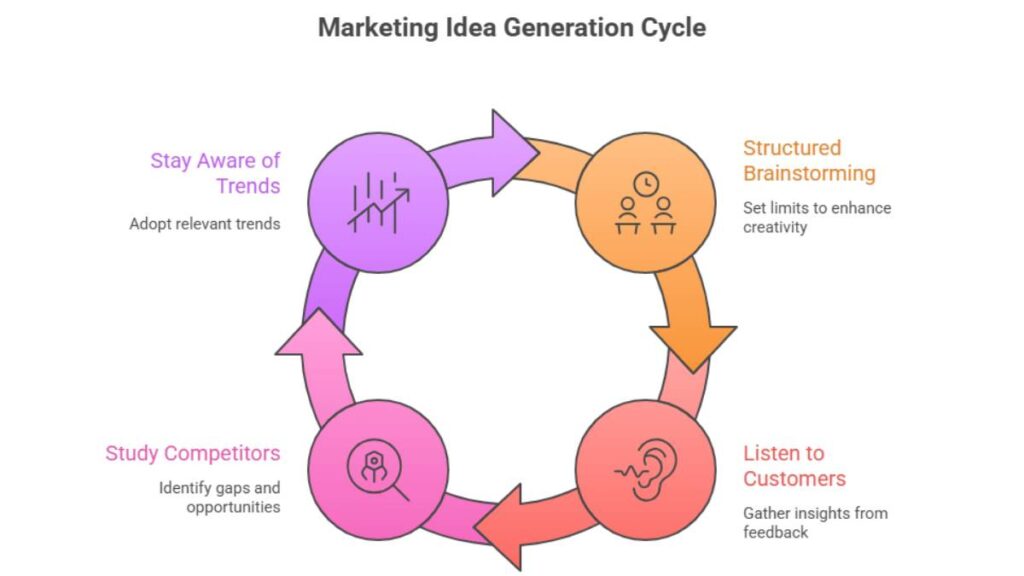
Use structured brainstorming
Set limits. One goal. One audience. One channel. Constraints force better thinking than open-ended sessions ever do.
Listen to customers closely
Support emails, reviews, casual feedback;all of it contains marketing insight. Pay attention to repeated questions and objections. Those are content and campaign ideas waiting to happen.
Study competitors without copying them
Look for gaps, not inspiration. What are they not saying? What are customers complaining about in their comments? That’s often where opportunity lives.
Stay aware of trends, not obsessed by them
Trends are signals, not instructions. Adopt what fits. Ignore the rest. Relevance matters more than speed.
Good ideas usually come from paying attention, not chasing novelty.
Conclusion
Marketing ideas don’t need to be flashy to work. They need to be intentional. Clear. Aligned with what the business actually offers.
The strongest ideas tend to share a few traits:
- They solve a real problem
- They respect the audience’s time
- They’re sustainable, not exhausting
Experimenting matters. So does tracking what works and letting go of what doesn’t. Over time, that process builds confidence; and results.
For small businesses, marketing isn’t about doing everything. It’s about doing the right things, consistently, with enough care to make people feel it.
FAQ: About Business Marketing Ideas
1. What are some good marketing ideas for small businesses?
Good ideas usually don’t announce themselves as “marketing.” They show up as small, sensible decisions made consistently. Clear explanations. Regular visibility. Following up when others don’t. When an idea fits the business rhythm and doesn’t feel forced, customers respond. If it’s easy to repeat and doesn’t drain the team, it’s probably a keeper.
2. How do you come up with marketing ideas that actually work?
Most working ideas come from paying attention, not creative bursts. Listen to how customers describe their problems. Notice where conversations stall or drop off. Those gaps are useful. Marketing works better when it reflects what’s already happening, rather than trying to invent something new just to feel innovative.
3. What makes a marketing idea “good”?
A good idea does one thing well. It clarifies. Or reassures. Or nudges someone forward. It doesn’t try to be clever for its own sake. If people understand it quickly and remember it later, it’s working. Complexity usually signals uncertainty, not sophistication.
4. How do you attract and retain customers with smart marketing?
Attraction and retention are closely linked, even if they’re treated separately. Attraction sets expectations. Retention depends on whether those expectations hold up. Smart marketing keeps both aligned. No overpromising. No disappearing after the sale. When the experience matches the message, loyalty tends to follow naturally.
5. Which marketing strategies are trending right now?
Trends come and go, but certain shifts are noticeable. Less polish. More clarity. Brands showing their thinking, not just outcomes. Shorter content that respects attention. Community over broadcast. These aren’t tactics as much as signals about how people want to engage. The ones that last usually feel honest.
6. Which marketing channels are best for small businesses?
The best channel is rarely the newest one. It’s the one customers already check without being reminded. That could be email. Local search. Social platforms. Sometimes even offline spaces. Spreading effort thin rarely pays off. Depth in one or two channels tends to create steadier results.
7. How can you promote your small business on a budget?
Budget constraints often lead to better decisions. Focus on clarity first. Make sure people understand what’s offered and why it matters. Use existing touchpoints better. Follow up more thoughtfully. Existing customers, local presence, and consistent communication usually outperform expensive, short-lived campaigns.