

Digital brand management is the ongoing discipline of keeping a brand aligned, consistent, and trustworthy across every online touchpoint. This blog explains how digital brand management connects strategy, governance, content, SEO, data, and crisis planning to protect brand equity, strengthen reputation, and create scalable systems that support long-term growth in competitive digital markets.
Table of Contents
Introduction
The Shift From Traditional Brand Management to Digital Brand Management
Brand management used to be relatively controlled. A company defined its positioning, created campaigns, approved messaging, and distributed it through a handful of channels. Print. TV. Maybe events. The brand lived where the company placed it.
That dynamic no longer exists.
Digital channels have fundamentally changed brand control. Today, a brand is shaped just as much by customer conversations, search results, and social commentary as by official marketing campaigns. The website matters. So do review platforms. So does that one viral post that wasn’t part of the plan.
Several forces drove this shift:
- The rise of social media: real-time public conversations about brands
- Search engines, where brand perception often starts before a customer even visits your site
- Online reviews: unfiltered feedback that influences trust instantly
- Always-on access; customers interacting with brands 24/7 across devices
The result? Brand management is no longer periodic. It’s continuous.
There’s no “campaign window” anymore. Your brand is always visible, always searchable, and always being evaluated.
That’s where digital brand management comes in.
Why Digital Brand Management Matters
The digital landscape is crowded. Every industry feels saturated. Attention spans are short. Switching costs are low.
In this environment, brand clarity and consistency are not optional; they’re protective.
Modern buyers don’t move in straight lines. They:
- Discover a brand on social media
- Search it on Google
- Compare reviews
- Visit the website
- See a retargeting ad
- Check LinkedIn or YouTube
- Then finally decide
That multi-channel journey means your brand must feel cohesive everywhere. The messaging. The tone. The visuals. Even the experience.
At the same time, AI-driven personalization, automation, and content generation have increased the volume of brand touchpoints. If governance isn’t tight, inconsistency creeps in quickly.
Digital brand management is less about aesthetics and more about:
- Maintaining trust at scale
- Aligning distributed teams
- Protecting brand equity in fast-moving markets
- Creating predictable, repeatable brand experiences
Without a structured approach, brand dilution happens quietly. And it’s expensive to fix.
What You’ll Learn in This Guide to Digital Brand Management
This guide breaks down digital brand management in practical terms, not theory.
You’ll learn:
- What digital brand management actually means in today’s environment
- The core components that keep brands consistent and competitive
- A clear strategy framework you can implement
- Best practices used by growing and enterprise-level organizations
- How to scale brand governance without slowing the business
The goal isn’t just understanding the concept. It’s understanding how to operationalize it.
What Is Digital Brand Management?
Digital Brand Management Definition
Digital brand management is the process of controlling, maintaining, and strengthening a brand’s identity, reputation, and consistency across all digital channels.
That includes:
- Websites
- Social media platforms
- Search engines
- Online ads
- Email campaigns
- Digital documents
- Customer-facing digital experiences
Traditional brand management focused heavily on messaging and campaigns. Digital brand management expands that scope. It integrates technology, governance, content systems, and data into the brand equation.
In simple terms:
Digital brand management ensures your brand looks, sounds, and feels the same everywhere online and performs strategically.
It connects brand identity with execution.
Core Objectives of Digital Brand Management
At its core, digital brand management serves four primary objectives:
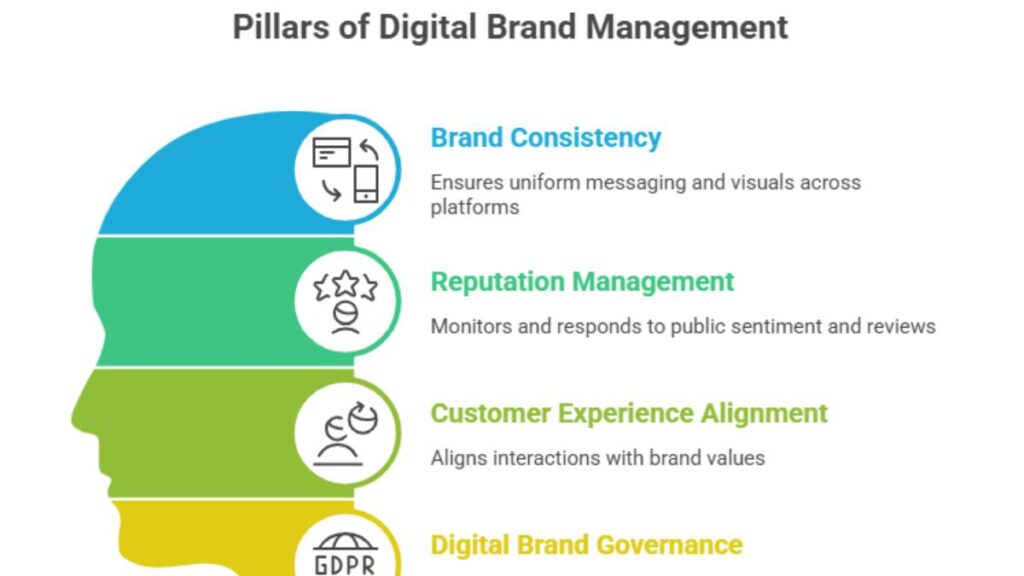
1. Brand Consistency Across Digital Channels
Customers should not experience tonal shifts, outdated visuals, or conflicting messages across platforms. Consistency builds recognition. Recognition builds trust.
2. Brand Reputation Management
Search results, reviews, and public sentiment directly affect perception. Digital brand management includes monitoring and responding to those signals.
3. Customer Experience Alignment
Brand is not just messaging; it’s experience. Load times, design clarity, personalization, and support interactions all contribute to brand perception.
4. Digital Brand Governance
Clear rules, documented guidelines, and controlled assets ensure that distributed teams, marketing, sales, HR, and partners represent the brand correctly.
When these objectives align, the brand becomes an asset that compounds. When they don’t, fragmentation sets in quickly.
Why Is Digital Brand Management Important?
Impact of Digital Brand Management on Brand Reputation
Reputation today is visible.
Search your brand name. What appears?
News articles? Reviews? Social posts? Competitor ads?
For many businesses, search results form the first impression before someone speaks to sales. Before they read your homepage. Before they see your pitch deck.
Online reviews alone can influence purchasing decisions dramatically. A handful of unresolved complaints can outweigh an expensive advertising campaign.
Digital brand management ensures that:
- Brand messaging aligns with what customers actually experience
- Negative sentiment is addressed early
- Positive stories are amplified
- Search visibility reflects brand positioning
Reputation isn’t built by accident anymore. It’s managed.
Digital Brand Management and Customer Trust
Trust rarely comes from a single touchpoint. It builds through repetition and coherence.
When customers see:
- The same tone across LinkedIn, your website, and email
- The same visual identity across ads and landing pages
- The same value proposition is reinforced consistently
They begin to feel stability.
Inconsistent branding, on the other hand, creates subtle doubt. Different taglines. Mixed visuals. Conflicting claims. These gaps may seem small internally, but externally they signal disorganization.
An omnichannel brand experience strengthens credibility because it reduces friction. Customers don’t need to “re-learn” who you are on every platform.
Trust compounds through clarity.
Role of Digital Brand Management in Revenue Growth
Brand isn’t just perception. It directly impacts performance.
Strong digital brand management contributes to:
- Higher conversion rates; clarity reduces hesitation
- Pricing power; differentiated brands compete less on discounting
- Customer retention: consistent experiences reinforce loyalty
- Shorter sales cycles; familiarity reduces resistance
Brand equity translates into economic value. That value shows up in margins, repeat purchases, and referral growth.
Organizations that treat digital brand management as operational infrastructure, not just marketing polish, tend to see more stable growth over time.
Because when a brand is aligned across digital channels, everything else works more efficiently.
Core Components of Digital Brand Management
Digital brand management sounds strategic; and it is; but at ground level, it’s operational. It lives in documents, dashboards, folders, landing pages, and social replies. In the details.
When those details align, the brand feels strong. When they don’t, it feels… off. Not broken, necessarily. Just inconsistent. And inconsistency is expensive.
Here’s what actually holds digital brand management together.
1. Brand Identity and Brand Positioning
Before systems. Before tools. Before campaigns.
Brand identity has to be clear.
Not just the visual identity, although that matters, but the underlying decisions:
- What does the brand stand for?
- What does it refuse to be?
- Who is it really for?
Mission and vision statements often get written once and forgotten. That’s a mistake. In digital environments, positioning gets tested daily. Competitors move fast. Customer expectations shift. Messaging gets stretched across dozens of channels.
A strong, unique value proposition (UVP) keeps everything grounded. It should be simple enough to explain in a few sentences, but sharp enough to differentiate. If it sounds like three competitors could claim the same thing, it probably needs work.
Audience segmentation also deserves more attention than it usually gets. Too many brands speak to “everyone.” In practice, different segments care about different proof points. Different objections. Different language.
A clear messaging framework helps prevent drift. It typically includes:
- Core value pillars
- Supporting claims and evidence
- Approved ways to describe the product or service
- Words to avoid
That last one matters more than most realize.
Without this foundation, digital brand management becomes reactive. With it, every new initiative has direction.
2. Brand Guidelines and Governance
Guidelines are not about control for the sake of control. They’re about reducing friction.
In growing organizations, brand inconsistency rarely happens because someone is careless. It happens because they don’t have clarity. Or they can’t find the right asset. Or they’re under deadline pressure.
Effective digital brand guidelines should feel usable, not like a dense PDF that no one opens.
They should cover:
- Logo usage and spacing rules
- Approved color systems
- Typography hierarchy
- Image direction (what “on-brand” visuals look like)
- Tone of voice examples: not just adjectives
Tone documentation, in particular, needs examples. Saying a brand is “confident but approachable” is vague. Showing before-and-after rewrites makes it practical.
Governance is the next layer. It answers operational questions:
- Who approves new templates?
- Who updates brand documentation?
- How are regional adaptations handled?
- What happens when someone wants to deviate?
If governance isn’t defined, brand decisions default to whoever speaks loudest in the room. That rarely scales well.
Consistency doesn’t happen naturally. It’s maintained.
3. Digital Asset Management (DAM) Systems
This is where many brands quietly struggle.
Assets are scattered across shared drives. Old logos still circulating. Outdated pitch decks were reused because “it was easier.”
A Digital Asset Management (DAM) system solves a simple but critical problem: access to the right assets, at the right time, in the right version.
Centralization matters. Especially as teams expand across departments or geographies.
Strong DAM practices include:
- A single source of truth for brand files
- Clear naming conventions
- Version control
- Permission levels for editing vs. downloading
Platforms like Bynder and Templafy are designed specifically to support this kind of structured brand control, particularly in larger organizations where document sprawl becomes real.
Without centralized asset management, brand inconsistency becomes a logistical issue, not a strategic one. And those are harder to detect until damage is already done.
4. Content Strategy for Digital Brand Management
Content is where brand positioning meets reality.
Every article, landing page, webinar, and social caption either reinforces the brand or slowly dilutes it.
A strong content strategy connects directly back to positioning.
That means defining:
- Core content themes tied to brand pillars
- Target audiences for each content stream
- Clear objectives (awareness, authority, conversion)
- Channel-specific adaptations
Brand storytelling plays a role here, but it shouldn’t feel forced. Customers can tell when narratives are manufactured.
Consistency matters more than creativity alone. Publishing five disconnected campaigns that look impressive individually doesn’t build long-term brand recognition. Repetition of core ideas does.
A practical content calendar helps maintain rhythm. It prevents the “what should we publish this week?” scramble that often leads to off-brand messaging.
Content should feel cohesive over time. That’s when brand perception strengthens.
5. Social Media Brand Management
Social media is often mistaken for just another distribution channel. It’s not. It’s a public stage.
Brand voice becomes more visible here than anywhere else.
Different platforms require tonal adjustments, but the underlying personality shouldn’t shift dramatically. A brand that sounds formal on LinkedIn and completely different on another platform creates confusion.
Effective social media brand management includes:
- Defined voice principles
- Response guidelines for comments and complaints
- Escalation paths for sensitive issues
- Visual consistency across posts
Community management is especially important. Silence in response to customer questions can signal indifference. Overly defensive replies can escalate minor issues.
A crisis response plan should exist before a crisis happens. Not after.
Influencer collaborations also require discipline. Alignment with brand values matters more than follower count. The wrong partnership can weaken positioning more quickly than it strengthens reach.
6. Search Engine Optimization (SEO) for Brand Visibility
Search results shape perception more than many organizations admit.
When someone types a brand name into Google, the results form an instant impression. If competitors appear above official pages, that’s a positioning issue. If outdated information ranks first, that’s a governance issue.
Branded keyword optimization ensures that official content dominates searches directly related to the company.
Non-branded keyword targeting supports discovery. It connects brand expertise to customer problems.
Structured data improves how brand information appears in search results ; FAQs, knowledge panels, and rich snippets. Small enhancements, but they improve authority signals.
Brand SERP optimization deserves focused attention. It includes optimizing:
- About and leadership pages
- Press coverage
- Social profiles
- Review visibility
Search isn’t just traffic acquisition. It’s brand reinforcement.
7. Data Analytics and Brand Performance Tracking
A brand can feel intangible. But in digital environments, it leaves measurable signals.
Tracking brand performance means looking at both quantitative and qualitative indicators.
Common data points include:
- Growth in branded search volume
- Direct traffic trends
- Engagement metrics across channels
- Sentiment analysis from reviews and social listening
Tools like Google Analytics provide behavioral insights: how users interact with brand content, where they drop off, and what resonates.
Numbers alone don’t tell the full story. Patterns do.
If engagement drops after a messaging shift, that’s feedback. If branded searches increase after a campaign, that’s reinforcement.
Data refines brand decisions. It prevents assumption-based strategies.
8. Crisis Management and Online Reputation Management
No brand operates in a perfectly controlled environment. Complaints happen. Missteps happen. Sometimes misinformation spreads faster than facts.
Crisis management within digital brand management is about preparation.
That includes:
- Monitoring brand mentions consistently
- Defining who responds publicly
- Aligning messaging across channels
- Responding promptly, but thoughtfully
Ignoring negative reviews rarely works. Overreacting doesn’t either. A calm, professional response often demonstrates maturity and accountability.
Online reputation is cumulative. Years of consistency can be undermined quickly if responses feel chaotic.
Preparation reduces panic. And in digital environments, speed matters.
Digital brand management isn’t glamorous work most days. It’s structured. Sometimes repetitive. Occasionally tedious.
But it’s what allows a brand to grow without losing its shape.
And in competitive digital markets, that shape, that clarity, is often the difference between momentum and noise.

Enroll Now: Brand Management course
Digital Brand Management Strategy (Step-by-Step Framework)
Digital brand management doesn’t run on good intentions. It runs on structure. When teams say, “We’ll keep the brand consistent,” but don’t define how, that’s where cracks start forming.
A practical framework keeps brand decisions aligned as the business grows.
Step 1: Define Your Brand Identity and Messaging
This is the anchor. If identity is vague, everything downstream becomes inconsistent.
Start by pressure-testing the fundamentals:
- Is the mission still relevant?
- Does the vision reflect where the company is actually headed?
- Are values visible in day-to-day operations, or just written on a slide?
Then refine positioning. Clarify the unique value proposition. Be specific. Avoid broad claims like “innovative” or “customer-focused.” Those words don’t differentiate.
Next, build a usable messaging structure:
- Core positioning statement
- Three to five messaging pillars
- Clear proof points for each pillar
- Short and long versions of brand descriptions
Messaging should be practical enough that sales, marketing, HR, and leadership can all use it without rewriting it from scratch.
When this step is rushed, everything else becomes patchwork.
Step 2: Create Clear Digital Brand Guidelines
Once identity is solid, document it. Clearly. Accessibly.
Digital brand guidelines should answer everyday questions:
- Which logo version goes where?
- What tone should customer support use?
- How should product claims be phrased?
- What visuals are off-brand?
Guidelines don’t need to be overly complex. They need to be usable.
Include real examples: sample headlines, email intros, social captions. Show what good looks like. People follow examples more easily than abstract rules.
And don’t treat guidelines as static. Brands evolve. Guidelines should too.
Step 3: Centralize Brand Assets Using a DAM Platform
As teams expand, asset control becomes operational, not just strategic.
If marketing is using one logo version and regional sales teams are using another, that’s not a creativity issue. It’s a systems issue.
Centralizing assets ensures:
- One approved logo set
- One updated pitch deck template
- One visual system
- Clear version history
It also removes friction. When teams can quickly access approved assets, they’re more likely to stay compliant.
Scattered files create shortcuts. Shortcuts create inconsistency.
Centralization supports discipline without slowing productivity.
Step 4: Develop a Multi-Channel Content Strategy
Digital brand management lives in execution. And execution today spans multiple channels.
A multi-channel content strategy should define:
- Core themes aligned with brand pillars
- Which channels serve which purpose
- Audience segmentation per channel
- Messaging adaptations by platform
Not every channel needs identical messaging. But they should feel connected.
For example:
- Website content might lean into authority and depth.
- Social media may feel more conversational.
- An email might focus on direct value and clarity.
The tone shifts slightly. The positioning does not.
A documented content roadmap prevents reactive publishing. It keeps messaging aligned over months, not just weeks.
Step 5: Optimize Brand Presence for Search Engines
Search visibility shapes perception more than many leaders realize.
When someone searches your brand name, they’re not just looking for a website. They’re evaluating credibility.
Brand optimization includes:
- Ensuring official pages rank prominently
- Updating outdated information
- Managing how reviews and third-party listings appear
- Publishing authoritative content tied to core positioning
Non-branded search matters too. It connects the brand to customer problems and industry topics.
If search results don’t reflect brand strategy, something is misaligned.
Search presence should reinforce positioning, not contradict it.
Step 6: Use Data and Analytics to Improve Brand Performance
Brand strategy shouldn’t run on assumptions.
Track signals that indicate brand strength:
- Growth in branded search traffic
- Direct traffic trends
- Engagement rates across channels
- Content performance by theme
- Sentiment trends in reviews
Patterns tell stories.
If a messaging shift leads to stronger engagement, that’s insight. If a rebrand causes confusion and drop-offs, that’s feedback.
Analytics should guide refinement, not dictate identity. Brand decisions are strategic, but data sharpens them.
Step 7: Prepare for Digital Brand Crises
Crisis planning rarely feels urgent. Until it is.
Preparation involves:
- Monitoring brand mentions regularly
- Defining who responds publicly
- Establishing tone guidelines for sensitive issues
- Creating internal escalation paths
When teams know how to respond, reactions are measured. When they don’t, responses become emotional or inconsistent.
Brand resilience depends on readiness.
A crisis handled well can reinforce credibility. A crisis handled poorly can erode years of brand equity.
Best Practices for Digital Brand Management
Strategy sets direction. Best practices keep execution tight.
These are habits, operational disciplines, that prevent brand drift.
1. Develop Clear Brand Guidelines
Vague guidelines create interpretation. Clear guidelines create alignment.
Make them practical. Include visuals. Include examples. Update them when positioning shifts.
Most importantly, make them accessible. If teams can’t find them easily, they won’t use them.
2. Ensure Brand Consistency Across Multiple Channels
Consistency doesn’t mean repetition word-for-word. It means coherence.
Ask:
- Does this social post reflect the same tone as the website?
- Does the sales deck reinforce the same value proposition as marketing campaigns?
- Do landing pages visually match brand standards?
Consistency builds recognition. Recognition builds trust.
Inconsistency creates doubt, even if the audience can’t articulate why.
3. Use a Digital Asset Management (DAM) System
Brand assets should not live in scattered folders.
Centralization reduces errors. It also speeds up execution.
When teams know exactly where to find approved materials, they’re less likely to improvise.
Improvisation isn’t always bad creatively. But structurally, it often weakens brand clarity.
4. Leverage Data for Personalization
Personalization strengthens relevance, but it must align with brand identity.
Use data to:
- Segment audiences
- Tailor messaging by industry or role
- Adjust content depth based on engagement behavior
Personalization should feel thoughtful, not intrusive.
When done correctly, it reinforces positioning. When overdone, it feels mechanical.
Balance matters.
5. Monitor and Measure Brand Performance
Brand strength is visible in patterns.
Track trends consistently:
- Awareness indicators
- Engagement shifts
- Content resonance
- Sentiment movement
Don’t rely on isolated data points. Look for direction over time.
Regular review sessions keep brand management proactive rather than reactive.
6. Organize and Update Brand Assets Regularly
Outdated assets create subtle confusion.
Schedule periodic audits:
- Remove old logo files
- Update templates
- Refresh imagery
- Align messaging with current positioning
Brand evolution is natural. Asset libraries should reflect that evolution, not archive past versions indefinitely.
7. Guarantee Internal Adoption of Brand Standards
Even the best strategy fails without adoption.
Internal education matters.
That can include:
- Onboarding sessions explaining brand positioning
- Workshops for sales and marketing teams
- Clear internal communication when updates occur
People are more likely to follow brand standards when they understand the reasoning behind them.
Adoption isn’t automatic. It’s cultivated.
Digital brand management isn’t about perfection. It’s about alignment. Over time. Across teams. Across channels.
When structure supports creativity, brands scale without losing coherence.
And that coherence, steady, recognizable, trusted, becomes a competitive advantage that’s difficult to replicate.
Digital Brand Management That Scales With Your Organization
Scaling a brand digitally isn’t about pushing out more content. It’s about control. Clarity. And a structure that doesn’t suffocate creativity.
As organizations grow, complexity creeps in. More teams. More regions. More campaigns. More platforms. Without a strong framework, brand dilution happens quietly; a slightly altered logo here, an inconsistent tone there, messaging that drifts just enough to confuse the market.
Scaling brand management means building systems that protect the brand while allowing teams to move fast.
Centralize Brand Control Without Slowing the Business
Centralization often gets misunderstood. It doesn’t mean bottlenecking every decision through one department. That approach collapses quickly.
Instead, strong digital brand management creates:
- Clear, accessible brand guidelines
- Pre-approved messaging frameworks
- Structured asset libraries
- Defined approval workflows
When those foundations exist, teams don’t need constant oversight. They know the boundaries. They understand the voice. They can execute confidently without going off-brand.
The key is controlled flexibility; guardrails, not handcuffs.
On-Brand Content Across Every Document, Not Just Marketing
Brand management is no longer confined to ads and social posts. Sales decks, proposals, onboarding materials, investor presentations, internal documents; all of it shapes perception.
And customers notice inconsistencies faster than companies do.
Scaling means ensuring:
- Templates reflect updated brand standards
- Visual identity is consistent across departments
- Messaging pillars show up beyond marketing
- Regional teams align with global positioning
Brand integrity should extend into operations, HR, customer support, everywhere communication happens because brand isn’t a campaign. It’s the sum of repeated experiences.
Brand Updates Applied Instantly Across All Channels
Rebrands and brand refreshes are where many organizations struggle. Updating one website is manageable. Updating dozens of landing pages, social banners, templates, partner materials, and regional assets? That’s where friction shows up.
Scalable digital brand management prepares for change before it happens.
That means:
- Modular design systems
- Centralized asset repositories
- Version control processes
- Clear sunset timelines for outdated materials
When brand elements evolve, a color shift, new tagline, updated positioning, changes should cascade systematically, not manually.
If updates require dozens of individual corrections, the system isn’t built for scale.
AI-Powered Brand Governance and Document Automation
As organizations expand, manual brand oversight becomes unrealistic. Governance must evolve.
Scalable brand systems now integrate:
- Brand-aligned content guardrails
- Pre-structured messaging templates
- Automated document formatting
- Approval routing based on role and region
The goal isn’t to remove human judgment. It’s to eliminate repetitive brand policing and reduce inconsistency at the source.
When teams generate content within structured brand parameters, quality improves. Risk decreases. Speed increases.
That balance, structure with autonomy, is what allows digital brand management to scale without breaking.
What Successful Digital Brand Management Looks Like in Practice
Theory is useful. But what does this actually look like inside a functioning organization?
Successful digital brand management rarely feels flashy internally. It feels smooth. Predictable. Aligned.
Here’s what that tends to look like.
Example of Scalable Brand Governance
In a well-governed organization:
- Brand guidelines are easy to find and easy to use
- Teams understand positioning without revisiting strategy decks
- Assets are centralized and up to date
- Approval workflows are defined, but not bureaucratic
There’s clarity around who owns what. Marketing owns positioning. Regional teams adapt messaging within defined limits. Leadership reinforces consistency.
Governance works best when it feels embedded, not enforced.
Example of Consistent Multi-Channel Brand Experience
Strong digital brands feel cohesive across platforms, even when the content format changes.
Website messaging aligns with social content. Paid ads reflect the same value proposition seen in email campaigns. Product pages reinforce the tone introduced in brand storytelling.
Consistency doesn’t mean repetition. It means alignment.
Customers shouldn’t feel like they’re interacting with different companies depending on the channel. Visual identity, tone of voice, and positioning should create recognition without feeling rigid.
When that happens, trust compounds quietly over time.
Example of Data-Driven Brand Optimization
Digital brand management becomes powerful when insights inform decisions.
That might include:
- Identifying which brand messages resonate most in specific segments
- Adjusting tone or visual presentation based on engagement trends
- Monitoring sentiment shifts during major campaigns
- Evaluating how brand search volume changes after awareness efforts
Brand strategy shouldn’t sit untouched for years. It should evolve based on market response.
But here’s the nuance: not every metric demands a reaction. Strong brands balance responsiveness with conviction. They adjust thoughtfully, not impulsively.
The brands that win long-term refine consistently. They don’t reinvent themselves every quarter.
Key Digital Marketing Services for Digital Brand Management
Digital brand management doesn’t operate in isolation. It connects directly to execution across marketing channels. Strategy shapes perception, but services bring it to life.
Here are the core disciplines that support and strengthen digital brand presence.
1. Search Engine Optimization (SEO)
Search visibility shapes first impressions. When prospects look for solutions, competitors, or brand names, what appears matters.
Effective optimization ensures:
- Branded search results reflect accurate positioning
- Non-branded searches connect audiences to relevant content
- Structured content reinforces authority
Search is often the first digital handshake between a brand and its audience. It needs to be intentional.
2. Content Marketing
Content carries brand voice further than ads ever could.
Through blogs, video, thought leadership, and educational resources, brands demonstrate expertise and values in action.
Strong content marketing:
- Reinforces positioning consistently
- Builds trust before purchase decisions
- Creates ongoing engagement beyond transactions
When content aligns tightly with brand strategy, it compounds. When it doesn’t, it fragments perception.
3. Social Media Marketing
Social platforms amplify brand personality.
Each platform requires subtle shifts in tone and format, but the underlying identity should remain recognizable.
Effective social brand management includes:
- Clear voice guidelines
- Defined engagement standards
- Rapid response processes
- Structured crisis escalation paths
Social is where brand character becomes visible. Consistency here builds familiarity quickly, or damages credibility just as fast.
4. Paid Advertising
Paid media accelerates brand exposure. It introduces positioning to audiences who may not be actively searching yet.
For brand management, paid advertising should:
- Reflect core messaging pillars
- Maintain visual consistency
- Reinforce long-term positioning, not just short-term offers
Too often, performance campaigns drift away from brand standards in pursuit of clicks. Short-term gains rarely compensate for long-term brand erosion.
Alignment matters.
5. Influencer Marketing
Influencers extend brand credibility through association. But alignment is critical.
Effective partnerships focus on:
- Shared audience values
- Tone compatibility
- Authentic integration of messaging
When influencer collaborations feel forced, audiences sense it immediately. When aligned thoughtfully, they strengthen brand perception and reach.
6. Website Design and Development
The website remains the digital headquarters of the brand.
It’s where positioning becomes tangible, where visual identity meets functionality, where customer journeys unfold.
Strong brand-driven web development ensures:
- Clear navigation aligned with messaging priorities
- Consistent visual identity across pages
- Cohesive storytelling from homepage to conversion
A fragmented website undermines even the strongest campaigns. A unified one anchors everything else.
Digital brand management isn’t a single initiative. It’s an operating system. When strategy, governance, execution, and measurement align, brands don’t just look consistent; they feel dependable.
And in crowded digital markets, dependability is power.
Conclusion:
Digital brand management isn’t some abstract marketing theory. It’s the daily discipline of making sure a brand doesn’t slowly drift off course online.
Every company starts with a clear idea of who it is. Then growth happens. New channels. New hires. New regions. Campaigns are moving fast. Somewhere along the way, the message starts bending. Slightly different tone here. Outdated logo there. A landing page that doesn’t quite sound like the homepage. It’s subtle. Until it isn’t.
At its core, digital brand management is about alignment.
Alignment between what the brand says and what customers experience.
Alignment between strategy and execution.
Alignment across search, social, paid media, content, and website journeys.
The fundamentals aren’t complicated, but they require consistency:
- A clearly defined brand identity that actually guides decisions
- Practical, usable guidelines (not a forgotten 80-page PDF)
- Centralized assets so teams don’t guess
- Ongoing monitoring of perception, not just performance
- A plan for when something goes wrong
Strong brands don’t obsess over every tiny detail. But they do protect the big ones: positioning, voice, visual coherence, customer promise.
And here’s something worth noting: brand management at scale becomes operational. It moves beyond marketing. Sales materials, recruitment messaging, support scripts; they all shape perception. If brand discipline only lives inside the marketing team, cracks form quickly.
Looking forward, the brands that stand out won’t just be creative. They’ll be steady. Recognizable. Clear about who they are, even as channels evolve. That steadiness builds trust over time. And trust is hard to win back once it’s lost.
Digital brand management, when done well, doesn’t feel loud internally. It feels organized. Intentional. A bit boring, maybe. But effective.
FAQs: About Digital Brand Management
What is digital brand management in simple terms?
It’s the practice of keeping a brand recognizable online, no matter where someone runs into it. The tone shouldn’t swing wildly between the website and social media. The positioning shouldn’t contradict itself in ads. When no one is paying attention, small differences creep in. Over time, those differences start to dilute trust.
What tools are used for digital brand management?
Most companies end up with a practical mix. A shared space for assets. Analytics tools that actually get checked. A content calendar that isn’t abandoned after two months. Maybe social monitoring software. The tools themselves aren’t magic. If teams don’t respect the process, even the best system falls apart quietly.
What is the difference between brand management and digital brand management?
Brand management used to move at campaign speed. Digital moves at conversation speed. Print ads didn’t change overnight. Search results do. Social reactions happen in real time. The foundation of branding hasn’t changed, but the pace has. And when things move faster, inconsistencies show up faster, too.
How do you measure digital brand performance?
Brand health doesn’t live in a single dashboard. Branded search trends matter. So does engagement depth. Sentiment shifts often tell a more honest story than raw impressions. Customer retention usually says more about brand strength than traffic spikes. If awareness grows but loyalty doesn’t, something isn’t fully connecting.
What are the best digital brand management platforms?
There isn’t one perfect solution. Larger organizations often need tighter governance controls. Smaller teams usually want speed and simplicity. The right platform reduces confusion and centralizes assets without creating endless approval bottlenecks. If a system slows teams down too much, they’ll find workarounds. That’s when alignment starts slipping.
How does digital brand management improve online reputation?
Reputation weakens through patterns, not single incidents. When messaging and responses stay steady, credibility builds gradually. Structured monitoring helps teams catch issues before they spiral. A consistent tone across reviews, social comments, and campaigns creates a sense of reliability. And reliability tends to protect reputation over time.
What is the role of digital asset management in brand management?
Centralized assets eliminate guesswork. Approved logos, templates, and visuals sit in one controlled environment. Without that structure, outdated materials resurface in new campaigns. It seems minor at first. But repeated visual inconsistencies make a brand feel disorganized. A proper asset system quietly prevents those avoidable mistakes.
How can businesses maintain brand consistency across multiple digital channels?
It starts with clarity around positioning. Then usable guidelines that teams can apply quickly. Not theoretical language, but practical direction. Clear ownership also matters. When no one knows who approves messaging, tone drifts. Consistency doesn’t mean copying content across channels. It means protecting the core identity while adapting thoughtfully.
What metrics are most important in digital brand management?
Look beyond surface numbers. Awareness trends show visibility. Sentiment reveals emotional response. Branded search volume indicates recognition. Repeat purchases often reflect trust. Over time, these patterns tell a clearer story than short bursts of engagement. Brand strength tends to reveal itself gradually, not in one campaign cycle.
How does SEO impact digital brand management strategy?
Search results often create the first impression. When branded queries show consistent messaging and relevant content, credibility strengthens quietly. Fragmented results raise subtle doubts. SEO isn’t just technical optimization. It reinforces positioning at a critical decision point, sometimes before a prospect even visits the website.
How does social media influence digital brand perception?
Social platforms expose how a brand behaves under pressure. Tone, responsiveness, and even silence shape perception quickly. Inconsistencies stand out in public spaces. A steady presence builds familiarity, and familiarity builds trust. Social doesn’t define a brand alone, but it certainly tests whether the brand identity holds up.
What is digital brand governance, and why does it matter?
Governance clarifies responsibility. Who approves content? How assets are stored. What standards apply? Without structure, teams improvise. Slight variations accumulate. Over time, the brand starts feeling fragmented. Effective governance doesn’t limit creativity. It protects core positioning so adaptation doesn’t turn into dilution.
How can AI be used in digital brand management?
AI can monitor sentiment trends, analyze performance patterns, and help draft content within established guidelines. It speeds up workflows. Still, nuance matters. Brand tone requires human judgment. Used carefully, AI supports consistency. Used without oversight, it can flatten personality and blur positioning.
What are common digital brand management challenges?
Cross-department alignment is a frequent issue. Messaging shifts slightly between teams. Outdated assets reappear. Approval processes either stall everything or allow too much freedom. As content demand grows, maintaining cohesion becomes harder. The balance between speed and discipline is rarely perfect. It requires ongoing adjustment.
How do large enterprises scale digital brand management globally?
Successful global brands centralize core positioning while allowing structured local flexibility. Shared frameworks and asset libraries maintain consistency. Regional teams adapt messaging within defined boundaries. Without those guardrails, localization quickly turns into fragmentation. Balance is essential. Too rigid, and markets resist. Too loose, and identity dissolves.
What is the connection between customer experience and digital brand management?
Customer experience is where brand promises are tested. Website usability, onboarding flows, support communication; they all reinforce or contradict positioning. If operations don’t match messaging, trust erodes quickly. Digital brand management ensures those touchpoints feel deliberate and aligned, not disconnected from the stated identity.
How often should digital brand guidelines be updated?
Annual reviews are usually healthy. Not every year requires major changes, but markets shift. Messaging evolves. Visual systems sometimes need refinement. Stability builds recognition, yet complete rigidity creates stagnation. Small, thoughtful updates tend to protect continuity while keeping the brand relevant.
What is brand compliance in digital marketing?
Brand compliance keeps campaigns aligned with approved messaging and visual standards. It prevents dilution, especially when many contributors create content. Small deviations seem harmless individually. Over time, they blur recognition. Compliance isn’t about strict control. It’s about maintaining clarity.
How does content marketing support digital brand management?
Content translates positioning into tangible expertise. Articles, videos, and educational pieces demonstrate capability rather than simply claiming it. When content aligns with strategy, authority grows gradually. When it drifts off-message, perception fragments. Consistency over time matters more than sheer publishing volume.
Can small businesses benefit from digital brand management?
Smaller businesses often see faster gains from brand discipline. Clear positioning and consistent messaging stand out in crowded markets. Even basic governance, like shared messaging documents and centralized assets, improves credibility. A steady brand presence can compete effectively against larger players that lack alignment.