
If you’ve ever run Facebook ads that started strong and then slowly died without any clear reason, you’ve most likely experienced Facebook Ad Fatigue.
One day your ad campaign is printing leads or sales. CTR looks healthy. ROAS is stable. And then suddenly, costs start creeping up, conversions drop, and you’re left wondering whether Facebook Ads are “dead” or if something broke inside Ads Manager.
They’re not dead. And nothing broke. What’s happening is simpler, and honestly more predictable than most marketers want to admit.
Your audience is tired of seeing the same ad.
Facebook ad fatigue is one of the biggest silent killers of ad performance. It affects beginners and advanced performance marketers alike, and it happens faster than ever because competition is high and attention spans are short.
In this blog, we’ll break down everything you need to know about Facebook Ad Fatigue:
- What it actually means
- How to identify ad fatigue early
- How fast fatigue can kick in
- How to diagnose fatigue at the ad, ad set, and campaign level
And most importantly, how to fix ad fatigue using trend-ready strategies
Table of Contents
What is Ad Fatigue ?
Facebook Ad Fatigue happens when your target audience sees the same ad too many times, too frequently, and starts ignoring it.
At its core, fatigue on Facebook ads is a psychological response. When people repeatedly see the same ad creative, the same ad copy, the same offer, and the same visual, their brain categorizes it as “noise.” They stop noticing it. Engagement drops. Clicks slow down. Conversions fall.
In simple terms:
Facebook Ad fatigue happens when your audience has seen your ad too often and no longer responds to it.
This can occur at different levels:
- Ad level (a specific ad is suffering)
- Ad set level (frequency issues within an audience)
- Campaign level (creative limited or delivery issues across the board)
It’s also important to understand that Facebook Ad Fatigue is closely linked with creative fatigue, but they’re not exactly the same. We’ll cover that distinction later in the blog.
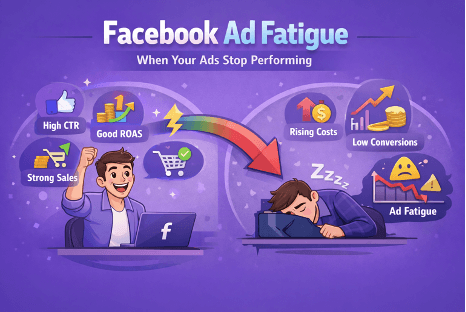
What’s changed now is how fast fatigue sets in.
With more advertisers, better targeting, and algorithm-driven delivery, your ad might reach the same specific user multiple times within a short window. If you don’t actively manage creative rotation and frequency, fatigue occurs faster than ever.
How to Check Ad Fatigue on Facebook (Key Signs You Can’t Ignore)
Facebook Ads Manager doesn’t always scream “HEY, YOUR AD IS DYING.” But the signals are there if you know what to look for.
Here are the most reliable signs of ad fatigue on Facebook.
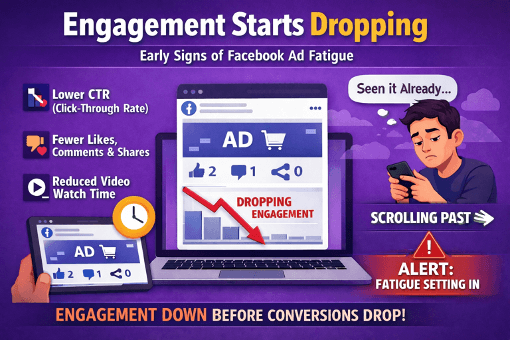
1. Engagement Starts Dropping
One of the earliest signs of ad fatigue is declining engagement.
You’ll notice:
- Lower CTR (link click-through rate)
- Fewer likes, comments, and shares
- Reduced video watch time on video ads
Your audience sees the same ad, recognizes it instantly, and scrolls past without interacting.
This usually happens before conversions drop, which is why engagement metrics are early warning signals. If your ad performance is stable and engagement suddenly drops without any major changes in targeting, budget, or offer, fatigue may already be setting in.
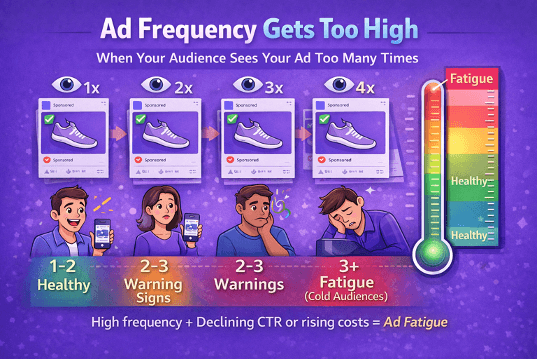
2. Ad Frequency Gets Too High
Ad frequency is one of the clearest indicators of Facebook ad fatigue.
Ad frequency tells you how many times, on average, a person has seen your ad.
Today,
- A frequency of 1 to 2 is generally healthy for cold audiences
- 2 to 3 can still work depending on the ad type
- Anything above 3 in cold traffic often signals fatigue
- For retargeting, higher frequency is normal, but performance still matters
When your audience sees the same ad repeatedly, fatigue happens. High frequency combined with declining CTR or rising costs is a classic sign that your ad is being shown too many times to the same people.
3. Cost Per Result Starts Climbing
Another major sign of Facebook ad fatigue is rising costs.
You might notice:
- Cost per lead increasing
- Cost per purchase rising
- CPMs increasing even though targeting hasn’t changed
This happens because Facebook’s delivery system prioritizes ads that generate engagement and conversions. When your ad performance drops due to fatigue, the algorithm struggles to find people who will respond, making delivery more expensive.
So if your cost per result starts climbing while everything else remains the same, fatigue may be the culprit.
4. Conversions Drop, ROI Takes a Hit
This is usually the most painful sign.
Your ads still get impressions. They still spend their budget. But conversions fall off a cliff.
Return on ad spend drops.
CPA increases.
Sales slow down.
At this stage, ad fatigue has already taken a firm grip. Your audience has mentally checked out.
This is why experienced advertisers try to identify ad fatigue early, before it reaches this point.
5. Facebook Gives You a Heads-Up (Creative Limited)
In Facebook Ads Manager, you may see a warning like:
- “Creative Limited”
- “Ad may not be delivering effectively”
This happens when Facebook detects that your ad creative is being shown too frequently to the same audience. While Facebook’s alerts aren’t perfect, they’re still a useful signal. If you see “creative limited” warnings, it’s a strong hint that your ad is suffering from creative fatigue or ad fatigue on Facebook.
How Fast Can Facebook Ad Fatigue Kick In?
This is one of the most common questions advertisers ask.
And the honest answer is: faster than you expect.
Facebook ad fatigue can kick in:
- Within 3 to 5 days for small audiences
- Within a week for high-budget campaigns
- Even faster if your daily ad budget is aggressive relative to audience size
Fatigue sets in faster when:
- Your target audience is small
- You’re using a single ad creative
- You’re spending heavily at the ad set level
- You’re running short-form creatives that people instantly recognize
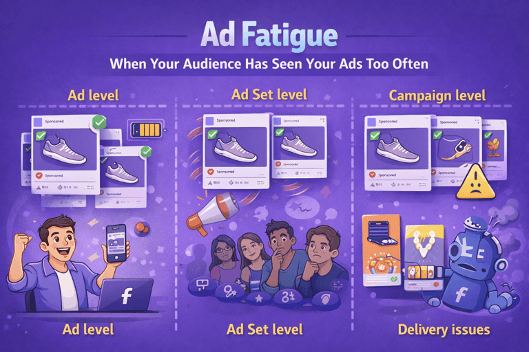
Ad fatigue happens when your audience sees the same ad again and again in a short time span. This is why “set and forget” Facebook campaigns don’t work anymore.
How to Diagnose Facebook Ad Fatigue Properly
Before you fix ad fatigue, you need to diagnose it correctly. Not every performance drop is fatigue. Sometimes it’s offer-market mismatch, seasonality, or tracking issues.
Here’s how to diagnose Facebook ad fatigue the right way.
1. Automatic Notifications in Ads Manager
Facebook Ads Manager sometimes flags ads that are experiencing fatigue.
You might see:
- Creative limited warnings
- Delivery insights suggesting creative refresh
These notifications aren’t always precise, but they’re a good starting point. Use them as a prompt to investigate further, not as the final verdict.
2. Manual Diagnosis (The Most Reliable Method)
Manual diagnosis is where real advertisers win.
Navigate to:
- Campaign level
- Ad set level
- Ad level
Check the following metrics together:
- Frequency
- CTR (link click-through rate)
- Cost per result
- CPM
- Conversion rate
If frequency is rising while CTR and conversions are falling, your ad fatigue occurs.
This is especially true if:
- The same ad creative has been running for days or weeks
- The audience sees the same ad repeatedly
- No new variations have been introduced
3. Facebook’s Delivery Insights
In Ads Manager, you can view delivery insights for specific ads.
These insights sometimes tell you:
- Whether your ad is being shown to the same users too often
- Whether creative is limiting delivery
- Opportunities based on your ad insights
While not perfect, delivery insights help confirm whether fatigue on Facebook ads is affecting your current ad.
How Do You Fix Facebook Ad Fatigue : 16 Ways that work
Now let’s get to the part that actually matters.
Fixing Facebook Ad Fatigue isn’t about one trick. It’s about building systems that prevent fatigue from killing performance repeatedly.
Below are the most effective, up-to-date ways to fight ad fatigue.
1. Refresh Your Ad Creatives, Not Just Minor Edits
Refreshing your ad doesn’t mean changing a button color and calling it a day.
A proper creative refresh involves:
- New visuals
- New hooks in the first 3 seconds
- New angles in ad copy
- Different storytelling structures
Your audience should feel like they’re seeing a different ad, not the same ad with cosmetic changes.
Creative optimization is the fastest way to fix ad fatigue when engagement drops.
2. Rotate Multiple Ad Variations From Day One
One of the biggest mistakes advertisers make is launching with a single ad.
You should:
- Launch with multiple ad creatives per ad set
- Use different versions of your ad with varied hooks
- Test different ad copy angles
This way, when fatigue sets in on one creative, others can continue performing.
3. Expand Your Audience Targeting
Sometimes fatigue occurs not because the creative is bad, but because the audience is too small.
To avoid ad fatigue:
- Broaden interest targeting
- Use Advantage+ audience expansion
- Test broader lookalike ranges
- Combine interest stacks carefully
A larger audience means your ad isn’t shown too many times to the same users.
4. Adjust Budget and Delivery Smartly
If you scale budgets too aggressively, fatigue kicks in fast.
Instead:
- Increase budgets gradually
- Monitor frequency daily
- Reduce daily ad budget on high-frequency ad sets
Sometimes, decreasing the budget actually improves performance by reducing overexposure.
5. Change Placements and Ad Formats
Different placements feel like different experiences to users.
To combat ad fatigue:
- Test Reels, Stories, Feeds, In-stream
- Experiment with different ad formats like carousel, video, collection
- Repurpose the same message into different formats
This helps your audience see your ads in fresh contexts.
6. Monitor Metrics Like a Hawk
Fixing ad fatigue requires proactive monitoring.
Watch:
- Frequency trends
- CTR changes
- Cost per result movement
If you wait until performance collapses, recovery becomes harder.
Early detection is your biggest advantage.
7. Optimize for Conversions, Not Clicks
Optimizing for clicks can accelerate fatigue because Facebook pushes ads to people who click impulsively but don’t convert.
Conversion-optimized campaigns:
- Reach higher-quality users
- Reduce unnecessary exposure
- Slow down fatigue
Always optimize for your actual business objective.
8. Test a New Offer (Not Just New Creative)
Sometimes the fatigue isn’t visual. It offers fatigue.
Your audience has seen the same promise too many times.
Try:
- New pricing angles
- Bundles
- Bonuses
- Limited-time incentives
A fresh offer can revive a tired ad campaign even with similar creatives.
9. Set a Frequency Cap, Where Applicable
In certain campaign types, especially awareness or reach campaigns, frequency caps help control overexposure.
While not always available for conversion campaigns, use them strategically where possible.
10. Exclude Past Users Strategically
If someone has already converted or interacted heavily, exclude them where appropriate.
This prevents showing the same ad to people who no longer need it.
11. Use Dynamic Ads and Dynamic Creative Optimization
Dynamic creative allows Facebook to mix and match:
- Headlines
- Primary text
- Visuals
- CTAs
This reduces creative fatigue by showing different combinations to users.
Dynamic creative optimization is one of the best ways to avoid ad fatigue at scale.
12. Leverage Third-Party Creative Tools
Many teams now use creative analysis tools to:
- Track fatigue patterns
- Predict creative burnout
- Benchmark performance
These tools don’t replace Ads Manager, but they add valuable context.
13. Expand Your Funnel, Don’t Push Sales Immediately
If every ad screams “BUY NOW,” fatigue happens faster.
Use a funnel:
- Awareness ads
- Consideration content
- Conversion ads
Different ad types reduce pressure and extend creative lifespan.
14. Reuse Existing Ads with Post ID
If an ad has strong social proof, reuse it using the same post ID while changing targeting.
This maintains credibility while refreshing delivery.
15. Duplicate Your Ad Set Strategically
Sometimes duplicating an ad set into a new window resets delivery learning.
This can temporarily relieve fatigue, especially when paired with new creatives.
16. Automatically Decrease Budgets for High-Frequency Ad Sets
In advanced setups, advertisers use rules to:
- Reduce budget when frequency crosses a threshold
- Pause ads with declining CTR and high frequency
Automation helps manage fatigue at scale.
Facebook Ad Fatigue Tips and Best Practices
- Never rely on one winning ad
- Plan creative refresh cycles weekly
- Monitor frequency alongside performance
- Build creative pipelines, not one-off ads
- Treat fatigue as inevitable, not avoidable
The goal isn’t to eliminate fatigue. It’s to manage it proactively.
Bonus: Ad Fatigue vs Creative Fatigue
These two terms are often used interchangeably, but they’re not the same.
| Aspect | Ad Fatigue | Creative Fatigue |
| Primary Cause | Overexposure of the same ad to the audience | Decline in the appeal or effectiveness of the creative |
| What Happens | Audience sees the same ad too many times | Message, visuals, or format stop resonating |
| Key Driver | Frequency-driven | Creative-driven |
| Frequency Level | Usually high frequency | Can occur even at low frequency |
| Creative Quality | Can happen even with strong, high-quality creatives | Happens because the creative itself loses impact |
| Audience Reaction | Users start ignoring or mentally blocking the ad | Users no longer feel engaged or motivated |
| Typical Performance Impact | Rising CPMs, CPLs, CPAs | Falling CTR, engagement, and conversions |
| Primary Fix | Refresh audiences, rotate ads, manage frequency | Change messaging, visuals, hooks, or format |
Understanding the difference helps you apply the right fix.
Final Thoughts
Facebook Ad Fatigue isn’t a flaw in the platform. It’s a natural outcome of human behavior.
People get bored.
Attention fades.
Repetition kills curiosity.
The advertisers who win aren’t the ones who find a magical ad. They’re the ones who build systems to manage fatigue consistently.
If you treat ad fatigue as part of the game, not a surprise problem, your Facebook ad campaigns will become more stable, scalable, and profitable over time. And honestly, once you start spotting fatigue early, Facebook ads become a lot less stressful.
Frequently Asked Questions (FAQs)
What is Facebook ad fatigue?
Facebook ad fatigue occurs when your audience sees the same ad repeatedly and stops engaging or converting.
What is an example of ad fatigue?
An ad with rising frequency, declining CTR, and increasing cost per result is a classic example.
How to solve ad fatigue?
Refresh creatives, rotate variations, expand audiences, adjust budgets, and monitor frequency.
How long does ad fatigue take?
It can happen within days, especially with small audiences or high budgets.
How to check ad fatigue in Meta Ads?
Check frequency, CTR, cost per result, and delivery insights in Ads Manager.
How can I prevent Facebook ad fatigue?
Launch with multiple creatives, monitor performance, rotate ads regularly, and avoid overexposure.
Why are my Facebook ads not driving any sales?
Possible reasons include ad fatigue, weak offer, poor targeting, or creative fatigue.