
Table of Contents
Introduction
Why Facebook Ads Strategy Is Crucial in 2026
Facebook advertising isn’t the “set it and forget it” playground it once was. The platform keeps changing, audiences keep shifting, and honestly, throwing money at ads without a plan is just… throwing money away. In 2026, a good strategy isn’t optional; it’s survival.
Some things to keep in mind:
The ecosystem is crowded, noisy, and diverse. Feeds, Reels, Stories, in-app shopping; people aren’t just scrolling in one place anymore. Ads have to fit naturally where they appear, or they’ll get ignored.
Engagement matters more than ever. Clicks alone don’t cut it. Shares, reactions, saves; they all signal that your audience actually cares, which in turn makes campaigns perform better.
ROI is king. Businesses now expect a measurable return. That could mean leads, purchases, or at least warm prospects. Ads that look pretty but don’t move the needle just won’t survive the budget review.
So the big idea here? Your strategy has to tie everything together: audience, creative, goals, and budget, so each piece actually works toward real results.
Why Structured Content Matters for Facebook Ads Visibility
Even if the focus is on Facebook campaigns, how your brand shows up elsewhere, like in search or discovery, is part of the picture. Lately, Google’s AI-powered overviews have been surfacing strategy content more often, which means if your writing and explanations are clear, you get noticed.
Some practical notes:
- Clarity helps a lot. Lists, steps, simple explanations; they’re not just easier to read, they get picked up in overviews and summaries more often.
- Relevance over fluff. Focus on things people actually need to know about planning, targeting, or measuring Facebook campaigns. Skip the generic filler.
- Consistency pays off. When your advice on Facebook aligns with your broader marketing content, it reinforces authority. People and AI systems start seeing your content as a go-to reference.
Basically, laying things out in a readable, structured way isn’t just “nice to have.” It helps your strategy ideas travel further.
Understanding Facebook Ads in 2026
Key Facebook Ads Features and Updates in 2026
Facebook ads today are a bit of a mixed bag; exciting, but also a little tricky if you don’t know the rules. Some highlights:
- New ad formats are everywhere. Reels ads, AR/VR placements, interactive polls; they all work, but only if used in the right context. You can’t just throw a video in Reels and hope for magic.
- Targeting has gotten smarter. Beyond demographics, you can now reach people based on behavior, past engagement, and even predicted interests. It’s tempting to rely on “set it and forget it” targeting, but some manual nudges still help.
- Campaign objectives have gotten granular. You can run campaigns for micro-conversions like newsletter sign-ups or full-funnel purchases. Picking the right objective upfront saves headaches later.
The key takeaway? Don’t try to do everything at once. Pick formats, targeting, and objectives that actually match what your business needs.
How the Facebook Algorithm Really Works
The algorithm can feel like a black box, but a few patterns are clear if you pay attention:
- It favors engagement. Ads that spark comments, shares, or saves get more reach. So your creative can’t just be “nice-looking”; it has to provoke some reaction.
- Budgets get shifted automatically. Facebook will push more money toward the ad sets performing well, so giving it clear signals early matters.
- Learning phase is fragile. Every new ad starts off by figuring out who responds best. Change too many things too fast, and it resets. Patience pays off more than over-optimization.
At the end of the day, understanding these quirks lets marketers focus on the stuff that really moves results: testing creative, refining targeting, and paying attention to what actually works, not what looks good on paper.
Step-by-Step Guide to Creating a Facebook Ads Strategy in 2026
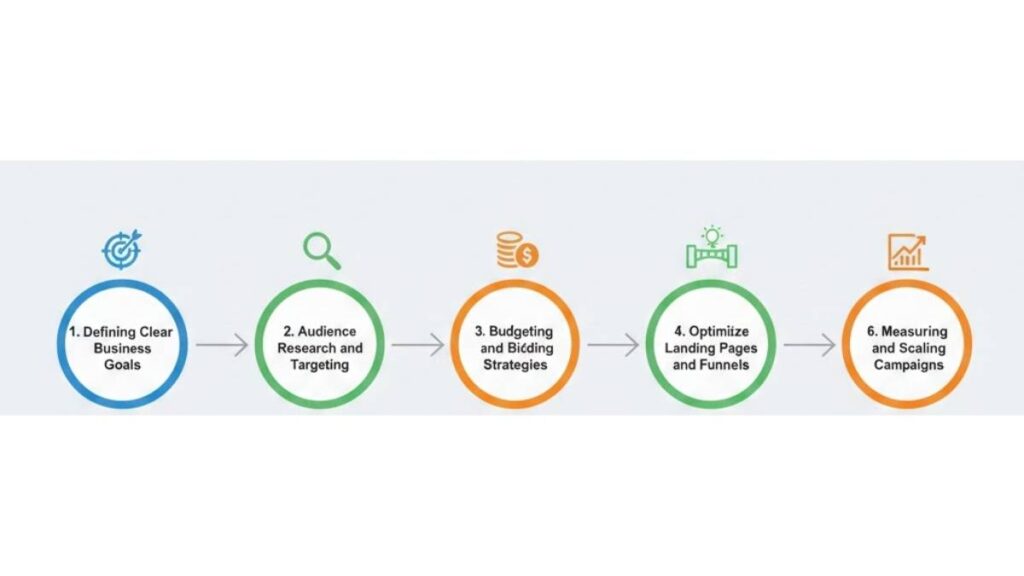
Defining Clear Business Goals for Facebook Ads
Before dropping a single rupee on ads, it’s worth stepping back and asking: what’s the point here? Too many campaigns get launched with “just run ads and see what happens,” and, well… that usually ends badly.
Think about it like this:
- Brand awareness vs. conversions vs. leads. Different objectives need different approaches. Awareness campaigns can be broader, story-driven, and maybe a bit playful. Conversion campaigns? Tighter targeting, clearer call to action, no fluff.
- KPIs are your north star. ROAS, CPA, CTR, CPM; pick the ones that actually matter for what you’re trying to do. Tracking everything just clutters the picture.
- Tie it to the business. Ads should connect to real outcomes. A campaign that drives clicks but no revenue? Not much use.
Bottom line: clarity upfront saves headaches later. Don’t overcomplicate it; get the goals right, and everything else flows from there.
Audience Research and Targeting
Knowing who you’re talking to is half the battle. Facebook gives you a ton of options: custom audiences, lookalikes, and interest targeting, but throwing spaghetti at the wall rarely works.
A few things to keep in mind:
- Custom and lookalike audiences. Start with people who’ve already engaged or bought from you. Find more like them, not just “people who like similar pages.”
- Behavioral and interest targeting. Useful, yes, but layering works best. Don’t treat it as a single magic bullet. People have patterns, not just single interests.
- Segmented messaging. Don’t send the same ad to everyone. Tailored messaging performs better and feels less “advertisy.”
Audience research isn’t one-and-done. Keep testing, keep refining.
Budgeting and Bidding Strategies
Money makes the world go round… and campaigns fail fast without it. But how you split and bid matters more than the total spend.
Here’s what usually works:
- Campaign Budget Optimization (CBO) vs. Ad Set Budgets. CBO hands the system some control, which can work nicely. Ad set budgets give more hands-on control. Each has a place; it depends on whether you want flexibility or precision.
- Manual vs. automatic bids. Automatic is easy, but manual gives you control to squeeze the last bit of efficiency. Often, a mix works best.
- Scaling carefully. Throwing money at a top performer all at once rarely ends well. Gradual increases usually get better results.
Remember, it’s less about the total spend and more about where each rupee is going.
Creating High-Converting Facebook Ad Creative
The ad itself is what people actually see. All the targeting and budget stuff won’t help if the creative flops.
Some rules of thumb:
- Copy that talks like a human. Short, punchy lines. Ask a question. Make them stop scrolling. Over-polished copy can feel stiff.
- Visuals that catch the eye. Bright, relevant, simple. Videos can work, but don’t overdo the effects. The first few seconds are all that matter.
- Test everything. Slight tweaks, a different headline, image, or CTA, can make a big difference. Don’t assume your first ad is the winner.
Creative isn’t just art. It’s measured, tested, and refined based on what works.
Optimizing Landing Pages and Funnels
An ad that clicks but drops people onto a confusing page? Money wasted. The landing page is the last handoff.
Key points:
- User experience counts. Fast, simple, mobile-friendly. Slow or clunky pages kill conversions.
- Match messaging. Headlines, images, offers; make sure they line up with the ad. Confusion kills momentum.
- Track what happens. If people click but don’t convert, you need to know why. Metrics matter; don’t fly blind.
Think of landing pages as the bridge between interest and action. Make it easy to cross.
Measuring and Scaling Campaigns
Once it’s live, don’t just sit back. This is where the work pays off.
- Watch the right metrics. CTR, CPC, CPA, ROAS; focus on what actually ties to results.
- Scale gradually. Top performers are tempting, but sudden jumps can backfire. A measured approach usually wins.
- Adjust based on patterns. Look at what’s actually happening, not what you hope happens. Small changes in creative, targeting, or budget can have a big impact.
Scaling isn’t magic; it’s careful observation, small tweaks, and letting winning strategies do more of what they’re good at.
Advanced Tactics for Facebook Ads in 2026
Using Smarter Automation and Targeting
Automation isn’t a silver bullet. It can make life easier, sure, but campaigns don’t run themselves. Think of it more like a helper than a replacement for thinking.
- Let the system do some heavy lifting. It can move the budget toward the ad sets performing better, but don’t just leave it alone. A quick check now and then can save wasted spending.
- Play with small creative tweaks. Headlines, images, even CTA buttons; tiny changes can shift results more than expected. Automation can test, but someone still has to look at the data.
- Spot patterns early. Some audiences or messages consistently perform better. Keep an eye on them, adjust, and repeat.
The point is simple: automation should handle the grunt work, not replace strategy.
Retargeting Without Annoying People
Retargeting is one of those areas where money can actually work harder for you, if it’s done right. Otherwise, it just feels like spam.
- Show the right product at the right time. Nothing generic. People respond when what they see feels relevant.
- Think in sequences. Don’t throw the same ad at someone a dozen times. Start with awareness, then engagement, then a stronger push for conversion.
- Combine with similar audiences. Once you know who converts, look for people like them. But don’t overreach; the quality of these lookalikes matters.
Timing and relevance are everything here. Push too hard, and people tune out. Push thoughtfully, and conversions climb.
Integrating Across Channels
Ads don’t exist in isolation. If you’re only thinking about Facebook, you’re leaving opportunities on the table.
- Instagram, Messenger, WhatsApp; they all behave differently. Same audience, different context. Don’t post identical content everywhere.
- Email follow-ups. People who clicked but didn’t buy can be nudged again through other channels. It often works better than throwing extra budget at Facebook alone.
- Align paid with organic. If your ads and content tell the same story, it feels more trustworthy. People notice when messaging is consistent, even subconsciously.
Integration isn’t complicated; it’s just about thinking through the journey and not isolating channels.
Common Facebook Ads Mistakes to Avoid in 2026
Even experienced marketers trip over the same issues. Some of the usual suspects:
- Ignoring audience insights. Just guessing who will respond usually ends in wasted budget. Keep an eye on engagement and adjust.
- Overcomplicating campaigns. Too many ad sets, too many objectives; it confuses the system and you. Keep it focused.
- Skipping tracking. Not knowing what happens after a click is like driving blind. Even a small conversion setup is better than nothing.
- Sticking with tired creative. Ads get stale fast. Refresh images, copy, offers; don’t expect old winners to keep performing forever.
Mistakes aren’t fatal. Spot them early, tweak, and move on. The campaigns that adapt usually come out ahead.
Future-Proofing Your Facebook Ads Strategy
Facebook changes constantly. If campaigns stay rigid, performance drops. Staying flexible is key.
- Watch for updates. Algorithms, ad formats, placements; they all shift. Staying aware keeps campaigns from falling behind.
- Expect shifts in audience behavior. What worked last year might flop this year. People’s habits, attention spans, and shopping patterns evolve; so should campaigns.
- Keep experimenting. Small tests, incremental changes, and careful observations go a long way. Don’t try to predict everything; just notice patterns and act on them.
Future-proofing isn’t about perfect predictions. It’s about staying alert, adapting quickly, and not getting too comfortable with “what worked last month.”
Conclusion
Facebook ads in 2026 aren’t what they used to be. It’s not enough to just throw some money at a few posts and hope for clicks. The campaigns that actually do anything usually have a few things in common: clear goals, a sense of who the audience is, and creative that makes people stop scrolling; really stop, not just glance.
A few points worth keeping in mind:
- Start with the goal. Are you trying to raise awareness, get leads, or drive sales? It might seem obvious, but too often that’s skipped. Everything else, the audience, the creative, the budget, follows from that.
- Know your audience. Broad strokes rarely work. People respond to messaging that feels like it’s actually meant for them. Segment, tweak, and pay attention to how different groups respond.
- Creative still matters. Even the most precisely targeted campaign fails if the ad itself is boring or confusing. Make it clear, make it relevant, and yes, sometimes a little boldness helps.
- Keep an eye on the numbers. Metrics tell you what’s actually happening. Ignore them, and you’re flying blind. Watch trends, notice what’s off, and adjust.
Bottom line? Treat Facebook ads like a system, not a set of random experiments. Every piece, audience, creative, and budget needs to line up. Miss one, and it’s like a chain with a weak link: the whole thing suffers.
FAQs:
1. What makes Facebook ads different in 2026?
Facebook ads aren’t just “boost a post and hope it sticks” anymore. There’s more automation, new formats like Reels and AR/VR, and smarter targeting. But it’s not magic. Clear goals, knowing who you’re trying to reach, and creative content that actually stops the scroll; that’s what makes a difference. Ignore any of that, and it usually flops.
2. How do Google AI overviews (SGE) affect Facebook ad content visibility?
SGE tends to highlight content that feels useful and structured. So, if your ad’s landing page or content actually answers questions, it can show up more prominently. It’s not some secret hack; just plain relevance. People notice content that makes sense. Ads that align with that tend to get a little extra traction.
3. What are the most important Facebook ad objectives to focus on?
Focus matters. Usually, it’s awareness, leads, or sales. Each one plays differently with targeting, creative, and budget. Pick your lane first. Without that, campaigns spend money randomly. You’ll see clicks, sure, but they might not help the business at all.
4. How do you choose the right audience for Facebook ads?
Precision is key. Custom audiences, lookalikes, interest segments… use them wisely. Watch how people respond. Test small changes. Adjust. Broad, vague targeting usually just burns budget. It’s slow and messy to clean up later. Segment properly, and results will follow.
5. What’s the difference between manual and automated bidding in Facebook ads?
Manual bidding gives control; you choose the max per action. Good if the budget is tight or you want to experiment. Automated bidding hands it over to the system and lets it chase results. Both have a place. Most of the time, a mix works best, with some monitoring and small tweaks here and there.
6. How can creatives improve Facebook ad performance?
Creative grabs attention. No one clicks a boring ad. Images, videos, headlines; they need to make people pause. Even perfect targeting won’t help if the creative is dull. Test variations. Tiny changes, different wording, or a slightly new thumbnail can completely change how an ad performs.
7. Why is landing page optimization important for Facebook ads?
Clicks aren’t results. The landing page is. Slow load times, confusing layout, or mismatched messaging kill conversions. Keep pages fast, simple, mobile-friendly, and consistent with the ad. If the ad promises one thing and the page delivers another, people leave, and your money goes with them.
8. What are the common mistakes to avoid in Facebook ads?
Ignoring audience signals. Overcomplicating campaigns. Not tracking conversions. Stale creative. These are the usual suspects. Overstuff campaigns with objectives and ad sets, and you’ll regret it. Simple, focused campaigns with regular tweaks almost always do better than fancy, convoluted setups.
9. How can Facebook ads integrate with other marketing channels?
Ads rarely work in isolation. Align them with Instagram, Messenger, WhatsApp, email, and even organic posts. Consistent messaging makes people remember the brand and take action. Cross-channel coordination doesn’t just feel nice; it actually improves results because the message is reinforced everywhere your audience is looking.
10. How can businesses future-proof their Facebook ad strategy?
Pay attention. Algorithms shift, people’s behavior shifts. Try new ad formats. Tweak targeting and creative. Watch results, adjust fast. The campaigns that last aren’t the ones that blindly follow trends; they’re the ones that notice patterns, experiment in small doses, and adapt before things break.