

Global brand management isn’t just about keeping the logo the same everywhere. That’s the easy part. The harder part, the part most teams underestimate, is keeping the brand’s meaning intact when it moves across borders, cultures, and internal silos.
In practice, things get messy. A campaign that works beautifully in one market feels flat in another. A centrally defined tone of voice clashes with local buying behavior. Regional teams push back. Headquarters tightens control. And somewhere in the middle, the brand starts to blur.
Strong global brands don’t scale because they standardize everything. They scale because they’re clear on what cannot change, positioning, promise, core narrative, and are flexible on what must adapt. Cultural nuance matters. So does governance. So does having the right decision rights mapped out before friction shows up.
This guide looks at what actually shapes international brand strength: structural choices, trade-offs, real risks, and the operational realities behind “global consistency.” It’s not theory. It’s the practical side of managing a brand that has to travel well, without losing its edge, its relevance, or its long-term equity.
Table of Contents
Introduction
What is global brand management?
Global brand management is less about logos and more about discipline.
On paper, it sounds straightforward: build a brand and take it across borders. In reality, it’s the ongoing work of keeping that brand coherent in very different markets; different cultures, different buying behaviors, different expectations, without losing what made it strong in the first place.
It asks a hard question that most companies underestimate:
How does a brand stay recognizable in every market… and still feel locally relevant?
That tension sits at the center of global brand management.
It’s not a marketing-only exercise. Operations shape delivery. Product teams shape perception. Legal teams affect messaging. Leadership shapes tone from the top. When any one function drifts, the brand starts to fracture.
Strong global brands don’t feel stitched together. They feel deliberate. There’s a sense that someone is steering the ship, not just reacting market by market.
Importance of global brand management in modern business
Markets don’t operate in isolation anymore. A campaign launched in one country gets screenshotted and shared globally within hours. A packaging mistake in one region can trend worldwide. A pricing decision in one market influences expectations elsewhere.
Without structured global brand management, small inconsistencies multiply:
- Messaging starts to contradict itself
- Visual systems get “slightly adjusted” until they barely resemble the original
- Regional teams reinterpret positioning in their own way
- Customers feel subtle confusion, and trust erodes quietly
It rarely collapses overnight. It just weakens, gradually.
When global brand management is handled well, though, the opposite happens:
- Brand equity compounds across markets
- Market entry becomes faster and less expensive
- Teams operate from shared clarity
- Strategic decisions feel aligned instead of improvised
Scalability isn’t about volume. It’s about control. A brand that scales without structure eventually loses coherence. A brand with structure scales with power.
Difference between global branding and local branding
There’s a common misconception that global branding and local branding compete with each other. They don’t. They just operate at different altitudes.
Global branding defines the core:
- What the brand stands for
- Its long-term positioning
- Its non-negotiable values
- The emotional territory it owns
Local branding interprets that core within context:
- Cultural nuances
- Language and tone
- Market-specific behavior patterns
- Local competitive dynamics
The friction usually appears when either side dominates too heavily.
Too much centralized control, and the brand becomes culturally stiff, polished but disconnected.
Too much local freedom, and the brand splinters. Each region feels like a different company using the same logo.
The real work of global brand management sits in the middle. A clear global spine. Flexible limbs.
That balance is rarely accidental. It requires governance, clarity, and constant calibration.
How global brand management drives international growth
Growth across borders is rarely just about distribution networks or logistics. It’s about perception.
A brand that is managed well globally carries built-in advantages:
- Immediate credibility in new markets
- Stronger negotiating power with partners
- Reduced friction in customer acquisition
- Ability to command price premiums
Consumers often associate global brands with reliability and scale. That perception doesn’t happen by default. It’s earned through consistency.
But here’s the part that gets overlooked: consistency isn’t sameness.
Customers will forgive adaptation. They won’t forgive contradiction.
When messaging promises innovation in one market and tradition in another, confusion sets in. When product quality varies across regions, trust fades. And once trust weakens, expansion becomes expensive.
Global brand management isn’t bureaucracy. Its growth architecture. It builds the framework that allows expansion without dilution.
The Global Branding Process
There’s no single blueprint for building a global brand. But there is a sequence. And skipping steps usually shows up later as avoidable friction.
Step 1: Conducting international market research
Expanding without research often feels bold. It’s usually reckless.
International market research in global brand management goes far beyond demographic data. It needs to uncover:
- Cultural norms and values
- Buying motivations and triggers
- Media behavior
- Local competitors and substitutes
- Regulatory constraints
This isn’t about gathering surface-level statistics. It’s about understanding context.
Humor translates poorly. Status signals shift. Colors carry different meanings. Even silence can communicate different things depending on the culture.
The goal is simple but demanding:
Identify what must remain constant, and what must flex.
Without that clarity, brands either over-standardize or over-adapt. Neither ends well.
Understanding cultural nuances and consumer behavior
Culture quietly shapes every purchasing decision.
In some markets, bold and direct messaging signals confidence. In others, subtlety builds credibility. Some cultures value individual achievement; others emphasize community and harmony.
These differences don’t show up in spreadsheets. They show up in reactions.
Misreading cultural nuance doesn’t always cause immediate backlash. Sometimes it just leads to indifference. And indifference is expensive.
Global brand management requires cultural literacy, not stereotypes, not assumptions. Real understanding. It’s slower work. But it prevents costly missteps.
Analyzing competitor global strategies
Before defining a global brand strategy, it helps to observe how others navigate the terrain.
Questions worth examining:
- Are competitors maintaining strict standardization?
- Where have they localized heavily, and why?
- How consistent is their brand voice across regions?
- Have they repositioned in certain markets?
Failures are often more instructive than successes.
Some brands expand aggressively but collapse under inconsistency. Others remain so rigid that they fail to resonate locally.
Competitive analysis reveals both opportunity and warning signs. It shows where there’s whitespace, and where repetition would be risky.
Step 2: Developing a global brand identity
Once research brings clarity, the next step is defining a brand identity that can travel.
This includes:
- Purpose
- Core values
- Positioning
- Personality
- Messaging pillars
- Visual system
If the identity only works within one cultural lens, it won’t survive internationally.
A global-ready brand identity usually rests on universal human themes: trust, aspiration, belonging, innovation, and security. Concepts that transcend geography.
The sharper the core, the easier the adaptation.
Core brand values, mission, and positioning
Values act as guardrails.
They prevent regional interpretations from drifting too far. They create internal alignment across teams that may never meet face-to-face but are shaping the same brand.
Positioning, especially, requires precision. It’s not a slogan. It’s the territory the brand chooses to own globally.
When positioning shifts from country to country, the brand becomes unstable. When it’s clearly defined and consistently reinforced, the brand accumulates equity over time.
Employees understand it. Partners trust it. Customers recognize it.
Logo, color palette, and universal visual language
Visual identity often becomes the battlefield of inconsistency.
A slight tweak here. A local variation there. Over time, those small deviations add up.
A strong global visual system includes:
- Clear logo usage rules
- Defined color palette
- Consistent typography
- Imagery direction
- Layout principles
Recognition builds familiarity. Familiarity builds memory. Memory builds preference.
At the same time, some elements may require thoughtful adaptation. Colors, symbols, and gestures carry different cultural meanings. Ignoring that reality can create avoidable friction.
Global brand management means anticipating nuance, not reacting to it.
Step 3: Ensuring brand consistency across borders
Once the brand identity is defined, implementation becomes the real test.
Consistency is not about micromanagement. It’s about alignment.
That usually requires:
- Comprehensive brand guidelines
- Training for regional teams
- Clear approval processes
- Defined governance structures
Without structure, drift happens quietly.
Teams reinterpret positioning. Messaging shifts slightly. Visual systems stretch. None of it feels dramatic until the brand feels unfamiliar.
Messaging and tone alignment
Translation is not localization.
Words can be technically correct and still emotionally wrong. Tone carries weight. Rhythm matters. Context changes meaning.
Effective global brand management ensures:
- Messaging pillars remain intact
- Tone of voice is clearly articulated
- Core brand phrases are protected
- Localization preserves intent
Customers should recognize the brand personality, even if the language changes. If the tone feels different in every region, the brand begins to feel fragmented.
Packaging and product experience standardization
Brand isn’t just communication. It’s an experience.
Packaging, service standards, product quality, and digital interfaces all of these reinforce or weaken the brand promise.
When experience varies significantly across markets, trust erodes. Not loudly. Quietly.
Strong global brands align operational standards with brand identity. The promise and the delivery match.
And when they match consistently, reputation strengthens.
Key Advantages of Global Brand Management
Handled carefully, global brand management creates advantages that are difficult for competitors to replicate.
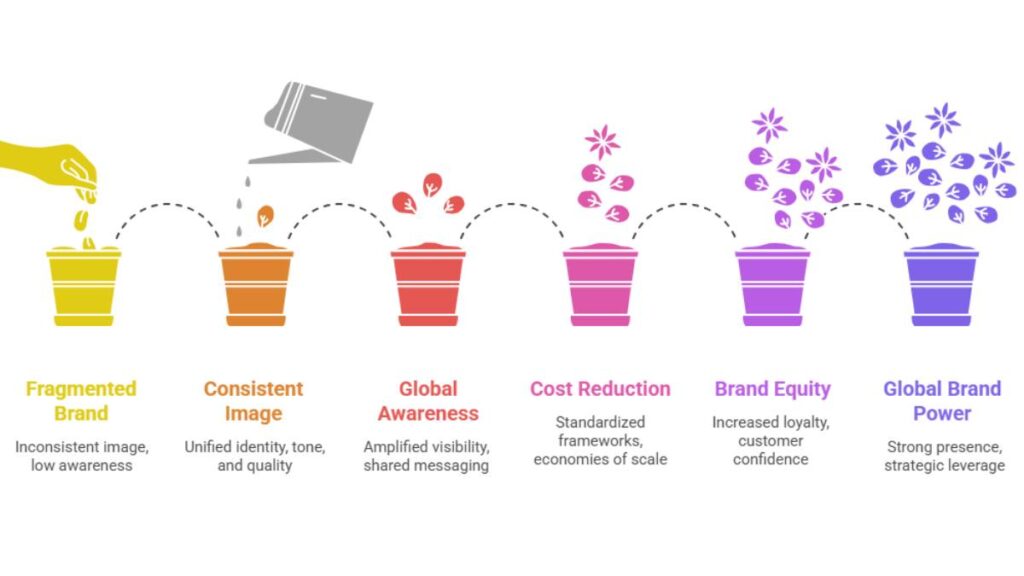
Building a consistent international brand image
Consistency builds familiarity. Familiarity builds trust.
When customers encounter the same identity, tone, and quality across markets, the brand feels stable.
A consistent international image:
- Reduces confusion
- Reinforces positioning
- Strengthens recall
- Signals professionalism
Over time, these signals accumulate into brand equity. Not overnight. Gradually.
Increasing customer awareness worldwide
A globally aligned brand amplifies its own visibility.
Centralized campaigns and shared messaging allow awareness to compound. Instead of rebuilding recognition in each new market, the brand carries momentum forward.
Digital channels accelerate this effect. A globally coherent strategy ensures that attention adds up instead of scattering.
Reducing marketing and production costs
While expansion requires investment, disciplined global brand management often reduces inefficiencies.
Standardized frameworks mean:
- Fewer duplicated creative efforts
- Faster campaign rollouts
- Shared production assets
- Streamlined approvals
Economies of scale become realistic when the brand operates from a unified foundation.
Without that foundation, every region starts from zero. And starting from zero repeatedly is expensive.
Strengthening brand equity and loyalty
Consistency reinforces reliability.
When customers know what to expect and receive it, confidence grows. And confident customers tend to stay.
Global brands that maintain coherence often enjoy stronger loyalty because they signal stability. They feel established. Assured.
Brand equity deepens when delivery aligns with promise, market after market.
Facilitating global expansion and partnerships
A well-managed global brand carries weight.
Distributors, retailers, and strategic partners prefer working with brands that demonstrate clarity and operational discipline. It reduces risk.
Clear positioning, consistent messaging, and stable identity signal long-term thinking.
Global brand management, at its best, transforms complexity into leverage. It allows a company to expand without reinventing itself at every border.
And that’s the difference between international presence and international power.
Challenges and Risks in Global Brand Management
Global brand management sounds powerful on paper. In execution, it’s messy.
The larger the footprint, the more fragile the alignment becomes. What looks like scale from the outside often feels like constant tension internally, between markets, teams, expectations, and realities on the ground.
Let’s talk about the friction points that actually matter.
Cultural and Linguistic Barriers
Culture is rarely the loud problem. It’s the subtle one.
A campaign can be grammatically correct and still feel off. A tagline might translate perfectly but lose emotional depth. Even humor, especially humor, can collapse completely across borders.
Linguistic barriers go beyond translation. They include:
- Tone sensitivity
- Contextual meaning
- Regional slang or idioms
- Formal vs. informal communication norms
Then there’s symbolism. Colors, gestures, imagery; all of it carries cultural weight. A design choice that signals innovation in one country might signal risk in another.
Brands that underestimate this layer often learn the hard way. And repair work is always more expensive than prevention.
Legal and Regulatory Differences Across Markets
Every market comes with its own compliance framework. Advertising restrictions, packaging regulations, labeling laws, and data protection standards; none of them is universal.
A brand that centralizes creative decisions without local legal input creates risk.
Global brand management must account for:
- Claims and disclaimers
- Industry-specific regulations
- Trademark protection
- Consumer protection laws
- Advertising standards
Ignoring regulatory nuance doesn’t just weaken brand credibility; it can halt expansion entirely.
Balancing Global Consistency with Local Adaptation
This is the core tension.
Too much global control, and regional teams feel constrained. Campaigns lose cultural resonance. Growth slows.
Too much local adaptation, and the brand starts to fracture. Messaging drifts. Visual identity mutates. The core becomes unrecognizable.
The challenge isn’t choosing one side. It’s defining clear boundaries:
- What is non-negotiable?
- What can flex?
- Who has final approval?
Without defined governance, this balance becomes political rather than strategic.
Managing Global Supply Chain and Operational Challenges
Brand perception is shaped by experience, not just marketing.
If product quality varies by region, customers notice. If delivery timelines differ drastically, expectations break. If service standards shift from market to market, trust erodes.
Operational inconsistency undermines even the strongest brand positioning.
Global brand management requires coordination with:
- Manufacturing
- Logistics
- Customer service
- Retail or distribution partners
The promise must align with the delivery. Otherwise, the brand becomes aspirational rather than dependable.
Risk of Brand Dilution
Dilution rarely happens overnight.
It happens when incremental compromises accumulate:
- Slight shifts in positioning
- Regional messaging experiments that drift too far
- Inconsistent visual updates
- Conflicting partnerships
Over time, the brand loses clarity. And clarity is currency.
Once a brand stands for “a bit of everything,” it stands for nothing in particular. Rebuilding focus after dilution is difficult and often painful.
Top Global Branding Strategies
There isn’t a single formula for global brand management. Different industries, growth stages, and competitive landscapes demand different structures.
What matters is intentionality.
Branded House vs. House of Brands vs. Hybrid Models
Brand architecture shapes global strategy more than most realize.
Branded House
A single master brand drives all products and markets. Think of companies like Apple, where the core identity carries across devices, services, and geographies.
Advantages:
- Strong global recognition
- Efficient marketing investment
- Unified positioning
Risks:
- A crisis affects the entire portfolio
- Limited flexibility for niche markets
House of Brands
Separate brands operate independently under a corporate parent. Procter & Gamble is a classic example.
Advantages:
- Targeted positioning per market
- Risk containment
- Flexibility across categories
Risks:
- Higher marketing investment
- Weaker corporate brand visibility
Hybrid Model
A blend of both. Some master brand strength with sub-brand differentiation.
Most global companies eventually evolve into some form of hybrid. Pure models rarely survive long-term expansion unchanged.
Endorsed Global Branding Strategy
An endorsed strategy sits somewhere in between.
A sub-brand operates with some autonomy but gains credibility from a parent brand. The endorsement signals trust without overshadowing local nuance.
This approach works well in markets where corporate reputation carries weight, but localized identity remains necessary.
The key is clarity. If the endorsement is subtle to the point of invisibility, it adds little value. If it’s overpowering, it defeats the purpose of differentiation.
Localized Marketing Within Global Branding Frameworks
One of the most effective global branding strategies is controlled localization.
The structure usually looks like this:
- Centralized brand guidelines
- Core messaging pillars
- Shared visual identity
- Local campaign adaptations
The framework remains global. Execution flexes locally.
This allows campaigns to reflect cultural nuance without abandoning brand coherence. It also empowers regional teams, which matters more than many executives realize.
Leveraging Digital Platforms for Consistent Messaging
Digital channels have reshaped global brand management.
Websites, social media platforms, e-commerce stores; they are borderless. Customers compare experiences instantly. A weak regional presence stands out immediately.
Consistency across digital touchpoints is no longer optional.
That includes:
- Visual identity across platforms
- Tone consistency in social content
- Cohesive messaging in paid campaigns
- Standardized customer experience in digital interfaces
When digital alignment is strong, the brand feels unified. When it’s inconsistent, fragmentation becomes visible.
Case Studies of Successful Global Brands
Some brands manage global identity with impressive discipline.
Apple maintains tight control over visual language, product experience, and positioning across markets. Stores look similar. Messaging feels consistent. The brand personality rarely wavers.
Coca-Cola, on the other hand, demonstrates the power of emotional universality combined with localized storytelling. The core idea, connection, and happiness travel globally. Campaign executions adapt locally.
Nike balances global aspiration with regional athlete representation. The tone remains bold and motivational worldwide, yet culturally relevant faces and narratives anchor campaigns locally.
None of these brands relies on sameness alone. They rely on clarity.
And that’s the thread running through every effective global branding strategy: a defined core, protected carefully, expanded thoughtfully.
Global brand management doesn’t eliminate complexity. It organizes it.
Types of Global Brand Management Strategies
Not every global brand should be managed the same way. That’s usually the first hard truth leadership teams run into. What works for a performance-driven tech company can quietly fail for a heritage fashion label. Category dynamics matter. Cultural sensitivity matters. Internal politics matter too, if we’re being honest.
Most global strategies fall into four broad approaches. The difference isn’t just operational. It’s philosophical.
Standardization Strategy: Consistent Global Identity
This is the most centralized model. The brand shows up the same way everywhere; same positioning, same tone, same campaigns, same visual system. Local markets execute, but they don’t reinterpret.
You’ll typically see:
- One global positioning statement
- Centralized campaign development
- Tight governance over messaging and visuals
- Minimal deviation across markets
Standardization works when the need state is universal. Think innovation, performance, aspiration. When customers in São Paulo and Stockholm are buying for similar reasons, consistency builds power.
The upside is efficiency and clarity. Assets scale. Media buying becomes cleaner. And customers traveling across borders see the same brand promise repeated. That repetition builds equity.
But here’s the tension: cultural nuance doesn’t disappear just because governance is tight. A message that feels bold in one region can feel aggressive in another. Humor rarely translates cleanly. Even silence communicates differently across cultures.
Standardization only works when cultural intelligence sits behind it. Otherwise, it becomes rigid. And rigid brands crack under pressure.
Adaptation Strategy: Localized Approach for Cultural Fit
At the other extreme sits adaptation. The global team sets broad guardrails: purpose, core values, and visual identity, but regional markets tailor execution more freely.
This approach makes sense when:
- Buying motivations differ significantly across regions
- Cultural identity deeply shapes decision-making
- Competitive sets vary dramatically from market to market
In some industries, adaptation isn’t optional. It’s survival.
Local teams adjust messaging. Sometimes they tweak product features. Occasionally, pricing architecture shifts to reflect economic realities. Campaign storytelling often reflects local humor, family dynamics, or status symbols.
The benefit? Relevance. Brands feel embedded rather than imported.
The risk? Gradual drift. A slightly different positioning here. A modified tagline there. Over time, customers traveling between markets may feel like they’re encountering cousins of the same brand, not the same entity.
Adaptation works best when the global core is sharply defined. If that core is vague, local creativity fills the vacuum. And not always in the same direction.
Glocal Strategy: Protect the Core, Flex the Expression
The glocal model has become the practical middle ground for many sophisticated organizations. It sounds simple. It isn’t.
The principle is straightforward:
Protect what makes the brand unmistakable. Allow flexibility in how that essence is expressed.
Under a glocal strategy:
- Purpose and values remain fixed
- Visual identity stays recognizable
- Messaging pillars stay intact
- Campaign narratives adapt culturally
The brand backbone doesn’t move. The storytelling does.
This model requires trust between central and regional teams. Headquarters must define non-negotiables clearly. Regional leaders must understand the spirit behind them, not just the rules.
Where this often fails is in overcorrection. Either the global team clamps down too tightly, or regional teams stretch “flexibility” beyond recognition.
The balance shifts over time, too. Emerging markets may need heavier adaptation early on. Mature markets might align more closely with global messaging as awareness stabilizes.
Glocal isn’t static. It’s managed tension.
Co-Branding and Partnerships for International Growth
Expansion doesn’t always happen organically. Partnerships can accelerate credibility, especially in markets where trust takes time.
Co-branding or strategic alliances can:
- Provide local legitimacy
- Expand distribution faster
- Share operational risk
- Elevate perception through association
But partnerships are delicate. Brand equity transfers both ways. A misaligned partner can erode hard-earned trust in months.
Alignment should go beyond revenue projections. It should examine:
- Shared values
- Audience overlap
- Positioning compatibility
- Reputation strength in local markets
When done thoughtfully, partnerships amplify visibility and acceptance. When rushed, they introduce confusion. And confusion is expensive to fix.
Global brand management must evaluate partnerships not just as growth levers, but as brand decisions. Because that’s exactly what they are.

Enroll Now: Brand Management course
Cultural Considerations in Global Brand Management
Culture is not a checkbox in a launch plan. It’s the operating system underneath the behavior.
Brands that underestimate this rarely face dramatic backlash. Instead, they experience something quieter: indifference. Campaigns that technically “work” but never resonate. Products that function but never connect.
Cultural depth shapes perception in ways metrics don’t always capture immediately.
Language Localization and Translation Strategies
Translation is literal. Localization is strategic.
A slogan that sounds sharp in English may feel awkward when directly translated. Idioms don’t travel well. Humor almost never does without adjustment.
Strong localization protects brand voice while respecting local expression. That often involves:
- Adapting tone, not just words
- Replacing cultural references that don’t translate
- Ensuring phrasing feels native, not imported
- Reviewing legal language for compliance
There’s also the question of what not to translate. Some brand names or taglines carry global prestige and should remain consistent.
Language signals respect. If messaging feels slightly off, just slightly, credibility drops. Not dramatically. Just enough to limit growth.
Visual and Design Considerations for Diverse Markets
Visual systems communicate before words are read.
Color associations differ widely. Symbolism shifts. Even layout preferences vary depending on reading patterns and cultural design norms.
Global brand management should regularly audit:
- Color meanings across regions
- Cultural representation in imagery
- Typography suitability for different scripts
- Layout hierarchy preferences
A clean, minimalist design may signal sophistication in one market. In another, it may feel sparse or underwhelming.
Consistency remains important. But blind consistency can overlook cultural context. Visual intelligence often determines whether a brand feels premium or simply foreign.
Consumer Behavior Differences and Cultural Sensitivity
Purchasing decisions are shaped by social norms.
In some markets, authority and expert endorsement drive trust. In others, peer reviews or community validation matter more. Risk tolerance differs. Price sensitivity fluctuates. Status signaling varies dramatically.
Global brand management must account for:
- Individualistic vs. collectivist tendencies
- Emotional vs. rational decision drivers
- Long-term vs. short-term orientation
- Trust-building mechanisms unique to the region
Ignoring these nuances doesn’t always create public controversy. It just reduces effectiveness. Campaigns perform below expectations. Conversions stall. Growth slows.
Cultural sensitivity is less about avoiding offense and more about unlocking relevance.
Festivals, Holidays, and Regional Marketing Nuances
Local calendars shape attention cycles.
Major festivals and national holidays present opportunities for visibility and connection. But participation must feel informed, not opportunistic.
Done well, regional activation can:
- Strengthen emotional ties
- Demonstrate cultural awareness
- Drive seasonal sales spikes
Done poorly, it feels superficial. Audiences can tell the difference.
Global teams should allow regional markets autonomy to activate culturally significant moments within defined brand boundaries. Oversight matters. So does local judgment.
That balance, again, is where discipline lives.
Building a Global Brand Management Plan
A global brand management plan isn’t a static document. It’s a living system. It keeps expansion from becoming chaotic.
Without structure, growth turns reactive. Different regions make independent decisions. Small inconsistencies compound. Over time, brand equity fragments.
A disciplined plan prevents that.
Step 1: Define Brand Purpose and Values
Clarity begins here.
Purpose should articulate why the brand exists beyond transactions. Values define behavioral expectations, internally and externally.
If these are vague, alignment becomes nearly impossible. Teams interpret loosely. Messaging drifts.
Purpose and values should be:
- Clear enough to guide decision-making
- Distinct from competitors
- Strong enough to withstand market pressure
This foundation anchors everything else.
Step 2: Conduct Market-Specific Research
Markets evolve. Competitors reposition. Cultural attitudes shift.
Ongoing research should monitor:
- Brand perception in each region
- Competitive movement
- Emerging consumer segments
- Changing media consumption patterns
Assumptions age quickly in global environments. Regular recalibration keeps positioning relevant.
Step 3: Audit Current Global Brand Presence
Before refining the strategy, reality needs assessment.
A thorough audit examines:
- Visual consistency
- Messaging alignment
- Digital presence across markets
- Customer experience standards
- Partner representation
Inconsistencies often hide in small details: outdated logos, inconsistent tone, conflicting taglines. Individually minor. Collectively damaging.
An honest audit surfaces friction points before they scale.
Step 4: Segment Markets and Define Target Groups
Not every market requires identical investment or emphasis.
Some regions may demand brand awareness campaigns. Others are ready for loyalty-building initiatives. Economic maturity, competitive intensity, and cultural openness all influence strategy.
Segmenting markets allows:
- Smarter resource allocation
- Tailored performance metrics
- Clear prioritization
Without segmentation, global plans become overly generalized and underperform everywhere.
Step 5: Develop Global Marketing Strategies
Once positioning and segmentation are clear, strategic direction follows.
This includes defining:
- Core messaging architecture
- Campaign frameworks
- Channel prioritization by region
- Clear boundaries between central control and local flexibility
Ambiguity at this stage creates tension later. Teams need clarity on what is non-negotiable and where creativity is encouraged.
Structure reduces friction.
Step 6: Establish Global Brand Identity Guidelines
Guidelines are often misunderstood as restrictive. In reality, they create freedom within clarity.
Strong global guidelines outline:
- Logo application standards
- Color systems
- Typography rules
- Tone-of-voice principles
- Visual storytelling expectations
They should be detailed enough to prevent erosion but flexible enough to allow regional relevance.
Overly rigid guidelines stifle innovation. Overly vague ones invite inconsistency.
The right balance keeps the brand recognizable without making it sterile.
Step 7: Monitor, Measure, and Adapt
Global brand management is continuous.
Measurement should track:
- Brand awareness and recognition
- Perceived consistency
- Market-specific performance indicators
- Loyalty and retention trends
Adjustment is not a sign of instability. It’s stewardship.
Markets shift. Cultural conversations evolve. New competitors emerge. Brands that endure are the ones that adapt deliberately, without abandoning their core.
Discipline and attentiveness. That’s usually the difference between global presence and global leadership.
Emerging Trends in Global Brand Management
Global brand management doesn’t really “evolve.” It gets pressured. By technology. By consumers. By regulators. By competitors moving faster than expected.
The core principles still hold: clarity of positioning, consistency across markets, and cultural awareness that goes deeper than surface symbolism. But the operating environment is tighter now. Less forgiving. A campaign misstep in one country doesn’t stay there.
A few forces are reshaping how global brands operate. Some are obvious. Others are quieter but just as disruptive.
Impact of Artificial Intelligence and Marketing Automation
Artificial intelligence has shifted from buzzword to infrastructure in many global organizations. Not in a flashy way. In a practical one.
Segmentation is sharper. Localization moves faster. Testing cycles that used to drag for months are compressed into weeks, sometimes days. Personalization scales across regions without rebuilding entire campaigns from scratch.
That’s the upside.
The downside? Speed exposes a weak strategy. If positioning isn’t solid, automation just distributes inconsistency more efficiently. If data is misread, decisions become reactive, chasing dashboards instead of building equity.
Technology enhances judgment. It doesn’t replace it.
Global brand leaders still need pattern recognition, cultural fluency, and the ability to say no to short-term wins that weaken long-term positioning. Automation supports execution. It cannot define meaning.
Industrial Cybersecurity in Global Digital Operations
As global brands digitize more of their operations, commerce, CRM systems, and content platforms, vulnerability increases. Quietly, but significantly.
Interconnected systems across regions mean a single security gap can ripple through multiple markets. Customer data exposure in one country becomes headline news everywhere.
And customers don’t separate “IT failure” from brand failure.
Cybersecurity now sits squarely inside brand management. Trust isn’t just built through messaging; it’s protected through infrastructure.
Forward-looking global teams are investing in:
- Rigorous data governance standards
- Crisis response protocols that work across time zones
- Vendor audits and accountability
- Clear, transparent communication frameworks
Reputation can erode faster than revenue forecasts predict. Prevention costs less than repair. Always.
Social Media and Digital-First Global Branding
Social media erased geographic boundaries. A campaign launched in Mexico can trend in Germany by the afternoon. A poorly translated tagline can become a global meme before regional teams even notice.
That reality has changed the campaign rhythm.
Instead of rigid, centralized rollouts, many global brands now operate with modular systems; adaptable content blocks built around a shared narrative. Regional teams activate locally, but within a defined framework.
What works well:
- Clear global storylines
- Defined messaging pillars
- Real-time listening across markets
- Strong coordination between headquarters and local teams
What fails is either extreme: total central control that ignores local context, or complete decentralization that fractures the brand voice.
Digital-first branding demands responsiveness. But responsiveness without structure creates noise. And noise weakens equity.
The conversation can vary by market. The core promise should not.
Sustainability and Environmental Expectations
Sustainability used to be a differentiator. Now, in many categories, it’s expected.
Consumers look beyond advertising claims. They examine sourcing. Packaging. Labor standards. Carbon reporting. And they compare notes globally.
At the same time, regulatory scrutiny is increasing. Environmental reporting requirements differ by region, but the pressure is consistent.
For global brand management, sustainability creates two challenges:
- Operational alignment; ensuring practices actually support the claims.
- Communication discipline: avoiding exaggerated promises.
Common priorities include:
- Transparent sourcing disclosures
- Regionally adapted sustainable packaging
- Clear, measurable environmental targets
- Internal accountability before external promotion
Overstating progress damages credibility. Under-communicating genuine effort wastes equity.
The brands navigating this space successfully embed sustainability into their operational model first. Messaging follows reality, not the other way around.
Conclusion:
Global brand management has never been simple. It’s more layered now, certainly. More moving parts. More voices. More scrutiny.
But the fundamentals haven’t changed as much as it might seem.
Strong global brands tend to share a few characteristics:
- A clearly articulated purpose
- Disciplined consistency across markets
- Respect for cultural nuance
- Governance structures that enable flexibility without chaos
- Ongoing measurement, not occasional audits
Expansion without strategy creates fragmentation. Strategy without cultural intelligence creates friction. And flexibility without guardrails creates dilution.
The real challenge lies in managing those tensions at the same time.
Organizations that treat global branding as a long-term system, not a campaign calendar, usually build more durable equity. They invest in alignment. They clarify non-negotiables. They allow local insight to shape execution, but not identity.
Looking ahead, the pressure will continue. Digital acceleration won’t slow down. Transparency expectations will increase. Emerging markets will demand a deeper understanding, not surface-level adaptation.
The brands that lead won’t necessarily be the most aggressive or the most visible. They’ll be the most coherent.
Clear about who they are. Consistent in how they show up. Adaptable without losing themselves.
That balance is difficult. It always has been. But that’s where enduring global brands are built.
FAQ:
What does a global brand manager do?
A global brand manager lives in the tension between clarity and complexity. On paper, the job is about defining positioning, guarding identity, and aligning execution. In reality, it’s more nuanced than that. It involves late calls with regional teams, reviewing campaigns that almost fit but not quite, and deciding where to push back and where to let local insight win.
The role is stewardship. Not control. The brand has to feel cohesive in Berlin, São Paulo, and Mumbai, even though the conversations behind the scenes rarely are.
How do you balance global consistency with local relevance?
This question sounds strategic. It’s actually structural.
The balance depends on knowing what is fixed. Purpose. Core promise. Visual DNA. Those are anchors. Everything else, tone, casting, media mix, cultural references, can flex if needed.
When teams argue endlessly about adaptation, it’s usually because the non-negotiables were never clearly defined. Once those are set, the rest becomes less emotional. Still complex, but manageable.
What are the measurable benefits of global brand management?
The obvious benefit is efficiency. Shared assets. Scalable campaigns. Fewer reinventions.
The less obvious benefit is compounding equity. Recognition builds faster when signals stay consistent. Negotiating power improves. Distributors trust stable brands. Over time, margins strengthen; not dramatically overnight, but steadily.
That’s the part that rarely shows up in flashy presentations. It shows up in resilience.
What are the biggest pitfalls to avoid in global branding?
Over-centralization is one. Headquarters dictating creative that simply doesn’t resonate locally.
The opposite is just as risky: letting each region drift until the brand becomes unrecognizable.
Another quiet pitfall: assuming cultural differences are small. They aren’t. Humor, aspiration, and even color symbolism can shift meaning dramatically. Most global branding failures don’t explode publicly. They just underperform. Quietly.
How does global brand management differ from domestic brand management?
Domestic branding operates within one cultural rhythm. One regulatory environment. One dominant consumer mindset.
Global branding stretches across many of those at once. Legal frameworks shift. Media consumption varies. Economic realities differ.
The complexity isn’t just geographic. It’s psychological. Aligning diverse teams without diluting meaning; that’s the real difference.
What skills matter most for a global brand manager?
Strategic thinking, yes. But also diplomacy. Patience. The ability to listen without immediately defending the headquarters’ perspective.
Cross-cultural literacy is not optional. Neither is clarity under pressure. Tough calls will be made. The strongest leaders protect the brand’s integrity while respecting local expertise. That balance takes experience. And restraint.
How do companies maintain brand consistency across multiple countries?
Guidelines help. Asset libraries help. Shared dashboards help.
But consistency is sustained through repetition and conversation. Regular alignment calls. Joint planning cycles. Clear documentation of what must remain stable.
When standards fade, it’s rarely because there wasn’t a brand book. It’s because no one reinforced it.
What role does cultural adaptation play in global branding?
Cultural adaptation is what keeps a brand from feeling imported. Translation alone isn’t enough. Emotional cues, humor, and social norms; they shape how messages land.
The trick is adapting expression without changing identity. When done well, the brand feels global in stature but local in tone. When done poorly, it feels generic everywhere.
How do legal and regulatory factors influence global brand decisions?
Every market brings its own constraints: advertising restrictions, data laws, and land availability requirements. These affect claims, packaging, and even visual choices.
Legal input should happen early. If it’s brought in at the final approval stage, revisions become expensive, and momentum slows. Experienced teams plan compliance into creative development, not around it.
What tools actually help manage a global brand?
Digital asset management systems are valuable. So are governance frameworks and performance dashboards.
But tools only work when organizational roles are clear. If accountability is vague, no platform fixes that. Structure matters more than software.
How does digital marketing change global brand management?
Digital channels amplify everything. Good strategy scales quickly. So do inconsistencies.
Campaigns can be localized with precision, tested rapidly, and optimized in real time. That’s powerful. It’s also risky. Without a strong central narrative, digital fragmentation happens fast.
Speed demands clarity.
How is the success of global branding measured?
Short-term sales matter, of course. But they don’t tell the whole story.
Long-term indicators: brand preference, perception shifts, equity tracking; reveal whether strength is building or eroding. Global branding is cumulative. Measuring only immediate returns misses the broader trajectory.
What mistakes do organizations repeat in global brand management?
Assuming alignment exists when it doesn’t.
Copying a successful domestic campaign internationally without questioning the context.
Failing to revisit positioning as markets evolve.
Brand drift rarely feels dramatic in the moment. It’s gradual. Which makes it dangerous.
Why is storytelling so important internationally?
Stories travel better than product claims. They connect at a human level.
Still, emotional triggers differ across cultures. What feels aspirational in one market may feel excessive in another. Strong global storytelling keeps the core theme intact but allows tone and nuance to shift naturally.
It’s less about translation. More about resonance.
How does social media influence global brand perception?
Geography has collapsed online. A campaign launched in one market can spark conversation globally within hours.
That visibility increases opportunity and exposure. Missteps travel quickly. Coordination across markets becomes critical, especially in moments of controversy or rapid response.
Monitoring isn’t optional anymore. It’s constant.
What companies demonstrate strong global brand management?
Brands like Apple, Coca-Cola, and Nike are often referenced for good reason. Their core positioning remains remarkably stable across markets. Visual identity is consistent. Messaging rarely contradicts itself.
Yet campaigns still reflect local culture. That disciplined flexibility, not rigid uniformity, is what sustains international equity over decades.
How can AI support global brand strategy?
AI accelerates data analysis. It surfaces patterns in consumer behavior across regions. It enables faster testing cycles and sharper personalization.
But tools don’t define meaning. Interpretation still requires judgment. Brand direction remains a human decision. Data informs. Leadership decides.
What are the cost considerations in managing a global brand?
There’s upfront investment; research, governance systems, and coordination infrastructure.
At first, it can feel heavy. Over time, efficiencies emerge. Shared campaigns reduce duplication. Assets travel further. The hidden cost, honestly, is inconsistency. Fragmented brands spend more time fixing confusion than building equity.
How should brands handle international crisis communication?
Preparation matters more than improvisation. Clear global protocols reduce confusion when pressure rises.
Regional teams may adjust tone, but the central narrative must stay aligned. Speed helps, but consistency protects credibility. In a crisis, mixed messages cause more damage than delayed ones.
How do partnerships and co-branding affect global identity?
Partnerships can accelerate trust, especially in new markets. Association transfers meaning; sometimes faster than advertising can.
But alignment is critical. If values clash, the damage is subtle at first, then cumulative. Every collaboration should be evaluated not just for revenue potential, but for long-term brand coherence.
Because reputation compounds. In both directions.