

How to build a career in product marketing isn’t a question people ask on day one of their marketing career. It shows up later. After a few launches. A few campaigns. Maybe some frustration. Product marketing sits in a slightly uncomfortable place close to product, close to sales, close to customers. And that’s exactly why it works. This guide walks through what the role actually looks like, how people get into it without a perfect background, and what growth looks like once you’re in. No shortcuts, no hype. Just the skills that matter, the experience that compounds, and the decisions that tend to shape a solid, long-term product marketing career.
Table of Contents
Introduction
What Is Product Marketing? – Definition & Career Context
Product marketing is often explained in neat frameworks. In reality, it’s messier than that.
At its simplest, product marketing exists to make sure a product is understood for the right reasons. By the right people. At the right moment. That sounds obvious. It rarely is.
Most products don’t fail because they’re bad. They struggle because the value gets lost somewhere between what was built and what the market hears. Product marketing sits in that gap. It pulls the signal out of the noise. It forces clarity where teams are tempted to stay vague.
This role matters more now than it did a decade ago. Markets are crowded. Features copy fast. Buyers are skeptical. Attention is short. Under those conditions, “more marketing” doesn’t help much. Better decisions do. Product marketing is where many of those decisions live.
It also helps to draw a line between product marketing and other marketing roles. Product marketing isn’t about owning a channel. It’s not measured by impressions or clicks alone. And it’s not a support function that shows up after the product is ready.
Compared to most marketing roles, product marketing:
- Starts earlier
- Asks harder questions
- And stays involved longer than people expect
That combination makes it appealing to beginners who want to learn how businesses actually think, and to career switchers who are tired of optimizing tactics without context. Product marketing gives perspective. And perspective changes how work feels.
Why You Should Build a Career in Product Marketing
Product marketing tends to become visible when something isn’t working.
Sales cycles stretch.
Launches feel flat.
Customers don’t repeat the story the company thinks it’s telling.
That’s usually when leaders start asking, “Do people actually understand what we do?”
Across industries, the pattern is the same. When companies grow, product marketing helps them focus. When growth slows, product marketing helps them diagnose. That’s why demand for the role holds up even when other hiring pauses.
From a career angle, product marketing has a quieter advantage. The skills age well. Learning how markets behave, how buyers decide, and how positioning shapes outcomes doesn’t become obsolete every time a platform changes.
Many start as Associate Product Marketing Managers, close to execution. Over time, the work shifts. Less doing. More deciding. At senior levels, product marketing often feeds directly into leadership because the role trains judgment. And when answers aren’t obvious, judgment matters more than output.
What Does a Product Marketer Do? Roles & Responsibilities
1. Core Product Marketing Responsibilities
Ask five companies what their product marketers do, and you’ll get five different answers. Still, the underlying work tends to rhyme.
Most product marketers spend time in a few recurring areas.
They study the market. Not just competitors, but how buyers frame choices and trade-offs.
They spend time with customers. Listening for patterns. Paying attention to the words customers use, especially when those words don’t match internal language.
They shape positioning and messaging. Deciding what the product should lead with and what should stay in the background. This part involves more subtraction than addition.
They help define the go-to-market strategy. Who the product is for now. Who it’s not for yet. What success actually means after launch.
And they support sales. Not by flooding teams with assets, but by giving them clarity. The kind that holds up in real conversations, not just decks.
What connects all of this is decision-making. Product marketing is rarely about doing everything. It’s about choosing the few things that matter and backing those choices with conviction.
2. How Product Marketing Fits into the GTM (Go-To-Market) Framework
Product marketing sits between teams that often move at different speeds.
Product teams think in roadmaps.
Marketing teams think in campaigns.
Sales teams think in quarters.
Customer success thinks in retention.
Product marketing tries to get them aligned around the same story.
In go-to-market work, that often means slowing things down before speeding them up. Asking questions others skip:
- Is this solving a real customer problem or just shipping progress?
- Are we clear on who this is for, and who it isn’t?
- Will sales recognize this value when a deal gets tense?
Launches are the visible part of the job, but not the whole thing. Strong product marketing shows up after launch, too. When messaging needs adjustment. When the market reacts differently than expected. When insights need to flow back into product decisions.
It’s less about control. More about coherence.
Essential Product Marketing Skills to Build Early
Product marketing doesn’t reward surface-level knowledge for long. The skills that matter take time to develop, and most of them aren’t learned in isolation.
Still, some foundations are worth focusing on early.
1. Market Research & Customer Insight Skills
Everything starts with understanding people who don’t work at the company.
That means getting comfortable talking to customers without pitching. Letting silence sit. Hearing things that don’t fit the roadmap. Not rushing to summarize.
Strong product marketers learn how to:
- Spot patterns across messy feedback
- Separate loud opinions from real signals
- Connect what customers say with how they actually behave
This isn’t about perfect research. It’s about building intuition that’s grounded in reality.
2. Positioning & Messaging Mastery
Positioning is where many stumble. Not because it’s complicated, but because it forces trade-offs.
Good positioning answers one hard question clearly: why this product, for this audience, right now.
That often requires:
- Saying no to secondary use cases
- Resisting the urge to sound impressive
- Choosing clarity over completeness
When positioning is right, messaging feels simple. When it’s wrong, no amount of clever wording fixes it.
3. Go-To-Market (GTM) Strategy & Launch Execution
A launch is a moment of focus, not a checklist.
Product marketers working on GTM need to think beyond announcements:
- Who needs to believe this first?
- What behavior should change after launch?
- How will success be recognized early?
Many product launches disappoint because the intent was fuzzy. Clear intent doesn’t guarantee success, but it gives teams something to learn from.
4. Sales Enablement & Cross-Functional Collaboration
Product marketing lives in the middle, and that comes with friction.
The role involves translating complexity into something usable. Helping sales teams tell a story that holds up when objections appear. Working with product teams without turning every insight into a request.
This work isn’t glamorous. It’s valuable.
5. Soft Skills: Communication, Strategic Thinking & Confidence
These skills don’t show up neatly in frameworks, but they shape careers.
Product marketers are often asked for answers before certainty exists. Being able to explain thinking clearly, change direction without drama, and hold a point of view without becoming rigid builds trust over time.
And trust is what gives the role real influence.
How to Build a Career in Product Marketing (Step-by-Step Guide)
This is the part most people rush through. And that’s usually where things fall apart.
Product marketing isn’t a role you stumble into by accident anymore. Teams expect clarity. They expect judgment. They expect someone who understands why a product exists, not just how to talk about it. Building a career here is less about ticking boxes and more about stacking the right kind of proof, over time.
Here’s how that usually plays out in the real world.
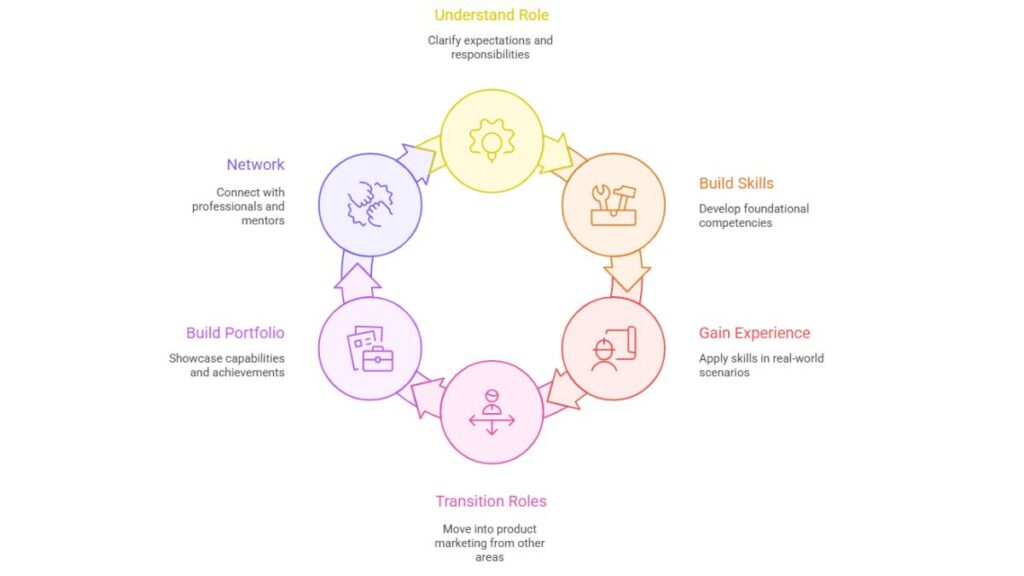
Step 1: Understand the Product Marketing Role and Career Expectations
Before learning tactics, get clear on what companies actually mean when they say “product marketing.”
Because it varies. A lot. In some teams, PMMs are launch-focused. In others, they own the positioning end-to-end. Some sit close to the product. Others are almost an extension of sales. The mistake is assuming there’s a single, universal definition.
What stays consistent is how success is measured:
- Can this person clearly explain who the product is for and why it matters?
- Can they align product, marketing, and sales around a shared story?
- Do launches land with intention, or just activity?
Understanding these expectations early helps avoid learning the wrong things too deeply. It also shapes how experience should be framed later.
Step 2: Build Core Product Marketing Skills and Knowledge
Product marketing lives at the intersection of strategy and execution. Ignore either side, and the role collapses.
The foundational skills usually fall into a few buckets:
Positioning and messaging
Not clever words. Clear ones. Language that makes sense to customers, not internal teams.
Customer and market understanding
Interviews. Win/loss insights. Pattern recognition. Knowing what customers say, and what they mean.
Go-to-market strategy
How a product enters the market, gains adoption, and stays relevant. This includes pricing logic, launch sequencing, and channel alignment.
Cross-functional communication
Explaining decisions. Navigating trade-offs. Saying no, thoughtfully.
These aren’t learned in isolation. They build on each other. Strong messaging comes from strong customer insight. Good GTM plans depend on honest positioning. It’s a system, not a checklist.
Step 3: Gain Hands-On Product Marketing Experience
Experience is the currency here. Not titles.
Hands-on product marketing experience can come from many places:
- Supporting a launch, even in a small way
- Writing or refining messaging for a feature or update
- Creating sales enablement content that actually gets used
- Running competitive research and turning it into something actionable
- Talking directly to customers and summarizing insights for teams
The key is ownership. Passive exposure doesn’t count for much. What matters is being able to say, this was the problem, this was the approach, and this is what changed because of it.
Even imperfect projects teach judgment. And judgment is what hiring managers listen for.
Step 4: Transition Into Product Marketing From Another Role
Most product marketers don’t start as product marketers.
Common transition paths include marketing, sales, customer success, consulting, and even product or operations. The move works when transferable skills are made explicit.
For example:
- Marketers bring campaign thinking, audience insight, and narrative building
- Sales professionals understand objections, deal with friction, and buyer psychology
- Customer success knows adoption barriers and retention drivers
- Product roles bring prioritization and roadmap context
The mistake is positioning past work by job title instead of impact. Product marketing hiring decisions are less about where experience came from and more about whether it maps cleanly to PMM responsibilities.
Step 5: Build a Product Marketing Portfolio That Proves Capability
Resumes explain. Portfolios convince.
A strong product marketing portfolio shows how thinking works, not just what was delivered. It doesn’t need to be flashy. It needs to be clear.
Useful elements often include:
- A positioning or messaging framework, with rationale
- A launch plan showing sequencing, goals, and trade-offs
- Sales enablement assets tied to a specific problem
- Competitive analysis with implications, not just features
Context matters. What constraints existed? What changed after? What would be done differently next time?
That reflection signals maturity more than polished slides ever will.
Step 6: Network With Product Marketers and Find Mentors
This part gets underestimated, usually because it sounds vague.
But product marketing is still a relationship-driven field. Teams hire people they trust to navigate ambiguity. Conversations build that trust faster than applications.
Networking here isn’t about asking for jobs. It’s about learning how others think:
- How they handle misalignment
- How tdo hey decide what not to work on
- How they push back without burning bridges
Mentorship doesn’t always look formal. Sometimes it’s a few recurring conversations that shape how decisions are made. Over time, those insights compound.
And that’s often the difference between someone who does product marketing tasks and someone who grows into a product marketing leader.

Enroll Now: Product Marketing Course
Product Marketing Career Path & Progression
Product marketing careers rarely move in straight lines. Titles matter less than scope, influence, and judgment. Still, most paths follow a familiar arc, especially as teams mature and expectations become clearer.
Entry Level: Associate Product Marketing Manager (APMM)
This is where many start, whether officially or in practice.
At this stage, the focus is on learning how the pieces fit together:
Supporting launches, messaging updates, and enablement work
Conducting competitive research and summarizing insights
Learning how product, sales, and marketing actually collaborate (and where they don’t)
What matters most here isn’t perfection. It’s curiosity, clarity in communication, and the ability to take feedback without getting defensive.
Mid Career: Product Marketing Manager (PMM)
This is where ownership begins.
PMMs are expected to:
- Own positioning and messaging for a product or segment
- Lead go-to-market strategy, not just execute tasks
- Translate customer insight into decisions that affect the roadmap, sales motion, or growth strategy
Strong PMMs stop reacting and start shaping. They see patterns early and help teams align before problems escalate.
Senior Roles: Senior PMM to Head of Product Marketing
Senior product marketers think beyond individual launches.
The work shifts toward:
- Portfolio-level positioning and narrative consistency
- Mentoring other PMMs and influencing without authority
- Driving adoption, expansion, and retention; not just launches
This level demands comfort with ambiguity. Decisions are less about “what’s right” and more about trade-offs.
Leadership Roles: VP, GM, or Executive Positions
At the top, product marketing becomes a lever for company direction.
Leaders here:
- Set the go-to-market vision
- Shape how the company understands its market
- Act as a bridge between executive strategy and customer reality
The strongest leaders never lose touch with the customer, even as their scope expands.
How to Get Product Marketing Jobs: Resume, Interview & Portfolio
Getting hired in product marketing isn’t about sounding impressive. It’s about sounding useful.
Writing a PMM Resume That Gets Noticed
Resumes should tell a story of impact, not activity.
What tends to work:
- Clear outcomes tied to launches, positioning changes, or GTM shifts
- Evidence of cross-functional influence
- Customer insight translated into business decisions
Buzzwords don’t help much here. Specifics do.
Building a Product Marketing Portfolio
Portfolios show how thinking works under real constraints.
A solid portfolio might include:
- A positioning or messaging framework with reasoning
- A launch plan showing goals, sequencing, and success metrics
- Sales enablement tied to a real objection or deal blocker
Hiring teams look for judgment. Clean logic beats flashy slides every time.
Interview Preparation for Product Marketing Roles
PMM interviews test how candidates think, not just what they know.
Expect questions around:
- How positioning decisions were made
- How conflicts with the product or sales were handled
- What success looked like, and what didn’t
Strong answers show clarity, humility, and awareness of trade-offs. Overconfidence usually works against candidates here.
Product Marketing Certifications and Learning Resources
There’s no single credential that makes someone a great product marketer. But structured learning can shorten the curve.
Product Marketing Certification
Certifications help build foundational language and frameworks, especially for those transitioning from other roles. They’re most useful when paired with a real application, not treated as a finish line.
Ongoing Learning Resources
The best product marketers stay sharp by:
- Studying strong positioning in the wild
- Following market shifts and buyer behavior
- Learning from peers through communities and conversations
Learning here is continuous. Markets move. Products change. The role evolves with them.
Core Tools and Frameworks to Understand
While tools vary by company, product marketers are expected to understand:
- Competitive analysis approaches
- Customer research methods
- Go-to-market planning frameworks
The value isn’t in the tools themselves, but in knowing when, and when not, to use them.
Product marketing rewards those who keep learning, stay close to customers, and remain honest about what’s working and what isn’t.
Common Product Marketing Challenges & How to Overcome Them
Product marketing rarely fails because someone didn’t know what to do. It struggles because the environment is messy. Too many opinions. Half-decisions. Moving targets. That’s the job, whether anyone says it out loud or not.
One of the earliest tensions is proving impact. Product marketing doesn’t always have a neat metric, the way paid marketing does. Revenue feels shared. Adoption is influenced by ten other things. That’s normal. The mistake is trying to reverse-engineer value after everything ships. Strong PMMs align on outcomes upfront; what should change if this work is successful? Fewer objections. Clearer sales conversations. Better launch momentum. When everyone agrees on that early, the ROI conversation becomes less defensive later.
Another constant challenge is cross-functional alignment. Most friction isn’t conflict; it’s silence. Assumptions fill the gaps. Product thinks messaging is obvious. Sales thinks it isn’t usable. Marketing thinks it landed. Product marketing sits in the middle, translating intent into something practical. Writing things down helps more than endless meetings. Repeating decisions helps even more. Alignment usually comes from clarity, not persuasion.
Then there’s the strategy vs execution trap. Calendars fill quickly in this role. Launch requests, enablement updates, reviews that “just need a quick pass.” Strategy gets postponed because it doesn’t scream for attention. The PMMs who last learn to protect thinking time. Not every week, but consistently. Without that space, the role quietly turns reactive.
Conclusion:
A career in product marketing doesn’t hinge on one perfect move. It builds slowly. Through better questions. Cleaner thinking. Saying no more often than feels comfortable.
The fundamentals stay steady:
Understand customers deeply.
Know the product well enough to challenge it.
Communicate clearly, even when the room is noisy.
For anyone starting out, short horizons help. The first month is about listening. The next two are about contributing without overreaching. After that, patterns start to emerge: what the team values, where clarity is missing, and where product marketing can actually help.
Progress in this field isn’t loud. But it compounds.
FAQs: About Building a Career in Product Marketing
1. How do you build a career in product marketing from scratch?
Start by learning how products are positioned and sold, not just marketed. Study customer problems, market context, and buying decisions. Early roles don’t need the PMM title, but they should involve real exposure to launches, messaging, or customer insight work. Momentum comes from showing judgment, not just activity.
2. What qualifications are needed to become a product marketer?
There’s no single credential that unlocks the role. Degrees matter less than clarity of thinking and communication. Certifications can help structure learning, especially early on, but hiring teams tend to focus on how someone reasons about customers, markets, and tradeoffs rather than formal qualifications.
3. Is product marketing a good career in 2025 and beyond?
Yes, largely because products are harder to explain than they used to be. Markets are crowded, features look similar, and attention is limited. Companies need people who can create clarity. That demand isn’t shrinking. If anything, it’s becoming more visible.
4. What skills are most important for a successful product marketing career?
Customer understanding, positioning, and influence across teams matter most. Execution skills help early, but long-term success comes from judgment; knowing what matters, what doesn’t, and how to communicate that clearly without overselling.
5. How do you transition into product marketing from another role?
Transitions usually work best when they’re gradual. Start doing PMM-adjacent work where possible; launch planning, messaging, enablement, and research. Map existing strengths to PMM outcomes. Over time, the work speaks louder than the job title.
6. How long does it take to become a product marketing manager?
There’s no standard timeline. Some move quickly through internal transitions. Others take longer while building the right experience. What matters isn’t time served, but exposure to real product marketing problems and decisions.
7. What is the typical product marketing career path?
Most paths move from Associate PMM to PMM, then into senior or leadership roles. As the scope increases, the work shifts. Less execution. More influence. More responsibility for direction rather than delivery.
8. Do you need technical or product management experience for product marketing?
Not always. Technical fluency helps, but deep engineering knowledge isn’t required in many roles. What matters more is understanding the product well enough to explain its value clearly and credibly to different audiences.
9. How do you get your first product marketing job without direct experience?
Proof matters more than promises. Build a portfolio with real or simulated work. Document how problems were approached and decisions made. Hiring managers want to see thinking, not just familiarity with frameworks.
10. What are the biggest challenges in a product marketing career?
Ambiguity is the constant. Ownership can be unclear. Impact isn’t always immediate. Priorities shift. The PMMs who thrive learn to create clarity where it doesn’t exist, and stay steady while doing it.