
How to Build a Product Marketing Framework from Scratch isn’t about filling templates or copying someone else’s playbook. It’s about creating a clear, usable structure that helps teams bring products to market with confidence and keep growing after launch. This guide breaks down what a product marketing framework actually is, why it matters more than ever in 2026, and how to build one step by step. From defining the right audience and positioning to GTM planning, launches, and measurement, the focus stays practical. No fluff. Just a framework that aligns product, marketing, and growth around real customer needs.
Table of Contents
Introduction
What is a product marketing framework, and why does it matter in 2026
A product marketing framework is the thinking layer behind how a product shows up in the world. Not the launch checklist. Not the campaign plan. The logic underneath all of it.
It answers the questions teams keep circling back to:
Who is this really for?
Why should anyone care?
What makes this different enough to win?
In 2026, those questions aren’t optional anymore. Markets are crowded. Features look similar. Buyers have seen every promise before. Products don’t usually lose because they’re weak; they lose because the story isn’t clear, or the positioning keeps shifting, or the launch feels disconnected from the actual customer problem.
That’s where a framework helps. It brings discipline without killing momentum. It gives teams something steady to work from when things get noisy.
At its core, a product marketing framework is a structured way to bring a product to market and grow it over time. Not just on launch day, but through iterations, expansions, and pivots.
This guide is for:
- Product marketers trying to create order from scattered efforts
- Product managers who want stronger market pull, not just feature output
- Founders who know the product works, but growth feels harder than it should
By the end, readers should walk away with:
- A clearer way to define their product’s audience and value
- A repeatable structure for positioning, messaging, and launches
- Better alignment between product, marketing, and sales
- Fewer last-minute scrambles and fewer “why didn’t this land?” moments
What Is a Product Marketing Framework?
Strip it down, and a product marketing framework is a decision system. It helps teams make the same kind of choices consistently, even as the product evolves.
It gives shape to things like:
- Who the product is built for (and who it’s not)
- What problem it actually solving
- How it should be talked about, priced, and launched
- How success is defined beyond vanity metrics
A good framework doesn’t live in slides. It shows up in everyday work: homepage copy, sales conversations, roadmap debates, launch timelines. When it’s missing, those things drift. Slowly at first. Then all at once.
Product marketing framework vs product strategy vs go-to-market plan
These terms often get lumped together, which causes a lot of confusion.
Product strategy is about direction. What to build. Why it matters. Where the product is headed.
Go-to-market plans are tactical how a specific product or feature gets launched, including channels, timing, and campaigns.
A product marketing framework connects the two. It translates product decisions into market-facing clarity and repeatable execution.
One sets the destination.
One runs the launch.
The framework keeps everything aligned in between.
Why building one from scratch actually matters
Using borrowed templates or one-off launch docs can work early on. Eventually, it breaks. Messaging changes every quarter. Sales decks don’t match the product. Features ship without a clear audience in mind.
Building a framework from scratch forces teams to slow down just enough to get aligned. Assumptions surface. Trade-offs become visible. And once that foundation is in place, scaling gets easier, not harder.
Consistency is the quiet advantage here. Over time, it compounds.
Why You Need a Product Marketing Framework from Scratch
Without a framework, product marketing becomes reactive by default. Launches happen because a feature is ready. Messaging shifts based on feedback from the last sales call. Priorities change fast, but alignment lags behind.
That gap shows up everywhere.
Why structure matters more than speed
Structure doesn’t mean bureaucracy. It means fewer debates about basics and more focus on what actually moves the needle.
When the framework is clear:
- Target customers are already defined
- Positioning has boundaries
- Messaging doesn’t restart from zero every time
Teams move faster because they’re not renegotiating fundamentals.
What a solid framework gives you
A strong product marketing framework brings a few important things:
Clarity: Everyone knows what problem the product solves and for whom
Alignment: Product, marketing, and sales work from the same market view
Consistency: Messaging feels connected, not scattered
Measurement: Success isn’t vague; it’s decided upfront
It also creates confidence. Teams stop guessing and start refining.
How it prevents common launch mistakes
Most failed launches don’t fail loudly. They quietly underperform.
Common patterns show up again and again:
- Trying to speak to too many audiences at once
- Leading with features instead of real buyer pain
- Treating go-to-market as a one-time event
- Measuring success after the launch, not before
A framework acts as a checkpoint. It forces teams to pressure-test decisions early, before momentum takes over. That alone can save months of rework and frustration.
When done right, the framework doesn’t limit creativity. It gives it direction, and that’s usually what’s missing.
Build a Product Marketing Framework from Scratch: Step-by-Step
This is where theory turns into something usable. Not a deck. Not a one-time exercise. A working system that holds up when the product changes, the market shifts, or the team grows.
The steps below aren’t meant to be rushed. Each one builds on the previous. Skip one, and the rest get shaky.
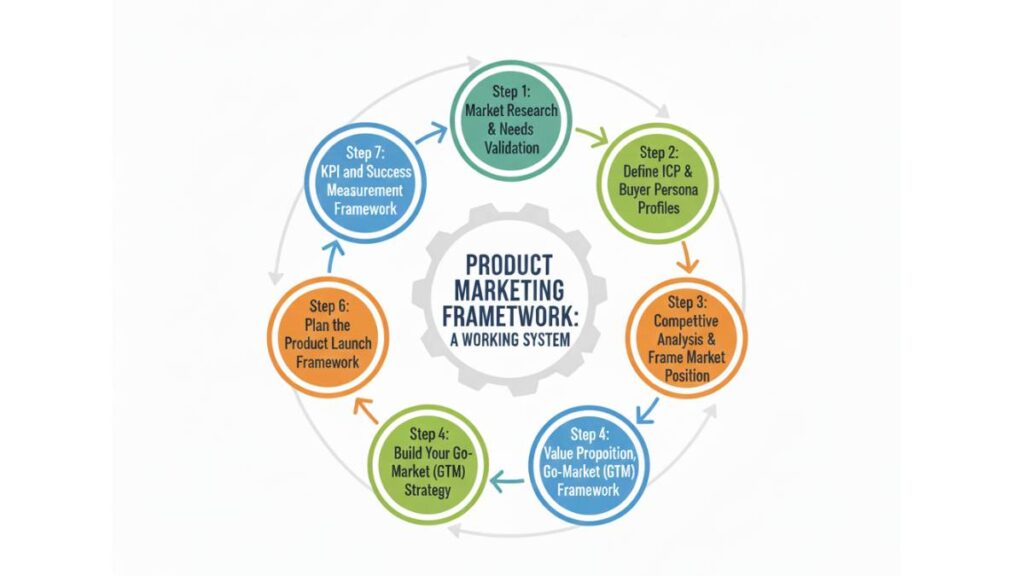
Step 1: Market Research & Needs Validation
Everything starts here. Not with positioning. Not with messaging. With an understanding of what people are actually struggling with.
Good market research isn’t about collecting quotes to justify a decision already made. It’s about pressure-testing assumptions. Especially the uncomfortable ones.
The goal is to answer a few core questions clearly:
- What problem is showing up repeatedly?
- How are people solving it today?
- Where are those solutions falling short?
- What outcomes matter more than features?
This usually means combining multiple signals. Conversations, usage patterns, objections heard during sales cycles, churn reasons, support tickets. No single source tells the full story. Patterns do.
At this stage, it’s better to be slightly unsure than falsely confident. Ambiguity here is normal. Pretending it doesn’t exist causes trouble later.
Step 2: Define ICP and Buyer Persona Profiles
Once the problem space is clearer, the focus narrows. Not everyone with the problem is the right customer.
An ideal customer profile isn’t just a firmographic description. It’s a context. A situation where the product naturally fits.
Strong ICP definitions usually include:
- The environment the buyer operates in
- The trigger that makes the problem urgent
- The constraints they’re dealing with (time, budget, risk)
- What success looks like in their role
Buyer personas go a layer deeper. They explain who is involved in the decision and why they care. Not generic titles, but motivations, fears, and internal pressures.
If personas feel vague or interchangeable, that’s a signal that more work is needed. Good personas make trade-offs obvious.
Step 3: Competitive Analysis & Frame Market Position
Competitive analysis isn’t about feature comparison tables. Buyers rarely choose that way.
What matters is perception. What alternatives come to mind when someone hears about the problem? What stories are competitors telling? What promises feel overused or unconvincing?
This step is about understanding:
- How the market categorizes solutions
- Where expectations are already set
- Which angles feel crowded
- Where there’s room to be meaningfully different
Positioning emerges from contrast. Without a clear view of the landscape, differentiation becomes vague. “Better,” “faster,” and “easier” stop meaning anything.
Step 4: Value Proposition, Messaging & Positioning Framework
This is where clarity starts to show. A value proposition isn’t a slogan. It’s a statement of relevance. Why this product, for this audience, right now?
Strong value propositions usually connect three things:
- A specific problem
- A meaningful outcome
- A reason to believe
Messaging then builds on that foundation. Not every message needs to be clever. It needs to be accurate, consistent, and grounded in how buyers think and talk.
Positioning sets the frame. Messaging fills it in.
Testing matters here. Not A/B tests in isolation, but real-world feedback. Do people nod along? Ask better questions? Push back on the right things? Those reactions tell you more than surface-level engagement.
Step 5: Build Your Go-to-Market (GTM) Strategy
With positioning in place, GTM becomes a lot simpler. Still complex. Just less chaotic.
A solid GTM strategy answers:
- Who is this for right now?
- Where will they encounter the product?
- What action should they take first?
- What needs to happen internally to support that motion?
This isn’t about being everywhere. It’s about choosing focus deliberately. Channels, timing, and sequencing matter more than volume.
A clear GTM blueprint keeps launches from becoming last-minute scrambles. It also sets expectations early for sales, support, and leadership.
Step 6: Plan the Product Launch Framework
Launches shouldn’t feel like one-offs. The framework defines how launches work, regardless of size.
That includes:
- What “ready” actually means
- Who needs to be involved and when
- What must be true before going live
- How feedback will be collected and acted on
Not every launch needs fireworks. Some need precision. Others need momentum. The framework helps teams decide which is which, instead of defaulting to the same playbook every time.
Cross-functional alignment matters most here. When product, marketing, and sales aren’t working from the same plan, launches feel noisy and underwhelming.
Step 7: KPI and Success Measurement Framework
Measurement shouldn’t be an afterthought. If success isn’t defined early, interpretation gets messy later.
The goal isn’t to track everything. It’s to track what signals real progress.
Good measurement frameworks connect:
- Business outcomes (growth, retention, expansion)
- Product signals (adoption, usage depth)
- Marketing indicators (reach, engagement, conversion quality)
OKRs and dashboards are useful only if they reflect reality. Vanity metrics create comfort, not clarity.
The strongest frameworks treat metrics as feedback, not judgment. When something underperforms, the question isn’t “who messed up?” It’s “what did we learn?”
That mindset keeps the framework alive and improving long after the first launch is done.

Apply Now for: Product Marketing Course
Align Product Marketing Framework with Product / PMM Collaboration
A product marketing framework only works if it’s shared. Not owned in isolation. Not “reviewed later.” Shared in the day-to-day decisions that shape the product.
The biggest breakdown usually happens here. Product teams live in delivery and trade-offs. Product marketing lives in perception and narrative. When those two drift apart, the framework becomes theoretical; accurate on paper, irrelevant in practice.
Strong frameworks sit at the intersection of two truths:
Product truth: what the product actually does, how it works, where it’s headed
Market truth: how buyers see the problem, what they compare you against, what convinces them to act
Neither side owns the full picture alone.
Alignment shows up in small but important ways:
- Roadmap discussions that include market impact, not just feasibility
- Positioning decisions informed by real product constraints
- Launch plans shaped early, not handed over at the end
Shared discovery is the real unlock. When product and product marketing listen to the same customer signals, review the same feedback, and pressure-test assumptions together, the framework stays grounded. It evolves with the product instead of lagging behind it.
When this alignment is missing, frameworks feel rigid. When it’s present, they feel alive.
Examples: Product Marketing Framework Templates
Frameworks don’t need to look identical to be effective. Context matters. The structure stays consistent, but emphasis shifts based on product type and market maturity.
B2B SaaS product marketing framework
B2B SaaS frameworks tend to lean heavily on:
- Clear ICP definition and buying committee dynamics
- Strong differentiation in crowded categories
- Tight alignment between sales messaging and product positioning
Here, the framework often centers around repeatable GTM motions. What works for one segment should scale to the next with minimal reinvention.
Marketplace product framework
Marketplace products introduce a different challenge: multiple audiences with different incentives.
The framework needs to account for:
- Supply and demand dynamics
- Different value propositions for each side
- Sequencing growth so one side doesn’t stall the other
Messaging and positioning are often split here. That’s fine. What matters is that the underlying logic stays consistent.
Mobile app launch framework
Mobile app frameworks usually move faster and iterate more often.
They focus on:
- Early activation and habit formation
- Clear first-use value
- Retention signals over long sales cycles
The framework still matters; maybe even more, because small messaging shifts can have an outsized impact. Without structure, experimentation turns into noise.
The takeaway across all examples is simple: frameworks flex, but they don’t disappear. The shape adapts. The foundation stays.
Product Marketing Framework Tools & Software
Tools can support a framework, but they don’t create one. When teams rely on software before clarity, the output looks impressive and says very little.
Used well, tools help answer specific questions:
- What are customers doing, not just saying?
- Where are they getting stuck?
- Which messages resonate and which confuse?
User research, analytics, feedback loops, journey mapping; all of these matter. But only after the fundamentals are clear.
A good rule of thumb:
If the framework isn’t clear without tools, tools won’t fix it.
Once the framework is in place, tools help maintain it. They surface patterns, validate assumptions, and highlight where things drift. They make iteration easier, not decisions harder.
The strongest teams use tools quietly. The framework does the heavy lifting.
Common Mistakes When Building a Framework from Scratch
Most product marketing frameworks don’t fail outright. They slowly lose relevance. Usually, because of a few predictable missteps.
One of the biggest is skipping real customer research. Not intentionally; it happens because teams feel time pressure. Assumptions get recycled. Old personas resurface. The framework looks fine, but it’s built on an outdated understanding. When messaging doesn’t land or launches stall, the root cause is often right here.
Another common issue is reactive go-to-market planning. Frameworks get built after a launch underperforms, not before. Decisions are driven by urgency instead of strategy. Over time, this trains teams to treat the framework as a post-mortem artifact rather than a planning tool.
Lack of alignment shows up everywhere:
- Sales messaging is drifting away from positioning
- Product shipping features with no clear audience
- Marketing optimizing campaigns that don’t reflect product reality
The framework might exist, but it’s not being used.
There’s also a quieter mistake: trying to make the framework too perfect. Overly detailed, over-engineered, hard to update. When a framework becomes fragile, teams stop trusting it. Simpler structures tend to last longer and get used more often.
How to Scale and Evolve Your Product Marketing Framework
A framework isn’t finished once it’s documented. It earns its value over time, through iteration.
Markets change. Products mature. New segments appear. If the framework stays static, it slowly stops reflecting reality.
Healthy frameworks have a rhythm:
- Regular reviews, not constant rewrites
- Clear signals for when something needs updating
- Space for learning without tearing everything down
Iteration works best when it’s intentional. Small adjustments to positioning. Revisited ICP definitions. Refined messaging based on real objections and outcomes. These changes compound.
Data matters here, but interpretation matters more. Metrics should inform questions, not dictate answers. When something shifts, the framework should help explain why, not just show what happened.
The goal isn’t to protect the framework. It’s to keep it useful.
Conclusion
Building a product marketing framework from scratch takes effort. There’s no shortcut around clarity. But the payoff is real.
A good framework brings order to complexity. It helps teams make better decisions, faster. It keeps messaging consistent, launches focused, and growth intentional. Most importantly, it creates a shared understanding of the market; something that’s surprisingly rare, even in experienced teams.
The framework doesn’t need to be perfect. It needs to be honest, grounded, and used.
Start where you are. Define what you know. Question what you assume. Build something that reflects your product, your market, and your reality. Then keep refining it.
That’s how product marketing frameworks actually work.
FAQs:
1. What is the first step in building a product marketing framework?
Resist the urge to start with messaging or positioning. That’s usually where teams jump first, and it’s usually where things go sideways. The real starting point is understanding the problem from the customer’s point of view. What’s broken in their world? What are they already trying? What’s frustrating them enough to look for a change? Until that’s clear, everything else is just educated guessing.
2. How is a product marketing framework different from a go-to-market plan?
A go-to-market plan is tactical. It answers, “How are we launching this?”
A product marketing framework is foundational. It answers, “Why this product, for this audience, in this market?”
GTM plans change often. New features, new launches, new experiments. The framework sticks around longer. It’s what keeps those launches from feeling disconnected or inconsistent over time.
3. How should someone structure their first product marketing framework?
Keep it simple. The first version only needs to do a few things well:
1. Clearly define who the product is for
2. Explain the problem in plain language
3. Articulate why this solution makes sense 4.Compared to alternatives
5. Set a rough definition of success
If the framework can guide real decisions, copy, launches, and sales conversations, it’s doing enough. Over-structuring too early usually slows teams down.
4. How long does it take to build a product marketing framework from scratch?
Longer than most people expect. Shorter than they fear.
A usable framework can come together in weeks, not months, if the inputs are solid. But clarity takes iteration. Teams often circle back once they see how the framework holds up in the real world. That’s normal. The time investment upfront almost always saves time later.
5. Who should own the product marketing framework: product marketing or product management?
Product marketing typically stewards it. Product management keeps it honest.
The framework only works when both sides are involved early. Product brings reality: constraints, trade-offs, direction. Product marketing brings context: buyers, perception, and market dynamics. When one side “hands off” to the other, gaps form fast.
6. What are the best product marketing frameworks for SaaS companies?
The best ones are rarely named or branded. They’re built around how buyers actually decide.
For SaaS, that usually means sharp ICP definitions, clear differentiation in crowded spaces, and messaging that aligns tightly with sales motion. If a framework looks great but doesn’t help close deals or guide launches, it’s not the right one, no matter how popular it is.
7. Can early-stage startups build a lightweight product marketing framework?
They should, especially early. Lightweight doesn’t mean sloppy. It means focused. Early frameworks often revolve around one audience, one core problem, and one primary motion. That focus prevents wasted effort and keeps teams aligned while things are still moving fast.
8. How often should a product marketing framework be reviewed or updated?
Not constantly. And not never.
Frameworks should be revisited when something meaningful changes: a new segment, a shift in product direction, or consistent feedback that no longer lines up. Outside of that, periodic check-ins help catch drift. The goal isn’t to rewrite it. It’s to make sure it still reflects reality.