
If you are here, chances are you are trying to figure out how to make sales battlecards that your sales team will actually use. Not just download once. Not just glance at during onboarding. But genuinely rely on in the heat of a sales call.
Because let’s be honest.
Most sales battlecards start with good intentions. Product Marketing builds them. Sales enablement teams upload them somewhere. Sales reps nod. And then… they disappear into a Notion folder nobody opens again.
This guide is different.
This is Sales Battlecards 101 for modern Product Marketing Managers, PMMs, sales leaders, and sales enablement teams who want to:
- Win more competitive deals
- Equip sales with real competitive intelligence
- Shorten the sales cycle
- Improve sales effectiveness
- Create battle cards that win deals
We will go deep. Templates. Examples. Strategy. Adoption. AI. Everything.
And yes, by the end of this article, you will know exactly how to make sales battlecards that help sales reps close.
Table of Contents
What is a Battlecard?
A battle card in sales is a concise, actionable cheat sheet that helps sales reps navigate competitive conversations, handle objections, and position your product effectively.
Think of it as a one-page tactical guide your sales team can use in the heat of a sales conversation.
A sales battle card typically includes:
- Key differentiators
- Competitor weaknesses
- Objection handling
- Use cases
- Questions to ask
- Value positioning
Battle cards provide sales reps with the clarity they need when a prospect says:
“We’re also evaluating Competitor X.”
That is when your right battlecard becomes powerful.
A strong sales battlecard:
- Enables sales teams to respond confidently
- Helps sales reps know what to say and what to avoid
- Ensures sales messaging stays aligned with Product Marketing
- Provides sales structure in competitive deals
If done right, battle cards for sales become a core part of your sales strategy.
The Role of Battlecards in Competitive Intelligence and Sales Enablement
Battlecards sit at the intersection of Product Marketing and Sales enablement.
They are not just documents. They are strategic assets.
1. To Create More Effective Pitches
Sales battle cards help your sales team craft sharper sales pitches. Instead of generic feature dumping, sales reps can:
- Focus on relevant benefits
- Use tailored use cases
- Highlight examples of how your product solves specific problems
A well-designed sales battlecard gives sales professionals confidence and clarity.
It transforms:
“Here’s what we do.”
Into:
“Here’s why we win in your exact situation.”
That shift alone can create winning sales moments.
2. To Stay a Step Ahead of the Competition
Competitive intelligence is useless if it lives in a spreadsheet.
Battle cards must translate competitive intelligence into tactical insights.
For example:
- Where does Competitor A overpromise?
- What pricing traps should reps know?
- Which industries do they struggle in?
- What objections commonly arise in competitive deals?
Competitor battle cards turn research into battlefield-ready insight.
This is how you create a competitive edge.
3. To Better Prepare Sales Reps for Objections or Unforeseen Complications
Sales reps need to think on their feet. But they should not improvise strategy.
Objection handling battle cards:
- Anticipate pushback
- Provide structured responses
- Include proof points
- Offer case studies
Sales battle cards help sales reps stay calm when prospects challenge pricing, features, or implementation.
It effectively supports your sales approach.
4. Prepare for Customer Challenges
Battle cards could include:
- Industry-specific compliance concerns
- Budget constraints
- Integration worries
- Procurement objections
When you provide your sales team with structured material for sales conversations, you reduce surprises.
And surprises kill deals.
5. Create Situational Pitches
Not all prospects are equal.
Prospect-specific battle cards allow sales reps to tailor messaging to:
- Industry
- Company size
- Buying stage
- Stakeholder type
A customized battle card gives sales reps situational confidence.
This is how you make your sales conversations feel consultative instead of scripted.
Types of Battlecards
There is no single sales battle card template that fits every scenario.
Here are the most common types of battle cards used by high-performing sales and marketing teams.
1. BDR Battlecards
Designed for Business Development Reps.
Focus on:
- Quick positioning
- Qualifying questions
- Common early-stage objections
- Key value propositions
BDRs need speed. Their battle cards must be crisp and tactical.
2. Sales Battlecards
These are broader cards used during discovery and demos.
They include:
- Competitor comparisons
- Differentiators
- Use cases
- Benefits & values
- Pricing positioning
This is the most common format when people search for how to make battlecards.
3. Product & Feature-Focused Battlecards
Created by PMMs and product marketers.
These product battle cards highlight:
- Feature advantages
- Roadmap insights
- Technical differentiators
- Integration strengths
They are especially useful for product-led sales cycles.
4. Executive Battlecards
These are high-level.
Designed for enterprise sales reps talking to CXOs.
They focus on:
- ROI
- Strategic value
- Risk mitigation
- Long-term partnership
Sales managers love these because they elevate the sales pitch.
5. Objection Handling Battle Cards
Highly tactical.
Each objection gets:
- Context
- Suggested response
- Proof
- Follow-up question
Sales battle cards help reps close when pricing or implementation concerns arise.
6. Cost/Value Battle Cards
Perfect for budget conversations.
They outline:
- TCO comparisons
- Value realization timeline
- Cost of inaction
- Revenue impact
These battle cards provide sales reps with confidence during pricing discussions.
7. Service Cancellation Battle Cards
For customer retention teams.
They include:
- Save strategies
- Upsell angles
- Renewal incentives
These battle cards enable sales and customer success teams alike.
8. Competitor Battle Cards
The most popular format.
Each competitor battlecard includes:
- Positioning overview
- Strengths
- Weaknesses
- Landmines
- Win themes
- FUD traps to avoid
Competitive battle cards must be factual, ethical, and specific.
9. Value Proposition-Based Battle Cards
These focus purely on:
- Target segment
- Core problem
- Unique value
- Social proof
They are particularly helpful in new market expansion.
10. Prospect-Specific Battle Cards
These are customized battle documents for high-value accounts.
A prospect-specific battle card includes:
- Company research
- Current tools
- Leadership insights
- Tailored messaging
These create serious leverage in enterprise deals.
11. Upsell Battle Card
Used to generate sales from existing accounts.
Includes:
- Expansion triggers
- Cross-sell use cases
- Upgrade positioning
Helps sales reps close more revenue from existing customers.
Who Creates Battle Cards?
Typically, Product Marketing Managers (PMMs) own creating battle cards.
But high-performing teams treat battlecards as a collaboration between:
- Product Marketing
- Sales enablement teams
- Sales leaders
- Product teams
- Customer Success
Product marketers gather competitive intelligence.
Sales reps provide real-world objections.
Sales managers validate positioning.
Product teams ensure accuracy.
The best battle cards provide sales insights from both strategic and frontline perspectives.
If PMMs build battlecards without talking to your sales team, adoption drops.
Always talk to your sales reps before you create your sales battle card.
Also Read: Best ChatGPT Prompts to Make Sales Battlecards
How Do Teams Actually Use Sales Battlecards?
In theory, battle cards help sales.
In reality, usage depends on accessibility.
Sales teams use battlecards during:
- Live sales calls
- Demo preparation
- Objection handling moments
- Competitive deals
- Onboarding new sales staff
Sales reps to use battle cards effectively need:
- Easy access
- Searchability
- Clear formatting
- Up-to-date content
If battle cards must be hunted down, they will not be used.
Where Are Battlecards Stored and Managed?
Modern teams store sales battlecards in:
- CRM systems
- Sales enablement platforms
- Notion or Confluence
- Shared drives
- Deal rooms
The key is frictionless access.
The team uses what is easiest.
Sales effectiveness improves when battle cards are embedded inside the sales process, not stored as static PDFs.
The Key to a 10/10 Battlecard?
Three things.
1. Context
A sales battle card must explain:
- When to use it
- For which competitor
- In which sales cycle stage
Context drives relevance.
2. Charge
This is energy.
Your battlecard content must:
- Be bold
- Be specific
- Show confidence
Weak positioning kills winning sales.
3. Specificity
Vague claims do not win deals.
Specificity does.
Instead of:
“We have better support.”
Say:
“We offer 24/7 live support with a 2-hour SLA, while Competitor X provides email-only support.”
Specific battle cards that win deals are built on proof.
Also Read: How to build Product Marketing Framework from Scratch
Sales Battlecard Examples: What Does a Winning Card Actually Look Like?
Let’s break it down.
1. Sales Battlecard Example #1: The ‘Why We Win’ Card
Structure:
- Target persona
- Core pain
- Why they consider alternatives
- Our differentiators
- Proof points
- Questions to ask
- Landmines to avoid
Example snippet:
Persona: Head of Marketing at a SaaS company
Pain: Low ROAS from paid ads
Why We Win: Advanced attribution + AI optimization
Proof: Case study showing 32% increase in ROAS
Battle card examples like this provide sales reps a guided narrative.
2. Sales Battlecard Example #2: Objection Handling Card
Structure:
- Objection
- Why it arises
- Response framework
- Evidence
- Follow-up question
Example:
Objection: “Your pricing is too high.”
Response:
- Acknowledge
- Reframe around value
- Provide ROI comparison
- Ask impact question
This gives sales reps a structured sales approach.
Creating Your First Sales Battlecard: Getting Started
If you are still wondering how to make battlecards, here is a practical framework.
Step 1: Identify Your Audience
Who is this battlecard for?
- BDRs?
- Enterprise AEs?
- Customer success?
Sales reps need different levels of detail.
Step 2: Get Feedback Early and Often
Talk to your sales team.
Ask:
- What objections do you hear most?
- Which competitor appears often?
- Where do deals get stuck?
This is how you create battle cards that help sales reps close.
Step 3: Source Intel Both Internally and Externally
Internally:
- Win-loss interviews
- CRM notes
- Sales managers insights
Externally:
- Competitor websites
- G2 reviews
- Analyst reports
Competitive battlecards must be rooted in reality.
Step 4: Tell a Story Rather Than Making a Point
Instead of listing features, show transformation.
Use examples of how your product solves real problems.
Story-driven battlecard content is easier to remember.
Step 5: Consistently Update Your Battlecard’s Information
Outdated battle cards damage credibility.
Update battle cards quarterly.
Assign ownership to PMMs.
Also Read: Impact of AI on Product Marketing
Step 6: Drive Battlecard Adoption Throughout Your Sales Team
Share your sales battlecards during:
- Weekly meetings
- Deal reviews
- Onboarding sessions
Encourage sales reps to use your battlecard live.
Recognize role models.

Sales Battle Card Template: What Do Your Battle Cards Need to Include?
A powerful sales battle card template should include these 10 elements. When structured correctly, battle cards provide sales reps clarity, confidence, and control during competitive deals.
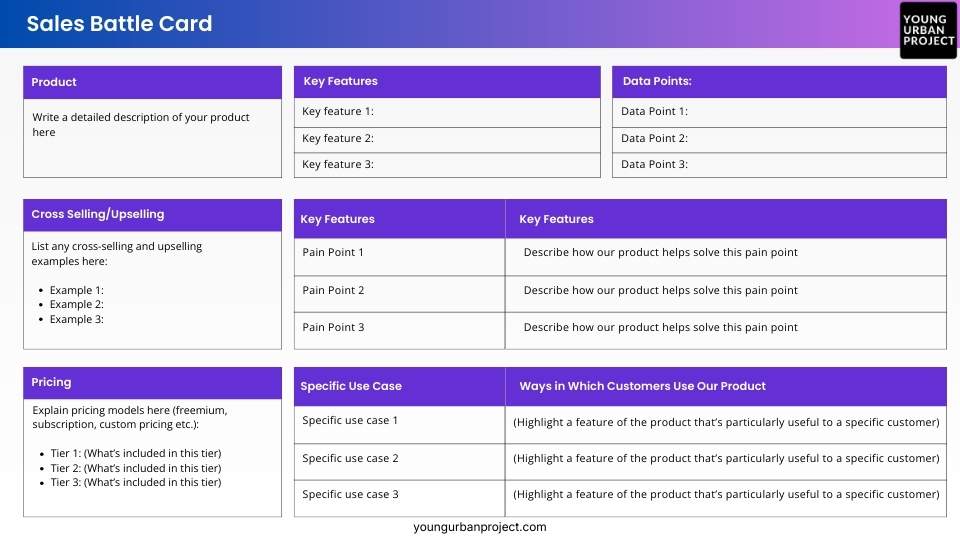
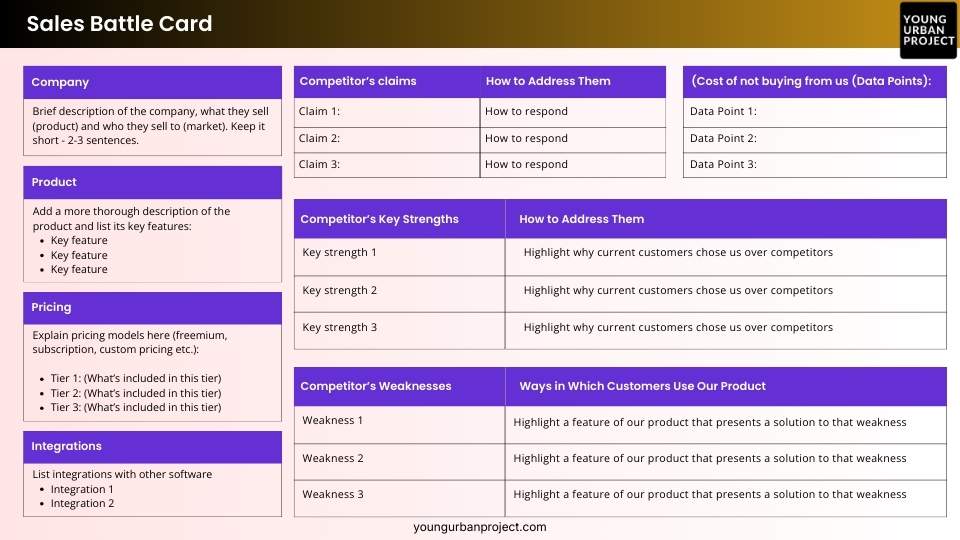
Access these editable battle card templates on Canva for free here.
Let’s break it down.
1. Vital Information About Your Company and/or Product Offering
This section anchors the entire card.
Your battle card is a one-page strategic tool, so this opening section should immediately answer:
- Who are we?
- What do we do?
- Who are we built for?
- Why do we exist?
But here’s the mistake most PMMs make…
They write a fluffy mission statement.
Your sales reps do not need poetry. They need positioning.
What to Include:
- 1-line positioning statement
- Target market
- Core category
- Primary differentiator
Example:
Instead of:
“We are an AI-powered platform transforming digital growth.”
Say:
“We help mid-market SaaS companies increase paid ad ROAS by 25–40% using AI-driven attribution and automated optimization.”
Notice the difference?
This gives sales reps language they can use immediately in a sales pitch.
This section ensures alignment between Product Marketing and the sales team’s messaging. It prevents reps from improvising positioning during the sales cycle.
2. Profile of the Target Prospect
Battle cards for sales should never be generic.
This section clarifies who this battlecard is for.
Sales reps need to know:
- Is this for SMB?
- Mid-market?
- Enterprise?
- Marketing leaders?
- CFOs?
What to Include:
- Industry
- Company size
- Revenue range
- Tech maturity
- Typical buying committee members
Example:
Target Profile:
- Industry: D2C eCommerce brands
- Revenue: $5M–$50M annually
- Team: In-house performance marketing team of 2–5 people
- Tools: Meta Ads, Google Ads, Shopify
- Decision Maker: Head of Growth or Founder
This helps sales reps tailor their sales approach instantly.
When creating battle cards, specificity is power.
3. Customer Pain Points (Be Specific, Not Generic)
This might be the most important section in your entire sales battlecard template.
Most battle cards fail here.
They say things like:
- “Low efficiency”
- “Need growth”
- “Poor performance”
That’s vague.
Sales reps need concrete friction points or customer pain points they can recognize during a sales call.
What to Include:
- Trigger events
- Operational bottlenecks
- Financial pressure points
- Emotional frustration points
Example (SaaS Example):
Instead of:
“They struggle with analytics.”
Say:
- Attribution is fragmented across multiple platforms
- They cannot connect ad spend to revenue
- Reporting takes 10+ hours weekly
- CFO questions ROI every quarter
This gives sales reps language to probe deeper.
Battle cards that win deals help sales professionals diagnose, not just pitch.
4. Key Competitor Insights and Comparisons
This is where competitive intelligence becomes tactical.
A strong competitor battlecard does not attack competitors emotionally. It provides structured guidance.
What to Include:
- Competitor overview
- Where they are strong
- Where they are weak
- Pricing positioning
- Ideal customer profile
- Landmines to avoid
- “Why we win” narrative
Example Structure:
Competitor: X Platform
Strengths:
- Strong brand recognition
- Enterprise integrations
- Large marketing budget
Weaknesses:
- Expensive for mid-market
- Complex onboarding
- Limited AI optimization
Landmine:
If prospect values brand reputation over cost efficiency, they may lean toward Competitor X.
Why We Win:
We deliver faster ROI with simpler onboarding and better mid-market pricing flexibility.
This section helps sales reps stay a step ahead in competitive deals.
Battle cards must provide clarity, not fear.
5. Unique Selling Points or Use Cases Applicable to the Target Audience
This is where your PMM mindset shines.
Product marketers must translate features into situational wins.
What to Include:
- 3–5 clear differentiators
- Direct linkage to pain points
- Micro use cases
Example:
Instead of:
“AI-powered automation.”
Say:
- Automatically shifts ad spend to high-performing channels daily
- Reduces manual optimization time by 70%
- Identifies underperforming campaigns within 24 hours
Even better:
Use Case:
For brands spending $50K+ monthly on ads, our AI reallocation engine typically reduces wasted ad spend within 30 days.
Now your sales reps have something concrete.
Sales battle cards help sales by turning features into business impact.
6. Benefits & Values (Outcome-Driven Messaging)
This section answers the prospect’s unspoken question:
“Why should I care?”
Your battle cards should also include outcomes, not just capabilities.
What to Include:
- Financial outcomes
- Operational improvements
- Strategic value
- Risk mitigation
Example:
Instead of:
“Real-time reporting dashboard.”
Say:
- Reduce reporting time from 10 hours/week to under 1 hour
- Improve ROAS by 25% within 90 days
- Increase confidence in board-level reporting
Outcome-driven messaging drives winning sales.
This is what enables sales teams to move beyond product demos into value conversations.
7. Use Cases (Practical Scenarios)
Yes, this is separate from USPs.
USPs explain differentiation.
Use cases show application.
What to Include:
- 2–4 real-world scenarios
- Context + problem + resolution
Example:
Use Case 1: Scaling Paid Ads
A D2C brand spending $80K/month was experiencing declining ROAS. Using our AI reallocation engine, they improved ROAS by 28% within 60 days.
Use Case 2: Reporting Automation
A SaaS company reduced weekly reporting workload from 12 hours to 90 minutes.
Battle card examples like this provide sales reps storytelling ammo.
And stories close deals.
8. Questions to Ask (Guide the Discovery Process)
This is massively underutilized.
Battle cards should guide discovery, not just response.
What to Include:
- Qualification questions
- Competitive probing questions
- Budget discovery prompts
- Urgency triggers
Example:
If competitor is mentioned:
- “What’s most important in your evaluation: cost, ease of use, or scalability?”
- “How are you currently measuring attribution?”
- “What happens if performance does not improve this quarter?”
This helps sales reps control the sales process.
Providing your sales team with structured questions increases sales effectiveness dramatically.
9. Pricing (Positioning Guidance)
Not necessarily exact numbers. But positioning guidance.
What to Include:
- Pricing tier overview
- Ideal budget range
- How to handle “too expensive” objection
- ROI framing
Example:
Pricing Positioning Strategy:
- Anchor against cost of wasted ad spend
- Emphasize ROI within 90 days
- Reframe price as performance investment
Battle cards must prepare reps for pricing tension.
Pricing conversations are where deals are won or lost.
10. Customer Success Stories (Proof Drives Trust)
This is where your battle card becomes credible.
Proof reduces risk perception.
What to Include:
- 1–2 short case study summaries
- Measurable outcomes
- Industry alignment
Example:
Case Study: Mid-Market SaaS Brand
- Increased SQLs by 35%
- Reduced CAC by 22%
- Achieved ROI within 3 months
Social proof helps sales reps close faster.
Battle cards provide sales reps with confidence because they are backed by results.
How Do You Drive Adoption of Battlecards?
1. Make It Effortless to Find Your Battlecards
Embed them inside CRM.
Create search tags.
Make it impossible not to use sales battle cards.
2. Spotlight Role Model Behavior
Highlight sales reps who use battle cards and win deals.
Behavior spreads culturally.
Sales Battlecards FAQs
How to make sales battle cards?
To make sales battle cards that actually help your sales team win competitive deals, follow a structured approach:
Step 1: Define the Audience
Identify whether the battlecard is for BDRs, AEs, enterprise sales reps, or customer success. Different roles require different depth.
Step 2: Gather Competitive Intelligence
Collect insights from win-loss interviews, CRM notes, G2 reviews, competitor websites, and frontline feedback from sales reps. A strong sales battlecard is grounded in real data, not assumptions.
Step 3: Identify Core Pain Points
Map customer pain points to your product’s strengths. Avoid generic statements. Be specific and outcome-driven.
Step 4: Structure Using a Sales Battle Card Template
Include positioning, target profile, competitor insights, objection handling, use cases, pricing guidance, and proof points.
Step 5: Validate with the Sales Team
Talk to your sales reps before finalizing. Ask what objections they hear and where deals stall in the sales cycle.
Step 6: Enable and Drive Adoption
Embed battle cards into your CRM or sales enablement platform. Train sales reps to use sales battle cards during competitive conversations.
If done correctly, battle cards provide sales reps with clarity, confidence, and a sharper sales approach.
How to make sales battle cards for free?
You can create a free sales battlecard using tools like:
Google Docs
Notion
Confluence
Canva
PowerPoint
Start with a simple sales battlecard template that includes:
Target prospect profile
Customer pain points
Competitor comparisons
Differentiators
Objection handling
Pricing positioning
Case study proof
Even a one-page Google Doc can function as a high-impact battle card if the content is specific and actionable.
What matters more than design is clarity. A clean, concise cheat sheet that sales reps can reference in the heat of a sales call will outperform a beautifully designed but vague document.
Are sales battle cards worth it?
Yes, but only when done correctly.
Sales battle cards help:
Improve sales effectiveness
Shorten the sales cycle
Increase win rates in competitive deals
Align sales and marketing teams
Equip sales reps with confidence
However, traditional battle cards that are outdated, generic, or hard to find rarely get used.
The right battlecard provides sales reps with tactical clarity during competitive conversations. When battle cards feature strong positioning, objection handling, and proof, they directly impact revenue.
Poor battlecards gather dust. Strong ones generate sales.
What should be included in your sales battlecards?
A complete sales battlecard template should include:
Company positioning statement
Target prospect profile
Customer pain points
Key competitor insights
Unique selling points
Outcome-driven benefits
Practical use cases
Discovery questions
Pricing positioning
Customer success stories
Battle cards must be specific, tactical, and easy to scan. They should enable sales teams to act quickly during competitive deals.
If your battle card cannot be used in under 60 seconds during a sales call, it is too complicated.
How does AI improve sales battle cards?
AI significantly enhances how Product Marketing Managers and sales enablement teams create battle cards.
Here’s how:
1. Competitive Monitoring
AI tools can track competitor website changes, pricing updates, and new feature releases automatically.
2. Win-Loss Analysis
AI can analyze CRM data and sales transcripts to identify patterns in competitive deals.
3. Draft Generation
AI can help PMMs quickly generate structured battlecard content using a sales battle card template.
4. Personalization at Scale
AI enables prospect-specific battle cards for enterprise accounts by summarizing company research instantly.
Used correctly, AI does not replace Product Marketing. It accelerates creating battle cards and improves competitive intelligence depth.
How Do Teams Actually Use Sales Battlecards?
In high-performing sales organizations, teams use battle cards in three main ways:
1. During Live Sales Calls
Sales reps reference competitor battle cards when a prospect mentions alternatives. This allows them to respond with structured positioning instead of improvising.
2. Deal Preparation
Before important demos or enterprise conversations, sales reps review battlecard content to refine messaging and anticipate objections.
3. Coaching and Onboarding
Sales managers use battle cards to train new sales staff on competitive positioning and sales strategy.
Battle cards provide sales reps with structure. They ensure consistency across the sales team’s messaging and help create winning sales conversations.
How should I use the sales battle card template?
A sales battlecard template should not be treated as a static document.
Instead:
Use it as a repeatable framework for creating new battle cards
Customize it for different competitors and personas
Update it quarterly based on market changes
Share your sales battlecards during training sessions
Your template ensures consistency across battle cards for sales. But each new battle card must reflect real-world feedback from your sales team.
Think of the template as the structure. The insight is what drives impact.
What are the Elements of a Sales Battle Card Template?
The essential elements include:
Clear positioning
Target ICP definition
Customer pain mapping
Competitor strengths and weaknesses
Differentiation narrative
Objection handling scripts
Use case examples
Pricing strategy guidance
Proof and case studies
Discovery questions
Battle cards provide sales reps with a structured sales strategy during competitive deals.
Every sales battle card must balance brevity with tactical depth.
What are the Types of Battle Cards?
There are multiple types of battle cards depending on use case:
BDR battlecards
Competitor battle cards
Objection handling battle cards
Executive battlecards
Product battle cards
Value proposition-based battle cards
Prospect-specific battle cards
Upsell battle cards
Service cancellation battle cards
Each type supports a different stage of the sales process.
The most common are competitor battlecards used in competitive deals, but advanced GTM teams use customized battle cards across the entire customer lifecycle.
What is a Battle Card in Sales & Marketing?
A battle card in sales and marketing is a concise, actionable document designed to equip sales reps with competitive positioning, objection handling guidance, and value-based messaging.
It acts as a tactical cheat sheet that:
Enables sales teams
Aligns Product Marketing and sales messaging
Supports competitive deals
Improves sales effectiveness
Helps sales reps close faster
In modern GTM organizations, battle cards are part of a broader sales enablement strategy.
They are not just comparison sheets. They are competitive weapons.
Who Creates Battle Cards?
Typically, Product Marketing Managers (PMMs) own creating battle cards.
However, high-performing sales and marketing teams treat battlecard creation as a collaborative process involving:
Product Marketing
Product teams
Sales leaders
Sales enablement teams
Customer success
PMMs gather competitive intelligence and define positioning. Sales reps provide frontline objections. Product teams ensure accuracy. Sales managers drive adoption.
Battle cards that win deals are built cross-functionally.
When creating battle cards becomes a shared GTM effort, they effectively support your sales strategy and help generate sales consistently.
Final Thoughts: Battlecards Are Strategy, Not Just Documents
If you take one thing away from this guide on how to make battlecards, let it be this:
Battle cards provide sales reps clarity.
Clarity wins deals.
Creating battle cards is not about formatting.
It is about enabling sales.
When your battle cards provide sales reps confidence in competitive deals, your sales team’s performance improves.
And that is when battle cards stop being documents.
They become revenue drivers.