

Getting performance marketing tracking right sounds simple. It rarely is. Most problems don’t come from missing data, but from tracking the wrong things, or tracking them inconsistently. This guide on how to set up performance marketing tracking correctly is built to fix that. It walks through the fundamentals first, then gets into the details that usually cause confusion: metrics that actually matter, tools that work together, and setups that don’t fall apart as campaigns scale. The focus stays practical. Fewer assumptions. Fewer reporting arguments. Just a clearer way to measure what’s working, what isn’t, and where effort should go next.
Table of Contents
1. Introduction
Performance marketing only works when the tracking behind it works. Without that foundation, campaigns look busy on the surface but quietly leak budget underneath. Clicks come in, dashboards light up, but no one can say with confidence what’s actually driving results.
This guide breaks down how to set up performance marketing tracking correctly, not in theory, but in a way that holds up when real money is on the line. The focus is on clarity, accuracy, and decision-making. The kind of setup that helps teams stop debating numbers and start acting on them.
What is performance marketing tracking?
Performance marketing tracking is the system used to measure what happens after a user sees or clicks an ad. It connects marketing activity to outcomes: leads, sales, revenue, retention, so performance can be evaluated objectively, not by gut feel.
At its core, tracking answers questions like:
- Which campaigns are actually converting?
- What is each conversion costing?
- Which channels bring profitable customers, not just traffic?
Why a correct tracking setup is crucial for marketing ROI and optimisation
When tracking is weak or inconsistent, optimisation becomes guesswork. Budgets shift based on partial data. Winning campaigns get paused. Losing ones keep running because the signals are noisy or misleading.
A correct setup:
- Protects ad spend by showing true performance
- Makes optimisation faster and more confident
- Creates trust in reporting across teams and stakeholders
How this guide helps brands measure performance accurately
This guide walks through the fundamentals first, then gets practical. Metrics, tools, and step-by-step setup; all structured so tracking supports real decisions, not just reports. Whether managing one channel or many, the goal is the same: clean data, clear insights, and fewer surprises at the end of the month.
Performance Marketing Tracking Fundamentals
Before tools and dashboards come into play, it’s important to understand what performance marketing tracking is actually meant to do. Most tracking problems don’t come from broken pixels; they come from unclear fundamentals.
What is performance marketing tracking?
Performance marketing tracking is the process of measuring user actions across marketing channels and tying them back to specific campaigns, audiences, and costs.
The core goals are simple:
- Measure clicks, impressions, and engagement
- Track conversions and revenue
- Calculate ROI and profitability
- Understand how users move from first touch to conversion
Tracking isn’t just measurement. It’s the foundation for optimisation. Without it, decisions rely on assumptions. With it, decisions rely on patterns.
Why performance tracking matters
Good tracking removes uncertainty from marketing decisions.
It helps teams:
- Eliminate guesswork and optimise spend with confidence
- See how each channel behaves across the funnel
- Understand campaign impact beyond surface metrics
- Prove performance clearly to stakeholders
- Scale what works, pause what doesn’t
When tracking is done right, performance marketing becomes predictable. Not perfect, but measurable enough to improve week after week.
Key Performance Marketing Tracking Metrics
Metrics are where tracking either becomes useful or overwhelming. The mistake is tracking everything. The goal is tracking what actually reflects performance.
Essential tracking metrics in performance marketing
These metrics form the baseline of most performance setups:
Clicks, impressions, views
Measure reach and traffic generation. Useful for context, not successful on their own.
Click-through rate (CTR)
Indicates how compelling ads and messaging are.
Conversion rate (CR)
Shows how efficiently traffic turns into outcomes: leads, signups, purchases.
Cost per click (CPC) and cost per acquisition (CPA)
Reveal efficiency and spending discipline.
Return on ad spend (ROAS) and ROI
Tie performance directly to revenue.
Customer lifetime value (CLV)
Helps evaluate long-term impact, not just first conversions.
Tracking these metrics together matters. A low CPA with poor CLV isn’t a win. High CTR with low conversion rate isn’t either. Performance lives in the relationship between numbers.
Behavioral and engagement metrics
These metrics add depth to performance data:
- Website session duration
- Bounce rate
- Pages per session
- Scroll depth and on-site interactions
- Social engagement metrics (likes, shares, comments)
They don’t replace conversion metrics, but they explain them. When conversions drop, engagement data often explains why.
Tools Needed for Accurate Tracking
No single tool gives a complete picture. Accurate performance tracking comes from connecting the right tools and keeping them aligned.
Analytics tools for performance tracking
Core analytics tools provide the foundation:
Google Analytics 4 (GA4)
Used for event-based tracking, conversion measurement, and user behaviour analysis across devices.
Google Search Console
Offers organic performance insights that support paid and overall marketing analysis.
These tools help answer what users do on owned properties, websites, and apps after they arrive.
Marketing channel-specific analytics
Each channel has its own data layer:
- Ad platforms like Google Ads and Meta Ads
- Social media analytics for platforms such as Facebook, Instagram, and LinkedIn
- Email marketing analytics covering open rates, click rates, and conversions
Channel tools show delivery and engagement. Analytics tools show outcomes. Both are needed.
Tag management and tracking pixels
Tag management systems simplify and stabilise tracking setups.
They help with:
- Centralised control of tags and pixels
- Faster updates without code changes
- Reduced risk of duplicate or broken tracking
Pixels from platforms like Facebook, LinkedIn, and TikTok are essential for conversion tracking and optimisation, but only when implemented cleanly.
Dashboard and reporting tools
Unified dashboards pull everything together.
Tools like Looker Studio help teams:
- See spend, conversions, and ROI in one place
- Compare channels without switching platforms
- Share consistent reports across teams
Good dashboards don’t add new data. They make existing data easier to trust and act on.
Step-by-Step Setup for Performance Marketing Tracking
This is where most teams either get clarity or quietly lose control of their data. A solid tracking setup isn’t about doing more. It’s about doing the right things, in the right order, and resisting the urge to rush.
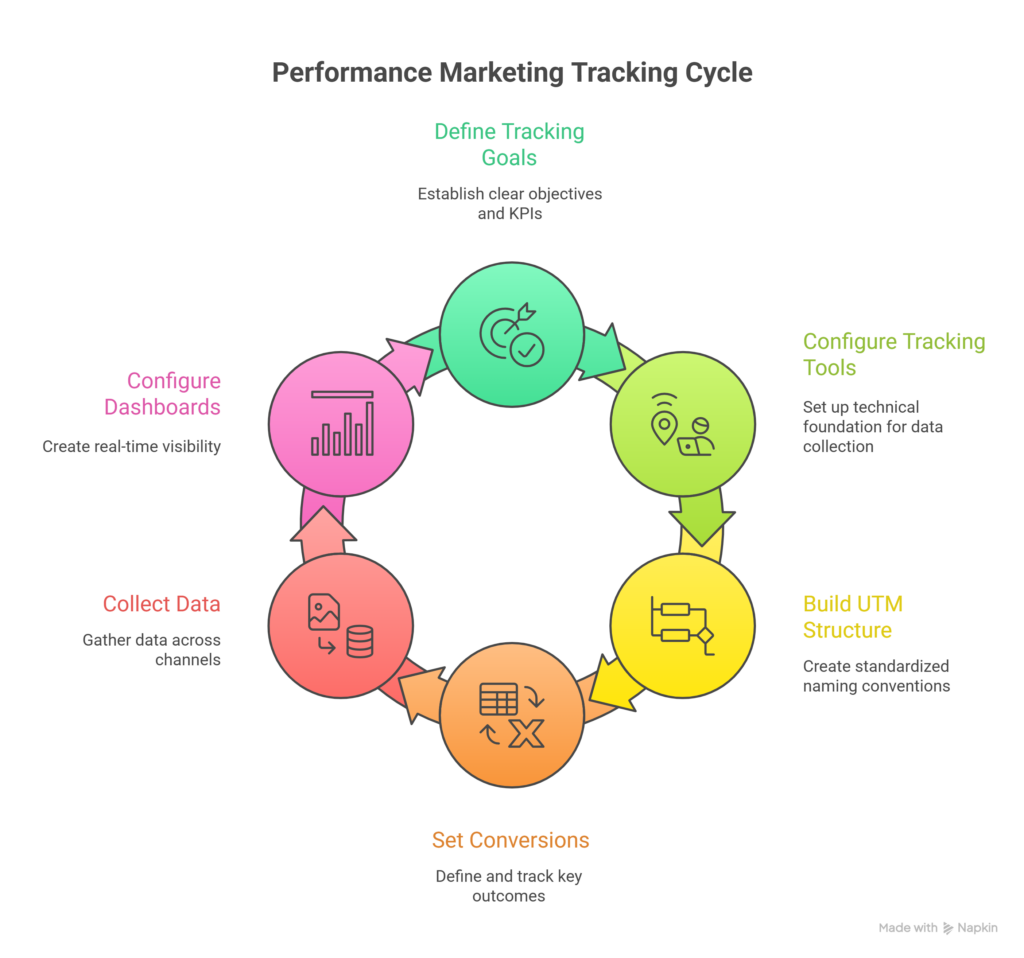
Step 1: Define Tracking Goals and KPIs
Before touching any tracking setup, get clear on what “performance” actually means for the campaign.
Start with business objectives, not metrics.
- Is the goal sales, qualified leads, app installs, or traffic?
- Is success short-term revenue or long-term customer value?
Once the objective is clear, align the KPIs:
- Sales-focused campaigns – purchases, revenue, ROAS, CPA
- Lead-generation campaigns – form submissions, lead quality, cost per lead
- Traffic or awareness campaigns – sessions, engagement, assisted conversions
If a KPI doesn’t influence a decision, it doesn’t belong in the setup. Tracking everything usually leads to trusting nothing.
Step 2: Configure Tracking Tools
Now comes the technical foundation. This step is about consistency and coverage, not complexity.
Key priorities:
- Ensure tracking code is installed across all relevant properties
- Track actions that actually matter, not vanity events
- Keep the setup uniform across pages and domains
Conversion events should reflect real intent:
- Form submissions that actually submit
- Purchases that complete successfully
- Key actions like demo requests or checkout starts
If multiple platforms and systems are involved, integrations matter. Analytics, ad platforms, CRM systems, and reporting views should speak the same language. Mismatched data here causes reporting conflicts later; guaranteed.
Step 3: Build a UTM Tracking Structure
UTMs are simple, but they’re also one of the most common sources of tracking chaos.
A good UTM structure:
- Uses clear, standardised naming
- Avoids personal shortcuts or inconsistent labels
- Scales as campaigns grow
At minimum, define rules for:
- Source (where traffic comes from)
- Medium (paid, organic, email, referral)
- Campaign (initiative or promotion name)
- Content (creative or variation, if needed)
Examples should be documented and shared. Email, paid ads, and social posts should follow the same logic. When UTMs are clean, reporting becomes calm. When they’re messy, every report turns into a debate.
Step 4: Set Conversions in Analytics Tools
Conversions are the heart of performance tracking. If these are wrong, everything downstream is wrong too.
Best practices:
- Track outcomes, not every click
- Use event-based tracking for flexibility
- Keep conversion definitions consistent across platforms
Common conversion types include:
- Purchases and revenue events
- Form fills or lead submissions
- Key funnel actions that strongly signal intent
Avoid changing conversion definitions mid-campaign unless absolutely necessary. Even small tweaks can break historical comparisons and confuse optimization efforts.

Apply Now: AI-Powered Performance Marketing Course
Step 5: Set Up Data Collection Across Channels
Performance rarely happens in a single channel. Tracking should reflect that reality.
This step involves:
- Connecting ad platforms to analytics
- Ensuring conversions are passed back correctly
- Capturing cross-device and cross-channel activity where possible
Offline conversions matter too, especially for lead-driven businesses. Sales closed in a CRM should be linked back to the original marketing source. Without this, campaigns that generate high-quality leads often look weaker than they actually are.
Step 6: Dashboard and Reporting Configuration
Finally, bring everything together.
Dashboards should answer real questions, not show everything available.
Key views often include:
- Spend vs conversions
- Cost per acquisition by channel
- Revenue or value by campaign
- ROI or ROAS trends over time
Real-time visibility helps, but clarity matters more than speed. A good dashboard highlights problems early and makes wins obvious, without forcing someone to dig through five different tools to understand what’s happening.
When this step is done right, reporting stops being a chore and starts becoming a decision-making tool.
Best Practices for Performance Marketing Tracking
A tracking setup doesn’t fail all at once. It slowly drifts. Small inconsistencies pile up, assumptions creep in, and suddenly the numbers feel “off,” but no one knows why. Best practices exist to prevent that drift.
Regular Monitoring and Reporting
Tracking is not a set-it-and-forget-it exercise. Even a perfect setup needs attention.
Daily and weekly monitoring helps spot:
- Sudden drops or spikes in conversions
- Spend increases without proportional returns
- Campaigns reporting clicks but no meaningful actions
Dashboards should be checked often, but not obsessively. The goal isn’t to watch numbers move every hour. It’s to catch problems early, before they compound into wasted budget or missed opportunities.
Alerts and simple trend checks go a long way. When performance shifts, tracking should surface it quickly and clearly.
Maintain Data Quality and Consistency
Most tracking problems aren’t technical; they’re organisational.
Common causes of bad data include:
- Inconsistent campaign naming
- UTMs are created differently by different teams
- Events are tracked slightly differently across pages or funnels
Consistency matters more than complexity. A simple, standardised structure that everyone follows beats a detailed system no one remembers.
Regular validation helps:
- Compare reported conversions across platforms
- Spot duplicate events or missing data
- Confirm that key actions are being tracked once, and only once
Clean data builds confidence. Without it, even accurate insights get questioned.
A/B Testing and Iterative Optimisation
Tracking only creates value when it’s used.
Performance data should directly inform:
- Creative testing
- Landing page experiments
- Audience and targeting decisions
- Budget reallocation across channels
The key is iteration. Small tests, measured cleanly, tell you far more than big changes made on instinct. Tracking should make it obvious what to test next, and when to stop testing something that clearly isn’t working.
Cross-Channel Attribution and Holistic Tracking
Rarely does a user convert after a single interaction. Performance tracking should reflect that reality.
Looking beyond last-click attribution helps teams:
- Understand assisted conversions
- See how channels support each other
- Avoid over-crediting or under-valuing touchpoints
Holistic tracking doesn’t mean overcomplicating reports. It means recognising that performance is shared, and optimisation should be too.
Common Tracking Issues and Fixes
Even strong setups run into problems. What matters is spotting them early and knowing how to fix them.
One of the most common issues is missing or broken tracking tags. Pages change, funnels get updated, and events quietly stop firing. Regular checks prevent long gaps in data that can’t be recovered later.
Misconfigured UTMs are another frequent culprit. Inconsistent naming, typos, or reused parameters lead to fragmented reporting. The fix is boring but effective: clear documentation and strict rules.
Attribution mismatches also cause confusion. When different platforms report different numbers, it’s tempting to assume something is “wrong.” Often, it’s just different attribution logic. The fix isn’t forcing numbers to match; it’s understanding why they don’t.
Duplicate tracking is more damaging than missing data. When conversions fire twice, performance looks better than it actually is. Budgets get scaled on false confidence. Auditing events regularly helps catch this before it affects decisions.
Tracking issues are inevitable. Ignoring them is optional.
Conclusion:
Performance marketing lives or dies on tracking quality. When tracking is clear, teams move faster, optimise smarter, and argue less about numbers. When it’s messy, even good campaigns struggle to prove their value.
A correct tracking setup connects effort to outcome. It shows what’s working, what’s not, and where to focus next. More importantly, it builds trust in data, in decisions, and in results.
The smartest next step isn’t launching another campaign. It’s auditing the current tracking setup with fresh eyes. Fix the gaps. Clean the structure. Make the data reliable again.
Growth follows clarity.
FAQs:
1. How do I set up performance marketing tracking?
It starts earlier than most teams expect. Before any tracking is touched, there has to be agreement on what success actually looks like. Not metrics on a dashboard, but real outcomes. Sales that close. Leads that convert. Revenue that can be traced back without mental gymnastics. Once that’s clear, tracking becomes a support system instead of a reporting headache. The setup should follow the customer journey closely, capture meaningful actions, and stay consistent over time. When tracking mirrors how the business really works, it tends to hold up under pressure.
2. Which tracking metrics matter most for performance marketing?
The metrics that matter are the ones that change decisions. Cost per acquisition, conversion rate, return on spend, revenue impact; those tend to earn their place quickly. Metrics like clicks or impressions still have value, but mostly as context. They explain movement, not success. A campaign with great traffic and weak outcomes isn’t performing, no matter how good the top-line numbers look. Strong tracking keeps the focus on efficiency and outcome, not activity.
3. What tools do I need for accurate tracking?
Accurate tracking usually isn’t about adding more tools. It’s about using a few core ones properly and making sure they agree with each other. Analytics tools explain what users do after they arrive. Channel platforms explain how they arrived and what it cost. Reporting systems pull it together so patterns are visible without digging. When those pieces are aligned, tracking feels calm. When they’re not, every meeting turns into a numbers debate.
4. What is the most common mistake in performance marketing tracking?
Overconfidence. Teams assume tracking is “set” because numbers are coming in, even when those numbers don’t quite make sense. Conversions fire twice. Campaign names change halfway through a month. Small fixes get made quietly, and no one updates the logic behind the reports. Over time, the data still looks clean, but it stops being true. That’s usually when performance decisions start missing the mark.
5. How do I know if my performance marketing tracking is accurate?
Accurate tracking has a certain feel to it. The numbers don’t jump without reason. Different reports tell roughly the same story, even if totals vary slightly. When a campaign improves, the change shows up in more than one place. It also holds up when questioned. If a result needs constant explanation or caveats, something’s off. Clean tracking doesn’t need defending. It just makes sense.
6. Can performance marketing tracking work without Google Analytics?
Yes. Tracking has never depended on one platform. What matters is the ability to record meaningful actions, connect them to spend, and review performance without guessing. Many teams rely on different systems depending on their business model, funnel complexity, or data preferences. The tool matters less than the discipline behind it. Consistency, clarity, and validation do most of the heavy lifting.
7. How often should performance marketing tracking be audited?
More often than people think, but less often than people fear. Light checks should happen regularly, especially after campaign launches, landing page updates, or funnel changes. Deeper audits make sense when budgets scale or results start behaving strangely. Waiting until performance drops usually means the problem started weeks earlier. Tracking issues rarely announce themselves loudly.
8. What is the difference between performance tracking and attribution tracking?
Performance tracking answers a basic question: Did this effort deliver value, and at what cost? Attribution goes a layer deeper and asks how that value was created across touchpoints. One measures outcomes. The other explains influence. Both matter, but performance tracking comes first. Without solid performance data, attribution becomes theoretical. When performance is clear, attribution actually becomes useful instead of confusing.