
Facebook ad copy gets clicks when it fits how people actually scroll. Fast. Half-distracted. Slightly impatient. The copy has to meet them there. Not with clever lines or big claims, but with something that feels familiar enough to pause on. A problem they recognize. A thought they’ve already had. Then a clear reason to take the next step.
Good ads don’t try to explain everything upfront. They focus on one idea and say it plainly. No filler. No hard sell. When the message matches intent, and the CTA feels like a natural continuation, clicking doesn’t feel like a decision. It feels like the obvious thing to do. That’s what this guide breaks down: how to write copy that earns attention without fighting the feed.
Table of Contents
Introduction
What Is Facebook Ad Copy?
Facebook ad copy is the text that carries your message inside the ad; the words people read before they decide whether to stop scrolling or keep moving. It includes the opening line, the body text, the headline, and often the link description. Together, these elements do one job: earn attention long enough to spark a click.
Good ad copy doesn’t sound like an ad. It feels like a relevant thought that showed up at the right time. It understands where the user is mentally, speaks their language, and gives them a clear reason to care, fast.
Why Facebook Ad Copy Matters for Click-Through Rates
On Facebook, you’re not competing with other ads. You’re competing with conversations, memes, opinions, reels, and friends’ updates. That’s a brutal environment for boring copy.
Click-through rate is often decided in the first line. If that line doesn’t create curiosity, relevance, or emotional pull, the rest of the copy doesn’t matter. Strong visuals help, but copy is what frames the meaning of that visual. It tells people why they should click, not just what they’re seeing.
High-performing Facebook ads usually share a few traits:
- They feel specific, not generic
- They talk about outcomes, not products
- They make the click feel like the obvious next step
When the copy is weak, even a great offer struggles. When copy is sharp, average offers often outperform expectations.
How This Guide Helps You Drive More Clicks & Conversions
This guide breaks down Facebook ad copy the way practitioners actually think about it: before, during, and after writing. Not theory-heavy. Not fluff. Just practical thinking around hooks, structure, intent, and clarity.
You’ll learn how to:
- Understand why people click, not just how to write
- Shape copy based on intent, awareness, and context
- Write ads that feel natural in the feed, not disruptive
- Improve click performance through smarter iteration
The focus is clicks, but always with an eye on what happens after the click. Because empty clicks don’t help anyone.
Who This Guide Is For
This is for:
- Marketers managing paid social campaigns
- Small business owners running their own ads
- E-commerce teams looking to improve CTR without increasing spend
- Agencies that want a repeatable way to improve ad performance
If you’ve ever looked at an ad and thought, “This should be working better than it is,” you’re in the right place.
Understanding the Psychology Behind Click-Worthy Facebook Ad Copy
The Facebook Ad Ecosystem
Facebook isn’t a search engine. People aren’t there to buy; they’re there to browse. Ads succeed when they respect that behavior instead of fighting it.
Most users scroll quickly, pausing only when something feels familiar, emotional, or unusually relevant. That means your ad copy has milliseconds to signal:
- This is for you
- This matters right now
Long explanations don’t work upfront. Clarity and resonance do. The feed rewards ads that blend in stylistically but stand out emotionally.
Attention is limited. Curiosity is earned.
What Makes Users Click: Intent Meets Emotion
Clicks happen when intent and emotion intersect.
Intent answers: Is this relevant to my situation?
Emotion answers: Do I feel compelled to act on it?
Some users click because something promises relief from a problem. Others click because it aligns with a desire: growth, ease, status, confidence, speed. Effective ad copy doesn’t guess. It mirrors what the audience already cares about.
Awareness level matters here:
- Unaware users respond to patterns and feelings
- Problem-aware users respond to clarity and empathy
- Solution-aware users respond to differentiation and proof
When copy matches awareness, clicks feel natural. When it doesn’t, even strong offers get ignored.
Pre-Writing Strategy: Planning High-Impact Facebook Ad Copy
Define Your Campaign Goal
Before writing a single line, the objective needs to be clear. Copy written for clicks looks different from copy written for conversions or engagement.
If the goal is clicks:
- The copy should prioritize curiosity and relevance
- Friction should be minimal
- The CTA should feel low-commitment
If the copy is trying to do too much: educate, convince, and close, it usually underperforms. One ad. One primary action.
Clarity here saves a lot of rewriting later.
Know Your Target Audience Inside Out
Effective Facebook ad copy sounds like it came from inside the audience’s head.
That means understanding:
- How they describe their problems
- What outcomes do they actually want
- What they’re tired of hearing
Demographics matter, but language matters more. Two audiences can want the same thing and respond to completely different copy. Tone, pacing, and word choice should feel familiar, not impressive.
When the copy reflects the audience’s own phrasing, clicks increase without trying harder.
Research Competitors & Winning Ads
High-performing ads leave clues.
By studying ads that consistently show up, you start noticing patterns:
- Common opening angles
- Repeated emotional triggers
- Similar promise structures
This isn’t about copying. It’s about understanding what the market already responds to, then finding a sharper or clearer way to say it.
Good research reduces guesswork. It grounds your copy in reality, not assumptions.
By the time you start writing, most of the hard thinking should already be done. The words become execution, not experimentation.
How to Write Facebook Ad Copy That Drives Clicks: Step-by-Step Guide
This is where most ads either earn attention or get ignored. Writing Facebook ad copy isn’t about clever wording. It’s about sequencing ideas in a way that feels natural in the feed and obvious to click. Each step builds on the previous one. Skip one, and performance usually drops.
Step 1: Craft an Attention-Grabbing Hook
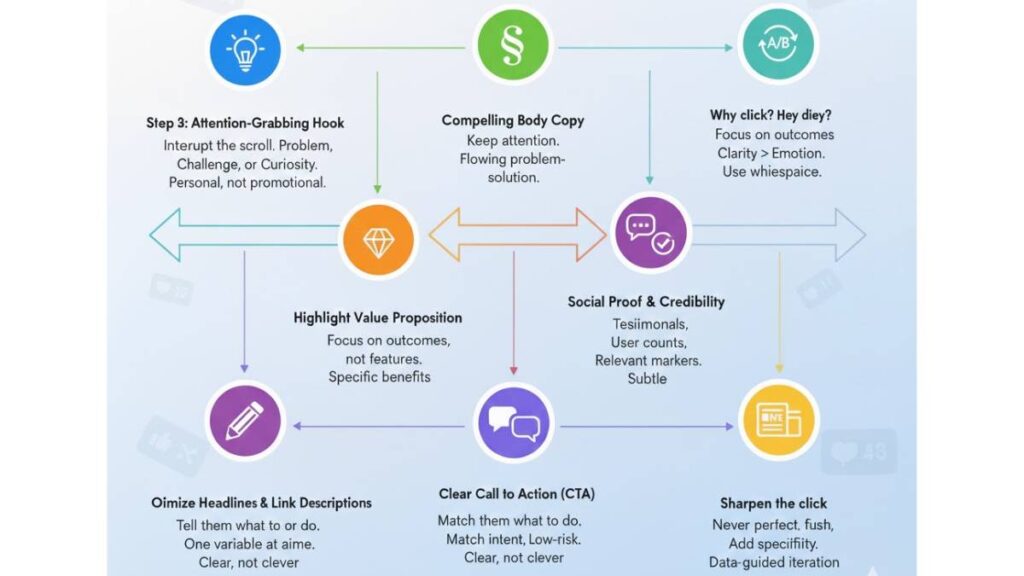
The first line decides everything. On Facebook, users don’t read ads; they scan them. Your hook has one job: interrupt the scroll.
Strong hooks usually do one of three things:
- Call out a specific problem the audience recognizes instantly
- Challenge an assumption they already believe
- Create curiosity without being vague
The best hooks feel personal, not promotional. They often sound like a thought someone was already having but hadn’t articulated yet. Questions can work. Bold statements can work. Short, blunt lines often outperform clever ones.
If the first line could apply to everyone, it probably won’t stop anyone.
Step 2: Write Compelling Body Copy
Once the hook earns attention, the body copy has to keep it. This is where relevance turns into interest.
Good body copy doesn’t ramble. It flows. It acknowledges the problem, expands on it just enough to show understanding, then introduces the solution naturally. Problem-solution frameworks work well here, especially when the problem is described in the audience’s own language.
Emotion matters, but clarity matters more. People click when they understand what’s in it for them and why it matters now. Long copy can work if it’s easy to read. Short copy can fail if it’s vague.
White space helps. Short paragraphs help. Every line should earn its place.
Step 3: Highlight Your Value Proposition
This is where many ads fall apart. They talk about features when the audience cares about outcomes.
A strong value proposition answers one simple question: Why should I click this instead of ignoring it?
Focus on:
- What changes for the user after they take action
- What makes this offer different from similar options
- Why this solution fits their situation specifically
Clarity beats hype. Specific beats broad. “Save time” is weak. “Cut reporting time by half” is stronger. When the value is obvious, the click feels justified.
Step 4: Include Social Proof & Credibility
People hesitate to click when trust is missing. Social proof reduces that hesitation.
This doesn’t have to be dramatic. Simple signals often work best:
- Short testimonials
- User counts or adoption numbers
- Credibility markers that feel relevant, not forced
The key is subtlety. Social proof should support the message, not dominate it. When placed naturally in the copy, it reassures without slowing momentum.
Trust doesn’t always need convincing. Sometimes it just needs confirming.
Step 5: Add a Clear Call to Action (CTA)
The CTA tells users what to do next. Sounds obvious, but many ads still get this wrong.
A good CTA:
- Matches the intent of the ad
- Feels low-risk for click-focused campaigns
- Is clear, not clever
“Learn more” works when curiosity is high. “Get started” works when the intent is stronger. What matters most is alignment. If the CTA asks for more commitment than the copy earned, clicks drop.
Placement matters too. CTAs work best when they feel like a natural conclusion, not an abrupt demand.
Step 6: Optimize Headlines and Link Descriptions
The headline reinforces the decision to click. It shouldn’t repeat the hook. It should sharpen it.
Strong headlines often:
- Clarify the benefit
- Add specificity
- Reduce uncertainty
Link descriptions are often overlooked, but they can quietly boost clicks by adding context or reassurance. Think of them as the final nudge, not the main pitch.
Consistency across hook, body, and headline builds confidence. Mixed messages create friction.
Step 7: Test and Refine
No ad copy is perfect on the first attempt. High-performing ads are shaped, not written once.
Testing works best when it’s focused:
- Test one variable at a time
- Compare hooks before tweaking body copy
- Let data guide decisions, not assumptions
Look beyond clicks alone. Engagement patterns, drop-offs, and comments often reveal what the copy is really doing. Refinement isn’t about chasing perfection. It’s about removing friction, one iteration at a time.
When copy improves, clicks follow. Not instantly. Consistently.

Apply Now: AI-Powered Performance Marketing Course
Writing for Different Ad Types
Not all Facebook ads are meant to do the same job, and copy shouldn’t be treated like a one-size-fits-all asset. The intent behind the campaign shapes how the message should feel, what it should emphasize, and how much persuasion is needed before the click.
1. Campaigns Focused on Clicks
When the goal is clicks, the copy should reduce friction as much as possible. You’re not asking for a decision yet; just curiosity.
Click-focused copy usually:
- Leads with intrigue or a relatable pain point
- Keeps explanations light
- Avoids heavy commitment language
The structure is simple: hook – relevance – promise – soft CTA. Over-explaining here often backfires. If the user feels they already “got it” from the ad, there’s less reason to click.
2. Lead Generation Ads
Lead gen ads ask for more. An email, a sign-up, a form. That changes the tone of the copy.
Here, clarity matters more than curiosity. The user wants to know:
- What they’re getting
- Why is it worth their information
- How much effort is required
Effective lead gen copy leans into value and reassurance. It addresses hesitation directly and often benefits from light social proof. Vague promises don’t convert well here. Specific outcomes do.
3. Conversion Ads
Conversion-focused ads carry the highest expectation. The click is meant to turn into an action: purchase, booking, or sign-up.
The copy needs to:
- Reinforce the intent that already exists
- Reduce doubt and objections
- Emphasize urgency or relevance
These ads work best when the audience is already warm. The language can be more direct. The CTA can be stronger. But even here, clarity beats pressure. If the copy feels rushed or pushy, clicks may happen; conversions won’t.
Copy + Creative Harmony: Aligning Text With Visuals
Facebook ads don’t work in isolation. Copy and creative are a single experience, not two separate elements.
When visuals and text say the same thing in different ways, the message lands faster. When they compete or feel disconnected, users hesitate or scroll past.
Good alignment looks like:
- Visuals that reinforce the main promise of the copy
- Text that explains why the visual matters
- A consistent emotional tone across both
Text overlays should support, not repeat. If the image already shows the outcome, the copy can focus on the benefit or next step. If the visual is abstract, the copy needs to do more explanatory work.
Format matters too. Static images often need stronger hooks. Carousels work well for step-by-step or comparison-based copy. Videos benefit from short, punchy lines that match the pacing.
When copy and creative feel as if they belong together, clicks feel effortless.
Testing & Optimization Strategies That Improve Click Rates
Great Facebook ad copy isn’t written once. It’s shaped over time.
1. A/B Testing Facebook Ad Copy
A/B testing works when it’s intentional, not random. Changing everything at once makes results meaningless.
The most useful elements to test:
- Opening hooks
- Angles (problem-led vs outcome-led)
- CTAs and phrasing
Small changes often produce bigger shifts than complete rewrites. A single line can double click-through rate if it hits the right nerve.
Give tests enough time to settle. Early performance spikes can be misleading.
2. Iterate Based on Performance Data
Click-through rate tells you if the copy earns attention. Engagement tells you how it’s being received. Together, they reveal where friction exists.
If CTR is low, the hook or relevance is off.
If CTR is high but engagement is poor, expectations may not match reality.
Optimization isn’t about constant change. It’s about knowing when to tweak and when to pivot. Let patterns guide decisions, not impatience.
The ads that perform best are rarely the most creative. They’re the ones who listened closely to the audience and adjusted accordingly.
Common Mistakes to Avoid When Writing Facebook Ad Copy
Most Facebook ads don’t fail because the offer is bad. They fail because the copy creates friction where there shouldn’t be any.
One of the biggest mistakes is trying to sound smart instead of sounding clear. Jargon-heavy copy might impress internally, but it rarely connects in the feed. People don’t click ads to decode them.
Another common issue is mixed intent. When an ad tries to educate, sell, and build a brand story all at once, the message gets diluted. Multiple CTAs in the same ad only make the decision harder. If the user has to think about what to do next, they usually do nothing.
Ignoring audience language is another quiet killer. When copy uses phrases the audience wouldn’t naturally say, it feels off, even if the message is technically correct. People respond to familiarity, not polish.
And then there’s length. Long copy isn’t the problem. Unfocused copy is. If the ad keeps talking without clearly reinforcing a benefit, clicks drop fast. Every line should move the reader closer to the click, not sideways.
Facebook Ad Copy Best Practices Checklist
This isn’t a rigid formula. Think of it as a quick gut check before an ad goes live.
- Does the first line clearly signal relevance to a specific audience?
- Is the main benefit obvious within the first few seconds of reading?
- Does the copy focus more on outcomes than features?
- Is the language simple, natural, and familiar to the audience?
- Does the CTA match the intent of the campaign?
- Is there one clear action, not several competing ones?
- Do the copy and visual support the same message?
- Would this still make sense if someone only skimmed it?
If most of these get a yes, the ad is usually in a good place.
Advanced Tips for High-Performing Facebook Ad Copy
Once the fundamentals are solid, small refinements start to matter more.
Urgency works best when it feels earned. Limited availability, time-bound relevance, or timely problems often outperform artificial countdowns. The goal isn’t pressure; it’s momentum.
Scarcity should be contextual. If the audience doesn’t believe it, it backfires. When it’s believable, it gives people a reason to act now instead of later.
Ad copy should also adapt to placement. What works in the feed may feel too dense for Stories. Shorter lines, faster pacing, and clearer CTAs usually perform better there. Video placements often benefit from copy that reads well, even if someone never turns the sound on.
Finally, high-performing copy comes from iteration, not inspiration. Testing different angles, emotional triggers, and structures over time sharpens instincts. Patterns start to emerge. You stop guessing what might work and start recognizing what usually does.
That’s when writing Facebook ad copy gets less stressful and a lot more effective.
Conclusion
Facebook ad copy that gets clicks isn’t magic. It’s pattern recognition. It’s noticing what makes people stop for half a second and leaning into that, without overthinking it.
Most winning ads aren’t loud. They’re clear. They know who they’re talking to, what problem is already sitting in that person’s head, and what next step feels reasonable. Not heroic. Just reasonable.
Clicks improve when the copy respects the reader’s time. When it says one thing well instead of five things badly. When it feels like a thought that fits naturally into the feed, not something trying to force attention.
The real gains don’t come from rewriting everything every week. They come from small adjustments. A tighter first line. A clearer benefit. A CTA that actually matches intent. Over time, those tweaks stack up.
That’s how ads get better. Quietly. Consistently.
FAQs: About Writing Facebook Ad Copy That Drives Clicks
1. What is the ideal length for Facebook ad copy to maximize clicks?
There isn’t one. Some audiences respond to five lines. Others need context. If the message feels complete without dragging, the length is usually fine.
2. How do you write a Facebook ad headline that actually gets attention?
Headlines work best when they remove doubt or sharpen the benefit. They’re not there to be clever. They’re there to make the click feel justified.
3. Should ad copy focus more on benefits or features?
Benefits first, almost always. Features only matter once the reader understands why they should care in the first place.
4. How important is a call-to-action in Facebook ads?
More important than most people think. Even a subtle CTA gives direction. Without it, many users just pause… then keep scrolling.
5. Can emojis or informal language help engagement?
Sometimes. When it matches how the audience already communicates. When it doesn’t, it stands out in the wrong way.
6. How do you know which Facebook ad copy will perform best?
You don’t, upfront. Performance shows up after real people react. That’s why testing different angles matters more than perfect wording.
7. Should Facebook ad copy be different for mobile and desktop?
It should assume mobile first. Short lines. Clear spacing. Easy to scan. If it only works when read slowly, it’s probably too dense.
8. What mistakes most often hurt click-through rates?
Generic hooks, too many messages in one ad, and copy that sounds like it’s trying to sell instead of trying to connect.
9. How can social proof be added without sounding forced?
Keep it simple. One believable signal is enough. Anything more starts to feel defensive.
10. Are AI-generated Facebook ads effective for clicks?
They can get you started. But clicks usually come from understanding real audience tension. That part can’t be automated.