

Most marketing doesn’t fail because of bad creative. It fails because nothing connects.
One team runs ads. Another sends emails. Social posts something “engaging.” A webinar goes live. Everyone’s busy. But when a potential customer moves from Instagram to a landing page to an email follow-up, the experience feels… stitched together. Not seamless. Not intentional. Just stitched.
That’s where integrated marketing comes in.
An integrated marketing campaign is a coordinated marketing effort built around one central idea, where every channel, social, email, paid ads, content, PR, and even offline, reinforces the same message and supports the same objective.
It’s not about being on every platform. It’s about alignment.
And alignment matters more now than it did five years ago. Customers bounce between platforms quickly. They might see a short video on YouTube, search for reviews, get retargeted later, and open a promotional email the next morning. They don’t consciously think about “channels.” They just evaluate whether the brand feels consistent.
If it doesn’t, trust drops quietly. No warning. Just lower conversions.
Integrated campaigns solve that by creating continuity. Same theme. Same promise. Different formats.
When done well, a few practical things happen:
- Campaign recall increases because repetition feels deliberate.
- The buyer journey feels smoother.
- Internal teams stop duplicating effort.
- Reporting becomes cleaner because everything ladders up to one defined goal.
This guide breaks down what integrated marketing actually looks like in practice, not just the textbook version, and why it consistently outperforms disconnected campaigns.
Table of Contents
Introduction:
What Is an Integrated Marketing Campaign?
An integrated marketing campaign is a structured, goal-driven marketing initiative where messaging, creative direction, timing, and performance metrics are aligned across multiple channels under one unified strategy.
Instead of running separate campaigns for each platform, the brand operates under one campaign umbrella. Different executions. Same core idea.
Simple concept. Harder in execution.
The difference shows up in the details. Headlines match across channels. Visual identity carries through. Offers are consistent. Follow-ups make sense. Nothing feels random.
Integrated Marketing Campaign vs Integrated Marketing Communications (IMC)
These terms get blended together, but they’re not identical.
Integrated Marketing Communications (IMC) is the long-term philosophy. It’s the commitment to maintaining consistent messaging across all brand communications over time.
An integrated marketing campaign is a focused, time-bound execution of that philosophy. It’s built around a specific objective: product launch, awareness push, lead generation sprint, or rebrand rollout.
Think of IMC as the discipline.
The campaign is a structured activation.
Without IMC, campaigns feel inconsistent. Without campaigns, IMC stays theoretical.
Omnichannel vs Multichannel vs Integrated Marketing
This is where people get tangled.
Multichannel marketing means operating on multiple platforms. That’s it. Presence without necessarily coordinating a strategy.
Omnichannel marketing focuses on customer experience continuity, making sure the journey flows smoothly between touchpoints.
Integrated marketing focuses on message and strategic alignment across channels.
There’s overlap, yes. But integration is about alignment of purpose and narrative. Omnichannel is about journey flow. Multichannel is simply about presence.
A brand can be multichannel and still feel scattered.
It can be omnichannel but lacks a strong unifying theme.
Integrated campaigns ensure the message itself stays consistent everywhere.
What Is an Integrated Marketing Campaign in Simple Terms?
In simple terms, it means everyone is solving the same problem with the same message, just in different formats.
- The social ad introduces the core idea.
- The landing page deepens it.
- The email reinforces it.
- The retargeting ad reminds the prospect of it.
- The content marketing piece expands on it.
No surprises. No mixed positioning.
Three traits usually define a real integrated campaign:
Unified Messaging
One dominant value proposition. Not five competing angles.
Coordinated Timing
Channels are sequenced intentionally. Momentum builds instead of scattering attention.
Consistent Positioning
Tone, design, and brand voice remain stable across touchpoints.
When those elements align, the campaign feels intentional. And intention builds trust.
Why Is an Integrated Marketing Campaign Important?
Because fragmentation is expensive.
Not just financially. Strategically.
When marketing efforts aren’t integrated, predictable issues appear:
- Paid ads promise urgency while email talks about education.
- Social pushes a different angle than the landing page.
- Teams measure success differently.
- Creative gets rebuilt repeatedly instead of repurposed intelligently.
The result? Confused customers. Inflated costs. Underwhelming performance.
Integrated campaigns reduce that chaos.
Benefits of an Integrated Marketing Campaign
Consistent Brand Messaging
Repetition builds familiarity. Familiarity builds trust. But only when the message stays stable. Integrated campaigns create controlled repetition instead of scattered noise.
Expanded Reach with Compounding Impact
Exposure stacks. A prospect who sees a campaign message three times across different channels processes it differently than someone who sees three unrelated ads.
Stronger Customer Experience
When a paid ad leads to a landing page that continues the same story, friction decreases. The experience feels deliberate.
Improved ROI and Attribution Clarity
When all efforts align under one objective, measurement becomes more meaningful. Data tells a coherent story instead of isolated channel reports.
Greater Brand Authority
Consistency signals competence. Brands that communicate cohesively appear more established, even if they’re still scaling operations behind the scenes.
How Integrated Marketing Campaigns Improve Performance
Beyond surface-level benefits, integration changes performance dynamics.
Reduced Message Dilution
One strong message repeated across channels outperforms five weaker ones competing for attention.
Higher Conversion Efficiency
Prospects move faster when they encounter the same promise consistently. Doubt decreases. Decision-making accelerates.
Better Data Alignment
Integrated campaigns force shared KPIs and tracking frameworks from the start. That clarity improves strategic decisions mid-campaign, not just in post-mortem reports.
Core Principles Behind Effective Integrated Campaigns
Most high-performing campaigns share a few foundational traits:
- A single, clearly defined objective.
- A central narrative strong enough to scale across formats.
- Defined channel roles before launch.
- Shared performance visibility across teams.
- Creative built for adaptation, not one-off usage.
Integration isn’t about complexity. It’s about coordination.
When marketing efforts connect, they compound. When they operate in isolation, they compete. That difference, subtle on the surface, is often what separates average campaigns from high-performing ones.
Key Components of an Integrated Marketing Campaign Strategy
Most integrated campaigns don’t fail because of bad creative. They fail because the foundation is messy. Different teams running in different directions. Slightly different messages. Different timelines. By the time it all goes live, it looks coordinated on the surface… but it doesn’t feel unified.
That’s where the real work is; beneath the surface.
Unified Brand Messaging
Every strong integrated campaign starts with one central idea. One.
Not five taglines for five platforms. Not a serious tone on LinkedIn and a completely different personality on Instagram.
There has to be a core belief that the campaign revolves around. A sharp value proposition. A defined problem. A clear promise.
If the campaign can’t be summarized in one tight sentence, it’s probably not focused enough.
Consistency here doesn’t mean repeating identical copy everywhere. It means the positioning never drifts. The audience should feel like they’re hearing different chapters of the same story, not unrelated ads competing for attention.
When messaging fragments, trust erodes quietly. And once trust slips, conversion gets expensive.
Cross-Channel Consistency
Each channel has a different job. That part is obvious.
- Social creates visibility and conversation.
- Email deepens the relationship.
- Paid search captures intent.
- Content builds authority over time.
But the experience between them should feel seamless.
Click an ad. Land on the page. Open the follow-up email. It should feel like one continuous interaction. Same tone. Same offer. Same narrative thread.
Too often, campaigns look integrated on a spreadsheet but disconnected in reality. The ad promises urgency. The landing page sounds generic. The email goes off on a tangent. Small gaps like that compound.
Consistency isn’t about control. It’s about clarity.
Centralized Campaign Planning
Fragmentation usually starts before launch. Different teams build assets in parallel without a shared campaign brief. Deadlines overlap. Creative directions diverge.
A real integrated strategy begins with one central plan:
- Clear objectives
- Defined timelines
- Agreed messaging hierarchy
- Known owners
When planning is centralized, execution becomes smoother. When planning is scattered, integration becomes cosmetic.
This part isn’t glamorous. But it prevents chaos later.
Data-Driven Decisions (Without Data Overload)
Data matters. Obviously. But integration isn’t about drowning in dashboards.
It’s about alignment.
When paid media, email, and content teams review performance together, patterns emerge. Maybe paid traffic converts better after email nurturing. Maybe social engagement drives branded search volume.
Those insights don’t show up when channels operate in silos.
The real advantage of integrated marketing is shared context. And shared context only happens when data is reviewed collectively, not in isolation.
Customer-Centric Content Strategy
Here’s the subtle shift that separates average campaigns from strong ones: the campaign isn’t built around what the brand wants to say. It’s built around where the customer is in their decision process.
At the awareness stage, clarity matters.
At the consideration stage, proof matters.
At the decision stage, reassurance matters.
The message evolves. The positioning stays grounded.
When that progression is intentional, campaigns feel natural. When it’s not, audiences feel pushed.
And pushed audiences rarely convert.
How to Plan an Integrated Marketing Campaign (Step-by-Step)
Planning an integrated campaign isn’t complicated. It’s just layered. Skip one layer, and everything above it gets unstable.
Here’s how it tends to work in practice.
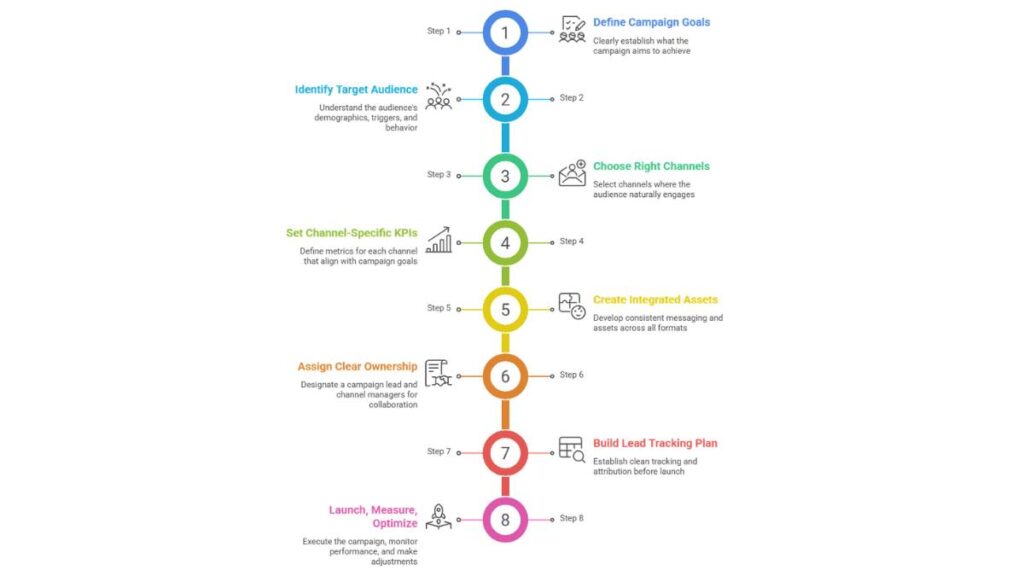
Step 1: Establish Clear Campaign Goals
Start with the uncomfortable question: what are we actually trying to achieve?
Awareness? Leads? Revenue? Market repositioning?
Too many campaigns try to do all four at once. That’s when KPIs become diluted, and reporting becomes confusing.
If the goal is brand awareness, measure reach, recall, and engagement trends.
If it’s lead generation, focus on cost per qualified lead and pipeline value.
If it’s revenue, track customer acquisition cost and return on ad spend.
Everything else is secondary.
Clear goals make budget allocation easier. They also make creative sharper. When the objective is vague, the campaign feels vague.
Step 2: Identify the Target Audience
Integration doesn’t mean being everywhere. It means being precise across touchpoints.
Audience clarity goes beyond demographics. It includes:
- Buying triggers
- Objections
- Decision timelines
- Channel behavior
Some audiences discover brands on social but convert through search. Others rely heavily on email nurturing. Mapping that journey early prevents wasted spend later.
Segmentation also matters more than most teams admit. A campaign targeting new prospects should not sound identical to messaging aimed at returning customers.
Subtle shifts in language can dramatically change performance.
Step 3: Choose the Right Channels
Not every campaign needs every channel. In fact, adding too many platforms often weakens focus.
Channel selection should answer one question: where does this audience naturally engage?
Social media can drive reach and conversation.
Email builds depth and frequency.
Paid ads capture intent.
Content marketing builds long-term authority.
Offline elements: events, print, in-store; add credibility and physical presence.
The goal isn’t expansion. It’s coordination.
Online and offline alignment, when done well, is powerful. A physical event supported by digital amplification and follow-up sequences feels intentional. Without that coordination, it feels random.
Step 4: Set Channel-Specific KPIs
Each channel plays a different role, so its metrics should reflect that role.
Social engagement metrics measure resonance.
Email open and click-through rates indicate interest.
Paid ad ROAS reflects direct response efficiency.
But here’s the key: these metrics must connect back to the campaign objective.
An integrated marketing campaign doesn’t evaluate channels independently. It evaluates the contribution. That shift changes how performance is interpreted.
Step 5: Create Integrated Assets & Messaging
This is where everything either aligns or drifts.
Start with a clear campaign theme. A core idea. A consistent value proposition.
From there, adapt it intelligently across formats.
A long-form article can become short-form social insights.
A webinar can feed email content.
A customer story can inform ad creative.
The goal isn’t duplication. It’s reinforcement.
When audiences encounter the same message in different forms, familiarity builds. Familiarity reduces resistance.
Step 6: Assign Clear Ownership
Integrated campaigns break when ownership is fuzzy.
There needs to be:
- One overall campaign lead
- Defined channel managers
- Agreed reporting cadence
Cross-functional collaboration isn’t optional here. Sales need context. Creative needs direction. Leadership needs visibility.
Without alignment internally, external consistency won’t happen.
Step 7: Build a Lead Collection & Tracking Plan
Before launch, tracking must be clean. Campaign tagging, CRM alignment, attribution clarity; all decided in advance.
Retrofitting measurement later usually leads to incomplete data and flawed conclusions.
When tracking is clear from the beginning, optimization becomes sharper.
Step 8: Launch, Measure, Optimize
Launch day feels big. It’s not. It’s simply the beginning of the feedback loop.
Early performance signals matter. So does patience.
Optimization should focus on:
- Message clarity
- Audience refinement
- Budget shifts
- Conversion bottlenecks
Small adjustments compound. Over time, the campaign tightens.
And that’s the point of integration; not just to look consistent, but to perform consistently across the entire journey.
Integrated Marketing Campaign Examples
The easiest way to understand an integrated marketing campaign is to see how the best brands execute it. Not because they’re perfect, but because their campaigns show what alignment actually looks like in the real world; across channels, formats, and audiences.
Apple – “Shot on iPhone” Integrated Campaign
The “Shot on iPhone” campaign from Apple is often referenced, but it’s worth studying closely. What made it powerful wasn’t just beautiful photography. It was cohesion.
The campaign turned user-generated content into the hero. Real customers took real photos. Those images appeared on billboards, social media feeds, digital ads, and in-store displays, all carrying the same message: the product speaks through the user.
Outdoor placements reinforced digital engagement. Social amplified physical visibility. The storytelling never shifted. It wasn’t about specs. It was about creativity in your pocket.
That’s integration; one idea, expressed everywhere, without dilution.
Nike – “So Win” Campaign
Nike has always understood emotional branding. “So Win” leaned into ambition, confidence, and self-belief. But what made it integrated wasn’t just the emotional tone; it was how the message carried across video, social, athlete partnerships, and community engagement.
The campaign didn’t treat social media as a distribution channel. It treated it as an extension of the brand’s voice. Video storytelling aligned with athlete content. Community conversations reinforced the same narrative.
The messaging didn’t change depending on the format. It evolved, but it stayed grounded in one emotional anchor.
The New York Times – “The Truth Is Hard”
When The New York Times launched “The Truth Is Hard,” the objective wasn’t product promotion. It was brand trust.
The campaign ran across print, television, digital, and out-of-home placements. The creative was minimal, almost stark. But that consistency made it stronger. Every channel reinforced the same positioning: journalism requires effort, and truth isn’t simple.
This wasn’t a scattered media push. It was a unified statement. And in moments of brand vulnerability, integration becomes even more important.
Kia Australia – EV Awareness Campaign
Kia in Australia approached EV awareness with storytelling instead of technical overload. The campaign connected digital video, social engagement, and live event experiences to introduce electric vehicles in a relatable way.
Online buzz wasn’t isolated from offline presence. Event activations were amplified digitally. Social content reflected real-world interactions.
When awareness campaigns combine physical and digital touchpoints intentionally, the brand feels present, not intrusive.
McAfee – “Secure in 15” B2B Campaign
McAfee approached integration from an educational angle. “Secure in 15” delivered digestible security insights through content, email, and paid media; all aligned under one educational framework.
In B2B, especially, integration often breaks because content and demand generation operate separately. Here, they reinforced each other. Educational assets drove traffic. Email nurtured it. Paid ads accelerated intent.
The message was clear: security doesn’t have to be complicated. And that message didn’t shift between channels.
YETI – “Map the Gaps” Digital Campaign
YETI has built its brand on lifestyle storytelling. “Map the Gaps” leaned into adventure culture, blending experiential marketing with video, social, and community-driven content.
The campaign didn’t feel transactional. It felt immersive.
That’s often the hidden strength of integrated marketing campaigns; they create an ecosystem around a theme. Audiences don’t encounter isolated ads. They encounter a world.
And when that world is consistent, it builds loyalty almost subconsciously.

Apply Now: Performance Marketing Course
Types of Integrated Marketing Campaigns
Not all integrated marketing campaigns look the same. The structure is similar; unified messaging and coordinated execution, but the objective changes the design.
B2B Integrated Marketing Campaign
In B2B, integration often revolves around education and pipeline development. The sales cycle is longer. Multiple stakeholders are involved.
An effective B2B integrated campaign typically connects thought leadership content, webinars, targeted paid campaigns, email nurturing, and direct sales outreach under one strategic theme.
The messaging must stay consistent from the first touchpoint to the final demo. When it doesn’t, credibility suffers. In B2B, especially, consistency signals competence.
B2C Integrated Marketing Campaign
B2C campaigns move faster. Emotional triggers often play a bigger role. Social media presence tends to be more prominent.
Here, integration usually connects brand storytelling, influencer collaborations, paid media, email promotions, and sometimes retail experiences. Timing matters more. Cultural relevance matters more.
But the same rule applies: one core narrative, expressed across every customer touchpoint.
Product Launch Integrated Campaign
Product launches demand tight coordination.
Teaser content builds anticipation.
Paid ads drive traffic at launch.
Email sequences activate existing audiences.
PR amplifies visibility.
If launch messaging is fragmented, momentum fades quickly. The first 30 days often determine long-term trajectory, so integration during this phase is critical.
Brand Awareness Integrated Campaign
Brand awareness campaigns focus on perception and reach rather than immediate conversion.
These campaigns often combine video storytelling, outdoor placements, digital amplification, and influencer engagement. The goal isn’t direct ROI in week one. It’s long-term brand recall and positioning.
Consistency over time becomes the competitive advantage here.
Digital Integrated Marketing Campaign
Some campaigns operate entirely within digital ecosystems: search, social, display, email, and content platforms.
Even without offline components, integration still matters. The audience may encounter the brand across multiple screens and sessions. If each touchpoint feels disconnected, performance weakens.
Digital integration is less about presence and more about continuity.
Offline + Online Integrated Campaign
Blending offline and online marketing requires careful alignment.
Events must connect with digital follow-up. Print advertising should mirror online messaging. QR codes, landing pages, and retargeting efforts must align under the same theme.
When offline and online reinforce each other, campaigns gain dimension. When they don’t, they compete for attention.
Measuring the Success of an Integrated Marketing Campaign
Measurement is where many integrated marketing campaigns get misunderstood. Teams often measure channels separately and then wonder why the overall picture feels unclear.
Integrated campaigns require integrated measurement.
Key Metrics to Track
Campaign ROI is the anchor. But it’s rarely the only metric that matters.
Customer acquisition cost provides clarity on efficiency.
Lifetime value reveals sustainability.
Conversion rates indicate message-market fit.
Engagement metrics reflect resonance.
Multi-touch attribution uncovers channel contribution.
The key is balance. Focusing only on last-click attribution undervalues upper-funnel efforts. Ignoring bottom-funnel performance hides profitability issues.
An integrated marketing campaign should be evaluated as a system, not as isolated tactics.
Tools for Measuring Integrated Campaign Performance
Performance measurement typically relies on a mix of CRM systems, marketing automation platforms, analytics dashboards, and attribution models.
But tools alone don’t create insight. Alignment does.
Sales and marketing must agree on definitions. What qualifies as a lead? What counts as a conversion? How is revenue attributed?
Without shared definitions, reporting becomes political instead of strategic.
Integrated measurement means looking at the entire journey:
- First interaction
- Middle engagement
- Final conversion
- Post-purchase retention
When teams understand how channels influence each other, budget decisions become more confident. Optimization becomes more targeted. And ROI discussions become grounded in data rather than opinion.
Ultimately, measuring an integrated marketing campaign isn’t about proving activity. It’s about proving contribution.
And contribution is what drives long-term growth.
Common Challenges in Integrated Marketing Campaigns
Integrated marketing campaigns look tidy in strategy decks. One idea. Multiple channels. Everything aligned.
Then execution starts.
That’s usually when reality steps in.
Teams Aren’t Actually Aligned
On kickoff calls, everyone nods. The campaign sounds clear. But once teams go back to their lanes, small interpretations creep in.
Paid media leans into urgency. Content focuses on education. Sales wants stronger CTAs. Social experiments with tone. None of it is “wrong.” It’s just slightly… off.
Those small shifts compound.
The core problem is rarely effort. It’s a translation. If the campaign strategy can’t be distilled into a tight internal brief: audience, promise, tone, one clear objective; fragmentation is almost guaranteed.
Before launch, pressure-test alignment:
- Can every channel owner explain the campaign in the same way?
- Is there one primary metric that matters most?
- Are there clear guardrails for tone and positioning?
If answers vary too much, the campaign will feel stitched together instead of integrated.
Brand Drift Across Channels
This one is subtle.
An ad makes a bold claim. The landing page softens it. Email introduces a slightly different benefit. Social shifts the personality. After a few touchpoints, the message feels… diluted.
Customers may not consciously articulate the inconsistency, but trust erodes when things don’t quite line up.
Integration isn’t about repeating the same headline everywhere. It’s about holding onto the same central idea. The same tension. The same promise.
When campaigns start drifting, it’s often because creative teams optimize in isolation. Strong integration requires someone who sees the full ecosystem, not just individual assets.
Data Lives in Silos
Another familiar issue: each channel reports success differently.
- Social celebrates reach and engagement.
- Paid reports return on ad spend.
- Email focuses on open and click rates.
- Sales tracks revenue.
Everyone has numbers. Few have shared clarity.
Without a unified measurement framework, discussions shift from “What’s working?” to “Which dashboard is right?” That’s not a productive place to be.
Integration requires shared definitions. What counts as a qualified lead? How is revenue attributed? Which KPIs signal early success versus final conversion?
Perfect attribution isn’t always realistic. But consistent attribution is essential.
Budget Friction
Integrated campaigns expose internal politics.
If paid media drives traffic but email closes conversions, who gets credit? Where should the budget increase? These conversations can turn territorial quickly.
The healthier approach is contribution thinking. Channels play different roles:
- Some generate demand.
- Some capture intent.
- Some nurture.
- Some convert.
Looking at isolated performance often leads to poor decisions. Looking at the full customer journey reveals interdependence.
It takes maturity to budget that way. Not every organization is ready for it. But high-performing ones are.
Attribution Is Messy; Accept It
Customers don’t move in straight lines anymore. They bounce. They compare. They disappear and return.
Trying to assign 100% credit to one touchpoint usually oversimplifies reality.
Instead of chasing perfect precision, focus on patterns:
- Which channels introduce new audiences?
- Which accelerate buying decisions?
- Which supports retention?
Directional clarity beats analytical paralysis.
How to Adapt Integrated Marketing Campaigns to Changing Consumer Behavior
Consumer behavior doesn’t wait for campaign timelines. Attention shifts. Platforms evolve. Expectations rise quietly in the background.
Integrated campaigns that feel rigid tend to lose momentum. The ones that adapt thoughtfully, not reactively, stay relevant.
Personalization That Feels Useful, Not Creepy
Personalization has matured. It’s no longer impressive to insert a first name into a subject line.
The real shift is behavioral relevance. Messaging that reflects actions:
- Downloaded a guide? Follow up with deeper content.
- Visited pricing? Adjust retargeting creative.
- Repeat customer? Shift from acquisition messaging to loyalty framing.
But there’s a boundary. When personalization feels invasive, trust drops fast.
The goal isn’t to prove how much data exists. It’s to reduce friction. Make the next step obvious. Helpful. Logical.
That’s the sweet spot.
Shorter Feedback Loops
Waiting until a campaign ends to analyze performance is risky.
Stronger teams review early signals often:
- Creative engagement trends
- Audience-level conversion differences
- Drop-off points in landing experiences
If a message angle underperforms, adjust. If a specific segment responds strongly, lean into it.
Agility doesn’t mean constant chaos. It means building space for iteration into the plan.
Rigid campaigns crack under pressure. Flexible ones evolve.
Move Beyond Demographics
Demographics still matter, but they rarely tell the whole story.
Behavior tells more.
Two customers in the same age bracket can interact with a brand in completely different ways. One skims content casually. Another compares product specs intensely. One reacts to urgency. Another needs reassurance.
Behavioral segmentation makes integrated campaigns sharper:
- New visitors vs returning users
- High-engagement subscribers vs dormant ones
- High-value customers vs discount-driven buyers
Messaging becomes more precise. Conversion friction drops.
It’s not about targeting everyone. It’s about responding intelligently.
First-Party Data as a Strategic Asset
Platform changes and privacy shifts have made one thing clear: brands need stronger direct relationships.
Email lists. CRM insights. Loyalty programs. Customer surveys.
First-party data stabilizes integrated marketing. It allows messaging consistency independent of algorithm shifts.
Brands that rely entirely on rented audiences feel every platform change. Brands with strong owned data ecosystems adjust more calmly.
That difference shows up in long-term performance.
Role of Storytelling in Integrated Marketing Campaigns
Without storytelling, integration becomes mechanical.
Assets align. Timelines coordinate. Metrics report. But nothing truly sticks.
Story is what binds everything together.
Emotional Positioning Matters More Than Features
Features explain. Stories resonate.
An integrated campaign might highlight performance, pricing, or convenience. But unless those benefits connect to a deeper emotional outcome, relief, confidence, belonging, momentum, they rarely linger.
Emotional positioning doesn’t require dramatic language. It requires clarity about what changes for the customer.
What becomes easier? Safer? Faster? More certain?
When that emotional layer is clear, every channel can reinforce it in its own way.
One Narrative, Multiple Expressions
Integration isn’t about copying and pasting the same message everywhere.
It’s about telling the same story from different angles.
- Social sparks curiosity.
- Email deepens the argument.
- Landing pages clarify the offer.
- Video amplifies the emotional tone.
- Sales conversations personalize the resolution.
Each channel plays a role in the arc.
When done well, customers don’t feel like they’re encountering separate messages. They feel progression.
Let Customers Carry the Story
User-generated content adds weight.
Reviews. Testimonials. Case studies. Social mentions.
When integrated properly, these elements strengthen the narrative instead of feeling like add-ons. A campaign becomes less about what the brand claims and more about what customers confirm.
That shift matters. Especially in crowded markets where trust is fragile.
Build Continuity, Not Just Campaign Bursts
Many integrated campaigns spike attention, then disappear.
Stronger brands treat storytelling as an ongoing thread. Campaigns evolve, but the underlying narrative stays recognizable.
Over time, that continuity builds familiarity. Familiarity builds trust. And trust compounds.
Integration, at its best, isn’t just coordinated marketing. It’s a cohesive brand experience that feels intentional, even when the customer doesn’t consciously notice it.
And that’s usually the point.
Integrated Marketing Campaign vs Multichannel Marketing vs Omnichannel Marketing
These three terms get tossed around like they mean the same thing. They don’t. And when a campaign underperforms, that confusion tends to surface quickly. Someone asks what strategy was actually in play, and the room goes quiet.
So let’s untangle it properly.
Multichannel Marketing
Multichannel marketing is the broadest approach. A brand shows up in several places at once: social, email, paid ads, the website, maybe events, or print. Each channel operates more or less on its own rhythm. Messaging might overlap, but it isn’t tightly coordinated.
It’s practical. Sometimes highly effective. But it’s usually channel-led. Teams focus on optimizing their slice of the pie. KPIs differ. Creative direction can drift. The brand is present in multiple places, yet the experience may feel slightly fragmented.
There’s nothing inherently wrong with that. For many organizations, it’s a natural starting point.
Integrated Marketing Campaign
An integrated marketing campaign is more deliberate. Instead of asking which channels to activate, the question shifts to how every channel supports one central idea.
There’s a defined objective. A clear audience. A shared narrative. Creative direction doesn’t vary wildly from platform to platform; it adapts, but the spine stays intact.
Paid media might introduce the core promise. Social builds engagement around it. Email deepens the message. Landing pages reinforce the positioning without changing the tone halfway through. Timing is coordinated. Messaging builds rather than competes.
Integration requires alignment behind the scenes. More planning, yes. Sometimes tougher internal conversations. But the payoff is clarity. Customers don’t experience scattered efforts. They experience one focused push delivered from different angles.
Omnichannel Marketing
Omnichannel marketing shifts the focus again, away from the campaign and toward the customer’s movement between touchpoints.
Here, the priority is continuity. A customer might browse on mobile, visit a store, receive a follow-up email, and later convert through a retargeting ad. The experience feels connected. Data informs the next interaction. Messaging adjusts based on prior behavior.
This approach demands stronger infrastructure. Data systems must talk to each other. Operational alignment needs to be tight. When it works, it feels seamless. When it doesn’t, the cracks show fast.
When to Use Each Approach
Not every business needs omnichannel sophistication. And not every initiative requires full integration.
Multichannel works when presence matters more than orchestration. Integrated campaigns make sense when there’s a specific objective that demands alignment. Omnichannel becomes essential when customer experience across environments drives competitive advantage.
The real mistake is assuming these are interchangeable labels. They’re not. Each reflects a different level of coordination and maturity.
Conclusion
An integrated marketing campaign isn’t about doing more. It’s about doing things together; intentionally.
Launching the activity is easy. Aligning teams around one focused objective is harder. Protecting that objective as the campaign evolves is harder still. Creative ideas multiply. Stakeholders add suggestions. Scope expands quietly. Focus weakens if no one guards it.
Strong campaigns keep the core idea intact. Not rigidly; adjustments are part of the process, but deliberately. Everyone understands the primary goal. Everyone knows what success looks like.
Consistency doesn’t mean repetition. It means coherence. The same story told in different ways, across different channels, without losing its essence.
Data and creativity aren’t competing forces. Data highlights friction. Creativity resolves it. When both operate together, performance improves in ways that isolated tactics rarely achieve.
Integration, in the end, is less about channels and more about discipline. A way of thinking. When that mindset becomes standard practice, campaigns feel sharper, more intentional, and far more effective.
FAQs: Integrated Marketing Campaign
1. What is an integrated marketing campaign?
An integrated marketing campaign is a coordinated effort where multiple marketing channels communicate the same core message around a shared objective. Rather than running disconnected promotions, every touchpoint reinforces the same positioning and timing. The result is a cohesive experience that feels intentional instead of scattered or repetitive.
2. What are the benefits of an integrated marketing campaign?
Integrated campaigns strengthen brand recognition because customers encounter a consistent message across platforms. They reduce confusion in the buying journey and often improve conversion rates through reinforcement. Internally, they also create clearer performance tracking and more efficient budget allocation since all channels work toward the same measurable outcome.
3. What are some examples of successful integrated marketing campaigns?
Successful integrated campaigns typically revolve around a strong central theme supported across digital, social, video, and sometimes offline media. The execution adapts to each channel’s strengths while maintaining a consistent tone and positioning. The unifying idea remains recognizable wherever the audience interacts with the brand.
4. How do companies measure the success of an integrated marketing campaign?
Measurement depends on campaign goals, but it usually combines revenue metrics and engagement indicators. Businesses track return on investment, customer acquisition cost, lifetime value, conversion rates, and multi-touch attribution trends. The important part is defining success before launch, so results are evaluated against clear expectations.
5. What are the key components of an integrated marketing campaign strategy?
A strong strategy includes a unified message, cross-channel consistency, centralized planning, defined KPIs, and customer-focused content. Without these elements, campaigns drift into isolated efforts. Integration works best when every channel understands its role in supporting a shared objective and narrative.
6. How can businesses create a successful integrated marketing campaign?
Start by defining one primary objective and a clearly identified audience. Develop a central message that addresses a real need. Map how each channel will express that message while maintaining consistency. Align measurement systems early, then monitor performance and refine based on what the data reveals.
7. What role does storytelling play in integrated marketing campaigns?
Storytelling provides emotional continuity across channels. It ensures the campaign feels connected rather than mechanical. When every touchpoint contributes to the same narrative arc, audiences are more likely to remember the message and associate it with the brand’s core positioning.
8. How do integrated marketing campaigns build brand consistency?
They establish clear positioning, tone, and visual identity at the beginning and protect those elements throughout execution. When customers repeatedly encounter the same promise expressed in complementary ways, trust grows. Inconsistent messaging, by contrast, weakens credibility and reduces overall impact.
9. What are the biggest challenges in implementing an integrated marketing campaign?
The most common challenges are internal. Teams may operate in silos, data systems might not align, and priorities can conflict. Attribution complexity and budget disputes also surface quickly. Successful integration usually depends on leadership alignment and disciplined coordination across departments.
10. How can businesses optimize integrated campaigns for better ROI?
Optimization involves reviewing cross-channel performance regularly, identifying friction points in the journey, and testing creative variations. Budget adjustments should reflect contributions across the funnel rather than isolated metrics. Incremental improvements across multiple touchpoints often produce stronger overall gains than dramatic changes in one channel.
11. What is the difference between integrated marketing and integrated marketing communications (IMC)?
Integrated marketing focuses broadly on aligning strategy, messaging, channels, and performance measurement to achieve business objectives. Integrated marketing communications traditionally emphasizes consistent messaging across communication tactics like advertising and PR. In practice, the concepts overlap, but integrated marketing often extends deeper into operational and performance alignment.
12. How long does an integrated marketing campaign typically last?
Campaign length varies based on objectives and industry dynamics. Product launches may run for several weeks, while brand-focused initiatives can extend for months. The timeline should reflect audience attention cycles and measurable milestones rather than arbitrary calendar constraints.
13. What budget is required for an integrated marketing campaign?
Budgets depend on scope, channel mix, and production requirements. Integration itself does not require massive spending. Even smaller organizations can coordinate messaging across a limited number of channels effectively. The defining factor is alignment, not scale.
14. Can small businesses run an effective integrated marketing campaign?
Yes, and often with surprising agility. Smaller teams can align messaging quickly and adjust faster when performance shifts. With fewer layers of approval, consistency is sometimes easier to maintain, making integration achievable even with modest resources.
15. What channels should be included in an integrated marketing campaign?
Channel selection should reflect where the target audience spends time and how they prefer to engage. Common options include social media, email, content marketing, paid advertising, PR, and offline activations. The goal is not to use every channel but to coordinate the right mix effectively.
16. How does an integrated marketing campaign improve customer experience?
By reducing inconsistencies across touchpoints, integrated campaigns create a smoother journey. Customers encounter the same promise and tone regardless of channel, which builds confidence and lowers friction in decision-making. That coherence often translates into stronger conversion outcomes.
17. What role does marketing automation play in integrated marketing campaigns?
Marketing automation supports coordination by aligning timing and follow-up across channels. It helps ensure that actions in one environment trigger relevant responses in another. While automation improves efficiency and personalization, strategic clarity remains the foundation of effective integration.
18. How do you ensure brand consistency across all marketing channels?
Consistency begins with clear brand guidelines and defined messaging priorities. Assigning ownership for brand oversight and reviewing assets holistically before launch helps prevent drift. Regular alignment checks during the campaign also ensure the core message remains intact as tactics evolve.
19. What are the most common mistakes in integrated marketing campaigns?
Common mistakes include launching without a clear central objective, allowing channels to operate independently, ignoring attribution complexity, and failing to adapt based on performance data. Many issues stem from insufficient alignment at the planning stage rather than flaws in execution.
20. How can AI and data analytics improve integrated marketing campaigns?
Advanced analytics can identify audience segments, surface behavioral patterns, and reveal optimization opportunities across channels. When used thoughtfully, data improves targeting precision and budget allocation. However, strategic judgment is still essential to interpret insights and maintain coherent messaging.