
Marketing often looks neater on slides than it does in real life. That’s where Integrated Marketing Communication (IMC) comes in; not a fancy term, but a practical approach to making sure all brand messages actually make sense together. Ads, social posts, emails, PR, even in-store signage; they’re all part of one story. When they line up, customers feel confident, and decisions become easier. This blog walks through why IMC matters, the principles behind it, the tools and channels that make it work, and real campaigns that got it right. It also tackles common challenges and glimpses at what’s next, showing how integration can turn scattered efforts into something coherent, memorable, and effective.
Table of Contents
Introduction:
Understanding Integrated Marketing Communication
Marketing used to be neat and compartmentalized. One team handled ads, another did brochures, and someone else looked after events. Things went out into the world and, more or less, that was that. Customers today don’t experience brands that way. Not even close.
A person might see a reel in the morning, Google the brand during lunch, read a couple of reviews later, and end up on the website that night. Different platforms, same day, same decision journey. If the brand feels different in each place, the experience feels shaky. Subtle, but it chips away at confidence.
That’s where Integrated Marketing Communication (IMC) comes in.
At its core, the integrated marketing communication’s meaning is about alignment. Every channel, advertising, social media, email, PR, website, and in-store communication should feel like it’s coming from the same brand brain. Same values. Same tone. Same overall message, just expressed differently depending on where it shows up.
It’s less about being everywhere and more about being connected everywhere. Customers shouldn’t have to “figure out” a brand each time they see it. Recognition should feel almost automatic.
The evolution of IMC: From traditional advertising to digital-first strategies
Back when media options were limited, marketing could afford to be fragmented. A TV campaign could run with one message while in-store promotions pushed another. The overlap in audiences was smaller, and tracking was… well, basic.
Digital changed that. Completely.
Now customers jump between platforms without thinking:
- Scroll social
- Search on Google
- Watch a review video
- Visit the website
- Get retargeted
- Open an email offer
All part of one continuous flow. The customer sees one journey. Brands, internally, often still operate in pieces. That mismatch is exactly why IMC became necessary.
Instead of planning by channel, social plan here, ad plan there; strong brands plan around the customer journey first. Then channels are chosen to support that journey. It’s a shift from “Where should we post?” to “What should the customer experience next?”
Why Integrated Marketing Communication matters in the modern marketing landscape
Attention spans are short. Competition is endless. Most categories look and sound the same. In that environment, scattered messaging doesn’t just underperform; it confuses.
The importance of integrated marketing communication shows up in a few very practical ways:
- Consistent messages are easier to remember
- Familiar brands feel safer to buy from
- Clear positioning reduces decision friction
- Repetition across channels strengthens recall
When a brand speaks with one voice across touchpoints, it feels established. Stable. Intentional. That perception alone can influence preference, even before product comparisons begin.
IMC isn’t just a coordination exercise. It shapes how reliable a brand feels in the mind of the customer. And reliability, especially today, carries weight.
Importance of Integrated Marketing Communication
Plenty of marketing activity happens every day. Ads go live. Emails are sent. Posts are scheduled. Promotions roll out. But activity doesn’t automatically add up to impact. Without integration, it’s just noise from different directions.
IMC brings structure to that noise.
Why IMC is critical for brand consistency and audience engagement
Consistency might sound like a branding cliché, but in practice, it’s where things fall apart.
A brand might position itself as premium in ads, then run heavy discount messaging on social. Email talks urgency. The website focuses on long-term value. None of these is wrong on its own. Together, though, they create mixed signals.
Customers may not consciously analyze this, but they feel it. The brand starts to seem unclear about what it stands for.
IMC aligns the fundamentals:
- Core promise
- Tone of voice
- Visual identity
- Key messages
Once those are steady, engagement improves. People respond better when they understand a brand quickly. No mental effort required to piece things together.
Key benefits of Integrated Marketing Communication
Consistency in brand messaging across all channels
Repeated, aligned messaging builds mental availability. Over time, certain phrases, visuals, or ideas become strongly associated with the brand. That familiarity makes recall faster when a purchase situation appears.
Improved consumer engagement and loyalty
When communication feels coherent, customers are more comfortable interacting. They’re more likely to follow, sign up, respond, and come back. Loyalty grows from a series of consistent experiences, not one-off campaigns.
Cost efficiency and better ROI
Separate teams often create separate ideas, assets, and campaigns. That duplication eats into budgets. IMC encourages one strong central idea that gets adapted across platforms. Production becomes more efficient, and each channel reinforces the others instead of competing for attention.
Competitive advantage in a fragmented media landscape
Many brands still operate in silos, even if they don’t admit it. The result is disjointed communication. A brand with clearly integrated messaging stands out; not necessarily by being louder, but by being clearer.
How IMC influences customer perception and trust
Trust builds slowly. Usually through consistency.
When customers see the same positioning in ads, experience similar messaging on the website, and receive aligned communication after purchase, the brand feels dependable. Predictable in a reassuring way.
That’s where IMC for brand loyalty becomes powerful. It reduces uncertainty. And when uncertainty drops, decisions feel easier. In crowded markets where features and prices look similar, that sense of reliability often tips the scale.
Core Principles of Integrated Marketing Communication
IMC sounds strategic, and it is, but it runs on a few practical principles. Ignore these, and integration becomes a slide in a presentation rather than something that shapes real campaigns.
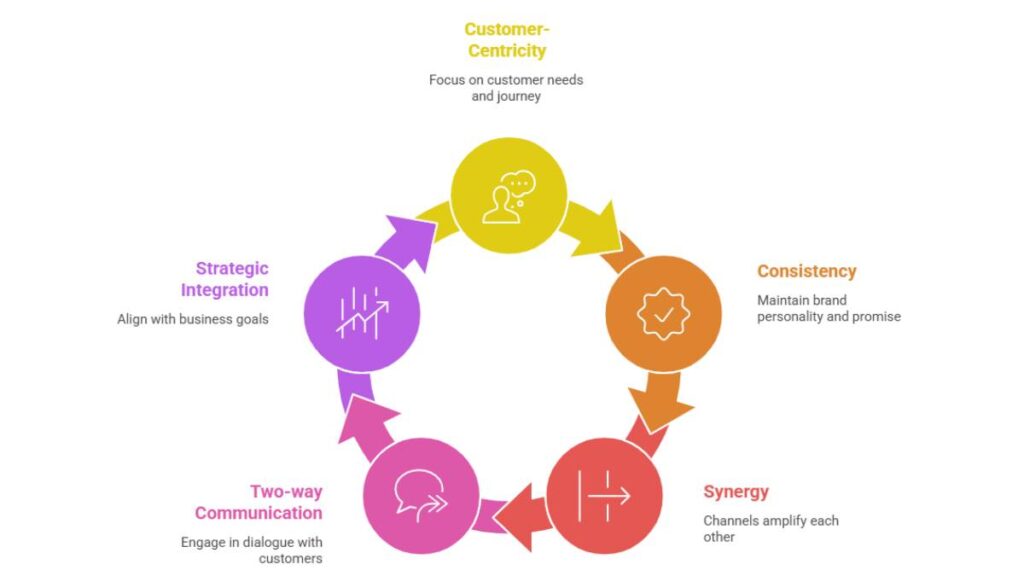
1. Customer-Centricity
IMC starts with the audience, not internal structures.
Communication should reflect:
- Who the customer is
- What problems they’re trying to solve
- Where do they spend time
- What stage of the journey they’re in
A first-time prospect needs different information than a repeat buyer. Integration doesn’t mean saying the same thing to everyone. It means tailoring messages while staying anchored to the same brand story.
2. Consistency
Consistency sits at the center of all IMC principles.
This isn’t about repeating identical copy everywhere. It’s about protecting the foundation:
- Same brand personality
- Same core promise
- Same positioning
The way that message shows up in a short social caption will differ from a long-form video or a landing page. Still, the underlying idea should feel connected. When that link breaks, brand memory weakens.
3. Synergy
Channels should amplify each other, not operate in isolation.
An advertising campaign might introduce a big idea. Social media can extend it through conversation. Content marketing explains it in depth. Email nudges action. Promotions add urgency. Each piece builds on the others.
That’s synergy in action. One direction, multiple touchpoints pushing together.
4. Two-way Communication
Modern communication works better as a dialogue than a broadcast.
Comments, reviews, polls, community discussions; these aren’t side activities. They’re part of how the brand communicates and learns. Listening helps refine messaging and makes customers feel acknowledged, which strengthens the connection over time.
IMC works best when feedback loops are built in, not treated as an afterthought.
5. Strategic Integration
Finally, IMC must link back to business goals. Otherwise, it becomes well-coordinated communication with no clear impact.
A solid strategic IMC framework connects campaigns to:
- Growth targets
- Market positioning
- Customer retention
- Product priorities
When that alignment is clear, communication stops being a series of disconnected promotions. It becomes a long-term system that builds brand value steadily, campaign after campaign.
Key Components of the IMC Mix
On paper, integrated marketing communication looks clean. A tidy framework. In practice, it’s more like controlled chaos; multiple teams, multiple deadlines, and one brand voice that somehow has to stay recognizable through all of it.
Advertising usually does the heavy lifting at the top. Big reach, fast visibility. TV spots, outdoor, digital video, display ads; all designed to plant an idea quickly. The issue is, awareness fades unless something else carries the story forward. Ads start the conversation. They rarely finish it.
Public relations works in a different lane. Media features, brand stories, interviews, influencer mentions. This is where credibility builds, slowly. PR tends to feel more “earned” than paid ads, and people treat it that way. But if PR pushes a message that doesn’t match the ad campaign, the brand starts sounding like it has multiple personalities. Not ideal.
Direct marketing gets more personal. Emails after a product view. SMS reminders. App notifications. These are behavior-triggered touchpoints, and when done right, they feel timely. When done badly, they feel like spam with good timing. In a proper IMC setup, these messages echo the larger campaign theme, just tailored to where the customer is in the journey.
Sales promotions are the quick spark. Discounts, limited-time bundles, coupon drops, loyalty perks. Useful tools, no doubt. But overuse them and the brand quietly shifts from “valuable” to “cheap.” Promotions need to support positioning, not fight against it in the background.
Personal selling is easy to forget in marketing decks, but it matters a lot. Sales teams, store staff, consultants; they translate brand messaging into real conversations. If they’re saying one thing while the ads say another, customers notice. And trust slips. Fast.
Social and digital marketing act like the glue. Organic posts, paid social, search ads, retargeting; these channels follow people around (in a non-creepy way, ideally) and keep the brand top of mind. Tone matters here. Social shouldn’t feel like it’s run by a completely different brand than the one in the TV commercial.
Content marketing adds depth. Blogs, guides, webinars, long-form videos. This is where brands actually explain things instead of squeezing everything into six words and a logo. Good content connects back to the campaign’s core idea. Random content just fills space and burns budget.
Partnerships and sponsorships extend reach sideways. Influencers, events, and co-branded campaigns. These associations shape brand perception, whether planned or not. A mismatch here can undo months of careful positioning. A strong fit, though, can fast-track trust.
And then there’s internal communication, the quiet backbone. Employees who understand the campaign message tend to deliver a consistent experience without even trying. Those who don’t… well, customers get mixed signals that no media budget can fix.
Behind all of this sit the tech systems: CRM platforms, automation tools, analytics dashboards. Not glamorous, but essential. They keep timing aligned and prevent customers from getting five unrelated messages in the same week. Which still happens, just less often.
IMC Strategies and Practical Approaches
Using lots of channels doesn’t automatically mean communication is integrated. Plenty of brands are active everywhere and still feel disconnected. Integration comes from coordination, not volume.
Cross-channel consistency is the baseline. Visuals, tone, core message; they should feel related across platforms. Not copy-paste identical, because each channel has its own style. But clearly from the same brand family. A customer moving from Instagram to the website shouldn’t feel like they clicked into another company by accident.
A solid IMC approach also stays audience-centered. Different segments care about different things. Some want a price. Some want quality. Others want convenience or status. Integration doesn’t mean repeating the same line to everyone. It means expressing the same brand truth from different angles.
Data plays a bigger role than many teams admit. Real customer journeys rarely match the neat funnel diagrams in presentations. People jump channels, pause, and return weeks later. Data helps map what’s actually happening, so messaging can follow behavior instead of assumptions.
The idea of a unified campaign platform sits at the core of IMC. One central theme, adapted across channels. Ads create awareness. Social drives engagement. Content explains. Email nudges. Promotions convert. Each channel has a job. When that’s clear, overlap reduces, and performance usually improves.
Technology integration just makes this manageable at scale. Automation tools control timing. CRM systems track interactions. Analytics show which touchpoints influence others. Without these systems, integration becomes manual and messy.
The IMC Planning Process (How It Usually Works in Real Life)
IMC planning sounds very structured in textbooks. In reality, it’s structured… with detours.
It starts with a situation review. Market conditions, competitor activity, customer behavior, internal strengths, and gaps. This is where uncomfortable truths sometimes show up. Better here than mid-campaign.
Then come clear objectives. Awareness? Leads? Retention? Repositioning? Vague goals lead to scattered messaging. Sharp goals make channel roles easier to define.
Next is audience definition. Not just age and income, but motivations, barriers, and decision triggers. The more grounded this is, the easier it becomes to design touchpoints that feel relevant instead of generic.
After that, teams shape the core message and brand narrative. This becomes the anchor. Different teams will interpret it slightly differently; that’s normal, but the central idea should stay steady.
Only then does channel selection really make sense. Where is the audience active? Which channels influence early discovery versus final decisions? Trendy platforms aren’t always the right ones.
The campaign blueprint follows. This maps how channels support each other over time. What launches first? What reinforces later? Where conversion pushes happen. It’s less about isolated tactics and more about sequence.
During execution, alignment is everything. Visual identity, tone, timing. Internal teams and external partners need the same playbook, or small inconsistencies multiply quickly.
Then comes measurement; not just channel metrics in isolation, but how channels interact. Did social traffic improve email performance? Did PR coverage lift branded search? Those connections matter.
Finally, post-campaign review. What actually worked. Where people dropped off. Which channels pulled more weight than expected? IMC improves in cycles. Each campaign leaves behind lessons, sometimes the hard way, that shape the next one.
And that’s really the heart of it. Integration isn’t a one-time setup. It’s an ongoing discipline. Slightly messy. Occasionally frustrating. But when it clicks, the brand feels consistent everywhere, and customers move through the journey with fewer bumps. Which is the whole point.

Enroll Now: Advanced Digital Marketing Course
Tools and Technologies for Integrated Marketing Communication
Talk about IMC long enough, and the conversation eventually lands on tools. Not the flashy part, sure. But this is where integration either holds together… or quietly falls apart behind the scenes.
Start with marketing automation. Its real job isn’t sending emails on autopilot. It’s sequencing communication so people don’t get hit with the wrong message at the wrong time. Someone just bought? Pause the promo stream. Someone browsing repeatedly? Nudge, don’t shout. These systems manage rhythm. Without that rhythm, campaigns feel noisy, even when the creative is strong.
Then there’s the CRM; the memory of the marketing ecosystem. Every interaction, preference, and transaction ideally feeds into one place. When teams actually use it (key detail), messaging becomes more relevant and less repetitive. Nothing breaks brand trust faster than asking loyal customers to “introduce themselves” again.
Content management systems play a quieter role, but an important one. Campaign pages, landing hubs, and blog content all need to stay aligned as messaging evolves. Because messaging always evolves. A solid CMS makes updates manageable instead of a scramble across disconnected pages that half-match the current campaign. To support this flexibility, a Range of CMS options allows teams to choose platforms that streamline updates, maintain consistent messaging, and adapt quickly as campaigns evolve.
Social media management tools keep day-to-day communication tied to the bigger picture. Scheduling helps, yes, but listening matters more. Audience reactions often shape how a campaign continues. Social channels are where tone can drift quickly if not guided by the same narrative holding up paid and owned media.
Analytics platforms are where integration becomes visible. They show overlaps; how a PR push increases branded searches, how paid social lifts email engagement, how content drives assisted conversions weeks later. These connections are easy to miss when looking at channels in isolation. Put the data together, and patterns start to show.
PR and influencer management systems help align earned media with campaign messaging. Outreach, coverage tracking, and relationship history are all organized. When PR operates on a separate storyline, integration weakens. When it reinforces the same themes, credibility rises.
And then there are project management tools. Often overlooked, constantly needed. Shared timelines, asset approvals, cross-team visibility. IMC involves a lot of moving parts, and coordination isn’t glamorous work. Still, it’s the glue. Without operational alignment, even a strong strategy struggles in execution.
No tool, on its own, creates integration. That part is human: planning, communication, judgment. But the right tech stack reduces friction, keeps information flowing, and makes it far easier to present one coherent brand voice across a very busy media landscape.
Examples of Successful Integrated Marketing Communication Campaigns
Good IMC campaigns don’t just appear everywhere. They unfold. One idea, expressed in different ways, depending on where the audience encounters it.
Coca-Cola’s “Share a Coke” is still one of the cleanest examples. Names on bottles created a reason to look twice in-store. Social media gave people a place to share discoveries. Outdoor ads extended visibility. Digital tools let customers search for specific names. Every channel circled the same emotional center: personal connection. Simple concept, wide integration.
Nike’s “Just Do It” works because the message is bigger than any single campaign. Ads tell stories of elite performance. Social content highlights everyday determination. Sponsorships bring the message into real-world events. Product storytelling ties innovation back to effort and ambition. Different executions, same belief system. Over time, that consistency builds something deeper than awareness; it builds identity.
Apple’s launch cycles show how timing strengthens integration. Keynote presentations spark global attention. The website updates instantly. Retail stores mirror the campaign visually. Email and paid media follow with focused product messages. Each touchpoint lands in sequence, reinforcing anticipation and clarity. It feels coordinated because it is.
Red Bull took a different route, building integration through lifestyle content. Extreme sports events, athlete partnerships, long-form videos, social clips, PR coverage; all tied to energy and pushing limits. Advertising exists, but it supports a broader content ecosystem. The brand behaves like a media platform, and that consistency makes the positioning feel authentic rather than imposed.
Dove’s “Real Beauty” campaign unified advertising, PR, social conversation, and educational initiatives around one theme: challenging narrow beauty standards. The message appeared in films, billboards, workshops, and influencer partnerships. Because the core idea had emotional weight, it adapted well across channels without losing meaning.
In every case, success didn’t come from using more platforms. It came from having a clear central idea and letting each channel express a different facet of the same story.
Measuring the Impact of Integrated Marketing Communication
IMC measurement can feel messy at first. That’s because integration doesn’t produce neat, single-channel results. It creates combined effects that show up across the customer journey.
Engagement metrics offer early signals. Clicks, shares, video completion rates, comments. They show whether messages are catching attention. But engagement alone doesn’t equal progress. It’s a starting point, not a finish line.
At the awareness stage, reach and brand visibility matter. Growth in branded search queries, direct traffic, social mentions, and brand recall studies often points to effective top-of-funnel integration. When multiple channels reinforce the same message, memory builds faster.
Further down the funnel, conversion metrics take focus. Purchases, sign-ups, demo requests, downloads. Integrated campaigns often lift conversion rates because audiences rarely act after a single touchpoint. Repetition across channels builds familiarity, and familiarity lowers hesitation.
This is where attribution analysis becomes important. Multi-touch attribution models, assisted conversion reports, and UTM tracking help map how channels support each other. A customer might discover the brand on social, research through search, return via retargeting, and convert after an email reminder. Remove one step, and the outcome changes.
Long-term retention and lifetime value reveal the deeper impact of integration. Consistent post-purchase communication; onboarding emails, helpful content, loyalty offers; strengthens relationships. When customers feel recognized across interactions, repeat behavior tends to rise. That’s IMC extending beyond campaigns into the overall brand experience.
Measurement also drives refinement. Patterns emerge. Certain channels amplify others. Some messages resonate more strongly in specific stages. Budgets shift, creative adjusts, timing improves. Integration becomes sharper over time, shaped by real performance data rather than assumptions.
Looked at holistically, IMC measurement isn’t about proving one channel worked. It’s about understanding how the whole system worked together to move people from awareness to action, and back again.
Challenges and Best Practices in Integrated Marketing Communication
IMC looks neat on a slide. Real life is louder. More moving parts, more opinions, more last-minute changes than anyone planned for. Integration doesn’t usually break because of a bad strategy. It breaks in the handoffs.
A big obstacle is siloed teams. Marketing runs campaigns, sales pushes offers, PR handles media, and social chases engagement. All valid goals. But when those efforts aren’t aligned, the brand starts sounding like four different companies sharing one logo. Customers feel that disconnect right away; mixed signals create hesitation.
Another common issue is message drift. Campaigns launch with strong positioning, then small edits creep in. A headline changes here, an offer gets tweaked there, a new audience segment gets layered on. A few months later, the core message is blurry. No single change caused it. The accumulation did.
Budget tension adds to the friction. Channels often compete for spend instead of working together. Paid teams want scale, content teams want production resources, and events teams need upfront investment. Without a shared IMC framework, budget decisions become political rather than strategic.
Then there’s the simple operational headache: coordination. Launch timelines shift. Creative approvals stall. Assets get updated in one channel but not another. Integration requires communication behind the scenes, frequent, clear, sometimes repetitive. It’s not glamorous work, but it’s what keeps the external experience consistent.
Some practical ways to keep things tighter:
- Build one core campaign narrative first
Before channels get involved, lock the central idea, audience focus, and value proposition. Everything else should ladder up to this. - Involve cross-functional teams early
Alignment works better at the planning stage than during damage control. Early input reduces late-stage conflict. - Create shared messaging guidelines
Key phrases, proof points, tone cues. Not to restrict creativity, but to keep interpretations from drifting too far apart. - Use shared reporting views
When teams see how channels influence each other, the mindset shifts from “my performance” to “overall impact.” - Run post-campaign reviews across teams
Look at what worked together, not just what worked in isolation. Integration improves when lessons are shared.
IMC challenges rarely come from a lack of effort. They come from efforts happening in different directions. Alignment is the multiplier.
Future Trends in Integrated Marketing Communication
The core idea behind IMC hasn’t changed; unified brand experiences still matter. What’s changing is the environment around it. More channels, faster feedback loops, higher customer expectations.
One major shift is toward deeper personalization across touchpoints. Customers are used to tailored recommendations and behavior-based messaging. The challenge now is keeping that personalization consistent. A brand can’t feel highly relevant in email but generic in ads and disconnected in-store. Integration is moving from message alignment to experience alignment.
Omnichannel behavior is also reshaping strategy. People jump between devices and environments without thinking about it. A product might be discovered on social, researched on a laptop, tested in a physical store, and purchased through an app later. IMC planning increasingly focuses on designing these connected journeys instead of treating each channel as a separate funnel.
There’s also more emphasis on real-time brand participation. Cultural moments, trending topics, live events; brands respond quickly to stay relevant. But speed creates risk. Quick content still needs to fit long-term positioning. Without guardrails, reactive marketing can dilute brand identity.
Experiential marketing continues to grow, often tied closely with digital amplification. Events, pop-ups, community initiatives; they don’t stand alone anymore. They feed social content, influencer partnerships, and ongoing storytelling. Physical and digital channels blend into one extended campaign lifecycle.
Another development is the use of predictive insights to guide integration decisions. Patterns in past performance help shape channel mix, timing, and messaging emphasis. Planning becomes more informed, with less guesswork. Still not perfect. But sharper.
The future of IMC isn’t about being everywhere. It’s about making increasingly complex journeys feel coherent from the customer’s point of view. Less fragmentation. More continuity.
Conclusion
Integrated Marketing Communication comes down to a simple truth: customers experience brands as a whole, not as separate departments. They don’t label interactions as “paid,” “owned,” or “earned.” They just notice whether things feel consistent or not.
When IMC is working, messages reinforce each other. Timing makes sense. The tone feels familiar from one touchpoint to the next. That familiarity builds confidence, and confidence makes decisions easier.
A few core ideas tend to hold up across industries:
- Strategy first, channels second
- One clear message, adapted thoughtfully
- Customer perspective over internal structure
- Measurement that looks at the full journey
- Continuous adjustment, not one-time setup
Brands that treat communication as an integrated system usually build stronger long-term relationships. Those that don’t often end up sounding scattered, even with large budgets behind them.
A useful starting point is simple: line up current campaigns side by side. Emails, ads, social posts, landing pages, sales materials. Do they tell the same story? If not, that’s the gap IMC is meant to close.
FAQs: About Integrated Marketing Communication
1. What is Integrated Marketing Communication?
Think of IMC as making sure every message a brand puts out feels like it’s part of the same story. Ads, emails, social posts, PR; all of it should talk in the same language. It’s not just consistency for the sake of it; it’s about helping customers feel the brand makes sense wherever they encounter it.
2. How does IMC differ from traditional advertising?
Traditional advertising often treated channels like separate islands: a TV ad here, a print ad there. IMC tries to connect those islands. Messages reinforce each other across platforms, and each touchpoint supports the others. It’s less about one big splash and more about creating a conversation that moves smoothly across channels.
3. Why is IMC important for brands today?
Customers don’t experience channels separately. They hop from social media to email to the website in a matter of minutes. If messaging isn’t aligned, brands feel disjointed. IMC keeps things coherent, builds trust, and makes campaigns more efficient; because channels aren’t working against each other, they’re amplifying each other.
4. What are the main components of IMC?
There’s a mix of tools, each with its role, but none works best alone:
1. Advertising to get noticed
2. PR to shape perception
3. Social and digital to engage directly
4. Direct marketing for personalized touches
5. Promotions and events to drive action
Integration is what turns these pieces into a campaign that feels unified.
5. How can businesses measure IMC effectiveness?
You can’t just look at one channel in isolation. Look at engagement across touchpoints, how conversions flow from one channel to another, and whether brand recall improves. It’s about the bigger picture; patterns over time matter more than one-off wins, because they show whether the whole system is actually working together.