

This blog breaks down marketing myopia in a practical, no-nonsense way. It looks at how businesses slowly drift into trouble by focusing too much on what they sell and not enough on why people buy. Using real examples, from railroads to Kodak and Blockbuster, it shows how strong brands can still lose relevance when customer needs change and no one’s paying attention. The piece goes beyond theory, digging into the causes, warning signs, and long-term damage marketing myopia creates. More importantly, it explains how to spot it early and avoid it altogether. The core message is simple but uncomfortable: markets move, customers evolve, and companies that stop listening eventually get left behind.
Table of Contents
Introduction
Marketing myopia happens when companies get a little too cozy with what they make. They focus on the product instead of the person buying it. The term comes from Theodore Levitt, way back in 1960. He used the railroad industry as an example; railroads thought they were in the railroad business. Really, they were in transportation. That’s a small shift in wording, but it’s huge in impact. Miss that, and the market leaves you behind.
The tricky thing is, it’s subtle. Companies don’t usually notice it right away. Everything looks fine on paper: sales are okay, production is efficient, and the team is working hard. But outside, customers are changing, competitors are moving, and suddenly your product isn’t the solution anyone wants.
The difference between selling and marketing comes into play here. Selling is about moving units. Marketing? That’s thinking about why someone buys, how their needs evolve, and how to stay relevant. A company can sell a lot today but still fall behind if it ignores the bigger picture.
History and Evolution of Marketing Myopia
Take the railroads again. They had the infrastructure, the brand, the money, and still fell behind because they didn’t think in terms of what the customer really needed. Cars and planes popped up, and railroads were slow to see the change. They were stuck in a product mindset, not a service mindset.
Fast forward to modern times, and it’s not so different. The pace of change is faster, sure; technology, trends, expectations all move quickly, but the trap is the same. Businesses cling to what worked yesterday or last year and forget to ask: Are we actually solving a problem people have today?
It happens in industries across the board. Cameras, video rentals, phones; companies can dominate for years and still stumble because they fail to look beyond the product itself. Marketing myopia isn’t just a “failure to innovate,” it’s a failure to step outside your own thinking and see the market clearly.
Causes of Marketing Myopia
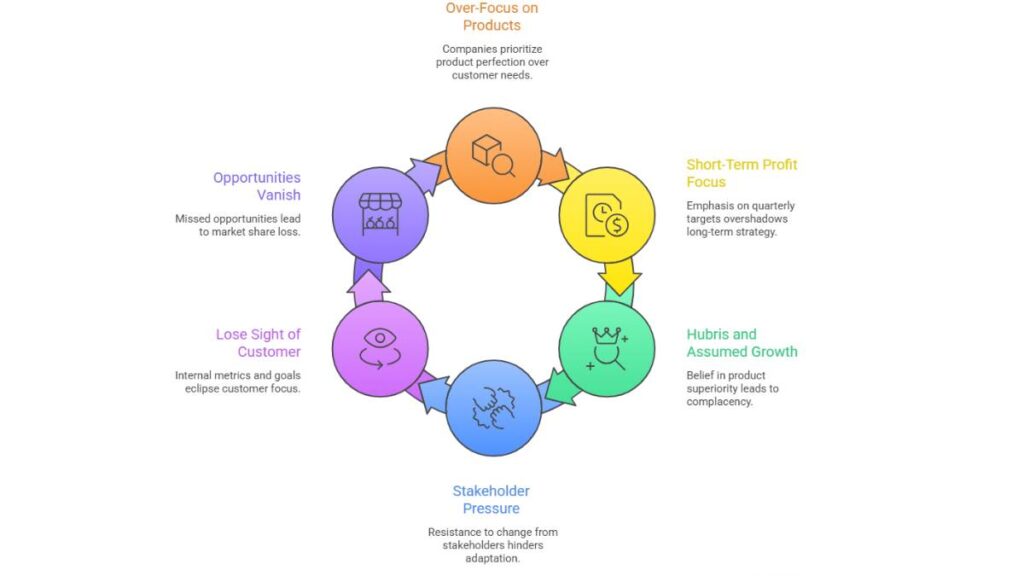
There’s no single reason this happens. Usually, it’s a mix.
- Over-Focus on Products and Production
A lot of companies get obsessed with perfecting the product, cutting costs, or tweaking features. That’s good in moderation, but it can make the customer invisible. - Short-Term Profit Focus
Quarterly targets, next month’s numbers; it’s tempting to chase them. But short-term wins can overshadow long-term strategy. Loyalty, brand strength, and future growth; they suffer. - Hubris and Assumed Market Growth
Thinking “our product is so good, customers will come” is a common trap. It makes a company slow to notice competitors or changing preferences. - Stakeholder Pressure and Fear of Change
Boards, investors, or even internal teams can push for predictability. Playing it safe is comfortable, but if it stops adaptation, that’s when myopia sets in.
All of this boils down to the same thing: losing sight of the customer. When internal metrics, old successes, or short-term goals dominate thinking, opportunities vanish quietly. Often, you don’t even notice until someone else has already filled the gap. That’s the sneaky part of marketing myopia; it creeps in slowly, almost harmlessly, until it’s a real problem.
Impact of Marketing Myopia on Businesses
Marketing myopia isn’t some fancy theory; it’s the kind of thing that quietly eats a business alive. Often, the signs are there, but nobody wants to see them until it’s too late.
Take innovation stagnation, for example. Companies get comfortable. The product works. Sales are okay. So why bother thinking about the next thing? But that “comfort zone” kills creativity. Teams stop asking the hard questions. “What could we make that actually matters next year?” gets pushed aside. And while that’s happening, competitors are moving, trying, failing, and sometimes winning.
Then there’s the short-term focus problem. It’s tempting to chase quarterly numbers; everyone’s doing it. But the risk? Loyalty suffers, relationships with customers weaken, and the brand starts to feel… disposable. The quick wins feel nice, but they rarely build anything lasting.
Missed market opportunities are another hit. Tastes change. People expect new things, better things, faster things. If a company is glued to what worked five years ago, or even last year, it starts to lose relevance. What seemed like a safe bet turns into a blind spot.
Finally, there’s the financial and competitive fallout. Less relevant products mean smaller margins. Missed innovations mean rivals get ahead. Slowly, the company becomes harder to compete with. Not all businesses die overnight from marketing myopia, but the slow burn is brutal.
Real-World Examples of Marketing Myopia
Sometimes the examples hit harder than the theory.
- Kodak: They literally invented the digital camera. Yet, they stuck to film, thinking customers would stay loyal. Spoiler alert: they didn’t. Other companies took the digital leap, and Kodak got left behind. Bankruptcy came later, but the seeds were sown decades earlier.
- Blockbuster: At one point, they had stores everywhere. Then Netflix came along, Redbox popped up, and customers started streaming. Blockbuster kept focusing on in-store rentals; too little, too late. That story’s practically a cautionary tale on every marketing desk.
- Nokia: Fantastic hardware, but the software ecosystem? They ignored it. When the iPhone arrived, suddenly, hardware wasn’t enough. The market wanted software, apps, and integration, and Nokia’s focus on physical features alone left them trailing.
- Railroads: Levitt’s original example. They thought they were in railroads, not transportation. Cars, buses, planes; they didn’t see them as competition until it was too late.
The pattern is obvious if you look closely: companies that ignore the customer’s evolving needs end up paying for it. Often big. Often painfully.
How to Identify Marketing Myopia in Your Business
Catching it early is tricky because it creeps in slowly. Sales might look fine. Margins seem healthy. But a few signs should make the alarm bells ring.
- Limited market understanding: If assumptions drive decisions more than actual customer feedback, that’s a problem. Talking to customers, checking trends; if that’s not happening, the business is likely behind the curve.
- Short-term wins at the cost of long-term growth: Boosting this month’s numbers is fine, but if it compromises loyalty or brand perception, it’s a warning.
- Missed opportunities: Are competitors meeting customer needs that your company ignores? Is your flagship product slowly becoming less relevant?
Some practical questions can help spot trouble:
- Do you really know what your customers need, or just what you think they need?
- Are competitors offering something you aren’t even noticing?
- Are shifts in technology, culture, or market dynamics being ignored because they seem “too far out”?
Marketing myopia doesn’t always scream. Most of the time, it whispers. Catch it early, and there’s a chance to course-correct. Ignore it, and eventually, the market will do it for you, whether you like it or not.

Apply Now: Advanced Digital Marketing Course
Strategies to Avoid Marketing Myopia
Fixing marketing myopia isn’t a one-and-done deal. It creeps in slowly, usually when the team is too busy checking metrics and not looking out.
First, actually pay attention to customers. Not the formal surveys that get filed and forgotten. Watch how people interact with your product, or struggle with it. Some tiny irritation they never complain about? That’s often a bigger gap than you think. Those little cracks show where the blind spots are.
Next, keep an eye on the market. Everyone says they do this, but honestly, most don’t. Trends move fast. Competitors move faster. Even a quick glance at what’s happening outside the office can save a company from being caught flat-footed.
Relationships matter more than one-off sales. Loyalty programs, check-ins, personalized campaigns; these aren’t just “nice extras.” They’re a feedback loop that helps you spot trouble before it’s too late.
Also, think long-term, not just next quarter. A five- or ten-year plan might feel abstract, even awkward. But mapping short-term actions to that bigger picture prevents the trap of chasing quick wins that don’t last.
Finally, use technology, but don’t worship it. Analytics, social listening, dashboards; great. But the tools don’t think. Someone still has to interpret the data, question assumptions, and actually act. Without that, it’s just noise.
Impact of Technological Advancements on Marketing Myopia
Technology can cut both ways. It either opens your eyes… or gives false confidence that you “already know everything.”
Analytics today can show patterns and habits you’d never notice otherwise. But spotting them isn’t the same as acting. Companies often get lulled into a sense of “we have the numbers, we’re safe”; not true.
Personalization is no longer optional. Customers tune out generic campaigns. If a competitor is tailoring experiences and you’re still sending the same mass messages, it stands out, and not in a good way.
Real-time feedback is gold. Social media, apps, live chat; it’s all happening now. Complaints, praise, sudden trends… miss them, and it’s like turning your back on the market entirely.
Agility is key. Technology lets you test, tweak, and pivot fast. But only if someone’s willing to act quickly, even when it’s messy or uncomfortable.
The Future of Marketing Myopia
Marketing myopia won’t vanish. If anything, it’s trickier than ever.
Technology keeps accelerating. AI, digital platforms, automation; everything moves faster. Companies stuck thinking about “last year’s product” will be left behind. It’s relentless.
Customer preferences don’t wait. What’s hot today might be irrelevant tomorrow. Demographics shift, cultural trends change, and values evolve. Checking in once a year? Not enough.
Global markets add another layer. Selling abroad isn’t copy-paste. Local tastes, laws, customs; they matter. Ignoring them? That’s a fast way to stumble.
Disruption can come from anywhere. Kodak, Blockbuster, Nokia; they didn’t see it coming. The companies that survive are watching, willing to adjust, and remembering that a product is just a tool to solve a problem, not the whole story.
At the end of the day, it’s messy, unpredictable, sometimes frustrating, but that’s exactly where the opportunities hide. You just have to pay attention.
Conclusion:
Marketing myopia has a way of sneaking up on companies. One moment, things look fine. Next, a shift in customer behavior or a competitor doing something new makes the business feel outdated almost overnight. The basic idea is simple enough; stop staring at the product and start looking at the problem it’s meant to solve. Sounds obvious, right? Yet, it gets ignored more than anyone would like to admit.
Customer focus isn’t just a catchphrase. It’s the anchor that keeps the business steady. Growth that matters; real growth; isn’t about flashy product launches or smashing quarterly numbers. It comes from paying attention to who’s buying, why, and how those needs might change over time. Ignore this, and companies risk repeating the familiar stories of Kodak, Blockbuster, or Nokia.
The market doesn’t wait. Trends shift, competitors pivot, and customer expectations change faster than planning cycles can keep up with. Companies that notice, adapt without panicking, and keep solving real problems are the ones that survive. The rest… well, history has a way of pointing fingers.
FAQs: on Marketing Myopia
1. What happens if a business ignores marketing myopia?
It rarely hits all at once. Usually, it’s slow; sales flatten, products start to feel stale, and competitors quietly move past. Sometimes it’s just small missed chances; sometimes it snowballs into a bigger problem.
2. How can a company spot it in its operations?
Look around. Are decisions driven mostly by what’s already in the catalog? Are customer gripes being brushed aside? Are competitors quietly innovating while your team doesn’t even notice? If yes, that’s a warning sign.
3. Can a company recover from marketing myopia?
It can, but it’s not easy. It means questioning assumptions, really listening to customers, and being willing to change; sometimes in ways that feel risky. Culture matters more than fancy processes. Without the right mindset, recovery stalls fast.
4. What practical steps prevent it?
1. Pay attention. Watch how customers actually use products.
2. Keep track of competitors; don’t assume the landscape is static.
3. Track trends, even those that feel far off.
4. Focus on loyalty and long-term relationships, not just one-off sales.
5. Accept that the market changes. What worked last year might fail today.
5. Any modern examples?
Yes, plenty. Even now, some companies stick to old sales models, ignore tech shifts, or fail to notice changing customer priorities until it hurts. The pattern is timeless: focus too narrowly, and the rest of the world quietly moves on.