
A solid marketing strategy example shows how to stop just “doing marketing” and actually make it work. This isn’t about following a template or chasing every shiny new channel. It’s about figuring out who matters, what message lands, and which actions actually move the needle. The blog walks through the basics: audience, messaging, channels, measurement; then digs into real examples from different industries. Along the way, it points out mistakes to avoid and ways to tweak things as markets shift. Nothing is perfect on day one; good strategies evolve. By looking at these examples, it becomes easier to see how small, smart choices add up to meaningful, steady growth.
Table of Contents
Introduction
What Is a Marketing Strategy Example? Definition and Importance for Business Growth
A marketing strategy example is simply a real-world illustration of how a business plans, positions, and promotes what it sells. Not theory. Not buzzwords. An actual approach that connects an offer to the people most likely to care about it.
Strategy is the thinking behind the marketing; the part that decides who the focus is, what the business wants to achieve, and how attention turns into revenue. When looking at a marketing strategy example, the goal isn’t to copy it line by line. It’s to understand the logic behind the choices.
Growth rarely comes from random acts of marketing. A few posts here, an ad there… that creates activity, not progress. Strategy is what ties everything together, so each campaign builds on the last instead of starting from zero every time.
Why Marketing Strategy Examples Matter for User Intent
Most people searching for a marketing strategy example aren’t looking for a dictionary definition. They’re trying to figure out what a good strategy actually looks like in practice.
Examples make things click because they:
- Show how goals turn into real campaigns
- Reveal how channels work together instead of competing for attention
- Help businesses spot which approaches match their size, budget, and audience
- Reduce trial-and-error that wastes time and money
There’s a big difference between knowing what marketing strategies exist and understanding how one is structured and executed. Examples close that gap.
How This Guide Helps You Learn 15 Real Marketing Strategy Examples
Ahead are 15 different marketing strategy examples used by businesses in different situations; some focused on growth, others on retention, others on visibility.
Each one breaks down:
- The main objective behind the strategy
- How it’s typically executed
- Where it tends to perform best
- The kind of outcome it’s built to drive
Before diving into those, though, it helps to slow down and look at the foundation. Strategy works best when the basics are clear.
What Is a Marketing Strategy?
A marketing strategy is a structured plan for reaching a defined audience and moving them toward a specific action: buying, signing up, booking, visiting, or something measurable. It’s the big-picture direction that guides day-to-day marketing decisions.
Without a strategy, marketing becomes reactive. With strategy, every campaign has a role to play.
Most strong marketing strategy examples share a few core building blocks.
Core Components of a Marketing Strategy Example
Goals and Objectives
Everything starts here. If the goal isn’t clear, the marketing won’t be either.
Common objectives include:
- Increasing awareness in a new region or audience segment
- Generating qualified leads for a sales pipeline
- Driving online purchases for a product line
- Improving repeat purchases or customer retention
Vague goals lead to vague results. Clear goals shape messaging, budgets, timelines; all of it.
Target Audience
Trying to reach everyone usually means connecting with no one in particular. A defined audience sharpens the strategy.
That includes understanding:
- Who they are (age range, role, location, income level)
- What problems they’re trying to solve
- What influences their decisions
- Where they spend time and how they research options
Good marketing feels relevant because it’s built around a specific group, not a generic “customer.”
Key Messages and Value Proposition
Once the audience is clear, the strategy needs a strong central message. This is where the value proposition sits: the reason someone should choose this offer instead of another.
Strong messaging usually answers three things:
- What problem gets solved
- Why this solution stands out
- Why the brand can be trusted
When messaging drifts too often, results usually dip. Consistency builds familiarity, and familiarity builds response.
Marketing Channels and Execution
Channels are simply the paths used to reach the audience. The strategy decides which ones deserve focus and how they work together.
That might include:
- Search visibility
- Social media engagement
- Email communication
- Paid advertising
- Partnerships or events
A solid marketing strategy example doesn’t chase every platform. It picks the ones that make sense for the audience and the buying journey.
How to Build an Effective Marketing Strategy Before You Explore Examples
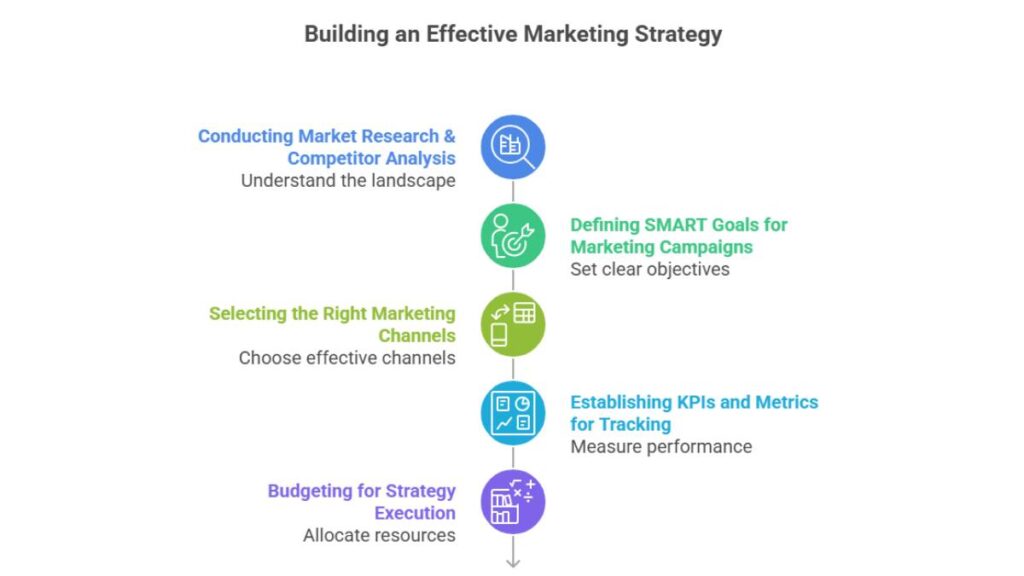
Looking at marketing strategy examples is useful. Building one from scratch is where the real learning happens.
Conducting Market Research & Competitor Analysis
Before planning campaigns, it helps to understand the landscape. What customers need. What competitors are already saying. Where gaps might exist.
Market research highlights:
- Unmet needs or frustrations
- Shifts in buying behavior
- Emerging trends that change expectations
Competitor analysis adds perspective. It shows how others position themselves, which channels they rely on, and where there may be room to stand apart. No need to overcomplicate it; even a focused review can reveal patterns.
Defining SMART Goals for Marketing Campaigns
Clear goals give strategy direction and make performance easier to judge later.
Examples of strong goals:
- Increase website traffic by 25% within six months
- Generate 150 qualified leads per quarter
- Improve email click-through rates over the next three campaigns
Specific targets help decide where to invest effort, and where to pull back if something isn’t working.
Selecting the Right Marketing Channels
Not every channel deserves equal attention. The right mix depends on the audience and how they make decisions.
Questions that usually help:
- Do customers actively search for this type of solution?
- Do they discover brands through social content?
- Is the purchase quick, or does it involve research and comparison?
The answers shape whether the strategy leans into search, social, email, paid ads, or a blend.
Establishing KPIs and Metrics for Tracking
If performance isn’t measured, improvement becomes guesswork.
Useful marketing KPIs often include:
- Traffic sources and volume
- Conversion rates on key pages
- Cost per lead or acquisition
- Engagement levels across content
- Repeat purchase or retention rates
Tracking these over time makes it easier to adjust before small dips turn into bigger problems.
Budgeting for Strategy Execution
Every strategy runs on resources. Time, money, and team capacity all matter.
Budget planning should consider:
- Ad spend where paid reach is needed
- Content creation costs
- Design, development, or landing page work
- Testing and optimization over time
The goal isn’t to outspend competitors. It’s to spend with purpose, based on goals and audience behavior.
With this groundwork in place, marketing strategy examples become more than inspiration. They turn into reference points; ways to compare approaches, borrow ideas, and shape a strategy that actually fits the business.
15 Marketing Strategy Examples (With Use Cases)
This is the part most people are really looking for; not theory, but actual marketing strategy examples that show how different approaches work in the real world. Some are long-term plays. Others move faster. None of them works in isolation forever, by the way… but each can carry serious weight when used with intention.
1. Content Marketing Example
Content marketing is the slow burn. It’s about earning attention instead of renting it.
Brands using this strategy focus on creating material that genuinely helps their audience; answers, ideas, guidance, without pushing for an immediate sale every time.
What this usually includes:
- Educational blog posts tied to real customer questions
- Downloadable guides or resources
- Content that supports other channels like email and social
Example:
A pet care brand publishes detailed articles about food choices, seasonal pet health, and grooming routines. Over time, pet owners start trusting the advice. When product recommendations appear, they don’t feel random; they feel earned.
2. Social Media Marketing Example
Social media marketing works best when it feels like participation, not broadcasting. Brands that treat it like a notice board rarely see real traction.
The focus here is visibility, relatability, and consistent presence.
Typical execution:
- Short videos that show products in everyday use
- Conversations in comments, not just scheduled posts
- Content shaped around platform behavior, not recycled everywhere
Example:
A lifestyle brand shares quick, casual clips showing how its products fit into daily routines. Nothing overly staged. The familiarity makes the brand easier to remember when it’s time to buy.
3. Email Marketing Strategy Example
Email marketing tends to look simple from the outside. It’s not. When done well, it’s one of the most reliable revenue drivers.
It reaches people who already raised their hand in some way.
Common elements:
- Welcome sequences that introduce the brand properly
- Timely campaigns tied to launches or promotions
- Follow-ups based on what someone browsed or bought
Example:
An online store sends post-purchase emails with usage tips and subtle add-on suggestions. Customers get more value from what they bought, and naturally come back for related items.
4. Search Engine Optimization (SEO) Strategy Example
SEO is about showing up when someone is actively looking for help, answers, or options. The intent is already there; the job is to be visible and useful.
It’s not instant, and that’s the tradeoff.
Strong SEO strategies usually involve:
- Pages built around specific customer questions
- Clear structure so search engines understand the content
- Earning mentions from other relevant sites over time
Example:
A local home services company creates separate, detailed pages for each service and service area. Gradually, those pages start bringing in steady inquiries without ongoing ad spend.
5. Pay-Per-Click (PPC) Advertising Example
PPC is often used when speed matters. It puts an offer in front of people right when they’re searching or browsing with intent.
But it needs tight alignment between ad, message, and landing page. Otherwise, money disappears quickly.
A typical PPC strategy includes:
- Bidding on high-intent search terms
- Testing different ad messages
- Sending traffic to focused pages built for conversion
Example:
A repair service runs ads for urgent problem-related searches. Because the need is immediate, the conversion rate stays strong even with competitive bids.
6. Influencer Marketing Example
Influencer marketing works when trust transfers naturally from creator to brand. Forced partnerships are easy to spot and easy to ignore.
The key is relevance, not just follower count.
Execution often looks like:
- Partnering with niche creators whose audience matches the brand
- Letting creators present products in their usual style
- Focusing on authenticity over scripted endorsements
Example:
A skincare brand collaborates with smaller creators known for honest reviews. Their audience values transparency, so recommendations carry real weight.
7. Affiliate Marketing Example
Affiliate marketing extends reach through partners who promote an offer in exchange for performance-based rewards.
It’s efficient when margins allow room for commission.
What this involves:
- Providing partners with trackable links
- Offering clear incentives
- Supporting them with accurate product information
Example:
A software company builds relationships with industry bloggers who include the tool in comparison articles. Readers already researching options are more likely to convert.
8. Video Marketing Strategy Example
Video builds understanding faster than text alone. It shows how something works, what it looks like, and what the results feel like.
That clarity reduces hesitation.
Video strategies often include:
- Product walkthroughs
- Tutorials and demonstrations
- Short educational clips adapted for social platforms
Example:
A cooking brand shares simple recipe videos using its kitchen tools. Viewers see the process and the results, which builds confidence before purchasing.
9. Mobile Marketing Example
Mobile marketing focuses on reaching people where they check most often ; their phones. Timing becomes just as important as messaging.
Common formats:
- SMS offers or alerts
- App notifications tied to behavior
- Mobile-first landing experiences
Example:
A retailer sends limited-time mobile offers during peak shopping hours. The immediacy increases both online and in-store activity.
10. CRM (Customer Relationship Management) Marketing Example
CRM marketing is about using customer data to deepen relationships instead of constantly chasing new leads.
Retention often costs less than acquisition. That’s the logic.
Tactics usually include:
- Segmenting customers based on past purchases
- Sending targeted offers tied to preferences
- Rewarding loyalty with exclusive perks
Example:
A brand identifies repeat buyers and sends them early access to new releases. Loyal customers feel valued and tend to buy again.
11. Guerrilla Marketing Example
Guerrilla marketing relies on surprise and creativity rather than large media budgets. It’s designed to spark conversation.
When it works, it spreads on its own.
Typical traits:
- Unexpected public displays or installations
- Strong visual elements
- Clear connection to brand message
Example:
A new brand stages a creative public display tied to its core idea. People take photos, share online, and amplify reach far beyond the original location.
12. Event Marketing Example
Event marketing creates direct interaction, which builds trust faster than digital touchpoints alone.
These events can be physical or virtual.
Often includes:
- Industry conferences
- Workshops or webinars
- Community-driven events
Example:
A B2B company hosts educational webinars addressing real industry challenges. Attendees associate the brand with expertise, making future sales conversations smoother.
13. Personalization Marketing Example
Personalization makes marketing feel more relevant by adapting messages and offers to individual behavior.
It works best when it feels helpful, not intrusive.
Execution may involve:
- Product recommendations based on browsing
- Emails tailored to past actions
- Website content that adjusts for returning visitors
Example:
An online retailer highlights items related to what a visitor previously viewed. The experience feels smoother, and purchase likelihood increases.
14. User-Generated Content (UGC) Strategy Example
UGC strategies encourage customers to share their own experiences with a brand. That social proof often carries more weight than brand-created messaging.
Common approaches:
- Featuring customer photos or testimonials
- Encouraging hashtag campaigns
- Reposting community content on brand channels
Example:
A fashion brand regularly shares customer outfit photos. New shoppers see real people wearing the products, which reduces doubt.
15. Multichannel Marketing Example
Multichannel marketing connects different platforms into one coordinated effort. Each channel reinforces the others instead of working alone.
This usually includes:
- Social campaigns that build awareness
- Email follow-ups that deepen engagement
- Retargeting ads that bring visitors back
Example:
A retailer runs a seasonal campaign supported by social media, email reminders, search ads, and in-store digital signage like Scalefusion. The message shows up in multiple places, which makes it far more memorable.

Enroll Now: Advanced Digital Marketing Course
Sector-Specific Marketing Strategy Examples
Not every marketing strategy example works the same way across industries. Context changes everything. Sales cycles, price sensitivity, competition, and even how people make decisions, all of it shifts the strategy.
So instead of copying tactics blindly, it helps to look at how strategy bends depending on who’s buying.
B2B Marketing Strategy Examples
B2B strategy usually leans on trust, proof, and patience. Decisions rarely happen overnight. There are approvals, budgets, internal debates… sometimes a few spreadsheets floating around.
Because of that, strong B2B marketing strategies tend to focus on depth over noise.
You’ll often see:
- Case studies that break down real results, not vague wins
- Educational content that helps buyers understand the problem before pitching a solution
- LinkedIn is used as a relationship channel, not just a posting platform
- Webinars or industry events that build authority slowly over time
Example:
A software company targeting operations teams builds its strategy around detailed use cases and quarterly webinars. Prospects spend weeks, sometimes months, learning from the brand. By the time they talk to sales, they’re not being convinced from scratch; they’re validating a decision already forming.
That’s a typical B2B strategy. Less push. More proof.
B2C Marketing Strategy Examples
B2C moves faster. Emotion plays a bigger role. And attention is harder to hold.
Here, marketing strategy examples usually prioritize visibility and connection. People need to recognize the brand before they trust it, and trust often comes from repeated exposure, not one perfect ad.
Common B2C elements include:
- Seasonal campaigns tied to events, trends, or buying moments
- Influencer collaborations that make products feel familiar
- Short-form videos that show the product in everyday use
- Limited-time promotions that give a small nudge to act now
Example:
A fashion brand builds monthly campaigns around new arrivals, supported by creators styling the pieces in real-life settings. Customers don’t just see product photos; they see how the items fit into daily life. That familiarity reduces hesitation when it’s time to buy.
Different audience. Different pace. Different strategy.
How to Measure Success in Your Marketing Strategy Example
A marketing strategy can look busy without being effective. Posts going out. Emails scheduled. Ads running. Activity everywhere.
But results? That’s a different question.
Measurement keeps strategy grounded in reality. Not to overcomplicate things, just to make sure effort is actually moving the needle.
Key Metrics: Traffic, Conversion Rates, ROI
Most marketing strategy examples rely on a mix of performance signals rather than one magic number.
Some of the big ones:
- Traffic quality – Not just how many people visit, but whether they’re the right audience
- Conversion rates – Are visitors taking action, or just passing through?
- Lead or customer acquisition cost – How expensive is growth, really?
- Customer retention – Do people come back, or disappear after one purchase?
- Overall return – Is the strategy generating more value than it consumes?
Looking at only one of these can be misleading. High traffic with low conversions, for example, often points to a messaging mismatch, not a traffic problem.
Marketing Analytics for Performance Tracking
The key isn’t checking numbers once in a while. It’s building a habit of reviewing performance consistently, even when things seem fine.
Patterns show up over time:
- A slow drop in email engagement
- A steady rise in ad costs
- A landing page that suddenly stops converting, as it used to
Those signals usually appear before major problems. Catching them early makes adjustments easier and cheaper.
Continuous Optimization Based on Data
Very few strategies hit perfectly on the first try. Most improve through steady refinement.
That might mean shifting the budget toward channels that convert better. Rewriting messaging that gets clicks but not leads. Simplifying a signup form that asks for too much.
Small changes, tested over time, often outperform dramatic overhauls. Marketing success is usually built in layers, not leaps.
Marketing Strategy Example for Small & Local Businesses
Small and local businesses don’t need complex funnels or massive budgets to build an effective marketing strategy. What they need is visibility, trust, and consistency.
And honestly, consistency does a lot of heavy lifting.
How Local Businesses Build Simple Yet Effective Strategies
Local marketing strategy examples usually focus on staying top-of-mind in a specific area rather than reaching everyone everywhere.
That can look like:
- Posting regularly so the business stays familiar
- Sharing updates, offers, or behind-the-scenes moments that feel human
- Encouraging reviews, which influence local decisions more than most ads
A neighborhood gym, for instance, might highlight member transformations, promote seasonal offers, and share quick workout tips. Nothing overly produced. Just a steady presence and proof that real people are getting results.
Local SEO, Community Engagement, Referral Programs
Some approaches consistently work well at the local level:
- Local search visibility so nearby customers can actually find the business when searching
- Community involvement, like sponsoring small events or collaborating with nearby brands
- Referral incentives that turn happy customers into advocates
Local growth often comes from familiarity. People choose businesses they’ve heard of, seen around, or had recommended by someone they trust.
For small businesses, the strongest marketing strategy examples are usually simple, repeatable, and rooted in real relationships, not flashy campaigns that disappear after a month.
Future Trends in Marketing Strategies
Marketing strategies don’t stand still for long. What works today slowly becomes background noise tomorrow. Attention shifts, platforms change, customer expectations quietly rise. The brands that keep up aren’t always the loudest; they’re the ones paying attention.
Here’s where strategy is clearly heading.
Integration of AI in Marketing Workflows
Automation is moving from “nice to have” to standard practice. Not in a flashy, robotic way, but in the background, helping teams move faster and make smarter decisions.
We’re seeing more:
- Predictive insights guiding campaign timing
- Smarter audience segmentation based on behavior, not just demographics
- Real-time adjustments to ads and messaging
The strategy shift here isn’t about replacing people. It’s about removing guesswork. Less manual tinkering, more informed decisions.
Voice Search Optimization
More people are talking to devices instead of typing. That changes how they search and how brands need to show up.
Voice searches tend to be:
- More conversational
- Longer and question-based
- Often local or immediate in intent
Marketing strategies are adapting by focusing on natural language content, clear answers, and location relevance. It’s subtle, but important. The brands that sound more human tend to win here.
Personalization at Scale
Customers have grown used to tailored experiences. Generic messaging stands out, and not in a good way.
Future-ready marketing strategy examples are leaning heavily into:
- Dynamic website experiences based on user behavior
- Product recommendations that actually make sense
- Emails and offers triggered by real actions, not random timing
Personalization used to feel impressive. Now it feels expected. When it’s missing, people notice.
Immersive AR & VR Experiences
This one’s still developing, but it’s moving steadily from novelty to practical use.
Brands are experimenting with:
- Virtual try-ons for fashion and beauty
- Interactive product demos
- Immersive brand experiences at events or online
Not every business needs this yet. But in industries where experience matters, retail, travel, real estate, immersive elements are starting to influence buying decisions in a real way.
Common Mistakes to Avoid in Your Marketing Strategy Examples
Even strong marketing strategy examples can fall apart in execution. Usually not because the idea was bad, but because a few fundamentals were overlooked.
Ignoring Audience Research
It’s surprisingly common. Campaigns are built around assumptions instead of actual customer insight.
When audience understanding is shallow:
- Messaging feels generic
- Offers miss real pain points
- Engagement stays low, even with high visibility
A good strategy starts with listening. What customers care about isn’t always what brands expect.
Failing to Adapt Based on Analytics
Some strategies are launched with energy… and then left on autopilot.
Performance data tells a story. When it’s ignored, small issues turn into expensive problems. A landing page that underperforms. An ad audience that’s too broad. An email sequence that people stop opening.
Adjustment doesn’t mean constant overhauls. Just steady refinement based on what the numbers are quietly saying.
Spreading Too Thin Across Channels
Trying to be everywhere at once usually leads to being effective nowhere.
Each channel takes time, content, and consistency. When resources are stretched too far:
- Quality drops
- Messaging becomes inconsistent
- Results weaken across the board
Most strong marketing strategies focus on a few channels done well, then expand once there’s stability.
Conclusion:
A good marketing strategy example isn’t just a list of tactics. It’s a clear plan built around real goals, a defined audience, and consistent execution.
The strongest strategies share a few traits:
- They’re grounded in customer understanding
- They use the right channels instead of every channel
- They evolve over time instead of staying fixed
For anyone building their first strategy, the best next step is simple: start with clarity. Clear audience. Clear message. Clear objective. From there, test, measure, adjust… repeat.
Marketing rarely works perfectly on the first attempt. Progress comes from iteration, not perfection.
FAQs:
1. What makes a good marketing strategy example?
A good marketing strategy example shows clear cause and effect. The goals make sense, the audience focus is specific, and the chosen channels feel appropriate, not random. It also explains the thinking behind the decisions. Results, even modest ones, add credibility. Without that connection, it’s just activity dressed up as strategy.
2. How do I choose the right strategy for my business?
Start with the audience, not the channel. Where they spend time, how they research, what influences their decisions; those clues shape the direction. Budget and team capacity matter too. A simpler strategy executed consistently often outperforms an ambitious one that runs out of steam halfway through. Practical beats impressive.
3. What’s the difference between strategy and tactics?
Strategy is the overall game plan. It defines who the brand wants to reach, how it wants to be seen, and what success looks like. Tactics are the individual moves: emails, ads, posts, events. Tactics without strategy create noise. Strategy without tactics goes nowhere. Both need each other to work.
4. What is the difference between a marketing strategy and a marketing plan?
A marketing strategy explains the long-term direction and positioning. A marketing plan gets more detailed and time-bound, covering campaigns, budgets, and schedules. One is about why and where; the other focuses on how and when. Mixing them up leads to busy calendars without a clear sense of purpose.
5. How long does it take to see results from a marketing strategy?
It depends on the approach and the market, but patience is usually part of the deal. Some paid efforts show early traction, while content and brand-building take longer to gain momentum. Consistency matters more than quick wins. Patterns tend to appear after steady effort, review, and a few smart adjustments.
6. Can small businesses use the same marketing strategy examples as large companies?
They can borrow the principles, yes, but execution looks different. Smaller businesses often focus on tighter audiences and fewer channels, which isn’t a disadvantage. It allows for more personal, relevant communication. Big-brand strategies scaled down usually work better than trying to copy large budgets or complex campaign structures.
7. How do you choose the best marketing strategy for your target audience?
Look at how the audience actually behaves, not how the brand hopes they behave. Some people read reviews carefully; others respond to visuals or recommendations. Their buying journey gives away useful hints. The right strategy fits naturally into those habits instead of forcing attention in places they tend to ignore.
8. What tools help implement and track a marketing strategy?
Most teams rely on a mix of platforms to manage communication, track performance, and organize customer data. The exact combination varies by business size and goals. What matters is visibility; knowing what’s running, what’s working, and what needs adjusting. Without that feedback loop, improvement becomes mostly guesswork.