
Paid social tends to get oversimplified. People talk about it like it’s a switch; turn it on, add budget, and sales come in. That’s rarely how it plays out.
What’s really happening behind the scenes is a mix of audience signals, creative fatigue, bidding pressure, and timing. Sometimes an ad works because the offer is sharp. Sometimes it works because competitors pulled back that week. And sometimes performance drops for no dramatic reason at all. That’s part of the game.
Running paid social properly means paying attention to small details that most brands ignore. Creative isn’t just “nice to have.” It carries the campaign. Targeting helps, sure, but strong messaging often beats hyper‑narrow audiences. Broad campaigns with clear positioning can outperform over-engineered setups. Seen it happen more than once.
Platform choice also isn’t about trends. It’s about behavior. A visually driven product may thrive on scroll-heavy feeds. B2B offers usually need a tighter context and intent. And short-form video? Powerful, yes, but only if the hook lands in the first few seconds. Otherwise, the budget disappears quietly.
There’s also the patience factor. Early data lies. Campaigns wobble before they stabilize. Scaling too fast can wreck something that was working just fine at a smaller spend. The steady approach wins more often than the aggressive one, even if it feels slower.
At its core, paid social is controlled experimentation. Test creative angles. Adjust bids. Watch conversion paths. Refresh before fatigue sets in. It’s not glamorous work. But when the structure is solid, and the offer actually solves a problem, the results compound. Leads come in more predictably. Revenue becomes less random.
That’s when paid social stops feeling like a gamble and starts behaving like a system.
Table of Contents
Introduction:
What Is Paid Social Media Advertising and Why It Matters
Paid social media advertising is exactly what it sounds like: paying social platforms to put your message in front of specific people. Not “followers.” Not whoever happens to see your post. Specific people.
That distinction matters more than most brands realize.
Organic social used to carry weight on its own. A good post could travel. Now? Organic reach is limited, inconsistent, and largely dependent on algorithms that change without warning. Paid social fills that gap. It gives predictability in a space that’s otherwise unpredictable.
It’s also fundamentally different from paid search. Search captures intent that already exists. Someone types, you respond. Paid social does something else entirely. It creates demand. It introduces a solution before someone actively looks for it. That interruption, when done well, is powerful.
Display ads follow users around the web. Paid social lives inside feeds. It blends into scrolling behavior. It competes with memes, updates, videos, and conversations. Which means the bar is higher. Attention isn’t handed over. It’s earned in seconds.
Why are businesses increasing paid social ad spend?
A few practical reasons:
- Customer acquisition costs on search continue to climb.
- Social platforms offer sharper audience segmentation.
- Short-form video consumption has exploded.
- Social commerce keeps shortening the path from discovery to purchase.
There’s also a broader shift happening. Brands are realizing that visibility now requires paid amplification. Not just for sales; for awareness, credibility, even branded search lift. Paid social isn’t a side channel anymore. It’s part of the core growth engine.
And here’s something many teams overlook: paid social activity influences how a brand shows up elsewhere. Strong engagement, consistent messaging, and campaign-driven awareness tend to ripple outward. Paid social rarely operates in isolation.
It’s performance marketing, yes. But it’s also brand building. The two are closer than they used to be.
What Is Paid Social Media Advertising?
Paid Social Media Advertising Definition
Paid social media advertising is sponsored content distributed on social platforms to reach a targeted audience, optimized around a specific goal: clicks, leads, sales, impressions, revenue.
Simple definition. The execution, though, is where things get layered.
Most platforms operate on an auction system. Advertisers set budgets and choose bidding strategies. The platform decides whose ad appears based on bid amount, predicted engagement, relevance, and past performance. It’s not always the highest bid that wins. Relevance can lower costs. Weak creativity can increase them.
That’s where many beginners miscalculate. They assume money alone guarantees reach. It doesn’t. Platforms reward ads that people actually engage with.
Common pricing models include:
- CPC (Cost Per Click) – paying when someone clicks.
- CPM (Cost Per Thousand Impressions) – paying for visibility.
- CPA (Cost Per Acquisition) – paying when someone converts.
- ROAS-focused optimization – optimizing toward revenue return.
Each model fits a different objective. Awareness campaigns behave differently from conversion campaigns. Mixing them without clarity often leads to confusing results.
How Paid Social Media Advertising Works
Paid social works because platforms collect behavioral data at scale. Interests. Engagement patterns. Purchase signals. Video watch time. Even subtle browsing behavior.
Advertisers can target based on:
- Demographics (age, gender, location)
- Interests and affinity categories
- Online behaviors
- Custom audiences (email lists, website visitors)
- Lookalike audiences modeled from existing customers
Install a tracking pixel on your website, and the system gets stronger. You can retarget someone who viewed a product page but didn’t buy. Or someone who watched 75% of a video ad. Or someone who added to the cart and stopped.
This is where paid social starts to feel less like advertising and more like structured persuasion.
Ad delivery algorithms optimize in the background. Once enough data accumulates, campaigns begin prioritizing users most likely to complete your chosen objective. But that learning phase takes time and a clean structure. Too many ad sets. Too many changes. Too little budget. The algorithm resets.
Patience matters more than people admit.
Paid Social Media Advertising vs Organic Social Media Marketing
Organic social builds presence. Paid social builds momentum.
Organic posts strengthen brand voice, community, and consistency. But reach is limited. Even engaged audiences don’t see every post.
Paid social guarantees distribution to a defined segment. It compresses timelines. What might take months organically can be tested in weeks through paid campaigns.
Speed is the obvious difference. Control is the bigger one.
With paid social, you control:
- Who sees your message
- How often do they see it
- What action do you want them to take
- How much are you willing to spend to make that happen
Organic is valuable, but it’s unpredictable. Paid is measurable. That difference changes how decisions are made inside marketing teams.
The strongest strategies don’t replace organic with paid. They use paid to amplify what already resonates organically. When a piece of content performs well on its own, paid support can extend its lifespan dramatically.
Think of organic as a signal. Paid as scale.
Types of Paid Social Media Advertising (With Examples)
Not all paid social looks the same. Format shapes behavior. Placement shapes attention. Creative shapes cost.
Image Ads in Paid Social Campaigns
Image ads are often underestimated. They’re straightforward; a single visual, a headline, a call to action. But simplicity can work.
Single image ads are common for:
- Product highlights
- Limited-time offers
- Service promotions
Carousel ads allow multiple images within one placement. They’re effective for storytelling or showcasing product variations. Collection ads, often tied to ecommerce catalogs, combine visuals with instant browsing experiences.
The mistake many brands make is overdesigning. Social feeds move quickly. Clear messaging usually outperforms complex graphics. Strong contrast. Focused copy. One main idea.
That’s enough.
Video Advertising on Social Media
Video now dominates feed inventory across platforms.
Short-form vertical videos, in-feed ads, Stories placements, Reels-style content; each format competes for seconds of attention. The first few seconds are critical. Not later. Immediately.
Video view campaigns prioritize reach and engagement. Conversion campaigns use video as a persuasive step toward action.
Polished production isn’t always required. In fact, overly polished creative can feel like traditional advertising and get skipped. Native-feeling content, often resembling user-generated material, tends to perform better. It blends in. It doesn’t scream “ad.”
There’s nuance here. High-production creative still has a place, especially for brand positioning. But performance-focused campaigns often lean toward authenticity.
Native Advertising on Social Media Platforms
Native ads mirror the structure of organic posts. Sponsored posts and boosted posts fall into this category.
Boosted posts are typically entry-level. They extend the reach of existing content. Useful, yes. But limited in targeting flexibility.
Fully built campaigns inside ad managers allow:
- Deeper audience segmentation
- Objective-based optimization
- Structured testing
There’s a difference between boosting visibility and building a performance system. Many businesses confuse the two.
Influencer Paid Social Campaigns
Influencer marketing has matured. It’s no longer just paying for posts and hoping for engagement.
Brands now run whitelisted ads through creators’ accounts. They license content. They use creator videos inside paid campaigns to combine trust with scale.
When executed thoughtfully, this approach can lower acquisition costs. Audiences respond differently to creators than to brands. The tone feels conversational. Less corporate.
But authenticity is fragile. Forced messaging shows. Audiences sense it quickly.
Lead Generation Ads
Lead generation ads reduce friction by keeping users inside the platform. Forms auto-fill with user data. Submission takes seconds.
For certain industries, such as education, real estate, and B2B services, this can significantly increase volume. The tradeoff? Lead quality sometimes requires additional filtering.
Sending traffic to a landing page allows more context. Native forms reduce drop-off. The right choice depends on your sales process.
Paid social offers flexibility. That’s the underlying theme. Formats can align with awareness, engagement, or direct conversion. But clarity around the objective has to come first. Without that, even the best creative struggles.
And once budgets scale, those early structural decisions matter more than expected.
The Benefits of Paid Social Media Advertising
There’s a reason paid social media advertising keeps absorbing more budget every year. It works when it’s treated seriously.
Not magically. Not instantly profitable. But predictably, if the structure is right.
Generate Engagement Immediately
The first real advantage is speed. Flip a campaign live, and distribution starts. No waiting for an algorithm to “bless” the post. No, hoping engagement builds momentum on its own.
That matters during launches. Or promotions. Or when a sales team is staring at pipeline numbers that need help this quarter, not next year.
Organic reach is still valuable, but it’s inconsistent. Even strong brands don’t reach all their followers anymore. Paid reach fills that gap and gives control back to the advertiser.
And speed creates feedback loops. Creative resonates; or it doesn’t. Offers convert, or they stall. You learn fast. That’s useful.
Target a Highly Specific Audience
This is where paid social becomes a serious growth channel.
Instead of broadcasting to everyone, campaigns can zero in on:
- People who visited specific pages
- Past purchasers
- Users who watched most of a video
- Lookalike audiences modeled from your best customers
Retargeting alone can shift performance dramatically. Someone who abandoned a cart doesn’t need brand education. They need reassurance. Or urgency. Or a small incentive.
Cold audiences? Different conversation entirely.
The mistake many brands make is running one message to all segments. Paid social allows nuance. It should be used that way.
Drive Leads, Sales, and Conversions
There’s still a perception that social ads are mostly for awareness. That hasn’t been true for years.
With proper tracking in place, paid social can optimize for direct outcomes: purchases, form fills, bookings, and installs. The platform’s delivery system adjusts based on who is most likely to complete that action.
Revenue attribution will never be perfect. But directional clarity is enough to make strong decisions. Cost per acquisition. Return on ad spend. Funnel drop-off points.
When campaigns are aligned with actual business goals, paid social becomes more than engagement. It becomes infrastructure for growth.
Build Brand Awareness at Scale
Performance without brand eventually plateaus. Awareness without performance wastes money.
Paid social supports both, which is part of its strength.
Impression-based campaigns introduce a brand repeatedly to defined audiences. Frequency can be controlled. Messaging can be layered over time. Done well, it builds familiarity without overwhelming people.
Familiarity reduces friction. Reduced friction improves conversion rates later.
That long-term effect often goes unnoticed in dashboards, but it shows up in overall efficiency.
5 Best Platforms for Paid Social Media Advertising
Platform choice should be deliberate. Not trendy. Not based on what competitors are doing blindly.
Each platform has its own rhythm, audience behavior, and creative expectations.
1. Facebook Paid Advertising
Facebook still carries significant weight in paid social media advertising.
The targeting depth is strong. The campaign structure options are flexible. It supports full-funnel strategies: awareness, traffic, conversions, and retargeting.
Facebook performs well for:
- Ecommerce brands
- Local businesses
- Info products
- Subscription services
The biggest challenge isn’t capability. It’s discipline. Overlapping audiences, too many ad sets, constant edits; those things quietly increase costs.
When structured cleanly, Facebook can scale efficiently. When messy, it gets expensive.
2. Instagram Paid Advertising
Instagram demands stronger creativity than most platforms.
It’s visual. Fast. Competitive.
Reels ads, Stories placements, in-feed videos; they need to feel native. Overly polished, corporate-looking ads often struggle. Content that blends into the feed tends to perform better.
Instagram works particularly well for:
- Fashion
- Beauty
- Fitness
- Lifestyle-driven brands
Creative fatigue happens quickly here. Rotating fresh variations isn’t optional; it’s necessary.
3. LinkedIn Paid Advertising
LinkedIn operates differently.
Costs are higher. Clicks are more expensive. Leads can cost significantly more than on other platforms. But the targeting precision, job title, company size, and seniority; makes it powerful for B2B.
For enterprise services or high-ticket consulting, LinkedIn can justify the higher cost per lead because deal value offsets acquisition expense.
This isn’t a volume platform. It’s a precision tool.
4. TikTok Paid Advertising
TikTok has matured into a legitimate performance channel.
It rewards authenticity. UGC-style creatives often outperform traditional brand ads because they match the culture of the platform.
Spark Ads allow brands to amplify creator content rather than forcing everything through a brand voice.
TikTok tends to perform well for:
- Direct-to-consumer brands
- Trend-responsive products
- Younger demographics
But it demands attention to creative trends. What worked three months ago may already feel stale.
5. X (Formerly Twitter) Advertising
X thrives on immediacy.
It’s conversation-driven. Timely. Reactive.
Conversation ads and trend placements can amplify visibility during live events or major announcements. It’s not always the strongest direct-response platform, but for real-time relevance, it has its place.
Choosing platforms shouldn’t be about spreading the budget thinly. It should be about alignment: audience behavior, offer type, and internal resources for creative production.

Enroll Now: AI-Powered Performance Marketing Course
How to Create a Paid Social Media Advertising Strategy (Step-by-Step)
Strategy is where most campaigns succeed or fail. Creative matters. Budget matters. But structure matters first.
Step 1: Set Paid Social Campaign Goals and Objectives
Start with clarity.
Are you trying to build awareness? Generate leads? Drive purchases? Improve return on ad spend?
Campaign objectives signal to the platform how to optimize delivery. If the objective doesn’t match the business goal, performance will feel misaligned.
Running traffic campaigns when the goal is revenue often produces impressive click numbers… and disappointing sales.
Be specific. Choose the outcome that actually matters.
Step 2: Conduct Audience Research for Paid Social Ads
Audience research goes deeper than demographics.
Understand:
- What problem are they trying to solve
- What hesitations do they have
- What triggers purchase decisions
- How they behave on that specific platform
A user on LinkedIn scrolls differently than someone on TikTok. Tone should reflect that. Creative should reflect that.
Segment audiences based on intent. Cold, warm, and hot audiences need different messaging. Treating them the same flattens performance.
Step 3: Set Advanced Audience Targeting
Targeting can become overly complex quickly. It doesn’t need to.
Custom audiences built from:
- Website visitors
- Email lists
- Past customers
These often outperform broad interest targeting because intent is already present.
Lookalike audiences help scale what’s proven to work. But they’re strongest when based on high-quality source data, not just random traffic.
Retargeting structure should follow logic. Someone who viewed a pricing page should see different messaging than someone who skimmed a blog post.
Relevance improves efficiency. Always.
Step 4: Set a Paid Social Media Advertising Budget
Budget planning is part math, part patience.
Daily budgets provide steady pacing. Lifetime budgets allow more flexibility across a campaign window.
Costs vary widely by industry. High-competition niches naturally see higher CPMs and CPCs. That’s not necessarily a red flag; it reflects demand.
Allocate budget across the funnel intentionally. Too much prospecting without retargeting wastes opportunity. Too much retargeting without new audience acquisition limits growth.
Testing requires enough spending to generate meaningful data. Starving campaigns rarely produce clarity.
Step 5: Create a Retargeting Strategy
Retargeting is often where profitability sharpens.
Focus on:
- Website visitors
- Video viewers
- Cart abandoners
Sequential messaging works well. Introduce value. Follow up with proof. Then add urgency.
Repeating the same creative too often leads to fatigue. Rotating angles keeps engagement stable.
Retargeting isn’t about chasing people endlessly. It’s about guiding them toward a decision.
Step 6: Design High-Converting Paid Social Ads
Creative carries more weight than many expect.
Strong ads typically have:
- An immediate hook
- Clear benefit-focused messaging
- Direct, simple calls to action
Clever copy rarely outperforms clarity. Users scroll fast. Confusion kills momentum.
Testing variations; different headlines, visuals, formats; surfaces patterns over time. Sometimes raw creativity wins. Sometimes structured brand ads perform better. Context decides.
Step 7: Measure and Optimize Paid Social Campaign Performance
Optimization should be deliberate, not reactive.
Monitor key metrics:
- Click-through rate
- Cost per click
- Conversion rate
- Cost per acquisition
- Return on ad spend
Avoid constant edits. Frequent changes reset learning phases and disrupt performance.
Scale gradually. Increase budgets on proven ad sets rather than aggressively duplicating.
Paid social media advertising rewards consistency. Emotional decision-making; pausing campaigns too early, over-editing, chasing trends without strategy; usually costs more than it saves.
When goals are clear, audiences are segmented properly, and creative aligns with intent, paid social becomes manageable. Not effortless. But manageable and scalable.
4 Main Bidding Strategies for Paid Social Media Ads
Bidding is where a lot of advertisers quietly lose money.
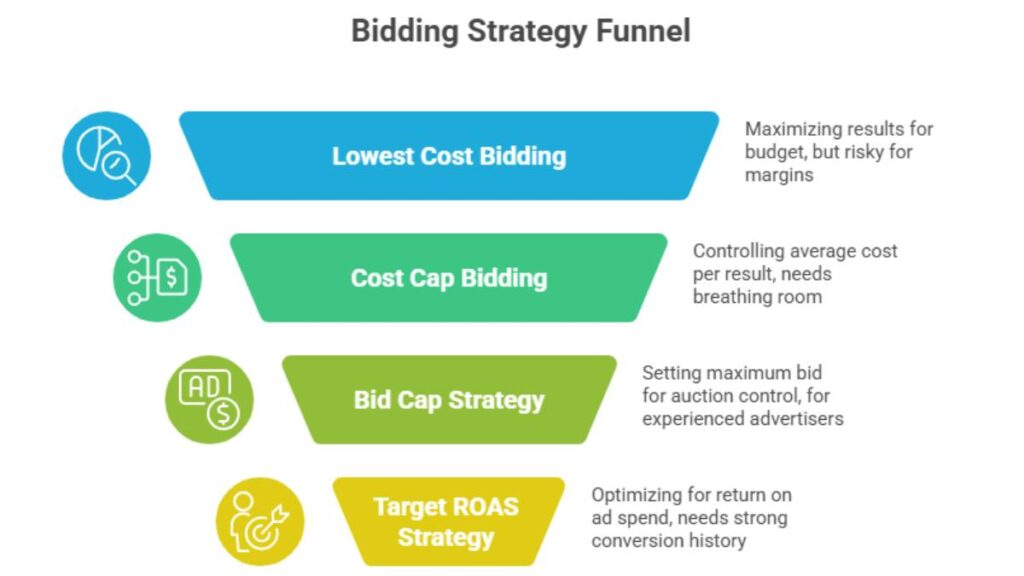
Most platforms make it look simple: set a budget, choose a goal, press publish. But underneath that clean dashboard is an auction system deciding who wins impressions and at what price. If bidding isn’t aligned with your margins, the algorithm will happily spend your budget without ever hitting profitability.
Here’s how the four main bidding strategies actually behave in the real world.
Lowest Cost Bidding
This is the default on most platforms, including Facebook and TikTok.
You’re essentially telling the platform:
“Get me the most results for my budget.”
It sounds efficient. And in early testing, it often works well.
When it works best:
- New campaigns in the testing phase
- Broad targeting with enough data
- When you don’t know your exact cost thresholds yet
But there’s a catch. Lowest cost doesn’t care about your profit margins. If your acceptable CPA is ₹800 and the platform finds conversions at ₹1,200, it will still spend.
It’s aggressive. Great for scale. Risky for tight-margin businesses.
Cost Cap Bidding
This is where things get more strategic.
With a cost cap, you tell the platform your average acceptable cost per result; say ₹600 per lead, and it tries to stay around that number.
Not always under it. Around it.
Best use cases:
- You know your break-even CPA
- You have consistent conversion data
- You want some control without micromanaging
The mistake advertisers make? Setting the cap too low. When that happens, delivery slows, impressions drop, and performance flatlines.
Cost caps need breathing room. If your historical CPA is ₹700, don’t set a cap at ₹400 and expect magic.
Bid Cap Strategy
Bid cap is more rigid. You’re setting a maximum bid in the auction itself, not just the average cost per result.
This is control-heavy and usually better for experienced advertisers running large budgets.
When to consider it:
- High-competition industries
- Very specific audience segments
- When you deeply understand auction dynamics
It can protect costs. But it can also throttle delivery fast if the bid is unrealistic.
For most beginners, this strategy feels like driving manually in heavy traffic. Possible. Stressful.
Target ROAS Strategy
This is performance marketing territory.
Instead of optimizing for cost per result, you optimize for return on ad spend. If your target ROAS is 3x, the platform tries to prioritize users likely to generate that level of return.
It works best for:
- E-commerce
- Large product catalogs
- Accounts with strong conversion history
Without enough data, target ROAS campaigns struggle. Algorithms need signal density. If you’re generating five conversions a week, it’s too early.
Platform Differences in Bidding
Not all platforms treat bidding the same.
- LinkedIn typically has higher CPCs and more limited automation flexibility. Bidding requires tighter budget monitoring.
- Instagram benefits from broader targeting and creative-led optimization.
- X (formerly Twitter) often demands closer cost monitoring due to fluctuating competition.
In short, bidding is not just a setting. It’s a lever. Pull it carefully.
Monitoring and Optimizing Paid Social Media Campaigns
Launching campaigns is easy. Managing them properly; that’s where the work begins.
Paid social isn’t “set and forget.” It’s watch, interpret, adjust. Repeat.
Key Paid Social Media Advertising Metrics
There are dozens of metrics available. Most don’t matter.
Focus on these:
- Click-Through Rate (CTR)
Indicates how compelling your creative and targeting are. Low CTR usually signals weak messaging or poor audience alignment. - Cost Per Click (CPC)
Reflects auction competition and relevance. Rising CPCs often point to creative fatigue. - Cost Per Acquisition (CPA)
The number that directly impacts profitability. Track this obsessively. - Return on Ad Spend (ROAS)
Especially critical for e-commerce. Revenue divided by ad spend. Simple math. Big implications. - Customer Lifetime Value (CLV)
Sometimes a campaign looks unprofitable at first purchase, but profitable over time. This changes decision-making entirely.
Metrics should be read together, not in isolation. High CTR with low conversions? Landing page issue. Good conversions but high CPA? Targeting too broadly or bidding too aggressively.
Conversion Tracking and Attribution Models
If tracking is broken, everything else collapses.
Pixel tracking must be installed correctly. Events must fire accurately. Purchase values must be captured.
Then comes attribution.
- First-click attribution values awareness.
- Last-click attribution values closers.
- Multi-touch attribution attempts to see the whole journey.
None is perfect. But ignoring attribution complexity leads to wrong scaling decisions.
Campaigns that appear underperforming sometimes assist conversions happening elsewhere.
That nuance matters.
Creative Testing and Performance Optimization
Creative fatigue is real. Even high-performing ads slow down.
Watch for:
- Rising CPC
- Declining CTR
- Stable impressions but falling conversions
When those patterns appear, refresh creativity; not necessarily targeting.
A healthy testing structure includes:
- 3–5 creative variations per ad set
- Multiple hooks in the first 3 seconds (for video)
- Different formats (carousel, single image, short-form video)
Scaling should happen gradually:
- Increase budgets by 15–25% increments
- Duplicate winning ad sets for horizontal scale
- Avoid dramatic overnight jumps
Optimization is controlled iteration. Not panic editing.
The 3 Pillars of Paid Social Media Advertising Success
After managing dozens of campaigns across industries, three patterns consistently separate profitable accounts from struggling ones.
It’s rarely just one thing.
1. Audience Targeting and Segmentation
Broad targeting works sometimes. But structure wins long-term.
Effective segmentation often includes:
- Cold audiences (interest or lookalike-based)
- Warm audiences (engaged users, video viewers)
- Hot audiences (website visitors, cart abandoners)
Each stage needs different messaging.
Cold traffic doesn’t respond well to aggressive “Buy Now” messaging. Warm audiences need proof. Hot audiences need urgency.
Blending them into one campaign muddies performance data.
2. Creative and Messaging Strategy
Creative drives performance more than most advertisers admit.
Algorithms optimize delivery, yes. But they optimize around engagement signals. Weak creative gives the system nothing to amplify.
Strong creative typically:
- Addresses a specific pain point
- Demonstrates the product clearly
- Builds trust quickly
- Uses natural language, not ad-speak
Highly polished isn’t always best. Sometimes, simple, direct content outperforms expensive production.
The audience decides. Always.
3. Data, Testing, and Optimization Framework
This is where discipline shows.
Winning accounts:
- Test continuously
- Kill underperforming ads quickly
- Protect the budget for experimentation
- Track profitability beyond surface metrics
They don’t rely on a single “hero ad.” They build systems.
Testing budgets are not wasted budgets. They’re investment in future stability.
And stability, in paid social, is rare without structure.
When these three pillars align: clear audience structure, strong creative, and consistent optimization, paid social media advertising stops feeling unpredictable.
It becomes measurable. Scalable. Sustainable.
Not easy. But controllable.
The Hidden Costs of Paid Social Media Advertising
On the surface, paid social media advertising looks predictable. You set a daily budget. You see a cost per click. You track conversions. Clean numbers.
But that’s not the whole financial picture.
There are costs that don’t show up neatly in the dashboard, and they’re often the reason campaigns feel “expensive” even when metrics look healthy.
Rising CPMs and Platform Competition
Competition has intensified across platforms like Facebook, Instagram, and TikTok.
More advertisers. More brands are shifting budget from traditional channels. More noise.
CPMs fluctuate constantly, especially during peak seasons, product launches, and Q4. A campaign that worked beautifully in March might struggle in November, simply because auction pressure doubled.
That volatility isn’t always about your strategy. Sometimes it’s just the market.
Still, your margins have to absorb it.
Creative Production Costs
Creative is no longer optional polish. It’s the engine.
And good creative costs money:
- Video production
- Editing
- Copywriting
- Design
- User-generated content sourcing
- Iteration and reshoots
Even brands that produce “raw” or UGC-style content invest time and coordination. Testing multiple creatives per month adds up quickly.
If you’re running performance campaigns seriously, expect to refresh creatives regularly. Otherwise, fatigue creeps in.
Quietly.
Agency and Management Fees
If campaigns are outsourced, fees typically fall into one of three models:
- Percentage of ad spend
- Flat monthly retainer
- Hybrid (base + performance bonus)
None is inherently bad. But they must align with revenue goals.
Paying 15–20% of ad spend makes sense when scaling profitably. It hurts when campaigns are unstable.
And internal teams aren’t “free” either. Salaries, training, oversight; those are costs, too.
Testing Budget Requirements
Many businesses underestimate this part.
Winning campaigns are built on testing. And testing means some budget goes to ads that will not perform.
A healthy structure usually allocates:
- 20–30% of the budget toward experimentation
- Creative variation testing
- Audience expansion testing
That spending isn’t a waste. It’s learning.
But it still impacts short-term profitability.
Learning Phase and Algorithm Volatility
Every platform has some version of a learning phase. During that period, performance fluctuates.
Cost per acquisition may spike.
Conversion rates may dip.
Delivery may feel inconsistent.
If budgets are too small, campaigns can get stuck in learning mode. If changes are made too frequently, the system resets.
There’s a rhythm to it. Push too hard, and stability disappears.
Paid social media advertising is rarely linear. And stability costs patience and money.
5 Best Practices for Paid Social Media Advertising
The fundamentals haven’t changed. What has changed is the margin for error.
Here’s what consistently separates sustainable accounts from those that constantly restart.
1. Integrated Campaign Planning Across Channels
Paid social works best when it’s not isolated.
Campaigns should connect with:
- Email marketing
- Search campaigns
- Landing page strategy
- Organic social presence
A user might see a paid ad, search the brand later, then convert through email.
If channels operate in silos, attribution gets messy and messaging feels disconnected.
Integrated planning increases efficiency without increasing spend.
2. Audience-Centric Creative Strategy
Many brands focus on what they want to say.
Stronger advertisers focus on what the audience is thinking.
Creative should reflect:
- Pain points
- Objections
- Desired outcomes
- Emotional triggers
Cold audiences need clarity. Warm audiences need proof. Hot audiences need urgency.
One-size-fits-all creativity rarely performs consistently.
3. Leveraging Advanced Analytics and Automation
Platforms are increasingly automation-driven. Smart advertisers don’t fight it; they guide it.
That means:
- Feeding platforms clean conversion data
- Tracking revenue accurately
- Structuring campaigns logically
- Avoiding constant micro-edits
When data is clean, algorithms optimize more effectively.
When data is messy, performance becomes unpredictable.
4. Multi-Platform Campaign Management
Relying on one platform is risky.
Algorithm changes happen.
CPMs spike.
Audiences saturate.
Diversifying across platforms like LinkedIn for B2B or TikTok for short-form discovery spreads risk and reveals new pockets of scale.
Each platform behaves differently. Creative that fails on one may dominate on another.
Adaptation is part of growth.
5. Retargeting and Full-Funnel Nurturing
Most conversions don’t happen on the first touch.
Retargeting bridges the gap between awareness and action.
Effective funnels often include:
- Website visitor retargeting
- Video viewer retargeting
- Cart abandonment campaigns
- Sequential messaging (education → proof → offer)
Without retargeting, you’re constantly paying to reacquire attention.
With it, you build efficiency over time.
How Paid Social Media Advertising Services Help Your Business
Not every business should manage paid social internally. And not every agency is the right fit.
The decision usually comes down to scale, expertise, and available bandwidth.
When to Hire a Paid Social Media Agency
An agency makes sense when:
- Monthly ad spend justifies professional oversight
- Internal teams lack deep platform expertise
- Growth goals require aggressive scaling
- Creative testing needs structured management
Agencies bring process. They’ve seen patterns across industries. They recognize warning signs early.
But they also require clear communication and defined KPIs.
In-House vs Agency vs Freelancer
Each model has trade-offs.
In-House Team
- Strong brand alignment
- Faster internal collaboration
- Higher fixed cost
Agency
- Broader experience
- Structured testing frameworks
- Percentage-based fees
Freelancer
- Lower cost
- Flexible engagement
- Varies widely in expertise
There’s no universal right choice. The key is accountability. Whoever runs campaigns must own performance, not just reporting.
What to Look for in a Paid Social Advertising Partner
If outsourcing, evaluate beyond surface metrics.
Look for:
- Clear explanation of strategy
- Transparency in reporting
- Defined testing roadmap
- Understanding of your margins and customer lifetime value
- Realistic performance expectations
Be cautious of guaranteed results. Paid social media advertising operates within auctions and market conditions. Guarantees usually ignore that reality.
The best partners think long-term. They build systems, not one-off campaigns.
Paid social media advertising can drive serious growth. But only when the hidden costs are acknowledged, best practices are followed, and management, whether internal or external, is disciplined.
It’s not about spending more.
It’s about structuring it better.
The Future of Paid Social Media Advertising
Paid social media advertising isn’t slowing down. It’s shifting.
The platforms are smarter. The competition is sharper. And audiences? They’re more selective than ever. What worked even two years ago feels outdated now.
Here’s where things are heading, and what that actually means for advertisers.
AI-Driven Ad Optimization
Automation is no longer optional. Platforms like Facebook and TikTok increasingly rely on machine learning to determine who sees what, when, and at what cost.
Manual micro-targeting is fading. Broad targeting with strong conversion signals is becoming more effective.
That doesn’t mean strategy disappears. It just moves.
Instead of obsessing over tiny audience tweaks, advertisers need to focus on:
- Feeding platforms clean, accurate data
- Structuring campaigns logically
- Giving algorithms room to learn
- Testing the reactive aggressively
The advantage will belong to brands that understand how to guide automation, not fight it.
Social Commerce Expansion
Buying directly inside social platforms is no longer experimental.
From in-app shops to integrated checkout flows, platforms are shortening the gap between discovery and purchase. Instagram and TikTok are investing heavily in frictionless shopping experiences.
That changes campaign strategy.
Instead of driving all traffic to external landing pages, brands are:
- Optimizing product catalogs inside platforms
- Testing native checkout experiences
- Using creator content as direct-response assets
Impulse buying thrives in-feed. The brands that adapt to that behavior will see stronger conversion velocity.
First-Party Data Strategy
Data ownership is becoming central.
With increasing privacy restrictions and tracking limitations, relying entirely on third-party data is risky. Platforms still provide targeting, yes, but long-term stability comes from building your own data assets.
That means:
- Growing email lists
- Encouraging account creation
- Capturing zero-party data through quizzes and forms
- Connecting CRM systems with ad platforms
The stronger your first-party data, the more resilient your campaigns become.
Privacy Changes and Cookieless Tracking
Privacy regulations and operating system updates have reshaped attribution.
Tracking is less deterministic. Attribution windows are shorter. Some conversions simply won’t be captured.
Advertisers need to adjust expectations.
Instead of chasing perfect attribution, the focus should shift to:
- Blended ROAS
- Trend analysis over time
- Incrementality testing
- Cross-channel performance impact
Conclusion:
The future of paid social media advertising won’t be about perfect visibility. It will be about informed decision-making in imperfect conditions.
And the brands that stay adaptable, not rigid, will stay competitive.
Is paid social media advertising worth it? In most cases, yes, but only when it’s handled with some discipline. It’s not a magic growth button. It’s leverage. When margins are clear, tracking is reliable, and campaigns are built around a real funnel instead of guesswork, the numbers tend to make sense. Creative needs attention, too. Let it run too long, and performance slips quietly. Refresh it early, and results usually stabilize.
Paid social works best for brands that already know their numbers; e-commerce with scalable products, service businesses that understand lead value, and B2B teams targeting specific roles on platforms like LinkedIn. It struggles when budgets are too tight or when the offer itself isn’t strong. Ads amplify whatever is there. Strong offer? Growth accelerates. Weak positioning? Spend increases, results don’t.
The key is patience. Look at trends over weeks, not days. Test properly. Scale gradually. When structure, messaging, and data line up, paid social becomes less unpredictable and far more profitable.
FAQs: Paid Social Media Advertising
1. What is paid social media advertising?
Paid social is basically putting your content, products, or offers in front of people on social platforms who actually matter to your business. Unlike organic posts, which rely on algorithms and luck, paid campaigns let you choose audiences based on interests, behaviors, or demographics. It’s measurable, you can tweak it, and it’s meant to drive real results: clicks, leads, or sales.
2. How much does paid social media advertising cost?
Costs fluctuate a lot. It depends on the platform, audience size, industry competition, and ad type. Some campaigns work fine on modest daily budgets, others need more to make a dent. CPC, CPM, and CPA models all play a role, but the main point is whether your spend produces profitable results.
3. Is paid social better than paid search?
Not really; they just do different jobs. Paid search catches people already looking, so conversions happen faster. Paid social is more about sparking interest and nudging people along before they’re ready to buy. The best strategies usually combine both instead of picking one.
4. Which platform is best for paid social ads?
6. What is a good ROAS for paid social campaigns?ROAS is very context-dependent. Some brands are happy at 2x, others need 4x or more. It’s not about hitting a number; it’s about actual profitability, including repeat purchases or backend revenue. Without that, ROAS can be misleading.
5. How long does it take to see results from paid social advertising?
You’ll see early data in a few days, but meaningful patterns take a couple of weeks. Campaigns need time to exit learning phases and gather real conversion signals. Making decisions too soon can backfire and slow down growth.
7. How do I reduce CPC in paid social media ads?
Focus on making ads relevant and engaging. Clearer messaging, strong creative, and smart audience targeting usually lift click-through rates, which brings down CPC. Sometimes, broader targeting with great content beats over-narrowed audiences in crowded markets.
8. What are the biggest mistakes in paid social media advertising?
Rushing campaigns, unclear goals, weak creative, and poor tracking are classic errors. Skipping retargeting or testing too little also kills results. Paid social punishes impatience; structure and steady testing matter more than flash spending.
9. How do I scale paid social campaigns profitably?
Only scale campaigns that are already performing well. Increase budgets gradually, replicate winning ad sets, and expand audiences carefully. Big spikes can break optimization. The aim is controlled, sustainable growth, not just higher spend.
10. How is paid social media advertising different from paid media?
Paid media covers everything: search, display, video, while paid social is only inside social platforms. The difference is mostly audience and format. Social ads live in feeds, use user behavior for targeting, and feel native rather than intrusive.
11. What is the average cost per click (CPC) for paid social media advertising?
It varies widely. Competitive sectors like finance or tech have higher CPCs; lifestyle or retail usually pay less. Instead of chasing averages, focus on your own data and whether each click leads to a profitable conversion.
12. What is the difference between CPC, CPM, and CPA in paid social ads?
CPC is per click, CPM is per thousand impressions, and CPA is per acquisition. Each fits different objectives. Awareness often uses CPM, traffic campaigns lean on CPC, and performance campaigns prioritize CPA. Pick the one that matches your goal.
13. Can small businesses benefit from paid social media advertising?
Yes, but they need realistic expectations. Target carefully, focus on niche audiences or local markets, and structure campaigns. Even small budgets can produce leads or sales if campaigns are set up properly.
14. How much budget should beginners allocate to paid social campaigns?
Enough to gather meaningful data. Too little and you won’t exit learning phases. Exact amounts depend on industry costs, but plan for consistent testing over a few weeks instead of short experiments.
15. What are custom audiences and lookalike audiences in paid social advertising?
Custom audiences are people who’ve already interacted with your brand, like past site visitors or email subscribers. Lookalike audiences find new people who behave similarly. Together, they balance retargeting with new prospecting, which is key for growth.
16. How does retargeting work in paid social media advertising?
Retargeting shows ads to people who’ve already engaged with your brand; visited your site, watched videos, or added items to cart. It keeps you on their radar and generally converts better than targeting completely cold audiences.
17. What are the most common paid social media advertising mistakes to avoid?
Overcomplicated campaigns, ignoring creative refresh, or constantly restructuring ads are common traps. Skipping retargeting or funnel considerations is another. Without proper testing and tracking, campaigns stall and spending drains fast.
18. How do you calculate return on ad spend (ROAS) for paid social campaigns?
Divide revenue generated by your ad spend. Spend ₹10,000 and earn ₹40,000, your ROAS is 4x. Just remember to consider refunds, overhead, and lifetime value, or the number can be misleading.
19. Is paid social media advertising effective for B2B marketing?
Yes, but precision is critical. LinkedIn lets you target by job title, company, or industry, which can get qualified leads faster. Success depends on clear value propositions and consistent follow-up; messy campaigns won’t cut it.