

Partnership business examples are all about showing how companies can do more together than alone. This blog walks through the different types of partnerships: strategic, joint ventures, affiliate, solution, technology, co-branding, and cross-promotion, and why they matter in real-world business growth. It digs into the practical side: picking the right partner, avoiding common pitfalls, and actually making these collaborations work over time. The examples, from Google and Samsung to Red Bull and GoPro, show that success comes from complementing strengths, solving real problems, and thinking long-term. For any business, the right partnership can open new markets, boost value, and accelerate growth.
Table of Contents
Introduction:
Understanding Partnership Business Models
A partnership business model is pretty straightforward on the surface. Two companies decide they can do more together than separately, so they team up in a structured way. They stay independent. No merger, no identity swap. Just a shared objective and a clear division of strengths.
What makes partnerships powerful isn’t just collaboration; it’s complementarity. One company might have reach but lack technology. Another might have a strong product but limited distribution. Put those pieces together, and suddenly growth doesn’t feel like an uphill climb anymore.
This approach has become less of an option and more of a necessity. Markets are noisy. Customer attention is expensive. Building every capability in-house takes years; most businesses simply don’t have the time. Partnerships close those gaps faster and usually more efficiently.
There isn’t just one kind of partnership, either. Different goals call for different structures:
- Strategic Partnerships – Long-term alliances focused on shared growth
- Joint Ventures – A new entity is formed and jointly owned
- Affiliate Partnerships – One partner promotes another for commission-based revenue
- Solution Partnerships – Companies bundle their offerings to solve a broader customer problem
- Technology Partnerships – Collaboration around platforms, integrations, or innovation
- Co-Branding Partnerships – Two brands show up together in a product or campaign
- Cross-Promotion Partnerships – Each business markets to the other’s audience
Each model solves a different problem. The real skill is choosing the structure that fits the business goal, not just copying what big brands are doing.
Why Businesses Form Partnerships
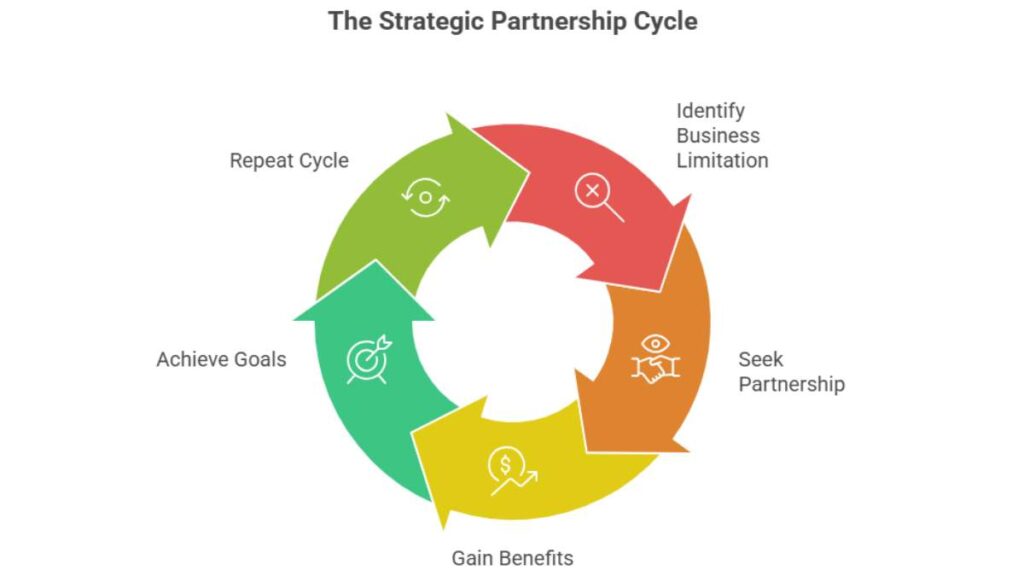
Most partnerships don’t start with “let’s collaborate.” They start with a business limitation. Slower growth than expected. Difficulty entering a new segment. Rising costs. A missing capability. Partnerships become the bridge between where a company is and where it wants to be.
Strong partnership business examples tend to share one thing: both sides gain something they couldn’t easily build alone.
Access to New Markets and Audiences
Entering a new market from scratch is expensive and slow. There’s local competition, cultural nuances, distribution challenges; the list goes on. A partner already established in that market reduces friction immediately.
Instead of guessing, companies gain:
- Built-in customer trust
- Existing sales or distribution networks
- Market knowledge that usually takes years to develop
That kind of shortcut can completely change expansion timelines.
Cost-Sharing and Risk Mitigation
Big moves come with big risk. New products fail. New regions underperform. Technology investments don’t always pay off right away. Partnerships spread that risk across multiple players.
Shared spending on:
- Product development
- Marketing launches
- Infrastructure or logistics
makes ambitious strategies more realistic. If results take time, the financial pressure isn’t sitting on one balance sheet.
Knowledge and Technology Sharing
Some partnerships are less about money and more about expertise. One company understands customer behavior deeply. Another owns advanced tech. Separately, both are strong. Together, they can create something much more competitive.
This is often where real innovation happens, not inside a single company, but between two that see the market differently.
Competitive Advantage
A well-designed partnership can shift how a company competes. Instead of offering a standalone product, it becomes part of a larger ecosystem. That ecosystem effect is difficult for competitors to replicate quickly.
It’s the difference between selling a tool and delivering a complete solution. Customers notice.
What Leading Companies Are Doing
Across industries, top performers are building networks, not just products. Integrations, bundled services, platform collaborations; these aren’t side initiatives anymore. They’re core growth strategies. The businesses that scale fastest are often the ones that plug into the right ecosystems early.
Partnerships, in other words, have moved from tactical to strategic.
Strategic Partnerships: Combining Strengths for Mutual Growth
Strategic partnerships are long-term collaborations between companies that stay legally independent but align closely around shared business goals. No new entity gets created. No ownership changes hands. But the relationship runs deep, often touching product, marketing, and customer experience.
These aren’t quick promotional tie-ins. They’re built for sustained advantage.
How Strategic Partnerships Differ from Other Collaborations
Strategic alliances usually involve:
- Ongoing coordination, not one-off campaigns
- Product or platform integration
- Shared planning around market expansion
- Mutual reliance for continued growth
There’s commitment here. Not the legal structure of a joint venture, but definitely more depth than a simple referral or affiliate setup.
Business Value of Strategic Partnerships
When structured well, these partnerships unlock growth on multiple fronts:
- Market Expansion – Each company helps the other reach customers that were previously hard to access
- Shared Resources – Technology, data, or infrastructure becomes more powerful when connected
- Stronger Market Presence – Joint positioning often carries more credibility than going alone
Customers don’t always see the partnership mechanics; they just experience a smoother, more capable solution.
Example: Google & Samsung
The relationship between Google and Samsung is one of the clearest modern examples of a strategic partnership done right.
Google develops the Android operating system. Samsung builds a large share of the world’s most popular Android smartphones. No joint company was formed. No merger happened. Yet their alignment has shaped the global mobile market for over a decade.
Why it works:
- Complementary Strengths
- Google brings software, services, and the app ecosystem
- Samsung brings hardware innovation, manufacturing scale, and global retail presence
- Mutual Growth
Samsung devices become more valuable because of Android’s app ecosystem. Android’s global reach expands through Samsung’s hardware dominance. - Coordinated Innovation
Hardware capabilities and software features often evolve in parallel, creating a more seamless experience for users.
This kind of partnership doesn’t just improve individual products. It builds an ecosystem that’s difficult for competitors to match. And that’s where the real strategic advantage lives.
Joint Ventures: Shared Ownership, Shared Success
Some opportunities are just too big or too risky for a loose partnership. That’s where joint ventures come in. Instead of simply collaborating, companies create a new, jointly owned entity built for a specific mission. New market. New product. New region. Something that needs real commitment.
This setup isn’t casual. There are legal agreements, shared equity, and defined governance. Everyone at the table has something to gain and something to lose. That tends to sharpen focus.
When a Joint Venture Is the Right Move
Joint ventures usually make sense when:
- The investment required is significant
- The risk level is high
- Local expertise or regulatory access is critical
- The goal is long-term, not experimental
A strategic partnership might open the door. A joint venture walks through it and sets up shop.
The trade-off, of course, is complexity. More structure, more negotiation, more alignment needed upfront. But for the right opportunity, that structure prevents confusion later, especially around money and decision-making.
Business Value of Joint Ventures
When executed well, joint ventures unlock growth that would be difficult to reach alone.
They allow for:
- Shared financial exposure – Big bets feel more manageable
- Stronger innovation capacity – Combined R&D, combined resources
- Faster global expansion – Local partners reduce market-entry friction
And because ownership is shared, commitment usually runs deeper than in lighter partnership models.
Example: Hulu (Disney, Comcast, WarnerMedia)
Hulu’s formation is a strong example of a joint venture built to respond to industry change. Major media companies; Disney, Comcast, and WarnerMedia, among them, pooled content and resources to build a streaming platform that could compete in a fast-moving market.
A few things made this structure work:
- Content strength through collaboration
Each partner contributed valuable media libraries. Individually strong, collectively far more competitive. - Shared platform investment
Streaming infrastructure, licensing, marketing; expensive moves. Sharing the load reduced individual risk. - Aligned long-term incentives
As owners, each company benefited directly from Hulu’s success. That’s a different mindset than simply licensing content to a third party.
It wasn’t just distribution. It was a coordinated response to a digital shift that none of them could ignore.
Affiliate Partnerships: Expanding Reach Through Collaboration
Affiliate partnerships run on a simple idea: reward performance. One business promotes another’s product or service and earns a commission when results happen: clicks, leads, sales, subscriptions.
Straightforward structure. But the strategy behind it can get surprisingly sophisticated.
At their best, affiliate relationships don’t feel like ads. They feel like recommendations from a trusted source. That trust is what makes the model work.
Why Affiliate Partnerships Keep Growing
Brands lean into affiliate programs because they reduce upfront risk. Instead of paying for impressions and hoping for conversions, they pay for actual outcomes.
Advantages usually include:
- Performance-based spending – Budgets tied directly to results
- Access to niche audiences – Affiliates often have focused, loyal communities
- Scalable growth – Programs expand by adding more partners, not just more ad spend
For affiliates, creators, bloggers, and publishers, it’s a way to monetize influence without building their own product line. When the audience fit is right, everyone benefits. When it’s not… performance drops fast.
Example: Patreon & Content Creators
Patreon’s model reflects affiliate-style dynamics, even though it operates as a platform. Creators bring their audiences. Patreon provides the infrastructure for memberships, payments, and community management. Revenue is shared.
Why it works:
- Aligned incentives
Creators earn recurring income from supporters. Patreon earns a percentage. Growth on one side fuels growth on the other. - Authentic promotion
Creators aren’t pushing unrelated products. They’re inviting fans to support their own work. That distinction matters. - Long-term value
This isn’t about one-time commissions. It’s recurring relationships, which change the economics for everyone involved.
It’s affiliate logic applied to creator economies, and it scales because the foundation is audience trust.
Solution Partnerships: Offering Complete Customer Solutions
Customers rarely wake up thinking, “Time to buy another tool.” They’re trying to solve problems. That’s where solution partnerships come in; two companies combining offerings to deliver something more complete and easier to use.
Especially in complex industries, one vendor rarely covers everything. Integration becomes the value.
How Solution Partnerships Typically Work
Each partner contributes a core strength. Together, they create a broader, more seamless experience.
This might include:
- Deep product integrations
- Bundled offerings are sold together
- Shared implementation or support
- Coordinated sales strategies
The conversation shifts from features to outcomes. That’s a big difference.
Business Value of Solution Partnerships
These partnerships tend to drive:
- More comprehensive offerings – Fewer gaps for customers to fill on their own
- Smoother user experiences – Systems that actually talk to each other
- Higher deal value – Broader solutions often justify larger contracts
They also increase switching costs. Once systems are integrated and workflows connected, customers are less likely to move away.
Example: Salesforce & Microsoft
Salesforce and Microsoft offer a good example of solution partnership logic at work. Salesforce leads in CRM. Microsoft dominates productivity tools and enterprise cloud. Instead of forcing customers to choose sides, the two companies have built integrations that connect their ecosystems.
Why this matters:
- Complementary roles
Salesforce handles customer data and sales processes. Microsoft powers communication, collaboration, and infrastructure. - Workflow efficiency
Sales teams can access CRM insights within tools they already use daily, like Outlook and Teams. Less friction. Better adoption. - Enterprise practicality
Many organizations already rely on both platforms. Integration reduces complexity and makes large-scale deployments more appealing.
This kind of partnership isn’t flashy. No big consumer campaign. But in enterprise markets, practical integrations often drive more value than bold branding ever could.
Technology Partnerships: Innovation Through Shared Expertise
Technology partnerships don’t always get public attention, but they’re often doing the heavy lifting behind the scenes. This is where companies team up around infrastructure, platforms, software, or data capabilities; usually because building everything alone would be slower, more expensive, and frankly unnecessary.
In a lot of industries now, no single company owns the full stack. One business might be strong in enterprise software but weak in cloud infrastructure. Another might lead in AI but lack industry-specific applications. Partnerships bridge those gaps.
Sometimes the collaboration is about licensing. Sometimes it’s tight product integration. In deeper cases, engineering teams from both sides work together for years. The format changes, but the objective stays consistent: move faster and build smarter.
Why Technology Partnerships Matter
A few practical reasons companies lean into these alliances:
- Speed to market – Sharing technical expertise shortens development timelines
- Stronger product ecosystems – Integrated tools fit more naturally into customer workflows
- Scalability – Infrastructure partnerships help products grow without constant rebuilds
There’s also a strategic layer. When systems work well together, customers tend to adopt both. Over time, those connections form ecosystems, and ecosystems are hard to compete against piece by piece.
Example: Google Cloud Platform & SAP
Google Cloud Platform and SAP illustrate how technology partnerships create value in very practical ways.
SAP powers core business operations for large enterprises: finance, logistics, HR, and procurement. Google Cloud provides global infrastructure along with advanced analytics and machine learning capabilities. Individually, both are strong. Together, they make enterprise modernization more achievable.
Where the partnership really shows up:
- Enterprise-ready cloud environments
SAP systems running on Google Cloud gain performance, global scalability, and security at scale. - Deeper data use
Operational data from SAP can be analyzed using Google’s analytics and AI tools, helping companies improve forecasting and decision-making. - Lower migration risk
Moving critical systems to the cloud is risky for large organizations. A coordinated partnership reduces uncertainty and technical friction.
Not the kind of story that goes viral. But in enterprise markets, dependable integration often matters more than flashy innovation.
Co-Branding Partnerships: Marketing Synergy That Converts
Co-branding partnerships put two brands side by side in a shared product, service, or campaign. Both names are visible. Both reputations are tied to the outcome. When the fit is right, the collaboration feels natural; almost obvious. When it’s forced, customers sense it immediately.
The strength of co-branding comes from shared brand equity. Each brand lends trust, recognition, and personality to the other. That combined perception can make an offering feel more premium, more innovative, or simply more credible.
When Co-Branding Actually Works
The strongest co-branded efforts usually have:
- Similar or overlapping audiences
- Complementary strengths rather than competing ones
- A product or experience that benefits from both brands being involved
If the only connection is a marketing deal, it tends to show. Customers today are quick to question partnerships that feel purely transactional.
Business Impact of Co-Branding
When alignment is real, co-branding can drive:
- Higher perceived value – The product feels more distinctive or advanced
- Audience crossover – Each brand gains exposure to the other’s customer base
- Stronger emotional engagement – Shared storytelling often resonates more deeply
The impact often extends beyond the campaign itself, shaping long-term brand perception.
Example: Nike & Apple
Nike and Apple built a co-branding relationship around fitness and technology, a pairing that makes intuitive sense.
Nike stands for athletic performance and sports culture. Apple represents personal technology and connected lifestyles. Together, they created integrated fitness experiences, including Apple Watch Nike editions and running-focused tracking features.
Why this partnership resonated:
- Clear lifestyle overlap
Both brands speak to people focused on performance, progress, and self-improvement. - Real product integration
This wasn’t just shared advertising. The technology and the gear worked together in a practical way. - Mutual brand reinforcement
Nike became more digitally connected. Apple became more embedded in everyday fitness routines.
It felt less like a promotion and more like a natural extension of both brands’ identities.

Enroll Now: Advanced Digital Marketing Course
Cross-Promotion Partnerships: Leveraging Audiences for Growth
Cross-promotion partnerships are simple in structure but powerful in practice. Two brands with complementary audiences agree to promote each other through their own marketing channels. No joint ownership. No deep technical work. Just coordinated exposure.
When audience alignment is strong, this approach can outperform paid acquisition at a fraction of the cost.
How Cross-Promotion Usually Plays Out
Common tactics include:
- Featuring each other in email newsletters
- Social media collaborations or shoutouts
- Joint giveaways or contests
- Co-created content, webinars, or events
Each brand introduces the other to an audience that already trusts them. That trust transfer is the real asset here.
Why Cross-Promotion Delivers
Customers are more open to discovering a new brand when the introduction comes from one they already follow. That reduces skepticism and shortens the path to engagement.
Key advantages often include:
- Lower acquisition costs – Exposure without large ad budgets
- Faster audience growth – Access to relevant, pre-qualified prospects
- Stronger brand credibility – Association with a trusted partner boosts perception
Of course, poor alignment shows quickly. If audiences don’t share interests or values, engagement drops, and the partnership feels random.
Example: Red Bull & GoPro
Red Bull and GoPro have built a long-term cross-promotional relationship centered on action sports and high-energy experiences.
Red Bull funds and produces extreme sports events. GoPro captures immersive, first-person footage from those environments. The resulting content naturally features both brands: speed, intensity, and movement.
Why this collaboration works:
- Shared audience mindset
Both brands appeal to adventure-focused, thrill-seeking communities. - Content that spreads organically
The videos are entertaining on their own, which helps them travel far beyond traditional advertising spaces. - Consistent brand reinforcement
Red Bull represents energy and boldness. GoPro represents capturing the moment. Together, they tell a cohesive story.
It doesn’t feel like a promotional swap. It feels like authentic content, which is exactly why people pay attention.
How to Choose the Right Partnership Model
Choosing a partnership model isn’t about picking what sounds impressive in a pitch deck. It’s about fit. Practical fit. The kind that still makes sense six months in, when teams are buried in execution, and the early excitement has worn off.
Start with the outcome. Not the structure; the outcome. Is the goal to enter a new market faster? Fill a product gap? Build credibility in a space where trust takes time? Each of those points is in a slightly different direction.
A few things usually shape the decision:
- Business goals – Growth looks different from innovation. Brand exposure isn’t the same as operational expansion.
- Internal capacity – Some partnerships demand heavy coordination. Others run quietly in the background. Know which one the team can actually handle.
- Audience alignment – Overlapping customers can help. Complementary customers can be even better.
If the goal is visibility or quick reach, lighter models like affiliate or cross-promotion partnerships often do the job. Less complexity, faster to launch. But when product development, technology integration, or long-term market positioning is involved, deeper structures, strategic partnerships, or joint ventures tend to make more sense.
Risks and Challenges to Keep in View
Partnerships rarely fail because the idea was bad. They fail because the working relationship wasn’t thought through.
A few common pressure points:
- Different working cultures – One company moves fast and experiments. The other wants three rounds of approval. Friction shows up quickly.
- Ownership of ideas – If new products or IP emerge, who controls what? Vague answers here can get expensive later.
- Money conversations – Revenue splits feel easy when projections are optimistic. Harder when results are mixed.
None of this means partnerships are risky by default. It just means clarity beats assumptions. Every time.
A Practical Way to Evaluate Potential Partners
A structured approach helps remove some of the guesswork:
- Define the exact goal – Not “grow faster,” but something measurable and specific
- List capability gaps – What’s missing internally that a partner could realistically provide?
- Look at operating style – Speed of decision-making, communication norms, risk tolerance
- Run financial scenarios – Optimistic, realistic, and conservative
- Test before scaling – Pilot campaigns or limited integrations often reveal more than long meetings do
Strong partnerships aren’t rushed. They’re built with eyes open.
Lessons from Successful Partnership Business Examples
Across industries, partnership success leaves clues. Different logos, different markets; similar patterns underneath.
What Strong Partnerships Tend to Get Right
- They combine different strengths
When both sides bring the same thing to the table, value plateaus. The real lift happens when capabilities are complementary. - They solve a clear customer problem
If customers don’t feel a noticeable benefit, the partnership becomes a branding exercise. And those fade. - Leadership stays involved
Partnerships pushed down the org chart too early often stall. Visible support from decision-makers keeps momentum alive. - Execution gets more attention than announcements
Press releases are easy. Integration work, joint planning, shared accountability; that’s where results come from.
How Smaller Businesses Can Use the Same Playbook
Big-brand examples get the headlines, but the principles work just as well at smaller scales.
Smaller companies can:
- Team up with complementary service providers to offer bundled solutions
- Run joint campaigns with local or niche brands targeting the same audience
- Integrate with established platforms to gain distribution without building everything from scratch
The budgets are smaller. The logic is identical. Combine strengths, reduce blind spots, and move faster together than alone.
How to Tell if a Partnership Is Actually Working
Without metrics, partnerships drift. Everyone stays busy, but impact stays fuzzy.
A few indicators that usually matter:
- Revenue is directly influenced by the partnership
- New customer acquisition or improved retention
- Increased product usage or adoption
- Entry into markets that were previously hard to access
If those numbers don’t move over time, it’s usually not a marketing issue. Its alignment or execution needs a reset.
Conclusion:
Partnerships have shifted from being optional growth tactics to a core business strategy. Markets move fast, technology evolves quickly, and customer expectations keep rising. Very few companies can build everything alone, at least not efficiently.
Different partnership types serve different roles. Some are built for scale and reach. Others for innovation and product depth. Some strengthen brand perception. Others quietly power the backend of an offering. The key is choosing the model that fits the goal, not just the one that looks good in a case study.
What consistently separates successful partnerships from forgettable ones is complementarity. Different capabilities. Shared direction. Mutual benefit that’s clear on both sides.
When businesses approach collaboration with realistic expectations, careful partner selection, and a willingness to invest in the relationship, not just the launch, partnerships stop being side projects. They become long-term growth engines.
FAQs: About Partnership Business Examples
1. What are the best examples of partnership businesses?
The partnerships people remember usually pair companies that solve different parts of the same problem. Google and Samsung didn’t just share branding space; one built the software backbone, the other put it in millions of hands. Hulu brought competing media giants under one roof because distribution mattered more than rivalry. Nike and Apple made fitness data feel mainstream, not technical. Real value first. Hype second.
2. How do strategic partnerships differ from joint ventures?
A strategic partnership is cooperation without a wedding ring. Companies stay independent, collaborate where it makes sense, and keep flexibility. A joint venture is more permanent. New entity, shared ownership, deeper operational ties. That structure usually shows up when both sides are investing serious resources and planning for the long haul, not just running a campaign together.
3. What types of businesses benefit most from partnerships?
Businesses in fast-moving spaces lean on partnerships more often because building everything alone just takes too long. Tech, SaaS, media, consumer brands; all common. But smaller players benefit too, sometimes more. A niche brand with the right partner can scale visibility quickly. It’s less about industry and more about whether another company fills a gap that’s slowing growth.
4. Can small businesses leverage partnership strategies effectively?
Small businesses actually have an advantage here. They can move faster, test collaborations without layers of approval, and build closer working relationships. A well-matched partnership can bring new audiences, shared marketing effort, and added credibility. That kind of lift is hard to buy with ads alone. The trick is choosing partners with overlapping customers, not just big names.
5. How do partnership business examples drive revenue growth?
Revenue impact usually comes from making the offer stronger, not just louder. Partnerships help businesses bundle solutions, enter new markets with local credibility, or shorten the sales cycle because trust transfers. Customers prefer complete answers over piecemeal ones. Over time, that added convenience improves retention too, which is where the quieter, long-term revenue gains show up.
6. What are the risks of partnership business models?
Most issues don’t come from bad intentions. They come from vague expectations. Different decision speeds, clashing work cultures, or unclear ownership over customers and data can wear things down. Revenue sharing also gets sensitive once money starts flowing. Problems tend to surface later, when pressure rises. That’s why alignment upfront matters more than excitement at launch.
7. How do cross-promotion partnerships work?
Cross-promotion works when two brands talk to similar people from different angles. They share audiences through content, offers, or campaigns that feel natural to both sides. When done right, it doesn’t feel like advertising at all. It feels like a recommendation. That shift in perception is what drives engagement and often better conversion than solo promotions.
8. Why is co-branding considered a successful partnership strategy?
Co-branding succeeds when each brand adds a real layer of value. Otherwise, it’s just logos side by side. When customers see two trusted names combining strengths, the offer feels more complete, sometimes even premium. It works best when the collaboration makes practical sense in everyday use, not just as a limited-edition marketing moment.
9. What makes a partnership business example “successful”?
Success shows up in sustained results, not launch noise. Revenue growth, stronger customer acquisition, deeper engagement, or expansion into new markets are common signs. Behind the scenes, smooth communication and clear responsibilities keep things running. Without operational stability, even exciting partnerships tend to stall once the initial momentum fades. Execution carries more weight than announcements.
10. How to choose the right type of partnership for my business?
The starting point is the gap, not the trend. Some businesses need distribution. Others need technology, brand credibility, or market access. The right structure depends on how closely both sides need to work and how much control they’re willing to share. Sometimes a simple collaboration does the job. Sometimes deeper integration is worth the complexity.