
The product life cycle in marketing explains why some products take off, some level out, and others quietly disappear. This blog breaks down that journey in plain terms. It covers what really changes as a product moves from introduction to growth, maturity, and eventually decline, and why marketing needs to change with it.
You’ll see how timing affects campaigns, budgets, pricing, and even when it’s better to stop pushing altogether. It also looks at the outside forces that shape a product’s lifespan, common mistakes marketers keep making, and practical ways to respond before problems get obvious. The goal isn’t theory. It’s helping marketers read the signals early, adjust faster, and make decisions that actually fit where the product is right now.
Table of Contents
Introduction to Product Life Cycle in Marketing
Every product has a life, whether anyone likes it or not. Some barely get off the ground, others stick around for years. The product life cycle in marketing is basically a map of that journey, showing when a product is fragile, when it’s growing fast, and when it’s starting to fizzle out.
It’s not just theory. Knowing the stage a product is in can save a lot of headaches. Launching a campaign without this understanding? Might as well be throwing darts blindfolded. The life cycle gives a sense of timing.
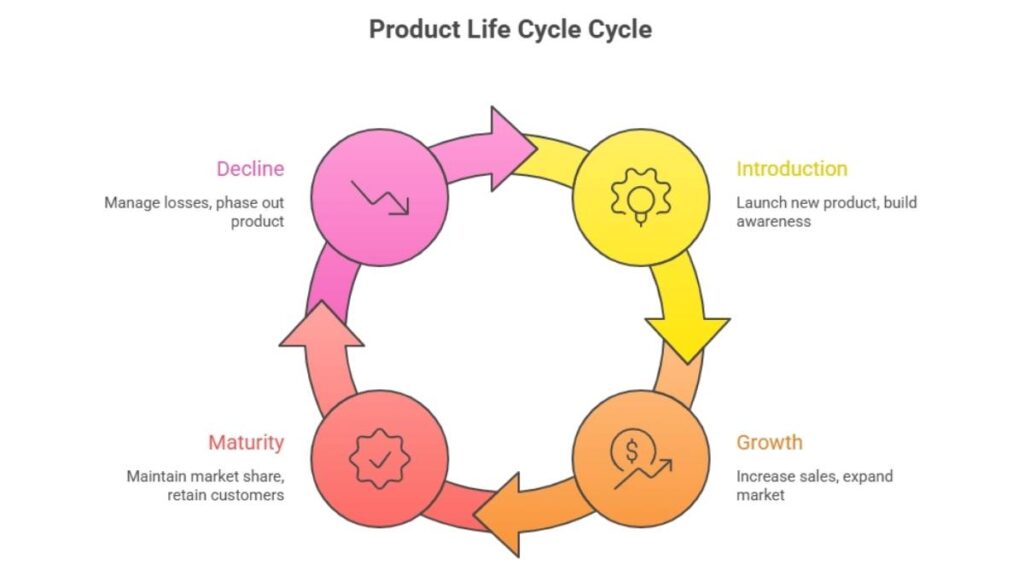
Most products go through four stages:
- Introduction: Brand-new, barely anyone knows it exists. Sales are slow. The big job here is getting attention.
- Growth: People notice, sales start climbing, competitors start circling. Things get exciting, but also tricky.
- Maturity: The market is crowded. Growth slows. Keeping customers loyal is hard work now.
- Decline: Interest fades, sales drop, tough choices loom: discount, relaunch, or retire.
It’s a bit like gardening. A seedling needs careful attention, a young plant needs water and sunlight, and a mature tree? Mostly maintenance. Marketing a product is the same; you can’t treat a new launch like an established bestseller.
Why Product Life Cycle Matters in Marketing
Paying attention to the life cycle isn’t some optional extra; it’s practical. A product’s stage tells you what works and what doesn’t. Pushing a huge ad spend on something in decline? Waste. Ignoring early adopters for a new product? Missed opportunity.
Here’s what happens when marketers actually use the life cycle:
- Marketing dollars hit harder: Spend where it counts. Early stages are all about awareness and trial. Later stages? Retention, upsells, maybe trying to squeeze a bit more life out.
- Smarter launches: Knowing the stage helps plan campaigns better. Target early adopters first, then scale. Don’t go full blast before anyone even knows the product exists.
- Pricing and promotions make sense: Random discounts don’t work. Timing them with the product’s life stage does.
- Avoid wasted effort: Too many products get over-promoted at the wrong stage. Recognizing the signs: maturity, stagnation, and decline saves money and stress.
- Learning from others: Brands that tweak strategies as products move through stages usually do better. Sometimes small changes in messaging or channel focus make a big difference.
At the end of the day, the product life cycle is less about fancy models and more about common sense applied to timing. Pay attention, adjust, and you’re already ahead of many competitors who just keep doing the same thing over and over.
Stages of the Product Life Cycle in Marketing
Introduction Stage
Characteristics of the Introduction Stage
This is the tricky part. A product is brand new, barely anyone knows it exists, and sales are naturally slow. That’s normal. Costs are high; production, marketing, distribution; it all adds up. At this point, it’s easy for a product to get lost in the noise.
Marketing Objectives and Strategies
The main goal is to get noticed and to explain why the product matters. Customers need to “get it” fast. Tactics that usually work include:
- Creating content that clearly shows what the product does and why it helps
- Targeting early adopters who don’t mind trying new things
- Partnering with credible voices or influencers to build trust
You might try a lot and fail a little; that’s just the stage.
KPIs and Challenges
The numbers that matter are awareness, early engagement, and first sales. Challenges? High costs, slow uptake, and the constant worry that the product might just sit there unnoticed. Patience helps, but so does adjusting quickly if things aren’t moving.
Growth Stage
Characteristics of the Growth Stage
Here, things start to pick up. More people are noticing, sales climb, and competitors start paying attention. Exciting, but also a stage where mistakes can slow you down.
Marketing Objectives and Strategies
The focus shifts to growth and standing out. This usually means:
- Scaling campaigns to reach more people
- Expanding where the product is sold
- Making sure the product doesn’t blend in with competitors
- Using testimonials or social proof to build trust
It’s a balancing act. Push too hard, it can feel pushy. Too soft, and someone else swoops in.
KPIs and Considerations
Metrics are sales trends, market share, and customer acquisition cost. Early feedback is important; small tweaks can make a huge difference. Ignoring competition or stretching the budget without a plan can stall growth fast.
Maturity Stage
Characteristics of the Maturity Stage
At this stage, everyone knows the product. Growth has slowed, and the market is crowded. The challenge now is keeping customers and holding market share. Profits are often at their peak, but staying relevant becomes harder.
Marketing Objectives and Strategies
The focus is on keeping customers happy and showing that the product still matters. Common approaches include:
- Loyalty programs to keep buyers coming back
- Product tweaks or variations to keep interest alive
- Cross-selling and upselling
- Seasonal or creative campaigns to keep the brand top-of-mind
Too little effort, and decline starts creeping in. Too much, and resources are wasted.
KPIs and Considerations
Repeat purchases, customer lifetime value, and engagement become more important than raw sales growth. The key is staying flexible. Complacency can quickly lead to decline.
Decline Stage
Characteristics of the Decline Stage
Eventually, most products hit this stage. Sales drop, customers lose interest, and competitors have moved on. It doesn’t mean failure; it just means the product has run its course in the market.
Marketing Objectives and Strategies
The focus shifts to managing losses carefully. Options include:
- Discounts or bundling to move remaining inventory
- Niche repositioning to retain a smaller, profitable audience
- Harvesting what revenue is left before retiring the product
KPIs and Considerations
Watch the right numbers: sales drop, inventory turnover, and ROI on remaining spend. Some products can be revived with a rebrand or update, but many are phased out strategically. The goal is to exit cleanly without hurting the brand.
Factors Affecting Product Life Cycle in Marketing
Products don’t live in a vacuum. Lots of things push and pull on them, often at the same time, and usually in ways that are hard to predict. Ignoring these factors is basically signing up for surprises.
Market saturation and competition
Too many similar products out there? Even the best product can stall. Competitors can drop prices, grab attention, or just make people confused about what to buy. Small tweaks in messaging, or repositioning, can sometimes save a product from fading away.
Technological changes
Technology moves fast. A gadget or software that was hot last year can feel outdated today. But on the flip side, adding small features or improvements can breathe new life into a product. Timing matters, though; you can spend a ton for little return if you get it wrong.
Shifts in consumer behavior
People’s tastes change. Trends come and go. What was hot last season might feel irrelevant now. Watching for shifts, even subtle ones, can be the difference between a product staying relevant and dropping off quickly.
Marketing strength and brand perception
A solid product can fail if marketing is weak. Mixed messages, inconsistent campaigns, or poor distribution can shorten a product’s life. Sometimes perception matters more than the product itself; people buy what feels right.
External factors
Economic shifts, policy changes, and global events; they can all hit a product unexpectedly. Can’t control them, but being alert makes it easier to pivot instead of scrambling.
The big takeaway? The product life cycle is shaped as much by the world around the product as the product itself. Keep an eye out. Adjust. Be ready to act.

Apply Now for: Product Marketing Course
Integrating Product Life Cycle into Marketing Strategy
Knowing the stages isn’t enough. The real work is letting them guide decisions; what campaigns run, how much to spend, where to focus effort.
Align campaigns with the stage
Different stages need different plays. Early on, it’s all about awareness and explaining why the product exists. Growth is about scaling and standing out. Maturity is retention. Decline? Efficiency and smart exits. Treating everything the same is a recipe for wasted money.
Budget and resource planning
New products need a heavier spend per sale. Mature products often do better with targeted campaigns. Declining products? Every dollar counts; no gimmicks, just smart moves.
Anticipate changes
Good marketers notice when growth might slow or when maturity is plateauing. Watching trends, customer behavior, and competitors lets you prepare for the next stage instead of scrambling.
Omnichannel approach
Where your audience is matters. Awareness campaigns might lean on social media or PR. Retention? Email, loyalty programs, and in-store experiences. Coordinating channels makes the life cycle work instead of just throwing money around blindly.
At the end of the day, it’s not just about knowing the stages; it’s about acting on them. Small adjustments at the right time often have a bigger impact than huge campaigns done at the wrong stage.
Case Studies: Product Life Cycle in Marketing
Seeing it in action makes it easier to understand. Here are a few examples that show how marketers actually move through the stages:
Tech product
A new gadgetwas launched targeting early adopters. Influencers helped spread the word. Growth came when it hit more stores, and social proof started showing in reviews. Maturity involved upselling accessories and small feature updates. Decline was handled with a minor refresh instead of a full relaunch; enough to keep momentum but not over-invest.
FMCG product
A snack brand released a new flavor. First, free samples and social contests generated buzz. Growth came through supermarket promotions. Maturity? Seasonal packaging and limited editions kept people buying. Decline? Bundled the flavor with other popular products to clear stock efficiently.
Seasonal product
Winter clothing launched with preorders and hype. Growth came with broader retail presence and influencer reviews. Maturity focused on upselling scarves, gloves, and complementary items. Decline? Discounts and targeted emails helped move stock without wasting effort.
The common thread? Timing, knowing when to push and when to pull back, and adjusting strategies in small but smart ways. Life cycle marketing isn’t some theory; it’s reading the product, the market, and the customer, and acting accordingly.
Common Mistakes in Product Life Cycle Marketing
Even experienced marketers stumble here. It’s easy to assume that what worked once will keep working. Or worse, ignore the signals entirely. Some mistakes tend to repeat across industries:
Treating every stage the same
Not every stage needs the same effort or type of marketing. Pushing a decline-stage product like it’s in growth? That’s just throwing money away. And acting as if every new launch will explode overnight? Also risky.
Hanging on too long
Declining products can be painful to let go of. Sometimes, the instinct is to keep spending to revive them. But at a point, it’s smarter to retire, reposition, or bundle with something else. Holding on too long just eats profit.
Ignoring innovation in maturity
Maturity is tricky. Sales aren’t spiking, and it’s tempting to coast. But products that don’t get small updates or marketing tweaks often plateau and slip into decline faster than expected. Even minor changes, new packaging, a subtle feature tweak, or a seasonal campaign can make a difference.
Watching the wrong numbers
Each stage has different key metrics. Awareness, trial, and engagement matter early. Growth looks at sales and market share. Maturity focuses on retention and lifetime value. Decline is about efficiency and ROI. Tracking the wrong metrics leads to bad decisions.
Assuming a one-size-fits-all approach works
Different markets, customers, and products behave differently. Just because a strategy worked for a tech gadget doesn’t mean it’ll work for a snack or a seasonal item. Flexibility is key.
Bottom line: mistakes happen, but catching them early and adjusting fast is what separates products that survive from those that fade quietly.
Tools and Techniques for Managing Product Life Cycle in Marketing
Managing a product through its stages isn’t just intuition; it’s also about working smarter. But tools only help if they’re used with thought.
Automation and campaign management
These platforms save time and keep campaigns running without micromanaging every detail. Useful, yes, but they’re not magic. You still need a strategy for each stage.
Customer feedback and CRM systems
Keeping track of what customers think is huge. Complaints, suggestions, or praise can signal when a product is ready for tweaks, updates, or targeted campaigns. CRMs help manage relationships, segment loyal customers, and support retention efforts.
Market research and competitive insights
You don’t want to miss what competitors are doing, especially in growth or maturity. Trends can shift fast, and knowing where the market is saturated or underserved helps plan smarter campaigns.
Predictive analytics
Looking at patterns in sales, adoption, or engagement helps anticipate stage changes. It’s not crystal ball stuff, but spotting signals early lets marketers plan campaigns, adjust spend, or innovate before it’s too late.
The human touch
Tools are only part of the picture. Observing, talking to customers, noticing subtle shifts in behavior, and trusting experience often make the difference between success and decline.
The key is balance. Tools support decisions; they don’t replace judgment.
Conclusion
The product life cycle isn’t just a theory. It’s a roadmap for understanding how a product behaves in the real world. Products rise, peak, and eventually fade if ignored. Marketing that adapts to the stage is far more effective than pushing the same campaigns across the board.
Some quick takeaways:
- Match campaigns to the product stage. Don’t treat all stages the same.
- Track the right metrics at the right time. Awareness, sales, retention, efficiency; they matter differently at different stages.
- Know when to let go. Clinging to declining products costs more than it gives.
- Stay alert to customers, competitors, and the market. Conditions shift fast.
- Use tools smartly, but rely on judgment and observation first.
A product’s journey doesn’t wait for marketers to catch up. Reading the signals, adjusting in time, and making stage-appropriate decisions can keep a product alive longer and profitable. Done right, life cycle marketing turns uncertainty into an actionable strategy, instead of guesswork.
FAQs: About Product Life Cycle in Marketing
1 . What is the product life cycle in marketing?
Think of it as the journey a product takes. Hits the market, grows, peaks, and eventually slows down. Introduction, growth, maturity, decline. Each stage comes with its own quirks. Knowing where a product sits isn’t just academic; it tells you what to push hard, what to hold back on, and sometimes, when to stop wasting energy altogether. It’s more of a rough map than a strict rule.
2. Why is the product life cycle important for marketing strategies?
Because you can’t treat every stage the same way. Launch campaigns on a dying product? Money down the drain. Treat a new product like it’s a giant brand already? Also wasted effort. Life cycle thinking shows where to focus, where to experiment, and where to pull back before things go sideways.
3. How do the four stages affect marketing decisions?
Each stage has a sort of personality:
Introduction: awareness first. Sales come later. Educate, explain, get people curious.
Growth: ramp things up, differentiate, make the product stick in people’s minds.
Maturity: retention and profit are king. Keep customers happy, maybe throw in small updates or upsells.
Decline: trim costs, maybe reposition, bundle, or retire. Don’t pour money into something that’s sinking.
4. What marketing strategies work best during the introduction stage?
Early days are messy. You want attention, but also clarity. Targeted campaigns, clear messaging, trial offers, maybe a few influencers if it makes sense. Nothing fancy; people need to get it first before they buy it.
5. How can companies extend the maturity stage of a product?
Even solid products get stale. Little changes help: packaging tweaks, small feature updates, seasonal promos. Sometimes, just nudging customers’ memories is enough to keep things rolling.
6. What are the signs that a product is in the decline stage?
Sales flatten or fall. Stock sits longer than it should. Engagement fades. Customers drift away. Strong campaigns stop working like they used to. That’s usually the cue to make a call; update, bundle, reposition, or let it go.
7. How does the product life cycle influence pricing and promotions?
Prices and promotions aren’t set-it-and-forget-it. Intro may need discounts or trials. Growth is about differentiation and reach. Maturity leans on loyalty programs, cross-sells, and upsells. Decline? Efficiency rules: move inventory without burning cash.
8. Can all products go through every stage?
Not really. Some never get off the ground. Some just hover in maturity forever. Life cycle is a framework, a guide to patterns, not a guarantee.
9. What role does market research play in managing the product life cycle?
Huge. Shows what customers want, what competitors are doing, and what trends are moving. Without it, you’re guessing. Research helps decide when to push, pivot, or pause.
10. How can analytics help in optimizing product life cycle marketing?
Analytics is like reading the signs. Sales trends, adoption, engagement, retention; patterns start showing. Not perfect, but it warns you before trouble hits. Helps you make moves instead of reacting after the fact.