

Social media brand management is less about flashy posts and more about the steady signals a brand sends every day. This guide walks through how voice, visuals, and messaging work together to shape recognition across platforms. It looks at the difference between running campaigns and building a brand people actually remember, then breaks down content strategy, engagement habits, and platform choices that support long-term growth. There’s also a practical look at visibility, performance tracking, and the common issues that quietly weaken brand presence. Overall, the blog frames social media brand management as an ongoing discipline; one that builds trust gradually and makes every future marketing effort work a little harder.
Table of Contents
Introduction
What Is Social Media Brand Management? Definition & Core Concepts
Social media brand management is the ongoing effort to shape how a brand feels online. Not just what gets posted, but the personality behind it. The tone in replies. The way visuals look from one post to the next. The small signals people pick up on without consciously thinking about them.
It’s often confused with social media marketing. Fair enough; they overlap. Still, they’re not the same thing.
- Social media marketing focuses on campaigns, promotions, launches, and lead generation
- Community management handles the back-and-forth ; comments, DMs, conversations
- Social media brand management makes sure all of it sounds and looks like it comes from one clear, consistent brand
Without that layer of control, things get messy fast. A playful post here, a stiff corporate reply there. A trendy meme today, a formal announcement tomorrow. Nothing is technically broken, yet the brand feels… scattered. Audiences may not articulate it, but they sense it.
Good brand management smooths that out. Same voice. Same values. Same visual direction. Across platforms, across formats, across time.
Why It Matters for Modern Businesses and Digital Identity Building
Social media profiles now act like digital storefronts. In many cases, they are the first impression.
People check Instagram before websites. They scan comments before trusting claims. They look at how a brand responds when something goes wrong. That constant stream of activity forms a digital identity, whether a company is intentional about it or not.
Strong social media brand management helps shape that identity deliberately. It:
- Builds recognition through consistent design and tone
- Signals credibility without sounding overly polished
- Creates emotional connection, not just visibility
- Makes the brand easier to remember in crowded feeds
Without that consistency, even strong businesses can feel generic. And generic doesn’t last long in social environments.
The Role of Social Media in Today’s Brand Ecosystem
Social media now wears multiple hats. It’s part media channel, part customer support desk, part public review board.
In a typical week, a brand might post:
- A product update
- A customer testimonial
- A lighthearted trend-based post
- A response to a complaint
Each interaction adds another layer to public perception. Over time, those layers form a reputation; helpful, responsive, human… or distant, inconsistent, hard to trust. The judgment builds quietly.
That’s why alignment matters so much. If short-form videos feel friendly but comment replies sound cold, there’s friction. The brand stops feeling like a real personality and starts feeling like different teams speaking different languages.
Consistency builds familiarity. Familiarity builds trust. Simple, but easy to overlook.
Influence on Customer Perception, Engagement, and Retention
Brand perception isn’t built in big, dramatic moments most of the time. It grows through small interactions.
A reply that actually answers the question.
A caption that doesn’t sound forced.
A brand acknowledging feedback without getting defensive.
These details influence whether someone keeps following or slowly loses interest.
Strong social media brand management pays attention to these everyday touchpoints. It guides:
- How the brand responds in positive and negative situations
- How casual or formal the tone should be
- How brand values show up in regular content, not just big campaigns
When people feel respected and understood, engagement becomes more natural. That familiarity makes them more likely to stay, return, and eventually choose the brand when it matters.
How AI & Google’s AI Mode (SGE) Impacts Brand Management Content Ranking
Search is evolving. People often see summarized answers and brand references pulled from across the web, not just traditional website pages. Social media content plays a growing role in that wider digital picture.
Profile descriptions, public posts, and consistent messaging all contribute to how clearly a brand is understood online. When communication is scattered or inconsistent, it becomes harder to form a strong, recognizable presence beyond social platforms.
Brands that communicate clearly, stick to a consistent identity, and regularly share useful, audience-focused content tend to build stronger overall recognition across the digital landscape, not just within one app or feed.
Why Social Media Brand Management Is Critical
Brand Visibility & Awareness
Feeds are noisy. Really noisy. New brands appear every day, and attention spans aren’t getting longer.
Posting more doesn’t automatically fix that. Consistency does more of the heavy lifting.
When a brand shows up with a familiar look and tone over time, it starts to feel known. People may not remember the exact post, but they remember the presence. That sense of familiarity makes future content easier to notice and easier to trust.
How Consistent Presence Across Platforms Builds a Recognizable Identity
Each platform has its own culture. LinkedIn leans professional. TikTok leans expressive. Instagram floats somewhere in between. Even so, the brand should still feel like the same organization everywhere.
That means adjusting the delivery, not the identity:
- Slightly more polished tone on LinkedIn, more relaxed on Instagram
- Different content formats, but consistent colors and visual style
- Messaging tailored to platform context while keeping the same core values
When that balance is right, the brand feels adaptable but stable. When it’s off, it feels fragmented, almost like separate brands operating under one logo.
Audience Engagement & Relationship Building
Social media gives brands direct access to people. That’s a big opportunity. Also easy to mishandle.
Accounts that only push promotions often struggle with real engagement. People don’t want to feel like they’re constantly being sold to. They respond better when interaction feels natural.
Strong brand management encourages:
- Asking for opinions, not just clicks
- Replies that sound human, not scripted
- Acknowledging feedback, even when it’s critical
These small interactions build familiarity over time. And familiarity makes people more open to future messages, including promotional ones.
From Followers to Brand Advocates
Not every follower becomes a customer. Even fewer become advocates. But those who do can have a big impact.
Advocacy grows when a brand consistently shows up with:
- Content that’s genuinely helpful or entertaining
- A clear personality or point of view
- Respectful, responsive communication
People share brands that reflect well on them. When the brand feels authentic and aligned with their interests, sharing becomes part of how they express themselves online.
Reputation & Crisis Management on Social Platforms
Social media amplifies everything. Praise spreads. Complaints spread faster.
A delayed or careless response can quickly damage trust. On the other hand, a calm and transparent reply can actually strengthen credibility. Audiences watch closely when something goes wrong.
Strong social media brand management includes:
- Monitoring mentions and conversations regularly
- Responding quickly, but with thought
- Keeping tone aligned with brand values, even under pressure
Mistakes are inevitable. What shapes reputation is how those moments are handled.
Conversion & Business Outcomes
Brand management might not look like direct selling, but it strongly influences buying decisions.
When people see a brand repeatedly in a consistent, positive light, trust builds in the background. So when an offer appears, it doesn’t feel like a cold pitch. It feels familiar. Safer.
A well-managed social presence supports conversions by:
- Building credibility before someone visits the website
- Reinforcing brand promises through everyday content
- Showing visible social proof through engagement and community
Sales often happen off social platforms, but the confidence to buy is built on them.
Strategic Role in Cross-Channel Digital Marketing
Social media brand management connects with every other marketing channel. Email, paid ads, website content; all perform better when the brand behind them feels familiar.
A consistent voice on social makes ad messaging feel aligned. Clear positioning helps website copy resonate faster. Strong engagement can even drive more interest in long-form content and offers.
When brand management is aligned across channels, marketing stops feeling scattered. It starts to feel like one connected experience. And that cohesion is what helps brands stay memorable long after a single campaign ends.
Social Media Brand Management Strategy
Strong brands on social media rarely look “busy.” They look clear. Recognizable. Like there’s a brain behind the posts, not just a calendar to fill. That clarity usually comes from structure, even if the audience never sees the planning underneath.
Here’s what actually shapes a brand presence that sticks.
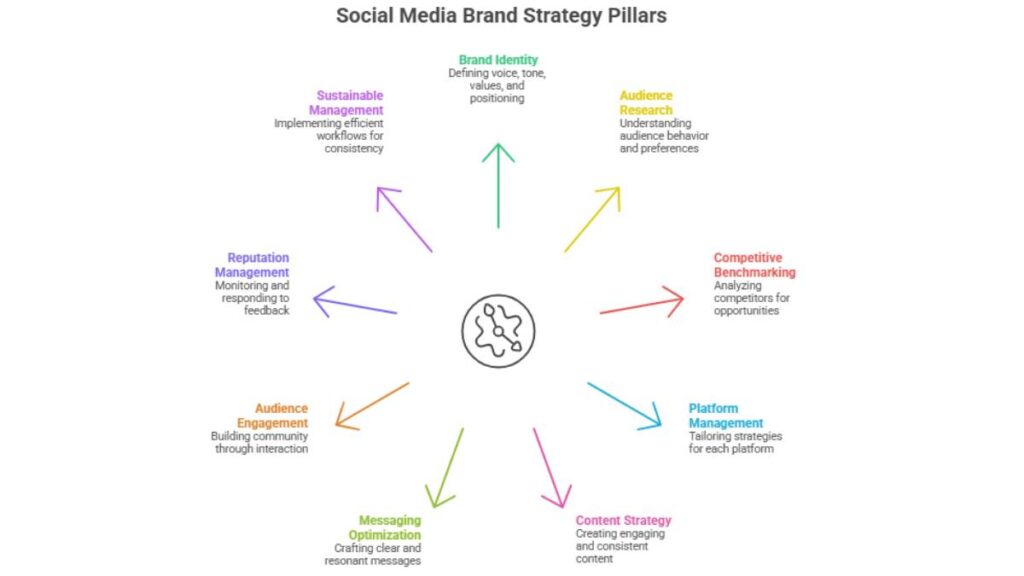
Foundations of a Strong Social Media Brand Strategy
Before posting more, the basics need to be settled. Otherwise, the feed turns into a mix of trends, announcements, and random tips that don’t quite connect.
Defining Brand Identity & Purpose on Social Platforms
A brand on social media should feel like a person with a steady personality, not a different mood every week.
That includes:
- Voice – Direct and bold? Calm and practical? Playful but sharp? Pick a style and stay close to it.
- Tone shifts – A serious update can sound different from a fun post, but both should still feel like the same “character.”
- Values – What the brand believes in should show up in how it talks, what it supports, and what it avoids. Quiet signals matter.
- Positioning – The simple answer to “why this brand?” needs to be obvious in the content, not buried on a website.
Without this, posts might get likes here and there… but no lasting memory.
Audience Research & Persona Development
Surface-level demographics don’t help much on social anymore. Age range and job title won’t tell what actually gets someone to stop scrolling.
Better clues come from behavior:
- What people complain about in comments
- What they save or share
- The kind of creators they follow alongside brands
- The language they use when describing problems
Patterns show up fast when attention is paid. And those patterns shape messaging that feels familiar, not forced.
Competitive Brand Benchmarking
Competitors aren’t just rivals. They’re signals.
Look at who consistently gets engagement in the space and ask:
- What topics do they repeat often?
- Is their tone formal, casual, or opinionated?
- Where do they feel strong, and where do they feel generic?
Gaps are where opportunities hide. Sometimes the gap is clarity. Sometimes it’s honesty. Sometimes it’s simply less noise and more focus.
Platform-Specific Brand Management
Each platform highlights a different side of a brand. Treating them all the same usually flattens personality instead of expanding reach.
Facebook Brand Management Tactics
Facebook leans toward community and conversation.
- Posts that invite discussion tend to travel further
- Groups can turn casual followers into regular participants
- Replies matter here; people notice when brands actually show up in comments
It’s slower-paced, but deeper when done well.
Instagram Brand Identity & Visual Consistency
Instagram builds visual recognition over time.
Consistent use of:
- Color styles
- Layout patterns in carousels
- Similar photography mood or lighting
…makes posts recognizable mid-scroll. That familiarity is quiet, but powerful.
LinkedIn Branding for B2B Authority
On LinkedIn, credibility grows through perspective.
Strong brand presence often includes:
- Industry takes, not just company updates
- Clear opinions backed by experience
- Team voices contributing, not just a logo speaking
Polish helps, but substance carries more weight.
TikTok & Short-Form Video Brand Storytelling
Short-form platforms reward clarity and personality. Overthinking production can backfire.
Brands that connect usually:
- Get to the point quickly
- Use everyday language
- Show real situations instead of perfect scenarios
It’s less about being trendy, more about being understandable.
YouTube Branding for Thought Leadership
YouTube gives room to go deeper.
Series-based content works well; recurring formats people can return to. Visual consistency in thumbnails and titles helps too. Over time, the channel becomes a resource, not just a content feed.
Pinterest & Niche Visual Branding
Pinterest is more about discovery than conversation.
Clear visuals, readable text overlays, and focused themes help content resurface months later. Especially strong for lifestyle, design, food, and DIY-related brands.
Platform Selection Based on Audience and Goals
Not every platform deserves equal energy.
Better to:
- Focus on where the audience is already active
- Match platform strengths to goals (awareness, education, community, sales)
- Go deep on two or three channels rather than stretching thin across six
Presence without quality doesn’t build a brand. It just creates noise.
Content Strategy for Social Media Branding
Content is where brand strategy becomes visible. Without structure, feeds drift. With structure, even simple posts reinforce identity.
Pillars of Brand-Focused Content
Most strong brands revolve around a few repeat themes. These pillars guide what gets posted and why.
Common ones include:
- Educational or insight-driven posts
- Behind-the-scenes brand moments
- Customer stories or proof
- Opinion or perspective pieces
- Lighter personality-driven content
Pillars create familiarity. Followers start knowing what to expect, and that predictability builds comfort.
Value-Driven vs Promotional vs Personality Posts
If every post sells, people tune out. Fast.
A healthier mix:
- Value-driven – Teaches something useful or clarifies a problem
- Personality-driven – Shows humor, culture, or human side
- Promotional – Product updates, offers, launches
When value leads, and promotion follows naturally, marketing feels less like marketing.
Content Calendar & Consistency Planning
Consistency doesn’t mean posting daily. It means showing up in a reliable rhythm.
A content plan helps balance:
- Different content pillars
- Seasonal or timely topics
- Realistic posting capacity for the team
Plans should guide, not trap. Room for spontaneous posts keeps the brand feeling current, not pre-scheduled.
Visual Branding Assets
Visual consistency often does more brand-building than captions do.
That includes:
- Repeating color usage
- Familiar text styles in graphics
- Consistent layout patterns
Over time, followers recognize posts before reading them. That’s brand memory forming in small, repeated moments.
Messaging & Brand Voice Optimization
Messaging is where identity becomes clear, or confusing.
Crafting Messages That Reinforce Brand Persona
Every caption, reply, and script should feel like it comes from the same personality.
Quick gut checks help:
- Does this sound natural for the brand?
- Is the tone drifting too formal or too casual?
- Would a follower recognize this voice without seeing the logo?
Small word choices shape perception more than big taglines.
Storytelling vs Transactional Messaging
Transactional messaging talks about features. Storytelling talks about experiences.
Stronger brand content leans into:
- Real scenarios customers relate to
- Problem–solution journeys
- Situations that feel familiar, not staged
People remember stories longer than product specs.
Using Search-Friendly Language Naturally
The words audiences already use to describe their needs should appear naturally in captions and titles. When phrasing mirrors real conversations, posts feel more relevant and easier to connect with.
Audience Engagement & Community Building
Brand management isn’t just publishing. It’s participation. Sometimes the quiet, behind-the-scenes interactions matter most.
Active Responses, DMs, Polls, Discussions
Simple habits go a long way:
- Replying with actual sentences, not just emojis
- Asking follow-up questions in comments
- Using polls or prompts to invite opinions
When brands respond like people, communities feel more human.
Fostering User-Generated Content
Customer-created content builds trust faster than brand-made content.
Encourage it by:
- Reposting customer experiences
- Creating simple prompts that people can join
- Highlighting community stories regularly
Featuring real voices signals confidence. And appreciation.
Role of Influencer Partnerships
The right creators can extend brand personality into new spaces.
Strong partnerships usually share:
- Audience alignment
- Natural product fit
- Creative freedom so content doesn’t feel scripted
Forced collaborations look like ads. Natural ones feel like recommendations.
Reputation Management & Social Listening
Brand perception forms in comments just as much as in campaigns.
Monitoring Brand Mentions and Sentiment
Watch for patterns:
- Repeated questions
- Common frustrations
- Sudden shifts in tone from the audience
These signals often show what needs attention before formal reports do.
Handling Criticism Constructively
Negative comments aren’t the enemy. Silence is worse.
Better responses:
- Stay calm
- Acknowledge concerns clearly
- Move detailed support to private messages when needed
How a brand responds publicly often shapes trust more than the issue itself.
Systems, Workflows & Sustainable Management
Managing multiple platforms without structure leads to burnout. And inconsistency.
Simple systems help with:
- Planning upcoming content
- Organizing creative assets
- Reviewing what’s working and what’s not
But no system should replace real interaction. Scheduled posts can start conversations. People need to continue them.
A solid social media brand strategy isn’t about doing everything. It’s about doing the right things repeatedly, with clarity. Over time, those repeated signals build recognition, trust, and familiarity; the foundations of a brand people actually remember.

Enroll Now: Advanced Digital Marketing Course
Technical Optimization: Social Media SEO & Ranking Signals
Branding gives a page personality. Structure gives it visibility. Both matter. A lot.
Social profiles and posts are indexed, categorized, and surfaced in more ways than most teams realize. So while creativity drives attention, the setup behind the scenes quietly decides how often that content gets discovered.
Optimizing Social Profiles for Search
A social media profile isn’t just a bio and a logo. It’s a searchable summary of what the brand is about.
The basics do more heavy lifting than flashy design:
- Bios that clearly describe what the brand does, in plain language, people actually use
- Consistent handles and naming across platforms so the brand is easy to find
- Relevant keywords are placed naturally in descriptions, not crammed awkwardly
- A simple, mobile-friendly link setup that leads somewhere useful, not a dead end
If someone lands on the profile without context, they should understand the brand within seconds. Confusion leads to drop-offs. Clarity keeps people exploring.
Content Optimization on Social Platforms
Captions, titles, and descriptions help platforms understand content themes. Vague posts may look clever, but often limit reach.
Stronger content signals tend to include:
- Clear phrasing about the topic in captions
- Hashtags that reflect real search and browsing behavior
- Video titles or on-screen text that explain what the viewer will learn or see
- Descriptive alt text where platforms support it
Specific beats clever most days. It’s easier to connect with content that states its value upfront.
Signals That Boost Discoverability
Platforms pay close attention to how people behave around content.
High-value signals usually include:
- Saves: people want to come back
- Shares; people think others should see it
- Meaningful comments; actual conversation, not just emojis
- Watch time on videos; attention held, not lost in seconds
Posting consistently also matters. Long gaps followed by bursts of activity make it harder to maintain visibility.
Cross-Platform Alignment
Social media works best when it connects with the brand’s wider digital presence.
That can look like:
- Sharing blog insights in social-friendly formats
- Reinforcing the same messaging themes across the website and social channels
- Guiding social audiences toward deeper resources when they want more
When messaging aligns across channels, the brand feels established rather than scattered.
Performance Tracking & Brand Metrics
Brand management sometimes gets labeled as “hard to measure.” Not really. The signals are there; they just go beyond vanity numbers.
Brand Awareness Metrics
These show how far the brand presence is spreading:
- Reach and impressions
- Profile views
- Video plays
Growth here suggests expanding visibility, though awareness alone doesn’t guarantee impact.
Engagement and Interaction Metrics
Engagement reveals how people feel about the content.
Important indicators:
- Comments that add to the conversation
- Shares and reposts
- Saves or bookmarks
- Direct messages sparked by posts
Engagement depth usually matters more than raw volume.
Sentiment & Reputation Indicators
Tone matters as much as numbers.
Pay attention to:
- The language people use when mentioning the brand
- Patterns in positive vs negative feedback
- Organic praise or recommendations in comments
These signals reflect trust, which is often a leading indicator of future conversions.
Conversion Tracking
Social brand management supports buying decisions, even when the sale happens elsewhere.
Helpful metrics include:
- Traffic from social to key website pages
- Sign-ups, downloads, or inquiries linked to social content
- Assisted conversions where social played an early role
Social often warms up the audience before other channels close the deal.
KPI Dashboards and Review Rhythm
Tracking works best when it’s steady, not rushed.
A practical rhythm:
- Weekly check-ins for short-term adjustments
- Monthly reviews for patterns and performance trends
- Quarterly strategy updates based on what’s consistently working
This keeps brand decisions grounded in real behavior, not assumptions.
Common Challenges & Solutions in Social Media Brand Management
Even strong brands run into friction on social. The platforms move fast, audiences shift, and attention is limited.
Inconsistency and a Diluted Brand Voice
This tends to happen when multiple people create content without shared guidelines.
Helpful fixes:
- Clear documentation of brand voice and tone
- Examples of what fits, and what doesn’t
- A light review process to catch off-brand messaging early
Consistency builds familiarity. Familiarity builds trust.
Negative Feedback or Brand Crises
Public criticism is part of being visible online. Ignoring it rarely works.
Stronger approaches usually involve:
- Responding calmly and respectfully
- Acknowledging the concern without getting defensive
- Moving detailed support conversations to private messages when needed
Handled well, tough moments can show reliability rather than weakness.
Content Fatigue and Low Engagement
When engagement dips, it’s often a relevance issue.
Ways to course-correct:
- Revisit common audience questions and pain points
- Experiment with new formats or angles
- Focus on fewer, stronger posts instead of increasing volume
Fresh perspective often reactivates attention faster than more content does.
Algorithm Changes and Platform Shifts
Platforms constantly tweak how content is shown. Chasing every rumor is exhausting and rarely effective.
Brands that adapt well usually:
- Watch performance data for real shifts
- Stay flexible with formats and content styles
- Avoid depending entirely on one platform for visibility
Stable brand identity paired with flexible execution tends to outlast most platform changes.
Social media brand management works best when creative expression is supported by structure and awareness of performance. The mix isn’t flashy. It’s steady. Over time, that steady presence builds recognition, trust, and long-term growth that doesn’t disappear with the next trend.
Best Practices Checklist
Brand Voice That Actually Shows Up
Most brands can describe their tone in a few nice-sounding words. Friendly. Confident. Approachable. The issue is that those words mean different things to different people. Without clear patterns, the voice changes depending on who’s writing that day.
Stronger brands define voice through repetition. Maybe captions often open with a short, punchy line. Maybe humor is dry and subtle, not loud. Maybe the brand prefers thoughtful, slightly longer explanations instead of quick one-liners. When those patterns repeat, the voice becomes recognizable. When they don’t, the brand starts sounding like a different person every week. And audiences notice that inconsistency, even if they can’t quite explain it.
Visual Identity Beyond Templates
A feed can look good and still feel disconnected. Slightly different shades of brand colors. Fonts swapped out depending on who made the graphic. Layout styles that don’t really relate to one another. Individually, each post works. Together, they feel scattered.
A tighter visual system creates a sense of familiarity. Similar spacing. Repeated design elements. Consistent color balance. Most followers won’t consciously point this out, but they’ll feel it. The feed starts to look cohesive, and that cohesion builds recognition. Small design choices, repeated over time, often do more for brand memory than big redesigns every few months.
Content That Connects Back to a Core Theme
When a brand talks about everything, it becomes known for nothing. One day educational tips, the next day trending humor, then a motivational quote that could belong to anyone. Engagement might spike here and there, but long-term positioning weakens.
Clear content themes help anchor the brand. Not strict boxes, just a few areas the brand keeps coming back to. That repetition builds association. Over time, people start linking the brand with certain topics or perspectives. Without that link, posts may perform individually, but the brand itself doesn’t grow stronger.
Engagement as Part of the Brand Experience
What happens after posting shapes perception just as much as the content itself. Long response times, generic replies, or ignoring thoughtful comments quietly signal that interaction isn’t a priority. Audiences pick up on that faster than expected.
On the other hand, considered responses, even short ones, make the brand feel attentive. Asking a question back. Thanking someone for a specific point. Responding calmly to criticism instead of getting defensive. These moments don’t always show up in reports, but they strongly influence how people feel about the brand.
Regular Review Without Overreaction
One low-performing post doesn’t mean the strategy is broken. Sometimes timing is off. Sometimes the topic just didn’t land. Looking at patterns over time tells a much clearer story than reacting to every dip.
Steady reviews help spot quiet signals. Maybe a certain format used to work, but now it feels tired. Maybe a topic consistently drives saves and shares, even if likes stay average. Small observations like these, applied gradually, keep the brand evolving without constant, exhausting pivots that confuse the audience.
Future Trends in Social Media Brand Management
Narrower Messaging, Stronger Connection
Broad messaging aimed at “everyone” is losing its impact. People respond more when content feels like it understands their specific situation. That doesn’t mean dozens of different campaigns. It usually means sharper angles and clearer positioning. Speaking directly to a defined group often creates stronger engagement than trying to stay universally relatable.
Faster Delivery of Value
Long build-ups before getting to the point are wearing thin. Audiences are more likely to engage when the main takeaway shows up early. Depth still matters, but it’s delivered more efficiently. Getting to the value quickly is becoming part of how brands show respect for their audience’s time.
Communities That Matter More Than Counts
Follower numbers still get attention, but they don’t tell the full story. Brands with smaller, active communities often have more real influence than accounts with large but silent audiences. Familiar names in the comments section, people returning to join conversations; those are signs of a genuine community forming.
Smoother Transitions From Content to Action
Hard shifts from helpful content to direct selling are becoming less effective. Instead, brands are blending next steps more naturally into their posts. A gentle nudge to explore more, learn more, or try something next. When the transition feels logical, people are far more open to it.
Trust Becoming Part of the Brand Itself
Audiences are watching behavior closely now. How brands respond when something goes wrong. Whether promises match reality. How openly issues are addressed. These moments spread quickly on social platforms and shape reputation just as much as polished campaigns.
All of these point to a broader shift. Social media brand management is moving away from constant noise and toward steady presence, clear positioning, and real interaction. Brands that stay grounded in who they are, while adjusting how they show up, tend to remain recognizable even as platforms and trends keep changing.
Conclusion:
Social media brand management rarely gets applause because the wins are quiet. No dramatic spike, no viral moment everyone can point to. Instead, it works in the background. The tone starts feeling familiar. Visuals become recognizable without people even realizing why. Replies sound like they come from the same personality, day after day.
That slow consistency shapes perception more than any one campaign. A brand that communicates clearly and shows up in a steady way feels dependable. And dependability, especially online, is a big deal. People follow plenty of accounts. They trust far fewer.
A lot of progress comes from simple check-ins, not sweeping changes. Scroll back through a month of posts. Do they feel connected, or like they came from different teams with different moods? Look at the comments section. Are replies thoughtful, or just quick acknowledgments to clear notifications? Small gaps in these areas tend to say more about brand health than reach numbers alone.
When handled with care, social media brand management becomes part of the company’s long-term equity. It supports launches, strengthens reputation during rough patches, and makes marketing efforts land faster because the audience already has context. Familiar brands get the benefit of the doubt. That advantage is earned slowly, then pays off for a long time.
FAQs:
1. What exactly does a social media brand manager do?
A social media brand manager focuses on how the brand consistently shows up online. That covers tone of voice, visual direction, messaging style, and the overall feel of posts and interactions. The goal is simple in theory, harder in practice: everything should feel like it comes from the same brand, no matter the platform.
This role also keeps an eye on audience reactions and conversations. If something feels off or feedback shifts, communication adjusts. During tense moments, complaints, misunderstandings, and public criticism, brand managers help guide responses so the brand stays aligned with its values instead of reacting emotionally.
2. How is social media brand management different from social media marketing?
Social media marketing is usually campaign-driven. It focuses on promotions, launches, lead generation, or traffic goals tied to a timeframe. Success is often measured in clicks, conversions, or sign-ups.
Social media brand management sits underneath all of that. It’s concerned with long-term perception. Every campaign still needs to sound and look like the same brand people recognize. Marketing asks, “Did this perform?” Brand management asks, “Did this feel like us?” Both matter, but they solve different problems.
3. What are the best platforms for brand building?
There’s no universal answer, even though people keep searching for one. The best platform is where the audience already spends time and where the brand’s style of communication fits naturally. Visual brands often thrive where imagery leads. Knowledge-driven brands may do better where discussion and insight are expected.
Spreading thin across every platform usually weakens brand presence. A smaller number of well-managed channels tends to build stronger recognition than a wide but inconsistent footprint.
4. How does SEO relate to social media branding?
Search and social shape how brands are discovered in different ways, but they overlap in perception. When people repeatedly see clear, consistent messaging on social platforms, the brand becomes easier to recognize elsewhere. That familiarity can influence whether someone clicks, reads further, or trusts what they find.
Clear descriptions, focused messaging, and steady content themes help connect those dots. Mixed signals make it harder for people to understand what a brand actually stands for.
5. What tools help with effective social media brand management?
Most teams use planning, publishing, and monitoring platforms to stay organized and keep track of conversations. Those systems help maintain rhythm and make sure important interactions don’t slip through.
Still, tools don’t create a brand voice. They just distribute it. Real consistency comes from shared guidelines, clear positioning, and regular reviews of how the brand actually sounds and looks in the wild. Without that alignment, even the most advanced setup won’t prevent the brand from feeling fragmented.